lock LAND ROVER DISCOVERY 1999 Workshop Manual
[x] Cancel search | Manufacturer: LAND ROVER, Model Year: 1999, Model line: DISCOVERY, Model: LAND ROVER DISCOVERY 1999Pages: 1529, PDF Size: 34.8 MB
Page 614 of 1529

AUTOMATIC GEARBOX - ZF4HP22 - 24
DESCRIPTION AND OPERATION 44-17
Operation
Refer to illustration.
+ AUTOMATIC GEARBOX - ZF4HP22 - 24, DESCRIPTION AND OPERATION, Control schematic.
When the ignition is switched on, a bulb check is performed on the transmission temperature warning lamp and the
mode warning lamps by the instrument pack and the EAT ECU respectively. The warning lamps are illuminated for
approximately 3 seconds and then extinguished.
The gear position switch outputs are monitored by the BCU and the EAT ECU. The BCU outputs gear position signals
to illuminate the position indicators each side of the gear selector lever and on the odometer LCD in the instrument
pack.
In D, 3, 2, and 1, the EAT ECU outputs control signals to the gearbox to select the required gear.
In D, all forward gears are available for selection by the EAT ECU. In 3, 2 and 1, a corresponding limit is imposed on
the highest gear available for selection. When R is selected, reverse gear only engages if the vehicle is stationary or
moving at 5 mph (8 km/h) or less. When R is deselected, reverse gear only disengages if the vehicle is moving at 4
mph (6 km/h) or less.
Selector lever interlock (where fitted)
The interlock solenoid on the selector lever is de-energised unless the foot brake is applied while the ignition is on.
While de-energised, the interlock solenoid allows the selector lever to move through the range unless P is selected.
On entering the P position, the interlock solenoid engages a latch which locks the selector lever. When the ignition is
on and the foot brake is applied, the BCU energises the interlock solenoid, which disengages the latch and allows the
selector lever to be moved out of P.
Economy, sport and manual modes
During the power-up procedure after the ignition is switched on, the EAT ECU defaults to an economy mode. Pressing
the mode switch causes the EAT ECU to change between the economy mode and the sport or the manual mode,
depending on the range selected on the transfer box:
lIf the transfer box is in high range, the EAT ECU changes to the sport mode and illuminates the sport mode
warning lamp in the instrument pack. In the sport mode the gearbox is more responsive to accelerator pedal
movement. Downshifts occur earlier and upshifts occur later.
lIf the transfer box is in low range, the EAT ECU changes to the manual mode and illuminates the manual mode
warning lamp in the instrument pack. Kickdown is disabled and the EAT ECU maintains the gearbox in the gear
selected on the selector lever (D = 4th gear) to give improved off road performance. Downshifts occur only to
prevent the engine stalling. From a standing start, the vehicle pulls away in 1st gear and, if a higher gear is
selected, upshifts almost immediately to the selected gear (shifts of more than one gear can occur).
After a second press of the mode switch the EAT ECU reverts to the economy mode, for the range selected on the
transfer box, and extinguishes the related mode warning lamp in the instrument pack.
Shift control
To provide the different driving characteristics for each mode of operation, the EAT ECU incorporates different shift
maps of throttle position/engine speed. Base shift points are derived from the appropriate shift map. When a shift is
required, the EAT ECU sends a request to the ECM for a reduction in engine torque, in order to produce a smoother
shift. The percentage of torque reduction requested varies according to the operating conditions at the time of the
request. When the EAT ECU receives confirmation of the torque reduction from the ECM, it then signals the shift
solenoid valves in the gearbox to produce the shift. To further improve shift quality, the EAT ECU also signals the
pressure regulating solenoid valve to modulate the hydraulic pressure and so control the rate of engagement and
disengagement of the brake clutches.
With time, the components in a gearbox wear and the duration of the gear shifts tends to increase, which has an
adverse effect on the brake clutches. To counteract this, the EAT ECU applies a pressure adaptation to each shift.
To calculate the adaptations, the EAT ECU monitors the pressure modulation used, and time taken, for each shift. If
a subsequent shift of the same type, in terms of throttle position and engine speed, has a longer duration, the EAT
ECU stores an adaptation for that type of shift in a volatile memory. The adaptation is then included in future pressure
calculations for that type of shift, to restore shift duration to the nominal.
Page 615 of 1529

AUTOMATIC GEARBOX - ZF4HP22 - 24
44-18 DESCRIPTION AND OPERATION
Kickdown
The EAT ECU monitors the input of the throttle position sensor to determine when kickdown is required. When it
detects a kickdown situation, the EAT ECU immediately initiates a down shift provided the target gear will not cause
the engine speed limit to be exceeded.
Torque converter lock-up
The EAT ECU energises the lock-up solenoid valve to engage the lock-up clutch. Lock-up clutch operation is
dependent on throttle position, engine speed, operating mode and the range selected on the transfer box.
High range
Unique lock-up maps, similar to the shift maps, are incorporated in the economy and sport modes for all forward gears.
Engagement and disengagement of the lock-up clutch is dependent on throttle position and engine speed.
Low range
To enhance off road control, particularly when manoeuvring at low speeds, torque converter lock-up does not occur
when there is any degree of throttle opening. When the throttle is closed above a preset engine speed, the lock-up
clutch engages to provide maximum engine braking.
Increased load/reduced torque compensation
To aid performance and driveability in the high range economy mode, the EAT ECU has three adaptive shift and lock-
up maps. These maps delay upshifts and torque converter lock-up similar to the sport mode if the inputs from the
engine indicate:
lA sustained high load on the engine, such as occurs when the vehicle is ascending a steep gradient or towing a
trailer.
lA lower than normal engine torque, such as occurs at altitude or high ambient temperatures.
The EAT ECU monitors the engine inputs and selects the most appropriate adaptive map for the prevailing conditions.
Diagnostics
While the ignition is on, the EAT ECU diagnoses the system for faults. The extent of the diagnostic capability at any
particular time depends on the prevailing operating conditions, e.g. it is not possible to check torque converter lock-
up while the vehicle is stationary, or to check for a short circuit to earth if the circuit concerned is already at a low
potential.
If a fault is detected, the EAT ECU immediately stores a fault code and the values of three operating parameters
associated with the fault. Depending on the fault, there are four possible effects:
lThe fault has little effect on gearbox operation or vehicle emissions. The driver will probably not notice any
change and the warning lamps remain extinguished.
lThe fault has little effect on gearbox operation but may effect vehicle emissions. On NAS vehicles, if the fault is
detected on a second consecutive drive cycle, the MIL illuminates.
lAll gears are available but kickdown does not function. The sport and manual warning lamps flash. The MIL
remains extinguished.
lLimp home mode is selected and vehicle performance is greatly reduced. The sport and manual warning lamps
flash. In all markets, if the fault is detected on a second consecutive drive cycle, the MIL illuminates.
After the detection of a fault, the effects remain active for the remainder of the drive cycle. In subsequent drive cycles,
as soon as the EAT ECU diagnoses the fault is no longer present, it resumes normal control of the gearbox. The
conditions required to diagnose that the fault is no longer present depend on the fault. Some faults require the engine
to be started, others require only that the ignition is switched on.
After a fault has not recurred for forty warm-up cycles, the fault is deleted from the EAT ECU memory. Only five
different faults can be stored in the memory at any one time. If a further fault occurs, the fault with the lowest priority
will be replaced by the new fault.
Mechanical limp home
In the mechanical limp home mode, gear engagement is controlled by the manual valve. The gearbox is fixed in 4th
gear if the fault occurs while the vehicle is moving, or 3rd gear if the fault occurs while the vehicle is stationary. 3rd
gear is also engaged if a vehicle is brought to a stop and the selector lever is moved out of, and back into, D. Neutral
and reverse gear are also available.
Page 616 of 1529

AUTOMATIC GEARBOX - ZF4HP22 - 24
DESCRIPTION AND OPERATION 44-19
Fault effects and warning indications
Fault code,
OBD II
(TestBook)Fault description Effect Warning lamp
illumination
MIL Sport/
Manual
P0705
(14, 23)* Gear position switch,
incorrect outputsMaintains current gear in low range, limp
home mode in high range. Shift pressure to
maximum, harsh gear shifts/engagement.On On
P0721
(21)* Downshift safety
monitor prevented
downshift which would
have caused engine
overspeedMaintains current gear in low range, limp
home mode in high range. Shift pressure to
maximum, harsh gear shifts/engagement.On On
P0722
(22)* Torque converter
slippingMaintains current gear in low range, limp
home mode in high range. Shift pressure to
maximum, harsh gear shifts/engagement.On On
P0731
(29)* Ratio monitoring,
implausible 1st gear
ratioNo apparent effect On On
P0732
(30)* Ratio monitoring,
implausible 2nd gear
ratioNo apparent effect On Off
P0733
(31)* Ratio monitoring,
implausible 3rd gear
ratioNo apparent effect On Off
P0734
(32)* Ratio monitoring,
implausible 4th gear
ratioNo apparent effect On Off
P0741
(5)* Torque converter
lock-up clutch faultMay affect driveability. On Off
P0743
(7, 25)* Torque converter
lock-up solenoid (MV
3), open or short circuitLimp home mode in low and high ranges. Shift
pressure to maximum, harsh gear shifts/
engagement.On On
P0748
(10, 28)* Pressure regulating
solenoid (MV 4), open
or short circuitLimp home mode in low and high ranges. Shift
pressure to maximum, harsh gear shifts/
engagement.On On
P0753
(8, 26)* Shift solenoid (MV 1),
open or short circuitLimp home mode in low and high ranges. Shift
pressure to maximum, harsh gear shifts/
engagement.On On
P0758
(9, 27)* Shift solenoid (MV 2),
open or short circuitLimp home mode in low and high ranges. Shift
pressure to maximum, harsh gear shifts/
engagement.On On
P1562
(24)* Battery supply below
9V while engine
runningMaintains current gear in low range, limp
home mode in range. Shift pressure to
maximum, harsh gear shifts/engagement.Off On
P1601
(4)* ECU, EEPROM
checksumLimp home mode in low and high ranges. Shift
pressure to maximum, harsh gear shifts/
engagement.On On
P1606
(3)* EEPROM No apparent effect On†Off
P1606
(6)* Watchdog No apparent effect On On
P1612
(2)* Solenoid valves
power supply relay,
sticking closed or open
circuitLimp home mode in low and high ranges. Shift
pressure to maximum, harsh gear shifts/
engagement.On On
Page 620 of 1529

AUTOMATIC GEARBOX - ZF4HP22 - 24
REPAIRS 44-23
REPAIRS
Cable and lever assembly - selector
$% 44.15.08
Remove
1.Remove centre console.
+ INTERIOR TRIM COMPONENTS,
REPAIRS, Console - centre - automatic
models.
2.Raise vehicle on ramp.
3.Loosen selector cable trunnion nut.
4.Remove 'C' clip and release selector cable
from gearbox bracket.
5.Lower vehicle on ramp.
6.Remove sound deadener pad. 7.Remove 3 bolts securing selector lever bracket
to tunnel, remove selector lever.
8.Remove 'C' clip securing outer cable to
selector lever bracket.
9.Remove locking ring securing inner cable to
selector lever.
10.Release inner cable from selector lever,
release cable from grommet and remove cable
from selector lever bracket.
Refit
1.Position cable through grommet, align to
bracket and secure with 'C' clip.
2.Fit inner cable to selector lever and secure with
locking ring.
3.Feed selector cable through tunnel, align
bracket, fit and tighten bolts.
4.Fit sound deadener pad.
5.Fit centre console.
+ INTERIOR TRIM COMPONENTS,
REPAIRS, Console - centre - automatic
models.
6.Position selector cable through trunnion and
gearbox bracket, secure with 'C' clip.
7.Adjust selector cable.
+ AUTOMATIC GEARBOX - ZF4HP22
- 24, ADJUSTMENTS, Cable - selector.
Page 622 of 1529
AUTOMATIC GEARBOX - ZF4HP22 - 24
REPAIRS 44-25
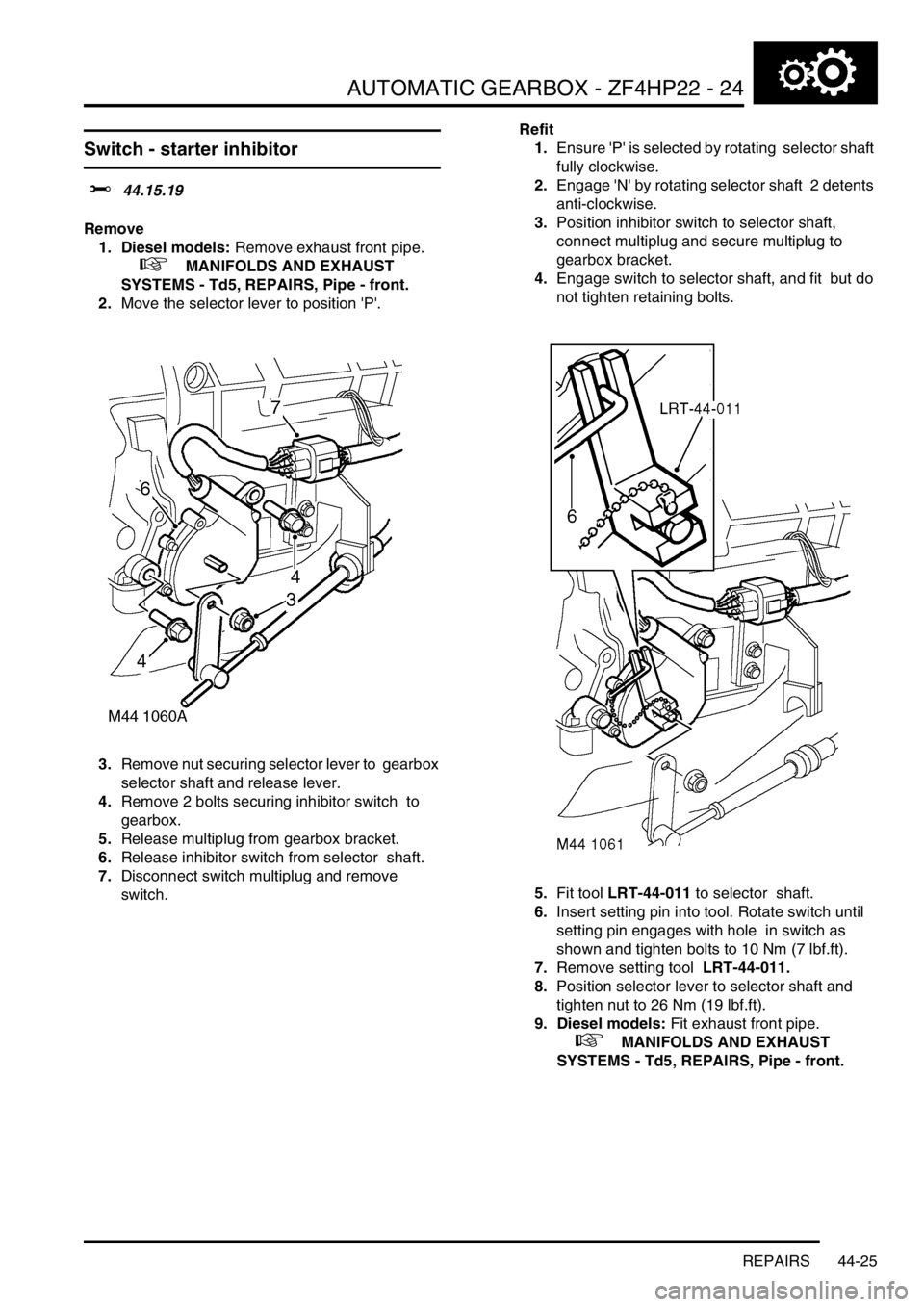
Switch - starter inhibitor
$% 44.15.19
Remove
1. Diesel models: Remove exhaust front pipe.
+ MANIFOLDS AND EXHAUST
SYSTEMS - Td5, REPAIRS, Pipe - front.
2.Move the selector lever to position 'P'.
3.Remove nut securing selector lever to gearbox
selector shaft and release lever.
4.Remove 2 bolts securing inhibitor switch to
gearbox.
5.Release multiplug from gearbox bracket.
6.Release inhibitor switch from selector shaft.
7.Disconnect switch multiplug and remove
switch. Refit
1.Ensure 'P' is selected by rotating selector shaft
fully clockwise.
2.Engage 'N' by rotating selector shaft 2 detents
anti-clockwise.
3.Position inhibitor switch to selector shaft,
connect multiplug and secure multiplug to
gearbox bracket.
4.Engage switch to selector shaft, and fit but do
not tighten retaining bolts.
5.Fit tool LRT-44-011 to selector shaft.
6.Insert setting pin into tool. Rotate switch until
setting pin engages with hole in switch as
shown and tighten bolts to 10 Nm (7 lbf.ft).
7.Remove setting tool LRT-44-011.
8.Position selector lever to selector shaft and
tighten nut to 26 Nm (19 lbf.ft).
9. Diesel models: Fit exhaust front pipe.
+ MANIFOLDS AND EXHAUST
SYSTEMS - Td5, REPAIRS, Pipe - front.
Page 625 of 1529

AUTOMATIC GEARBOX - ZF4HP22 - 24
44-28 REPAIRS
15.Remove handbrake drum retaining screw and
remove brake drum.
16.Remove 4 bolts from handbrake back plate,
release back plate and tie aside.
17. Models fitted with high/low shift interlock
solenoid: Release interlock solenoid multiplug
and disconnect multiplug from main harness.
18. Models fitted with high/low shift interlock
solenoid: Remove sleeve retaining rings and
remove sleeve from high/low selector cable.
19. If fitted Remove and discard clevis pin
securing differential lock selector cable to
transfer gearbox.20. If fitted Loosen locknuts securing differential
lock selector cable to differential lock selector
cable abutment bracket.
21. If fitted Release and remove differential lock
selector cable from differential lock selector
cable abutment bracket.
22.Remove clevis pin securing high/low ratio
selector cable to selector lever, remove 'C' clip
and remove outer cable from abutment
bracket.
23. Up to 03 Model Year - If fitted: Disconnect
from differential lock warning lamp switch and
multiplugs from high/low ratio switch and
neutral sensor.
Page 626 of 1529

AUTOMATIC GEARBOX - ZF4HP22 - 24
REPAIRS 44-29
24. 03 Model Year onwards - If fitted: Release
and disconnect both differential lock warning
lamp switch multiplugs from main harness.
25.Remove cable tie and multiplug from bracket
on transfer box.
26.Release transfer and automatic gearbox
breather pipes from clip at rear of cylinder
block.
27.Position gearbox support jack and secure tool
LRT-99-008A to support plate on jack. 28.Position a second support jack under engine
using a block between engine sump and jack
to prevent damage to sump.
29.Remove 4 bolts and nut, remove engine LH
rear mounting.
30.Remove 4 bolts and nut, remove engine RH
rear mounting.
31.Remove 2 bolts securing gearbox oil cooler
pipe clips to engine sump and alternator
mounting bracket.
Page 627 of 1529

AUTOMATIC GEARBOX - ZF4HP22 - 24
44-30 REPAIRS
32.Remove bolt and 2 nuts securing clamps to oil
cooler pipes and remove clamps.
33.Loosen gearbox oil cooler pipe unions, release
pipes from gearbox and discard 'O' rings.
CAUTION: Always fit plugs to open
connections to prevent contamination.34.Remove 'C' clip securing selector cable to
gearbox bracket.
35.Remove nut securing selector lever to inhibitor
switch and release lever.
36.Disconnect multiplug from inhibitor switch.
37.Loosen gearbox multi plug locking ring and
disconnect plug.
38.Remove 6 remaining gearbox housing bolts.
39.With assistance remove automatic gearbox
from engine.
Page 628 of 1529
AUTOMATIC GEARBOX - ZF4HP22 - 24
REPAIRS 44-31
40.Fit suitable strap to retain torque converter.
Refit
1.Clean gearbox to engine mating faces.
2.Remove torque converter retaining strap.
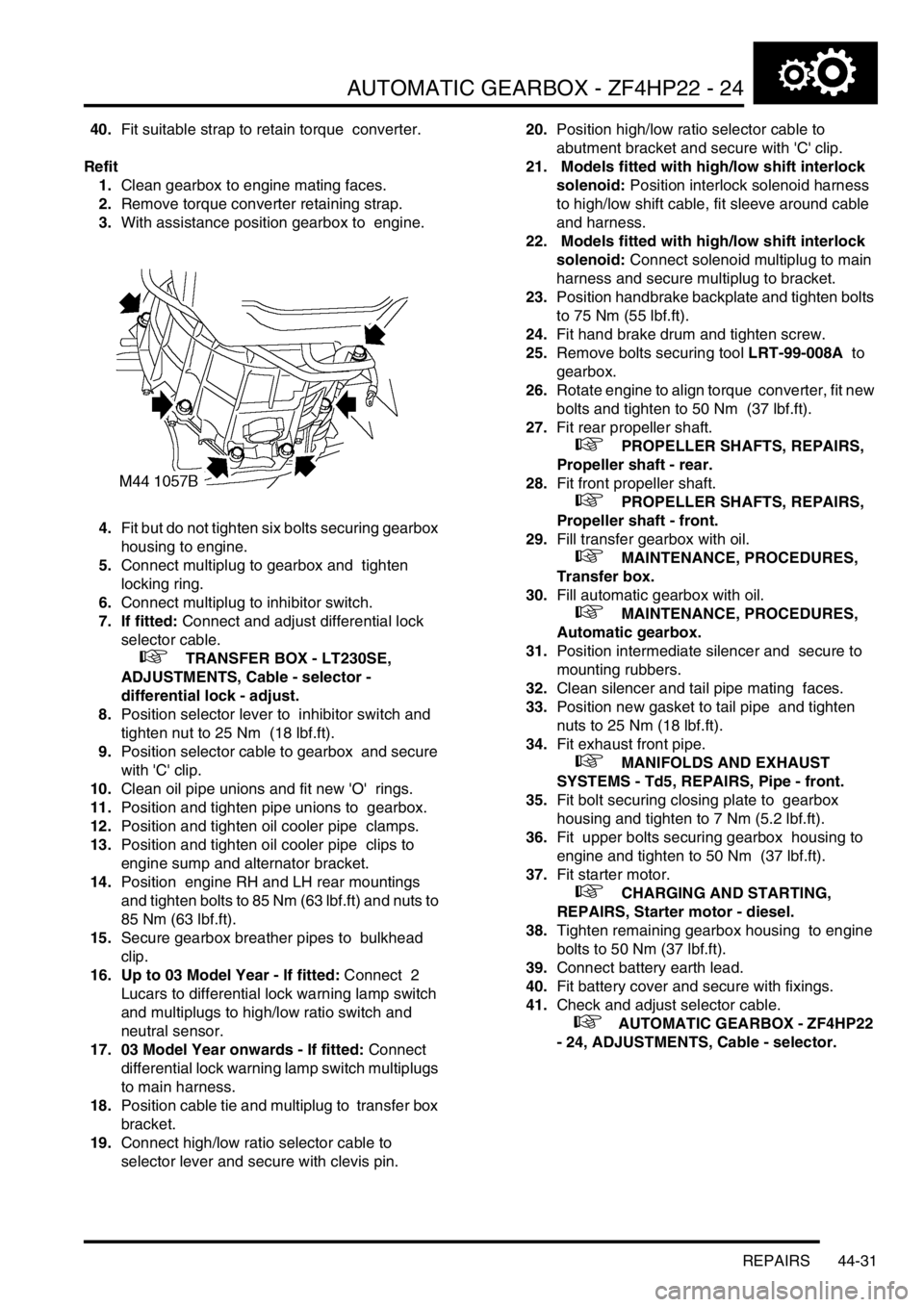
3.With assistance position gearbox to engine.
4.Fit but do not tighten six bolts securing gearbox
housing to engine.
5.Connect multiplug to gearbox and tighten
locking ring.
6.Connect multiplug to inhibitor switch.
7. If fitted: Connect and adjust differential lock
selector cable.
+ TRANSFER BOX - LT230SE,
ADJUSTMENTS, Cable - selector -
differential lock - adjust.
8.Position selector lever to inhibitor switch and
tighten nut to 25 Nm (18 lbf.ft).
9.Position selector cable to gearbox and secure
with 'C' clip.
10.Clean oil pipe unions and fit new 'O' rings.
11.Position and tighten pipe unions to gearbox.
12.Position and tighten oil cooler pipe clamps.
13.Position and tighten oil cooler pipe clips to
engine sump and alternator bracket.
14.Position engine RH and LH rear mountings
and tighten bolts to 85 Nm (63 lbf.ft) and nuts to
85 Nm (63 lbf.ft).
15.Secure gearbox breather pipes to bulkhead
clip.
16. Up to 03 Model Year - If fitted: Connect 2
Lucars to differential lock warning lamp switch
and multiplugs to high/low ratio switch and
neutral sensor.
17. 03 Model Year onwards - If fitted: Connect
differential lock warning lamp switch multiplugs
to main harness.
18.Position cable tie and multiplug to transfer box
bracket.
19.Connect high/low ratio selector cable to
selector lever and secure with clevis pin. 20.Position high/low ratio selector cable to
abutment bracket and secure with 'C' clip.
21. Models fitted with high/low shift interlock
solenoid: Position interlock solenoid harness
to high/low shift cable, fit sleeve around cable
and harness.
22. Models fitted with high/low shift interlock
solenoid: Connect solenoid multiplug to main
harness and secure multiplug to bracket.
23.Position handbrake backplate and tighten bolts
to 75 Nm (55 lbf.ft).
24.Fit hand brake drum and tighten screw.
25.Remove bolts securing tool LRT-99-008A to
gearbox.
26.Rotate engine to align torque converter, fit new
bolts and tighten to 50 Nm (37 lbf.ft).
27.Fit rear propeller shaft.
+ PROPELLER SHAFTS, REPAIRS,
Propeller shaft - rear.
28.Fit front propeller shaft.
+ PROPELLER SHAFTS, REPAIRS,
Propeller shaft - front.
29.Fill transfer gearbox with oil.
+ MAINTENANCE, PROCEDURES,
Transfer box.
30.Fill automatic gearbox with oil.
+ MAINTENANCE, PROCEDURES,
Automatic gearbox.
31.Position intermediate silencer and secure to
mounting rubbers.
32.Clean silencer and tail pipe mating faces.
33.Position new gasket to tail pipe and tighten
nuts to 25 Nm (18 lbf.ft).
34.Fit exhaust front pipe.
+ MANIFOLDS AND EXHAUST
SYSTEMS - Td5, REPAIRS, Pipe - front.
35.Fit bolt securing closing plate to gearbox
housing and tighten to 7 Nm (5.2 lbf.ft).
36.Fit upper bolts securing gearbox housing to
engine and tighten to 50 Nm (37 lbf.ft).
37.Fit starter motor.
+ CHARGING AND STARTING,
REPAIRS, Starter motor - diesel.
38.Tighten remaining gearbox housing to engine
bolts to 50 Nm (37 lbf.ft).
39.Connect battery earth lead.
40.Fit battery cover and secure with fixings.
41.Check and adjust selector cable.
+ AUTOMATIC GEARBOX - ZF4HP22
- 24, ADJUSTMENTS, Cable - selector.
Page 630 of 1529

AUTOMATIC GEARBOX - ZF4HP22 - 24
REPAIRS 44-33
16. Models fitted with high/low shift interlock
solenoid: Release interlock solenoid multiplug
and disconnect multiplug from main harness.
17. Models fitted with high/low shift interlock
solenoid: Remove sleeve retaining rings and
remove sleeve from high/low selector cable.
18. If fitted Remove and discard clevis pin
securing differential lock selector cable to
transfer gearbox.
19. If fitted Loosen locknuts securing differential
lock selector cable to differential lock selector
cable abutment bracket.
20. If fitted Release and remove differential lock
selector cable from differential lock selector
cable abutment bracket.
21.Remove clevis pin securing high/low ratio
selector cable to selector lever, remove 'C' clip
and remove outer cable from abutment bracket22. Up to 03 Model Year - If fitted: Disconnect 2
Lucars from differential lock switch and
multiplugs from high/low ratio switch and
neutral sensor.
23. 03 Model Year onwards - If fitted: Release
and disconnect both differential lock warning
lamp switch multiplugs from main harness.
24.Release transfer and automatic gearbox
breather pipes from clip at rear of cylinder
block.