oil LAND ROVER DISCOVERY 1999 Workshop Manual
[x] Cancel search | Manufacturer: LAND ROVER, Model Year: 1999, Model line: DISCOVERY, Model: LAND ROVER DISCOVERY 1999Pages: 1529, PDF Size: 34.8 MB
Page 722 of 1529

STEERING
REPAIRS 57-29
12. RH drive models with ACE: Position ACE
control arms to access steering box bolts.
13.With assistance remove 4 securing bolts and
remove steering box.
14.Remove centralising bolt from steering box. Refit
1.Fit centralising bolt to steering box.
2. With assistance, position steering box, fit bolts
and tighten to 90 Nm (66 lbf.ft).
3. RH drive models with ACE: Ensure washer is
in place on lower ball joint of anti-roll bar link,
then connect lower ball joint to axle. Tighten nut
to 100 Nm (74 lbf.ft).
4.Position drag link, fit nut and tighten to 80 Nm
(59 lbf.ft).
5.Position Panhard rod, fit bolt and nut and
tighten to 230 Nm (170 lbf.ft).
6.Clean PAS pipe ends and 'O' ring recess.
7.Lubricate new 'O' rings for PAS pipes with clean
PAS fluid.
8.Fit 'O' rings to PAS pipes and position pipes in
steering box. Fit PAS pipe bracket and tighten
bolt to 22 Nm (16 lbf.ft).
9. RHD models: Fit oil filter and housing:
lClean oil filter housing and engine mating
faces.
lLubricate new 'O' ring with clean engine oil
and fit to housing.
lPosition oil filter housing and tighten bolts to
9 Nm (7 lbf.ft).
10.Ensure steering wheel is centralised. Fit
universal joint between steering box and
intermediate shaft and tighten bolts to 25 Nm
(18 lbf.ft).
11.Remove centralising bolt from steering box.
12.Fit road wheel(s) and tighten nuts to 140 Nm
(103 lbf.ft)..
13.Remove stand(s) and lower vehicle.
14.Check and top up engine oil.
15.Bleed PAS system.
+ STEERING, ADJUSTMENTS,
Hydraulic system - bleed.
16.Centralise steering linkage
+ STEERING, ADJUSTMENTS,
Steering linkage - centralise.
Page 730 of 1529

STEERING
REPAIRS 57-37
Refit
1.Fit centralising bolt to steering box.
2.With assistance, position steering box to
chassis, fit bolts and tighten to 90 Nm (66 lbf.ft).
3. Models with ACE: Ensure washer is in place
on lower ball joint of anti-roll bar link, then
connect lower ball joint to axle and tighten nut
to 100 Nm (74 lbf.ft).
4.Position drag link, fit nut and tighten to 80 Nm
(59 lbf.ft).
5.Position Panhard rod, fit bolt and nut and
tighten to 230 Nm (170 lbf.ft).
6.Position coolant rail and secure with clips and
bolt.
7.Fit coolant hoses and secure with clips.
8. Models with ACE: Fit and tighten bolt
securing ACE pipes to chassis.
9.Clean PAS pipes ends and 'O' ring recess.
10.Lubricate new 'O' rings for PAS pipes with
clean PAS fluid.
11.Fit 'O' rings to PAS pipes and position pipes in
steering box. Fit PAS pipe bracket and tighten
bolt to 22 Nm 16 lbf.ft).
12.Ensure steering wheel is centralised. Fit
universal joint between steering box and
intermediate shaft and tighten bolts to 25 Nm
(18 lbf.ft).
13.Remove centralising bolt from steering box.
14.Fit road wheel(s) and tighten nuts to 140 Nm
(103 lbf.ft).
15.Remove stand(s) and lower vehicle.
16.Connect battery earth lead.
17.Fit battery cover.
18.Refill cooling system.
+ COOLING SYSTEM - Td5,
ADJUSTMENTS, Drain and refill.
19.Bleed PAS system.
+ STEERING, ADJUSTMENTS,
Hydraulic system - bleed.
20.Centralise steering linkage
+ STEERING, ADJUSTMENTS,
Steering linkage - centralise.
Seal - input shaft - steering box
$% 57.10.16
Remove
1.Remove steering box:
lFor V8 models:
+ STEERING, REPAIRS, Power
steering box - V8.
lFor LHD diesel models:
+ STEERING, REPAIRS, Power
steering box - LHD - diesel.
lFor RHD diesel models:
+ STEERING, REPAIRS, Steering
box - RHD - diesel.
2.Secure steering box in vice.
3.Remove circlip and extract oil seal from
steering box. Take care not to damage
surface of the shaft.
Refit
1.Clean oil seal recess and input shaft.
2.Lubricate new seal with clean PAS fluid.
3.Fit seal using LRT-57-503.
4.Fit circlip.
5.Fit steering box.
lFor V8 models:
+ STEERING, REPAIRS, Power
steering box - V8.
lFor LHD diesel models:
+ STEERING, REPAIRS, Power
steering box - LHD - diesel.
lFor RHD diesel models:
+ STEERING, REPAIRS, Steering
box - RHD - diesel.
Page 733 of 1529

STEERING
57-40 REPAIRS
5. Models with A/C: Disconnect A/C compressor
multiplug. Remove 4 bolts securing A/C
compressor, release compressor and position
aside.
6.Remove 3 bolts securing PAS pump pulley and
remove pulley.
7.Position tray to catch spillage, release PAS
pump pressure pipe.
8.Remove clip and release PAS pump inlet hose.
CAUTION: Always fit plugs to open
connections to prevent contamination.9.Remove jockey pulley.
10.Remove bolt securing oil cooling pipe bracket
and release bracket from housing.
11.Remove two bolts securing PAS pump.
12.Remove 4 bolts and one nut securing auxiliary
housing. Pull housing forward and release
PAS pump. Remove PAS pump.
Page 736 of 1529

STEERING
REPAIRS 57-43
Steering column assembly and lock
$% 57.40.01
Remove
1.Remove steering column intermediate shaft.
+ STEERING, REPAIRS, Shaft -
intermediate and universal joint - steering
column.
2.Remove rotary coupler.
+ RESTRAINT SYSTEMS, REPAIRS,
Rotary coupler.
3.Open fascia lower access panel.
4.Remove steering column nacelle.
+ STEERING, REPAIRS, Nacelle -
steering column.
5.Disconnect multiplug and illumination bulb
from passive coil and remove passive coil.
6.Disconnect 2 multiplugs from wiper switch
assembly. 7.Disconnect 2 multiplugs from light switch
assembly.
8.Loosen screw and remove switch assembly.
9.Disconnect ignition switch multiplug.
10.Disconnect multiplug from ignition switch
housing.
11.Release harness from column clip.
Page 737 of 1529

STEERING
57-44 REPAIRS
12.Remove 4 nuts securing steering column
assembly to fascia rail and remove steering
column assembly.
13.Remove rubber boot from steering column
assembly.
14.Position steering column assembly in a vice.
15.Remove 2 screws and remove ignition switch.
16.Remove cable tie and remove multiplug from
ignition switch.
17.Centre punch or drill out steering lock shear
bolts.
18.Remove steering lockRefit
1.Position lock to steering column assembly and
fit shear bolts. Do not tighten shear bolts at this
stage.
2.Insert starter key, check operation of steering
lock and that key turns freely.
3.Tighten shear bolts fully and shear heads off.
4.Position ignition switch to column, fit and
tighten screws.
5.Position multiplug to switch and secure with
new cable tie.
6.Fit rubber boot to column.
7.Remove column from vice.
8.Position steering to fascia rail fit nuts and
tighten to 22 Nm (16 lbf.ft).
9.Secure harness to column clip.
10.Position rubber grommet.
11.Close access panel and secure turn buckles.
12.Connect ignition switch multiplugs.
13.Position column switch and tighten clamp
screw.
14.Connect column switch multiplugs.
15.Position passive coil, connect multiplug and
illumination bulb.
16.Fit steering column nacelle.
+ STEERING, REPAIRS, Nacelle -
steering column.
17.Fit rotary coupler.
+ RESTRAINT SYSTEMS, REPAIRS,
Rotary coupler.
18.Close fascia lower access panel.
19.Fit steering column intermediate shaft.
+ STEERING, REPAIRS, Shaft -
intermediate and universal joint - steering
column.
Page 746 of 1529
FRONT SUSPENSION
DESCRIPTION AND OPERATION 60-1
FRONT SUSPENSION DESCRIPTION AND OPERAT ION
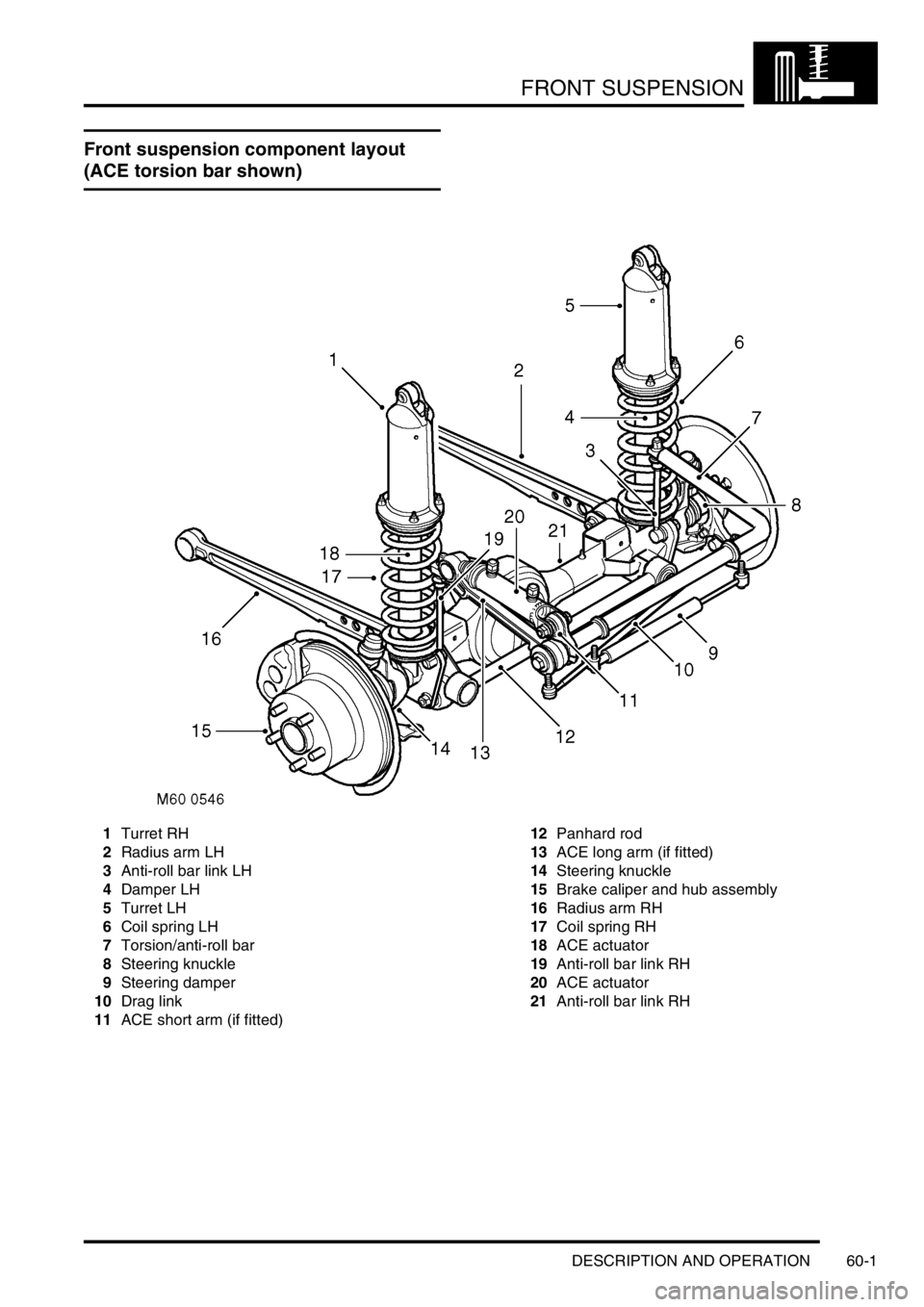
Front suspension component layout
(ACE torsion bar shown)
1Turret RH
2Radius arm LH
3Anti-roll bar link LH
4Damper LH
5Turret LH
6Coil spring LH
7Torsion/anti-roll bar
8Steering knuckle
9Steering damper
10Drag link
11ACE short arm (if fitted)12Panhard rod
13ACE long arm (if fitted)
14Steering knuckle
15Brake caliper and hub assembly
16Radius arm RH
17Coil spring RH
18ACE actuator
19Anti-roll bar link RH
20ACE actuator
21Anti-roll bar link RH
Page 748 of 1529

FRONT SUSPENSION
DESCRIPTION AND OPERATION 60-3
1Damper 2 off
2Bolt 2 off
3Turret 2 off
4Nut 8 off
5Nut
6Bolt 4 off
7Nut
8Washer
9Anti-roll bar link RH
10Torsion/Anti-roll bar assembly
11Anti-roll bar link LH
12Washer
13Nut
14Nut
15Mounting rubber 2 off
16Clamp plate 2 off
17Bolt 2 off
18Lower spring seat LH
19Front axle20Nut
21Bush
22Panhard rod
23Bolt
24Radius arm LH
25Bolt
26Bush
27Nut
28Nut
29Bush
30Bolt
31Radius arm RH
32Bolt
33Bush
34Nut
35Lower spring seat RH
36Coil spring 2 off
37Upper spring seat 2 off
Page 749 of 1529

FRONT SUSPENSION
60-4 DESCRIPTION AND OPERATION
Description
General
The front suspension comprises two dampers and coil springs, two radius arms, a Panhard rod and an anti-roll bar.
The front axle provides the location points for the dampers, springs, radius arms and the Panhard rod.
The anti-roll bar assembly is an essential part of the front suspension. On vehicles without Active Cornering
Enhancement (ACE) a conventional 'passive' anti-roll bar is fitted. On vehicles fitted with the ACE system, a thicker
diameter anti-roll bar, known as a torsion bar, is used with an actuator at one end.
+ FRONT SUSPENSION, DESCRIPTION AND OPERATION, Description - ACE.
The hydraulic dampers and coil springs provide springing for each front wheel. The long travel dampers, springs and
radius arms provide maximum axle articulation and wheel travel for off-road driving. The front axle is controlled
longitudinally by two forged steel radius arms and transversely by a Panhard rod.
Radius arms
Each radius arm is manufactured from forged steel. Two bushes are pressed into the forward end of the radius arm.
The forward end of the radius arm is located in a fabricated bracket on the axle and secured through the bushes with
two bolts and nuts. A bush is pressed into the rear of the radius arm which is also located in a fabricated bracket on
each chassis longitudinal and secured through the bush with a bolt and nut.
The radius arms prevent longitudinal movement of the front axle and because of their length allow maximum axle
articulation. The stiffness of the bushes in each radius arm also contributes to the vehicle roll stiffness.
Each radius arm has a notch on its lower edge which provides location for the vehicle jack.
Dampers
Two conventional telescopic dampers are used to control body/axle movement. A turret is located on a bracket welded
to the chassis. The upper spring seat has four studs which pass through holes in the bracket and align with
corresponding holes in the turret. Four nuts are screwed onto the studs and secure the turret and upper spring seat
to the chassis.
A fabricated platform is welded to the axle. The platform has two captive nuts which provide for the attachment of the
damper. A lower spring seat is located on the platform. Each spring seat is handed and has a bracket which secures
the ABS sensor harness and the front brake hose.
Each damper is fitted with a bush at its upper end. The bush locates in the top of the turret and is secured with a cross
bolt. The lower attachment point for the damper is also fitted with a bush. This bush has a spindle through its centre
with a hole at each end. The spindle is seated on the lower spring seat and the axle platform and secured with two
bolts. The coil spring is fitted in a compressed state between the upper and lower spring seats and assists the damper
in controlling the body/axle movement. The upper and lower bushes are replaceable items.
Rubber bump stops are fitted to the chassis above each end of the axle. The bump stops are progressive in their
compression and prevent the axle from contacting the chassis in the event of maximum suspension travel being
reached. The bump stops revert to their original shape once the compression load has been removed from them.
The damper functions by restricting the flow of a hydraulic fluid through internal galleries within the damper body. A
chromium plated rod moves axially within the damper. As the rod moves, its movement is limited by the flow of fluid
through the galleries thus providing damping of undulations in the terrain. The damper rod is sealed at its exit point
from the body to maintain fluid within the unit and prevent the ingress of dirt and moisture. The seal also acts as a
wiper to keep the rod outer diameter clean. A plastic shroud protects the rod and slides over the body as the damper
moves. The coil spring aids the damper to extend after being compressed and also aids the damping process.
Page 750 of 1529

FRONT SUSPENSION
DESCRIPTION AND OPERATION 60-5
Coil springs
Coil springs are fitted to the front axle of the vehicle. The front springs differ between petrol and Diesel variants. Each
spring is retained at its base by the lower spring seat. The top of each spring is located in the upper spring seat
isolator. The upper spring seat is manufactured from natural rubber , with a bonded metal plate and four bonded studs
which provide for the attachment of the damper turret. The rubber isolator reduces noise transmitted to the chassis
and body from the suspension.
The coil springs must be installed correctly. The bottom coil of the spring locates in a recess in the lower spring seat.
The top coil of the spring is ground flat to locate the upper spring seat isolator.
Coil Spring Specifications – Models up to 03 Model Year
The front springs on petrol variants are manufactured from carbon chrome 13.9 mm (0.55 in) diameter bar. The spring
has 7.6 coils and a free length of 377 mm (14.8 in). The petrol front spring is identified by a pink and orange stripe
painted on a number of coils.
The front springs on Diesel variants are manufactured from carbon chrome 13.9 mm (0.55 in) diameter bar. The spring
has 7.6 coils and a free length of 383 mm (15.0 in). The Diesel front spring is identified by a white and purple stripe
painted on a number of coils.
Coil Spring Specifications – Models from 03 Model Year
The introduction of the 03MY vehicle introduced a range of additional spring fitments. These were introduced to cover
the introduction of the 4.6l V8 engine, the fitment of a front mounted winch and to optimise the vehicle trim heights.
The coil springs are manufactured from silicon manganese 13.8 mm or 13.9 mm (0.54 in or 0.55 in) diameter bar. The
following spring data table shows the colour codes, number of coils and spring free length.
Spring Data
The following table shows spring fitment applicablity.
Spring Fitment Applicability
The following table shows standard springs and uprated springs required when a front winch is fitted.
Winch Fitment Spring Applicability
Colour Code Total No. of Coils Free Length
Red/Purple 7.4 371 mm (14.6 in)
Yellow/Purple 7.4 378.4 mm (14.9 in)
Blue/Purple 7.4 365 mm (14.4 in)
Grey/Purple 7.4 387 mm (15.2 in)
Purple/Purple 7.4 373.8 mm (14.7 in)
Yellow/Orange 7.4 394.6 mm (15.5 in)
Green/Orange 7.4 382.6 mm (15 in)
Pink/Brown 7.6 405.6 mm (15.9 in)
Left Hand Drive Right Hand Drive
RH side LH side RH side LH side
Red/Purple Red/Purple Yellow/Purple Blue/Purple
Yellow/Purple Yellow/Purple Grey/Purple Purple/Purple
Grey/Purple Grey/Purple Yellow/Orange Green/Orange
Standard Spring Winch Fitted Spring
RH Side LH Side Both Sides
Red/Purple Red/Purple Grey/Purple
Yellow/Purple Blue/Purple Yellow/Orange
Yellow/Purple Yellow/Purple Yellow/Orange
Grey/Purple Purple/Purple Green/Orange
Grey/Purple Grey/Purple Green/Orange
Yellow/Orange Green/Orange Pink/Brown
Page 754 of 1529
FRONT SUSPENSION
DESCRIPTION AND OPERATION 60-9
Description - ACE
General
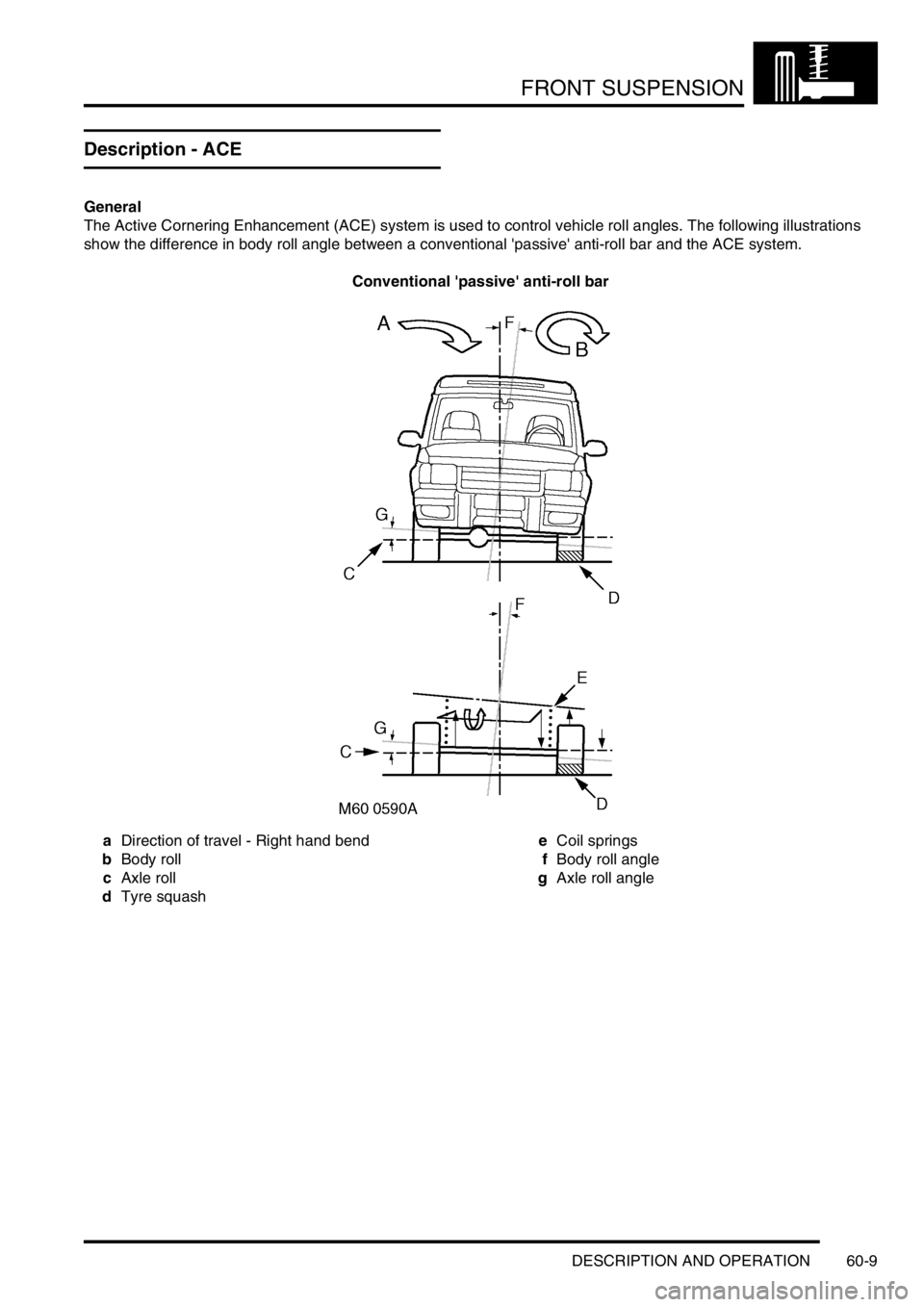
The Active Cornering Enhancement (ACE) system is used to control vehicle roll angles. The following illustrations
show the difference in body roll angle between a conventional 'passive' anti-roll bar and the ACE system.
Conventional 'passive' anti-roll bar
aDirection of travel - Right hand bend
bBody roll
cAxle roll
dTyre squasheCoil springs
fBody roll angle
gAxle roll angle