oil LAND ROVER DISCOVERY 1999 Workshop Manual
[x] Cancel search | Manufacturer: LAND ROVER, Model Year: 1999, Model line: DISCOVERY, Model: LAND ROVER DISCOVERY 1999Pages: 1529, PDF Size: 34.8 MB
Page 755 of 1529
FRONT SUSPENSION
60-10 DESCRIPTION AND OPERATION
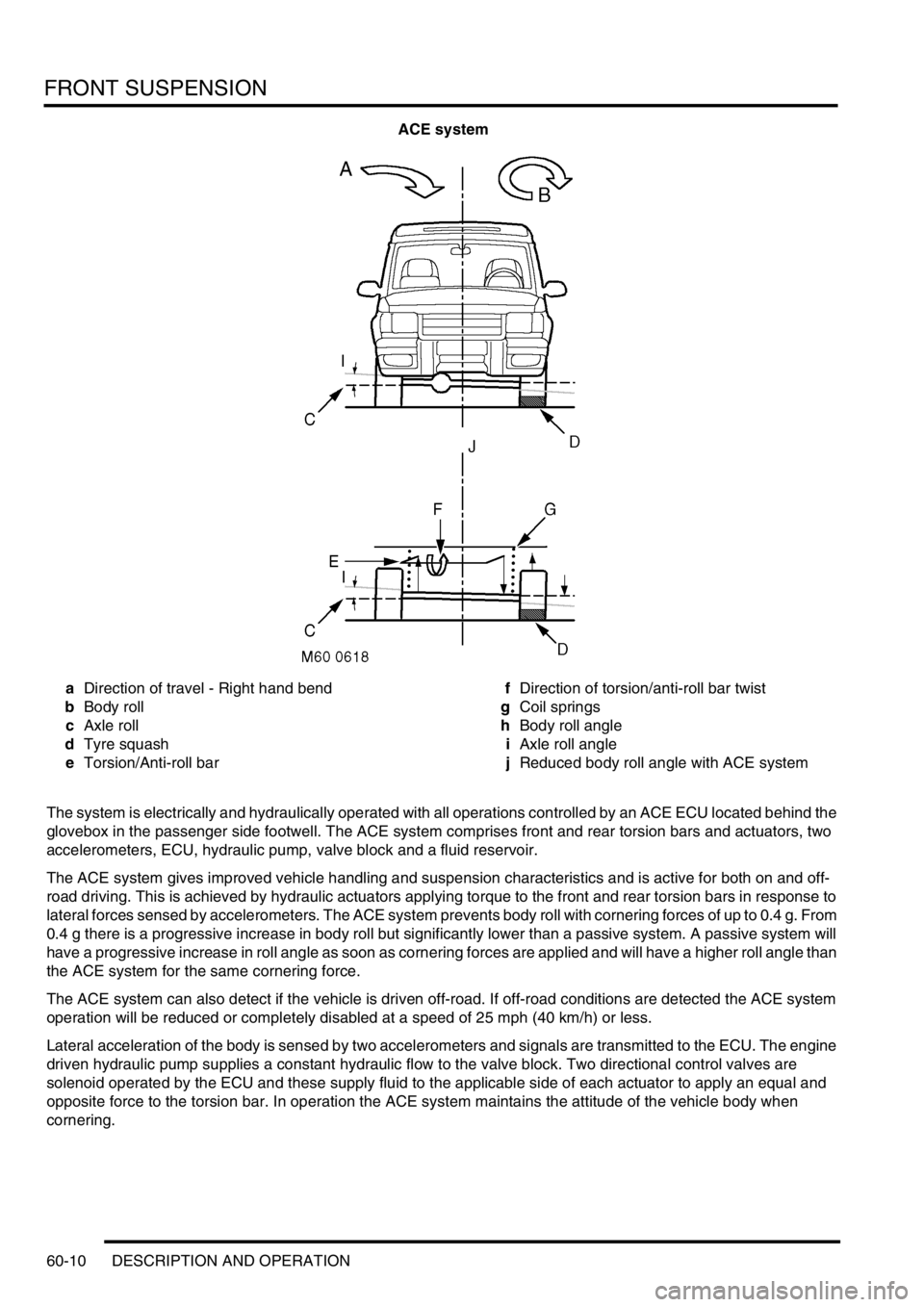
ACE system
aDirection of travel - Right hand bend
bBody roll
cAxle roll
dTyre squash
eTorsion/Anti-roll barfDirection of torsion/anti-roll bar twist
gCoil springs
hBody roll angle
iAxle roll angle
jReduced body roll angle with ACE system
The system is electrically and hydraulically operated with all operations controlled by an ACE ECU located behind the
glovebox in the passenger side footwell. The ACE system comprises front and rear torsion bars and actuators, two
accelerometers, ECU, hydraulic pump, valve block and a fluid reservoir.
The ACE system gives improved vehicle handling and suspension characteristics and is active for both on and off-
road driving. This is achieved by hydraulic actuators applying torque to the front and rear torsion bars in response to
lateral forces sensed by accelerometers. The ACE system prevents body roll with cornering forces of up to 0.4 g. From
0.4 g there is a progressive increase in body roll but significantly lower than a passive system. A passive system will
have a progressive increase in roll angle as soon as cornering forces are applied and will have a higher roll angle than
the ACE system for the same cornering force.
The ACE system can also detect if the vehicle is driven off-road. If off-road conditions are detected the ACE system
operation will be reduced or completely disabled at a speed of 25 mph (40 km/h) or less.
Lateral acceleration of the body is sensed by two accelerometers and signals are transmitted to the ECU. The engine
driven hydraulic pump supplies a constant hydraulic flow to the valve block. Two directional control valves are
solenoid operated by the ECU and these supply fluid to the applicable side of each actuator to apply an equal and
opposite force to the torsion bar. In operation the ACE system maintains the attitude of the vehicle body when
cornering.
Page 759 of 1529
FRONT SUSPENSION
60-14 DESCRIPTION AND OPERATION
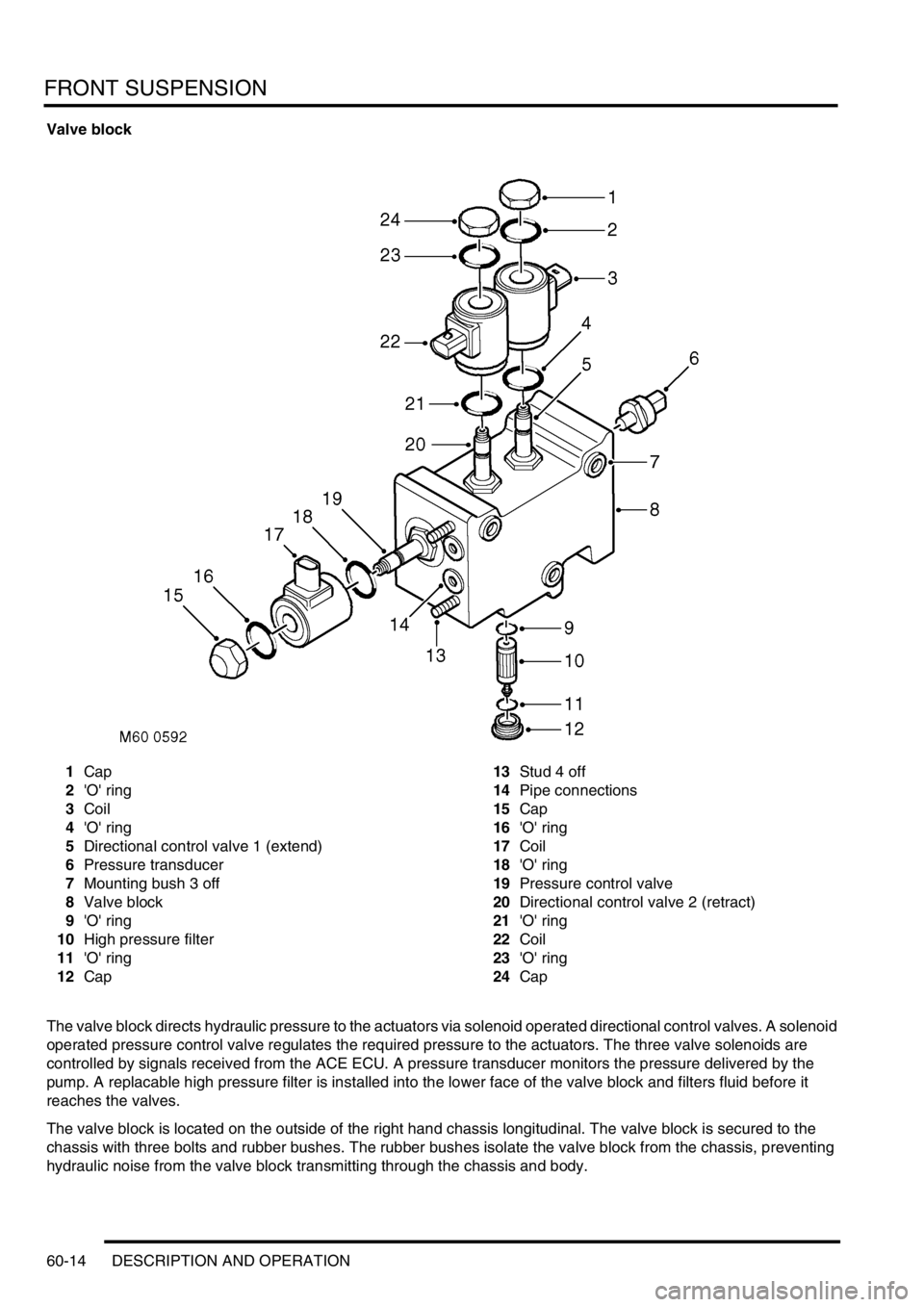
Valve block
1Cap
2'O' ring
3Coil
4'O' ring
5Directional control valve 1 (extend)
6Pressure transducer
7Mounting bush 3 off
8Valve block
9'O' ring
10High pressure filter
11'O' ring
12Cap13Stud 4 off
14Pipe connections
15Cap
16'O' ring
17Coil
18'O' ring
19Pressure control valve
20Directional control valve 2 (retract)
21'O' ring
22Coil
23'O' ring
24Cap
The valve block directs hydraulic pressure to the actuators via solenoid operated directional control valves. A solenoid
operated pressure control valve regulates the required pressure to the actuators. The three valve solenoids are
controlled by signals received from the ACE ECU. A pressure transducer monitors the pressure delivered by the
pump. A replacable high pressure filter is installed into the lower face of the valve block and filters fluid before it
reaches the valves.
The valve block is located on the outside of the right hand chassis longitudinal. The valve block is secured to the
chassis with three bolts and rubber bushes. The rubber bushes isolate the valve block from the chassis, preventing
hydraulic noise from the valve block transmitting through the chassis and body.
Page 760 of 1529

FRONT SUSPENSION
DESCRIPTION AND OPERATION 60-15
The two solenoid operated directional control valves (DCV's) are fitted to ports in the top face of the valve block. The
DCV's are screwed into the valve block and sealed with O ring seals. Each DCV has a solenoid for electrical operation
of the valve. The solenoid is sealed to the DCV with two O ring and secured with a cap. The cap, coil and O rings are
serviceable items. The DCV's are non-serviceable and failure of a DCV requires the replacement of the valve block
assembly.
The pressure control valve is fitted to a port in the rear face of the valve block. The pressure control valve is screwed
into the valve block and sealed with O rings. The pressure control valve has a coil for electrical operation. The coil is
sealed to the pressure control valve with two O rings and secured with a cap. The cap, coil and O rings are serviceable
items. The pressure control valve is non-serviceable and failure requires replacement of the valve block assembly.
The pressure transducer is fitted to a port in the forward face of the valve block. The pressure transducer is screwed
into the valve block and sealed with an O ring seal. The pressure transducer is a serviceable item.
The high pressure filter locates in a port on the lower face of the valve block. The gauze and fibre filter is sealed in
the port with O ring seals. A threaded cap secures the filter in the valve block and is also sealed with an O ring seal.
A threaded hole on the lower face of the filter allows a bolt to be fitted to remove the filter from the port. If a system
component is replaced, the filter must be changed.
Four ports are located on the forward face of the valve block and two ports on the rear. Each port is fitted with a seal
pack which contains two O ring seals and backing rings. The ACE pipes locate and seal in the seal packs and are
secured to the valve block with the studs and nuts located on the forward and rear faces.
Actuators
Two actuators are used for the ACE system and are attached to the front and rear torsion bars. The actuators apply
hydraulically generated force to the torsion bar to oppose lateral forces caused by the vehicle cornering.
Each actuator is a conventional double-acting cylinder. A piston is attached to a rod and moves within the cylinder
when hydraulic pressure is applied. The rod is sealed at the point where it exits the cylinder. The outer end of the rod
is threaded and locates in a bush in the ACE long arm and secured with a nut. A rubber gaiter covers the rod and
prevents dirt and moisture from damaging the rod surface and cylinder seals. The cylinder has a forked attachment
which locates on the short arm bush and secured with a bolt and nut.
Two banjo connections provide for the attachment of the hydraulic hoses from the ACE valve block. The connections
provide hydraulic flow to each side of the piston to extend or retract the rod.
Page 763 of 1529
FRONT SUSPENSION
60-18 DESCRIPTION AND OPERATION
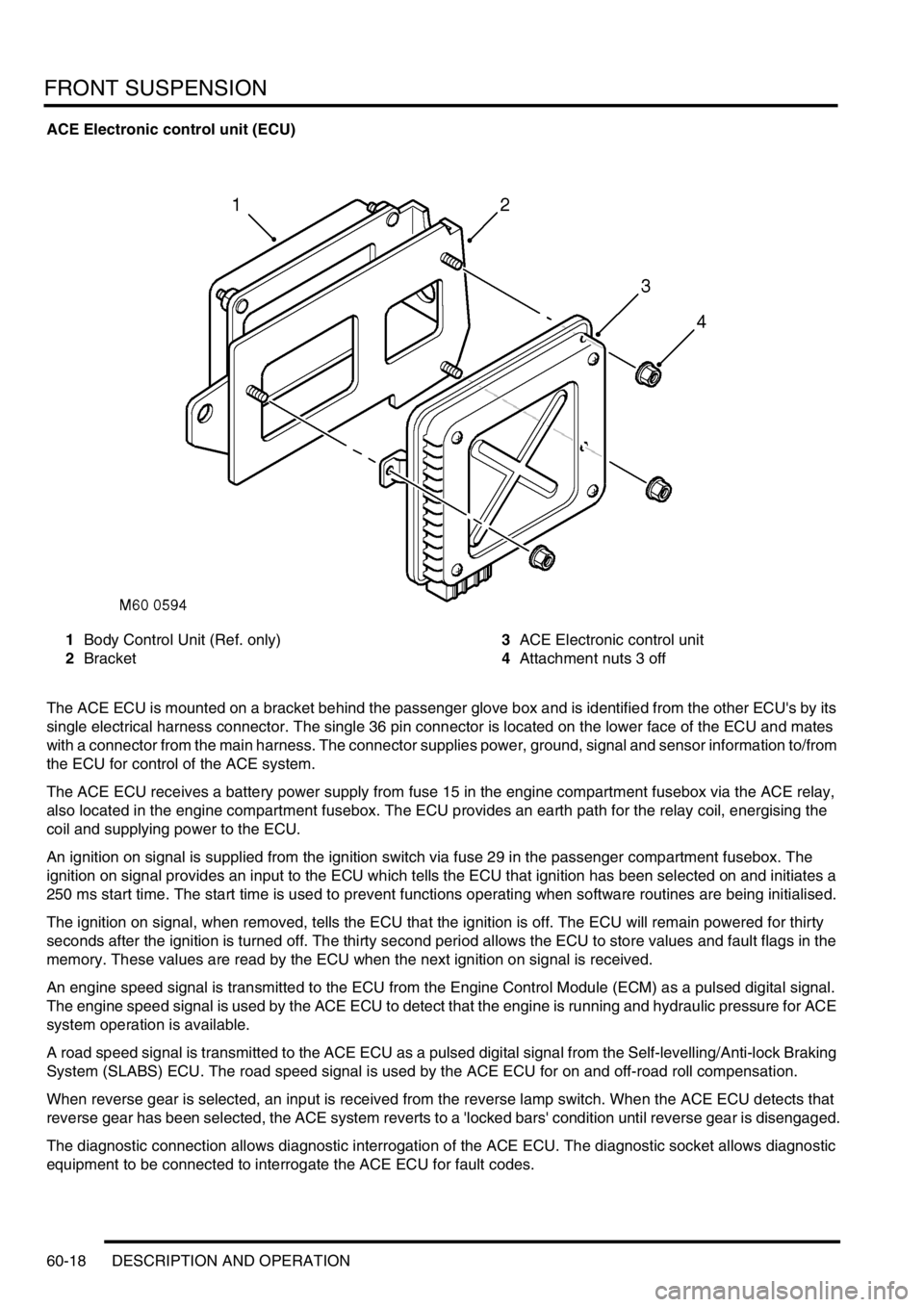
ACE Electronic control unit (ECU)
1Body Control Unit (Ref. only)
2Bracket3ACE Electronic control unit
4Attachment nuts 3 off
The ACE ECU is mounted on a bracket behind the passenger glove box and is identified from the other ECU's by its
single electrical harness connector. The single 36 pin connector is located on the lower face of the ECU and mates
with a connector from the main harness. The connector supplies power, ground, signal and sensor information to/from
the ECU for control of the ACE system.
The ACE ECU receives a battery power supply from fuse 15 in the engine compartment fusebox via the ACE relay,
also located in the engine compartment fusebox. The ECU provides an earth path for the relay coil, energising the
coil and supplying power to the ECU.
An ignition on signal is supplied from the ignition switch via fuse 29 in the passenger compartment fusebox. The
ignition on signal provides an input to the ECU which tells the ECU that ignition has been selected on and initiates a
250 ms start time. The start time is used to prevent functions operating when software routines are being initialised.
The ignition on signal, when removed, tells the ECU that the ignition is off. The ECU will remain powered for thirty
seconds after the ignition is turned off. The thirty second period allows the ECU to store values and fault flags in the
memory. These values are read by the ECU when the next ignition on signal is received.
An engine speed signal is transmitted to the ECU from the Engine Control Module (ECM) as a pulsed digital signal.
The engine speed signal is used by the ACE ECU to detect that the engine is running and hydraulic pressure for ACE
system operation is available.
A road speed signal is transmitted to the ACE ECU as a pulsed digital signal from the Self-levelling/Anti-lock Braking
System (SLABS) ECU. The road speed signal is used by the ACE ECU for on and off-road roll compensation.
When reverse gear is selected, an input is received from the reverse lamp switch. When the ACE ECU detects that
reverse gear has been selected, the ACE system reverts to a 'locked bars' condition until reverse gear is disengaged.
The diagnostic connection allows diagnostic interrogation of the ACE ECU. The diagnostic socket allows diagnostic
equipment to be connected to interrogate the ACE ECU for fault codes.
Page 776 of 1529

FRONT SUSPENSION
REPAIRS 60-31
5.Remove 2 nuts securing ball joints to steering
knuckle.
6.Break taper joints using LRT-54-027 and
remove steering knuckle.
7.Remove tension collet from steering knuckle.
8.Remove drive shaft oil seal from axle casing.Refit
1.Clean taper bores in steering knuckle and
tension collet.
2.Fit tension collet into steering knuckle and
tighten to 5 Nm (3.7 lbf.ft).
3.Clean ball joint tapers and taper seats.
4.Position steering knuckle to axle yoke. Fit
upper ball joint nut and tighten to 110 Nm (81
lbf.ft). Fit lower ball joint nut and tighten to 135
Nm (100 lbf.ft).
5.Clean track rod and (if applicable) drag link
tapers and taper seats.
6.Connect track rod and drag link to steering
knuckle. Fit track rod and drag link nuts and
tighten to 80 Nm (59 lbf.ft).
7.Clean mudshield and steering knuckle mating
faces. Position mudshield, fit bolts and tighten
to 10 Nm (7 lbf.ft).
8.Fit wheel hub.
+ FRONT SUSPENSION, REPAIRS,
Wheel hub.
Page 777 of 1529

FRONT SUSPENSION
60-32 REPAIRS
Road spring - front
$% 60.20.11
Remove
1.Raise front of vehicle.
WARNING: Do not work on or under a
vehicle supported only by a jack. Always
support the vehicle on safety stands.
2.Support vehicle under chassis.
3.Remove front road wheels.
4.Support weight of front axle.
5.Remove 2 nuts securing anti-roll bar links to
front axle and disconnect links from axle.
6.Remove 2 bolts securing each damper to front
axle.
WARNING: Make sure the axle cannot move
when the damper is disconnected. The
damper limits the downward movement of
the axle. If the axle is not restrained,
disconnecting the damper will allow
unrestricted movement which may cause
personal injury or damage to equipment.
7.Lower front axle.
CAUTION: Ensure brake hoses and ABS
sensor harnesses are not damaged when
lowering front axle.
8.Release and remove front spring from damper.Refit
1.Clean front spring seats.
2.Position front spring, with close coil uppermost,
over damper and locate in cut out in lower
spring seat.
3.Ensure both front springs are correctly located
in spring seats and raise front axle. Fit bolts
securing both dampers to front axle and tighten
to 45 Nm (33 lbf.ft).
4.Ensure washer is in place on lower ball joint of
each anti-roll bar link, then connect lower ball
joints to axle. Tighten nuts to 100 Nm (74 lbf.ft).
5.Fit front road wheels and tighten nuts to 140
Nm (103 lbf.ft).
6.Remove stands and lower vehicle.
Page 779 of 1529

FRONT SUSPENSION
60-34 REPAIRS
11.Position the wheel hub and drive shaft on a
press, place supports beneath the wheel studs
and press the drive shaft from the wheel hub.
12.Remove drive shaft oil seal from axle casing. Refit
1.Clean drive shaft oil seal recess, drive shaft
splines, oil seal running surface, wheel hub
and steering knuckle mating faces, ABS
sensor and sensor recess.
2.Lubricate lip of new drive shaft oil seal and
running surface on drive shaft with clean
differential oil.
+ CAPACITIES, FLUIDS,
LUBRICANTS AND SEALANTS,
Lubrication.
3.Use tool LRT-51-012 to fit new drive shaft oil
seal to axle casing.
4.Fit drive shaft to axle casing.
5.Apply anti-seize compound to wheel hub and
steering knuckle mating face.
M51 0057
Page 812 of 1529
REAR SUSPENSION
DESCRIPTION AND OPERATION 64-3
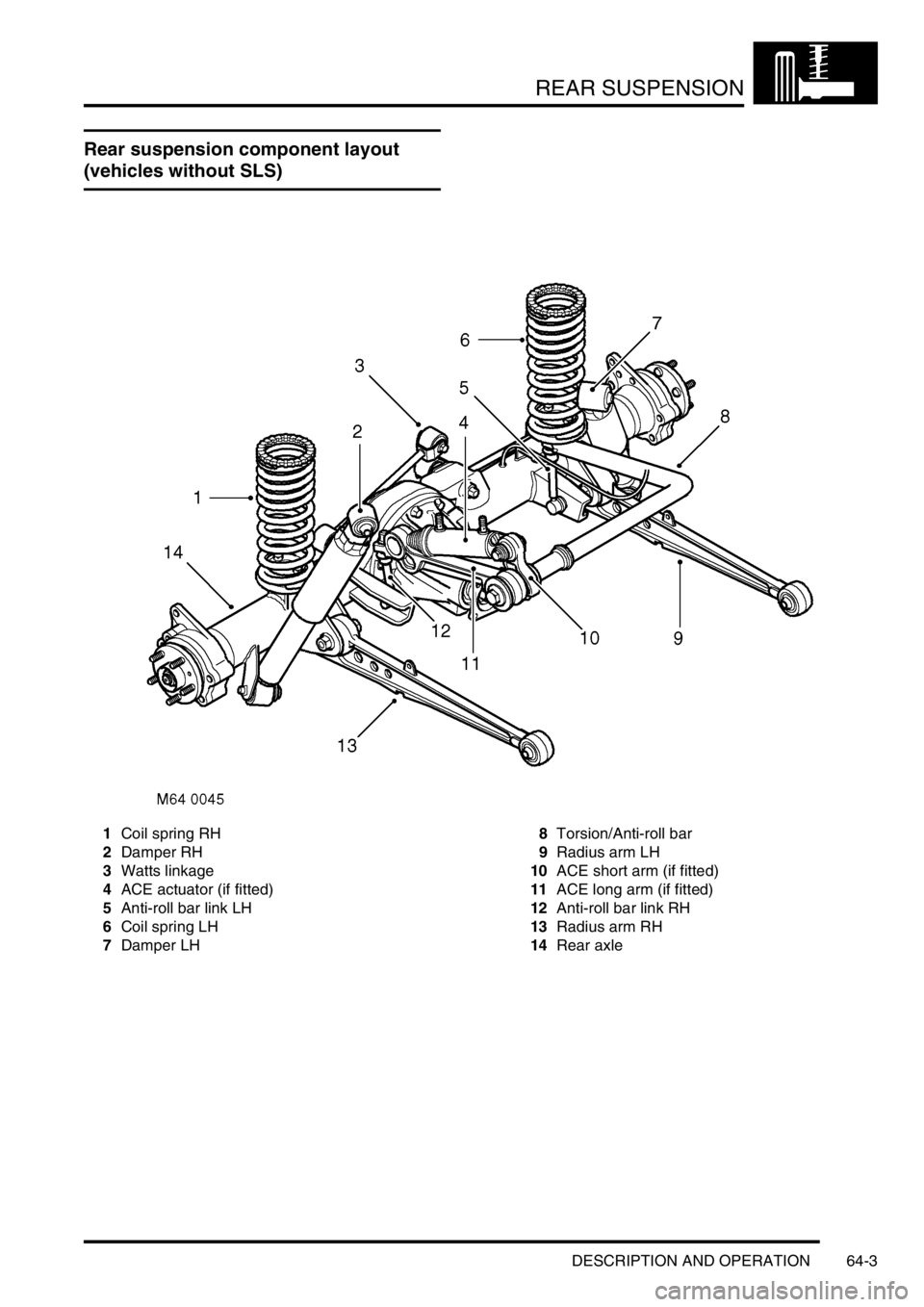
Rear suspension component layout
(vehicles without SLS)
1Coil spring RH
2Damper RH
3Watts linkage
4ACE actuator (if fitted)
5Anti-roll bar link LH
6Coil spring LH
7Damper LH8Torsion/Anti-roll bar
9Radius arm LH
10ACE short arm (if fitted)
11ACE long arm (if fitted)
12Anti-roll bar link RH
13Radius arm RH
14Rear axle
Page 814 of 1529

REAR SUSPENSION
DESCRIPTION AND OPERATION 64-5
1Rear axle
2Bolt
3Bush
4Locknut
5Transverse link
6Locknut
7Bolt
8Locknut
9Bush
10Bush
11Bolt
12Bolt
13Transverse link
14Bolt
15Bush
16Pivot housing
17Locknut
18Bush
19Lower spring seat 2 off
(vehicles without SLS only)
20Bolt 4 off (vehicles without SLS only)
21Coil spring 2 off (vehicles without SLS only)
22Spring seat isolator 2 off
(vehicles without SLS only)
23Clip 4 off (vehicles with SLS only)
24Air spring 2 off (vehicles with SLS only)25Locknut
26Bush 2 off
27Locknut 2 off
28Radius arm LH
29Locknut
30Torsion/Anti-roll bar link LH
31Washer
32Locknut
33Anti-roll bar assembly
34Mounting rubber 2 off
35Clamp plate 2 off
36Bolt 2 off
37Locknut
38Washer
39Anti-roll bar link RH
40Locknut
41Radius arm RH
42Bush 2 off
43Locknut 2 off
44Locknut 2 off
45Bush 2 off
46Bolt 2 off
47Bolt 2 off
48Bolt 2 off
49Damper 2 off
Page 815 of 1529

REAR SUSPENSION
64-6 DESCRIPTION AND OPERATION
Description
General
The rear suspension comprises two dampers, two radius arms, a Watts linkage and an anti-roll bar assembly. On
vehicles without Self Levelling Suspension (SLS) coil springs are used. On vehicles with SLS air springs are used.
The anti-roll bar is an essential part of the rear suspension. On vehicles without ACE, a conventional 'passive' anti-
roll bar is fitted. On vehicles fitted with the ACE system, a thicker diameter anti-roll bar, known as a torsion bar, is used
with an actuator at one end.
+ FRONT SUSPENSION, DESCRIPTION AND OPERATION, Description - ACE.
The hydraulic dampers and springs provide springing for each rear wheel. The long travel dampers, springs and
radius arms provide maximum axle articulation and wheel travel for off-road driving. The rear axle is controlled
longitudinally by two forged steel radius arms and transversely by a Watts linkage.
Radius arms
Each radius arm is manufactured from forged steel. Two bushes are pressed into the rear of the radius arm. The rear
of the radius arm is located between a fabricated bracket on the axle and secured through the bushes with two bolts
and nuts. A bush is pressed into the forward end of the radius arm which is located in a fabricated bracket on each
chassis longitudinal and secured through the bush with a bolt and nut. Each radius arm is similar in its construction
to the front radius arms. The rear radius arms are shorter than the front and have a lug for attachment of the SLS
height sensor (when fitted).
The radius arms prevent longitudinal movement of the rear axle and because of their length allow maximum axle
articulation. The stiffness of the bushes in each radius arm also contributes to the vehicle roll stiffness.
Each radius arm has a notch on its lower edge which provides location for the vehicle jack.
Dampers
Two conventional telescopic dampers are used to control body/axle movement. The upper damper mounting is fitted
with a bush which locates in a bracket on the chassis longitudinal. The damper is secured with a bolt which screws
into a captive nut on the bracket. The lower damper mounting is also fitted with a bush and locates in a fabricated
bracket attached to the rear axle. The lower mounting is secured with a bolt which screws into a captive nut on the
bracket. The upper and lower bushes are replaceable items.
Air springs (vehicles with SLS)
On vehicles with SLS fitted, air springs are fitted between the rear axle and the chassis. Each spring is located at its
base on a fabricated platform on the rear axle. The top of the spring locates in a fabricated bracket attached to the
outside of each chassis longitudinal.
The plastic base of the air spring has two lugs which locate in a slotted hole in the rear axle platform. The spring is
secured by rotating the spring through 90°, locating the lug in the platform. The plastic top of the air spring has two
grooved pins which locate in holes in the bracket on the chassis. Two spring clips locate on the grooved pins and
retain the top of the spring in position.
Each air spring comprises a top plate assembly, an air bag and a base piston. The air bag is attached to the top plate
and the piston with a crimped ring. The air bag is made from a flexible rubber material which allows the bag to expand
with air pressure and deform under load. The top plate assembly comprises the plastic top plate with two bonded
grooved pins on its top face. In the centre of the top face is a female connector which allows for the attachment of the
air hose from the SLS compressor. The piston is made from plastic and is shaped to allow the air bag to roll over its
outer diameter. The base of the piston is recessed with a boss moulded in the centre. The boss has two lugs which
provide attachment to the axle platform.
Coil springs (vehicles without SLS)
On vehicles without SLS fitted, coil springs are fitted between the rear axle and the chassis in place of the SLS air
springs. Each spring is located at its base by the lower spring seat which is secured to a fabricated platform on the
rear axle with two bolts. The top of each spring is located in the upper spring seat. The upper spring seat comprises
a pressed metal plate with an outer coating of natural rubber bonded to the plate. The upper spring seat is retained
in position by the compression of the spring.