oil LAND ROVER DISCOVERY 1999 Workshop Manual
[x] Cancel search | Manufacturer: LAND ROVER, Model Year: 1999, Model line: DISCOVERY, Model: LAND ROVER DISCOVERY 1999Pages: 1529, PDF Size: 34.8 MB
Page 1289 of 1529

BODY CONTROL UNIT
86-3-2 DESCRIPTION AND OPERATION
Power supply
Battery supply to the BCU and the IDM is provided through a 10 A fuse located in the engine compartment fuse box.
The BCU unit receives an ignition switched power supply (ignition switch position II) input via a 10 A fuse in the
passenger compartment fuse box.
The BCU receives a signal when the ignition switch is turned to the crank position, it then supplies an earth path to
the starter relay coil, to enable the crank operation by supplying power through the starter relay contacts to the starter
motor.
Battery voltage is monitored and BCU operation will function normally between 8 and 18 volts. Between 5.7 and 8
volts the BCU is in the 'under volts' state. The status of the battery is used to determine which outputs may be driven.
If a voltage supply above 18 volts is experienced, outputs will not normally be driven except for those functions which
are required during cranking (robust immobilisation, antenna coil, crank enable relay and feed to gear position switch
contacts W, X, Y, Z). In the over voltage state the vehicle can be driven, but all other functions are disabled and
outputs are switched off (power windows, heated screen, direction indicators etc.).
All functions are disabled on power up until communications between the BCU and IDM have been established. If
communications cannot be established, operation will commence with degraded functionality.
Battery supply to the IDM is provided through the inertia switch and a 10 A fuse in the engine compartment fuse box.
If the inertia switch contacts are closed battery voltage is available at the IDM; if the inertia switch contacts are open
there is no battery supply to the IDM. The supply condition of the IDM is signalled to the BCU via the serial bus. If the
inertia switch is operated (contacts open) the change in state is detected by the BCU which unlocks the doors if the
ignition switch is in position II and the alarm is not set.
The BCU is earthed through a hard-wire connection.
Inputs and outputs
The BCU and IDM process inputs and provide the necessary outputs for control and operation of the vehicle's 'body'
systems.
BCU inputs
The BCU processes signals received from the following components:
lDoor latch switches.
lDriver's door key lock/ unlock switches.
lBonnet activated security system.
lVolumetric sensors.
lCentral Door Locking (CDL) switches.
lRemote transmitter (via receiver unit).
lInertia fuel cut-off switch.
lIgnition switch.
lFuel flap release switch.
The input voltages (V
in) for BCU digital signals are defined as follows:
lLogic 1 when V
in ≥ 6V.
lLogic 0 when V
in ≤ 2V.
BCU input voltages between 2 and 6 volts are indeterminate and cannot be guaranteed.
Analogue input voltages are measured as a ratio with respect to battery voltage.
Page 1290 of 1529
BODY CONTROL UNIT
DESCRIPTION AND OPERATION 86-3-3
BCU outputs
The BCU processes the input signals it receives and uses the information to determine the control outputs that need
to be established for any given set of conditions. The BCU provides controlled outputs for the following systems:
lInterior courtesy lamps.
lFuel flap release actuator.
lAnti-theft status LED.
lEngine Control Module.
lDoor lock actuators.
lDirection indicators and hazard warning lamps.
lHeadlamps.
lAlarm sounder.
lVehicle horns.
lBattery backed sounder.
lStarter relay.
lPassive re-mobilisation exciter coil.
Simultaneous switching of outputs in different units is limited by the bus transfer time, but the skew is no longer than
100 ms for either the BCU or the IDM. When the processor is reset, all outputs are switched off until the inputs have
been read for the first time to check current condition.
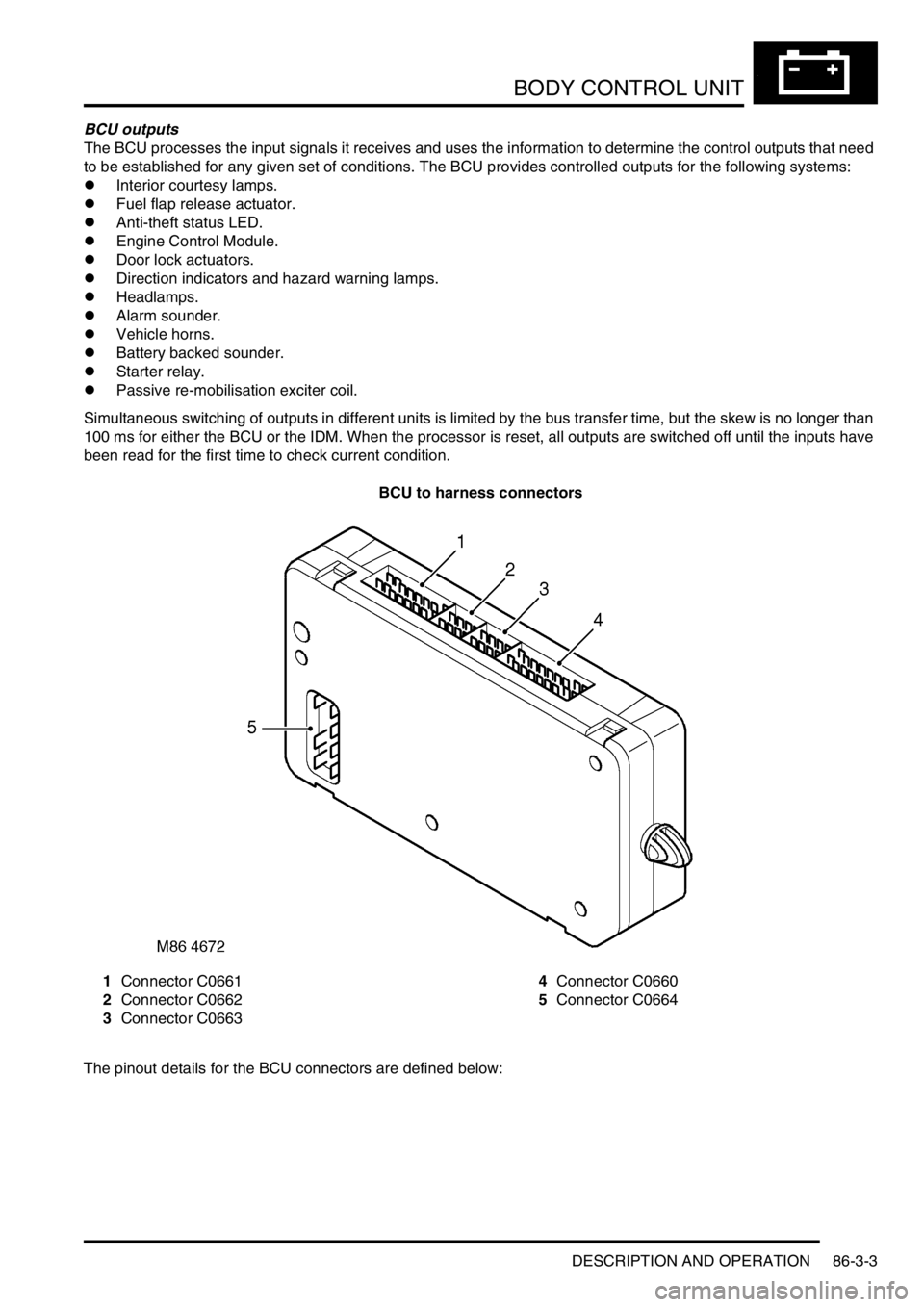
BCU to harness connectors
1Connector C0661
2Connector C0662
3Connector C06634Connector C0660
5Connector C0664
The pinout details for the BCU connectors are defined below:
Page 1292 of 1529

BODY CONTROL UNIT
DESCRIPTION AND OPERATION 86-3-5
C0661 connector pin details
Pin No. Description Input/Output
1 Serial bus to instrument pack and IDM Input/Output
2 Not used -
3 Battery backed up sounder code (AL) Output
4 Diagnostic bi-directional 'K'-line Input/Output
5 RF regulated power supply Output
6 RF receiver input Input
7 Brake switch activated Input
8 Reverse gear selected Input
9 Sunroof enable line Output
10 Robust immobilisation Output
11 Front washer pump Input
12 Heated front screen relay Output
13 Heated front screen active Output
14 Battery backed up sounder code (ST) Output
15 Heated rear screen active Output
16 'N' or 'R' or 'P' or brake selected Output
17 Not used -
18 Passive remobilisation exciter coil Output
19 RF battery supply from fuse 20 in passenger compartment
fuseboxInput
20 Security status LED Output
21 Front intermittent wiper Input
22 Driver's door key unlock Input
Page 1300 of 1529

BODY CONTROL UNIT
DESCRIPTION AND OPERATION 86-3-13
Anti-theft system
The BCU controls the logical switching operations for enabling and activating the anti-theft system. Features include:
lPerimetric protection – monitors the condition of doors and hinged panels.
lVolumetric protection – monitors the vehicle's interior space.
lRemote locking, superlocking and unlocking functions.
lEngine immobilisation and remobilisation.
lAdvanced mislock detection and automatic compensation.
lEKA code functions.
lCustomer configuration options.
lMarket configuration options.
Immobilisation
The immobilisation system comprises the following components:
lRF receiver.
lRF transmitter/ transponder.
lTransponder coil.
lBCU.
lDoor switches, door lock switches and bonnet switch.
lIDM.
lECM.
lStarter solenoid relay.
lStatus LED.
Alarm system
The alarm system comprises the following components:
lRF receiver.
lRF transmitter.
lBCU.
lIDM.
lDoor switches, door lock switches and bonnet switch.
lBattery backed-up sounder (BBUS).
lStatus LED.
On non NAS vehicles, power supply for the alarm sounder and the battery BBUS is provided through two relays in the
passenger compartment fuse box. Each of the coils of the alarm relays are directly connected to the IDM which
controls their operation under the direction of BCU signals received via the serial data bus.
On NAS vehicles, an audible warning is provided through operation of the vehicle horns. The BCU provides an earth
path for the coil of the horn relay to initiate vehicle horn operation.
+ ALARM SYSTEM AND HORN, DESCRIPTION AND OPERATION, Description.
Acclimatisation locking Disabled The vehicle cannot be locked if the ignition is on.
Enabled The vehicle can be locked if the ignition is on and the engine is
running.
Alarm tamper Disabled The security system LED does not flash when the security system has
been tampered with.
Enabled The security system LED flashes when the security system has been
tampered with.
Engine immobilised LED off The security system LED does not flash when the engine is
immobilised.
LED flash The security system LED flashes when the engine is immobilised.
Low battery warning Disabled The security system LED does not flash when the remote transmitter
battery is low.
Enabled The security system LED flashes when the remote transmitter battery
is low.
Emergency Key Access
(EKA)Disabled EKA is disabled.
Enabled EKA is enabled and the door locks operate electrically.
No unlock EKA is enabled, but the door locks do not operate electrically. Function Option Details
Page 1306 of 1529

BODY CONTROL UNIT
DESCRIPTION AND OPERATION 86-3-19
Operation
For IDM inputs which are also inputs for BCU functions, the delay before the BCU recognises the change in input
status is less than 250 ms. The BCU uses a debounce algorithm to ignore changes in input having a duration less
than 100 ms with the exception of automatic gearbox W, X, Y, Z inputs, which have a debounce period of 33 ms.
Transit mode
To prevent excessive battery drain during transit to overseas markets, the vehicle is placed in a transit mode.
To exit the transit mode, simultaneously hold down the heated rear window switch and the rear fog lamp switch, turn
the ignition switch from 0 to II and, after a minimum of 2 seconds, release the switches.
Transit mode can be entered using TestBook. When TestBook communicates with the BCU for diagnostics related to
BCU operation, it first checks that the vehicle is not in transit mode.
Anti-theft system
The BCU uses the driver's door key lock and unlock switches to activate and deactivate the security system. The
driver's door lock is also used for entering the EKA.
+ ALARM SYSTEM AND HORN, DESCRIPTION AND OPERATION, Description.
Immobilisation
For immobilisation, the BCU disables the starter motor relay. When the engine is cranking, the ECM looks for a coded
signal from the BCU. If the signal is not received within one second of cranking, the fuel supply to the engine is
stopped and the injectors are disabled. This also prevents unburnt fuel from entering the catalyst.
If the BCU is disconnected, the engine starter motor will remain isolated by the starter motor relay and the ECM will
remain immobilised. The main wiring for the system is contained within the main harness which is relatively
inaccessible, so preventing intruders from disabling the system by cutting the wires for the immobilisation system.
Once the immobiliser has been activated, destruction of the trigger device or the wiring to it will not disarm the system.
The RF transmitter communicates to the BCU via the RF receiver using a 70 bit code. Pressing the unlock button on
the transmitter will re-mobilise the vehicle. The RF transponder is integrated into the metal key assembly, inserting
the key into the ignition switch will induce a signal in the exciter coil to re-mobilise the vehicle.
Anti-theft alarm
The alarm system provides a warning of unauthorised access to the vehicle and includes perimetric and volumetric
monitoring under the control of the BCU.
The perimetric protection system detects opening of all doors, tail door and bonnet and will also detect the operation
of the ignition key switch. The following conditions must be satisfied before the BCU will operate all of the functions
of perimetric protection:
lAll doors and hinged panels are in the closed position.
lIgnition key out of the ignition switch.
lInertia switch is not tripped.
If all conditions are not satisfied the BCU will enter a mislock condition.
The volumetric sensor uses two ultrasonic sensors mounted in the headlining to detect movement within the vehicle.
The alarm will trigger when the sensor signals the BCU for 200 ms or greater. Within a single setting period the alarm
system will allow a maximum of 10 triggers as a result of any combination of sensor inputs. It is possible to lock the
vehicle without enabling the volumetric alarm by using the key. The same conditions needed to satisfy enabling of the
perimetric protection system is also needed to enable volumetric protection.
When the alarm system is set the BCU checks the status of all the inputs from the door and bonnet switches to ensure
the integrity of the vehicle before setting the alarm system into operational mode. In some markets, when the alarm
is set the BCU sends a signal to the IDM which will cause the direction indicators to flash three times for a duration of
3 seconds.
If the sensors are triggered the BCU will activate an alarm sounder to provide an audible warning of a theft attempt.
The activation period of the alarm sounder is 25 to 30 seconds. The duty cycle of the alarm sounder is 50:50 ± 10%.
Page 1307 of 1529

BODY CONTROL UNIT
86-3-20 DESCRIPTION AND OPERATION
In some markets, when the alarm is triggered the BCU also activates the direction indicators, in phase with the audible
warning, to provide an optical warning of a theft attempt. The activation period of the optical alarm is 25 to 30 seconds.
The duty cycle of the optical warning is 50:50 ± 10%.
The alarm system relies upon the vehicle battery for power. However, the BCU remembers the status of the security
system if it loses battery supply. If the security system was in a set condition when battery supply was lost the BCU
will trigger the alarm and initiate a visual warning by flashing the hazard lamps when the battery voltage is restored.
On vehicles with a BBUS fitted, the BBUS will sound if the battery is disconnected while the alarm system is set.
Door switches
The BCU uses the door latch switches to indicate if a door is open or closed. The BCU provides power to all door latch
switches; the switches are in the 'normally open' condition when the doors are shut. When a door is opened, the door
switch contacts are closed and the circuit is earthed, signalling a change in state to the BCU. All doors except the
driver's doors are connected in parallel, so the BCU will recognise a passenger door has been opened but will not be
able to distinguish which one. The driver's door has a dedicated signal line which enables the BCU to detect if the
driver's door has been opened or closed.
Door lock actuators
The CDL system has the facility to enable superlocking. All door lock actuators are controlled by the BCU via the IDM.
The driver's door is controlled separately from all other doors, enabling functions like single point entry and key
access.
Driver's door key lock and unlock switches
The BCU uses the driver's door key lock and unlock switches to activate and deactivate the security system. The
driver's door lock is also used for entering the EKA code.
Two separate switches are incorporated into the key lock assembly of the driver's door. The switches are normally
open and the BCU provides a separate power supply to each. The BCU is signalled when a circuit is earthed enabling
it to determine the direction in which the lock has been turned.
Bonnet switch
The bonnet switch is powered from the BCU and is used as a logical input for operation of the security system. The
switch is normally open with the bonnet closed, when the bonnet is opened the switch contacts close to complete a
circuit to earth and signal the change in state to the BCU.
Key-in sensor
When the ignition key is inserted into the lock barrel the key-in sensor contacts close and supply a signal to the BCU.
The BCU monitors the ignition switch for a change in state and triggers the alarm if it receives an ignition signal before
it receives an alarm disarm signal.
Another feed to the ignition switch is provided by the BCU to provide switch illumination.
A key-in warning can be enabled or disabled. When the key-in warning is enabled, an audible warning is generated
if the ignition key is in and the driver's door is opened.
Passive coil
The passive coil is located around the ignition key barrel. When the BCU detects that the ignition key has been turned
to the crank position, the vehicle's immobilisation system is activated and a signal is sent to the passive coil at a
frequency of 125 kHz. The magnetic field generated in the coil is induced in the remote transmitter to trigger a re-
mobilisation signal.
BBUS/ alarm sounder/ vehicle horn
The BBUS is an audible warning device which operates under the control of the BCU if the anti-theft system is
activated or the vehicle battery is disconnected. The unit contains its own internal battery power source which is
charged via a feed from the passenger compartment fuse box. The BBUS will not sound if the battery is disconnected
while the security system has not been set.
Some markets utilise an alarm sounder which operates independently or in conjunction with the vehicle horn if the
anti-theft system is triggered.
Page 1308 of 1529

BODY CONTROL UNIT
DESCRIPTION AND OPERATION 86-3-21
Security system status LED
The LED flashes when the anti-theft system has been set. There are four different flash rates dependent on mode of
operation or other system information.
Central door locking
The doors can be locked by the following methods:
lPressing the lock button on the remote transmitter.
lLocking the vehicle from the driver's door with the key.
lPressing the lower half of the central door lock switch.
lPushing the sill button down (will only lock that particular door).
lBy driving over 7 km/h (4 mph) – ( if the speed related locking function has been enabled).
The BCU will prevent locking if the logical conditions for locking are not satisfied. Conditions which will prevent door
locking include:
lDriver's door open.
lIgnition switch on.
lInertia switch tripped.
lVehicle is already superlocked.
A mislock may occur if the logical conditions are not met.
The doors can be unlocked by the following methods:
lPressing the unlock button on the remote transmitter
lUnlocking the vehicle from the driver's door with the key.
lPressing the upper half of the central door locking switch (not operational if the vehicle is superlocked).
lPulling the interior door handles (not operational if the vehicle is superlocked).
lInertia switch being triggered while the ignition is on and the security system is de-activated.
The BCU supplies information via the serial data bus to the IDM to energise the coil of the relays for each of the door
lock actuators.
The BCU normally checks the following inputs to determine lock/ unlock requirements:
lUnlock request.
lLock request.
lSuperlock request.
lSingle point entry request.
lLock passenger and rear doors request.
The following outputs are generated by the BCU dependent on the prevailing logic conditions and the input requests
the BCU has detected:
lUnlock all doors enable.
lLock passenger and rear doors enable.
lSuperlock all doors enable.
lLock driver's door enable.
All lock/ unlock pulses have a duration of 800 ms.
Input/Output logic for door lock/unlock
To determine if the vehicle speed is appropriate for enabling speed related locking, the BCU uses the vehicle speed
signal supplied over the serial data bus from the instrument pack.
Output/Request Superlock all
doors enableUnlock all doors
enableLock driver's
door enableLock passenger
and rear doors
enable
Unlock request 0 1 0 0
Lock request 0 0 1 1
Superlock request 1 0 1 1
Single point entry request 0 1 0 1
Lock passenger and rear doors request 0 0 0 1
Page 1310 of 1529

BODY CONTROL UNIT
DESCRIPTION AND OPERATION 86-3-23
A timeout function is included which allows the windows and sunroofs to be operated for a period of 44 ± 1 seconds
after the ignition key has been removed from the ignition switch. The timeout function will be cancelled if the BCU
detects the following conditions:
lThe driver's door has been closed after the ignition has been switched off.
lAny door open after the ignition is switched off.
The preconditions are programmed into the BCU dependent on market specification.
The BCU does not directly control rear window operation, but it can request the IDM to remove the power feed to the
rear windows. The IDM enables power supply to be provided to the rear lift relay in the passenger fuse box. When the
relay coil is energised the relay contacts close and power is applied to the rear window motor. If the window lift
isolation switch located in the centre console is latched out, the earth path from the LH and RH rear door window
switches is broken and operation of the rear window motors through the use of the rear window switches is prevented.
Rear window operation using the console switches is not affected by the isolation switch.
In the event of a communications link failure occurring while rear window enable is on, the relay remains on until the
ignition switch is turned to the off position.
Heated screens
The heated screen time-outs and logical operations are controlled by the BCU.
Heated front screen
The BCU provides an output to the heated front screen relay and a 'heated front screen active signal' for the heated
front screen warning lamp. The BCU uses the status of the following inputs to determine the appropriate logical
operations for this feature:
lIgnition state.
lEngine running (link from instrument pack).
lHeated front screen selected (non-latched button pressed).
If the ignition switch is not in position II, or the engine running signal is OFF, the heated front screen will not be active.
The heated front screen operation period and voltage supply is controlled by the BCU. The BCU receives a voltage
supply feed from the engine compartment fuse box and an ignition switched supply through a fuse in the passenger
compartment fuse box. When the heated front screen switch is operated, it completes a path to earth, signalling a
request for heated screen operation to the BCU. The BCU then supplies a feed to the heated front screen switch to
light the switch indicator, and earths the supply from the coil of the heated screen relay to turn the heated front screen
on. The BCU maintains a supply for a predetermined time (5 minutes), then opens the earth path after the time out
period to turn the heated screen off. During the timeout period, if the heated front screen switch is pressed a second
time, the circuit is also interrupted to turn off the supply to the heated front screen.
On vehicles fitted with air conditioning, the heated front screen is also operated by the ATC ECU when DEF (defrost)
is selected. In this case the ATC ECU provides the trigger signal to the BCU to turn the heated front screen circuit on
or, if it is already on, to re-start the time out period.
+ AIR CONDITIONING, DESCRIPTION AND OPERATION, Description.
In the event of a communications link failure occurring while the heated front screen relay is on, the relay and lamp
will remain on until the ignition switch is turned off or the time-out period elapses or the heated front screen switch is
pressed.
Heated rear window
The heated rear window will only function when the engine is running, and is operated by a non-latching switch on the
instrument pack cowl.
The BCU provides a 'heated rear window enable output' and a 'heated rear window active warning lamp signal' based
on the logic status of the following inputs:
lIgnition state.
lEngine running (link from instrument pack).
lHeated rear window selected (non-latched button pressed).
If the ignition switch is not in position II, or the engine running signal is OFF, the heated rear window will not be active.
Page 1311 of 1529

BODY CONTROL UNIT
86-3-24 DESCRIPTION AND OPERATION
The heated rear window operation period and voltage supply is controlled by the BCU. The BCU receives a voltage
supply feed from the engine compartment fuse box and an ignition switched supply through a fuse in the passenger
compartment fuse box. When the heated rear window switch is operated, it completes a path to earth, signalling a
request for heated rear window operation to the BCU. The BCU then supplies a feed to the heated rear window switch
to light the switch indicator, and earths the supply from the coil of the heated rear window relay via the IDM to turn the
heated rear window elements on. The BCU maintains a supply for a predetermined time (15 minutes), then opens the
earth path after the time-out period to turn the heated rear window operation off. If the heated rear window switch is
pressed a second time, the circuit is also interrupted to turn off the supply to the heated front screen.
On vehicles fitted with air conditioning, the heated rear window is also operated by the ATC ECU when DEF (defrost)
is selected. In this case the ATC ECU provides the trigger signal to the BCU to turn the heated rear window circuit on
or, if it is already on, to re-start the time out period.
+ AIR CONDITIONING, DESCRIPTION AND OPERATION, Description.
In the event of a communications link failure occurring while the heated rear window enable is on, the relay and lamp
will be de-activated.
Wipers and washers
Front and rear wash/ wipe operations are controlled by the BCU via the IDM.
Front wipers and washers
When front intermittent wipe is selected using the wiper switch on the column stalk, the BCU signals the IDM to
operate the wiper motor. The IDM then supplies a voltage to the normal speed winding of the wiper motor for a period
of no longer than 500 ms. The timed feed ensures the wiper motor operates, but does not complete more than a single
wipe of the screen. The BCU checks the position of the delay switch to determine the delay period which should be
utilised for the intermittent wipe operation. The delay period of the front intermittent wipe is maintained until the wiper
switch is moved to the off, normal or fast speed position, or the delay period is changed.
When front intermittent wipe is selected, a delay period of 500 ms will be incurred before the wipers operate. This
delay prevents the occurrence of a wipe action when the wiper switch is changed to the off position from the normal
or fast modes of operation.
To enable the front intermittent wipe facility, the BCU checks the state of the following inputs:
lIgnition state.
lFront intermittent wiper switch.
lFront intermittent wiper rate.
If the ignition switch is in the off or crank position, the front wipers are not active and the front wiper enable output is
switched off.
If the option to initiate a wipe action in addition to a front screen wash action has been configured in the BCU, the
wipers will operate 400 ms after the washer pump becomes active. If the washer switch is released within 400 ms,
the wipers will not be activated. If a washer switch is pressed for longer than 400 ms, the BCU will operate the wipers
after an initial delay of 400 ms, and will continue to operate for as long as the washer switch is depressed plus an
additional 4 seconds.
The front wash/ wipe programme can be configured to operate in one of two ways:
lOption 1 – normal.
lOption 2 – no wipe.
The BCU checks for the following inputs:
lIgnition state.
lFront washer pump switch.
The BCU can provide the following wash / wipe outputs depending on the logic states prevailing:
lFront wiper enable.
lFront wash/ wipe in progress flag.
In the event of a communications link failure occurring while the front wash/ wipe programme is in operation, the front
wiper enable output is switched off.
Page 1312 of 1529

BODY CONTROL UNIT
DESCRIPTION AND OPERATION 86-3-25
Rear wipers and washers
The rear wiper is initially operated for a period of 4 seconds when the rear wiper switch is pressed, to complete two
full cycles. After this, the rear wiper will operate every other time the front wiper completes a wipe operation. During
the wipe operation, the front and rear wipers are synchronised, and changes to the delay period during intermittent
wipe will change the delay period for both front and rear wipers.
Operation of the rear washer switch causes the washer motor to operate for as long as the switch is operated. The
wiper also operates while the switch is depressed and for a further 4 seconds after the switch is released.
The BCU checks for the following inputs to determine when to provide the rear wiper enable signal:
lIgnition state.
lRear wiper switch.
lFront intermittent wiper rate.
lFront intermittent wiper switch.
If the ignition switch is in the off or crank position, the rear wipers are not active and the rear wiper enable output is
switched off.
In the event of a communications link failure occurring while the rear intermittent wipe programme is in operation, the
rear wiper enable output is switched off.
Reverse gear wipe
The BCU changes the operation of the rear wiper when the front wiper is active and reverse gear is selected. The rear
wiper operation rate used when the preconditions have been satisfied depend on the prevailing front wiper operating
mode and the position of the rear wiper switch. If the rear wiper is on or the front wiper is operating at an intermittent
rate when reverse gear is selected, the BCU will operate the rear wiper continuously for 4 seconds via the IDM. After
the initial period, the rear wiper will operate at the same rate as the front wiper.
The BCU checks for the following inputs to determine when to provide the rear wiper enable signal if the vehicle is in
reverse gear:
lIgnition state.
lRear wiper switch.
lFront intermittent wiper rate.
lReverse gear selected.
lFront intermittent wiper switch.
lFront wiper switch state.
lFront wash/ wipe in progress flag.
In the event of a communications link failure occurring while the reversing wipe is in operation, the rear wiper enable
output is switched off.
Headlamp wash
The headlamp wash will only operate when the headlamps are on, and then only every third time the front windscreen
wash button is pressed. When the BCU operates the headlamp washers, it activates the washer pump relay for a
period of 500 ms. The BCU supplies an earth path for the coil of the power wash relay located in the engine
compartment fuse box when the washer function is selected.
The BCU checks for the following inputs to determine when to provide power to the headlamp power wash relay:
lIgnition state.
lFront washer pump switch.
lDipped beam.
lMain beam state.
If the ignition switch is in the off position, the headlamp power wash relay is also held off. if the ignition state is crank,
the headlamp power wash relay is switched off and the headlamp power wash counter is reset to 0.
In the event of a communications link failure occurring while the headlamp power wash relay in on , the relay remains
on until the 500 ms timer has completed, then the relay is switched off.