oil filter LAND ROVER DISCOVERY 1999 Owner's Guide
[x] Cancel search | Manufacturer: LAND ROVER, Model Year: 1999, Model line: DISCOVERY, Model: LAND ROVER DISCOVERY 1999Pages: 1529, PDF Size: 34.8 MB
Page 261 of 1529
EMISSION CONTROL - V8
17-2-28 DESCRIPTION AND OPERATION
The air delivery pipe is a flexible plastic type, and is connected to the air pump outlet via a plastic quick-fit connector.
The other end of the flexible plastic pipe connects to the fixed metal pipework via a short rubber hose. The part of the
flexible plastic pipe which is most vulnerable to engine generated heat is protected by heat reflective sleeving. The
metal delivery pipe has a fabricated T-piece included where the pressurised air is split for delivery to each exhaust
manifold via the SAI control valves.
The pipes from the T-piece to each of the SAI control valves are approximately the same length, so that the pressure
and mass of the air delivered to each bank will be equal. The ends of the pipes are connected to the inlet port of each
SAI control valve through short rubber hose connections.
The T-piece is mounted at the rear of the engine (by the ignition coils) and features a welded mounting bracket which
is fixed to the engine by two studs and nuts.
The foam filter in the air intake of the SAI pump provides noise reduction and protects the pump from damage due to
particulate contamination. In addition, the pump is fitted on rubber mountings to help prevent noise which is generated
by pump operation from being transmitted through the vehicle body into the passenger compartment.
If the secondary air injection (SAI) pump is found to be malfunctioning, the following fault codes may be stored in the
ECM diagnostic memory, which can be retrieved using Testbook/T4:
NOTE: Refer to 'SAI System Fault Finding' and 'Checking Malfunctions on SAI System' at the end of this section to
determine root cause of fault codes.
NOTE: The electrical test of the SAI pump powerstage only indicates that there is a problem with the relay or the
power supply to the relay. It does not indicate the state of the SAI pump itself (i.e. broken or not connected).
As a result of a SAI pump powerstage malfunction, other fault codes may also become stored in the ECM memory.
These may include the following P codes.
NOTE: A malfunction of the SAI pump powerstage is logically expected to result in both engine banks reporting the
same fault.
NOTE: Refer to 'SAI System Fault Finding' and 'Checking Malfunctions on SAI System' at the end of this section to
determine root cause of fault codes.
Secondary Air Injection (SAI) Pump Relay
The secondary air injection pump relay is located in the engine compartment fusebox. The engine control module
(ECM) is used to control the operation of the SAI pump via the SAI pump relay. Power to the coil of the relay is supplied
from the vehicle battery via the main relay and the ground connection to the coil is via the ECM.
Power to the SAI pump relay contacts is via fusible link FL2 which is located in the engine compartment fusebox.
P-code Description
P0418Secondary Air Injection System – Relay 'A' circuit malfunction (SAI pump
powerstage fault, e.g. - SAI pump relay fault or relay not connected / open circuit /
harness damage).
P-code Description
P1412Secondary Air Injection System – Malfunction Bank 1 LH (Insufficient SAI flow
during passive test)
P1414Secondary Air Injection System – Low air flow Bank 1 LH (Insufficient SAI flow
during active test)
P1415Secondary Air Injection System – Malfunction Bank 2 RH (Insufficient SAI flow
during passive test)
P1417Secondary Air Injection System – Low air flow Bank 2 RH (Insufficient SAI flow
during active test)
Page 267 of 1529
EMISSION CONTROL - V8
17-2-34 DESCRIPTION AND OPERATION
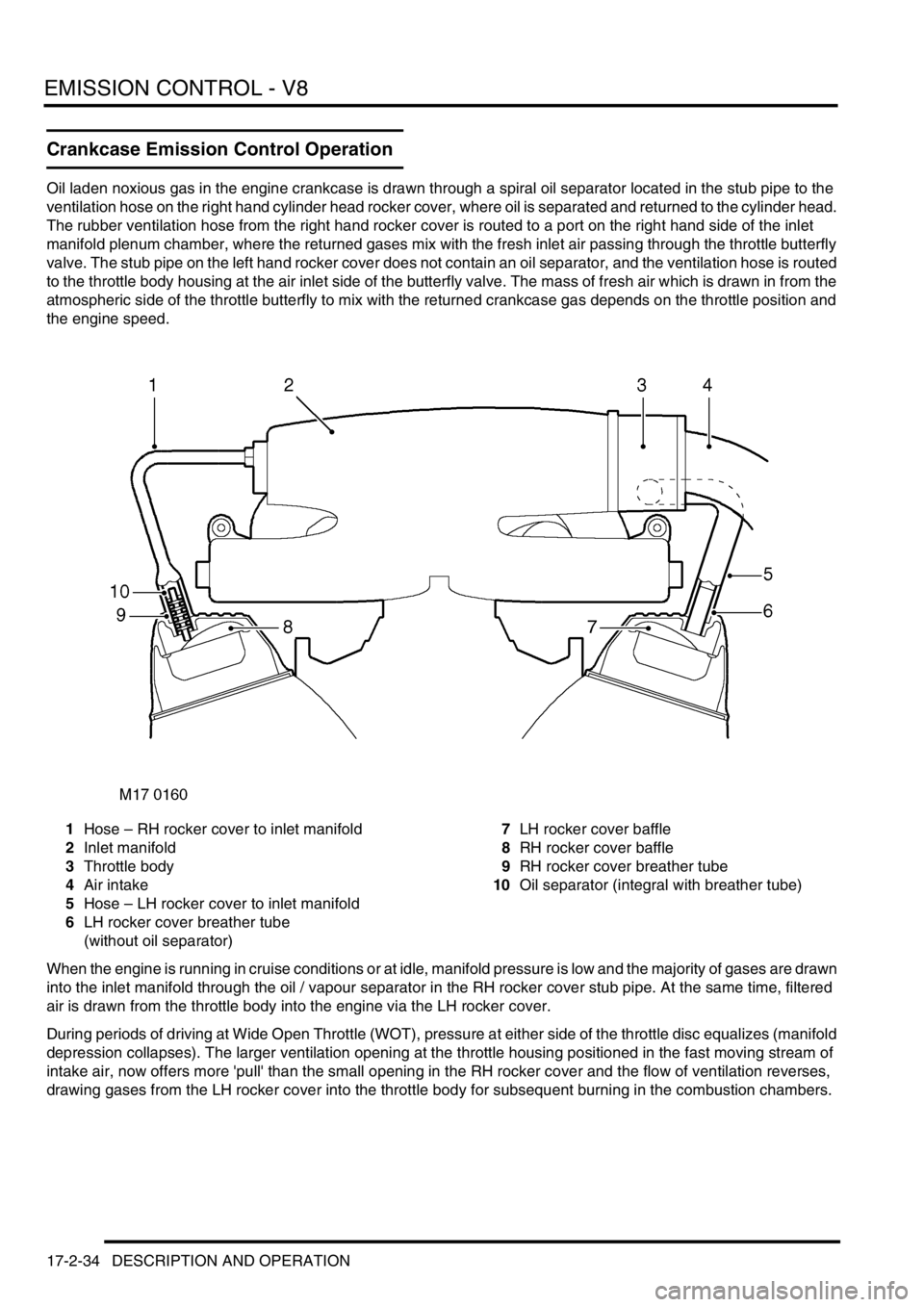
Crankcase Emission Control Operation
Oil laden noxious gas in the engine crankcase is drawn through a spiral oil separator located in the stub pipe to the
ventilation hose on the right hand cylinder head rocker cover, where oil is separated and returned to the cylinder head.
The rubber ventilation hose from the right hand rocker cover is routed to a port on the right hand side of the inlet
manifold plenum chamber, where the returned gases mix with the fresh inlet air passing through the throttle butterfly
valve. The stub pipe on the left hand rocker cover does not contain an oil separator, and the ventilation hose is routed
to the throttle body housing at the air inlet side of the butterfly valve. The mass of fresh air which is drawn in from the
atmospheric side of the throttle butterfly to mix with the returned crankcase gas depends on the throttle position and
the engine speed.
1Hose – RH rocker cover to inlet manifold
2Inlet manifold
3Throttle body
4Air intake
5Hose – LH rocker cover to inlet manifold
6LH rocker cover breather tube
(without oil separator)7LH rocker cover baffle
8RH rocker cover baffle
9RH rocker cover breather tube
10Oil separator (integral with breather tube)
When the engine is running in cruise conditions or at idle, manifold pressure is low and the majority of gases are drawn
into the inlet manifold through the oil / vapour separator in the RH rocker cover stub pipe. At the same time, filtered
air is drawn from the throttle body into the engine via the LH rocker cover.
During periods of driving at Wide Open Throttle (WOT), pressure at either side of the throttle disc equalizes (manifold
depression collapses). The larger ventilation opening at the throttle housing positioned in the fast moving stream of
intake air, now offers more 'pull' than the small opening in the RH rocker cover and the flow of ventilation reverses,
drawing gases from the LH rocker cover into the throttle body for subsequent burning in the combustion chambers.
Page 383 of 1529

ENGINE MANAGEMENT SYSTEM - V8
18-2-84 REPAIRS
Sensor - radiator temperature
$% 18.30.20
Remove
1.Disconnect battery earth lead.
2.Position container to collect coolant spillage.
3.Disconnect multiplug from sensor.
4.Remove sensor and discard sealing washer.
Refit
1.Fit new sealing washer to sensor.
2.Fit and tighten sensor.
3.Connect multiplug to sensor.
4.Refill cooling system.
5.Connect battery earth lead.
Sensor - camshaft position (CMP)
$% 18.30.24
Remove
1.Release fixings and remove battery cover.
2.Disconnect battery earth lead.
3.Raise front of vehicle.
WARNING: Do not work on or under a
vehicle supported only by a jack. Always
support the vehicle on safety stands.
4.Release fixings and remove underbelly panel.
5.Remove engine oil filter.
+ ENGINE - V8, REPAIRS, Filter - oil.
6.Disconnect engine harness from CMP sensor
and release CMP sensor multiplug from
bracket.
7.Remove bolt from clamp securing CMP sensor
to timing gear cover.
8.Remove clamp and CMP sensor. Discard 'O'
ring from CMP sensor.
Refit
1.Ensure CMP sensor is clean, fit new 'O' ring
and sensor to cover.
2.Fit clamp to CMP sensor and tighten bolt to 8
Nm (6 lbf.ft).
3.Fit sensor multiplug to bracket and connect
engine harness to multiplug.
4.Fit engine oil filter.
+ ENGINE - V8, REPAIRS, Filter - oil.
5.Fit underbelly panel and secure with fixings.
6.Lower vehicle and connect battery earth lead.
7.Fit battery cover and secure with fixings.
Page 474 of 1529

MANUAL GEARBOX - R380
DESCRIPTION AND OPERATION 37-3
1Front cover
2Input shaft oil seal
3Oil filler/level plug
4Sealing washer
5Oil drain plug
6Gear case
7Interlock spool retainer, bolt and 'O' ring
8Centre plate
9Locating dowels
10Selector plug, detent balls and spring
11Splash shield and retaining bolt
12Extension housing
13Gate plate and retaining bolt
14Interlock spool retainer, retaining bolt and 'O'
ring – if fitted – extension housing
15Inhibitor cam spring
16Inhibitor cam
17Reverse inhibitor shaft
18Output shaft oil seal
19Oil seal collar
20Oil pump and retaining bolt
21'O' ring
22Reverse lamp switch23Oil by-pass block - UK and European models
24Bolt - oil by-pass block
25'O' ring - oil by-pass block
26Thermostat and housing - non UK and non
European models
27'O' ring - thermostat housing
28Bolt - thermostat housing
29Oil pick-up pipe
30Oil filter
31Oil pick-up ring
32Rubber gaiter
33Cable tie
34Upper gear lever
35Clamp bolt
36Bias springs
37Bolts and washers - bias adjusting plate and
housing
38Bias adjusting plate
39Lower gear lever and ball
40Railko bush
41Oil seal
42Gear change housing
Page 477 of 1529

MANUAL GEARBOX - R380
37-6 DESCRIPTION AND OPERATION
R380 gearbox cross section
1Input shaft
2Breather
3Input shaft 4th gear
4Selector shaft
53rd/4th selector fork
6Output shaft 3rd gear
7Output shaft 2nd gear
81st/2nd selector fork
9Output shaft 1st gear
10Selective shims - output shaft and layshaft end-
float
11Selective shim - reverse gear idler shaft end-
float
125th/reverse selector fork
13Selector yoke14Gear change assembly
15Railko bush
16Output shaft 5th gear
17Output shaft oil seal
18Output shaft
19Oil pump
205th/reverse gear synchromesh assembly
21Output shaft reverse gear
22Centre plate
23Oil filter
241st/2nd synchromesh assembly
25Layshaft
263rd/4th gear synchromesh assembly
27Input shaft oil seal
Page 478 of 1529

MANUAL GEARBOX - R380
DESCRIPTION AND OPERATION 37-7
Description
General
The R380 all synchromesh gearbox has five forward speeds and reverse and is mounted in line with the engine. The
clutch bell housing is bolted to the front of the gearbox and the transfer box is mounted at the rear.
Gearbox casings
Gearbox casings consist of a front cover, gearcase, centre plate and extension housing. All casings with the exception
of the front cover are located to each other by dowels and sealed. Gearbox filler/level and drain plugs are located in
the gearcase.
Reverse lamp switch
A reverse lamp switch is inserted into the extension housing. Selection of reverse gear will close the switch allowing
current from fuse 25 to flow through the switch to illuminate the reverse lamps. The switch also provides a feed to the
BCU and the electrochromic automatic interior mirror - if fitted; the mirror moving from the dimmed position if
applicable.
Gearchange assembly
The gearchange assembly is bolted to the top of the gearcase, the upper gear lever being attached to the lower gear
lever by means of a clamp bolt. The lower gear lever ball is housed in a Railko bush inserted in the gear change
housing, the end of the lever locating in the selector yoke which is attached to the end of the selector shaft. Bias
springs provide a positive return of the gear lever to the neutral position with selection of 1st/2nd and 5th/reverse gears
being against bias spring pressure. Spring loaded detent balls fitted in the centre plate locate in grooves in the selector
shaft to provide positive gear and neutral selection.
Lubrication
Lubrication is by an oil pump located in the extension housing and driven by the layshaft with additional lubrication
being provided by splash. The pump directs oil via a filter and internal drillings in the output shaft to lubricate the
components. On non UK and non European models, provision for oil cooling is by means of a thermostat housed in
a cover bolted to the side of the extension housing. The cover incorporates tappings for connections to an oil cooler.
On UK and European models, the thermostat and cover are replaced by an oil by-pass block.
Internal pressures produced within the gearbox are vented to atmosphere via a plastic breather pipe. The pipe is
attached to the extension housing and is routed across the top of the gearcase and secured at the open end by a clip
attached to the engine cylinder block.
Selector shaft and forks
Selector forks for 1st/2nd, 3rd/4th and 5th/reverse gears are located on a single selector shaft; the 1st/2nd and 3rd/
4th selector forks are inside the main gearcase whilst the 5th/reverse selector fork is inside the extension housing.
Each of the selector forks locates inside its corresponding synchromesh hub.
Synchromesh assemblies
Each synchromesh assembly is located on the output shaft adjacent to its corresponding gears and comprises a
synchromesh ring, hub, slippers and sleeve. The hubs and slippers are retained in the sleeves by means of spring
clips. 1st/2nd and 3rd synchromesh assemblies are fitted with double synchromesh rings whilst 4th, 5th and reverse
assemblies are fitted with single rings.
The gear train
The gear train comprises an input shaft, output shaft, layshaft and reverse idler shaft together with their appropriate
gears and synchromesh assemblies.
The gear train input shaft, output shaft and layshaft are supported by taper roller bearings with all gears on the input
and output shafts running on caged needle roller bearings. Layshaft gears are integral with the shaft with the
exception of reverse/5th gears which are splined to the shaft and retained with a nut. 1st, 2nd, 3rd and 4th gears are
shot peened to improve durability. The reverse idler shaft and gear are supported in the centre plate by a caged
needle roller bearing. End-float of the output shaft and layshaft is controlled by selective shims located in the centre
plate whilst reverse idler shaft end-float is controlled by a selective shim located behind reverse gear.
Page 512 of 1529
MANUAL GEARBOX - R380
OVERHAUL 37-41
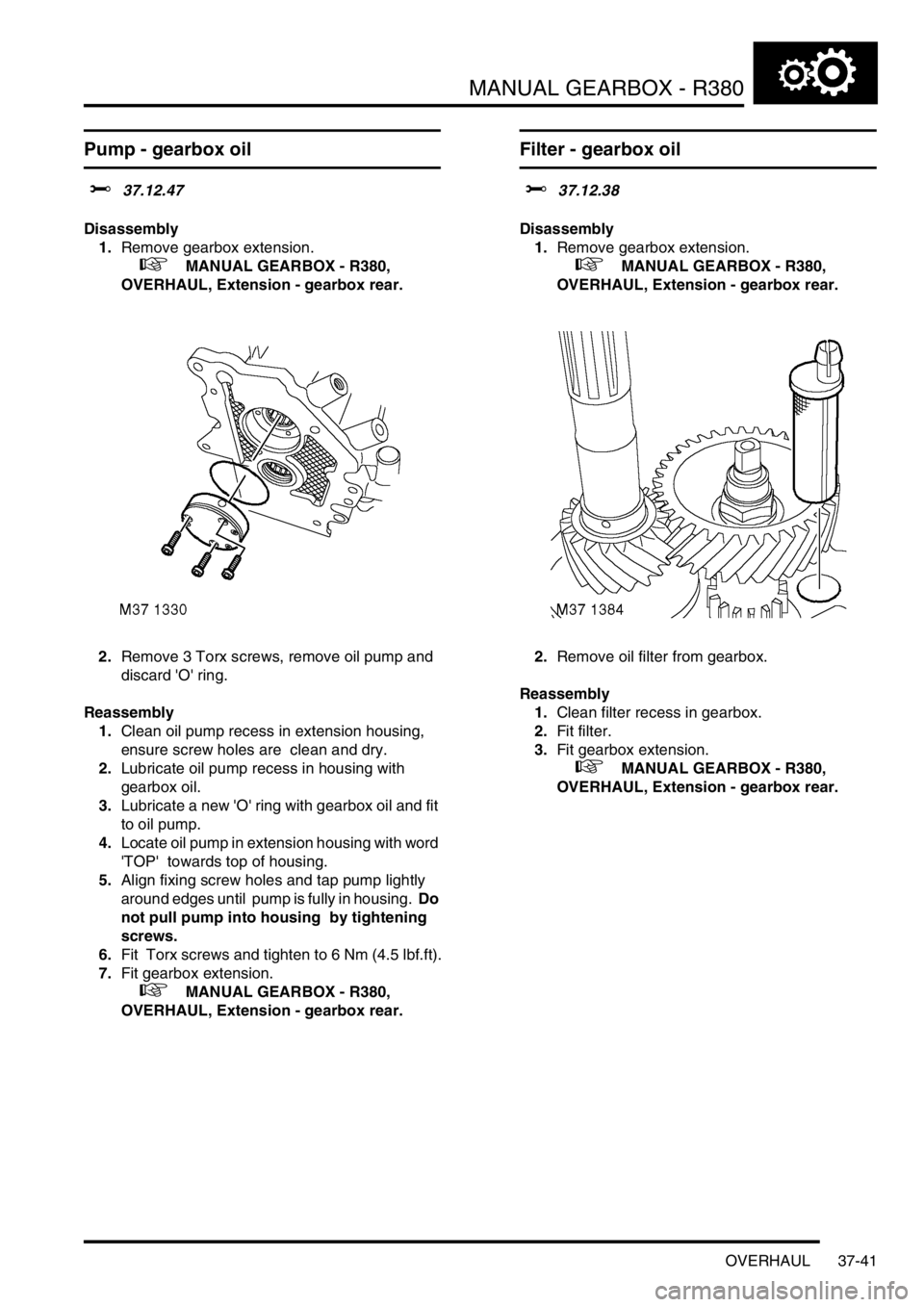
Pump - gearbox oil
$% 37.12.47
Disassembly
1.Remove gearbox extension.
+ MANUAL GEARBOX - R380,
OVERHAUL, Extension - gearbox rear.
2.Remove 3 Torx screws, remove oil pump and
discard 'O' ring.
Reassembly
1.Clean oil pump recess in extension housing,
ensure screw holes are clean and dry.
2.Lubricate oil pump recess in housing with
gearbox oil.
3.Lubricate a new 'O' ring with gearbox oil and fit
to oil pump.
4.Locate oil pump in extension housing with word
'TOP' towards top of housing.
5.Align fixing screw holes and tap pump lightly
around edges until pump is fully in housing. Do
not pull pump into housing by tightening
screws.
6.Fit Torx screws and tighten to 6 Nm (4.5 lbf.ft).
7.Fit gearbox extension.
+ MANUAL GEARBOX - R380,
OVERHAUL, Extension - gearbox rear.
Filter - gearbox oil
$% 37.12.38
Disassembly
1.Remove gearbox extension.
+ MANUAL GEARBOX - R380,
OVERHAUL, Extension - gearbox rear.
2.Remove oil filter from gearbox.
Reassembly
1.Clean filter recess in gearbox.
2.Fit filter.
3.Fit gearbox extension.
+ MANUAL GEARBOX - R380,
OVERHAUL, Extension - gearbox rear.
Page 521 of 1529
MANUAL GEARBOX - R380
37-50 OVERHAUL
Reassembly
1.Clean centre plate and reverse gear
components.
2.Lubricate gearbox components with clean gear
oil.
3.Position idler gear, bearing and spacer to idler
shaft.
4.Using a suitable press fit idler shaft to centre
plate.
5.Using feeler gauges, check clearance between
reverse idler and shaft flange; fit a thicker or
thinner spacer if necessary in order to achieve
correct clearance:
lNew clearance = 0.04 - 0.38 mm (0.002 -
0.015 in)
lService limit = 0.38 mm (0.015 in)
6.Apply sealant, Part No. STC 4404 to gearbox
casing.
7.Fit lower spring and detent ball into centre
plate, retain using a dummy shaft.
8.Align selector shaft pin with slot in centre plate.
9.Fit centre plate and fit 2 off 8x35 mm slave bolts
to retain centre plate in position on gearbox
case; recover dummy shaft.
10.Fit filter to gearbox case.
11.Fit interlock spool to selector shaft.
12.Using new 'O' ring, fit spool retainer and tighten
bolts to 8 Nm (6 lbf.ft).
13.Clean threads of detent plug.
14.Apply sealant, Part No. STC 50552 to threads
of detent plug, fit upper detent ball and spring.
15.Fit detent plug and tighten to 25 Nm (18 lbf.ft).
16.Position reverse gear to layshaft.
17.Position reverse gear complete with bearing,
collar and selective spacer to output shaft.
18.Fit 5th / reverse gear synchroniser.
+ MANUAL GEARBOX - R380,
OVERHAUL, Synchronizer assembly - 5th/
reverse.
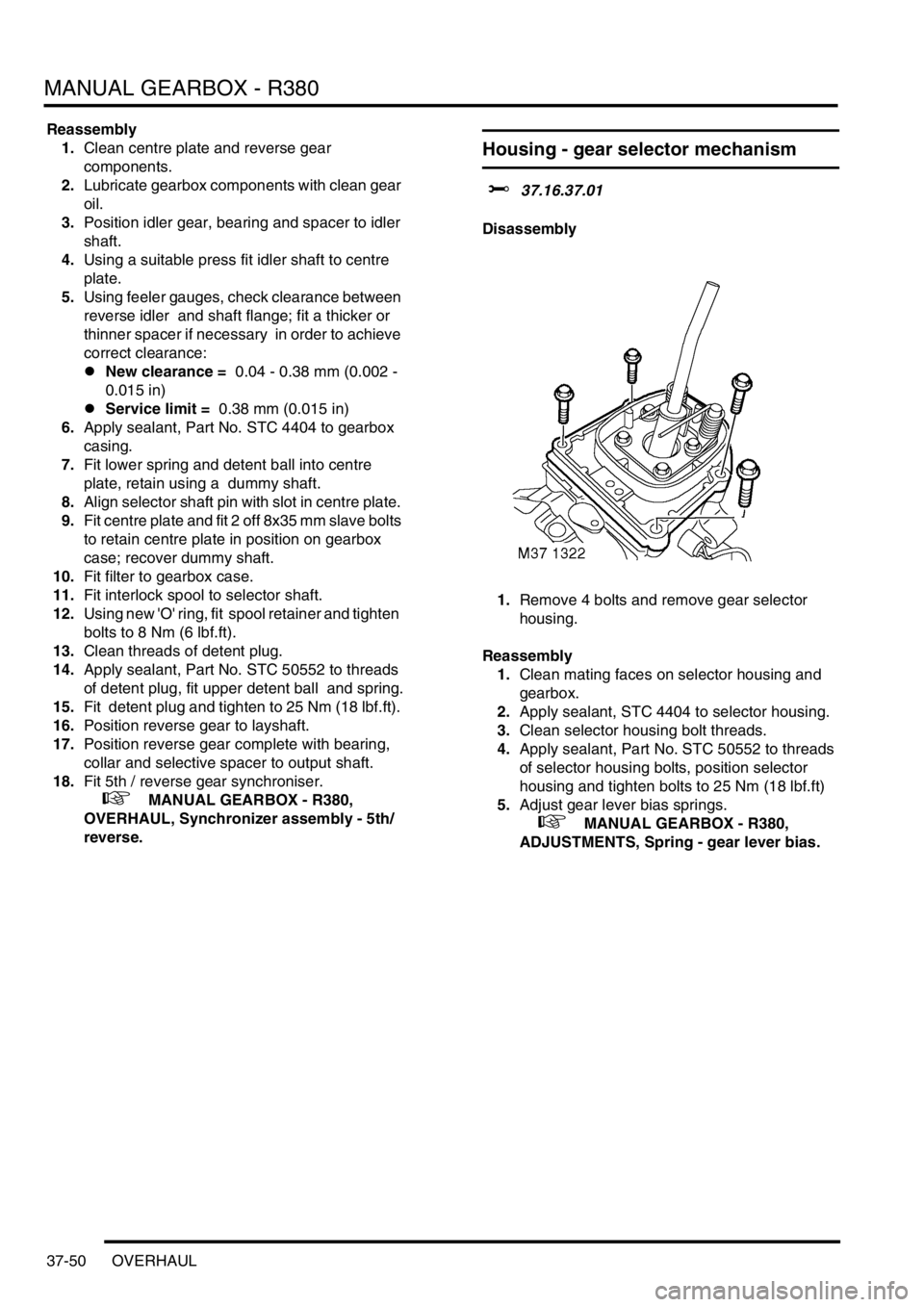
Housing - gear selector mechanism
$% 37.16.37.01
Disassembly
1.Remove 4 bolts and remove gear selector
housing.
Reassembly
1.Clean mating faces on selector housing and
gearbox.
2.Apply sealant, STC 4404 to selector housing.
3.Clean selector housing bolt threads.
4.Apply sealant, Part No. STC 50552 to threads
of selector housing bolts, position selector
housing and tighten bolts to 25 Nm (18 lbf.ft)
5.Adjust gear lever bias springs.
+ MANUAL GEARBOX - R380,
ADJUSTMENTS, Spring - gear lever bias.
Page 645 of 1529

AUTOMATIC GEARBOX - ZF4HP22 - 24
44-48 REPAIRS
Filter - oil
$% 44.24.07
Remove
1.Remove oil sump gasket.
+ AUTOMATIC GEARBOX - ZF4HP22
- 24, REPAIRS, Gasket - oil sump.
2.Remove Torx screw securing oil pick-up tube
and remove tube.
3.Remove 2 Torx screws securing filter to valve
body and discard 'O' rings. Refit
1.Clean filter and pick-up tube using a lint free
cloth.
2.Fit new 'O' rings to filter.
3.Position filter and tighten Torx screws to 8 Nm
(6 lbf.ft).
4.Position oil pick-up tube and tighten Torx
screw to 8 Nm (6 lbf.ft).
5.Fit oil sump gasket.
+ AUTOMATIC GEARBOX - ZF4HP22
- 24, REPAIRS, Gasket - oil sump.
Page 648 of 1529

AUTOMATIC GEARBOX - ZF4HP22 - 24
REPAIRS 44-51
Valve body assembly
$% 44.40.01
Remove
1.Remove gearbox oil filter.
+ AUTOMATIC GEARBOX - ZF4HP22
- 24, REPAIRS, Filter - oil.
2.Remove 2 bolts securing speed sensor
harness bracket to valve body.
3.Disconnect multiplug from gearbox housing.
4.Using a 30 mm socket, remove nut securing
multiplug connector block to gearbox housing. 5.Remove 6 long bolts securing valve body to
gearbox.
6.Remove 5 short bolts securing valve body to
gearbox.