heating LAND ROVER DISCOVERY 1999 Workshop Manual
[x] Cancel search | Manufacturer: LAND ROVER, Model Year: 1999, Model line: DISCOVERY, Model: LAND ROVER DISCOVERY 1999Pages: 1529, PDF Size: 34.8 MB
Page 5 of 1529

CONTENTS
2CONTENTS
IDENTIFICATION NUMBERS .................................................................. 05-1
Vehicle Identification Number ......................................................................................................... 05-1
Identification Number Locations ..................................................................................................... 05-3
TORQUE WRENCH SETTINGS .............................................................. 06-1
Maintenance ................................................................................................................................... 06-1
Engine Td5 ..................................................................................................................................... 06-2
Engine V8 ....................................................................................................................................... 06-4
Emission control - Td5 .................................................................................................................... 06-5
Emission control - V8 ...................................................................................................................... 06-5
Engine management system - Td5 ................................................................................................. 06-6
Engine management system - V8................................................................................................... 06-6
Cooling system ............................................................................................................................... 06-7
Manifolds and exhaust systems - Td5 ............................................................................................ 06-8
Manifolds and exhaust systems - V8 .............................................................................................. 06-8
Clutch.............................................................................................................................................. 06-9
Manual gearbox - R380 .................................................................................................................. 06-10
Transfer box - LT230SE ................................................................................................................. 06-11
Automatic gearbox - ZF4HP22 ....................................................................................................... 06-12
Propeller shafts ............................................................................................................................... 06-13
Axles ............................................................................................................................................... 06-13
Steering .......................................................................................................................................... 06-14
Front suspension ............................................................................................................................ 06-15
Rear suspension ............................................................................................................................. 06-16
Brakes............................................................................................................................................. 06-17
Restraint systems ........................................................................................................................... 06-18
Body................................................................................................................................................ 06-19
Heating and air conditioning ........................................................................................................... 06-20
Wipers and washers ....................................................................................................................... 06-20
Electrical ......................................................................................................................................... 06-21
LIFTING AND TOWING ........................................................................... 08-1
LIFTING .......................................................................................................................................... 08-1
TOWING ......................................................................................................................................... 08-2
TRANSPORTING ........................................................................................................................... 08-4
CAPACITIES, FLUIDS, LUBRICANTS AND SEALANTS ...................... 09-1
Capacities ....................................................................................................................................... 09-1
Fluids .............................................................................................................................................. 09-2
Anti-Freeze Concentration .............................................................................................................. 09-2
Lubrication ...................................................................................................................................... 09-3
Sealants .......................................................................................................................................... 09-4
Page 23 of 1529

CONTENTS
20 CONTENTS
SCREENS ................................................................................................. 76-4-1
REPAIRS
Glass/sealing rubber - tail door ..................................................................................................... 76-4-1
Windscreen ................................................................................................................................... 76-4-2
Glass - body side - rear ................................................................................................................ 76-4-4
Glass - alpine light ........................................................................................................................ 76-4-6
SEATS ....................................................................................................... 76-5-1
DESCRIPTION AND OPERATION
Electric seat component location .................................................................................................... 76-5-1
Electric seat block diagram ............................................................................................................. 76-5-2
Description - electric seats.............................................................................................................. 76-5-4
Operation - electric seats ................................................................................................................ 76-5-8
DESCRIPTION AND OPERATION
Heated seat component location .................................................................................................... 76-5-9
Heated seat block diagram (electric seats).................................................................................... 76-5-10
Description - heated seats .............................................................................................................. 76-5-11
Operation - heated seats ................................................................................................................ 76-5-13
REPAIRS
Seat - front ..................................................................................................................................... 76-5-15
Seat - third row ............................................................................................................................... 76-5-16
Seat - rear ....................................................................................................................................... 76-5-18
Bolster assembly - rear armrest ..................................................................................................... 76-5-19
Cover - cushion - front seat .......................................................................................................... 76-5-20
Heating element - cushion - front seat .......................................................................................... 76-5-21
Cover - cushion - rear seat ........................................................................................................... 76-5-22
Bladder - lumbar support .............................................................................................................. 76-5-23
Motor - fore and aft - front seat ..................................................................................................... 76-5-23
Motor - rise and fall - front seat ..................................................................................................... 76-5-24
Motor - tilt - front seat .................................................................................................................... 76-5-24
Motor - recline ................................................................................................................................. 76-5-25
Switch - electric seats .................................................................................................................... 76-5-25
Cable - rear squab latch ............................................................................................................... 76-5-26
Latch - rear seat ........................................................................................................................... 76-5-26
Cover - squab - front seat ............................................................................................................. 76-5-28
Cover - squab - RH rear seat ........................................................................................................ 76-5-31
Heating element - squab - front seat ............................................................................................ 76-5-33
Head restraint - third row seat ....................................................................................................... 76-5-33
Page 26 of 1529

CONTENTS
CONTENTS 23
BODY SEALING MATERIALS ................................................................. 77-3-1
MATERIALS AND APPLICATIONS
Materials applications ..................................................................................................................... 77-3-1
Approved materials ......................................................................................................................... 77-3-2
Application equipment..................................................................................................................... 77-3-4
CORROSION PREVENTION AND SEALING .......................................... 77-4-1
CORROSION PREVENTION
Cavity wax treatment areas and injection holes - 'A' post and sill ................................................... 77-4-1
Cavity wax treatment area and injection hole - fuel filler neck ........................................................ 77-4-2
Cavity wax treatment areas and injection holes - rear cross member ............................................ 77-4-3
Cavity wax treatment areas and injection holes - front door, rear door and tail door ...................... 77-4-4
Corrosion prevention....................................................................................................................... 77-4-6
SEALING
Body Sealing ................................................................................................................................... 77-4-9
Water leaks ..................................................................................................................................... 77-4-22
PAINTING ................................................................................................ 77-5-1
PROCEDURES
Panel preparation............................................................................................................................ 77-5-1
Paint preparation............................................................................................................................. 77-5-2
HEATING AND VENTILATION................................................................. 80-1
DESCRIPTION AND OPERATION
Heating and ventilation component layout ...................................................................................... 80-1
Fuel burning heater component layout ........................................................................................... 80-2
Description ...................................................................................................................................... 80-3
Operation ........................................................................................................................................ 80-13
REPAIRS
Heater control and fan switch ....................................................................................................... 80-15
Cables - heater control .................................................................................................................. 80-15
Servo - recirculation flap ............................................................................................................... 80-17
Switch - recirculation control ......................................................................................................... 80-18
Servo - air distribution control ........................................................................................................ 80-19
Servo - air temperature control ....................................................................................................... 80-20
Plenum Air Intake ........................................................................................................................... 80-21
Heater assembly - models without air conditioning ......................................................................... 80-22
Heater assembly - models with air conditioning .............................................................................. 80-24
Blower assembly ............................................................................................................................ 80-26
Motor - blower ............................................................................................................................. 80-27
Resistor pack - power resistor A/C ............................................................................................... 80-28
Heater matrix ................................................................................................................................ 80-29
Pipe - Heater - Feed ...................................................................................................................... 80-29
Pipe - Heater - Return .................................................................................................................... 80-30
Fuel burning heater - (FBH) - Td5................................................................................................... 80-31
Page 36 of 1529
GENERAL INFORMATION
03-1
GENERAL INFORMATION
General Precautions
Dangerous substances
Modern vehicles contain many materials and liquids
which if not handled with care can be hazardous to
both personal health and the environment.
WARNING: Many liquids and other substances
used in motor vehicles are poisonous and should
under no circumstances be consumed and
should, as far as possible, be kept from contact
with the skin. These liquids and substances
include acid, anti-freeze, asbestos, brake fluid,
fuel, windscreen washer additives, lubricants,
refrigerants and various adhesives.
Always read carefully the instructions printed on
labels or stamped on components and obey them
implicitly. Such instructions are included for
reasons of your health and personal safety.
Never disregard them.
Synthetic rubber
Many 'O' rings, seals, hoses, flexible pipes and other
similar items which appear to be natural rubber, are
in fact, made of synthetic materials called
Fluoroelastomers. Under normal operating
conditions this material is safe and does not present
a health hazard. However, if the material is damaged
by fire or excessive heating, it can break down and
produce highly corrosive Hydrofluoric acid.
Contact with Hydrofluoric acid can cause serious
burns on contact with skin. If skin contact does occur:
lRemove any contaminated clothing
immediately.
lIrrigate effected area of skin with a copious
amount of cold water or limewater for 15 to 60
minutes.
lObtain medical assistance immediately.
Should any material be in a burnt or overheated
condition, handle with extreme caution and wear
protective clothing (seamless industrial gloves,
protective apron etc.).
Decontaminate and dispose of gloves immediately
after use.Lubricating oils
Avoid excessive skin contact with used lubricating
oils and always adhere to the health protection
precautions.
WARNING: Avoid excessive skin contact with
used engine oil. Used engine oil contains
potentially harmful contaminants which may
cause skin cancer or other serious skin
disorders.
WARNING: Avoid excessive skin contact with
mineral oil. Mineral oils remove the natural fats
from the skin, leading to dryness, irritation and
dermatitis.
Health protection precautions
The following precautions should be observed at all
times.
lWear protective clothing, including impervious
gloves where practicable.
lAvoid prolonged and repeated contact with oils,
particularly used engine oils.
lDo not put oily rags in pockets.
lAvoid contaminating clothes (particularly those
next to the skin) with oil.
lOveralls must be cleaned regularly. Discard
heavily soiled clothing and oil impregnated
footwear.
lFirst aid treatment should be obtained
immediately for open cuts and wounds.
lApply barrier creams before each work period to
help prevent lubricating oil from contaminating
the skin.
lWash with soap and water to ensure all oil is
removed (proprietary skin cleansers and nail
brushes will help).
lUse moisturisers after cleaning; preparations
containing lanolin help replace the skin's natural
oils which have been removed.
lDo not use petrol/gasoline, kerosene, diesel
fuel, oil, thinners or solvents for cleaning skin.
lWhere practicable, degrease components prior
to handling.
lIf skin disorders develop, obtain medical advice
without delay.
lWear eye protection (e.g. goggles or face
shield) if there is a risk of eye contamination.
Eye wash facilities should be provided in close
vicinity of the work area.
Page 39 of 1529

GENERAL INFORMATION
03-4
Spill kits
Special materials are available to absorb a number of
different substances. They can be in granular form,
ready to use and bought in convenient containers for
storage. Disposal of used spill-absorbing material is
dealt with in 'Waste Management' section.
Land contamination
Oils, fuels and solvents etc. can contaminate any soil
that they are allowed to contact. Such materials
should never be disposed of by pouring onto soil and
every precaution must be taken to prevent spillage
reaching soil. Waste materials stored on open
ground could also leak, or have polluting substances
washed off them that would contaminate the land.
Always store these materials in suitable skips or
other similarly robust containers.
Checklist
Always adhere to the following.
lDon't pour or spill anything onto the soil or bare
ground;
ldon't store waste materials on bare ground, see
'Spillage prevention' list.
Legal compliance
Some sites may have a discharge consent for
effluent discharge to the foul drain for a car wash etc.
It is important to know what materials are allowed in
the drain and to check the results of any monitoring
carried out by the Water Company.
Where paint-spraying operations are carried out it
may be necessary to apply to the Local Authority for
an air emissions licence to operate the plant. If such
a licence is in operation, additional precautions will
be necessary to comply with the requirements, and
the results of any air quality monitoring must be
checked regularly.
Checklist
Always adhere to the following.
lKnow what legal consents and licences apply to
the operations;
lcheck that the emissions and discharges
comply with legal requirements.
Local issues
A number of environmental issues will be of
particular concern to residents and other neighbours
close to the site. The sensitivity of these issues will
depend on the proximity of the site and the layout
and amount of activity carried on at the site.
Noise is a major concern and therefore
consideration should be given to the time spent
carrying out noisy activities and the location of those
activities that can cause excessive noise. Car alarm testing, panel beating, hammering and
other such noisy activities should, whenever
possible, be carried out indoors with doors and
windows shut or as far away from houses as
possible.
Running vehicle engines may be an outside activity
which could cause nuisance to neighbours because
of both noise and smell.
Be sensitive to the time of day when these activities
are carried out and minimise the time of the noisy
operation, particularly in the early morning and late
evening.
Another local concern will be the smell from the
various materials used. Using less solvent, paint
and petrol could help prevent this annoyance.
Local residents and other business users will also be
concerned about traffic congestion, noise and
exhaust fumes, be sensitive to these concerns and
try to minimise inconvenience from deliveries,
customers and servicing operations.
Checklist
Always adhere to the following.
lIdentify where the neighbours who are likely to
be affected are situated;
lminimise noise, smells and traffic nuisance;
lprevent litter by putting waste in the correct
containers;
lhave waste skips emptied regularly.
Use of resource
Another environmental concern is the waste of
materials and energy that can occur in day to day
activities.
Electricity for heating, lighting and compressed air
uses resources and releases pollution during its
generation.
Fuel used for heating, running cars or vans and
mobile plant is another limited resource which
consumes large amounts of energy during its
extraction and refining processes.
Water has to be cleaned, piped to site and disposed
of; all of which creates more potential pollution.
Oil, spares, paint etc., have all produced pollution in
the process of manufacture and they become a
waste disposal problem if discarded.
Page 40 of 1529

GENERAL INFORMATION
03-5
Checklist
Always adhere to the following.
Electricity and heating:
lkeep doors and windows closed in the winter;
lswitch off machinery or lights when not needed;
luse energy efficient heating systems;
lswitch off computers and photocopiers when
not needed.
Fuel:
ldon't run engines unnecessarily;
lthink about whether journeys are necessary and
drive to conserve fuel.
Water:
ldon't leave taps and hose pipes running;
lmend leaks quickly, don't be wasteful.
Compressed air:
ldon't leave valves open;
lmend leaks quickly;
ldon't leave the compressor running when not
needed.
Use of environmentally damaging materials:
lcheck whether a less toxic material is available.
Handling and storage of materials:
lhave the correct facilities available for handling
liquids to prevent spillage and wastage as listed
above;
lprovide suitable locations for storage to prevent
frost damage or other deterioration.
Waste Management
One of the major ways that pollution can be reduced
is by the careful handling, storage and disposal of all
waste materials that occur on sites. Legislation
makes it illegal to dispose of waste materials other
than to licensed waste carriers and disposal sites.
This means that it is necessary to not only know what
the waste materials are, but also to have the
necessary documentation and licenses.
Handling and storage of waste
Ensure that waste materials are not poured down the
drain or onto soils. They should be stored in such a
way as to prevent the escape of the material to land,
water or air.
They must also be segregated into different types of
waste e.g. oil, metals, batteries, used vehicle
components. This will prevent any reaction between
different materials and assist in disposal.Disposal of waste
Disposal of waste materials must only be to waste
carriers who are licensed to carry those particular
waste materials and all the necessary
documentation must be completed. The waste
carrier is responsible for ensuring that the waste is
taken to the correct disposal sites.
Dispose of waste in accordance with the following
guidelines.
lFuel, hydraulic fluid, anti-freeze and oil: keep
separate and dispose of to specialist contractor.
lRefrigerant: collect in specialist equipment and
reuse.
lDetergents: safe to pour down the foul drain if
diluted.
lPaint, thinners: keep separate and dispose of
to specialist contractor.
lComponents: send back to supplier for
refurbishment, or disassemble and reuse any
suitable parts. Dispose of the remainder in
ordinary waste.
lSmall parts: reuse any suitable parts, dispose
of the remainder in ordinary waste.
lMetals: can be sold if kept separate from
general waste.
lTyres: keep separate and dispose of to
specialist contractor.
lPackaging: compact as much as possible and
dispose of in ordinary waste.
lAsbestos-containing: keep separate and
dispose of to specialist contractor.
lOily and fuel wastes (e.g. rags, used spill kit
material): keep separate and dispose of to
specialist contractor.
lAir filters: keep separate and dispose of to
specialist contractor.
lRubber/plastics: dispose of in ordinary waste.
lHoses: dispose of in ordinary waste.
lBatteries: keep separate and dispose of to
specialist contractor.
lAirbags - explosives: keep separate and
dispose of to specialist contractor.
lElectrical components: send back to supplier
for refurbishment, or disassemble and reuse
any suitable parts. Dispose of the remainder in
ordinary waste.
lElectronic components: send back to supplier
for refurbishment, or disassemble and reuse
any suitable parts. Dispose of the remainder in
ordinary waste.
lCatalysts: can be sold if kept separate from
general waste
lUsed spill-absorbing material: keep separate
and dispose of to specialist contractor.
lOffice waste: recycle paper and toner and ink
cartridges, dispose of the remainder in ordinary
waste.
Page 111 of 1529

TORQUE WRENCH SETTINGS
06-20
Heating and air conditioning
Wipers and washers
TORQUE DESCRIPTION METRIC IMPERIAL
Heater assembly16 Nm (12 lbf.ft)
Compressor bolts22 Nm (16 lbf.ft)
Blower motor19 Nm (14 lbf.ft)
Compressor to mounting bracket bolts 25 Nm (18 lbf.ft)
A/C pipes to compressor bolts 10 Nm (7 lbf.ft)
Condenser pipe bolt 5 Nm (3.7 lbf.ft)
Receiver drier to bracket bolts 5 Nm (3.7 lbf.ft)
Adaptor block to receiver drier bolt 5 Nm (3.7 lbf.ft)
Evaporator pipe bolts 5 Nm (3.7 lbf.ft)
Dual pressure switch to receiver drier 10 Nm (7 lbf.ft)
Air conditioning pipes to receiver drier bolts 5 Nm (3.7 lbf.ft)
TX valve pressure pipe union 22 Nm (16 lbf.ft)
Evaporator pipe to TXV valve 32 Nm (24 lbf.ft)
Evaporator assembly to body bolts 16 Nm (12 lbf.ft)
High and low pressure pipe, bolts 10 Nm (7 lbf.ft)
Fuel burning heater Torx bolts 25 Nm (18 lbf.ft)
TORQUE DESCRIPTION METRIC IMPERIAL
Link to motor spindle 7 Nm (5.2 lbf.ft)
Front motor assembly 2.5 Nm (1.8 lbf.ft)
Spindle nut 3 Nm (2.2 lbf.ft)
Wiper arm nut13 Nm (10 lbf.ft)
Page 132 of 1529
MAINTENANCE
PROCEDURES 10-9
Air suspension intake filter
Check
1.Check condition of filter and that filter is clean,
replace if necessary.
+ REAR SUSPENSION, REPAIRS,
Filter - intake - SLS.
Anti-freeze
Replace
1.Replace anti-freeze.
+ COOLING SYSTEM - Td5,
ADJUSTMENTS, Drain and refill.
+ COOLING SYSTEM - V8,
ADJUSTMENTS, Drain and refill.
Cooling system
Check
1.Check cooling, intercooler and heating systems
for leaks; hoses and oil pipes for security and
condition.
2.Check accessible hose clips for tightness.
3.Check coolant level, top-up if necessary.
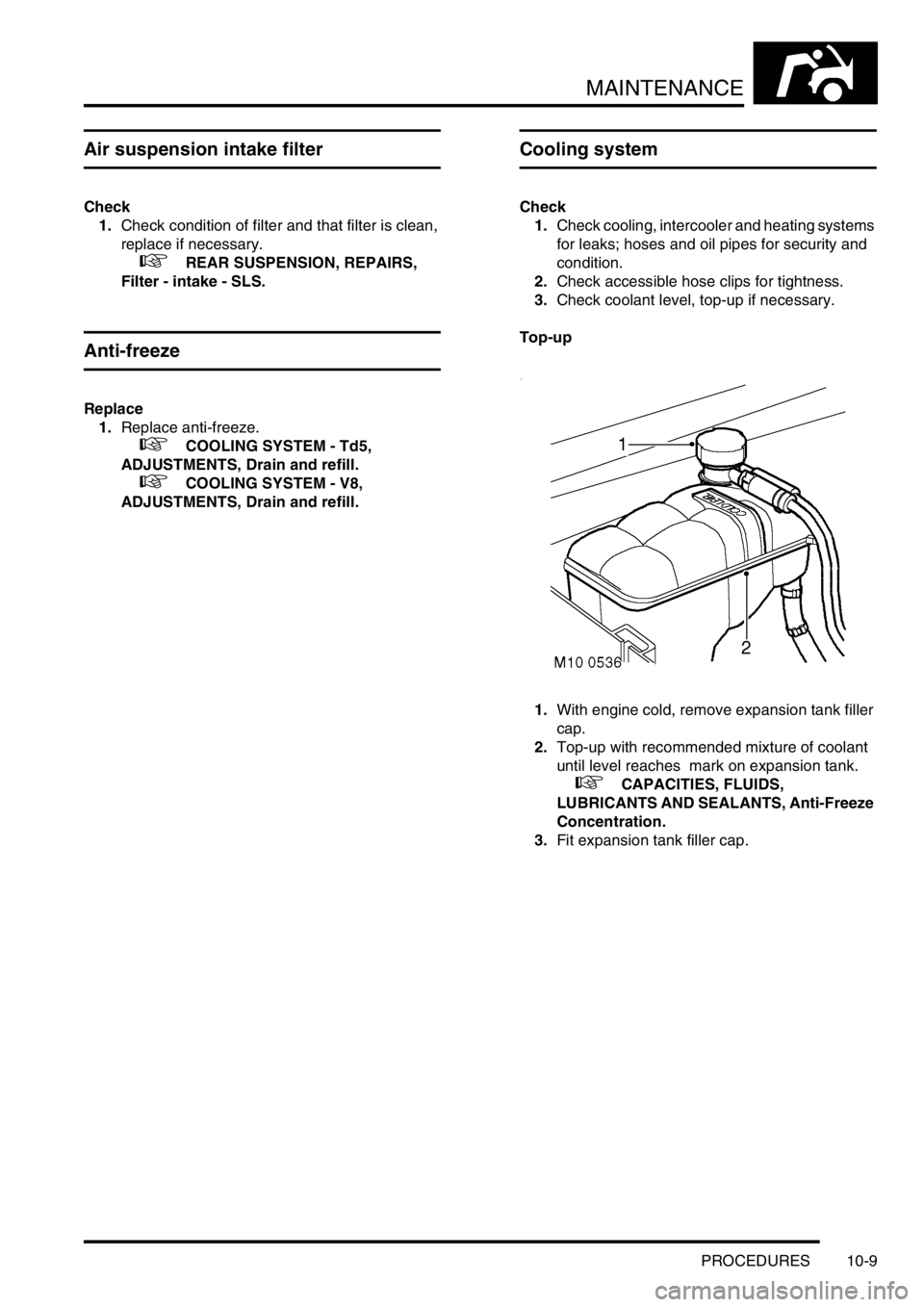
Top-up
1.With engine cold, remove expansion tank filler
cap.
2.Top-up with recommended mixture of coolant
until level reaches mark on expansion tank.
+ CAPACITIES, FLUIDS,
LUBRICANTS AND SEALANTS, Anti-Freeze
Concentration.
3.Fit expansion tank filler cap.
Page 133 of 1529

MAINTENANCE
10-10 PROCEDURES
Spark plugs - V8 engine
Replace
Take great care when fitting spark plugs not
to cross-thread plug, otherwise costly
damage to cylinder head will result. It is
essential that correct grade of spark plugs
are fitted. Incorrect grade of spark plugs
may lead to piston overheating and engine
failure. Use only approved spark plugs, use
of unapproved spark plugs may cause the
misfire detection system to malfunction.
1.Disconnect battery earth lead.
2.Noting their fitted position, disconnect ht leads
from spark plugs.
3.Remove 8 spark plugs.
4.Ensure that gap of new spark plugs is 1.0 ±
0.05 mm (0.040 ± 0.002 in).
Do not attempt to clean or adjust gaps. If a
spark plug problem exists, try substituting
defective spark plug(s) with new one(s).
CAUTION: Do not attempt to clean or adjust
spark plug gaps. If a spark plug problem
exists, try substituting the defective spark
plug with a new one.
5.Fit spark plugs and tighten to 20 Nm (15 lbf.ft).
6.Connect ht leads to spark plugs.
7.Connect battery earth lead.
Air cleaner - V8 engine
Replace
1.Replace air cleaner element.
+ ENGINE MANAGEMENT SYSTEM -
V8, REPAIRS, Element - air filter.
Clean
1.Clean the drain hole in filter casing.
Air cleaner and dump valve - diesel
engine
Replace/clean
1.Replace air cleaner element.
+ ENGINE MANAGEMENT SYSTEM -
Td5, REPAIRS, Element - air filter.
2.Remove all dirt from dump valve.
Page 223 of 1529
ENGINE - V8
12-2-68 OVERHAUL
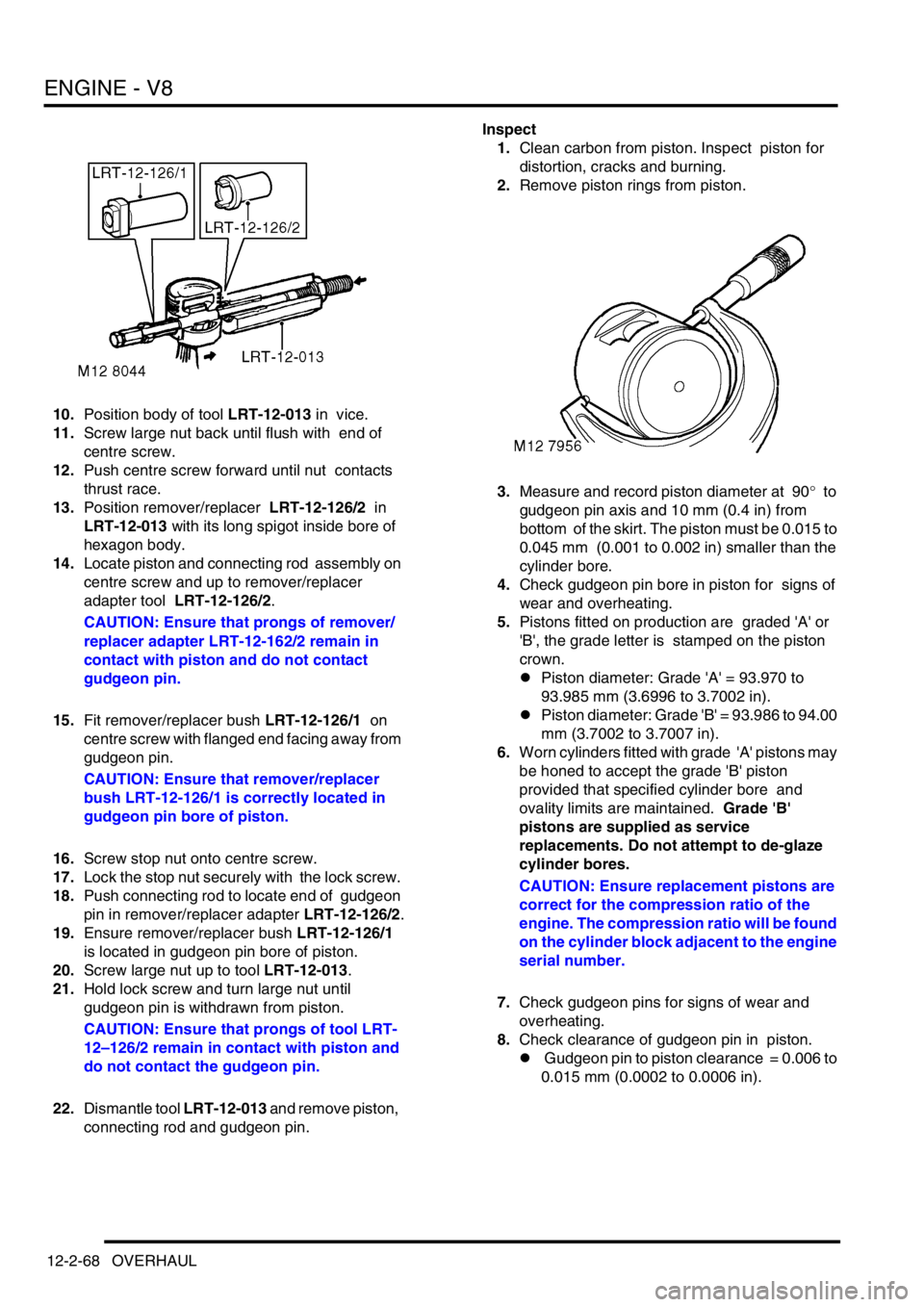
10.Position body of tool LRT-12-013 in vice.
11.Screw large nut back until flush with end of
centre screw.
12.Push centre screw forward until nut contacts
thrust race.
13.Position remover/replacer LRT-12-126/2 in
LRT-12-013 with its long spigot inside bore of
hexagon body.
14.Locate piston and connecting rod assembly on
centre screw and up to remover/replacer
adapter tool LRT-12-126/2.
CAUTION: Ensure that prongs of remover/
replacer adapter LRT-12-162/2 remain in
contact with piston and do not contact
gudgeon pin.
15.Fit remover/replacer bush LRT-12-126/1 on
centre screw with flanged end facing away from
gudgeon pin.
CAUTION: Ensure that remover/replacer
bush LRT-12-126/1 is correctly located in
gudgeon pin bore of piston.
16.Screw stop nut onto centre screw.
17.Lock the stop nut securely with the lock screw.
18.Push connecting rod to locate end of gudgeon
pin in remover/replacer adapter LRT-12-126/2.
19.Ensure remover/replacer bush LRT-12-126/1
is located in gudgeon pin bore of piston.
20.Screw large nut up to tool LRT-12-013.
21.Hold lock screw and turn large nut until
gudgeon pin is withdrawn from piston.
CAUTION: Ensure that prongs of tool LRT-
12–126/2 remain in contact with piston and
do not contact the gudgeon pin.
22.Dismantle tool LRT-12-013 and remove piston,
connecting rod and gudgeon pin. Inspect
1.Clean carbon from piston. Inspect piston for
distortion, cracks and burning.
2.Remove piston rings from piston.
3.Measure and record piston diameter at 90° to
gudgeon pin axis and 10 mm (0.4 in) from
bottom of the skirt. The piston must be 0.015 to
0.045 mm (0.001 to 0.002 in) smaller than the
cylinder bore.
4.Check gudgeon pin bore in piston for signs of
wear and overheating.
5.Pistons fitted on production are graded 'A' or
'B', the grade letter is stamped on the piston
crown.
lPiston diameter: Grade 'A' = 93.970 to
93.985 mm (3.6996 to 3.7002 in).
lPiston diameter: Grade 'B' = 93.986 to 94.00
mm (3.7002 to 3.7007 in).
6.Worn cylinders fitted with grade 'A' pistons may
be honed to accept the grade 'B' piston
provided that specified cylinder bore and
ovality limits are maintained. Grade 'B'
pistons are supplied as service
replacements. Do not attempt to de-glaze
cylinder bores.
CAUTION: Ensure replacement pistons are
correct for the compression ratio of the
engine. The compression ratio will be found
on the cylinder block adjacent to the engine
serial number.
7.Check gudgeon pins for signs of wear and
overheating.
8.Check clearance of gudgeon pin in piston.
l Gudgeon pin to piston clearance = 0.006 to
0.015 mm (0.0002 to 0.0006 in).