instrument cluster LAND ROVER DISCOVERY 1999 Workshop Manual
[x] Cancel search | Manufacturer: LAND ROVER, Model Year: 1999, Model line: DISCOVERY, Model: LAND ROVER DISCOVERY 1999Pages: 1529, PDF Size: 34.8 MB
Page 304 of 1529

ENGINE MANAGEMENT SYSTEM - V8
DESCRIPTION AND OPERATION 18-2-5
1Engine control module
2Crankshaft speed and position sensor
3Camshaft position sensor
4Engine coolant temperature sensor
5Mass air flow/ inlet air temperature sensor
6Throttle position sensor
7Heated oxygen sensors
8Fuel injectors
9Idle air control valve
10Fuel pump relay
11EVAP canister
12EVAP canister vent valve
13EVAP canister purge valve
14Fuel tank pressure sensor15Ignition coils
16Knock sensor
17Spark plugs
18High/ Low ratio switch
19Malfunction indication lamp
20Diagnostic connector
21Air temperature control clutch relay
22Air temperature control cooling fan relay
23ATC ECU
24CAN link to EAT
25SLABS ECU
26BCU
27Instrument cluster
28Thermostat monitoring sensor (where fitted)
Page 306 of 1529

ENGINE MANAGEMENT SYSTEM - V8
DESCRIPTION AND OPERATION 18-2-7
The ECM controls the following outputs:
lFuel injectors (1 per cylinder).
lIgnition coils/ high tension leads/ spark plugs.
lFuel pump relay.
lIdle air control valve.
lHeated oxygen sensors.
lEVAP canister purge valve.
lEVAP canister vent solenoid (CVS) valve (where fitted).
lMalfunction Indicator Lamp (MIL)/ service engine soon lamp (where fitted).
lHill descent control (via SLABS interface).
lEVAP system fuel leak detection pump (where fitted)
lSecondary air injection pump (where fitted)
The ECM also interfaces with the following:
lDiagnostics via diagnostic connector with TestBook.
lController Area Network (CAN) link to EAT ECU.
lAir conditioning system.
lSelf Levelling & Anti-lock Braking System (SLABS) ECU.
lImmobilisation system via the body control unit (BCU).
lInstrument cluster.
lCruise control ECU
lActive Cornering Enhancement (ACE) ECU
Page 317 of 1529
ENGINE MANAGEMENT SYSTEM - V8
18-2-18 DESCRIPTION AND OPERATION
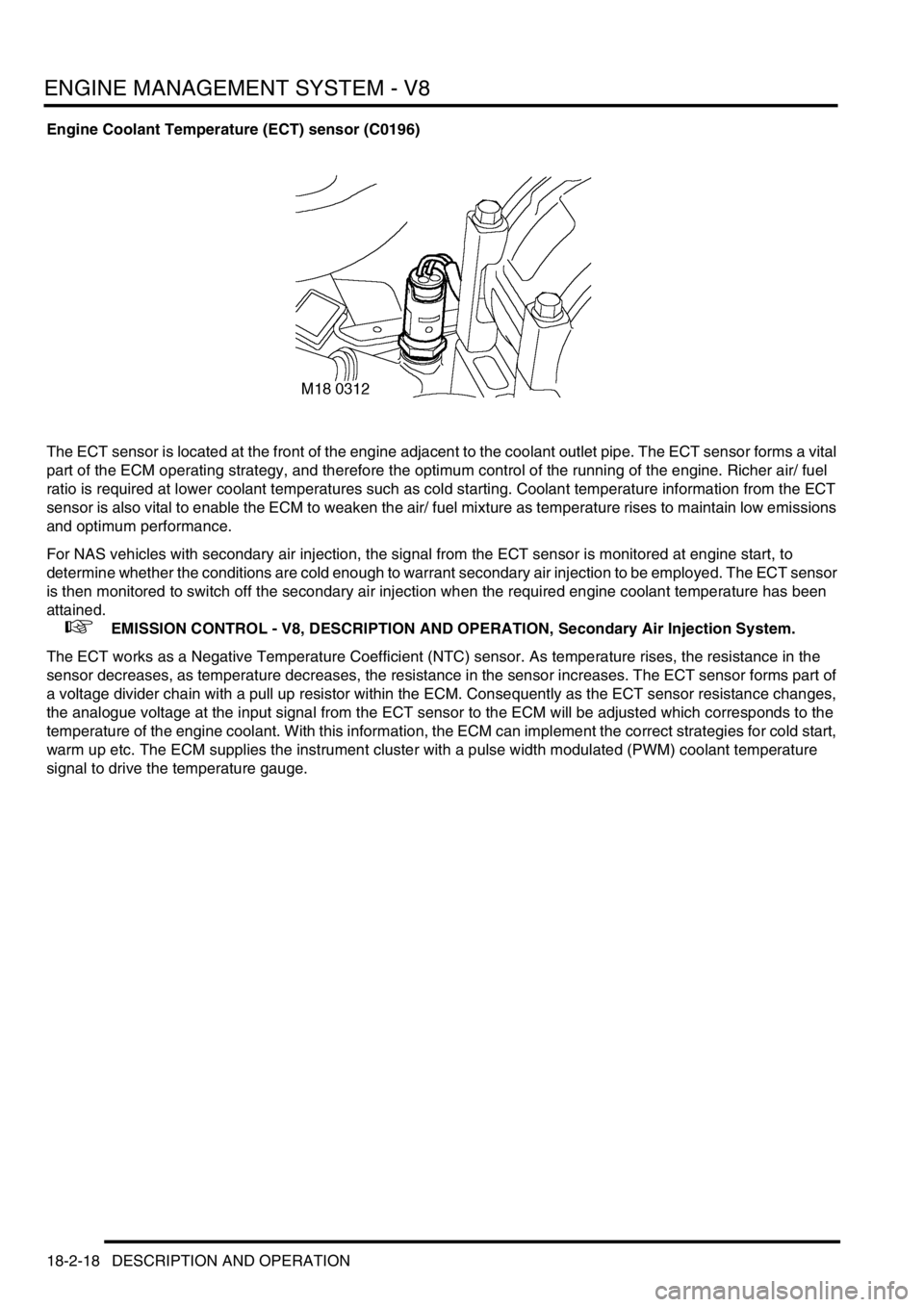
Engine Coolant Temperature (ECT) sensor (C0196)
The ECT sensor is located at the front of the engine adjacent to the coolant outlet pipe. The ECT sensor forms a vital
part of the ECM operating strategy, and therefore the optimum control of the running of the engine. Richer air/ fuel
ratio is required at lower coolant temperatures such as cold starting. Coolant temperature information from the ECT
sensor is also vital to enable the ECM to weaken the air/ fuel mixture as temperature rises to maintain low emissions
and optimum performance.
For NAS vehicles with secondary air injection, the signal from the ECT sensor is monitored at engine start, to
determine whether the conditions are cold enough to warrant secondary air injection to be employed. The ECT sensor
is then monitored to switch off the secondary air injection when the required engine coolant temperature has been
attained.
+ EMISSION CONTROL - V8, DESCRIPTION AND OPERATION, Secondary Air Injection System.
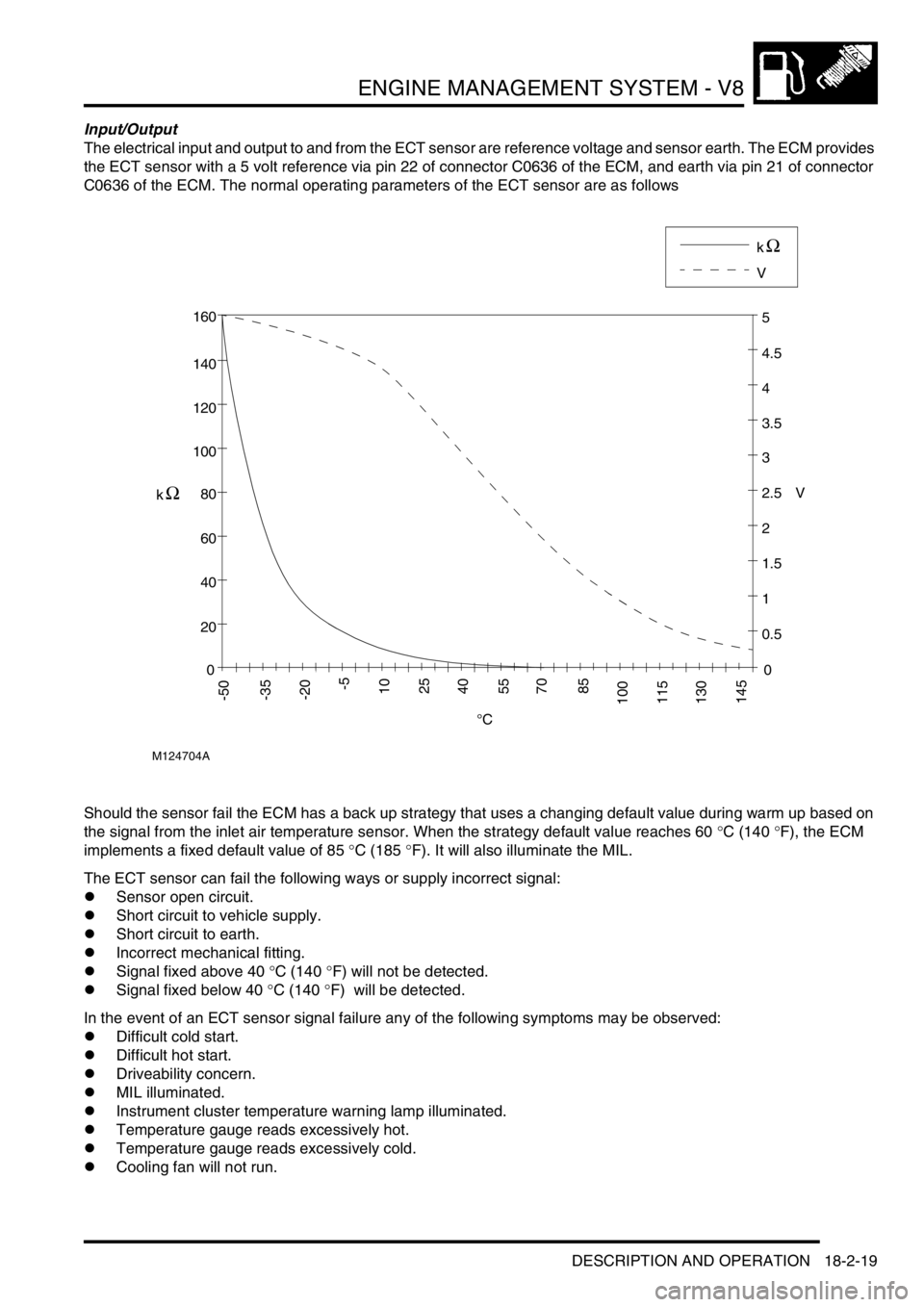
The ECT works as a Negative Temperature Coefficient (NTC) sensor. As temperature rises, the resistance in the
sensor decreases, as temperature decreases, the resistance in the sensor increases. The ECT sensor forms part of
a voltage divider chain with a pull up resistor within the ECM. Consequently as the ECT sensor resistance changes,
the analogue voltage at the input signal from the ECT sensor to the ECM will be adjusted which corresponds to the
temperature of the engine coolant. With this information, the ECM can implement the correct strategies for cold start,
warm up etc. The ECM supplies the instrument cluster with a pulse width modulated (PWM) coolant temperature
signal to drive the temperature gauge.
Page 318 of 1529
ENGINE MANAGEMENT SYSTEM - V8
DESCRIPTION AND OPERATION 18-2-19
Input/Output
The electrical input and output to and from the ECT sensor are reference voltage and sensor earth. The ECM provides
the ECT sensor with a 5 volt reference via pin 22 of connector C0636 of the ECM, and earth via pin 21 of connector
C0636 of the ECM. The normal operating parameters of the ECT sensor are as follows
Should the sensor fail the ECM has a back up strategy that uses a changing default value during warm up based on
the signal from the inlet air temperature sensor. When the strategy default value reaches 60 °C (140 °F), the ECM
implements a fixed default value of 85 °C (185 °F). It will also illuminate the MIL.
The ECT sensor can fail the following ways or supply incorrect signal:
lSensor open circuit.
lShort circuit to vehicle supply.
lShort circuit to earth.
lIncorrect mechanical fitting.
lSignal fixed above 40 °C (140 °F) will not be detected.
lSignal fixed below 40 °C (140 °F) will be detected.
In the event of an ECT sensor signal failure any of the following symptoms may be observed:
lDifficult cold start.
lDifficult hot start.
lDriveability concern.
lMIL illuminated.
lInstrument cluster temperature warning lamp illuminated.
lTemperature gauge reads excessively hot.
lTemperature gauge reads excessively cold.
lCooling fan will not run.
M124704A
0
20
40
60
80
100
120
140
160
0
0.5
1
1.5
2
2.5
3
3.5
4
4.5
5
VkΩ
kΩ
V
°C
145-50-35-20-5102540557085100115130
Page 344 of 1529

ENGINE MANAGEMENT SYSTEM - V8
DESCRIPTION AND OPERATION 18-2-45
Malfunction Indicator Lamp (MIL)/ service engine soon warning lamp
The MIL/ service engine soon warning lamp is located in the instrument cluster. It illuminates to alert the driver to
system malfunctions. Service engine soon warning lamp is the name for this warning lamp in NAS only, it is called
MIL in all other markets.
During ignition a self-test function of the lamp is carried out. The lamp will illuminate for 3 seconds then it will
extinguish if no faults exist.
+ INSTRUMENTS, DESCRIPTION AND OPERATION, Description.
Input/Output
The MIL is supplied with battery voltage from the instrument cluster. When the ECM detects a fault, it provides an
earth path to illuminate the MIL. Output to the MIL is via pin 20 of connector C0637 of the ECM.
Air Temperature Control (ATC) request
The ATC request comes via the ATC switch located in the facia panel. When the driver operates the switch it acts as
a request from the ATC ECU to engage the ATC clutch to drive the system.
During periods of high driver demand such as hard acceleration or maximum rev/min the ATC clutch will be disabled
for a short time. This is to reduce the load on the engine.
+ AIR CONDITIONING, DESCRIPTION AND OPERATION, Description.
Page 356 of 1529

ENGINE MANAGEMENT SYSTEM - V8
DESCRIPTION AND OPERATION 18-2-57
Low fuel level signal
When the fuel level in the fuel tank becomes low enough to illuminate the low fuel level warning lamp in the instrument
cluster, the instrument cluster generates a low fuel level signal. If the low fuel level signal is present during the ECM
misfire detection function the ECM can use it to check for a 'false misfire'.
Conditions
The fuel sender generates the low fuel level signal when the fuel sender resistance is greater than 158 ± 8 ohms.
Function
The illumination of the low fuel level warning lamp in the instrument cluster triggers the low fuel level signal to be sent
to the ECM. This signal is processed via pin 8 of connector C0637 of the ECM.
Should a misfire occur while the fuel level is low, the following fault code may be evident and can be retrieved by
TestBook.
Coolant temperature gauge signal
The ECM controls the temperature gauge in the instrument cluster. The ECM sends a coolant temperature signal to
the temperature gauge in the instrument cluster in the form of a PWM square wave signal.
The frequency of the signal determines the level of the temperature gauge.
Conditions
The ECM operates the PWM signal under the following parameters:
l-40 °C (-40 °F) = a pulse width of 768 µs.
l140 °C (284 °F) = a pulse width of 4848 µs.
Function
The coolant temperature signal is an output from the ECM to the instrument cluster. The coolant temperature signal
is generated via pin 44 of connector C0636 of the ECM.
The coolant temperature signal can fail in the following ways:
lWiring short circuit to vehicle supply.
lWiring short circuit to vehicle earth.
lWiring open circuit.
In the event of a coolant temperature signal failure any of the following symptoms may be observed:
lCoolant temperature gauge will read cold at all times.
lCoolant temperature warning lamp remains on at all times.
Controller Area Network (CAN) system
The controller area network (CAN) system is a high speed serial interface between the ECM and the Electronic
Automatic Transmission (EAT) ECU. The CAN system uses a 'data bus' to transmit information messages between
the ECM and the EAT ECU. Because there are only two components in this CAN system, one will transmit information
messages and the other will receive information messages, and vice-versa.
P Code J2012 Description Land Rover Description
P1319 Misfire detected at low fuel level Misfire detected with low fuel level
Page 910 of 1529
RESTRAINT SYSTEMS
DESCRIPTION AND OPERATION 75-7
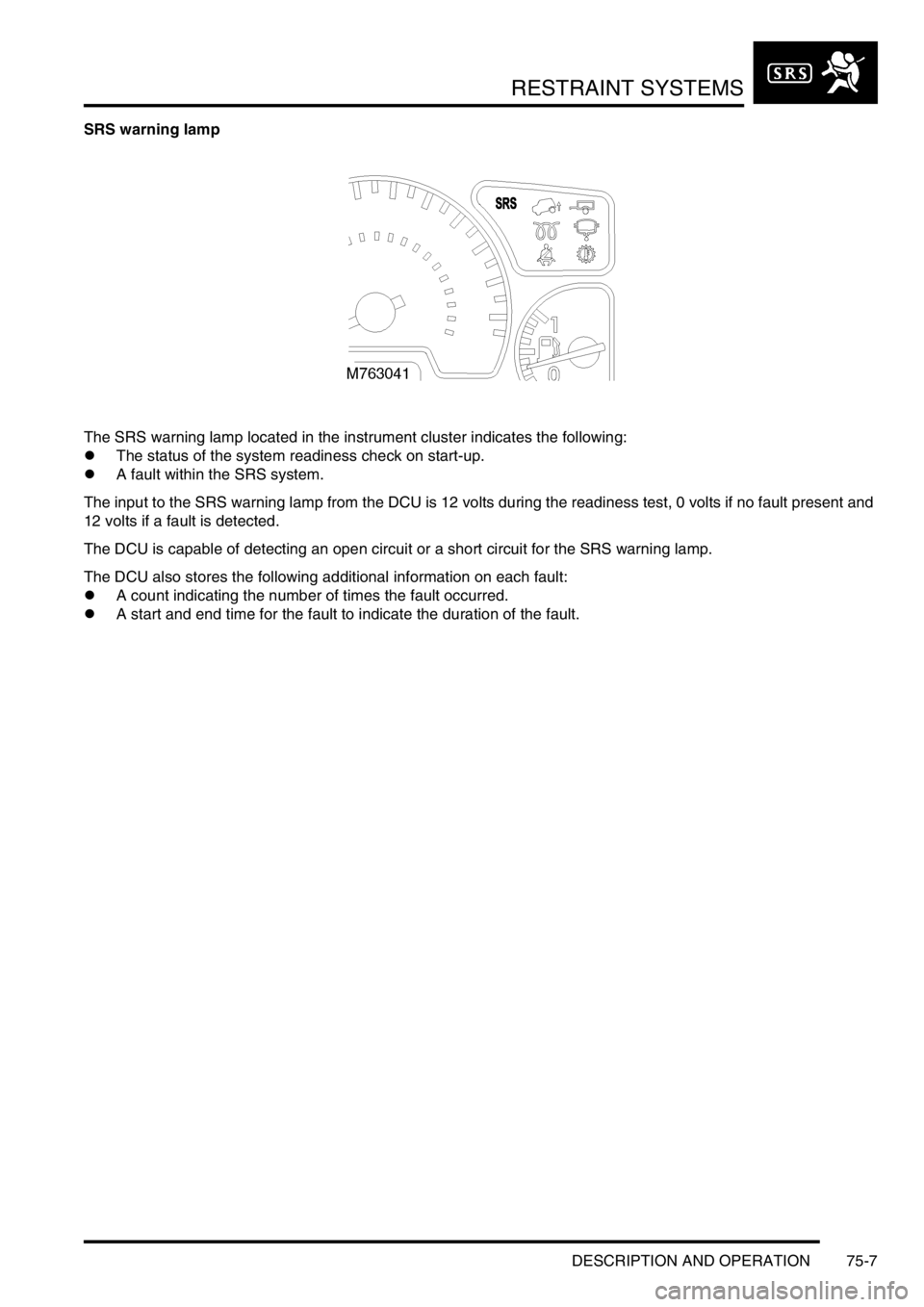
SRS warning lamp
The SRS warning lamp located in the instrument cluster indicates the following:
lThe status of the system readiness check on start-up.
lA fault within the SRS system.
The input to the SRS warning lamp from the DCU is 12 volts during the readiness test, 0 volts if no fault present and
12 volts if a fault is detected.
The DCU is capable of detecting an open circuit or a short circuit for the SRS warning lamp.
The DCU also stores the following additional information on each fault:
lA count indicating the number of times the fault occurred.
lA start and end time for the fault to indicate the duration of the fault.
Page 911 of 1529
RESTRAINT SYSTEMS
75-8 DESCRIPTION AND OPERATION
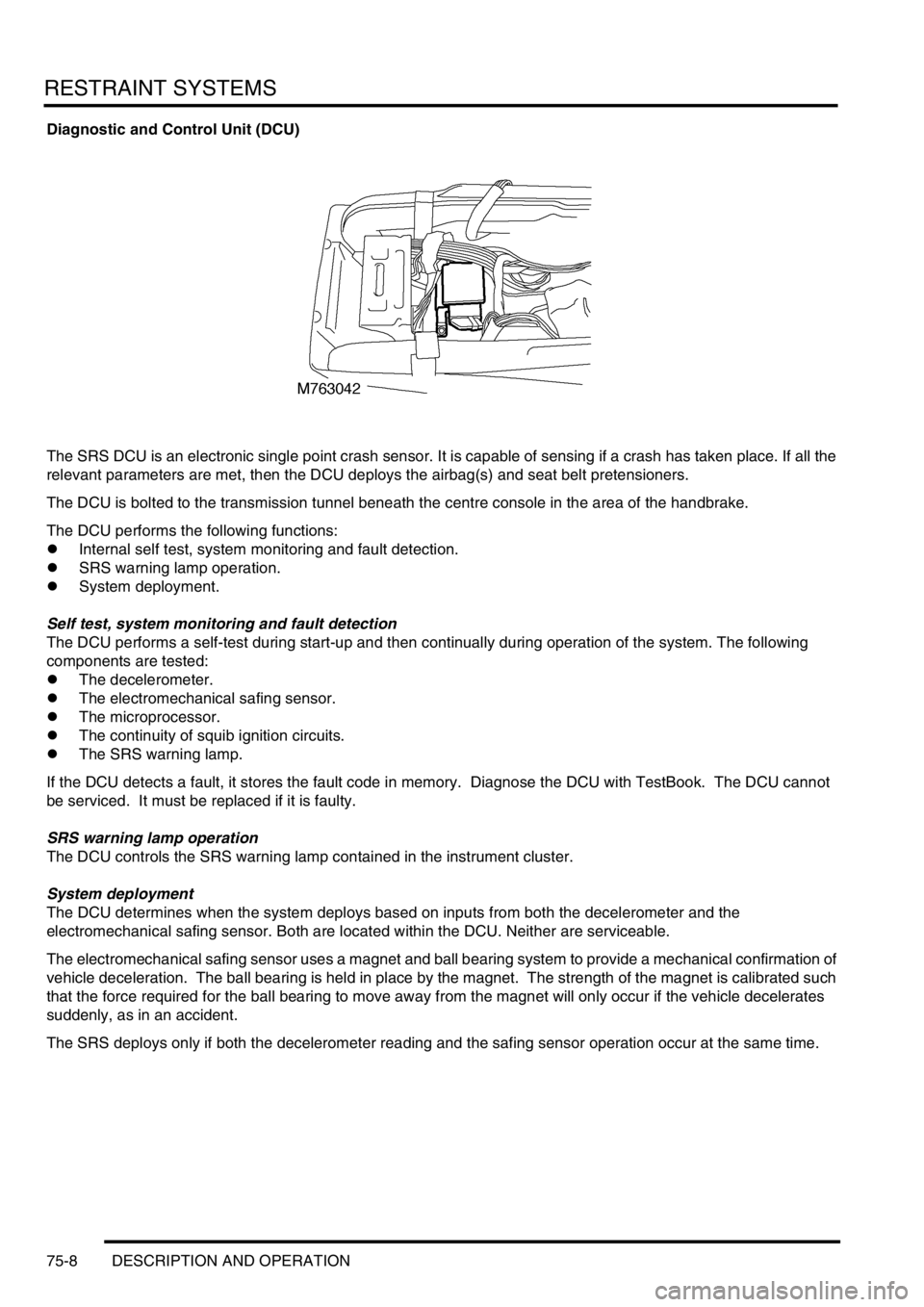
Diagnostic and Control Unit (DCU)
The SRS DCU is an electronic single point crash sensor. It is capable of sensing if a crash has taken place. If all the
relevant parameters are met, then the DCU deploys the airbag(s) and seat belt pretensioners.
The DCU is bolted to the transmission tunnel beneath the centre console in the area of the handbrake.
The DCU performs the following functions:
lInternal self test, system monitoring and fault detection.
lSRS warning lamp operation.
lSystem deployment.
Self test, system monitoring and fault detection
The DCU performs a self-test during start-up and then continually during operation of the system. The following
components are tested:
lThe decelerometer.
lThe electromechanical safing sensor.
lThe microprocessor.
lThe continuity of squib ignition circuits.
lThe SRS warning lamp.
If the DCU detects a fault, it stores the fault code in memory. Diagnose the DCU with TestBook. The DCU cannot
be serviced. It must be replaced if it is faulty.
SRS warning lamp operation
The DCU controls the SRS warning lamp contained in the instrument cluster.
System deployment
The DCU determines when the system deploys based on inputs from both the decelerometer and the
electromechanical safing sensor. Both are located within the DCU. Neither are serviceable.
The electromechanical safing sensor uses a magnet and ball bearing system to provide a mechanical confirmation of
vehicle deceleration. The ball bearing is held in place by the magnet. The strength of the magnet is calibrated such
that the force required for the ball bearing to move away from the magnet will only occur if the vehicle decelerates
suddenly, as in an accident.
The SRS deploys only if both the decelerometer reading and the safing sensor operation occur at the same time.
Page 912 of 1529
RESTRAINT SYSTEMS
DESCRIPTION AND OPERATION 75-9
Operation - SRS
The diagnostic and control unit (DCU) controls the SRS system. The DCU is located beneath the centre console close
to the handbrake area. The DCU contains both an electronic deceleration sensor as well as an electromechanical
safing sensor. When the electronic deceleration sensor within the DCU detects rapid deceleration of the vehicle, it
compares the deceleration rate with stored values in its' memory. If the deceleration rate exceeds the stored value
and the electromechanical safing sensor triggers, the DCU deploys the airbag and the seat belt pretensioners. The
DCU will not deploy the airbags and seat belt pretensioners unless both sensors trigger.
The SRS has diagnostic capabilities through TestBook. In the event that a fault is detected, the DCU alerts the driver
by illuminating a warning lamp in the instrument cluster.
The DCU controls the following:
lSRS warning lamp.
lDrivers airbag module.
lPassenger airbag module (where fitted).
lDriver seat belt pretensioner.
lPassenger seat belt pretensioner.
WARNING: The integrity of the SRS system are critical for safety reasons. Ensure the following precautions
are always adhered to:
lNever install used SRS components from another vehicle or attempt to repair an SRS component.
lWhen repairing an SRS system only use genuine new parts.
lNever apply electrical power to an SRS component unless instructed to do so as part of an approved test
procedure.
lSpecial Torx bolts are necessary for installing the airbag module - do not use other bolts. Ensure bolts
are tightened to the correct torque.
lAlways use new fixings when replacing an SRS component.
lEnsure the SRS Diagnostic Control Unit (DCU) is always installed correctly. There must not be any gap
between the DCU and the bracket to which it is mounted. An incorrectly mounted DCU could cause the
system to malfunction.
System deployment
The airbag and seat belt pretensioners deploy to protect the front seat occupants when the DCU senses a rapid
vehicle deceleration. The system deploys when the following conditions are met:
lThe ignition switch is on.
lThe vehicle decelerates beyond a threshold defined within the DCU.
lThe electromechanical safing sensor within the DCU triggers.
When all of the above conditions are met, the DCU deploys the airbag(s) and seat belt pretensioners. If the above
conditions are not met, the DCU will not deploy the system.
Component replacement policy
After an impact which deploys the airbags and pretensioners, the following components must be renewed:
lDCU.
lDriver and passenger airbag modules.
lDriver and passenger buckle pretensioners.
lRotary coupler.
lFlyleads (where applicable) connecting airbags and pre-tensioners to SRS harness
SRS warning lamp
The SRS warning lamp illuminates for 5 seconds during system readiness check on starting the engine. The SRS
warning lamp extinguishes for one second after the system readiness check is performed. If a fault is present the
warning lamp then illuminates continuously. If no fault is present, the SRS warning lamp remains extinguished. If a
system fault occurs in excess of two seconds after the readiness check has been completed, the SRS warning lamp
illuminates for that ignition cycle. It remains illuminated for a minimum of 12 seconds ± 4 seconds for all fault
conditions.
The SRS warning lamp will only illuminate for low voltage concerns while the low voltage condition is present. If the
low voltage condition is corrected, the SRS warning lamp extinguishes and the fault is recorded in the DCU's memory.
Page 1339 of 1529

ALARM SYSTEM AND HORN
86-4-16 DESCRIPTION AND OPERATION
Anti-theft status LED
A Light Emitting Diode (LED) situated in the instrument cluster indicates the condition of the anti-theft system and acts
as a warning to potential thieves that the alarm system is activated.
Input/Output
The LED has a dedicated signal from the BCU to indicate the status of the following:
lAlarm armed: The LED flashes at 10 Hz with a 50:50 duty cycle for 10 seconds, after which the LED flashes 50
ms on, 2 seconds off until the state of the system changes.
lEngine immobilised: If the engine is immobilised and the ignition is on, the LED is illuminated continuously. If the
engine is immobilised and the ignition is off, the LED flashes 50 ms on, 2 seconds off.
lAlarm tampered: If the alarm has been triggered, the LED flashes at 10 Hz with a 50:50 duty cycle.
lHandset battery low indicator: If the handset battery is low, the driver's door is open and the ignition is switched
off, the LED flashes two pulses of 50 ms on, 50 ms off, every 10 seconds.