fuel LAND ROVER DISCOVERY 2002 Workshop Manual
[x] Cancel search | Manufacturer: LAND ROVER, Model Year: 2002, Model line: DISCOVERY, Model: LAND ROVER DISCOVERY 2002Pages: 1672, PDF Size: 46.1 MB
Page 415 of 1672
ENGINE MANAGEMENT SYSTEM - TD5
18-1-22 DESCRIPTION AND OPERATION
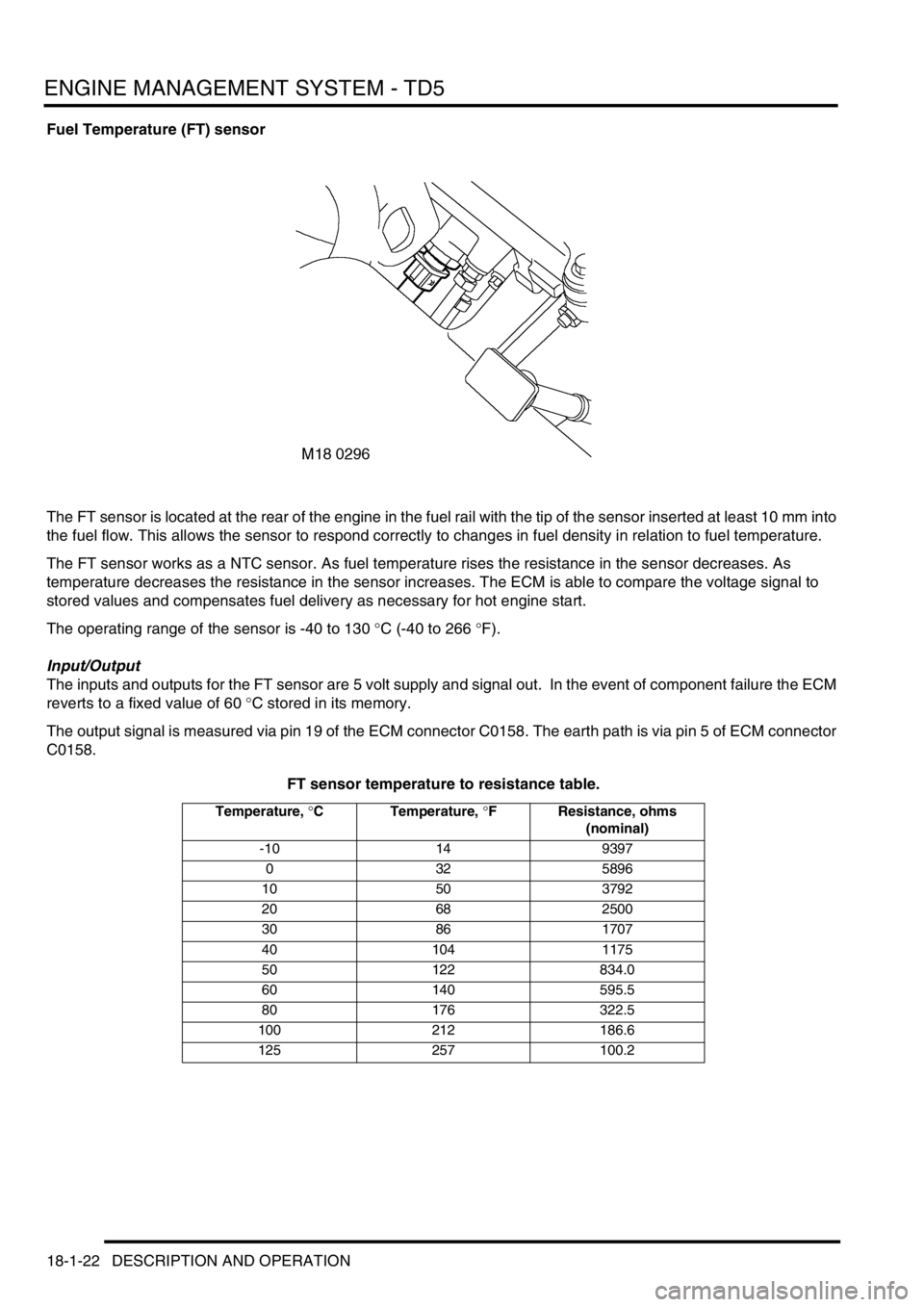
Fuel Temperature (FT) sensor
The FT sensor is located at the rear of the engine in the fuel rail with the tip of the sensor inserted at least 10 mm into
the fuel flow. This allows the sensor to respond correctly to changes in fuel density in relation to fuel temperature.
The FT sensor works as a NTC sensor. As fuel temperature rises the resistance in the sensor decreases. As
temperature decreases the resistance in the sensor increases. The ECM is able to compare the voltage signal to
stored values and compensates fuel delivery as necessary for hot engine start.
The operating range of the sensor is -40 to 130
°C (-40 to 266 °F).
Input/Output
The inputs and outputs for the FT sensor are 5 volt supply and signal out. In the event of component failure the ECM
reverts to a fixed value of 60
°C stored in its memory.
The output signal is measured via pin 19 of the ECM connector C0158. The earth path is via pin 5 of ECM connector
C0158.
FT sensor temperature to resistance table.
Temperature, °C Temperature, °F Resistance, ohms
(nominal)
-10 14 9397
0325896
10 50 3792
20 68 2500
30 86 1707
40 104 1175
50 122 834.0
60 140 595.5
80 176 322.5
100 212 186.6
125 257 100.2
Page 417 of 1672
ENGINE MANAGEMENT SYSTEM - TD5
18-1-24 DESCRIPTION AND OPERATION
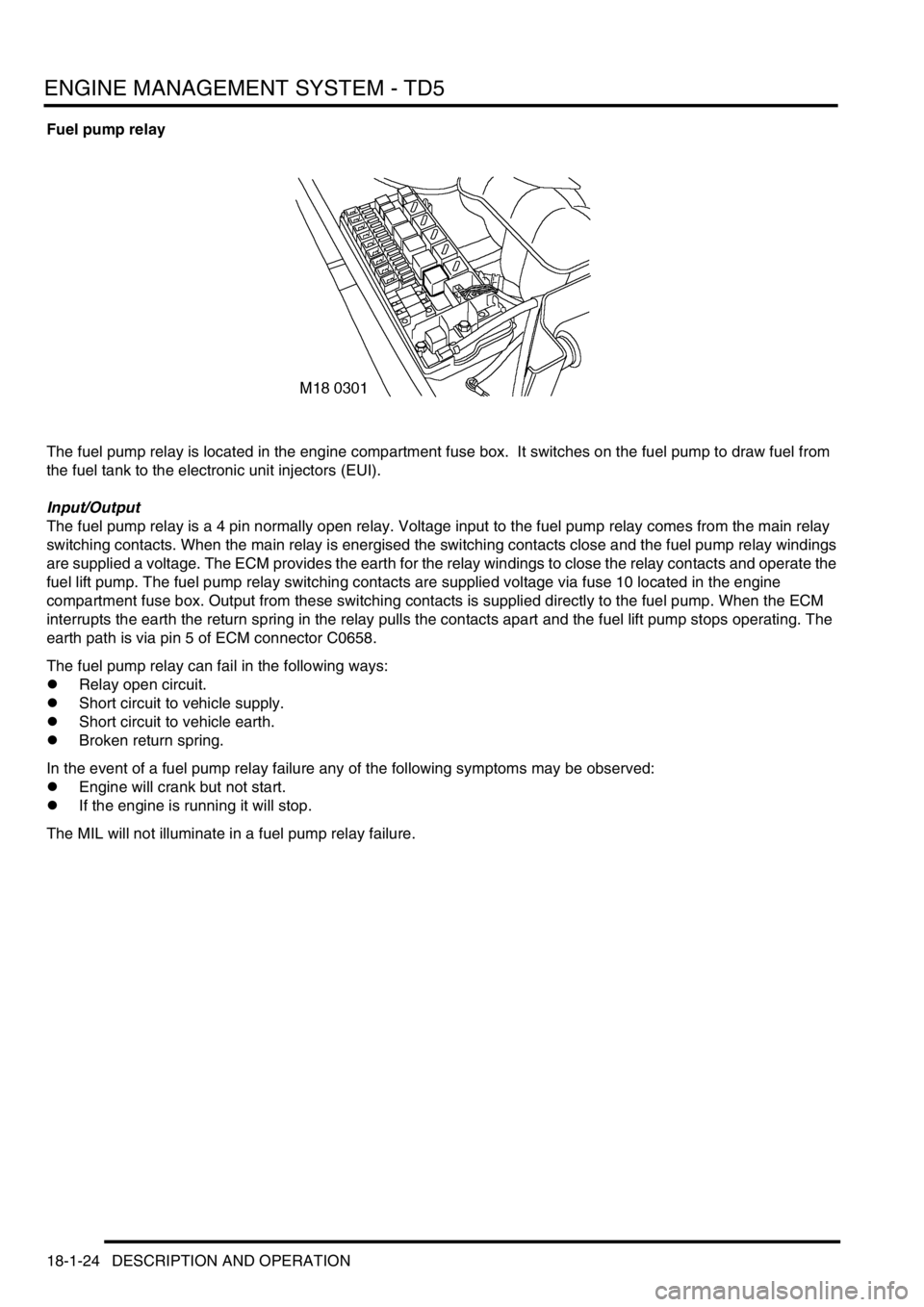
Fuel pump relay
The fuel pump relay is located in the engine compartment fuse box. It switches on the fuel pump to draw fuel from
the fuel tank to the electronic unit injectors (EUI).
Input/Output
The fuel pump relay is a 4 pin normally open relay. Voltage input to the fuel pump relay comes from the main relay
switching contacts. When the main relay is energised the switching contacts close and the fuel pump relay windings
are supplied a voltage. The ECM provides the earth for the relay windings to close the relay contacts and operate the
fuel lift pump. The fuel pump relay switching contacts are supplied voltage via fuse 10 located in the engine
compartment fuse box. Output from these switching contacts is supplied directly to the fuel pump. When the ECM
interrupts the earth the return spring in the relay pulls the contacts apart and the fuel lift pump stops operating. The
earth path is via pin 5 of ECM connector C0658.
The fuel pump relay can fail in the following ways:
lRelay open circuit.
lShort circuit to vehicle supply.
lShort circuit to vehicle earth.
lBroken return spring.
In the event of a fuel pump relay failure any of the following symptoms may be observed:
lEngine will crank but not start.
lIf the engine is running it will stop.
The MIL will not illuminate in a fuel pump relay failure.
Page 418 of 1672
ENGINE MANAGEMENT SYSTEM - TD5
DESCRIPTION AND OPERATION 18-1-25
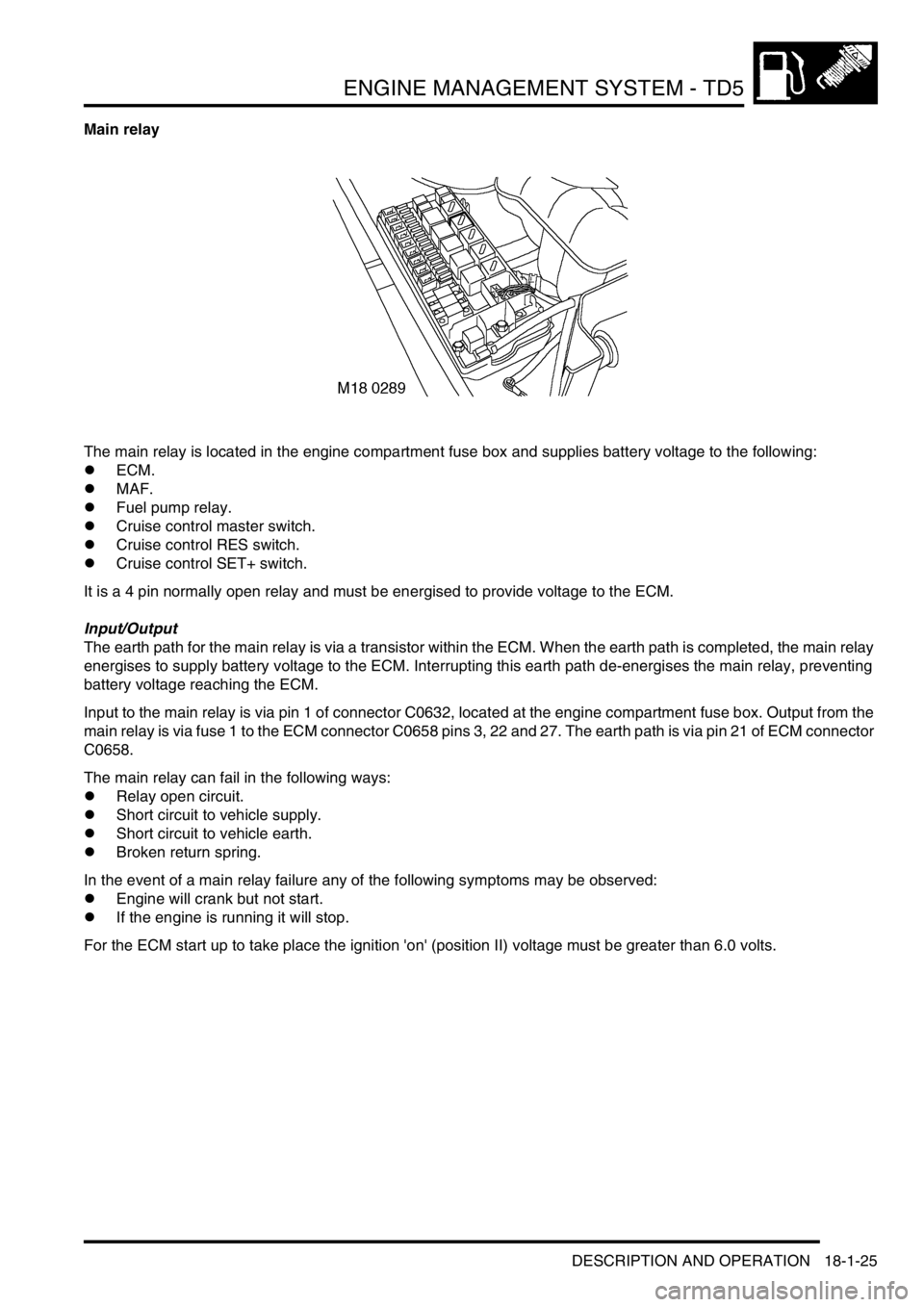
Main relay
The main relay is located in the engine compartment fuse box and supplies battery voltage to the following:
lECM.
lMAF.
lFuel pump relay.
lCruise control master switch.
lCruise control RES switch.
lCruise control SET+ switch.
It is a 4 pin normally open relay and must be energised to provide voltage to the ECM.
Input/Output
The earth path for the main relay is via a transistor within the ECM. When the earth path is completed, the main relay
energises to supply battery voltage to the ECM. Interrupting this earth path de-energises the main relay, preventing
battery voltage reaching the ECM.
Input to the main relay is via pin 1 of connector C0632, located at the engine compartment fuse box. Output from the
main relay is via fuse 1 to the ECM connector C0658 pins 3, 22 and 27. The earth path is via pin 21 of ECM connector
C0658.
The main relay can fail in the following ways:
lRelay open circuit.
lShort circuit to vehicle supply.
lShort circuit to vehicle earth.
lBroken return spring.
In the event of a main relay failure any of the following symptoms may be observed:
lEngine will crank but not start.
lIf the engine is running it will stop.
For the ECM start up to take place the ignition 'on' (position II) voltage must be greater than 6.0 volts.
Page 419 of 1672
ENGINE MANAGEMENT SYSTEM - TD5
18-1-26 DESCRIPTION AND OPERATION
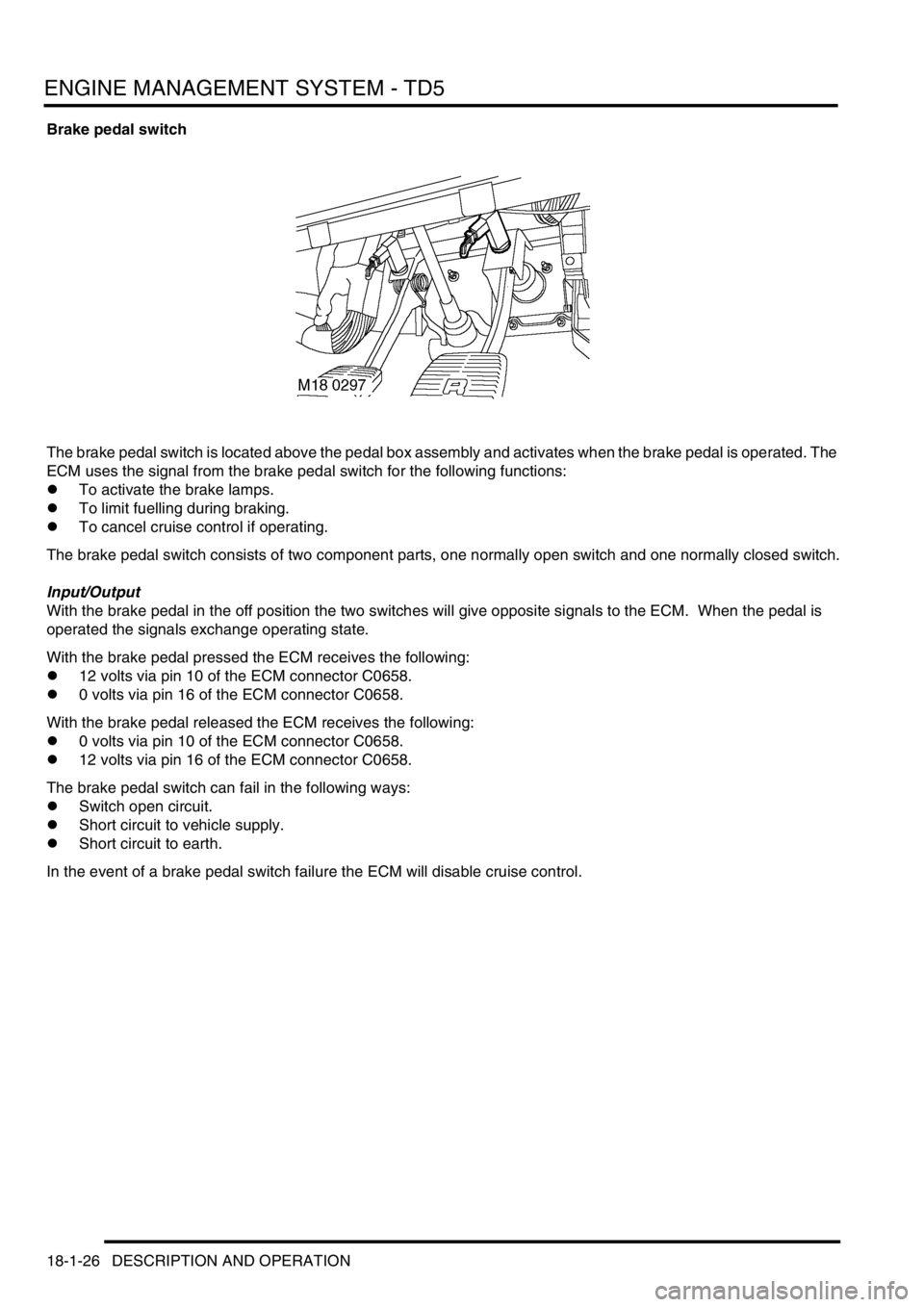
Brake pedal switch
The brake pedal switch is located above the pedal box assembly and activates when the brake pedal is operated. The
ECM uses the signal from the brake pedal switch for the following functions:
lTo activate the brake lamps.
lTo limit fuelling during braking.
lTo cancel cruise control if operating.
The brake pedal switch consists of two component parts, one normally open switch and one normally closed switch.
Input/Output
With the brake pedal in the off position the two switches will give opposite signals to the ECM. When the pedal is
operated the signals exchange operating state.
With the brake pedal pressed the ECM receives the following:
l12 volts via pin 10 of the ECM connector C0658.
l0 volts via pin 16 of the ECM connector C0658.
With the brake pedal released the ECM receives the following:
l0 volts via pin 10 of the ECM connector C0658.
l12 volts via pin 16 of the ECM connector C0658.
The brake pedal switch can fail in the following ways:
lSwitch open circuit.
lShort circuit to vehicle supply.
lShort circuit to earth.
In the event of a brake pedal switch failure the ECM will disable cruise control.
Page 420 of 1672
ENGINE MANAGEMENT SYSTEM - TD5
DESCRIPTION AND OPERATION 18-1-27
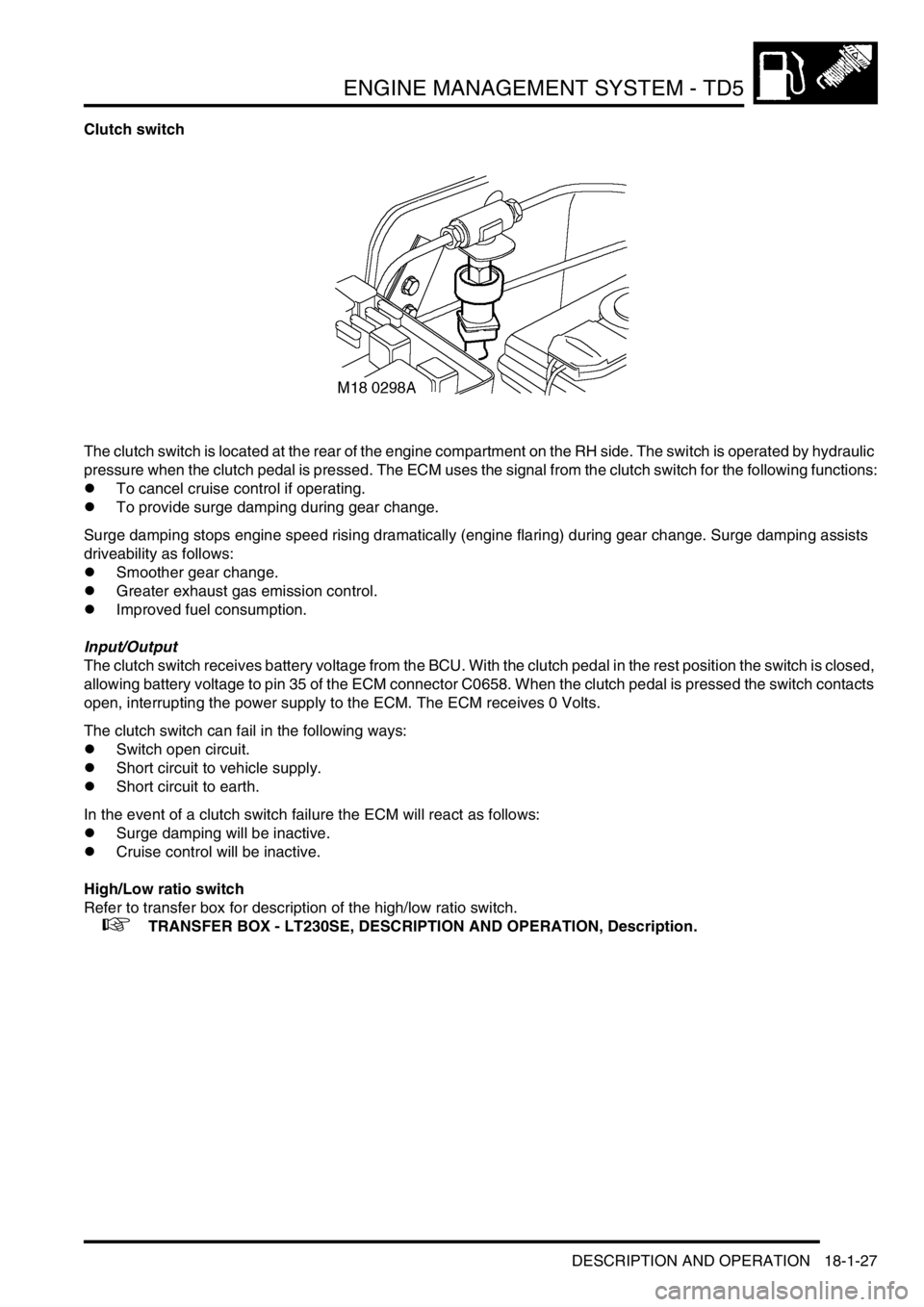
Clutch switch
The clutch switch is located at the rear of the engine compartment on the RH side. The switch is operated by hydraulic
pressure when the clutch pedal is pressed. The ECM uses the signal from the clutch switch for the following functions:
lTo cancel cruise control if operating.
lTo provide surge damping during gear change.
Surge damping stops engine speed rising dramatically (engine flaring) during gear change. Surge damping assists
driveability as follows:
lSmoother gear change.
lGreater exhaust gas emission control.
lImproved fuel consumption.
Input/Output
The clutch switch receives battery voltage from the BCU. With the clutch pedal in the rest position the switch is closed,
allowing battery voltage to pin 35 of the ECM connector C0658. When the clutch pedal is pressed the switch contacts
open, interrupting the power supply to the ECM. The ECM receives 0 Volts.
The clutch switch can fail in the following ways:
lSwitch open circuit.
lShort circuit to vehicle supply.
lShort circuit to earth.
In the event of a clutch switch failure the ECM will react as follows:
lSurge damping will be inactive.
lCruise control will be inactive.
High/Low ratio switch
Refer to transfer box for description of the high/low ratio switch.
+ TRANSFER BOX - LT230SE, DESCRIPTION AND OPERATION, Description.
Page 425 of 1672
ENGINE MANAGEMENT SYSTEM - TD5
18-1-32 DESCRIPTION AND OPERATION
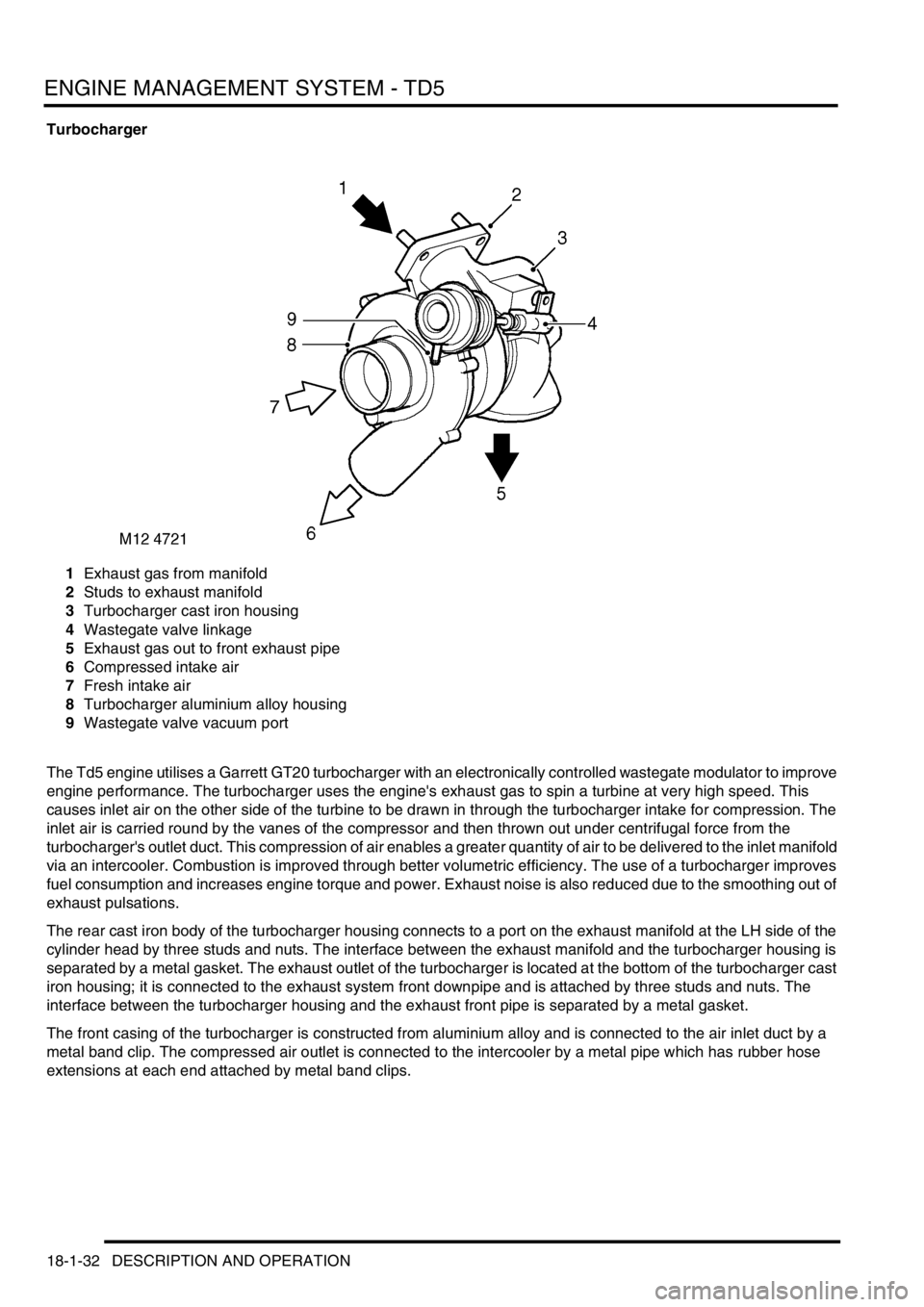
Turbocharger
1Exhaust gas from manifold
2Studs to exhaust manifold
3Turbocharger cast iron housing
4Wastegate valve linkage
5Exhaust gas out to front exhaust pipe
6Compressed intake air
7Fresh intake air
8Turbocharger aluminium alloy housing
9Wastegate valve vacuum port
The Td5 engine utilises a Garrett GT20 turbocharger with an electronically controlled wastegate modulator to improve
engine performance. The turbocharger uses the engine's exhaust gas to spin a turbine at very high speed. This
causes inlet air on the other side of the turbine to be drawn in through the turbocharger intake for compression. The
inlet air is carried round by the vanes of the compressor and then thrown out under centrifugal force from the
turbocharger's outlet duct. This compression of air enables a greater quantity of air to be delivered to the inlet manifold
via an intercooler. Combustion is improved through better volumetric efficiency. The use of a turbocharger improves
fuel consumption and increases engine torque and power. Exhaust noise is also reduced due to the smoothing out of
exhaust pulsations.
The rear cast iron body of the turbocharger housing connects to a port on the exhaust manifold at the LH side of the
cylinder head by three studs and nuts. The interface between the exhaust manifold and the turbocharger housing is
separated by a metal gasket. The exhaust outlet of the turbocharger is located at the bottom of the turbocharger cast
iron housing; it is connected to the exhaust system front downpipe and is attached by three studs and nuts. The
interface between the turbocharger housing and the exhaust front pipe is separated by a metal gasket.
The front casing of the turbocharger is constructed from aluminium alloy and is connected to the air inlet duct by a
metal band clip. The compressed air outlet is connected to the intercooler by a metal pipe which has rubber hose
extensions at each end attached by metal band clips.
Page 427 of 1672
ENGINE MANAGEMENT SYSTEM - TD5
18-1-34 DESCRIPTION AND OPERATION
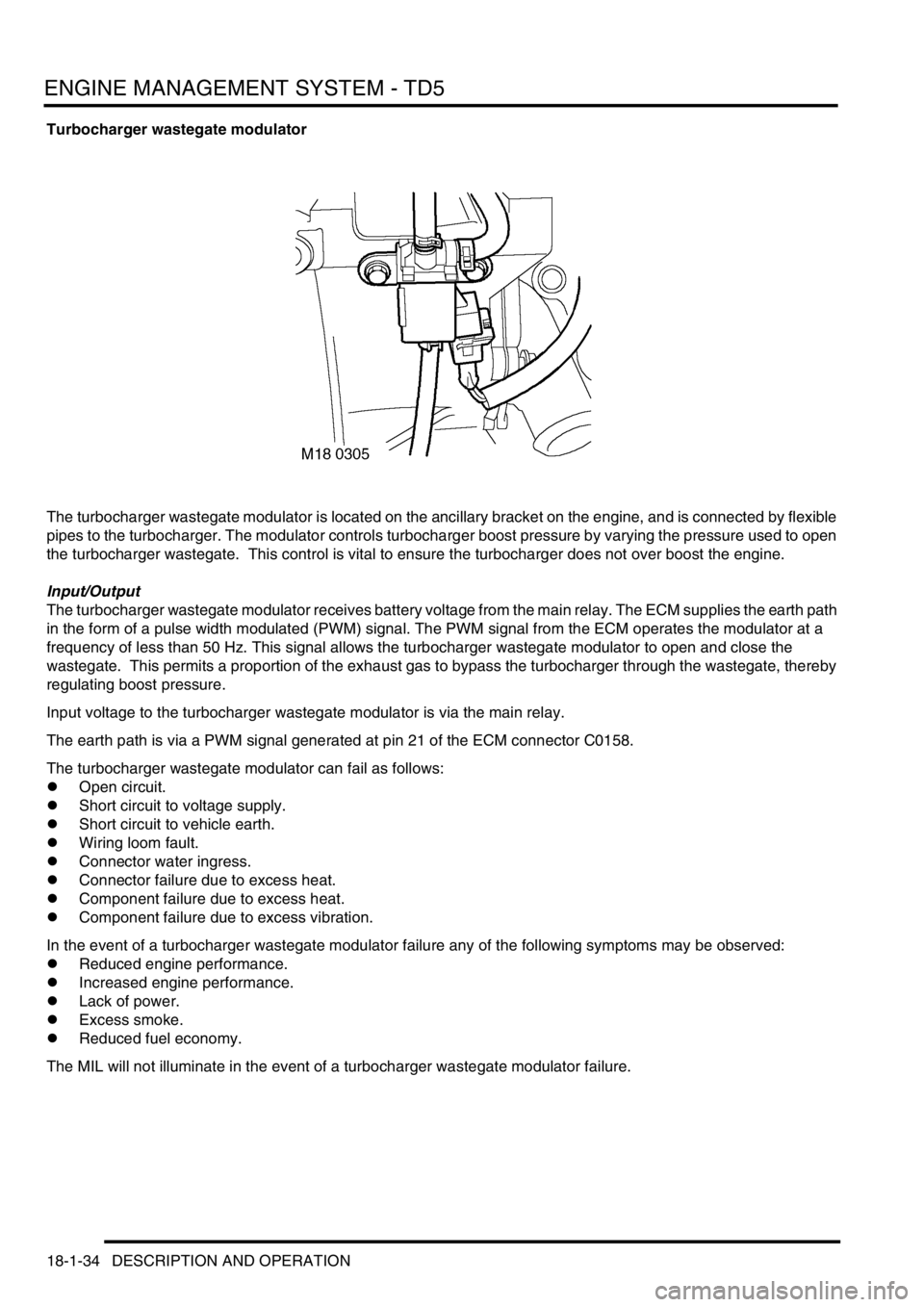
Turbocharger wastegate modulator
The turbocharger wastegate modulator is located on the ancillary bracket on the engine, and is connected by flexible
pipes to the turbocharger. The modulator controls turbocharger boost pressure by varying the pressure used to open
the turbocharger wastegate. This control is vital to ensure the turbocharger does not over boost the engine.
Input/Output
The turbocharger wastegate modulator receives battery voltage from the main relay. The ECM supplies the earth path
in the form of a pulse width modulated (PWM) signal. The PWM signal from the ECM operates the modulator at a
frequency of less than 50 Hz. This signal allows the turbocharger wastegate modulator to open and close the
wastegate. This permits a proportion of the exhaust gas to bypass the turbocharger through the wastegate, thereby
regulating boost pressure.
Input voltage to the turbocharger wastegate modulator is via the main relay.
The earth path is via a PWM signal generated at pin 21 of the ECM connector C0158.
The turbocharger wastegate modulator can fail as follows:
lOpen circuit.
lShort circuit to voltage supply.
lShort circuit to vehicle earth.
lWiring loom fault.
lConnector water ingress.
lConnector failure due to excess heat.
lComponent failure due to excess heat.
lComponent failure due to excess vibration.
In the event of a turbocharger wastegate modulator failure any of the following symptoms may be observed:
lReduced engine performance.
lIncreased engine performance.
lLack of power.
lExcess smoke.
lReduced fuel economy.
The MIL will not illuminate in the event of a turbocharger wastegate modulator failure.
Page 431 of 1672

ENGINE MANAGEMENT SYSTEM - TD5
18-1-38 DESCRIPTION AND OPERATION
Operation
Engine management
The ECM controls the operation of the engine using stored information within its memory. This guarantees optimum
performance from the engine in terms of torque delivery, fuel consumption and exhaust emissions in all operating
conditions, while still giving optimum driveability.
The ECM will receive information from its sensors under all operating conditions, especially during:
lCold starting.
lHot starting.
lIdle.
lWide open throttle.
lAcceleration.
lAdaptive strategy.
lBackup strategy for sensor failures.
The ECM receives information from various sensors to determine the current operating state of the engine. The ECM
then refers this information to stored values in its memory and makes any necessary changes to optimise air/fuel
mixture and fuel injection timing. The ECM controls the air/fuel mixture and fuel injection timing via the Electronic Unit
Injectors (EUI), by the length of time the EUI's are to inject fuel into the cylinder. This is a rolling process and is called
adaptive strategy. By using this adaptive strategy the ECM is able to control the engine to give optimum driveability
under all operating conditions.
During cold start conditions the ECM uses ECT information to allow more fuel to be injected into the cylinders, this
combined with the glow plug timing strategy supplied by the ECM facilitates good cold starting.
During hot start conditions the ECM uses ECT and FT information to implement the optimum fuelling strategy to
facilitate good hot starting.
During idle and wide open throttle conditions the ECM uses mapped information within its memory to respond to input
information from the throttle pedal position sensor to implement the optimum fuelling strategy to facilitate idle and wide
open throttle.
To achieve an adaptive strategy for acceleration the ECM uses input information from the CKP sensor, TP sensor,
ECT sensor, MAP/ IAT sensor, and the FT sensor. This is compared to mapped information within its memory to
implement the optimum fuelling strategy to facilitate acceleration.
Immobilisation system
When the starter switch is turned on, the BCU sends a unique security code to the ECM. The ECM must accept this
code before it will allow the engine to operate. If the ECM receives no security code or the ECM receives the incorrect
security code, then the ECM allows the engine to run for 0.5 seconds only. During this operation all other ECM
functions remain as normal.
The ECM operates immobilisation in three states:
l'New.'
l'Secure'.
l'No Code'.
When an ECM is unconfigured it will operate in the 'New' state. When an unconfigured ECM is installed the engine
can be started and operated once only, then the ECM has to be re-configured to either 'secure' or 'no code'
configuration depending on whether a security system is fitted to the vehicle. This is achieved by using TestBook.
Page 432 of 1672

ENGINE MANAGEMENT SYSTEM - TD5
DESCRIPTION AND OPERATION 18-1-39
With the ECM in a 'Secure' state, it will not function unless an alarm system is fitted to the vehicle. A 'Secure' ECM
cannot be configured into a 'No Code' ECM.
With the ECM in a 'No Code' state, it does not require an alarm system to be fitted to allow the engine to operate. If
the ECM senses that an alarm system is fitted it will not start. A 'No Code' ECM can be configured to a 'Secure' ECM
using TestBook. A 'Secure' ECM can not be configured to a 'No Code' state.
Setting up of the ECM immobilisation configurations can only be performed using TestBook.
If a vehicle stalls immediately after starting it is possible that it has been immobilised. This means either:
lThe ECM was configured as 'No Code' but the ECM is receiving a code at its alarm input pin.
lThe ECM received an incorrect code.
lThe ECM was expecting a security code but did not receive one at its alarm input pin.
Fuel delivery/injection control
The fuel delivery/injection control delivers a precise amount of finely atomised fuel to mix with the air in the
combustion chamber to create a controlled explosion.
To precisely control fuel delivery and control fuel injection, the following input conditions must be met:
lCKP information.
lInjection timing map information.
lFT information.
lECT information.
The ECM monitors the conditions required for optimum combustion of fuel in the cylinder from the various sensors
around the engine and then compares it against stored information. From this calculation the ECM can adjust the
quantity and timing of the fuel being delivered to the cylinder.
The ECM uses CKP information as follows:
lTo calculate engine speed.
lTo determine engine crankshaft position.
Engine speed and crankshaft position allows the ECM to determine fuel injection timing.
The ECM also uses ECT information and FT sensor information to allow optimum fuel delivery and injection control
for all engine coolant and fuel temperatures.
Turbocharger control
Turbocharger control is vital to ensure the turbocharger does not over boost the engine. Within the turbocharger is a
wastegate, which when operated by the turbocharger wastegate modulator will open and close a bypass valve
regulating boost pressure.
The turbocharger wastegate modulator, via the ECM, controls boost pressure under the following conditions:
lAcceleration.
lWide open throttle.
lIdle.
lOverrun.
The turbocharger wastegate modulator receives a battery voltage supply from the main relay. The ECM supplies the
earth path in the form of a pulse width modulation (PWM) signal. This signal allows the turbocharger wastegate
modulator to open and close the wastegate. A proportion of the exhaust gas can bypass the turbocharger through
the wastegate, regulating boost pressure.
Page 443 of 1672

ENGINE MANAGEMENT SYSTEM - TD5
18-1-50 REPAIRS
2.Disconnect multiplug from AAP sensor.
3.Release 2 clips and remove cover from air
filter.
4.Remove air filter element.
Refit
1.Clean air filter body and cover.
2.Fit new air filter element.
3.Position air cleaner cover and secure clips.
4.Position MAF sensor and secure clips.
5.Connect multiplug to AAP sensor.
Sensor - fuel temperature
$% 19.22.08
Remove
1.Remove 3 bolts and remove engine acoustic
cover.
2.Release fixings and remove battery cover.
3.Disconnect battery earth lead.
4.Disconnect multiplug from fuel temperature
sensor.
5. Thoroughly clean area around fuel
temperature sensor before removal.
6.Remove fuel temperature sensor and discard
sealing washer.
Refit
1.Clean fuel temperature sensor mating faces.
2.Fit new sealing washer and tighten fuel
temperature sensor to 13 Nm (10 lbf.ft) .
3.Connect multiplug to fuel temperature sensor.
4.Connect battery earth lead.
5.Fit battery cover and secure fixings.
6.Fit engine acoustic cover, and secure with
fixings.