fuel pressure LAND ROVER DISCOVERY 2002 User Guide
[x] Cancel search | Manufacturer: LAND ROVER, Model Year: 2002, Model line: DISCOVERY, Model: LAND ROVER DISCOVERY 2002Pages: 1672, PDF Size: 46.1 MB
Page 117 of 1672
MAINTENANCE
10-8 PROCEDURES
Brake fluid
Replace
1.Replace brake fluid.
+ BRAKES, ADJUSTMENTS, Brake
system bleeding.
Fuel filter - diesel engine
Replace
1.Replace filter element.
+ ENGINE MANAGEMENT SYSTEM -
Td5, REPAIRS, Element - fuel filter.
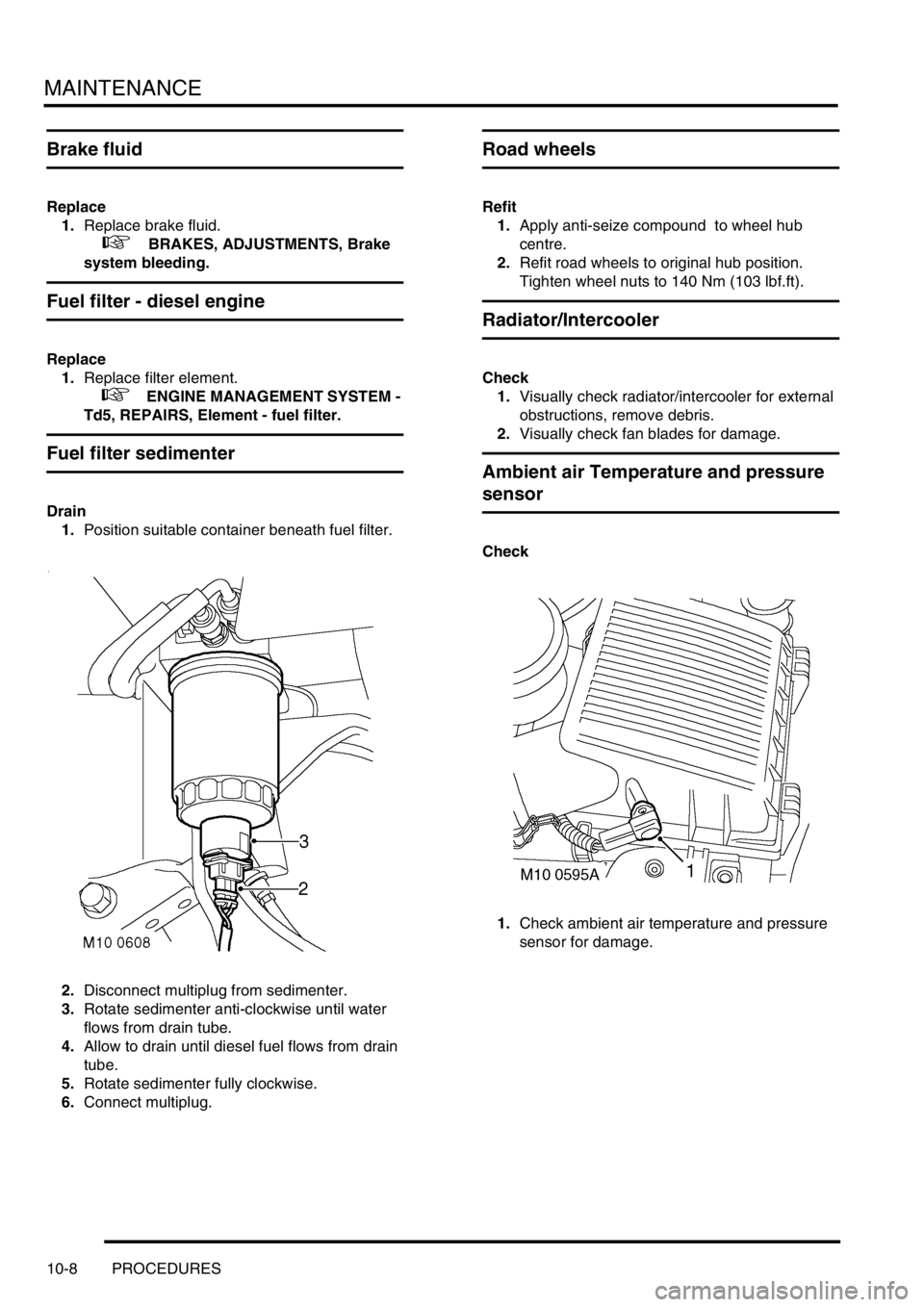
Fuel filter sedimenter
Drain
1.Position suitable container beneath fuel filter.
2.Disconnect multiplug from sedimenter.
3.Rotate sedimenter anti-clockwise until water
flows from drain tube.
4.Allow to drain until diesel fuel flows from drain
tube.
5.Rotate sedimenter fully clockwise.
6.Connect multiplug.
Road wheels
Refit
1.Apply anti-seize compound to wheel hub
centre.
2.Refit road wheels to original hub position.
Tighten wheel nuts to 140 Nm (103 lbf.ft).
Radiator/Intercooler
Check
1.Visually check radiator/intercooler for external
obstructions, remove debris.
2.Visually check fan blades for damage.
Ambient air Temperature and pressure
sensor
Check
1.Check ambient air temperature and pressure
sensor for damage.
Page 151 of 1672

ENGINE - TD5
12-1-12 DESCRIPTION AND OPERATION
Description
General
The Td5 diesel engine is a 2.5 litre, 5 cylinder, in-line direct injection unit having 2 valves per cylinder, operated by a
single overhead camshaft. The engine emissions, on pre EU3 models, comply with ECD2 (European Commission
Directive) and on EU3 models, comply with ECD3 legislative requirements. Both models employ electronic engine
management control, positive crankcase ventilation and exhaust gas recirculation to limit the emission of pollutants.
The unit is water cooled and turbo-charged and is controlled by an electronic engine management system.
The engine is a monobloc cast iron construction with an aluminium stiffening plate fitted to the bottom of the cylinder
block to improve lower structure rigidity. The cylinder head and sump are cast aluminium. An acoustic cover is fitted
over the upper engine to reduce engine generated noise.
The engine utilises the following features:
lElectronic Unit Injectors (EUI's) controlled by an Engine Management System for precise fuel delivery under
all prevailing operating conditions.
lTurbocharging which delivers compressed air to the combustion chambers via an intercooler for improved
power output.
lFuel Cooler
lOil Cooler
lCentrifuge Oil Filter
lHydraulic Lash Adjusters with independent finger followers
Cylinder block components
The cylinder block components are described below:
Cylinder Block
The cylinders and crankcase are contained in a single cast iron construction. The cylinders are direct bored and
plateau honed with lubrication oil supplied via lubrication jets for piston and gudgeon pin lubrication and cooling. It is
not possible to rebore the cylinder block if the cylinders become worn or damaged. Three metal core plugs are fitted
to the three centre cylinders on the right hand side of the cylinder block.
Lubrication oil is distributed throughout the block via the main oil gallery to critical moving parts through channels
bored in the block which divert oil to the main and big-end bearings via oil holes machined into the crankshaft. Oil is
also supplied from the cylinder block main gallery to the five lubrication jets which cool and lubricate the piston and
gudgeon pins. Plugs are used to seal both ends of the main oil gallery at front and rear of the engine block. An oil
cooler is fitted to the LH side of the engine block; ports in the oil cooler assembly mate with ports in the cylinder block
to facilitate coolant flow. Oil is diverted through the oil cooler, centrifuge filter and full-flow filter before supplying the
main oil gallery. A tapping in the oil filter housing provides a lubrication source for the turbocharger bearings and an
oil pressure switch is included in a tapping in the oil cooler housing which determines whether sufficient oil pressure
is available to provide engine lubrication and cooling.
Cylinder cooling is achieved by water circulating through chambers in the engine block casting. A threaded coolant
jacket plug is located at the front RH side of the cylinder block.
Cast mounting brackets are bolted to both sides of the engine block for mounting the engine to the chassis on the LH
and RH hydramount studs.
The gearbox bolts directly to the engine block; a gearbox shim plate is located between the adjoining faces of the
gearbox and the flywheel side of the engine block and is fixed to the rear of the engine block by two bolts. Two hollow
metal dowels locate the rear of the cylinder block to the gearbox shim plate. The gearbox casing provides the
mounting for the starter motor.
A port is included at the rear left hand side of the cylinder block which connects to the turbocharger oil drain pipe to
return lubrication oil to the sump.
A plug sealing the lubrication cross-drilling gallery is located at the front right hand side of the cylinder block and plugs
for the main lubrication gallery is included at the front and rear of the cylinder block.
Page 153 of 1672
ENGINE - TD5
12-1-14 DESCRIPTION AND OPERATION
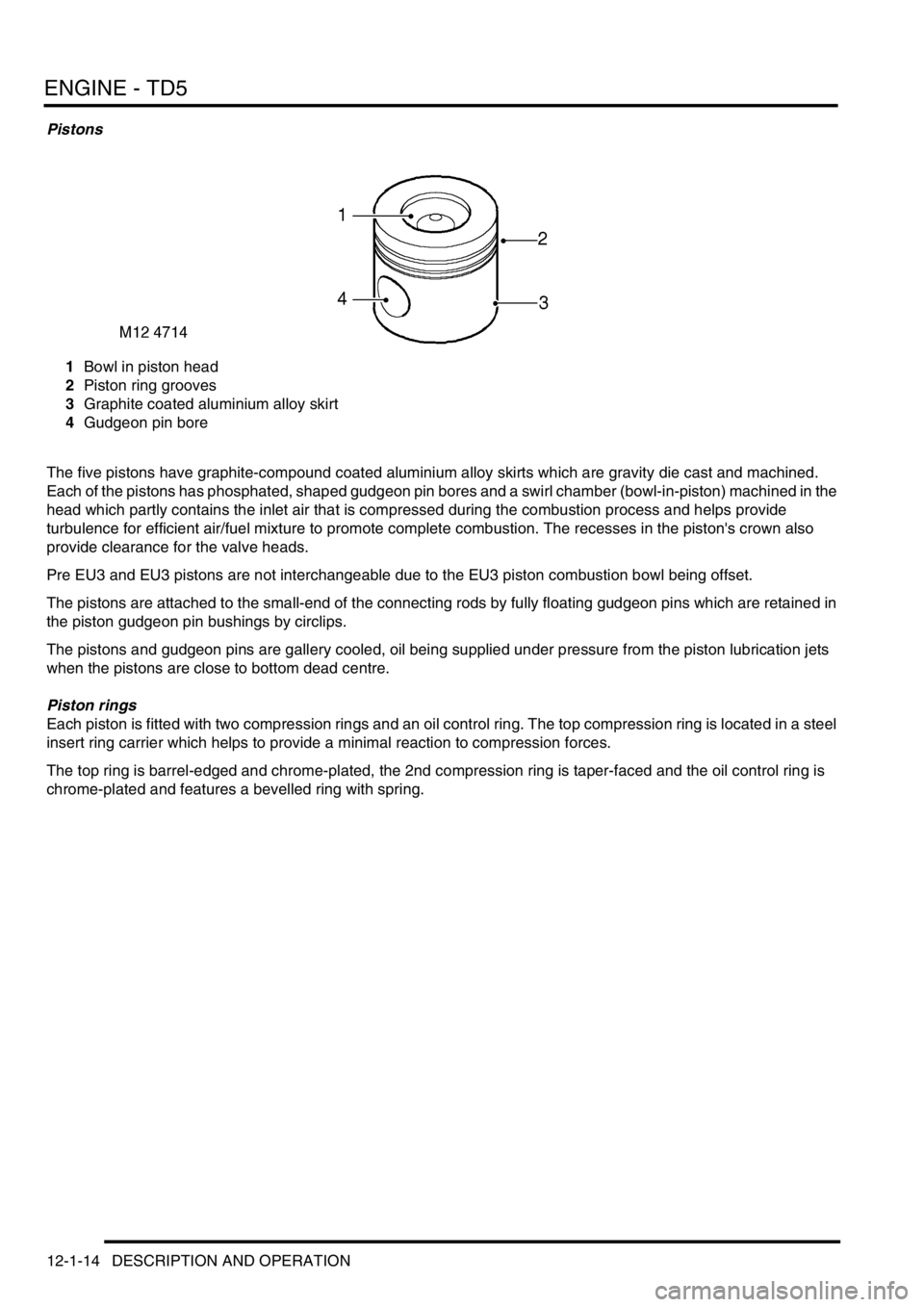
Pistons
1Bowl in piston head
2Piston ring grooves
3Graphite coated aluminium alloy skirt
4Gudgeon pin bore
The five pistons have graphite-compound coated aluminium alloy skirts which are gravity die cast and machined.
Each of the pistons has phosphated, shaped gudgeon pin bores and a swirl chamber (bowl-in-piston) machined in the
head which partly contains the inlet air that is compressed during the combustion process and helps provide
turbulence for efficient air/fuel mixture to promote complete combustion. The recesses in the piston's crown also
provide clearance for the valve heads.
Pre EU3 and EU3 pistons are not interchangeable due to the EU3 piston combustion bowl being offset.
The pistons are attached to the small-end of the connecting rods by fully floating gudgeon pins which are retained in
the piston gudgeon pin bushings by circlips.
The pistons and gudgeon pins are gallery cooled, oil being supplied under pressure from the piston lubrication jets
when the pistons are close to bottom dead centre.
Piston rings
Each piston is fitted with two compression rings and an oil control ring. The top compression ring is located in a steel
insert ring carrier which helps to provide a minimal reaction to compression forces.
The top ring is barrel-edged and chrome-plated, the 2nd compression ring is taper-faced and the oil control ring is
chrome-plated and features a bevelled ring with spring.
Page 161 of 1672

ENGINE - TD5
12-1-22 DESCRIPTION AND OPERATION
The camshaft carrier and cylinder head assembly is attached to the cylinder block by twelve cylinder head retaining
bolts which pass through the camshaft carrier and the cylinder head to secure the assembly to the cylinder block.
CAUTION: The valve heads, tips of the injectors and glow plugs protrude below the face of the cylinder head
and will be damaged if the cylinder head is stored face down.
The camshaft is located between the cylinder head and the camshaft carrier, and the bearing journals are line bored
between the two components to form a matched pair.
CAUTION: Always fit plugs to open connections to prevent contamination.
The valve guides and valve seat inserts are sintered components which are interference fit to the cylinder head. The
cylinder head machining also provide the locations for the electronic unit injectors, glow plugs, hydraulic lash
adjusters, finger followers and low pressure fuel rail.
Cooling to the cylinder head is provided by coolant flow through a water jacket machined into the cylinder head.
Drillings through the block provide lubrication channels for pressurised oil supply to cylinder head components such
as the lash adjusters, finger followers, rocker arms and camshaft bearings.
A coolant outlet elbow is fitted to the front LH side of the cylinder head to allow flow of coolant from the cylinder head
back to the radiator. A metal gasket is used to seal the joint between the water outlet elbow and the cylinder head. A
coolant temperature sensor is located in a port in the side of the water outlet elbow for monitoring coolant temperature.
A stub pipe is connected at the front RH side of the cylinder block above the timing cover which connects a pipe to
supply oil to the vacuum pump. The timing chain tensioner adjuster is screwed in a thread in the cylinder head at a
location on the front RH side of the engine below the oil feed port for the vacuum pump.
An access hole for the camshaft gear is included at the front of the cylinder head which is sealed with a plastic plug
and rubber 'O'-ring. A press-fit core plug for the chain chest is located on the front face of the cylinder head.
A press-fit core plug for the cylinder head water jacket is located at the rear of the cylinder head and a threaded brass
plug for the water jacket is located on the LH side of the cylinder head beneath the exhaust manifold assembly.
Page 162 of 1672
ENGINE - TD5
DESCRIPTION AND OPERATION 12-1-23
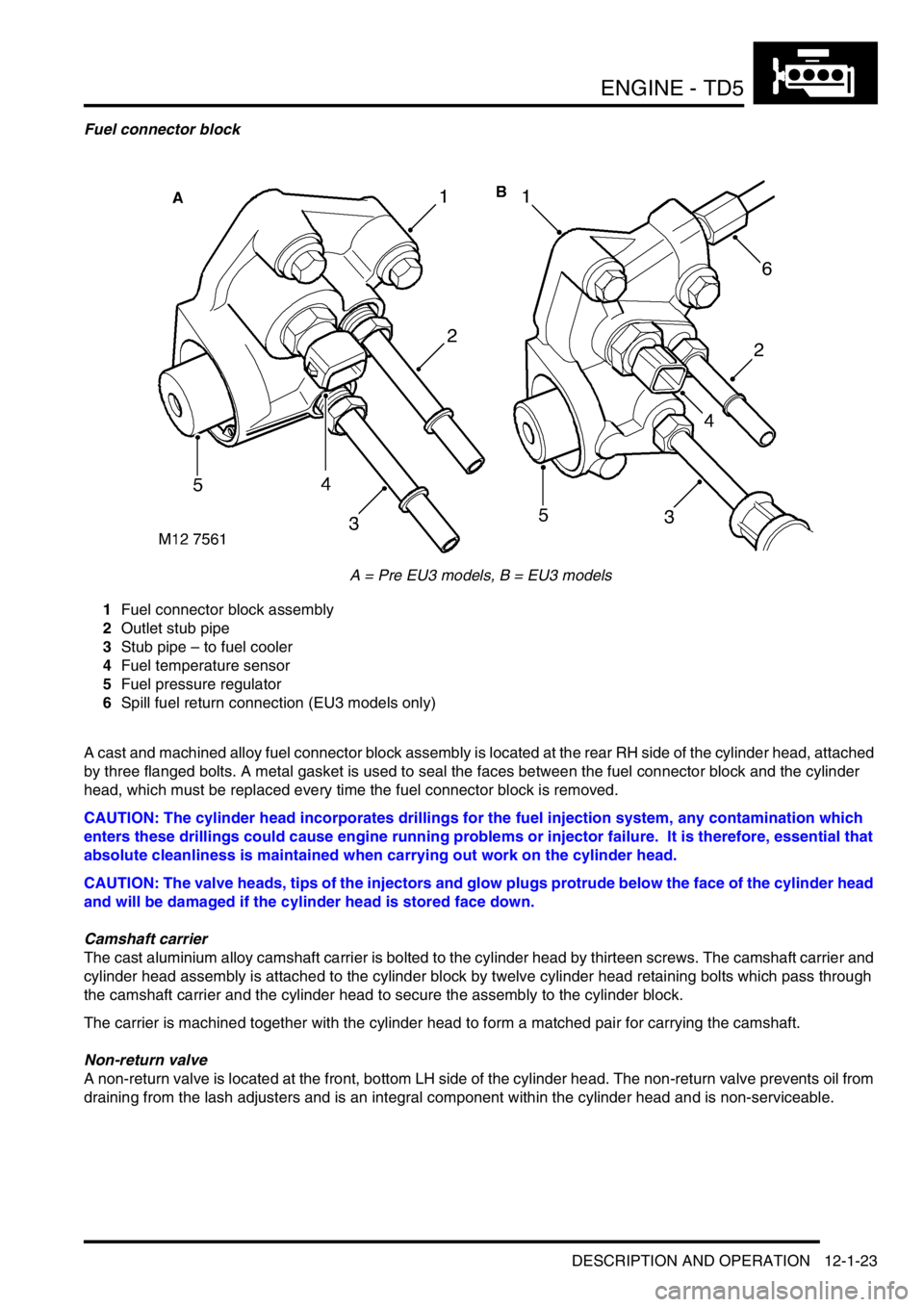
Fuel connector block
A = Pre EU3 models, B = EU3 models
1Fuel connector block assembly
2Outlet stub pipe
3Stub pipe – to fuel cooler
4Fuel temperature sensor
5Fuel pressure regulator
6Spill fuel return connection (EU3 models only)
A cast and machined alloy fuel connector block assembly is located at the rear RH side of the cylinder head, attached
by three flanged bolts. A metal gasket is used to seal the faces between the fuel connector block and the cylinder
head, which must be replaced every time the fuel connector block is removed.
CAUTION: The cylinder head incorporates drillings for the fuel injection system, any contamination which
enters these drillings could cause engine running problems or injector failure. It is therefore, essential that
absolute cleanliness is maintained when carrying out work on the cylinder head.
CAUTION: The valve heads, tips of the injectors and glow plugs protrude below the face of the cylinder head
and will be damaged if the cylinder head is stored face down.
Camshaft carrier
The cast aluminium alloy camshaft carrier is bolted to the cylinder head by thirteen screws. The camshaft carrier and
cylinder head assembly is attached to the cylinder block by twelve cylinder head retaining bolts which pass through
the camshaft carrier and the cylinder head to secure the assembly to the cylinder block.
The carrier is machined together with the cylinder head to form a matched pair for carrying the camshaft.
Non-return valve
A non-return valve is located at the front, bottom LH side of the cylinder head. The non-return valve prevents oil from
draining from the lash adjusters and is an integral component within the cylinder head and is non-serviceable.
Page 163 of 1672

ENGINE - TD5
12-1-24 DESCRIPTION AND OPERATION
Camshaft
The camshaft is machined from cast steel and is located between the cylinder head and the camshaft carrier, and the
six bearing journals are line bored between the two components to form a matched pair. The machined camshaft has
15 lobes. Ten lobes operate the inlet and exhaust valves through hydraulic lash adjusters and finger followers which
are located below the camshaft. Five larger lobes activate the injector rockers which are located above the camshaft
on the rocker shaft and are used to generate fuel pressure in the EUI injectors.
The camshaft is sprocket driven via a duplex chain connected to the crankshaft sprocket at a speed ratio of 2:1. The
camshaft sprocket is fixed to the front end of the camshaft by three bolts.
Camshaft lubrication is splash and channel fed via pressurised oil flowing through galleries in the cylinder head.
Rocker shaft and Rocker Arms
A = Pre EU3 rocker arm, B = EU3 rocker arm
1Rocker shaft
2Rocker arm adjusting screw
3Rocker arm
4EUI pin and roller assembly
5Roller pin retention slug6Camshaft lobe
7Injector spring
8Injector push-rod
9Adjusting nut
The hollow rocker shaft is located in the camshaft carrier in six fixed mountings which sit above the camshaft. Six bolts
are used to lock the rocker shaft to the camshaft carrier. The front rocker shaft bearing has a ring dowel located at the
front rocker shaft mounting of the camshaft carrier for rocker shaft alignment. Two circlips hold each rocker arm in
position at the relevant positions on the rocker shaft.
The rocker shaft from a pre EU3 model must not be fitted to an EU3 engine. This is because the stroke of the
EU3 injector has increased which requires the rocker to articulate over a larger angle.
The camshaft end of each rocker arm features a roller which is free to rotate about a pin which passes through two
webs in the rocker arm, the roller pins are held in place by an interference fit retention slug passing through a hole in
the front web of each rocker arm.
To correctly function against the higher injection loads of the EU3 engine the geometry of the contact between the
injector pushrod and rocker arm adjusting screw has been modified. Both designs of adjusting screw are separately
available with the EU3 version being identified by an engraved dimple in the slotted end.
Rocker shaft and rocker arm lubrication is splash and channel fed via pressurised oil flowing through galleries in the
cylinder head and through the rocker shaft.
Page 273 of 1672

ENGINE - V8
12-2-30 REPAIRS
Refit
1.Clean mating faces of engine and gearbox,
dowel and dowel holes.
2.Lubricate splines and bearing surface on first
motion shaft with grease.
3.With assistance position engine in engine bay,
align to gearbox and locate on dowels.
4.Position support brackets, fit bell housing bolts
and tighten to 50 Nm (37 lbf.ft).
5.Position engine mountings, fit nuts and tighten
to 85 Nm (63 lbf.ft).
6.Lower lifting equipment and remove from
engine.
7. Models with automatic gearbox: Align torque
converter to drive plate, fit bolts and tighten to
50 Nm (37 lbf.ft). Fit access plug.
8.Fit exhaust front pipe.
+ MANIFOLDS AND EXHAUST
SYSTEMS - V8, REPAIRS, Front pipe.
9.Position oil cooling pipe saddle clamps and
tighten bolts.
10.Position engine harness into foot well.
11.Connect 5 multiplugs to ECM.
12.Fit toe board and secure with trim fixings.
13.Connect engine harness earth to body and
secure with nut.
14.Connect engine harness to main harness
multiplug.
15.Connect multiplug to EVAP purge valve.
16.Connect engine harness multiplugs to fuse
box.
17.Connect starter lead to fuse box and secure
with nut.
18.Connect engine harness positive lead to
battery and tighten nut.
19.Fit fuse box cover.
20.Position engine earth lead and secure with
bolt.
21.Position coolant rail and secure with bolt.
22.Connect harness clips to coolant rail.
23.Connect hose to coolant rail and coolant pump
and secure with clips.
24.Connect PAS pump high and low pressure
pipes and secure with clips.
25.Position oil cooling pipe saddle clamp to PAS
pump housing and secure with bolt.
26.Clean A/C compressor and housing mating
faces, dowels and dowel holes. 27.Position A/C compressor, fit bolts and tighten
to 22 Nm (16 lbf.ft).
28.Connect multiplug to A/C compressor.
29.Clean ACE pump and housing mating faces,
dowels and dowel holes.
30.Position ACE pump, fit bolts and tighten to 22
Nm (16 lbf.ft).
31.Clean all pulley 'V's, fit auxiliary drive belt,
using a 15mm spanner, release belt tensioner
secure belt and re-tension drive belt .
32.Ensure auxiliary drive belt is correctly located
on all pulleys.
33.Fit radiator.
+ COOLING SYSTEM - V8, REPAIRS,
Radiator.
34.Fit top hose and secure with clips.
35.Connect fuel pipe to fuel rail.
36.Position ignition coils and connect ht leads.
37.Fit upper inlet manifold.
+ MANIFOLDS AND EXHAUST
SYSTEMS - V8, REPAIRS, Gasket - inlet
manifold - upper - Without Secondary Air
Injection.
38.Fit new oil filter and refill engine with oil.
+ ENGINE - V8, REPAIRS, Filter - oil.
+ MAINTENANCE, PROCEDURES,
Engine oil - V8 engine.
39.Top up gearbox oil.
+ MAINTENANCE, PROCEDURES,
Automatic gearbox.
Page 326 of 1672
EMISSION CONTROL - TD5
DESCRIPTION AND OPERATION 17-1-5
Exhaust gas recirculation
The exhaust gas recirculation (EGR) valve permits a controlled amount of exhaust gas to combine with the fresh air
entering the engine. The exhaust gas reduces the combustion temperature by delaying the fuel burning rate, which
assists in reducing the quantity of oxides of nitrogen.
On EU3 models, an EGR cooler is employed to further reduce the combustion temperature. By passing the exhaust
gas through a bundle of pipes flooded by coolant, the density of the exhaust gas going into the engine is increased.
This process further reduces the amount of oxygen, which in turn, further reduces the amount of NO
2 in the exhaust.
Recirculating too much exhaust gas can result in higher emissions of soot, HC and CO due to insufficient air. The
recirculated exhaust gas must be limited so that there is sufficient oxygen available for combustion of the injected fuel
in the combustion chamber, to do this the Engine Control Module (ECM) is used to control the precise quantity of
exhaust gas to be recirculated in accordance with the prevailing operating conditions. Influencing factors include:
lthe mass of air flow detected by the mass air flow sensor.
+ ENGINE MANAGEMENT SYSTEM - Td5, DESCRIPTION AND OPERATION, Description.
lthe ambient air pressure, determined by the ambient air pressure sensor which is used to initiate adjustments
to reduce the amount of smoke produced at high altitudes.
+ ENGINE MANAGEMENT SYSTEM - Td5, DESCRIPTION AND OPERATION, Description.
Other factors which are taken into consideration by the engine management system for determining the optimum
operating condition include:
lManifold inlet air temperature
lCoolant temperature
lEngine speed
lFuel delivered
The main components of the EGR system are as follows.
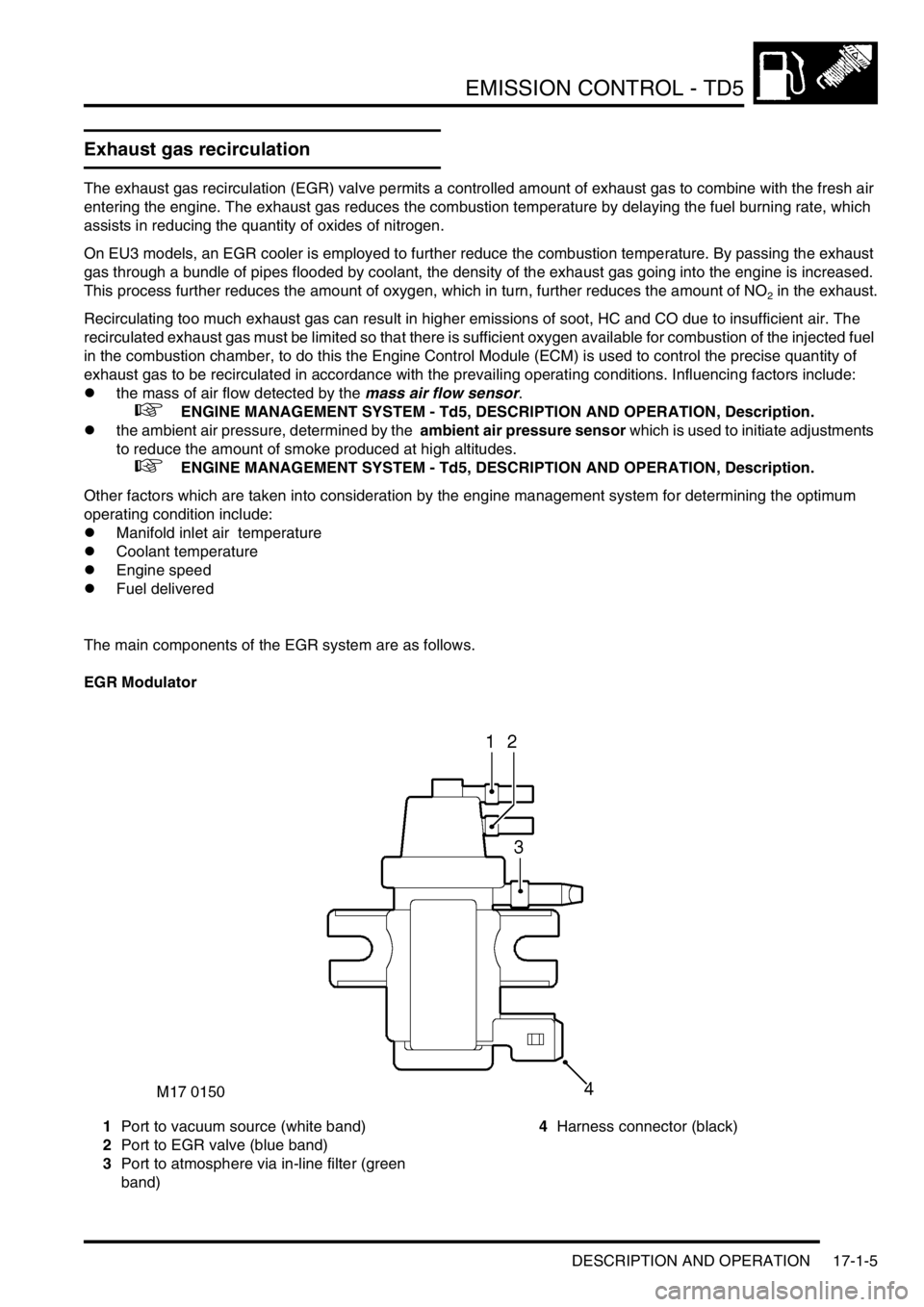
EGR Modulator
1Port to vacuum source (white band)
2Port to EGR valve (blue band)
3Port to atmosphere via in-line filter (green
band)4Harness connector (black)
Page 340 of 1672
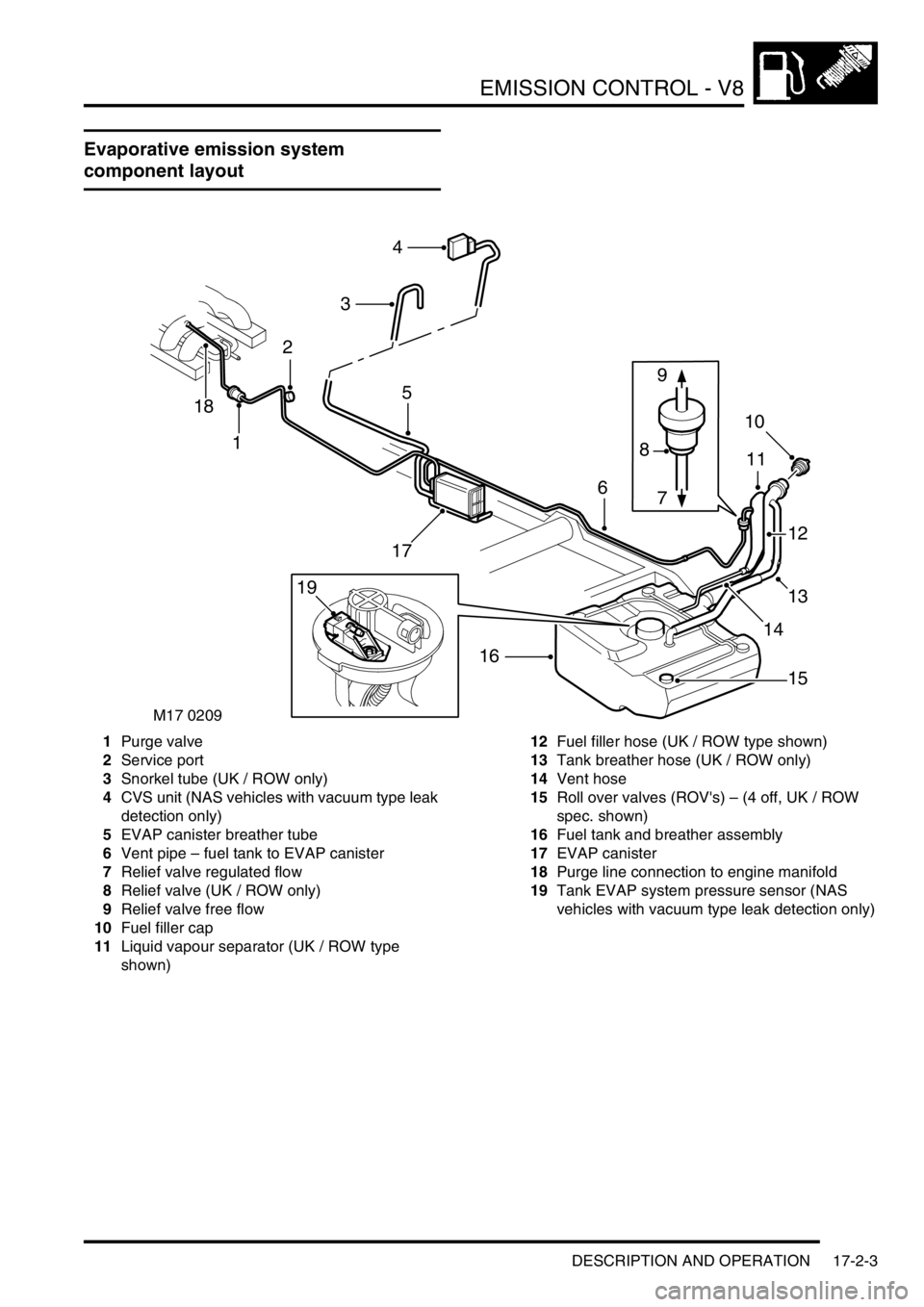
EMISSION CONTROL - V8
DESCRIPTION AND OPERATION 17-2-3
Evaporative emission system
component layout
1Purge valve
2Service port
3Snorkel tube (UK / ROW only)
4CVS unit (NAS vehicles with vacuum type leak
detection only)
5EVAP canister breather tube
6Vent pipe – fuel tank to EVAP canister
7Relief valve regulated flow
8Relief valve (UK / ROW only)
9Relief valve free flow
10Fuel filler cap
11Liquid vapour separator (UK / ROW type
shown)12Fuel filler hose (UK / ROW type shown)
13Tank breather hose (UK / ROW only)
14Vent hose
15Roll over valves (ROV's) – (4 off, UK / ROW
spec. shown)
16Fuel tank and breather assembly
17EVAP canister
18Purge line connection to engine manifold
19Tank EVAP system pressure sensor (NAS
vehicles with vacuum type leak detection only)
M17 0209
4
3
1
6
5
16
10
8
13
17
9
7
11
12
15
14
18
2
19
Page 341 of 1672

EMISSION CONTROL - V8
17-2-4 DESCRIPTION AND OPERATION
Evaporative emission system (with
positive pressure leak detection)
component layout (NAS only)
1Purge valve
2Service port
3Air filter canister
4EVAP canister breather tube
5Leak detection pump
6EVAP canister
7Vent pipe – fuel tank to EVAP canister
8Liquid vapour separator (metal)9Fuel filler cap
10Fuel filler
11Fuel tank breather assembly
12Vent hose
13Roll over valves (inside fuel tank)
14Fuel tank
15Purge line connection to engine manifold
M17 0208
3
1
7
4
14
11
6
8
10
13
12
15
2
5
9