fuel pressure LAND ROVER DISCOVERY 2002 Owner's Guide
[x] Cancel search | Manufacturer: LAND ROVER, Model Year: 2002, Model line: DISCOVERY, Model: LAND ROVER DISCOVERY 2002Pages: 1672, PDF Size: 46.1 MB
Page 363 of 1672

EMISSION CONTROL - V8
17-2-26 DESCRIPTION AND OPERATION
Secondary air injection system
The secondary air injection (SAI) system comprises the following components:
lSecondary air injection pump
lSAI vacuum solenoid valve
lSAI control valves (2 off, 1 for each bank of cylinders)
lSAI pump relay
lVacuum reservoir
lVacuum harness and pipes
The secondary air injection system is used to limit the emission of carbon monoxide (CO) and hydrocarbons (HCs)
that are prevalent in the exhaust during cold starting of a spark ignition engine. The concentration of hydrocarbons
experienced during cold starting at low temperatures are particularly high until the engine and catalytic converter
reach normal operating temperature. The lower the cold start temperature, the greater the prevalence of
hydrocarbons emitted from the engine.
There are several reasons for the increase of HC emissions at low cold start temperatures, including the tendency for
fuel to be deposited on the cylinder walls, which is then displaced during the piston cycle and expunged during the
exhaust stroke. As the engine warms up through operation, the cylinder walls no longer retain a film of fuel and most
of the hydrocarbons will be burnt off during the combustion process.
The SAI pump is used to provide a supply of air into the exhaust ports in the cylinder head, onto the back of the
exhaust valves, during the cold start period. The hot unburnt fuel particles leaving the combustion chamber mix with
the air injected into the exhaust ports and immediately combust. This subsequent combustion of the unburnt and
partially burnt CO and HC particles help to reduce the emission of these pollutants from the exhaust system. The
additional heat generated in the exhaust manifold also provides rapid heating of the exhaust system catalytic
converters. The additional oxygen which is delivered to the catalytic converters also generate an exothermic reaction
which causes the catalytic converters to 'light off' quickly.
The catalytic converters only start to provide effective treatment of emission pollutants when they reach an operating
temperature of approximately 250
°C (482°F) and need to be between temperatures of 400°C (752°F) and 800°C
(1472
°F) for optimum efficiency. Consequently, the heat produced by the secondary air injection “afterburning”,
reduces the time delay before the catalysts reach an efficient operating temperature.
The engine control module (ECM) checks the engine coolant temperature when the engine is started, and if it is below
60º C (131
°F), the SAI pump is started. Secondary air injection will remain operational for a period controlled by the
ECM (76 seconds for NAS vehicles, 64 seconds for EU-3 vehicles). The SAI pump operation can be cut short due to
excessive engine speed or load.
Air from the SAI pump is supplied to the SAI control valves via pipework and an intermediate T-piece which splits the
air flow evenly to each bank.
At the same time the secondary air pump is started, the ECM operates a SAI vacuum solenoid valve, which opens to
allow vacuum from the reservoir to be applied to the vacuum operated SAI control valves on each side of the engine.
When the vacuum is applied to the SAI control valves, they open simultaneously to allow the air from the SAI pump
through to the exhaust ports. Secondary air is injected into the inner most exhaust ports on each bank.
When the ECM breaks the ground circuit to de-energise the SAI vacuum solenoid valve, the vacuum supply to the
SAI control valves is cut off and the valves close to prevent further air being injected into the exhaust manifold. At the
same time as the SAI vacuum solenoid valve is closed, the ECM opens the ground circuit to the SAI pump relay, to
stop the SAI pump.
A vacuum reservoir is included in the vacuum line between the intake manifold and the SAI vacuum solenoid valve.
This prevents changes in vacuum pressure from the intake manifold being passed on to cause fluctuations of the
secondary air injection solenoid valve. The vacuum reservoir contains a one way valve and ensures a constant
vacuum is available for the SAI vacuum solenoid valve operation. This is particularly important when the vehicle is at
high altitude.
Page 372 of 1672

EMISSION CONTROL - V8
DESCRIPTION AND OPERATION 17-2-35
Failure of the closed loop control of the exhaust emission system may be attributable to one of the failure modes
indicated below:
lMechanical fitting & integrity of the sensor.
lSensor open circuit / disconnected.
lShort circuit to vehicle supply or ground.
lLambda ratio outside operating band.
lCrossed sensors.
lContamination from leaded fuel or other sources.
lChange in sensor characteristic.
lHarness damage.
lAir leak into exhaust system (cracked pipe / weld or loose fixings).
System failure will be indicated by the following symptoms:
lMIL light on (NAS and EU-3 only).
lDefault to open-loop fuelling for the defective cylinder bank.
lIf sensors are crossed, engine will run normally after initial start and then become progressively unstable with
one bank going to its maximum rich clamp and the other bank going to its maximum lean clamp – the system will
then revert to open-loop fuelling.
lHigh CO reading
lStrong smell of H
2S (rotten eggs)
lExcessive emissions
Fuel metering
When the engine is cold, additional fuel has to be provided to the air:fuel mixture to assist starting. This supplementary
fuel enrichment continues until the combustion chamber has heated up sufficiently during the warm-up phase.
Under normal part-throttle operating conditions the fuel mixture is adjusted to provide minimum fuel emissions and
the air:fuel mixture is held close to the optimum ratio (
λ = 1). The engine management system monitors the changing
engine and environmental conditions and uses the data to determine the exact fuelling requirements necessary to
maintain the air:fuel ratio close to the optimum value that is needed to ensure effective exhaust emission treatment
through the three-way catalytic converters.
During full-throttle operation the air:fuel mixture needs to be made rich to provide maximum torque. During
acceleration, the mixture is enriched by an amount according to engine temperature, engine speed, change in throttle
position and change in manifold pressure, to provide good acceleration response.
When the vehicle is braking or travelling downhill the fuel supply can be interrupted to reduce fuel consumption and
eliminate exhaust emissions during this period of operation.
If the vehicle is being used at altitude, a decrease in the air density will be encountered which needs to be
compensated for to prevent a rich mixture being experienced. Without compensation for altitude, there would be an
increase in exhaust emissions and problems starting, poor driveability and black smoke from the exhaust pipe. For
open loop systems, higher fuel consumption may also occur.
Page 374 of 1672

EMISSION CONTROL - V8
DESCRIPTION AND OPERATION 17-2-37
In the case of a catalytic converter failure the following failure symptoms may be apparent:
lMIL light on after 2 driving cycles (NAS market only).
lHigh exhaust back pressure if catalyst partly melted.
lExcessive emissions
lStrong smell of H
2S (rotten eggs).
Oxygen sensor voltages can be monitored using 'Testbook', the approximate output voltage from the heated oxygen
sensors with a warm engine at idle and with closed loop fuelling active are shown in the table below:
Mass air flow sensor and air temperature sensor
The engine management ECM uses the mass air flow sensor to measure the mass of air entering the intake and
interprets the data to determine the precise fuel quantity which needs to be injected to maintain the stoichiometric
air:fuel ratio for the exhaust catalysts. If the mass air flow sensor fails, lambda control and idle speed control will be
affected and the emission levels will not be maintained at the optimum level. If the device should fail and the ECM
detects a fault, it invokes a software backup strategy.
+ ENGINE MANAGEMENT SYSTEM - V8, DESCRIPTION AND OPERATION, Description - engine
management.
The air temperature sensor is used by the engine management ECM to monitor the temperature of the inlet air. If the
device fails, catalyst monitoring will be affected. The air temperature sensor in integral to the mass air flow sensor.
+ ENGINE MANAGEMENT SYSTEM - V8, DESCRIPTION AND OPERATION, Description - engine
management.
Throttle position sensor
If the engine management ECM detects a throttle position sensor failure, it may indicate a blocked or restricted air
intake filter. Failure symptoms may include:
lPoor engine running and throttle response
lEmission control failure
lNo closed loop idle speed control
lAltitude adaption is incorrect
If a signal failure should occur, a default value is derived using data from the engine load and speed.
+ ENGINE MANAGEMENT SYSTEM - V8, DESCRIPTION AND OPERATION, Description - engine
management.
Atmospheric pressure will vary with altitude and have a resulting influence on the calculations performed by the ECM
in determining the optimum engine operating conditions to minimise emissions. The following are approximate
atmospheric pressures for the corresponding altitudes:
l0.96 bar at sea level
l0.70 bar at 2,750 m (9,000 ft.)
Measurement Normal catalyst Defective catalyst
Pre-catalytic heated oxygen sensors ~ 100 to 900 mV switching @ ~ 0.5
Hz~ 100 to 900 mV switching @ ~ 0.5 Hz
Post-catalytic heated oxygen sensors ~ 200 to 650 mV, static or slowly
changing~ 200 to 850 mV, changing up to same
frequency as pre-catalytic heated oxygen
sensors
Amplitude ratio (LH HO
2 sensors & RH
HO
2 sensors)<0.3 seconds >0.6 seconds (needs to be approximately
0.75 seconds for single catalyst fault)
Number of speed/load monitoring areas
exceeded (LH & RH)0 >1 (needs to be 3 for fault storage)
Page 375 of 1672

EMISSION CONTROL - V8
17-2-38 DESCRIPTION AND OPERATION
Evaporative emission control operation
Fuel vapour is stored in the activated charcoal (EVAP) canister for retention when the vehicle is not operating. When
the vehicle is operating, fuel vapour is drawn from the canister into the engine via a purge control valve. The vapour
is then delivered to the intake plenum chamber to be supplied to the engine cylinders where it is burned in the
combustion process.
During fuel filling the fuel vapour displaced from the fuel tank is allowed to escape to atmosphere, valves within the
fuel filler prevent any vapour escaping through to the EVAP canister as this can adversely affect the fuel cut-off height.
Only fuel vapour generated whilst driving is prevented from escaping to atmosphere by absorption into the charcoal
canister. The fuel filler shuts off to leave the tank approximately 10% empty to ensure the ROVs are always above
the fuel level and so vapour can escape to the EVAP canister and the tank can breathe. The back pressures normally
generated during fuel filling are too low to open the pressure relief valve, but vapour pressures accumulated during
driving are higher and can open the pressure relief valve. Should the vehicle be overturned, the ROVs shut off to
prevent any fuel spillage.
Fuel vapour generated from within the fuel tank as the fuel heats up is stored in the tank until the pressure exceeds
the operating pressure of the two-way valve. When the two-way valve opens, the fuel vapour passes along the vent
line from the fuel tank (via the fuel tank vapour separator) to the evaporation inlet port of the EVAP canister. The fuel
tank vents between 5.17 and 6.9 kPa.
Fuel vapour evaporating from the fuel tank is routed to the EVAP canister through the fuel vapour separator and vent
line. Liquid fuel must not be allowed to contaminate the charcoal in the EVAP canister. To prevent this, the fuel vapour
separator fitted to the fuel neck allows fuel to drain back into the tank. As the fuel vapour cools, it condenses and is
allowed to flow back into the fuel tank from the vent line by way of the two-way valve.
The EVAP canister contains charcoal which absorbs and stores fuel vapour from the fuel tank while the engine is not
running. When the canister is not being purged, the fuel vapour remains in the canister and clean air exits the canister
via the air inlet port.
The engine management ECM controls the electrical output signal to the purge valve. The system will not work
properly if there is leakage or clogging within the system or if the purge valve cannot be controlled.
+ ENGINE MANAGEMENT SYSTEM - V8, DESCRIPTION AND OPERATION, Description - engine
management.
When the engine is running, the ECM decides when conditions are correct for vapour to be purged from the EVAP
canister and opens the canister purge valve. This connects a manifold vacuum line to the canister and fuel vapour
containing the hydrocarbons is drawn from the canister's charcoal element to be burned in the engine. Clean air is
drawn into the canister through the atmosphere vent port to fill the displaced volume of vapour.
The purge valve remains closed below preset coolant and engine speed values to protect the engine tune and
catalytic converter performance. If the EVAP canister was purged during cold running or at idling speed, the additional
enrichment in the fuel mixture would delay the catalytic converter light off time and cause erratic idle. When the purge
valve is opened, fuel vapour from the EVAP canister is drawn into the plenum chamber downside of the throttle
housing, to be delivered to the combustion chambers for burning.
The purge valve is opened and closed in accordance with a pulse width modulated (PWM) signal supplied from the
engine management ECM. The system will not work properly if the purge valve cannot be controlled. Possible failure
modes associated with the purge valve are listed below:
lValve drive open circuit.
lShort circuit to vehicle supply or ground.
lPurge valve or pipework blocked or restricted.
lPurge valve stuck open.
lPipework joints leaking or disconnected.
Page 376 of 1672

EMISSION CONTROL - V8
DESCRIPTION AND OPERATION 17-2-39
Possible symptoms associated with a purge valve or associated pipework failure is listed below:
lEngine may stall on return to idle if purge valve is stuck open.
lPoor idling quality if the purge valve is stuck open
lFuelling adaptions forced excessively lean if the EVAP canister is clear and the purge valve is stuck open.
lFuelling adaptions forced excessively rich if the EVAP canister is saturated and the purge valve is stuck open.
lSaturation of the EVAP canister if the purge valve is stuck closed.
To maintain driveability and effective emission control, EVAP canister purging must be closely controlled by the
engine management ECM, as a 1% concentration of fuel vapour from the EVAP canister in the air intake may shift
the air:fuel ratio by as much as 20%. The ECM must purge the fuel vapour from the EVAP canister at regular intervals
as its storage capacity is limited and an excessive build up of evaporated fuel pressure in the system could increase
the likelihood of vapour leaks. Canister purging is cycled with the fuelling adaptation as both cannot be active at the
same time. The ECM alters the PWM signal to the purge valve to control the rate of purging of the canister to maintain
the correct stoichiometric air:fuel mixture for the engine.
Fuel leak detection system (vacuum type) – NAS only
The advanced evaporative loss control system used on NAS vehicles is similar to the standard system, but also
includes a CVS valve and fuel tank pressure sensor and is capable of detecting holes in the fuel evaporative system
down to 1 mm (0.04 in.). The test is carried out in three parts. First the purge valve and the canister vent solenoid
valve closes off the storage system and the vent pressure increases due to the fuel vapour pressure level in the tank.
If the pressure level is greater than the acceptable limit, the test will abort because a false leak test response will
result. In part two of the test, the purge valve is opened and the fuel tank pressure will decrease due to the depression
from the intake manifold, evident at the purge port of the EVAP canister during purge operation. In part three of the
test, the leak measurement test is performed. The pressure response of the tests determines the level of leak, and if
this is greater than the acceptable limit on two consecutive tests, the ECM stores the fault in diagnostic memory and
the MIL light on the instrument pack is illuminated. The test is only carried out at engine idle with the vehicle stationary,
and a delay of 15 minutes after engine start is imposed before diagnosis is allowed to commence.
Page 377 of 1672

EMISSION CONTROL - V8
17-2-40 DESCRIPTION AND OPERATION
EVAP system, leak detection diagnostic (vacuum type)
The EVAP system leak detection is performed as follows:
1The ECM checks that the signal from the fuel tank pressure sensor is within the expected range. If the signal is
not within range, the leakage test will be cancelled.
2Next the purge valve is held closed and the canister vent solenoid (CVS) valve is opened to atmosphere. If the
ECM detects a rise in pressure with the valves in this condition, it indicates there is a blockage in the fuel
evaporation line between the CVS valve and the EVAP canister, or that the CVS valve is stuck in the closed
position and thus preventing normalisation of pressure in the fuel evaporation system. In this instance, the
leakage test will be cancelled.
3The CVS valve and the purge valve are both held in the closed position while the ECM checks the fuel tank
pressure sensor. If the fuel tank pressure sensor detects a decline in pressure, it indicates that the purge valve
is not closing properly and vapour is leaking past the valve seat face under the influence of the intake manifold
depression. In this instance, the leakage test will be cancelled.
4If the preliminary checks are satisfactory, a compensation measurement is determined next. Variations in fuel
level occur within the fuel tank, which will influence the pressure signal detected by the fuel tank pressure
sensor. The pressure detected will also be influenced by the rate of change in the fuel tank pressure, caused by
the rate of fuel evaporation which itself is dependent on the ambient temperature conditions. Because of these
variations, it is necessary for the ECM to evaluate the conditions prevailing at a particular instance when testing,
to ensure that the corresponding compensation factor is included in its calculations.
The CVS valve and purge valves are both closed while the ECM checks the signal from the fuel tank pressure
sensor. The rise in fuel pressure detected over a defined period is used to determine the rate of fuel evaporation
and the consequent compensation factor necessary.
5With the CVS valve still closed, the purge valve is opened. The inlet manifold depression present while the purge
valve is open, decreases EVAP system pressure and sets up a small vacuum in the fuel tank. The fuel tank
pressure sensor is monitored by the ECM and if the vacuum gradient does not increase as expected, a large
system leak is assumed by the ECM (e.g. missing or leaking fuel filler cap) and the diagnostic test is terminated.
If the EVAP canister is heavily loaded with hydrocarbons, purging may cause the air:fuel mixture to become
excessively rich, resulting in the upstream oxygen sensors requesting a leaner mix from the ECM to bring the
mixture back to the stoichiometric ideal. This may cause instability in the engine idle speed and consequently
the diagnostic test will have to be abandoned. The ECM checks the status of the upstream oxygen sensors
during the remainder of the diagnostic, to ensure the air:fuel mixture does not adversely affect the engine idle
speed.
6When the fuel tank pressure sensor detects that the required vacuum has been reached (-800 Pa), the purge
valve is closed and the EVAP system is sealed. The ECM then checks the change in the fuel tank pressure
sensor signal (diminishing vacuum) over a period of time, and if it is greater than expected (after taking into
consideration the compensation factor due to fuel evaporation within the tank, determined earlier in the
diagnostic), a leak in the EVAP system is assumed. If the condition remains, the MIL warning light will be turned
on after two drive cycles.
The decrease in vacuum pressure over the defined period must be large enough to correspond to a hole
equivalent to 1 mm (0.04 in.) diameter or greater, to be considered significant enough to warrant the activation
of an emissions system failure warning.
The diagnostic test is repeated at regular intervals during the drive cycle, when the engine is at idle condition. The
diagnostic test will not be able to be performed under the following conditions:
lDuring EVAP canister purging
lDuring fuelling adaption
lIf excess slosh in the fuel tank is detected (excess fuel vapour will be generated, invalidating the result)
Page 378 of 1672

EMISSION CONTROL - V8
DESCRIPTION AND OPERATION 17-2-41
Following the test, the system returns to normal purge operation after the canister vent solenoid opens. Possible
reasons for an EVAP system leak test failure are listed below:
lFuel filler not tightened or cap missing.
lSensor or actuator open circuit.
lShort circuit to vehicle supply or ground.
lEither purge or CVS valve stuck open.
lEither purge or CVS valve stuck shut or blocked pipe.
lPiping broken or not connected.
lLoose or leaking connection.
If the piping is broken forward of the purge valve or is not connected, the engine may run rough and fuelling adaptions
will drift. The fault will not be detected by the leak detection diagnostic, but it will be determined by the engine
management ECM through the fuelling adaption diagnostics.
The evaluation of leakage is dependent on the differential pressure between the fuel tank and ambient atmospheric
pressure, the diagnostic is disabled above altitudes of 9500 ft. (2800 m) to avoid false detection of fuel leaks due to
the change in atmospheric pressure at altitude.
Fuel leak detection system (positive pressure leak detection type) – NAS only
The EVAP system with positive pressure leak detection capability used on NAS vehicles is similar to the standard
system, but also includes a fuel evaporation leak detection pump with integral solenoid valve. It is capable of detecting
holes in the EVAP system down to 0.5 mm (0.02 in.). The test is carried out at the end of a drive cycle, when the
vehicle is stationary and the ignition switch has been turned off. The ECM maintains an earth supply to the Main relay
to hold it on, so that power can be supplied to the leak detection pump.
First a reference measurement is established by passing the pressurised air through a by-pass circuit containing a
fixed sized restriction. The restriction assimilates a 0.5 mm (0.02 in) hole and the current drawn by the pump motor
during this procedure is recorded for comparison against the value to be obtained in the system test. The purge valve
is held closed, and the reversing valve in the leak detection pump module is not energised while the leak detection
pump is switched on. The pressurised air from the leak detection pump is forced through an orifice while the current
drawn by the pump motor is monitored.
Next the EVAP system diagnostic is performed; the solenoid valve is energised so that it closes off the EVAP system's
vent line to atmosphere, and opens a path for the pressurised air from the leak detection pump to be applied to the
closed EVAP system.
The current drawn by the leak detection pump is monitored and checked against that obtained during the reference
measurement. If the current is less than the reference value, this infers there is a hole in the EVAP system greater
than 0.5 mm (0.02 in) which is allowing the positive air pressure to leak out. If the current drawn by the pump motor
is greater than the value obtained during the reference check, the system is sealed and free from leaks. If an EVAP
system leak is detected, the ECM stores the fault in diagnostic memory and the MIL light on the instrument pack is
illuminated.
On NAS vehicles, the ECM works on a 2 trip cycle before illuminating the MIL. On EU-3 vehicles, the ECM works on
a 3 trip cycle before illuminating the MIL.
Following the test, the solenoid valve is opened to normalise the EVAP system pressure and the system returns to
normal purge operation at the start of the next drive cycle. Possible reasons for an EVAP system leak test failure are
listed below:
lFuel filler not tightened or cap missing.
lSensor or actuator open circuit.
lShort circuit to vehicle supply or ground.
lEither purge or solenoid valve stuck open.
lEither purge or solenoid valve stuck shut.
lBlocked pipe or air filter.
lPiping broken or not connected.
lLoose or leaking connection.
If the piping is broken forward of the purge valve or is not connected, the engine may run rough and fuelling adaptions
will drift. The fault will not be detected by the leak detection test, but will be determined by the engine management
ECM through the fuelling adaption diagnostics. This test can be run from TestBook.
Page 396 of 1672
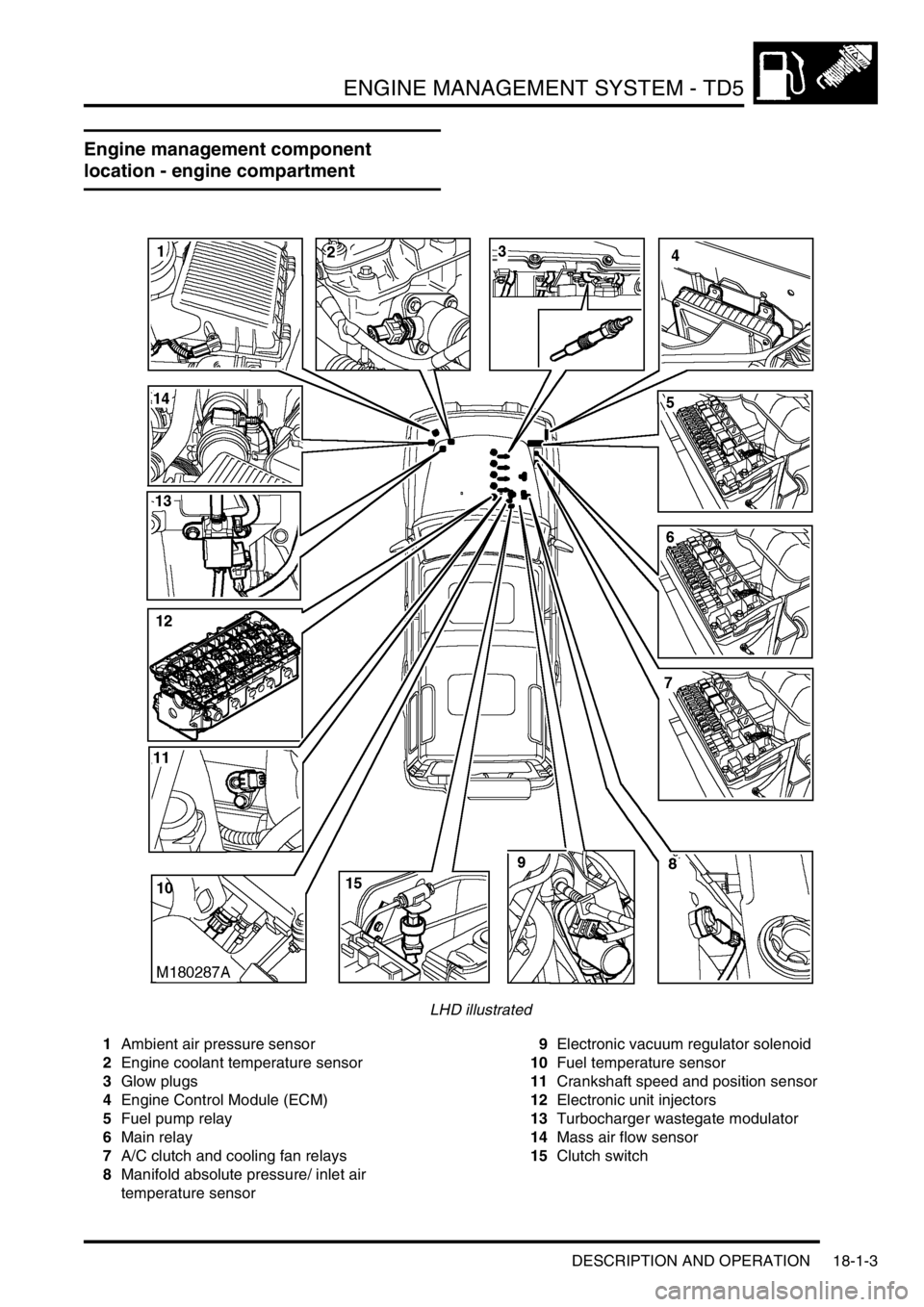
ENGINE MANAGEMENT SYSTEM - TD5
DESCRIPTION AND OPERATION 18-1-3
Engine management component
location - engine compartment
LHD illustrated
1Ambient air pressure sensor
2Engine coolant temperature sensor
3Glow plugs
4Engine Control Module (ECM)
5Fuel pump relay
6Main relay
7A/C clutch and cooling fan relays
8Manifold absolute pressure/ inlet air
temperature sensor9Electronic vacuum regulator solenoid
10Fuel temperature sensor
11Crankshaft speed and position sensor
12Electronic unit injectors
13Turbocharger wastegate modulator
14Mass air flow sensor
15Clutch switch
Page 398 of 1672

ENGINE MANAGEMENT SYSTEM - TD5
DESCRIPTION AND OPERATION 18-1-5
1Mass air flow sensor
2Ambient air pressure sensor
3Manifold absolute pressure/ inlet air
temperature sensor
4Engine coolant temperature sensor
5Crankshaft speed and position sensor
6Throttle position sensor
7Fuel temperature sensor
8Brake pedal switch
9Clutch switch
10High/ Low ratio switch
11Main relay
12Malfunction indicator lamp
13Fuel pump relay
14Glow plug warning lamp
15Glow plugs16Electronic unit injectors
17Turbocharger wastegate modulator
18EGR modulator
19Diagnostic connector
20Engine control module
21Cruise control master switch
22Cruise control SET+ switch
23Cruise control RES switch
24Air conditioning clutch relay
25Air conditioning cooling fan relay
26Electronic automatic transmission ECU
27Self levelling and anti-lock brakes ECU
28Instrument cluster
29Body control unit
Page 399 of 1672

ENGINE MANAGEMENT SYSTEM - TD5
18-1-6 DESCRIPTION AND OPERATION
Description
General
An engine control module (ECM) controls the five-cylinder direct injection diesel engine, and works on the drive by
wire principle. This means there is no throttle cable, the ECM controls the drivers needs via a signal from the Throttle
Position (TP) sensor on the throttle pedal.
The ECM is a full authoritative diesel specific microprocessor that also incorporates features for cruise control and air
conditioning control. In addition, the ECM supplies output control for the exhaust gas recirculation and turbocharger
boost pressure. The ECM has a self-diagnostic function, which is able to provide backup strategies for most sensor
failures.
The ECM processes information from the following input sources:
lMass air flow sensor.
lAmbient air pressure sensor.
lManifold absolute pressure/inlet air temperature sensor.
lEngine coolant temperature sensor.
lCrankshaft speed and position sensor.
lThrottle position sensor.
lFuel temperature sensor.
lAir conditioning request.
lAir conditioning fan request.
lBrake pedal switch.
lClutch switch.
lCruise control master switch.
lCruise control SET+ switch.
lCruise control RES switch.
lHigh/low ratio switch.
The input from the sensors constantly updates the ECM with the current operating condition of the engine. Once the
ECM has compared current information with stored information within its memory, it can make any adjustment it
requires to the operation of the engine via the following:
lAir conditioning clutch relay.
lAir conditioning cooling fan relay.
lElectronic vacuum regulator solenoid.
lMalfunction indicator lamp.
lFuel pump relay.
lGlow plug warning lamp.
lGlow plugs.
lFuel injectors.
lMain relay.
lTurbocharger wastegate modulator.
lTemperature gauge.
The ECM interfaces with the following:
lElectronic Automatic Transmission (EAT).
lSelf Levelling and Anti-lock Brakes System (SLABS).
lSerial communication link.
lInstrument cluster.
lBody Control Unit (BCU).