recommended oil LAND ROVER DISCOVERY 2002 User Guide
[x] Cancel search | Manufacturer: LAND ROVER, Model Year: 2002, Model line: DISCOVERY, Model: LAND ROVER DISCOVERY 2002Pages: 1672, PDF Size: 46.1 MB
Page 126 of 1672
MAINTENANCE
PROCEDURES 10-17
Automatic gearbox
WARNING: Avoid excessive skin contact with
mineral oil. Mineral oils remove the natural fats
from the skin, leading to dryness, irritation and
dermatitis.
Replace oil filter
1.Replace oil filter.
+ AUTOMATIC GEARBOX - ZF4HP22
- 24, REPAIRS, Filter - oil.
Replace oil
1. Ensure that gearbox is cool. Apply
handbrake and securely chock front and rear
wheels.
2.Place a suitable container beneath gearbox.
3.Clean area around oil filler/level and drain
plugs.
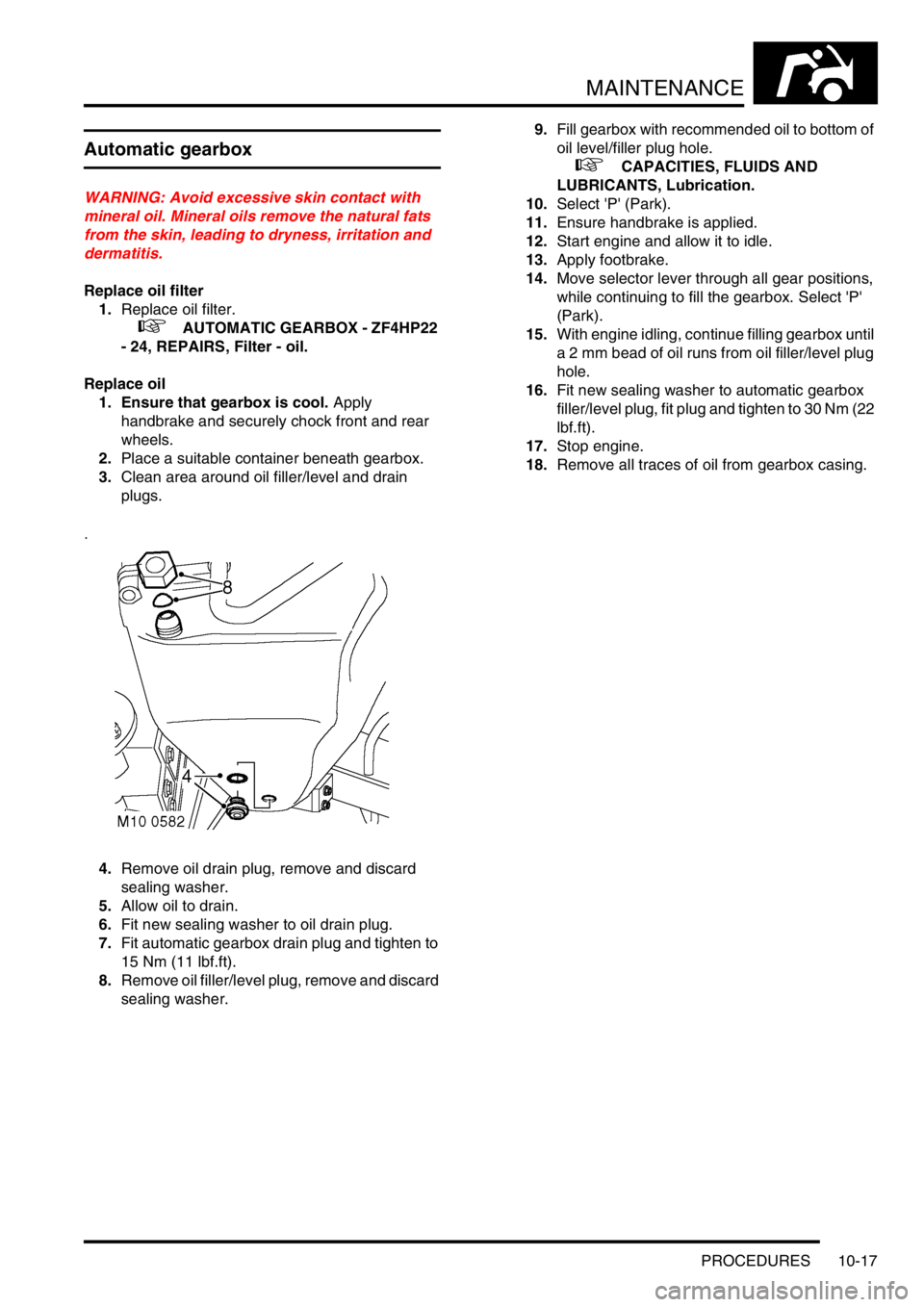
4.Remove oil drain plug, remove and discard
sealing washer.
5.Allow oil to drain.
6.Fit new sealing washer to oil drain plug.
7.Fit automatic gearbox drain plug and tighten to
15 Nm (11 lbf.ft).
8.Remove oil filler/level plug, remove and discard
sealing washer.9.Fill gearbox with recommended oil to bottom of
oil level/filler plug hole.
+ CAPACITIES, FLUIDS AND
LUBRICANTS, Lubrication.
10.Select 'P' (Park).
11.Ensure handbrake is applied.
12.Start engine and allow it to idle.
13.Apply footbrake.
14.Move selector lever through all gear positions,
while continuing to fill the gearbox. Select 'P'
(Park).
15.With engine idling, continue filling gearbox until
a 2 mm bead of oil runs from oil filler/level plug
hole.
16.Fit new sealing washer to automatic gearbox
filler/level plug, fit plug and tighten to 30 Nm (22
l b f . f t ) .
17.Stop engine.
18.Remove all traces of oil from gearbox casing.
Page 127 of 1672

MAINTENANCE
10-18 PROCEDURES
Transfer box
WARNING: Avoid excessive skin contact with
mineral oil. Mineral oils remove the natural fats
from the skin, leading to dryness, irritation and
dermatitis.
Check/top-up oil level
1.Release fixings, remove rear underbelly panel.
2.Clean area around oil filler/level plug.
3.Remove oil filler/level plug.
4.Check that oil level is to bottom of filler/level
plug hole.
5.Top-up level (if required) with recommended oil
to bottom of oil filler/level plug hole.
+ CAPACITIES, FLUIDS AND
LUBRICANTS, Lubrication.
6.Remove all traces of sealant from threads of oil
filler/level plug.
7.Apply Loctite 290 to threads of oil filler/level
plug.
8. Fit transfer box filler/level plug and tighten to 25
Nm (18 lbf.ft).
9.Remove all traces of oil from main casing.
10.Fit rear underbelly panel (if fitted), secure
fixings.Replace oil
1. Release fixings, remove rear underbelly panel.
2.Place a suitable container beneath transfer box
drain plug.
3.Clean area around oil filler/level and drain
plugs.
4.Remove oil filler/level plug.
5.Remove oil drain plug.
6.Allow oil to drain.
7.Apply Loctite 290 to threads of oil drain plug.
8. Fit transfer box drain plug and tighten to 30
Nm (22 lbf.ft).
9.Fill transfer box with recommended oil to
bottom of oil filler/level plug hole.
+ CAPACITIES, FLUIDS AND
LUBRICANTS, Lubrication.
10.Remove all traces of sealant from threads of oil
filler/level plug.
11.Apply Loctite 290 to threads of oil filler/level
plug.
12. Fit transfer box filler/level plug and tighten to 25
Nm (18 lbf.ft).
13. Remove all traces of oil from transfer box.
14.Fit rear underbelly panel (if fitted), secure
fixings.
Page 128 of 1672
MAINTENANCE
PROCEDURES 10-19
Front and rear axle
WARNING: Avoid excessive skin contact with
mineral oil. Mineral oils remove the natural fats
from the skin, leading to dryness, irritation and
dermatitis.
Replace oil
1.Place a suitable container beneath differential
housing of axle to be drained.
2.Clean area around oil filler/level and drain
plugs.
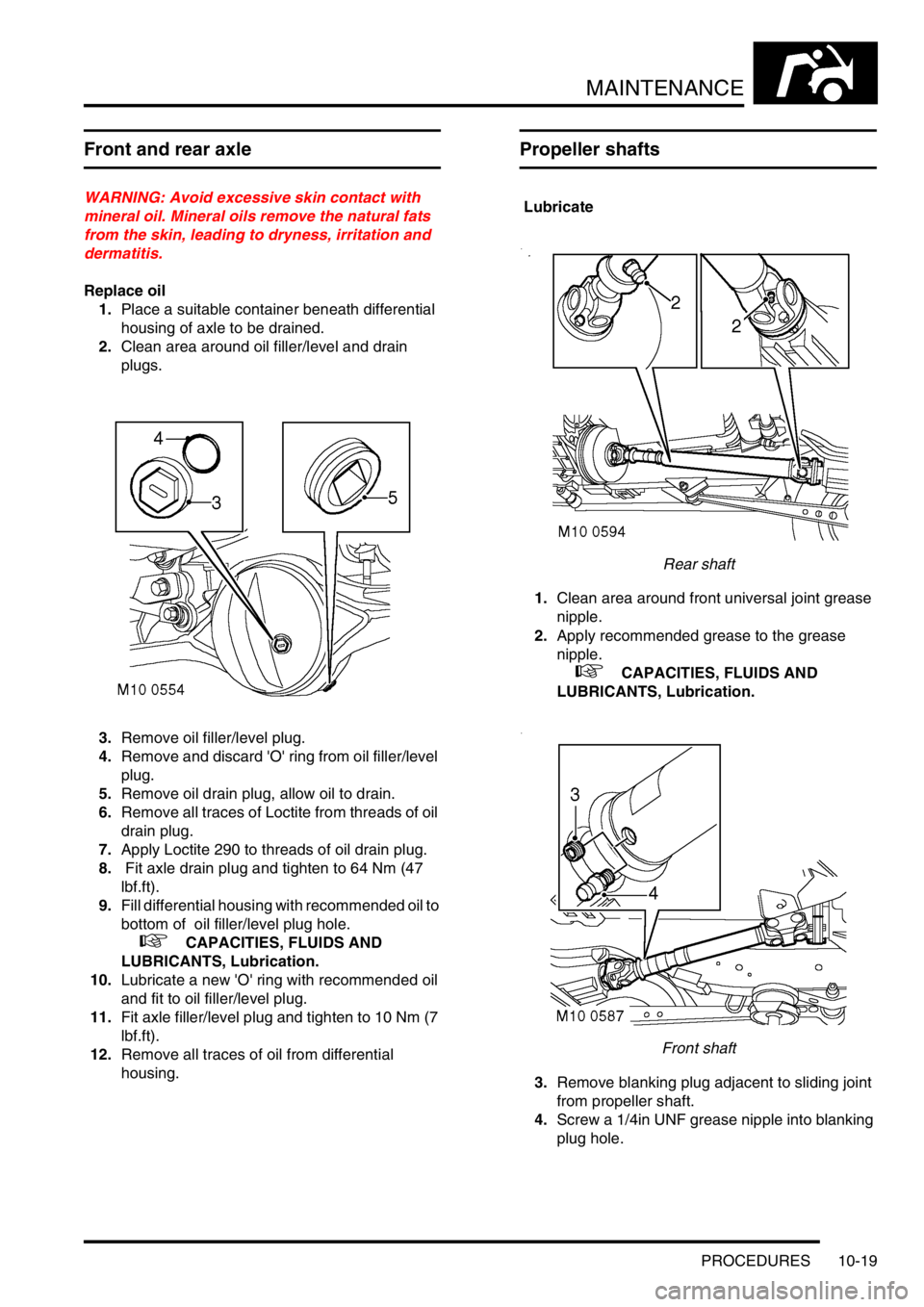
3.Remove oil filler/level plug.
4.Remove and discard 'O' ring from oil filler/level
plug.
5.Remove oil drain plug, allow oil to drain.
6.Remove all traces of Loctite from threads of oil
drain plug.
7.Apply Loctite 290 to threads of oil drain plug.
8. Fit axle drain plug and tighten to 64 Nm (47
lbf.ft).
9.Fill differential housing with recommended oil to
bottom of oil filler/level plug hole.
+ CAPACITIES, FLUIDS AND
LUBRICANTS, Lubrication.
10.Lubricate a new 'O' ring with recommended oil
and fit to oil filler/level plug.
11.Fit axle filler/level plug and tighten to 10 Nm (7
lbf.ft).
12.Remove all traces of oil from differential
housing.
Propeller shafts
Lubricate
Rear shaft
1.Clean area around front universal joint grease
nipple.
2.Apply recommended grease to the grease
nipple.
+ CAPACITIES, FLUIDS AND
LUBRICANTS, Lubrication.
Front shaft
3.Remove blanking plug adjacent to sliding joint
from propeller shaft.
4.Screw a 1/4in UNF grease nipple into blanking
plug hole.
Page 347 of 1672
EMISSION CONTROL - V8
17-2-10 DESCRIPTION AND OPERATION
A spiral oil separator is located in the stub pipe to the ventilation hose on the right hand cylinder head rocker cover,
where oil is separated and returned to the cylinder head. The rubber ventilation hose from the right hand rocker cover
is routed to a port on the right hand side of the inlet manifold plenum chamber where the returned gases mix with the
fresh inlet air passing through the throttle butterfly valve. The stub pipe on the left hand rocker cover does not contain
an oil separator, and the ventilation hose is routed to the throttle body housing at the air inlet side of the butterfly valve.
The ventilation hoses are attached to the stub pipe by metal band clamps.
Exhaust emission control system
The fuel injection system provides accurately metered quantities of fuel to the combustion chambers to ensure the
most efficient air to fuel ratio under all operating conditions. A further improvement to combustion is made by
measuring the oxygen content of the exhaust gases to enable the quantity of fuel injected to be varied in accordance
with the prevailing engine operation and ambient conditions; any unsatisfactory composition of the exhaust gas is
then corrected by adjustments made to the fuelling by the ECM.
The main components of the exhaust emission system are two catalytic converters which are an integral part of the
front exhaust pipe assembly. The catalytic converters are included in the system to reduce the emission to
atmosphere of carbon monoxide (CO), oxides of nitrogen (NO
x) and hydrocarbons (HC). The active constituents of
the catalytic converters are platinum (Pt), palladium (PD) and rhodium (Rh). Catalytic converters for NAS low
emission vehicles (LEVs) from 2000MY have active constituents of palladium and rhodium only. The correct
functioning of the converters is dependent upon close control of the oxygen concentration in the exhaust gas entering
the catalyst.
The two catalytic converters are shaped differently to allow sufficient clearance between the body and transmission,
but they remain functionally identical since they have the same volume and use the same active constituents.
The basic control loop comprises the engine (controlled system), the heated oxygen sensors (measuring elements),
the engine management ECM (control) and the injectors and ignition (actuators). Other factors also influence the
calculations of the ECM, such as air flow, air intake temperature and throttle position. Additionally, special driving
conditions are compensated for, such as starting, acceleration, deceleration, overrun and full load.
The reliability of the ignition system is critical for efficient catalytic converter operation, since misfiring will lead to
irreparable damage of the catalytic converter due to the overheating that occurs when unburned combustion gases
are burnt inside it.
CAUTION: If the engine is misfiring, it should be shut down immediately and the cause rectified. Failure to do
so will result in irreparable damage to the catalytic converter.
CAUTION: Ensure the exhaust system is free from leaks. Exhaust gas leaks upstream of the catalytic
converter could cause internal damage to the catalytic converter.
CAUTION: Serious damage to the engine may occur if a lower octane number fuel than recommended is used.
Serious damage to the catalytic converter and oxygen sensors will occur if leaded fuel is used.
Air : fuel ratio
The theoretical ideal air:fuel ratio to ensure complete combustion and minimise emissions in a spark-ignition engine
is 14.7:1 and is referred to as the stoichiometric ratio.
The excess air factor is denoted by the Lambda symbol
λ, and is used to indicate how far the air:fuel mixture ratio
deviates from the theoretical optimum during any particular operating condition.
lWhen
λ = 1, the air to fuel ratio corresponds to the theoretical optimum of 14.7:1 and is the desired condition for
minimising emissions.
lWhen
λ > 1, (i.e. λ = 1.05 to λ = 1.3) there is excess air available (lean mixture) and lower fuel consumption can
be attained at the cost of reduced performance. For mixtures above
λ = 1.3, the mixture ceases to be ignitable.
lWhen
λ < 1, (i.e. λ = 0.85 to λ = 0.95) there is an air deficiency (rich mixture) and maximum output is available,
but fuel economy is impaired.
The engine management system used with V8 engines operates in a narrower control range about the stoichiometric
ideal between
λ = 0.97 to 1.03 using closed-loop control techniques. When the engine is warmed up and operating
under normal conditions, it is essential to maintain
λ close to the ideal (λ = 1) to ensure the effective treatment of
exhaust gases by the three-way catalytic converters installed in the downpipes from each exhaust manifold.
Page 495 of 1672
ENGINE MANAGEMENT SYSTEM - V8
18-2-38 DESCRIPTION AND OPERATION
Spark plugs
The spark plugs are platinum tipped on both centre and earth electrodes. The platinum tips give a long maintenance
free life.
Cleaning or resetting the spark plug gap is not recommended as this could result in damaging the platinum tips and
thereby reducing reliability.
The misfire detection system will malfunction and store erroneous codes if the incorrect spark plugs are used.
Input/Output
The ignition coils provide a voltage to the spark plugs via the ht leads. The cylinder head via the individual thread of
each spark plug provides the earth path.
The spark plugs can fail in the following ways:
lFaulty component.
lConnector or wiring fault.
lBreakdown of high tension lead causing tracking to chassis earth.
lIncorrect spark plugs fitted.
In the event of a spark plug failure, misfire on specific cylinder may be observed:
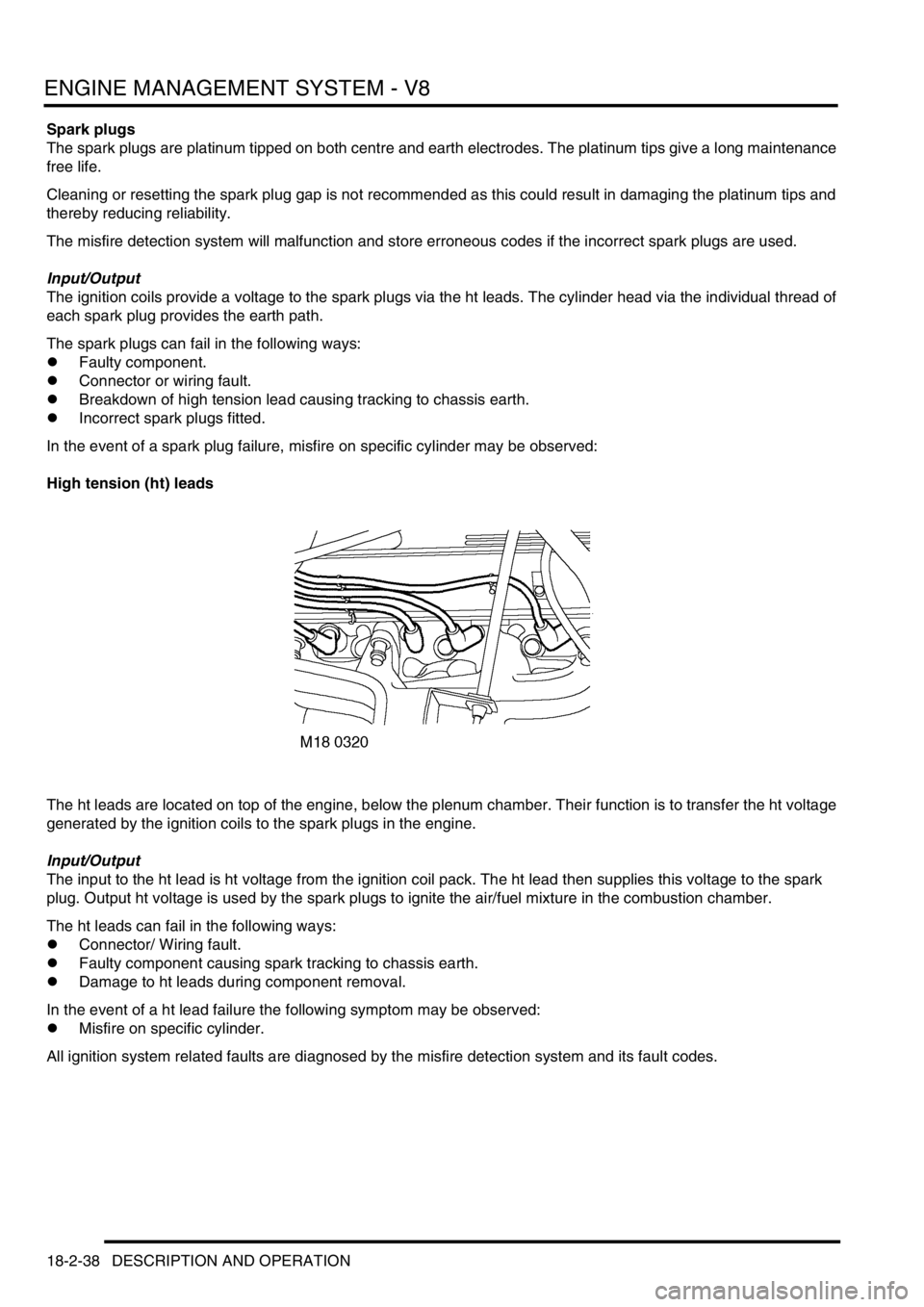
High tension (ht) leads
The ht leads are located on top of the engine, below the plenum chamber. Their function is to transfer the ht voltage
generated by the ignition coils to the spark plugs in the engine.
Input/Output
The input to the ht lead is ht voltage from the ignition coil pack. The ht lead then supplies this voltage to the spark
plug. Output ht voltage is used by the spark plugs to ignite the air/fuel mixture in the combustion chamber.
The ht leads can fail in the following ways:
lConnector/ Wiring fault.
lFaulty component causing spark tracking to chassis earth.
lDamage to ht leads during component removal.
In the event of a ht lead failure the following symptom may be observed:
lMisfire on specific cylinder.
All ignition system related faults are diagnosed by the misfire detection system and its fault codes.
Page 750 of 1672
TRANSFER BOX - LT230SE
DESCRIPTION AND OPERATION 41-17
Lubrication
Lubrication is by splash, oil filler/level and drain plugs being located in the main casing.
Internal pressures caused by thermal expansion and contraction are avoided by the use of a plastic breather pipe
venting the interior of the box to atmosphere. The pipe is attached to the top of the high/low selector housing by a
banjo bolt and is then routed in a continuously rising path into the engine compartment where the open end is secured
by a clip attached to the engine cylinder block.
Oil temperature warning lamp switch
An oil temperature switch is fitted to V8 engine models. In the event of the transfer box oil approaching maximum
recommended working temperature of 145
°C (293°F), the switch will close and a warning lamp in the instrument pack
will be illuminated.
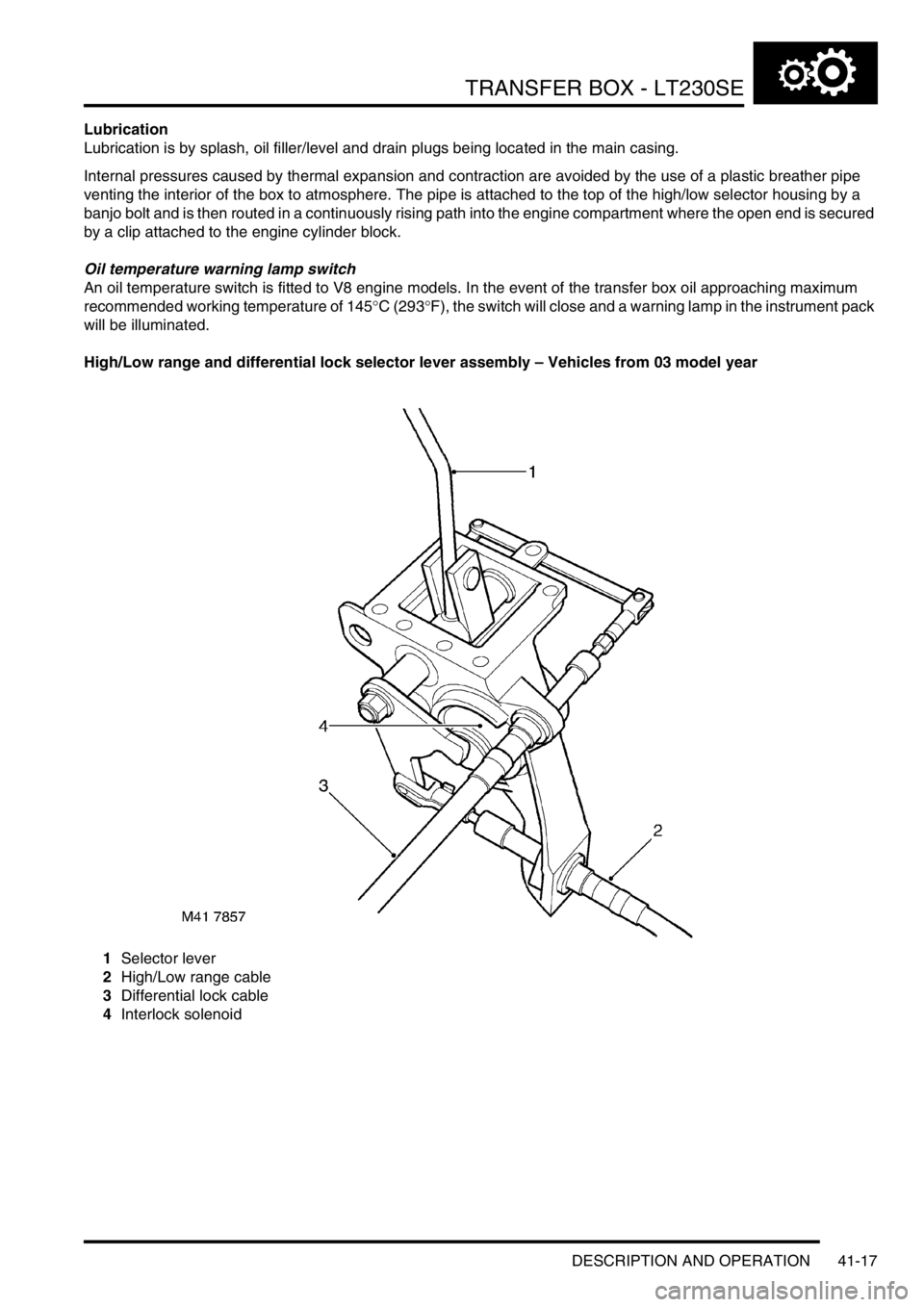
High/Low range and differential lock selector lever assembly – Vehicles from 03 model year
1Selector lever
2High/Low range cable
3Differential lock cable
4Interlock solenoid
Page 782 of 1672

TRANSFER BOX - LT230SE
OVERHAUL 41-49
19.Check width of high/low selector groove.
lGroove width = 16.0 to 16.1 mm (0.63 to
0.64 in).
20.Check high/low selector fork for cracks and
wear. Check selector fork finger width.
lFinger width = 7.37 to 7.47 mm (0.290 to
0.294 in).
21.03 MY onwards: Check high/low selector fork
clips for wear and damage. Check spring for
distortion, check free length of spring:
lSpring free length = 75 mm (2.95 in)
Note: High/low selector shaft, fork and spring
fitted to 03 MY transfer boxes may be fitted to
pre 03 MY boxes as an assembly.
22.Check differential sun and planet gears for
wear, cracks and chipping of teeth.
23.Check cross shafts and recesses in both halves
of differential carrier for damage and
wear.Ensure planet gears are retained with
their respective shafts.
24.Check retaining ring for distortion.
25.Check differential splines for wear and
damage.26.Check high/low hub for cracks, chipping and
uneven wear. Check width of selector fork
groove.
lGroove width = 7.5 to 7.6 mm (0.295 to 0.30
in).
27.Check splines and teeth on high/low selector
sleeve for uneven wear, cracks, damage and
chipping.
28.Check teeth of high and low range gears for
cracks, chipping and uneven wear.
29.Check high range gear bush for wear and
damage.
Reassembly
1.Lubricate all components with recommended
oil and lightly oil the differential bolt threads.
Page 795 of 1672
TRANSFER BOX - LT230SE
41-62 OVERHAUL
7.Position dial gauge with stylus contacting input
gear, push input gear rearwards and zero
gauge.
8.Push input gear forwards and note gauge
reading.
9.Calculate thickness of shim required using the
formula - A+B+C=D where:
lA= Thickness of installed shim - 3.15 mm
(0.12 in)
lB= Recorded end-float.
lC= Required pre-load - 0.05 mm (0.002 in).
lD= Thickness of shim required.
10.If an alternative shim is required to establish
correct pre-load, fit an alternative shim. Shims
are available from 3.15 to 4.00 mm (0.12 to
0.16 in) thickness, in increments of 0.05 mm
(0.002 in).
11.Remove 2 bolts, remove bearing housing and
input gear.
12.Lubricate input gear and bearings with
recommended oil.
13.Position input gear into main casing.
14.Apply sealant, Part No. STC 3254 to bearing
housing and cover.
15.Position bearing housing/cover, align reference
marks and tighten by diagonal selection to 45
Nm (33 lbf.ft).
16.Using tool LRT-37-014 fit new input shaft oil
seal.
Low gear - differential
$% 41.20.62
Disassembly
1.Remove differential.
+ TRANSFER BOX - LT230SE,
OVERHAUL, Dog clutch - differential lock.
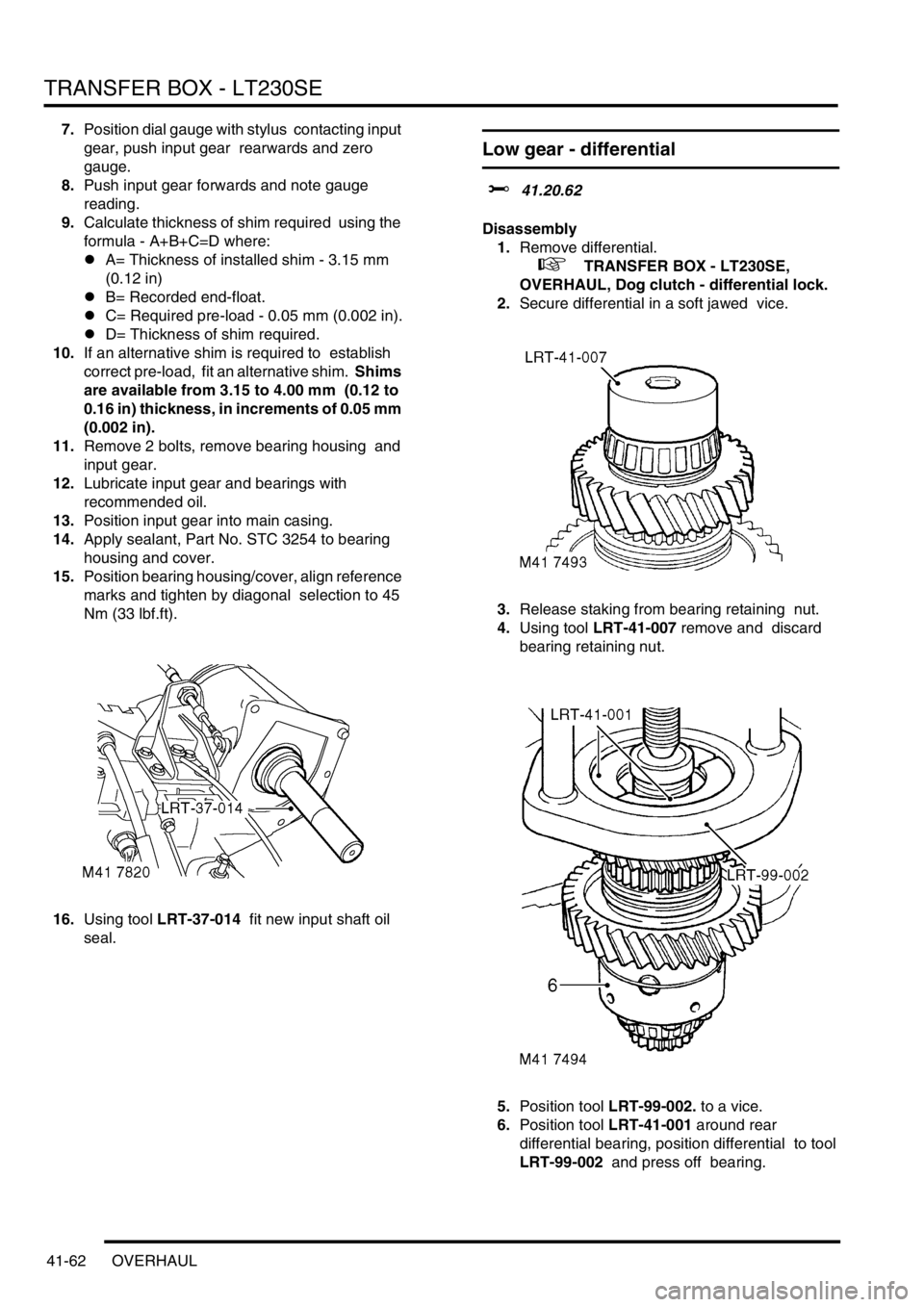
2.Secure differential in a soft jawed vice.
3.Release staking from bearing retaining nut.
4.Using tool LRT-41-007 remove and discard
bearing retaining nut.
5.Position tool LRT-99-002. to a vice.
6.Position tool LRT-41-001 around rear
differential bearing, position differential to tool
LRT-99-002 and press off bearing.