water pump LAND ROVER DISCOVERY 2002 User Guide
[x] Cancel search | Manufacturer: LAND ROVER, Model Year: 2002, Model line: DISCOVERY, Model: LAND ROVER DISCOVERY 2002Pages: 1672, PDF Size: 46.1 MB
Page 555 of 1672

FUEL DELIVERY SYSTEM - TD5
19-1-10 DESCRIPTION AND OPERATION
Water sensor
The water sensor has a three pin electrical connector. When the sensor detects water in the filter it illuminates a
warning lamp in the instrument pack .
+ INSTRUMENTS, DESCRIPTION AND OPERATION, Description.
The water sensor attachment thread has a slot machined down one side. The filter can be purged of water by partially
unscrewing the sensor which aligns the slot in the threads with a corresponding hole in the sensor. When aligned,
water and fuel can flow down the slot and flows from a small cast tube on the side of the sensor. Re-tightening the
sensor misaligns the slot and stops the flow of fuel.
The water sensor receives a battery supply from the fuel pump relay in the engine compartment fusebox on one of
the electrical connector pins. The two remaining pins are connected to the instrument pack and an earth header joint.
The sensor operation uses the measurement of resistance between two electrodes submerged in the fuel and
activated by the presence of water.
When the ignition is moved to position II the warning lamp will illuminate for approximately two seconds to check
warning lamp functionality. TestBook can also illuminate the warning lamp to check its functionality.
When the filter is full with fuel and no water is present the resistance of the Diesel fuel will show a reading of 15 mA
maximum on the feed wire to the instrument pack. This current will not illuminate the water sensor warning lamp in
the instrument pack. When sufficient water surrounds both electrodes the resistance of the water will show a reading
of 130 mA maximum. This will supply sufficient voltage to the instrument pack to illuminate the warning lamp to alert
the driver to the presence of water in the fuel system.
Page 588 of 1672

COOLING SYSTEM - TD5
DESCRIPTION AND OPERATION 26-1-5
Description
General
The cooling system used on the Diesel engine is a pressure relief by-pass type system which allows coolant to
circulate around the engine block and heater circuit when the thermostat is closed. With coolant not passing through
the by-pass or the radiator promotes faster heater warm-up which in turn improves passenger comfort.
A coolant pump is mounted on a casting behind the PAS pump and is driven from the PAS pump at crankshaft speed
by the auxiliary drive belt. The pump mounting casting connects with passages in the cylinder block and pumps
coolant from the radiator through the cylinder block.
A viscous fan is attached to an idler pulley at the front of the engine. The fan is attached to a threaded spigot on the
pulley with a left hand threaded nut. The fan draws air through the radiator to assist in cooling when the vehicle is
stationary. The fan rotational speed is controlled relative to the running temperature of the engine by a thermostatic
valve regulated by a bi-metallic coil.
The cooling system uses a 50/50 mix of anti-freeze and water.
A Fuel Burning Heater (FBH) is available as an optional item for Diesel engine variants. The FBH is located on the
bulkhead and is connected in series in the coolant supply to the heater. The FBH is used to compensate for the
relatively low coolant temperatures inherent in the Diesel engine.
+ HEATING AND VENTILATION, DESCRIPTION AND OPERATION, Description.
Thermostat housing
A plastic thermostat housing is located behind the radiator. The housing has three connections which locate the
radiator bottom hose, top hose and coolant pump feed pipe. The housing contains a wax element thermostat and a
spring loaded by-pass flow valve.
Thermostat - Main valve
The thermostat is used to maintain the coolant at the optimum temperature for efficient combustion and to aid engine
warm-up. The thermostat is closed at temperatures below approximately 82
°C (179°F). When the coolant
temperature reaches approximately 82
°C the thermostat starts to open and is fully open at approximately 96°C
(204
°F). In this condition the full flow of coolant is directed through the radiator.
The thermostat is exposed to 90% hot coolant from the engine on one side and 10% cold coolant returning from the
radiator bottom hose on the other side.
Hot coolant from the engine passes from the by-pass pipe through four sensing holes in the flow valve into a tube
surrounding 90% of the thermostat sensitive area. Cold coolant returning from the radiator, cooled by the ambient air,
conducts through 10% of the thermostat sensitive area.
In cold ambient temperatures, the engine temperature is raised approximately 10
°C (50°F) to compensate for the heat
loss of 10% exposure to the cold coolant returning from the radiator bottom hose.
By-pass flow valve
The by-pass flow valve is held closed by a light spring. It operates to further aid heater warm-up. When the main valve
is closed and the engine speed is below 1500 rev/min, the coolant pump does not produce sufficient flow and pressure
to open the valve. In this condition the valve prevents coolant circulating through the by-pass circuit and forces the
coolant through the heater matrix only. This provides a higher flow of warm coolant through the heater matrix to
improve passenger comfort in cold conditions.
When the engine speed increases above 1500 rev/min the coolant pump produces a greater flow and pressure than
the heater circuit can take. The pressure acts on the flow valve and overcomes the valve spring pressure, opening
the valve and limiting the pressure in the heater circuit. The valve modulates to provide maximum coolant flow through
the heater matrix and yet allowing excess coolant to flow into the by-pass circuit to provide the engines cooling needs
at higher engine rev/min.
Page 590 of 1672
COOLING SYSTEM - TD5
DESCRIPTION AND OPERATION 26-1-7
Pipes and hoses
The coolant circuit comprises flexible hoses and metal formed pipes which direct the coolant into and out of the
engine, radiator and heater matrix. Plastic pipes are used for the bleed and overflow pipes to the expansion tank.
A bleed screw is installed in the radiator top hose and is used to bleed air during system filling. A drain plug to drain
the heater and cylinder block circuit of coolant is located on the underside of the coolant pump feed pipe.
Oil cooler
The oil cooler is located on the left hand side of the engine block behind the oil centrifuge and oil filter. Oil from the oil
pump is passed through a heat exchanger which is surrounded by coolant in a housing on the side of the engine.
Full water pump flow is directed along the cooler housing which also distributes the flow evenly along the block into
three core holes for cylinder cooling. This cools the engine oil before it is passed into the engine. A small percentage
of the coolant from the oil cooler passes into a metal pipe behind the engine. It then flows into the lower radiator via
a hose.
Fuel cooler
The fuel cooler is located on the right hand side of the engine and is attached to the inlet manifold. The cooler is
cylindrical in design and has a coolant feed connection at its forward end. A 'T' connection at the rear of the cooler
provides a connection for the coolant return from the heater matrix and coolant return from the fuel cooler.
The 'T' connection houses a thermostat which opens at approximately 82
°C. This prevents the cooler operating in
cold climates.
Two quick release couplings on the cooler allow for the connection of the fuel feed from the pressure regulator and
return to the fuel tank. A counter flow system is used within the cooler.
Fuel flows around a coolant jacket within the cooler and flows from the back to the front of the cooler. As the hot fuel
cools travelling slowly forwards it meets progressively colder coolant travelling in the opposite direction maintaining a
differential cooling effect.
EGR Cooler
The EGR Cooler is mounted on the front of the cylinder head. Coolant from the oil cooler flows around the EGR cooler,
cooling the exhaust gas, to improve exhaust emissions, before being returned to the expansion tank.
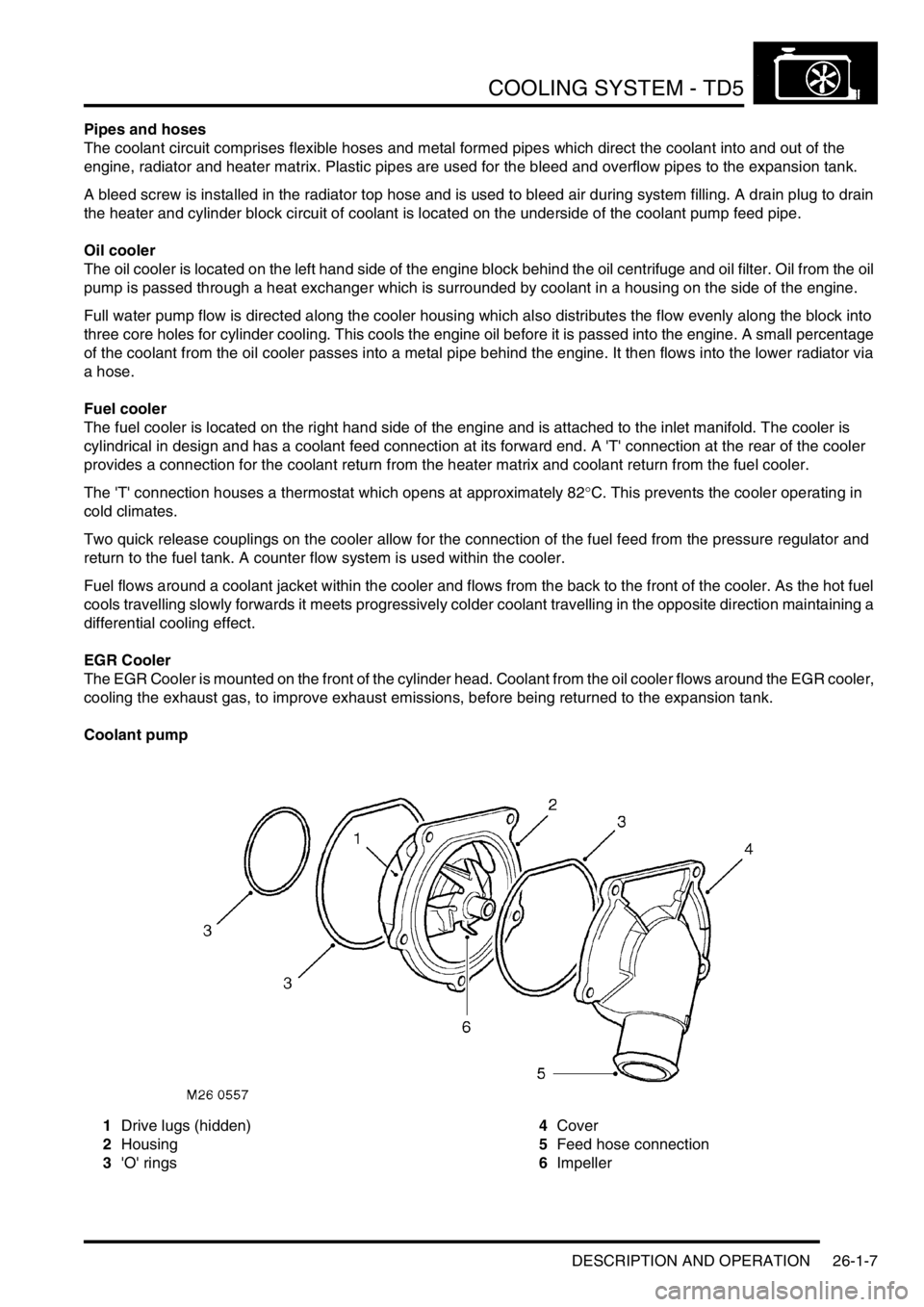
Coolant pump
1Drive lugs (hidden)
2Housing
3'O' rings4Cover
5Feed hose connection
6Impeller
Page 596 of 1672

COOLING SYSTEM - TD5
ADJUSTMENTS 26-1-13
ADJUST ME NTS
Drain and refill
$% 26.10.01
WARNING: Since injury such as scalding could
be caused by escaping steam or coolant, do not
remove the filler cap from the coolant expansion
tank while the system is hot.
Drain
1.Visually check engine and cooling system for
signs of coolant leaks.
2.Examine hoses for signs of cracking, distortion
and security of connections.
3.Position drain tray to collect coolant.
4.Remove expansion tank filler cap.
5.Remove drain plug access cover from
underbelly panel.
6.Remove drain plug from coolant pump feed
pipe and allow cooling system to drain. Discard
drain plug sealing washer.
Refill
1.Flush system with water under low pressure.
Do not use water under high pressure as it
could damage the radiator.
2.Fit new sealing washer to drain plug. Fit and
tighten drain plug in coolant pump feed pipe.
3.Fit access cover to underbelly panel.
4.Prepare coolant to required concentration.
+ CAPACITIES, FLUIDS AND
LUBRICANTS, Anti-Freeze Concentration.5.Remove bleed screw from top hose.
6.Unclip the bleed hose from the battery box.
7.Unclip the expansion tank from its mounting
bracket, remove the expansion tank cap and
raise the expansion tank vertically 10 cm (4 in).
Retain the tank in this position.
8.Slowly fill the system through the coolant
expansion tank until a steady flow of coolant is
emitted from the bleed hole.
9.Fit the bleed screw, then, with the expansion
tank still raised, continue filling the system until
coolant level reaches the cold level mark on
expansion tank.
10.Fit expansion tank filler cap, fit the expansion
tank to its mounting bracket and clip the bleed
hose to the battery box.
11.Start and run engine until normal operating
temperature is reached, and check for leaks.
12.Switch off engine and allow to cool.
13.Check for leaks and top-up coolant to the cold
level mark on expansion tank
Page 607 of 1672

COOLING SYSTEM - V8
26-2-6 DESCRIPTION AND OPERATION
Description
General
The cooling system used on the V8 engine is a pressure relief by-pass type system which allows coolant to circulate
around the cylinder block and the heater circuit when the thermostat is closed. With coolant not passing through the
radiator, this promotes faster heater warm-up which in turn improves passenger comfort.
A coolant pump is located in a housing at the front of the engine and is driven by a drive belt. The pump is connected
into the coolant passages cast in the cylinder block and pumps coolant from the radiator through the cylinder block.
A viscous fan is attached by means of a nut to the coolant pump pulley drive spindle. The fan draws air through the
radiator to assist in cooling when the vehicle is stationary. The fan rotational speed is controlled relative to the running
temperature of the engine by a thermostatic valve regulated by a bi-metallic coil.
The cooling system uses a 50/50 mix of anti-freeze and water.
Thermostat housing
A plastic thermostat housing is located behind the radiator. The housing has three connections which locate the
radiator bottom hose, top hose and coolant pump feed hose. The housing contains a wax element and a spring loaded
by-pass flow valve.
Thermostat - Main valve
The thermostat is used to maintain the coolant at the optimum temperature for efficient combustion and to aid engine
warm-up. The thermostat is closed at temperatures below approximately 82
°C (179°F). When the coolant
temperature reaches approximately 82
°C the thermostat starts to open and is fully open at approximately 96°C
(204
°F). In this condition the full flow of coolant is directed through the radiator.
The thermostat is exposed to 90% hot coolant from the engine on one side and 10% cold coolant returning from the
radiator bottom hose on the other side.
Hot coolant from the engine passes from the by-pass pipe through four sensing holes in the flow valve into a tube
surrounding 90% of the thermostat sensitive area. Cold coolant returning from the engine, cooled by the radiator,
conducts through 10% of the sensitive area.
In cold ambient temperatures, the engine temperature is raised by approximately 10
°C (50°F) to compensate for the
heat loss of 10% exposure to the cold coolant returning from the bottom hose.
By-pass flow valve
The by-pass flow valve is held closed by a light spring. It operates to further aid heater warm-up. When the main valve
is closed and the engine speed is at idle, the coolant pump does not produce sufficient flow and pressure to open the
valve. In this condition the valve prevents coolant circulating through the by-pass circuit and forces the coolant through
the heater matrix only. This provides a higher flow of coolant through the heater matrix to improve passenger comfort
in cold conditions.
When the engine speed increases above idle the coolant pump produces a greater flow and pressure than the heater
circuit can take. The pressure acts on the flow valve and overcomes the valve spring pressure, opening the valve and
limiting the pressure in the heater circuit. The valve modulates to provide maximum coolant flow through the heater
matrix and yet allowing excess coolant to flow into the by-pass circuit to provide the engine's cooling needs at higher
engine rev/min.
Page 609 of 1672

COOLING SYSTEM - V8
26-2-8 DESCRIPTION AND OPERATION
Pipes and hoses
The coolant circuit comprises flexible hoses and metal formed pipes which direct coolant into and out of the engine,
radiator and heater matrix. Plastic pipes are used for the bleed and overflow pipes to the expansion tank.
A bleed screw is installed in the radiator top hose and is used to bleed air during system filling. A drain plug is fitted
to each cylinder bank in the cylinder block. These are used to drain the block of coolant.
Coolant pump
1Pulley flange
2Body
3Impeller
4Gallery
5Inlet connection
The coolant pump is attached to the front of the cylinder block with nine bolts and sealed between the pump housing
and the cylinder block with a gasket. The pump comprises a shaft which passes through an alloy housing. The outer
end of the shaft has a flange which allows for the attachment of the pump drive pulley which is secured with three
bolts. The drive pulley is driven by the grooved auxiliary drive belt and rotates at the same speed as the crankshaft.
The inner end of the shaft is fitted with an impeller which draws coolant from the thermostat housing and circulates it
through the galleries in the cylinder block and through the heater matrix.
The shaft is supported on bearings in the housing which are packed with grease and sealed for life. A seal is
positioned in the housing to further protect the bearings from the ingress of coolant. The seal is manufactured from a
synthetic material which will allow for expansion of the casing when hot coolant is present.
The cast alloy housing has a hose connection which provides the attachment for the coolant pump feed hose. The
cast housing connects with galleries in the cylinder block and distributes coolant from the pump impeller into the
galleries and water jackets.
Page 614 of 1672

COOLING SYSTEM - V8
ADJUSTMENTS 26-2-13
ADJUST ME NTS
Drain and refill
$% 26.10.01
WARNING: Since injury such as scalding could
be caused by escaping steam or coolant, do not
remove the filler cap from the coolant expansion
tank while the system is hot.
Drain
1.Visually check engine and cooling system for
signs of coolant leaks.
2.Examine hoses for signs of cracking, distortion
and security of connections.
3.Position drain tray to collect coolant.
4.Remove expansion tank filler cap.
LH side
RH side5.Remove drain plugs from LH and RH sides of
cylinder block and allow cooling system to
drain.
6.Disconnect bottom hose from radiator and
allow cooling system to drain.
7.Disconnect top hose from thermostat and
position open end of hose below level of
coolant pump inlet, to allow coolant to drain
from the system.
Refill
1.Flush system with water under low pressure.
Do not use water under high pressure as it
could damage the radiator.
2.Apply Loctite 577 to cylinder block drain
plugs.Fit drain plugs to cylinder block and
tighten to 30 Nm (22 lbf.ft).
3.Connect bottom hose to radiator and top hose
to thermostat housing. Secure with hose clips.
4.Prepare coolant to required concentration.
+ CAPACITIES, FLUIDS AND
LUBRICANTS, Anti-Freeze Concentration.
Page 901 of 1672

STEERING
57-14 DESCRIPTION AND OPERATION
The PAS pump is located on the auxiliary housing, two bolts go through the PAS pump, mounting bracket and into
the auxiliary housing. One bolt also attaches the mounting bracket to the PAS pump, two bolts secure the mounting
bracket to the auxiliary housing. An inlet adaptor pipe with a seal is secured to the bottom of the pump with two bolts.
A drive pulley is attached to the pump drive shaft with three bolts, and is belt driven at a ratio of 1.35 crankshaft
revolutions to 1 of the drive pulley. A coupling on the rear of the PAS pump rotates the water pump impeller located
in the auxiliary housing. Fluid is supplied to the PAS pump inlet from the reservoir through a flexible hose at low
(suction) pressure. Fluid at high pressure from the PAS pump outlet is supplied to the rotary control valve on the
steering box.
The PAS pump is a roller vane type and has an internal pressure regulator and flow control valve. The roller vanes
can move in slots in the pumps rotor and are moved outwards by centrifugal force as the pump rotates. The pump
rotor rotates in the pump housing, the internal shape of the housing forms a 'cam' shape. Due to the 'cam' shape the
volume of the housing decreases between the inlet and outlet ports.
As the pump rotor rotates towards the pump inlet the volume between the roller vanes and the pump housing
increases, this action causes a depression in the chamber between the pump roller vanes and the housing. As the
rotation continues the chamber is opened to the pump inlet, and the depression in the chamber causes fluid to be
drawn in. The roller vanes continue past the inlet port, closing off the inlet port and trapping the fluid in the chamber
between the rollers and the pump housing.
The internal 'cam' shape of the pump housing causes the rollers to move closer together as the pump rotor rotates
towards the outlet port. The reduced volume of the chamber between the roller vanes causes the fluid to become
pressurised. When the chamber is opened to the outlet port of the pump the fluid escapes at high pressure. The roller
vanes continue turning and go past the outlet port, closing off the chamber between the two roller vanes.
As rotation continues the inlet sequence begins again. The inlet and pressurisation/outlet sequences continue as the
pump rotates, and is repeated between each two roller vanes. The pump is a positive displacement type and the
potential pump output increases with engine (drive pulley) speed. The pressure relief and flow control valve regulates
flow/pressure by diverting fluid back to the pump inlet through internal recirculation passages in the pump body.
Steering damper
The steering damper is located behind and just below the first cross member of the chassis. The ends of the steering
damper have steel 'eyes' welded on, rubber bushes are installed in each 'eye'. The steering damper is attached
between brackets on the chassis rail and the drag link. Each end of the steering damper is secured by a bolt and
locknut. The hydraulic damper absorbs shocks in the steering, caused by road wheel deflections when operating on
rough terrain.
Page 1092 of 1672

BRAKES
REPAIRS 70-47
Sensor – ABS – rear
$% 70.65.31
ABS sensor is supplied fitted to wheel hub and
must not be removed.
Remove
1.Remove wheel hub.
+ REAR SUSPENSION, REPAIRS,
Wheel hub.
Refit
1.Fit wheel hub.
+ REAR SUSPENSION, REPAIRS,
Wheel hub.
Modulator unit - ABS
$% 70.65.49
Remove
1.Position cloth under modulator to absorb fluid
spillage.
CAUTION: Brake fluid will damage paint
finished surfaces. If spilled, immediately
remove fluid and clean area with water.
2.Disconnect 3 multiplugs from ABS modulator.
3.Disconnect 2 inlet brake pipe unions from pump
side of modulator.
CAUTION: Always fit plugs to open
connections to prevent contamination.
4.Disconnect 4 outlet brake pipe unions from top
of modulator.
CAUTION: Always fit plugs to open
connections to prevent contamination.
5.Loosen 3 nuts securing modulator to mounting
bracket.
6.Release and remove modulator from mounting
bracket.
7.Remove 3 mounting rubbers from modulator.
Page 1657 of 1672
INSTRUMENTS
88-30 DESCRIPTION AND OPERATION
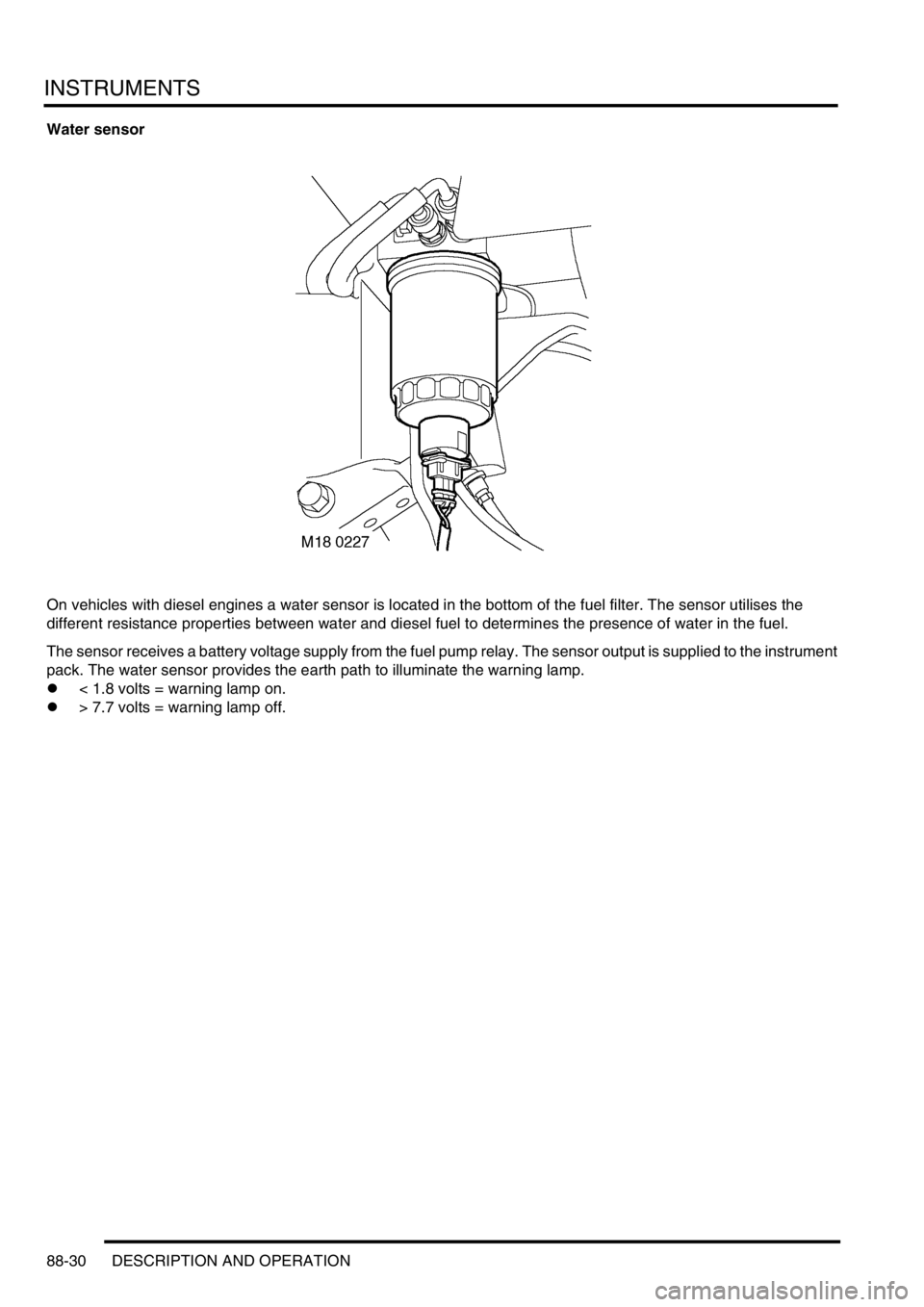
Water sensor
On vehicles with diesel engines a water sensor is located in the bottom of the fuel filter. The sensor utilises the
different resistance properties between water and diesel fuel to determines the presence of water in the fuel.
The sensor receives a battery voltage supply from the fuel pump relay. The sensor output is supplied to the instrument
pack. The water sensor provides the earth path to illuminate the warning lamp.
l< 1.8 volts = warning lamp on.
l> 7.7 volts = warning lamp off.