earth LAND ROVER DISCOVERY 2002 Workshop Manual
[x] Cancel search | Manufacturer: LAND ROVER, Model Year: 2002, Model line: DISCOVERY, Model: LAND ROVER DISCOVERY 2002Pages: 1672, PDF Size: 46.1 MB
Page 1522 of 1672

ALARM SYSTEM AND HORN
DESCRIPTION AND OPERATION 86-4-13
Battery Backed-up Sounder (BBUS)
The BBUS is located behind the rear quarter trim panel on the right hand side of the vehicle and is utilised as an
additional alarm warning device. It has a self contained power source allowing it to operate when the vehicle battery
is disconnected.
NOTE: Always disarm the BBUS before carrying out any procedures related to the BBUS.
Input/Output
The BBUS utilises a 12 volts power supply from fuse 20 (15 amperes) located in the passenger compartment fusebox
via a relay to charge the self contained battery.
When the alarm is triggered, the BCU is pulled high internally triggering the BBUS to sound continuously for 30
seconds.
The BCU sets the BBUS to its internal battery backed mode when the vehicle battery is disconnected.
If a mislock occurs the BCU triggers the BBUS for a period of 50 ms.
The BCU triggers the BBUS once for a period of 50 ms when an EKA code is requested.
When the EKA code is entered correctly, the BBUS will operate twice for a period of 50 ms on, 200 ms off.
The BBUS utilises a dedicated earth path.
Page 1523 of 1672

ALARM SYSTEM AND HORN
86-4-14 DESCRIPTION AND OPERATION
Vehicle horn/alarm sounder
Vehicle horn
Alarm sounder
Depending on system configuration, the alarm sounder will either sound independently or in conjunction with the
vehicle horns as an alarm triggered warning. The alarm sounder is located under the bonnet on the bulkhead. If the
alarm is triggered, the alarm sounder operates at 0.5 second intervals in phase with the direction indicators.
Input/Output
The BCU provides an earth path for the alarm sounder relay situated in the passenger compartment fuse box.
Fuse 21 supplies battery power to the alarm sounder relay. When an unauthorised entry to the vehicle is detected,
the BCU provides an earth path for the alarm sounder relay. This earth path energises the alarm sounder relay, which
activates the alarm sounder.
If a mislock occurs the BCU triggers the alarm sounder 2 times for a period of 50 ms on, 200 ms off.
The BCU triggers the alarm sounder once for a period of 50 ms when an EKA code is requested.
When the EKA code is entered correctly, the alarm sounder will operate twice for a period of 50 ms on, 200 ms off.
The alarm sounder relay has a dedicated signal to the BCU.
Page 1534 of 1672

ALARM SYSTEM AND HORN
REPAIR 86-4-25
REPAIR
Switch - central door locking
$% 86.26.30
Remove
1.Carefully remove clock assembly from louvre
panel.
2.Disconnect multiplug from door lock switch.
3.Remove door lock switch from clock.
Refit
1.Fit door lock switch to clock assembly.
2.Connect multiplug to door lock switch.
3.Position clock assembly and push to secure in
position.
Switches - horn
$% 86.30.01
Remove
WARNING: It is imperative that before any
work is undertaken on the SRS system the
appropriate information is read thoroughly.
1.Disconnect both battery leads, negative lead
first, and wait 10 minutes.
2.Remove driver's airbag module.
+ RESTRAINT SYSTEMS, REPAIRS,
Airbag module - drivers.
3.Release horn switch multiplugs and leads from
steering wheel base.
4.Disconnect horn switch multiplugs from
harness.
5.Disconnect horn switch multiplug from rotary
coupler harness.
6.Remove screw securing earth leads to steering
wheel.
7.Using a broad round edged tool, carefully prise
horn switches from steering wheel.
Refit
1.Fit to steering wheel and connect multiplugs.
2.Fit earth leads and secure with screw.
3.Secure leads and multiplugs to base of steering
wheel.
4.Fit driver's airbag module.
+ RESTRAINT SYSTEMS, REPAIRS,
Airbag module - drivers.
Page 1543 of 1672

WINDOWS
86-5-4 DESCRIPTION AND OPERATION
Description
Body Control Unit (BCU)
RHD shown, LHD similar
The BCU controls all operations for the front windows. It controls the voltage and the earth paths to the window
motors, it controls one-touch down operation and it detects stall conditions. Stall detection protects the system from
sustained high current draw that occurs when a window reaches the fully up/down position or becomes stuck. When
the BCU detects a stall condition, it disables operation at the stalled window until the window switch is released. Upon
releasing the window switch, the BCU allows normal window operation.
The BCU receives power from fuse 34 (30A) of the passenger compartment fusebox. There is a unique earth signal
between each pole of the front window switches and the BCU. This allows the BCU to determine which window motor
to operate as well as which direction to operate the motor. The BCU operates the front window motors directly. There
are no relays or switches between the BCU and the window motors.
The BCU disables stall detection on the front windows for a period of 500 ms when an electric window operates to
allow for initial current surge to the window motor. After this period, if the BCU detects a stall signal (high current draw)
for more than 300 ms, it disables the window motor until the window switch is released.
The BCU also contains the ignition switched off timeout information for both the front and the rear windows. It controls
the rear window timeout function through the IDM.
TestBook communicates with the BCU and can determine the status of the front window switches. TestBook can also
operate both front windows. TestBook can only determine rear window timeout status. It cannot determine the status
of the rear windows, nor can it operate the rear windows.
Do not feed TestBook cables through open windows as the windows operate while performing test.
Page 1544 of 1672
WINDOWS
DESCRIPTION AND OPERATION 86-5-5
Front window switches
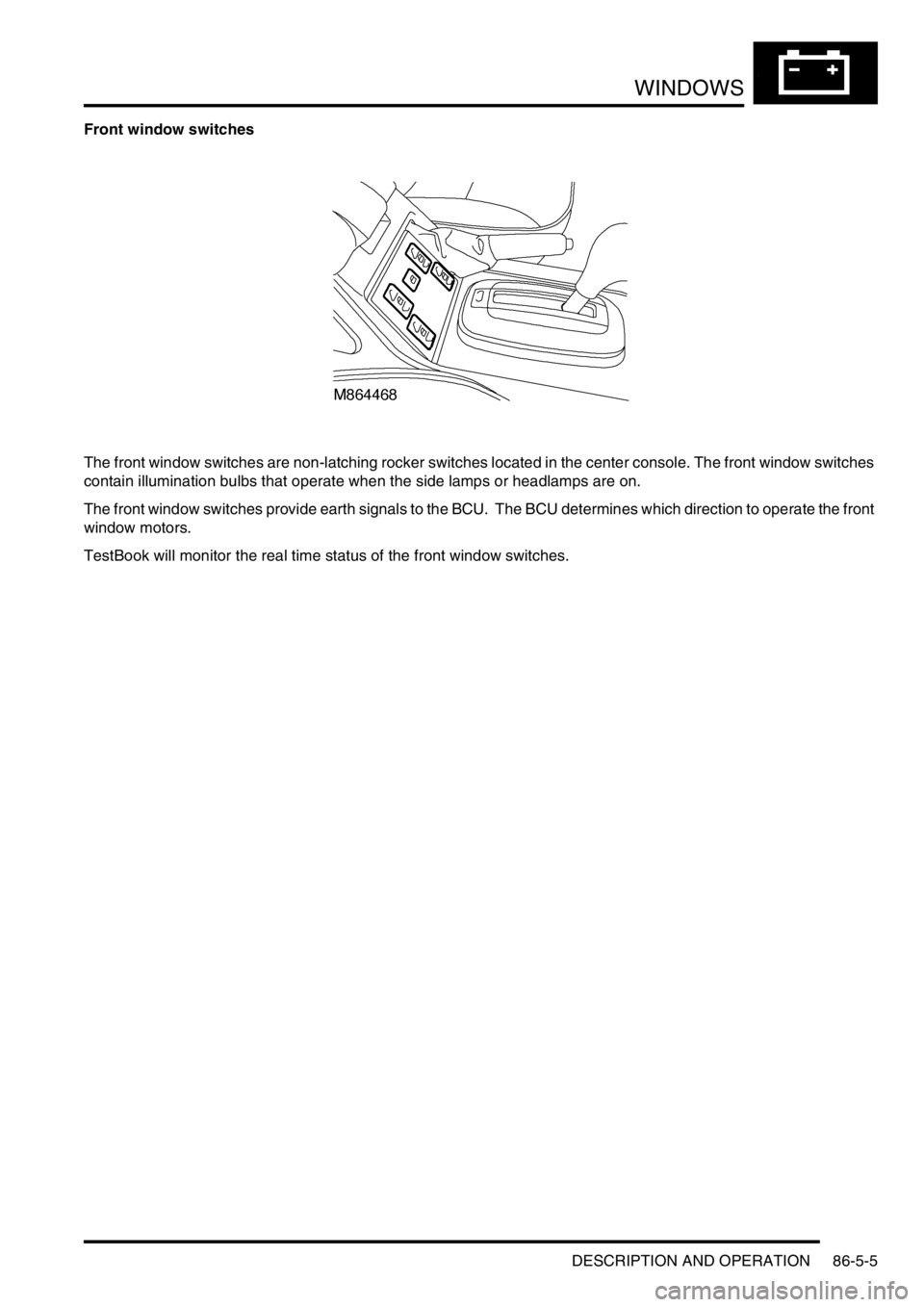
The front window switches are non-latching rocker switches located in the center console. The front window switches
contain illumination bulbs that operate when the side lamps or headlamps are on.
The front window switches provide earth signals to the BCU. The BCU determines which direction to operate the front
window motors.
TestBook will monitor the real time status of the front window switches.
Page 1545 of 1672

WINDOWS
86-5-6 DESCRIPTION AND OPERATION
Front window motors
The front window motors are permanent magnet motors. There is a window motor in each front door. The front
window motors are controlled by the BCU.
The BCU provides both the voltage and the earth paths to the front window motors. The BCU reverses the direction
the window motor operates by switching the voltage and earth paths to the window motor. The BCU also monitors
stall current for the front window motors.
TestBook can operate the front window motors remotely.
Page 1546 of 1672

WINDOWS
DESCRIPTION AND OPERATION 86-5-7
Rear window lift relay
The rear window lift relay is a normally open relay that provides power to the rear window system. It is controlled by
the IDM. The IDM receives a rear window enable signal from the BCU to allow operation during the ignition switched-
off timeout period.
Both the rear window lift relay and the IDM are located in the passenger compartment fusebox. The IDM is integral
to the passenger compartment fusebox.
The rear window lift relay receives voltage from fuse 13 (30A) in the passenger compartment fusebox. The IDM
controls the earth side of the relay coil.
TestBook cannot monitor the status of the rear window lift relay.
Page 1547 of 1672

WINDOWS
86-5-8 DESCRIPTION AND OPERATION
Rear window switches
There are two sets of switches that operate the rear windows. There is a set of rear window switches located in the
centre console that allow the front seat occupants to operate the rear windows. The second set of switches are
located on the rear doors. All rear window switches are non-latching rocker switches.
A conventional window switch circuit controls the rear window system. In the rest position, there is battery voltage at
both sides of every switch as well as at the window motors. Operating any switch provides a ground path through the
switch to the window motor. Operating the switch in the opposite direction switches the voltage path and the earth
path to the motor allowing the motor to run in the opposite direction.
Voltage for the rear windows is from fuse 13 (30A) in the passenger compartment fusebox through the rear window
lift relay to the switches and motors.
TestBook cannot monitor the status of the rear window switches.
Page 1548 of 1672
WINDOWS
DESCRIPTION AND OPERATION 86-5-9
Rear window isolation switch
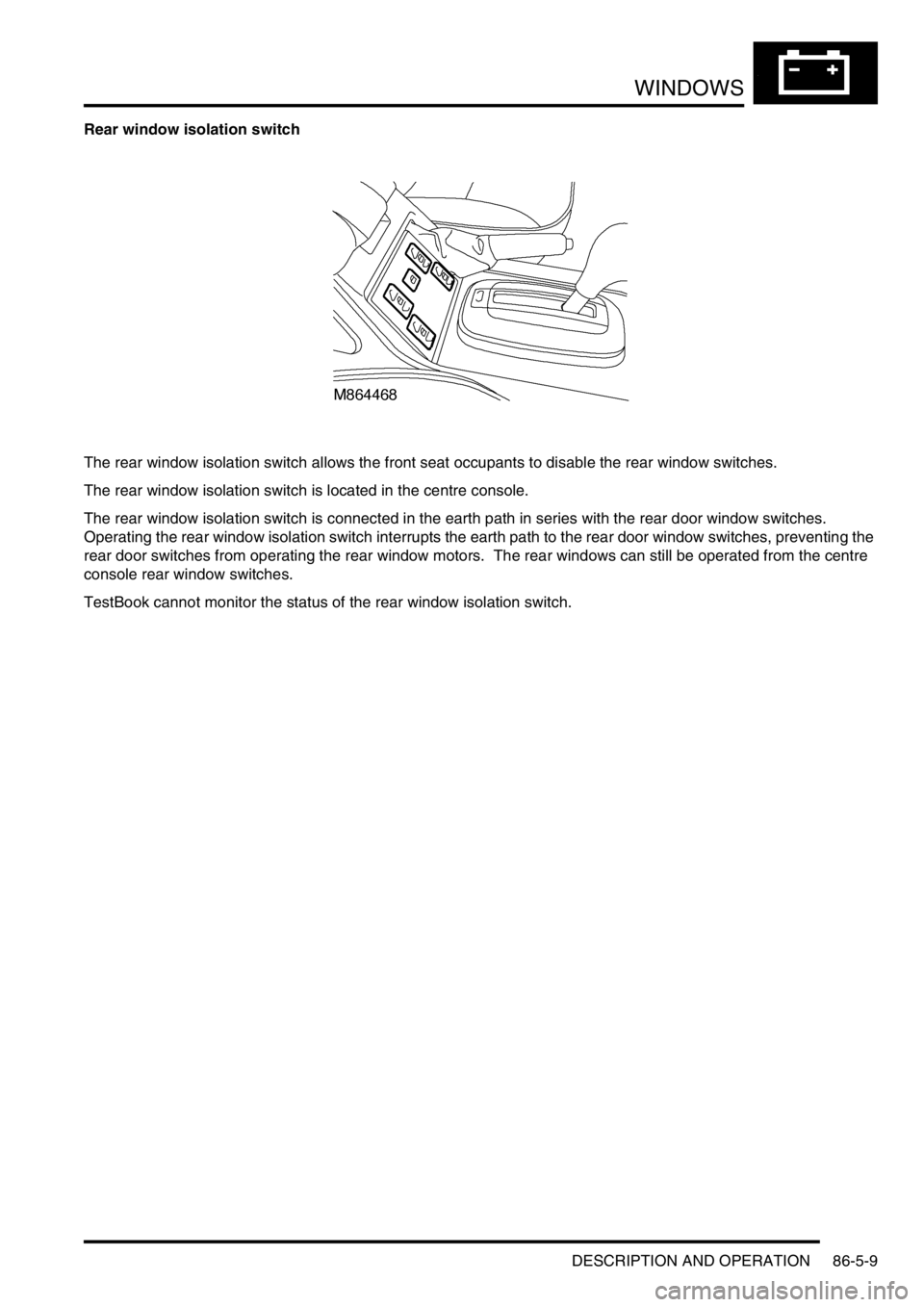
The rear window isolation switch allows the front seat occupants to disable the rear window switches.
The rear window isolation switch is located in the centre console.
The rear window isolation switch is connected in the earth path in series with the rear door window switches.
Operating the rear window isolation switch interrupts the earth path to the rear door window switches, preventing the
rear door switches from operating the rear window motors. The rear windows can still be operated from the centre
console rear window switches.
TestBook cannot monitor the status of the rear window isolation switch.
Page 1549 of 1672
WINDOWS
86-5-10 DESCRIPTION AND OPERATION
Rear window motors
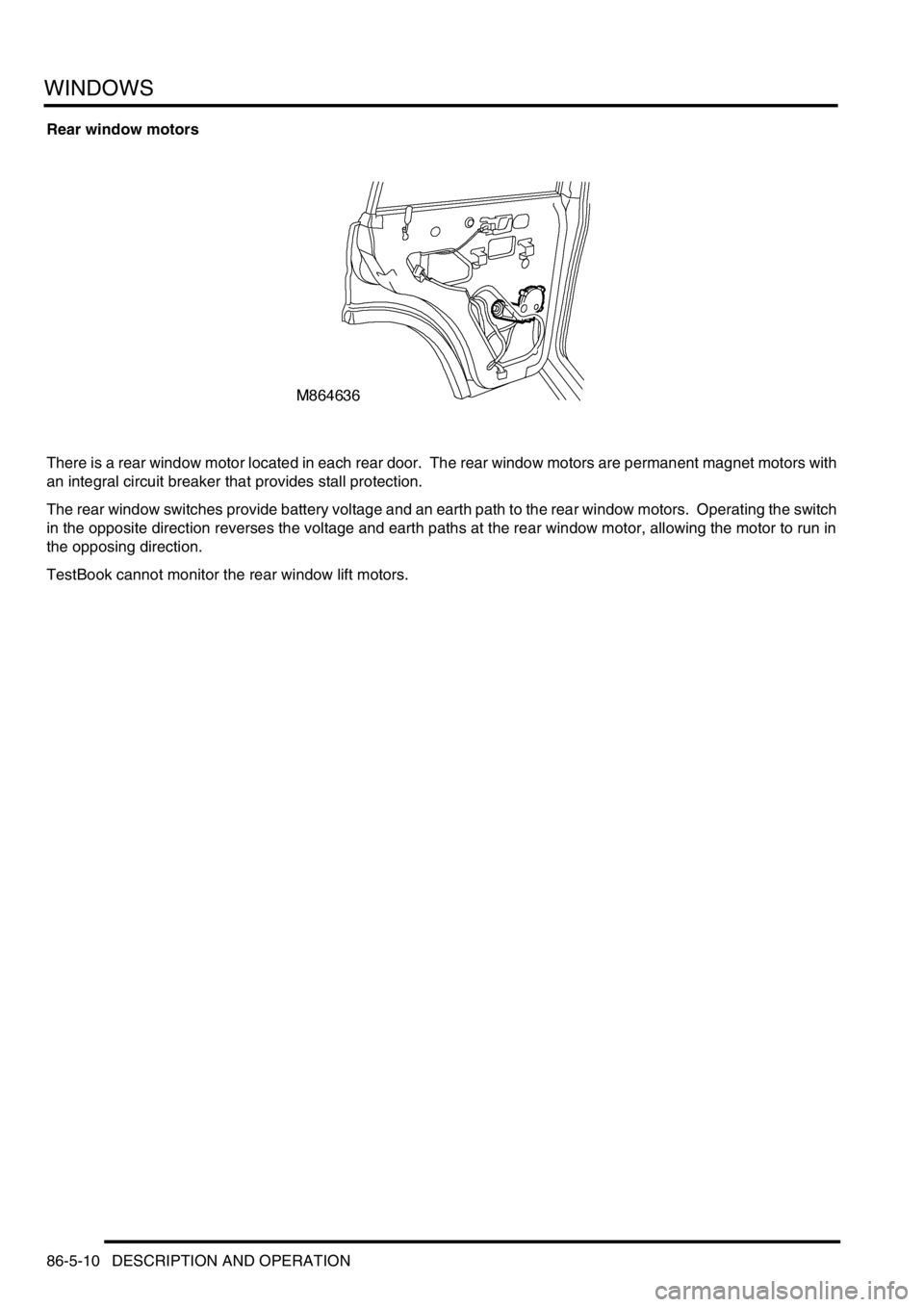
There is a rear window motor located in each rear door. The rear window motors are permanent magnet motors with
an integral circuit breaker that provides stall protection.
The rear window switches provide battery voltage and an earth path to the rear window motors. Operating the switch
in the opposite direction reverses the voltage and earth paths at the rear window motor, allowing the motor to run in
the opposing direction.
TestBook cannot monitor the rear window lift motors.