oil filter LAND ROVER DISCOVERY 2002 Owner's Manual
[x] Cancel search | Manufacturer: LAND ROVER, Model Year: 2002, Model line: DISCOVERY, Model: LAND ROVER DISCOVERY 2002Pages: 1672, PDF Size: 46.1 MB
Page 154 of 1672
ENGINE - TD5
DESCRIPTION AND OPERATION 12-1-15
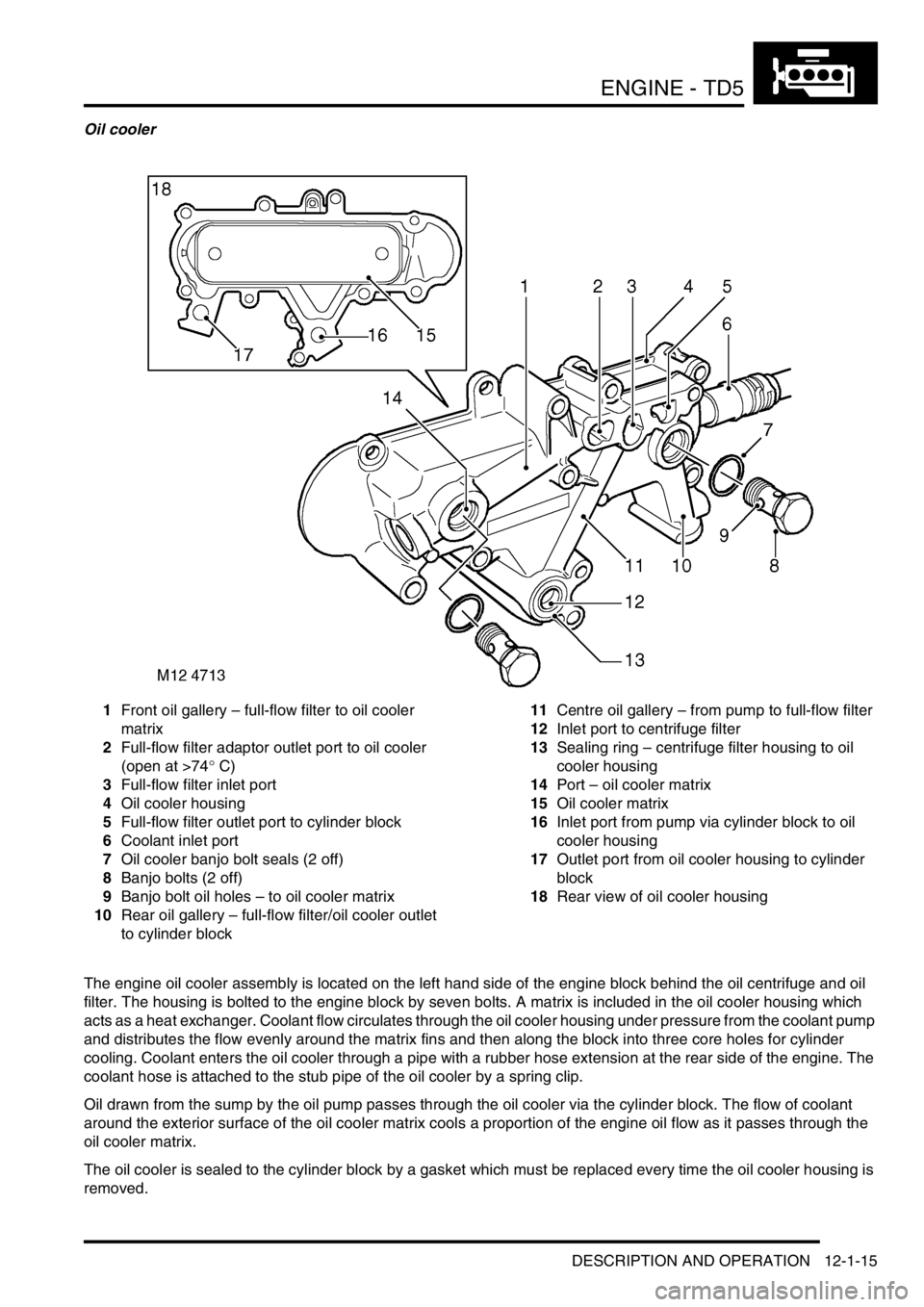
Oil cooler
1Front oil gallery – full-flow filter to oil cooler
matrix
2Full-flow filter adaptor outlet port to oil cooler
(open at >74
° C)
3Full-flow filter inlet port
4Oil cooler housing
5Full-flow filter outlet port to cylinder block
6Coolant inlet port
7Oil cooler banjo bolt seals (2 off)
8Banjo bolts (2 off)
9Banjo bolt oil holes – to oil cooler matrix
10Rear oil gallery – full-flow filter/oil cooler outlet
to cylinder block11Centre oil gallery – from pump to full-flow filter
12Inlet port to centrifuge filter
13Sealing ring – centrifuge filter housing to oil
cooler housing
14Port – oil cooler matrix
15Oil cooler matrix
16Inlet port from pump via cylinder block to oil
cooler housing
17Outlet port from oil cooler housing to cylinder
block
18Rear view of oil cooler housing
The engine oil cooler assembly is located on the left hand side of the engine block behind the oil centrifuge and oil
filter. The housing is bolted to the engine block by seven bolts. A matrix is included in the oil cooler housing which
acts as a heat exchanger. Coolant flow circulates through the oil cooler housing under pressure from the coolant pump
and distributes the flow evenly around the matrix fins and then along the block into three core holes for cylinder
cooling. Coolant enters the oil cooler through a pipe with a rubber hose extension at the rear side of the engine. The
coolant hose is attached to the stub pipe of the oil cooler by a spring clip.
Oil drawn from the sump by the oil pump passes through the oil cooler via the cylinder block. The flow of coolant
around the exterior surface of the oil cooler matrix cools a proportion of the engine oil flow as it passes through the
oil cooler matrix.
The oil cooler is sealed to the cylinder block by a gasket which must be replaced every time the oil cooler housing is
removed.
Page 155 of 1672
ENGINE - TD5
12-1-16 DESCRIPTION AND OPERATION
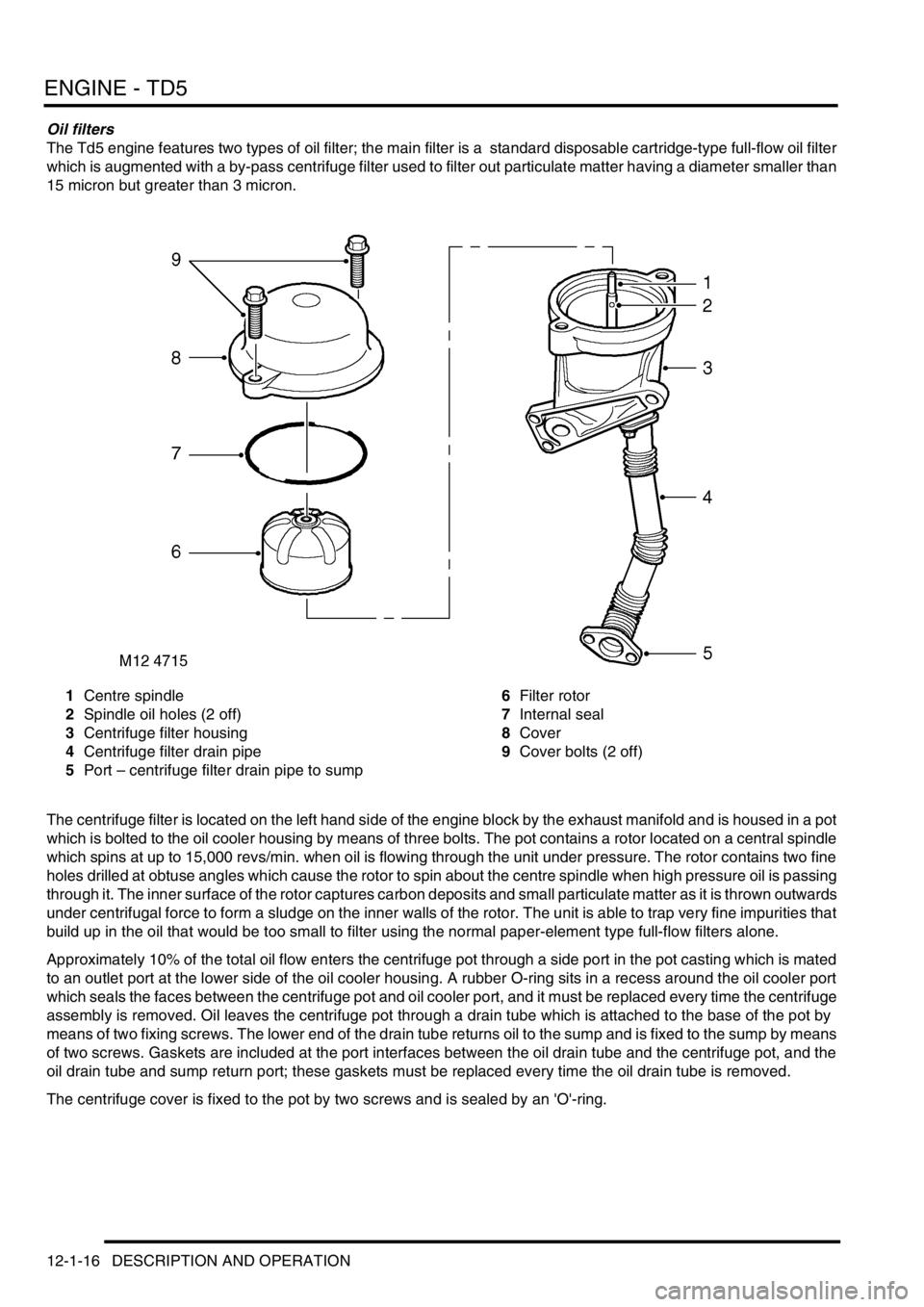
Oil filters
The Td5 engine features two types of oil filter; the main filter is a standard disposable cartridge-type full-flow oil filter
which is augmented with a by-pass centrifuge filter used to filter out particulate matter having a diameter smaller than
15 micron but greater than 3 micron.
1Centre spindle
2Spindle oil holes (2 off)
3Centrifuge filter housing
4Centrifuge filter drain pipe
5Port – centrifuge filter drain pipe to sump6Filter rotor
7Internal seal
8Cover
9Cover bolts (2 off)
The centrifuge filter is located on the left hand side of the engine block by the exhaust manifold and is housed in a pot
which is bolted to the oil cooler housing by means of three bolts. The pot contains a rotor located on a central spindle
which spins at up to 15,000 revs/min. when oil is flowing through the unit under pressure. The rotor contains two fine
holes drilled at obtuse angles which cause the rotor to spin about the centre spindle when high pressure oil is passing
through it. The inner surface of the rotor captures carbon deposits and small particulate matter as it is thrown outwards
under centrifugal force to form a sludge on the inner walls of the rotor. The unit is able to trap very fine impurities that
build up in the oil that would be too small to filter using the normal paper-element type full-flow filters alone.
Approximately 10% of the total oil flow enters the centrifuge pot through a side port in the pot casting which is mated
to an outlet port at the lower side of the oil cooler housing. A rubber O-ring sits in a recess around the oil cooler port
which seals the faces between the centrifuge pot and oil cooler port, and it must be replaced every time the centrifuge
assembly is removed. Oil leaves the centrifuge pot through a drain tube which is attached to the base of the pot by
means of two fixing screws. The lower end of the drain tube returns oil to the sump and is fixed to the sump by means
of two screws. Gaskets are included at the port interfaces between the oil drain tube and the centrifuge pot, and the
oil drain tube and sump return port; these gaskets must be replaced every time the oil drain tube is removed.
The centrifuge cover is fixed to the pot by two screws and is sealed by an 'O'-ring.
Page 156 of 1672

ENGINE - TD5
DESCRIPTION AND OPERATION 12-1-17
1Full-flow filter housing
2Thermostat
3Roll-pin
4Port – feed line to turbocharger
5Outlet port from full-flow filter (> 74
° C)
6Inlet port to full-flow filter
7Outlet port from full-flow filter (< 74
° C)
The main filter is a conventional full-flow cartridge-type filter containing a paper element able to trap particles greater
than 15 micron (0.015 mm) in diameter.
The cartridge is screwed to an adaptor casting by way of a hollow brass threaded insert which connects the filter outlet
port to the adaptor casting. A sealing ring seals the union between the oil filter cartridge and the adaptor casting.
Page 157 of 1672
ENGINE - TD5
12-1-18 DESCRIPTION AND OPERATION
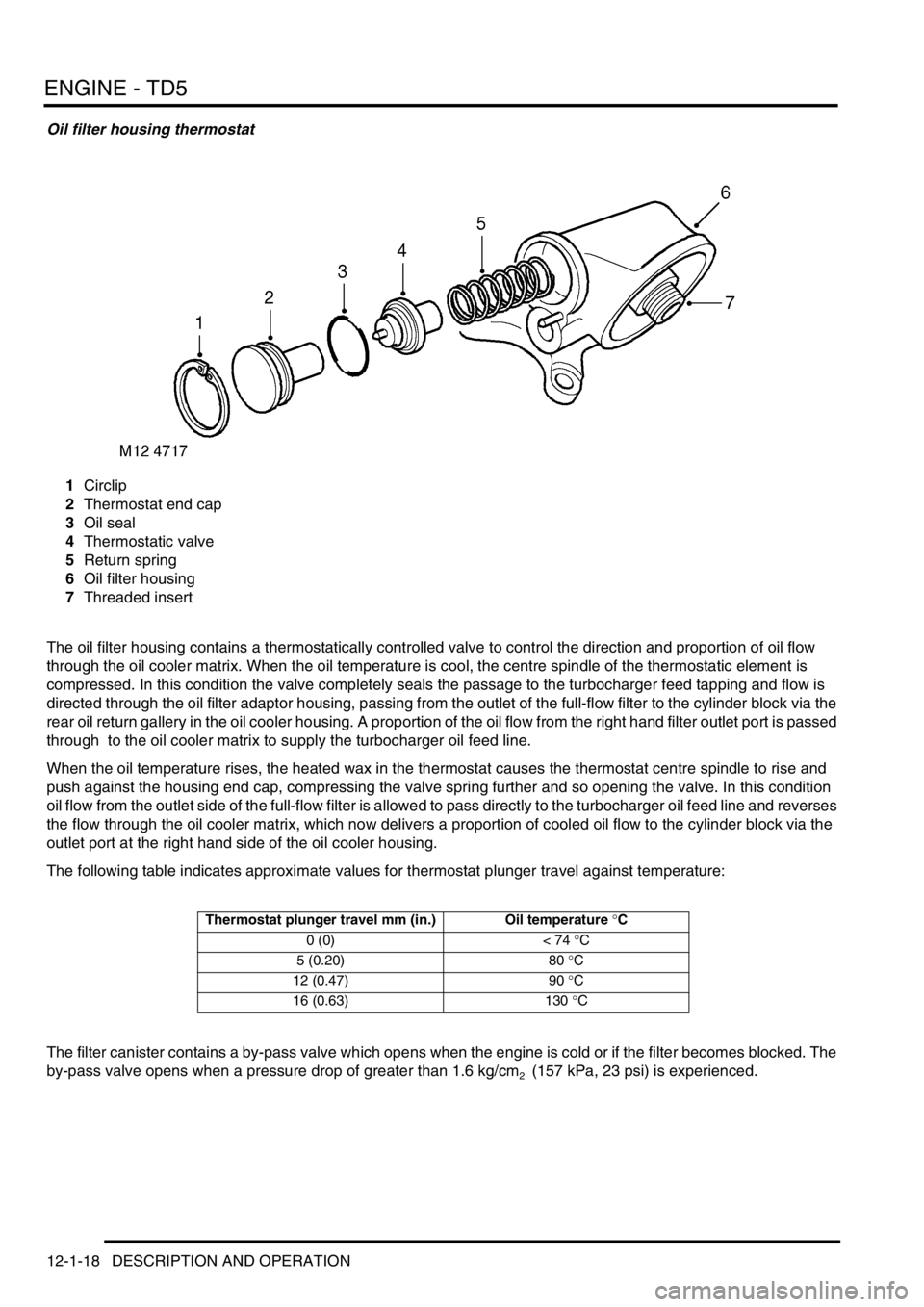
Oil filter housing thermostat
1Circlip
2Thermostat end cap
3Oil seal
4Thermostatic valve
5Return spring
6Oil filter housing
7Threaded insert
The oil filter housing contains a thermostatically controlled valve to control the direction and proportion of oil flow
through the oil cooler matrix. When the oil temperature is cool, the centre spindle of the thermostatic element is
compressed. In this condition the valve completely seals the passage to the turbocharger feed tapping and flow is
directed through the oil filter adaptor housing, passing from the outlet of the full-flow filter to the cylinder block via the
rear oil return gallery in the oil cooler housing. A proportion of the oil flow from the right hand filter outlet port is passed
through to the oil cooler matrix to supply the turbocharger oil feed line.
When the oil temperature rises, the heated wax in the thermostat causes the thermostat centre spindle to rise and
push against the housing end cap, compressing the valve spring further and so opening the valve. In this condition
oil flow from the outlet side of the full-flow filter is allowed to pass directly to the turbocharger oil feed line and reverses
the flow through the oil cooler matrix, which now delivers a proportion of cooled oil flow to the cylinder block via the
outlet port at the right hand side of the oil cooler housing.
The following table indicates approximate values for thermostat plunger travel against temperature:
The filter canister contains a by-pass valve which opens when the engine is cold or if the filter becomes blocked. The
by-pass valve opens when a pressure drop of greater than 1.6 kg/cm
2 (157 kPa, 23 psi) is experienced.
Thermostat plunger travel mm (in.) Oil temperature °C
0 (0) < 74 °C
5 (0.20) 80 °C
12 (0.47) 90 °C
16 (0.63) 130 °C
Page 158 of 1672
ENGINE - TD5
DESCRIPTION AND OPERATION 12-1-19
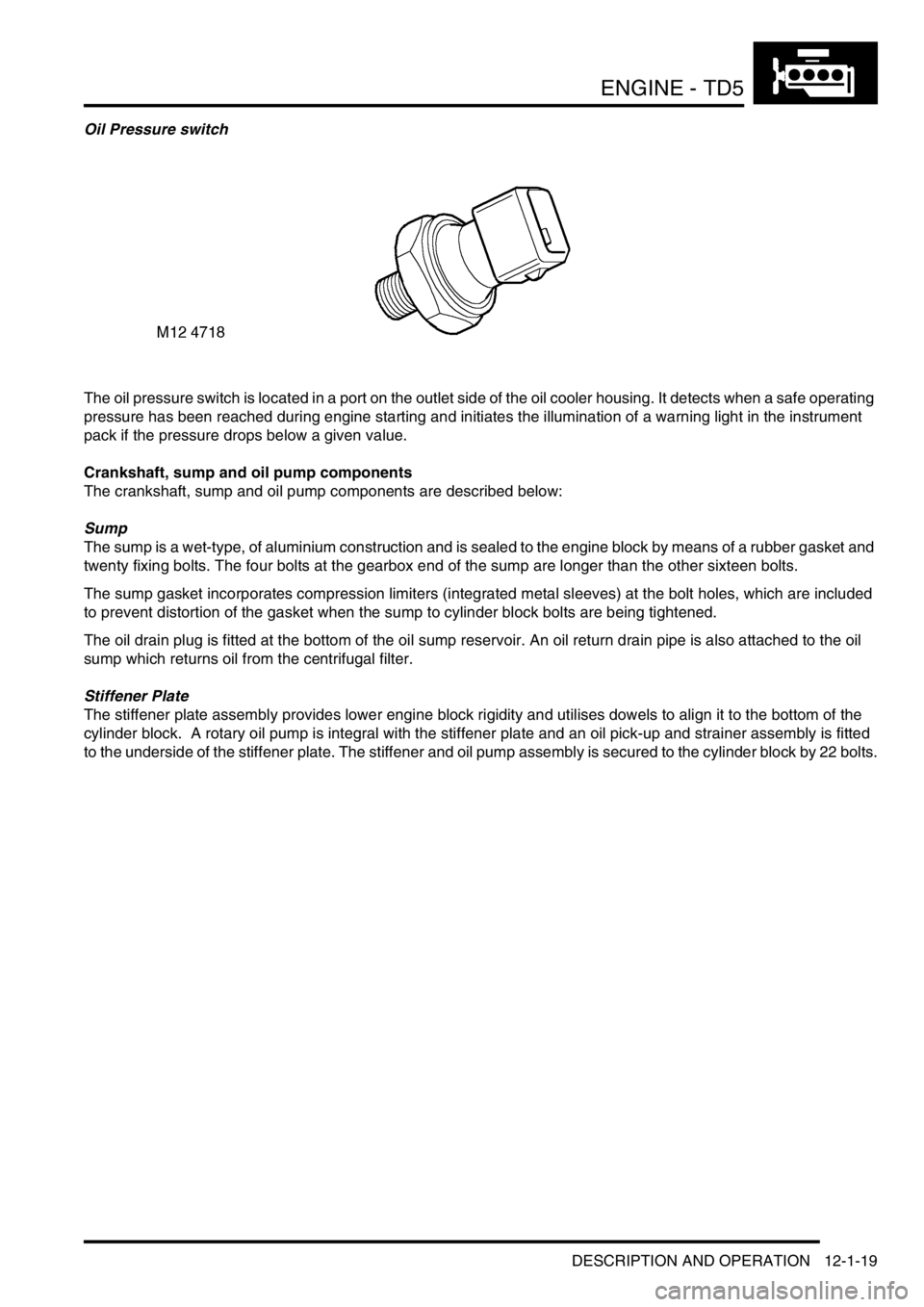
Oil Pressure switch
The oil pressure switch is located in a port on the outlet side of the oil cooler housing. It detects when a safe operating
pressure has been reached during engine starting and initiates the illumination of a warning light in the instrument
pack if the pressure drops below a given value.
Crankshaft, sump and oil pump components
The crankshaft, sump and oil pump components are described below:
Sump
The sump is a wet-type, of aluminium construction and is sealed to the engine block by means of a rubber gasket and
twenty fixing bolts. The four bolts at the gearbox end of the sump are longer than the other sixteen bolts.
The sump gasket incorporates compression limiters (integrated metal sleeves) at the bolt holes, which are included
to prevent distortion of the gasket when the sump to cylinder block bolts are being tightened.
The oil drain plug is fitted at the bottom of the oil sump reservoir. An oil return drain pipe is also attached to the oil
sump which returns oil from the centrifugal filter.
Stiffener Plate
The stiffener plate assembly provides lower engine block rigidity and utilises dowels to align it to the bottom of the
cylinder block. A rotary oil pump is integral with the stiffener plate and an oil pick-up and strainer assembly is fitted
to the underside of the stiffener plate. The stiffener and oil pump assembly is secured to the cylinder block by 22 bolts.
Page 168 of 1672

ENGINE - TD5
DESCRIPTION AND OPERATION 12-1-29
Lubrication circuit
Cylinder block flow
1Oil squirt jets (5 off)
2Main oil delivery gallery
3Inflow from oil cooler housing
4Flow to oil cooler / filters (from oil pump via
cylinder block)
5Sump
6Oil pick-up pipe
7Flow from oil pump (relief-valve in housing)
8Oil pump9Cross-drilling supply to main and crankshaft
bearings
10To cylinder head
Page 169 of 1672

ENGINE - TD5
12-1-30 DESCRIPTION AND OPERATION
Oil from the sump is drawn up through a two-piece plastic pick-up which contains a mesh to siphon any relatively large
pieces of material which could cause damage to the pump. The head of the pick-up is centrally immersed in the sump
oil and oil is delivered to the inlet side of the eccentric rotor pump through a gallery in the stiffener plate.
Pressurised oil from the pump is passed through to the cylinder block where it is delivered to the centrifuge filter and
full-flow filter via a port in the RH cylinder block which interfaces with a port in the centre gallery of the oil cooler
housing. The oil pump contains an oil pressure relief valve which opens to allow oil to be recirculated back around the
pump if the oil pressure increases to a high enough level.
10% of the oil flow from the pump is diverted through the centrifuge filter and returned to the sump via the centrifuge
filter drain tube. The remaining 90% of the oil passes through the standard full-flow filter to the main oil gallery in the
cylinder block.
Page 170 of 1672

ENGINE - TD5
DESCRIPTION AND OPERATION 12-1-31
Oil cooler / Filter flow (thermostat open)
1To cylinder block main gallery (from rear of oil
cooler housing)
2Oil cooler housing
3Oil pressure switch
4Full-flow filter
5Centrifuge filter6Return to sump
7Flow from oil pump (via cylinder block)
8Oil cooler matrix
Page 171 of 1672

ENGINE - TD5
12-1-32 DESCRIPTION AND OPERATION
When the engine temperature is below 74° C, the thermostat in the full-flow filter housing is closed and a proportion
of the oil flow to the main oil gallery is diverted to the oil cooler to supply an oil feed to the turbocharger bearings. Oil
passes through the oil cooler to the front gallery in the oil cooler housing where there is a tapping to connect the feed
pipe to the turbocharger. Oil used by the turbocharger bearings is returned to the sump through an oil drain pipe which
connects to a port in the LH side of the cylinder block.
The remainder of the oil flow leaving the full-flow filter outlet is passed into the cylinder block via a port at the rear of
oil cooler rear gallery.
When the oil temperature rises above 74
° C the thermostat in the full-flow filter adaptor housing begins to open to
allow a proportion of the oil from the full-flow filter to pass through the oil cooler before it reaches the main oil gallery
in the cylinder block. In this instance, oil supply to the turbocharger bearings is fed directly from the full-flow filter
without first passing through the oil cooler. Between 74
° C and 88° C the thermostat valve plunger opens by about
9mm to allow proportionally more oil to flow through the oil cooler before being passed to the cylinder block main oil
delivery gallery. Above 88
°C the thermostat valve continues to open by about 1mm for every 10° C increase in
temperature until the valve is fully open, when all the oil flow to the cylinder block is forced to pass to the cylinder block
via the oil cooler.
An oil pressure switch is located in a port in the rear gallery of the oil cooler housing to sense the oil pressure level
before flow enters the main oil gallery in the engine block. A warning lamp in the instrument cluster is switched on if
the oil pressure is detected as being too low.
+ INSTRUMENTS, DESCRIPTION AND OPERATION, Description.
Drillings from the cylinder block main oil gallery direct oil to the crankshaft main bearings and cross drillings in the
crankshaft direct oil to the big-end bearings. An additional five drillings in the cylinder block supply oil at reduced
pressure to the oil squirt jets for piston cooling and gudgeon pin lubrication.
Oil supply from the cylinder block is then passed to the cylinder head galleries through a non-return valve which is
included as an integral item in the lower face of the cylinder head.
Page 192 of 1672

ENGINE - TD5
REPAIRS 12-1-53
Mounting - front - LH
$% 12.45.01
Remove
1.Remove centrifuge assembly.
+ ENGINE - Td5, REPAIRS, Gasket -
centrifuge oil drain pipe.
2.Remove 3 bolts, remove oil filter adaptor
housing and discard gasket.
3.Fit suitable lifting chains to support engine.
4.With assistance remove 2 bolts securing
engine mounting to chassis.
5.Remove 4 bolts securing engine mounting
bracket to cylinder block.
6.Remove nut securing mounting to mounting
bracket.
7.Remove mounting and mounting bracket.
8.Remove mounting shield.
Refit
1.Fit shield to mounting. 2.Fit mounting and mounting bracket.
3.Fit mounting bracket to cylinder block and
tighten – bolts securing front LH engine
mounting bracket to cylinder block to 48 Nm (35
lbf.ft).
4.With assistance, fit mounting to chassis and
tighten – bolts securing front LH engine
mounting to chassis to 85 Nm (63 lbf.ft).
5.Fit mounting to mounting bracket and tighten –
nut securing front LH mounting to mounting
bracket to 85 Nm (63 lbf.ft).
6.Remove engine support chains.
7.Clean oil filter adaptor housing and mating
face.
8.Fit oil filter adaptor housing to oil cooler
housing and tighten bolts to 25 Nm (18 lbf.ft).
9.Fit centrifuge assembly.
+ ENGINE - Td5, REPAIRS, Gasket -
centrifuge oil drain pipe.