clutch LAND ROVER DISCOVERY 2002 Service Manual
[x] Cancel search | Manufacturer: LAND ROVER, Model Year: 2002, Model line: DISCOVERY, Model: LAND ROVER DISCOVERY 2002Pages: 1672, PDF Size: 46.1 MB
Page 497 of 1672
ENGINE MANAGEMENT SYSTEM - V8
18-2-40 DESCRIPTION AND OPERATION
Air Temperature Control (ATC) request
The ATC request comes via the ATC switch located in the facia panel. When the driver operates the switch it acts as
a request from the ATC ECU to engage the ATC clutch to drive the system.
During periods of high driver demand such as hard acceleration or maximum rev/min the ATC clutch will be disabled
for a short time. This is to reduce the load on the engine.
+ AIR CONDITIONING, DESCRIPTION AND OPERATION, Description.
Input/Output
The operation of the ATC request is via a switch being connected to earth. Voltage is supplied via pin 38 of connector
C0637 of the ECM, at the point at when the switch is pressed the connection is made and the ATC clutch is engaged.
The ATC request can fail as follows:
lOpen circuit.
lShort circuit to voltage supply.
lShort circuit to vehicle earth.
lWiring loom fault.
In the event of an ATC request failure, the ATC system does not work.
Should a malfunction of the component occur the following fault codes may be evident and can be retrieved by
TestBook.
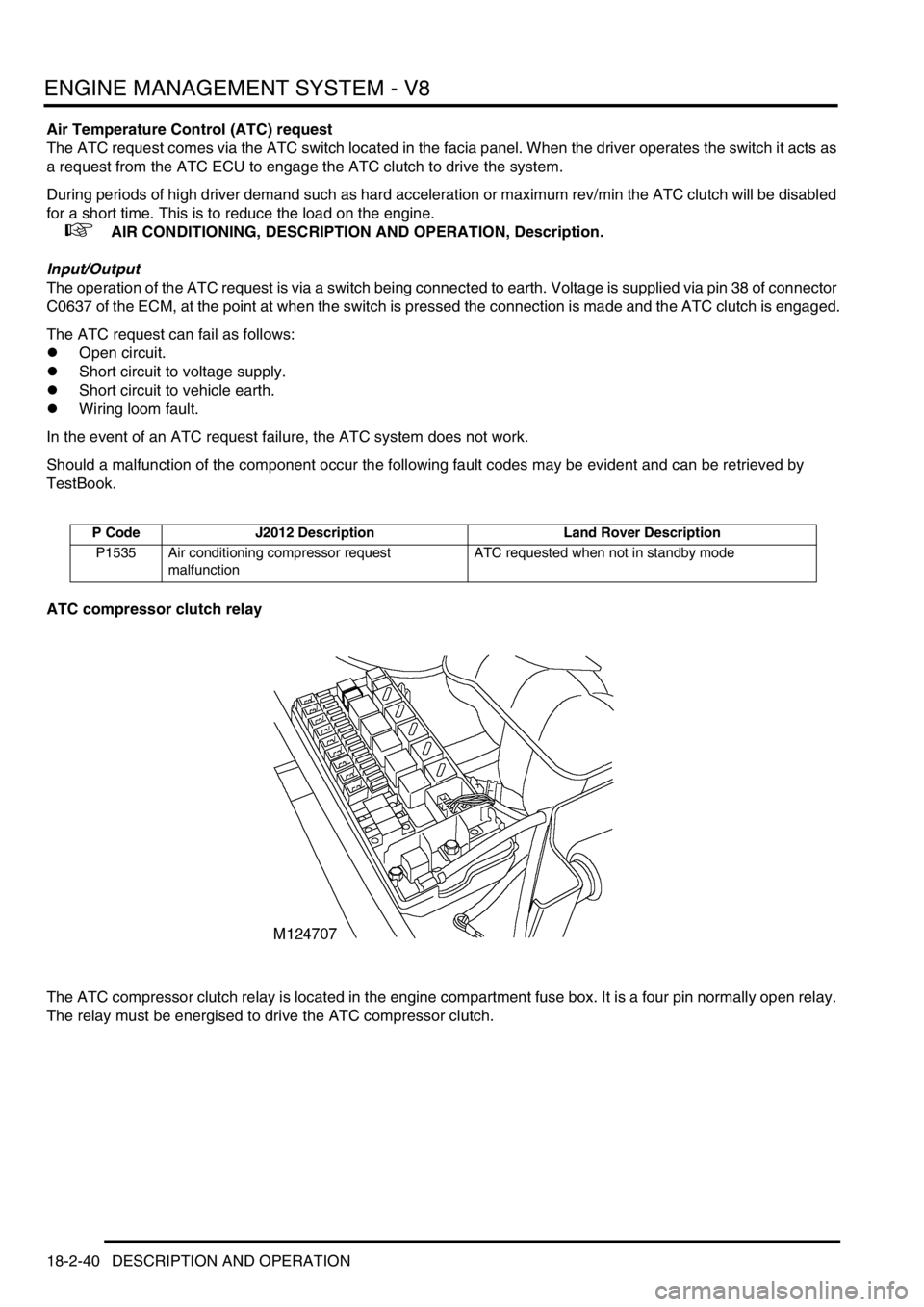
ATC compressor clutch relay
The ATC compressor clutch relay is located in the engine compartment fuse box. It is a four pin normally open relay.
The relay must be energised to drive the ATC compressor clutch.
P Code J2012 Description Land Rover Description
P1535 Air conditioning compressor request
malfunctionATC requested when not in standby mode
Page 498 of 1672

ENGINE MANAGEMENT SYSTEM - V8
DESCRIPTION AND OPERATION 18-2-41
Input/Output
The ECM provides the earth for the relay coil to allow the relay contacts to close and the ATC clutch drive to receive
battery voltage. The ECM uses a transistor as a switch to generate an open circuit in the earth path of the relay coil.
When the ECM opens the earth path, the return spring in the relay will pull the contacts apart to shut down the ATC
clutch drive.
Input to the ATC clutch relay switching contacts is via fuse 6 located in the engine compartment fuse box. The relay
coils are supplied with battery voltage from the main relay, also located in the engine compartment fuse box. The earth
path for the relay coil is via pin 29 of the ECM C0657 connector. When the relay is energised the output from the
switching contacts goes directly to the ATC compressor clutch.
The ATC clutch relay can fail in the following ways:
lRelay open circuit.
lShort circuit to vehicle supply.
lShort circuit to vehicle earth.
lBroken return spring.
In the event of an ATC clutch relay failure, the ATC does not work.
Should a malfunction of the component occur, the following fault codes may be evident and can be retrieved by
TestBook.
P Code J2012 Description Land Rover Description
P1536 Air conditioning compressor request range/
performanceATC compressor clutch relay open circuit
P1537 Air conditioning compressor request low input ATC compressor clutch relay short to earth
P1538 Air conditioning compressor request high input ATC compressor clutch relay short to battery supply
Page 512 of 1672

ENGINE MANAGEMENT SYSTEM - V8
DESCRIPTION AND OPERATION 18-2-55
DESCRIPTION AND OPERAT ION
Cruise control component layout
1Cruise control ECU
2Cruise control master switch
3SET+ switch
4RES switch
5Brake pedal switch
6Clutch pedal switch7BCU
8Vacuum pump assembly
9Pneumatic actuator
10SLABS ECU
11Automatic gear selector lever
Page 513 of 1672
ENGINE MANAGEMENT SYSTEM - V8
18-2-56 DESCRIPTION AND OPERATION
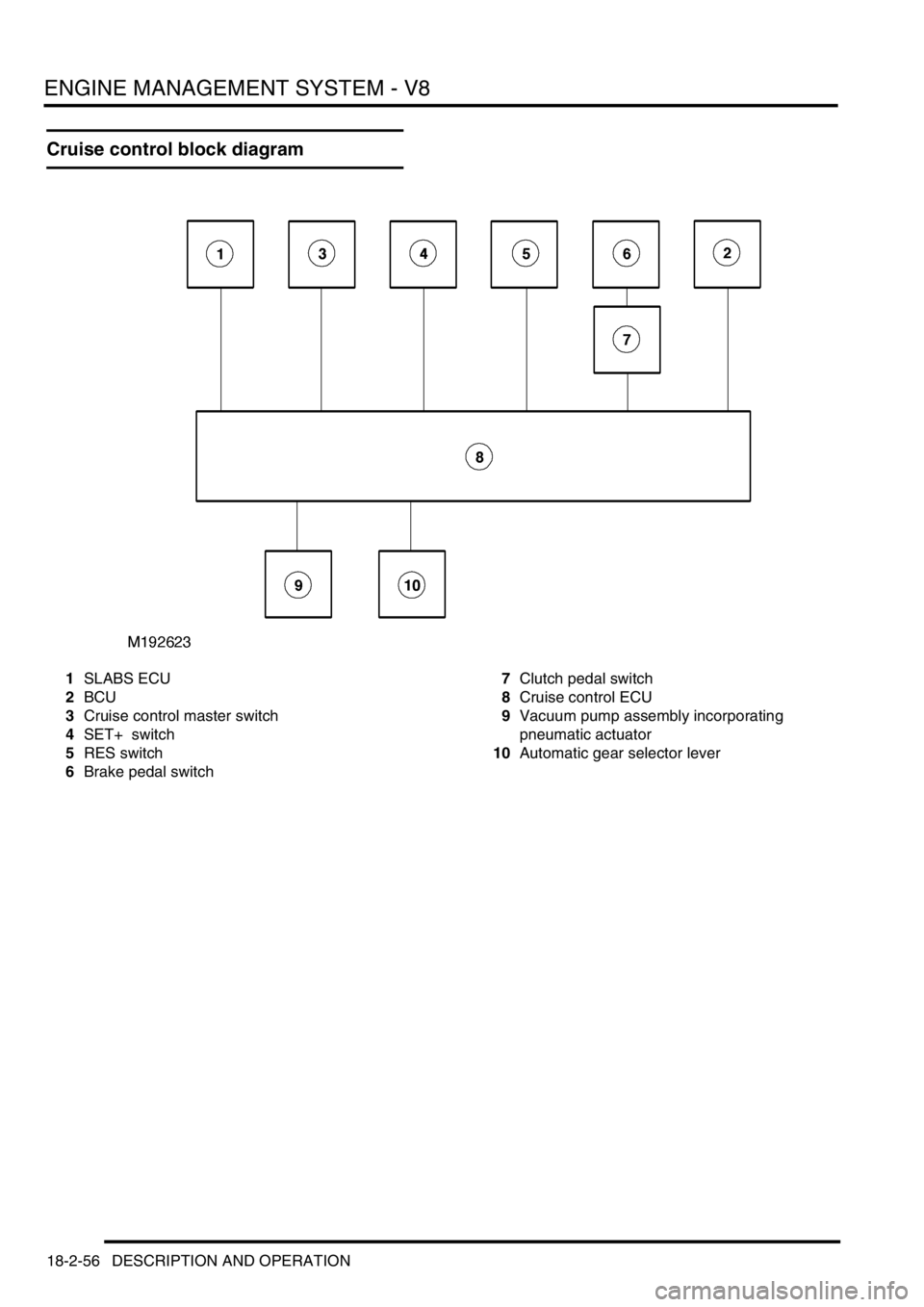
Cruise control block diagram
1SLABS ECU
2BCU
3Cruise control master switch
4SET+ switch
5RES switch
6Brake pedal switch7Clutch pedal switch
8Cruise control ECU
9Vacuum pump assembly incorporating
pneumatic actuator
10Automatic gear selector lever
Page 514 of 1672

ENGINE MANAGEMENT SYSTEM - V8
DESCRIPTION AND OPERATION 18-2-57
Description - cruise control
General
All markets have a common cruise control system. The cruise control system, when activated, regulates vehicle
speed. The system consists of an electrical sub-system and a mechanical sub-system.
The electrical sub-system consists of the following components:
lCruise control master switch (on/off switch).
lSET+ switch.
lRES switch.
lCruise control ECU.
lVacuum pump assembly.
lBrake pedal switch.
lClutch pedal switch (manual gearbox only).
lSLABS ECU (speed signal).
lBCU (brake pedal switch and automatic gearbox gear selector lever position signal).
The mechanical sub-system consists of the following components:
lPneumatic actuator.
lVacuum pump.
The cruise control ECU controls the cruise control system. It is located on the right hand A post.
The system has diagnostic capabilities through TestBook.
WARNING: To avoid the risk of losing control of the vehicle, do not use cruise control on winding, snow
covered or slippery roads, or in traffic conditions where a constant speed cannot be safely maintained. In
these conditions and at any time the system is not being used, ensure the cruise control switch is OFF.
Cruise control master switch
The cruise control master switch switches the system on and off. When the cruise control master switch is on, an
LED within the switch illuminates. If the cruise control master switch is off, cruise control will not operate. The switch
provides a 12 Volt feed to the cruise control ECU.
The cruise control master switch is located on the instrument panel near the steering column.
Page 518 of 1672

ENGINE MANAGEMENT SYSTEM - V8
DESCRIPTION AND OPERATION 18-2-61
Brake pedal switch
The cruise control ECU has two inputs from the brake pedal switch that determine the position of the brake pedal.
One input comes through the BCU and is low when the brake pedal is not pressed. The second input comes directly
from the brake pedal switch. This input is high when the brake pedal is not pressed. On vehicles with a manual
gearbox, the input from the clutch pedal switch to the cruise control ECU is connected in series with the direct signal
from the brake pedal switch.
If the cruise control ECU receives a changed signal from either source, it deactivates cruise control, removing power
to the vacuum pump and activating the vacuum control valve releasing all vacuum in the system.
The brake pedal switch also provides the signal to illuminate the brake lamps and the brake input to the SLABS ECU.
Input/Output
With the brake pedal and the clutch pedal in the rest position, the cruise control ECU receives 12 Volts.
With the brake pedal pressed, the cruise control ECU receives 0 Volts and a low voltage logic signal from the BCU.
NOTE: If the clutch pedal is pressed, 0 Volts are present at the cruise control ECU irrespective of brake pedal position.
ECU operating parameters (connector connected)
Pin No. Condition Volts Ohms
1 Ignition in position II, brake pedal
released, clutch pedal released12
1 Ignition in position II, brake pedal
pressed, clutch pedal releasedMore than 10,000
1 Ignition in position II, brake pedal
released, clutch pedal pressedMore than 10,000
Page 519 of 1672

ENGINE MANAGEMENT SYSTEM - V8
18-2-62 DESCRIPTION AND OPERATION
Clutch pedal switch
The clutch pedal switch is a single pole normally closed switch. It is part of the 12 Volt brake pedal switch circuit to
the cruise control ECU. When the clutch pedal is pressed, the cruise control ECU deactivates the cruise control
system and releases system vacuum. The last set speed is retained in the cruise control ECU.
Input/Output
The cruise control ECU receives a 12 Volt signal through the normally closed contacts of the brake pedal switch and
the normally closed clutch pedal switch.
Page 521 of 1672

ENGINE MANAGEMENT SYSTEM - V8
18-2-64 DESCRIPTION AND OPERATION
Vacuum pump assembly
The vacuum pump assembly contains three components:
lThe vacuum pump.
lThe vacuum control valve.
lThe vacuum dump valve.
The vacuum pump provides the vacuum for the system while the two valves work in conjunction to allow the pump to
increase the vacuum to the pneumatic actuator (increase vehicle speed) or release vacuum from the pneumatic
actuator (decrease vehicle speed). On vehicles from 03 model year, the cruise control vacuum pump and pneumatic
actuator assembly is fitted with a heat shield to protect the components from heat from the exhaust manifold.
The vacuum control valve opens to allow the vacuum pump to increase the vacuum in the pneumatic actuator to
increase vehicle speed. When the vehicle reaches the set speed, the vacuum pump control valve closes to hold
vacuum in the pneumatic actuator and the vacuum pump is turned off by the cruise control ECU.
The vacuum dump valve is normally open. When cruise control is active, the cruise control ECU provides voltage to
close the vacuum dump valve. If power is lost, (e.g. when the brakes or clutch are applied or cruise control is turned
off at the cruise control master switch) the vacuum dump valve will immediately open and cruise control will be
deactivated.
The cruise control ECU provides power for all three components within the vacuum pump assembly. The cruise
control ECU provides earth control circuits for the vacuum pump and the vacuum control valve. The vacuum dump
valve is permanently grounded.
Input/Output
The cruise control ECU provides both power and earth to the components within the vacuum pump assembly. Current
draw at the vacuum pump assembly varies depending on components operating.
Vacuum pump current draw
Component State of components
Vacuum dump valve Off On On On
Vacuum control valve Off Off On On
Vacuum pump Off Off Off On
Current draw, amperes 0 0.23 0.37 2.14
Page 523 of 1672

ENGINE MANAGEMENT SYSTEM - V8
18-2-66 DESCRIPTION AND OPERATION
Operation - cruise control
Cruise control activation
Cruise control is a passive system. The driver must activate it. Switching on the cruise control master switch located
on the instrument panel activates cruise control. An LED in the switch illuminates, indicating cruise control is
available. The driver must accelerate the vehicle to the desired speed using the accelerator pedal. When the desired
speed is reached, pressing the SET+ switch activates cruise control. Cruise control will only activate if the following
conditions are met:
lVehicle speed is between 28 - 125 mph (45 - 200 km/h).
lThe brake pedal is not pressed.
lThe clutch pedal is not pressed (manual gearbox only).
lThe gearbox is not in park, reverse or neutral (automatic gearbox only).
Function
The cruise control ECU receives the set signal and determines the vehicle speed provided by the SLABS ECU. The
cruise control ECU activates the vacuum pump assembly to move the pneumatic actuator and the linkage to the
throttle disc to maintain set road speed. It does this by controlling the vacuum to the pneumatic actuator.
Cruise control cancellation
Cancelling cruise control enables the driver to regain control of the vehicle speed by using the accelerator pedal.
Cruise control is cancelled if any of the following conditions occur:
lThe brake pedal is pressed.
lThe RES switch button is pressed.
lThe clutch pedal is pressed (manual gearbox only).
lThe cruise control master switch is turned off.
lThe gearbox is placed in park, neutral, or reverse (automatic gearbox only).
Function
The cruise control ECU cancels cruise control operation by opening a vacuum control valve in the vacuum pump
assembly. This releases the throttle linkage from the control of the pneumatic actuator and returns it to the control of
the accelerator pedal.
The set speed will be stored in the cruise control ECU unless:
lThe cruise control master switch is turned off.
lThe ignition switch is turned off.
If cruise control is deactivated using either of the above methods, the set speed will be erased from the memory of
the cruise control ECU.
Cruise control resume
Cruise control can be resumed at the previously set speed, provided the set speed has not been erased from the
cruise control ECU memory as described above. To resume cruise control operation to the previously set speed,
depress the RES switch once when the following conditions are met:
lA set speed is stored in the cruise control ECU.
lVehicle speed is between 28 - 125 mph (45 - 200 km/h).
lThe brake pedal is not pressed.
lThe clutch pedal is not pressed (manual gearbox only).
lThe gearbox is not in park, reverse or neutral (automatic gearbox only).
Page 524 of 1672

ENGINE MANAGEMENT SYSTEM - V8
DESCRIPTION AND OPERATION 18-2-67
Function
The cruise control ECU activates the vacuum pump assembly to move the pneumatic actuator. This moves the
throttle to the set speed by adjusting the position of the throttle disc.
Accelerating while cruise control is active
There are three ways of increasing vehicle speed when cruise control is active:
lTemporarily increase vehicle speed (e.g. when overtaking another vehicle).
lIncrease vehicle set speed in 1 mph (1.5 km/h) increments.
lIncrease vehicle set speed.
To temporarily increase vehicle speed press the accelerator pedal until the desired speed is reached. When the
accelerator pedal is released, the vehicle coasts back to the set speed. When it reaches the set speed, cruise control
operation continues.
To increase the vehicle set speed in 1 mph (1.5 km/h) increments, tap the SET+ switch. Each tap on the switch
increases vehicle speed.
To increase the vehicle set speed, press and hold the SET+ switch until the desired set speed is reached.
The vehicle set speed will increase if the following conditions are met:
lThe vehicle is under cruise control operation.
lVehicle speed is between 28 - 125 mph (45 - 200 km/h).
lThe brake pedal is not pressed.
lThe clutch pedal is not pressed (manual gearbox only).
lThe gearbox is not in park, reverse or neutral (automatic gearbox only).
Function
The vehicle responds as follows:
lIf the driver accelerates using the accelerator pedal, vehicle speed increases overriding pneumatic actuator
position. When the driver releases the accelerator pedal, the vehicle returns to the set speed.
lIf the SET+ switch is tapped, the driver increases the stored speed and vehicle speed by 1 mph (1.5 km/h) per
tap on the switch.
lIf the driver presses and holds the SET+ switch, the vehicle speed increases until the SET+ switch is released.
This becomes the new set speed for the cruise control ECU.
Switching off cruise control
Switching off cruise control allows the driver to regain control of vehicle speed. It erases the set road speed from the
cruise control ECU memory.
To switch off cruise control, press the cruise control master switch to the off position.
Function
When the cruise control master switch is turned off, the cruise control ECU switches off power to the vacuum pump
assembly. The vacuum dump valve opens releasing the vacuum in the pneumatic actuator, returning the throttle disc
to driver control via the accelerator pedal.