suspension LAND ROVER DISCOVERY 2002 Repair Manual
[x] Cancel search | Manufacturer: LAND ROVER, Model Year: 2002, Model line: DISCOVERY, Model: LAND ROVER DISCOVERY 2002Pages: 1672, PDF Size: 46.1 MB
Page 965 of 1672

FRONT SUSPENSION
60-26 DESCRIPTION AND OPERATION
Vehicle moving and turning left
When the vehicle is turning left, the accelerometers detect the cornering forces applied and transmit signals to the
ECU. The ECU determines that an opposing force must be applied to the torsion bars to counter the cornering forces.
The ECU supplies a current to the solenoid of the DCV2. Simultaneously, a current is sent from the ECU to the
pressure control valve which operates to restrict the flow of fluid returning to the reservoir.
The restriction causes the hydraulic pressure in the system to rise and the pressure is sensed by the pressure
transducer which sends a signal to the ECU. The ECU determines from the inputs it receives what pressure is required
and adjusts the pressure control valve accordingly.
The pressure in the system is applied to the annulus of each actuator, applying an opposing force to the torsion bar
and minimising the cornering effect on the vehicle and maintaining the vehicle attitude. The fluid displaced from the
full area of the actuator is returned to the reservoir via the valve block.
As the cornering force is removed when the vehicle straightens up, the ECU opens the pressure control valve to
reduce the pressure in the system. The fluid bleeds from the actuator back into the system as the cornering force is
reduced, removing the force from the torsion bar. When the vehicle is moving in a straight line DCV 2 closes.
Vehicle moving and turning right
When the vehicle is turning right, the accelerometers detect the cornering forces applied and transmit signals to the
ECU. The ECU determines that an opposing force must be applied to the torsion bars to counter the cornering forces.
The ECU supplies a current to the solenoid of the DCV1. Simultaneously, a current is sent from the ECU to the
pressure control valve which operates to restrict the flow of fluid through the by-pass gallery.
The restriction causes the hydraulic pressure in the system to rise and the pressure is sensed by the pressure
transducer which sends a signal corresponding to the pressure to the ECU. The ECU determines from the inputs it
receives what pressure is required and adjusts the pressure control valve accordingly.
The pressure in the system is applied to the full area of each actuator, applying an opposing force to the torsion bar
and minimising the cornering effect on the vehicle and maintaining the vehicle attitude. The fluid displaced from the
annulus of the actuator is returned to the reservoir via the valve block.
As the cornering force is removed when the vehicle straightens up, the ECU opens the pressure control valve to
reduce the pressure in the system. The fluid bleeds from the actuator back into the system as the cornering force is
reduced, removing the force from the torsion bar. When the vehicle is moving in a straight line the DCV 1 closes.
Vehicle moving in a straight line
The ECU is constantly monitoring the signals received from the accelerometers and operates the DCV's and pressure
control valve to maintain the vehicle attitude when the vehicle is moving.
Off-road driving
Off-road detection is achieved by the ECU by monitoring the signals from the upper and lower accelerometers for
varying degrees of body movement. Off-road driving generates differing signals to the accelerometers which in turn
produce differing outputs due to their vertical separation and the location of the roll centre of the vehicle. The two
signals are passed through a filter to remove any offset caused by the vehicle leaning or the terrain. The ECU then
uses this signal to calculate the percentage of road roughness.
Below 25 mph (40 km/h) the percentage of road roughness calculated is used by the ECU to limit the operation of the
ACE system. The system is completely inoperative at speeds below 2 mph (3 km/h). At speeds above 25 mph (40
km/h) the system disables the percentage road roughness signal and full ACE system assistance is restored.
Side slope detection
The ECU uses side slope detection when the upper and lower accelerometers detect an average acceleration of more
than
± 0.2 g and a road speed of less than 25 mph (40 km/h).
When side slope is detected both DCV's close to provide a 'locked bars' condition. This condition increases stability
and gives a consistent vehicle response. As the road speed increases up to 25 mph (40 km/h), the level of average
lateral acceleration must also increase and be maintained for the system to recognise that the vehicle is on a side
slope. If the side slope angle is steep and the road speed is low, the ECU will detect the side slope in a short time.
Page 966 of 1672

FRONT SUSPENSION
ADJUSTMENTS 60-27
ADJUST ME NTS
ACE hydraulic system bleeding
$% 60.60.13
Introduction
CAUTION: The ACE hydraulic system is
extremely sensitive to the ingress of dirt or
debris. The smallest amount could render the
system unserviceable. It is imperative that the
following precautions are taken.
lACE components are thoroughly cleaned
externally before work commences;
lall opened pipe and module ports are
capped immediately;
lall fluid is stored in and administered
through clean containers.
Check
1.Check the ACE system fluid level.
+ FRONT SUSPENSION,
ADJUSTMENTS, Fluid level check - ACE
system.
Bleed
1.With vehicle on ramp, connect TestBook and
follow bleed procedure as described.
Fluid level check - ACE system
$% 60.60.14
Introduction
CAUTION: The ACE hydraulic system is
extremely sensitive to the ingress of dirt or
debris. The smallest amount could render the
system unserviceable. It is imperative that the
following precautions are taken.
lACE components are thoroughly cleaned
externally before work commences;
lall opened pipe and module ports are
capped immediately;
lall fluid is stored in and administered
through clean containers.
Check
1.Clean reservoir around fluid level marks.
2.Visually check fluid level through side of
reservoir. Fluid level must be between upper
and lower fluid level marks.
Top-up
1.Clean reservoir around filler cap.
2.Remove filler cap from reservoir and fill to
upper fluid level mark with recommended fluid.
+ CAPACITIES, FLUIDS AND
LUBRICANTS, Fluids.
3.Fit filler cap to reservoir
4.Start and run engine for 2 minutes to circulate
fluid.
5.If necessary, top-up reservoir to upper fluid
level mark.
Page 967 of 1672

FRONT SUSPENSION
60-28 ADJUSTMENTS
Page 968 of 1672
FRONT SUSPENSION
REPAIRS 60-29
REPAIRS
Bushes - Panhard rod
$% 60.10.07
Remove
1.Raise front of vehicle.
WARNING: Do not work on or under a
vehicle supported only by a jack. Always
support the vehicle on safety stands.
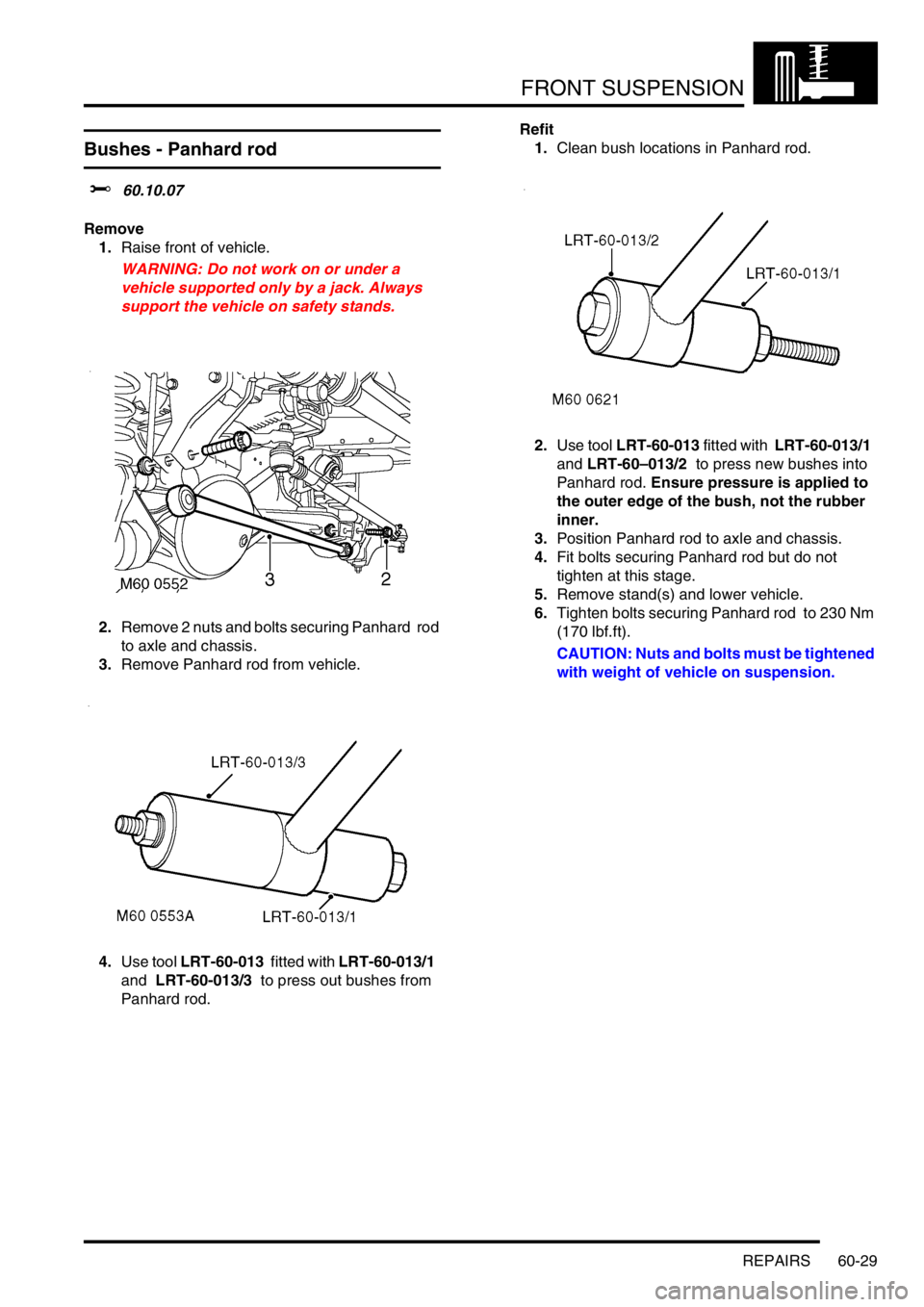
2.Remove 2 nuts and bolts securing Panhard rod
to axle and chassis.
3.Remove Panhard rod from vehicle.
4.Use tool LRT-60-013 fitted with LRT-60-013/1
and LRT-60-013/3 to press out bushes from
Panhard rod. Refit
1.Clean bush locations in Panhard rod.
2.Use tool LRT-60-013 fitted with LRT-60-013/1
and LRT-60–013/2 to press new bushes into
Panhard rod. Ensure pressure is applied to
the outer edge of the bush, not the rubber
inner.
3.Position Panhard rod to axle and chassis.
4.Fit bolts securing Panhard rod but do not
tighten at this stage.
5.Remove stand(s) and lower vehicle.
6.Tighten bolts securing Panhard rod to 230 Nm
(170 lbf.ft).
CAUTION: Nuts and bolts must be tightened
with weight of vehicle on suspension.
Page 969 of 1672

FRONT SUSPENSION
60-30 REPAIRS
Ball joint - upper - steering knuckle
$% 60.15.02
CAUTION: Each ball joint can be replaced up to
three times before the axle yoke bore becomes
oversize. Before commencing work, thoroughly
clean surface of joint and check for yellow paint
marks approx. 12 mm (0.5 in) wide. If 3 marks are
found, the axle case must be renewed.
Remove
1.Remove steering knuckle.
+ FRONT SUSPENSION, REPAIRS,
Steering knuckle.
2.Support the chassis on stands.
3.Support the front axle on stands.
4.Remove 2 nuts securing anti-roll bar lower links
to front axle, use a 16 mm spanner to prevent
link joint from turning.
5.Remove 2 bolts securing each front damper to
axle.
6.Remove 8 bolts securing chassis crossmember
and remove crossmember.
7.Remove bolt securing brake hose and ABS
sensor harness bracket to axle.
8.Lower the front axle, release front spring from
damper and remove front spring.9.Fit tool LRT-54-008/22 to tool LRT-54-008.
10.Fit tool LRT-54-008/4 to tool LRT-54-008, and
secure with screw.
11.Fit tool LRT-54-008 with all attachments to
upper ball joint..
12.Fit tool LRT-54-008/5 to the top of the ball
joint.
13.Press upper ball joint from axle. When ram lead
screw reaches the end of its stroke, retract the
lead screw and screw the ram further into the
tool. Repeat the operation until the ball joint is
released from the axle.
14.Dismantle the tools.
Refit
1.Clean upper ball joint location and surrounding
area of axle yoke.
2.Apply a 12 mm (0.5 in) wide yellow paint stripe
on axle yoke, adjacent to upper ball joint
location.
Page 970 of 1672
FRONT SUSPENSION
REPAIRS 60-31
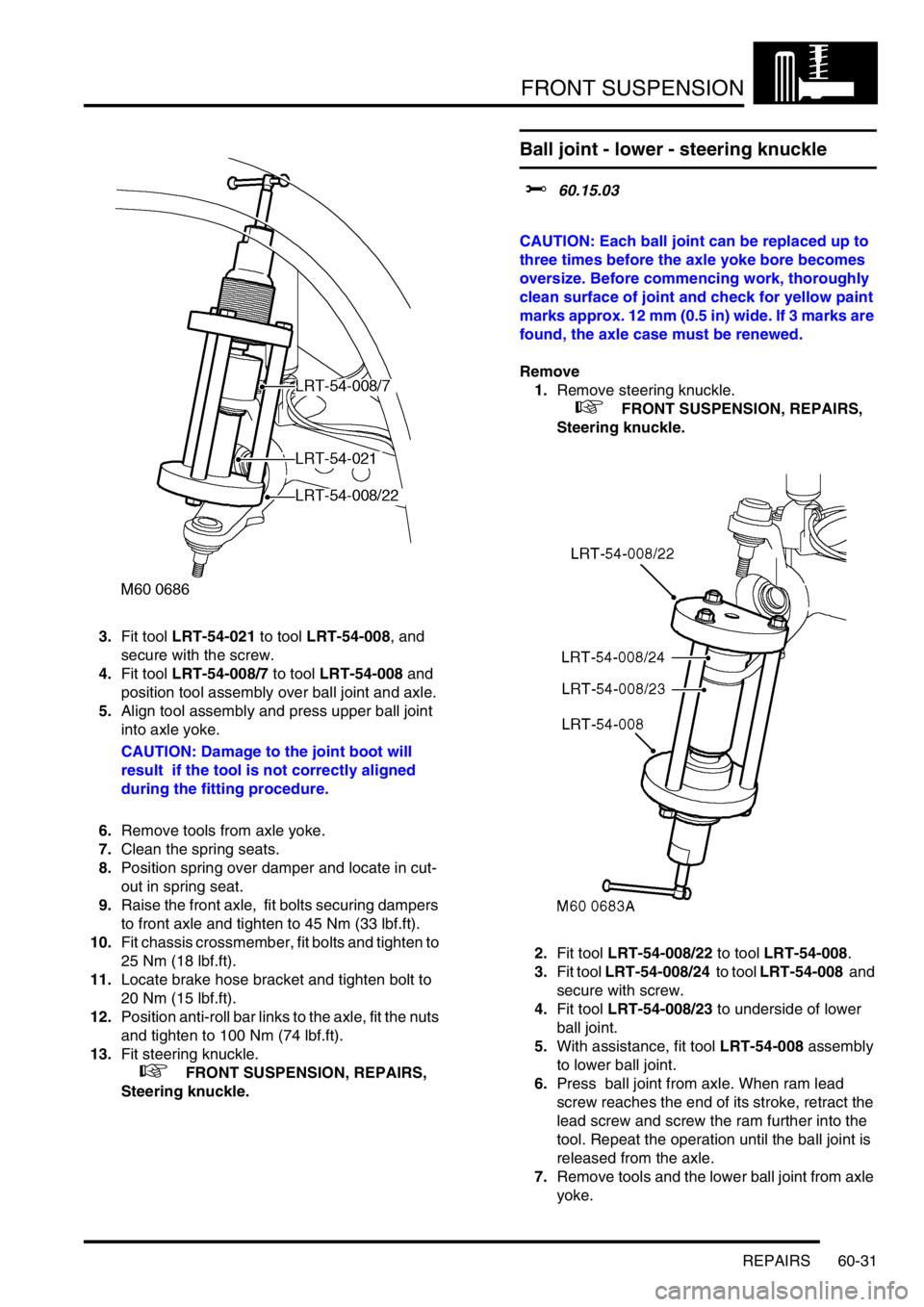
3.Fit tool LRT-54-021 to tool LRT-54-008, and
secure with the screw.
4.Fit tool LRT-54-008/7 to tool LRT-54-008 and
position tool assembly over ball joint and axle.
5.Align tool assembly and press upper ball joint
into axle yoke.
CAUTION: Damage to the joint boot will
result if the tool is not correctly aligned
during the fitting procedure.
6.Remove tools from axle yoke.
7.Clean the spring seats.
8.Position spring over damper and locate in cut-
out in spring seat.
9.Raise the front axle, fit bolts securing dampers
to front axle and tighten to 45 Nm (33 lbf.ft).
10.Fit chassis crossmember, fit bolts and tighten to
25 Nm (18 lbf.ft).
11.Locate brake hose bracket and tighten bolt to
20 Nm (15 lbf.ft).
12.Position anti-roll bar links to the axle, fit the nuts
and tighten to 100 Nm (74 lbf.ft).
13.Fit steering knuckle.
+ FRONT SUSPENSION, REPAIRS,
Steering knuckle.
Ball joint - lower - steering knuckle
$% 60.15.03
CAUTION: Each ball joint can be replaced up to
three times before the axle yoke bore becomes
oversize. Before commencing work, thoroughly
clean surface of joint and check for yellow paint
marks approx. 12 mm (0.5 in) wide. If 3 marks are
found, the axle case must be renewed.
Remove
1.Remove steering knuckle.
+ FRONT SUSPENSION, REPAIRS,
Steering knuckle.
2.Fit tool LRT-54-008/22 to tool LRT-54-008.
3.Fit tool LRT-54-008/24 to tool LRT-54-008 and
secure with screw.
4.Fit tool LRT-54-008/23 to underside of lower
ball joint.
5.With assistance, fit tool LRT-54-008 assembly
to lower ball joint.
6.Press ball joint from axle. When ram lead
screw reaches the end of its stroke, retract the
lead screw and screw the ram further into the
tool. Repeat the operation until the ball joint is
released from the axle.
7.Remove tools and the lower ball joint from axle
yoke.
Page 971 of 1672
FRONT SUSPENSION
60-32 REPAIRS
Refit
1.Clean lower ball joint location and surrounding
area of axle yoke.
2.Apply a 12 mm (0.5 in) wide yellow paint stripe
on axle yoke, adjacent to lower ball joint
location.
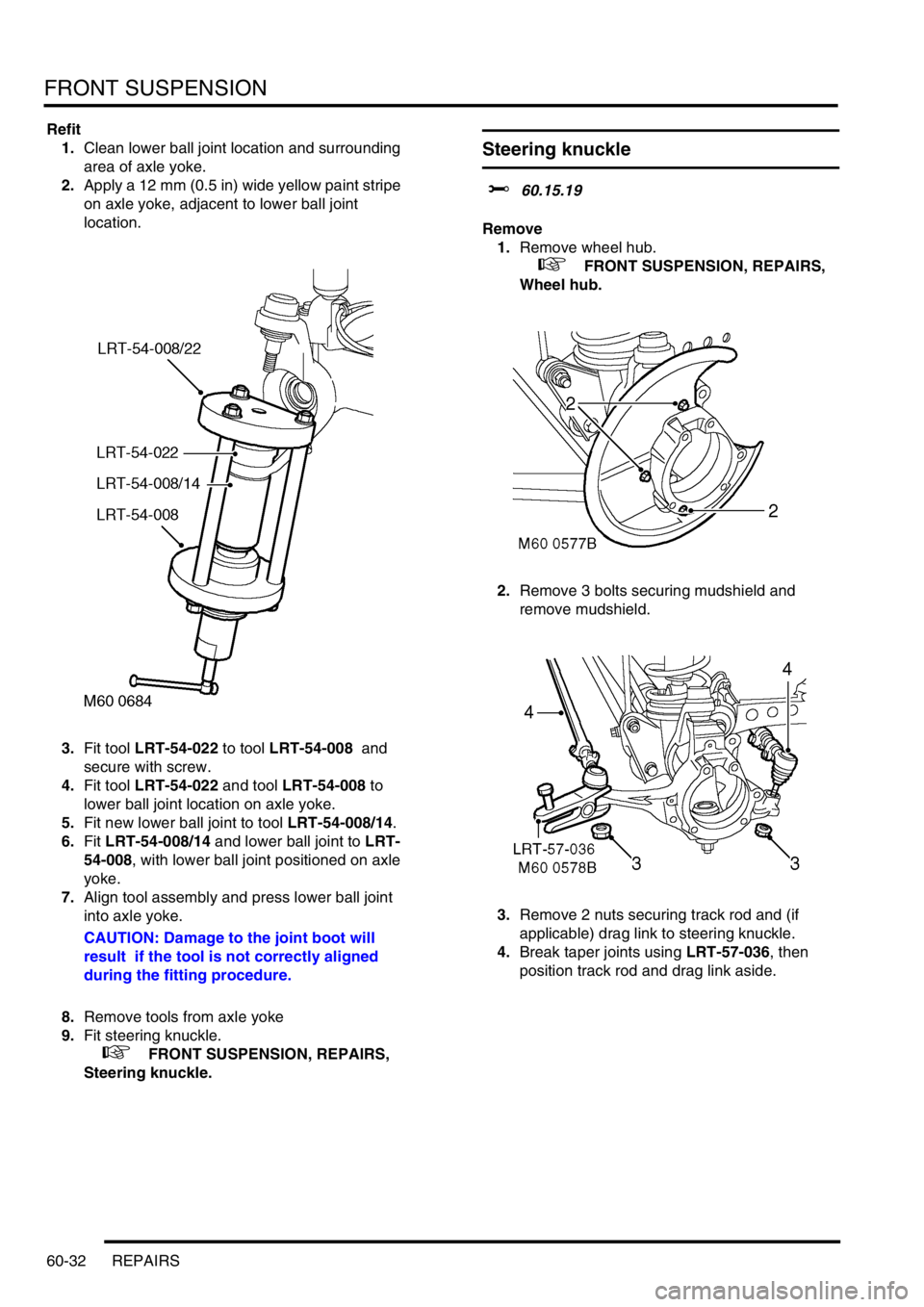
3.Fit tool LRT-54-022 to tool LRT-54-008 and
secure with screw.
4.Fit tool LRT-54-022 and tool LRT-54-008 to
lower ball joint location on axle yoke.
5.Fit new lower ball joint to tool LRT-54-008/14.
6.Fit LRT-54-008/14 and lower ball joint to LRT-
54-008, with lower ball joint positioned on axle
yoke.
7.Align tool assembly and press lower ball joint
into axle yoke.
CAUTION: Damage to the joint boot will
result if the tool is not correctly aligned
during the fitting procedure.
8.Remove tools from axle yoke
9.Fit steering knuckle.
+ FRONT SUSPENSION, REPAIRS,
Steering knuckle.
Steering knuckle
$% 60.15.19
Remove
1.Remove wheel hub.
+ FRONT SUSPENSION, REPAIRS,
Wheel hub.
2.Remove 3 bolts securing mudshield and
remove mudshield.
3.Remove 2 nuts securing track rod and (if
applicable) drag link to steering knuckle.
4.Break taper joints using LRT-57-036, then
position track rod and drag link aside.
Page 972 of 1672
FRONT SUSPENSION
REPAIRS 60-33
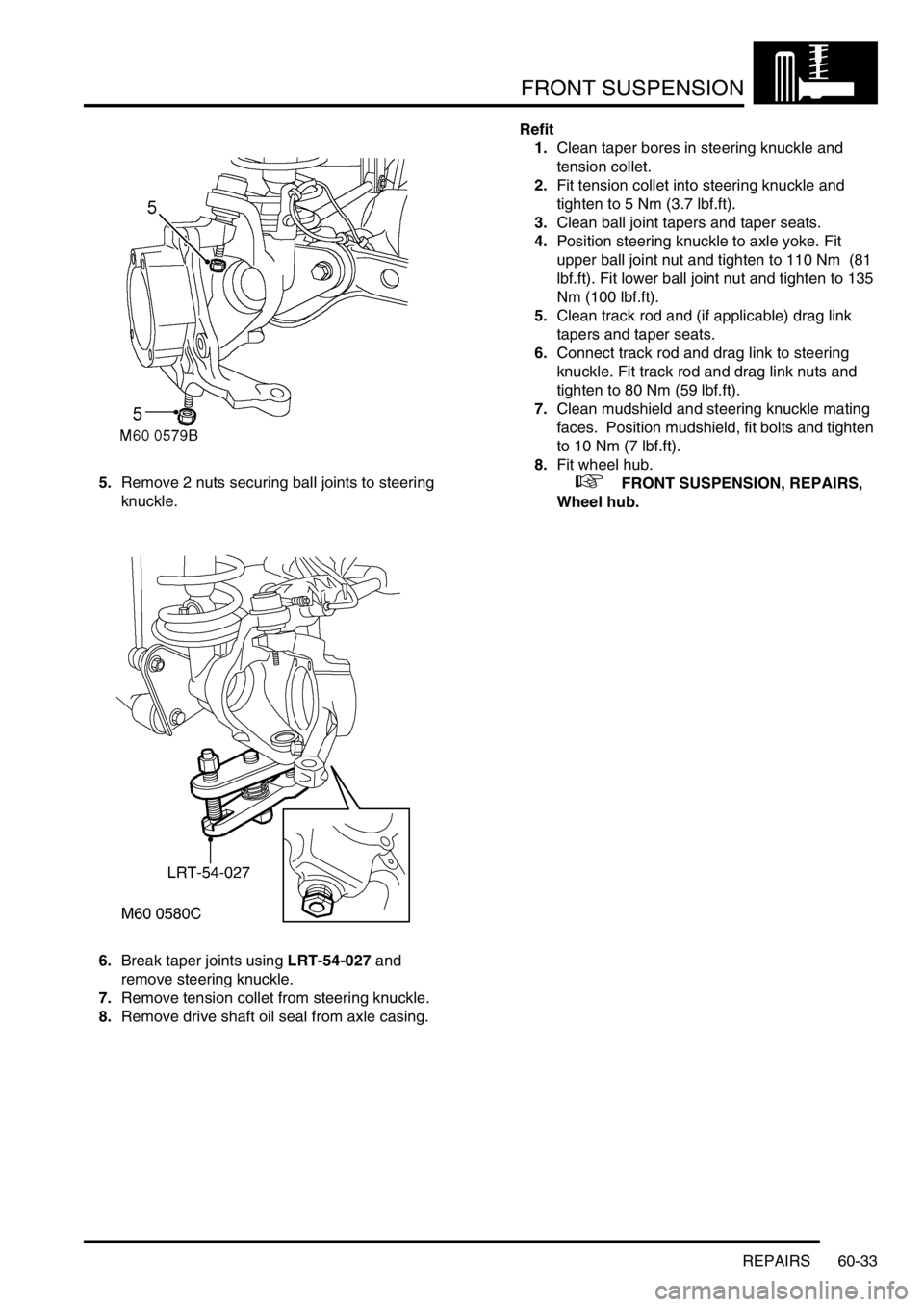
5.Remove 2 nuts securing ball joints to steering
knuckle.
6.Break taper joints using LRT-54-027 and
remove steering knuckle.
7.Remove tension collet from steering knuckle.
8.Remove drive shaft oil seal from axle casing.Refit
1.Clean taper bores in steering knuckle and
tension collet.
2.Fit tension collet into steering knuckle and
tighten to 5 Nm (3.7 lbf.ft).
3.Clean ball joint tapers and taper seats.
4.Position steering knuckle to axle yoke. Fit
upper ball joint nut and tighten to 110 Nm (81
lbf.ft). Fit lower ball joint nut and tighten to 135
Nm (100 lbf.ft).
5.Clean track rod and (if applicable) drag link
tapers and taper seats.
6.Connect track rod and drag link to steering
knuckle. Fit track rod and drag link nuts and
tighten to 80 Nm (59 lbf.ft).
7.Clean mudshield and steering knuckle mating
faces. Position mudshield, fit bolts and tighten
to 10 Nm (7 lbf.ft).
8.Fit wheel hub.
+ FRONT SUSPENSION, REPAIRS,
Wheel hub.
Page 973 of 1672
FRONT SUSPENSION
60-34 REPAIRS
Road spring - front
$% 60.20.11
Remove
1.Raise front of vehicle.
WARNING: Do not work on or under a
vehicle supported only by a jack. Always
support the vehicle on safety stands.
2.Support vehicle under chassis.
3.Remove front road wheels.
4.Support weight of front axle.
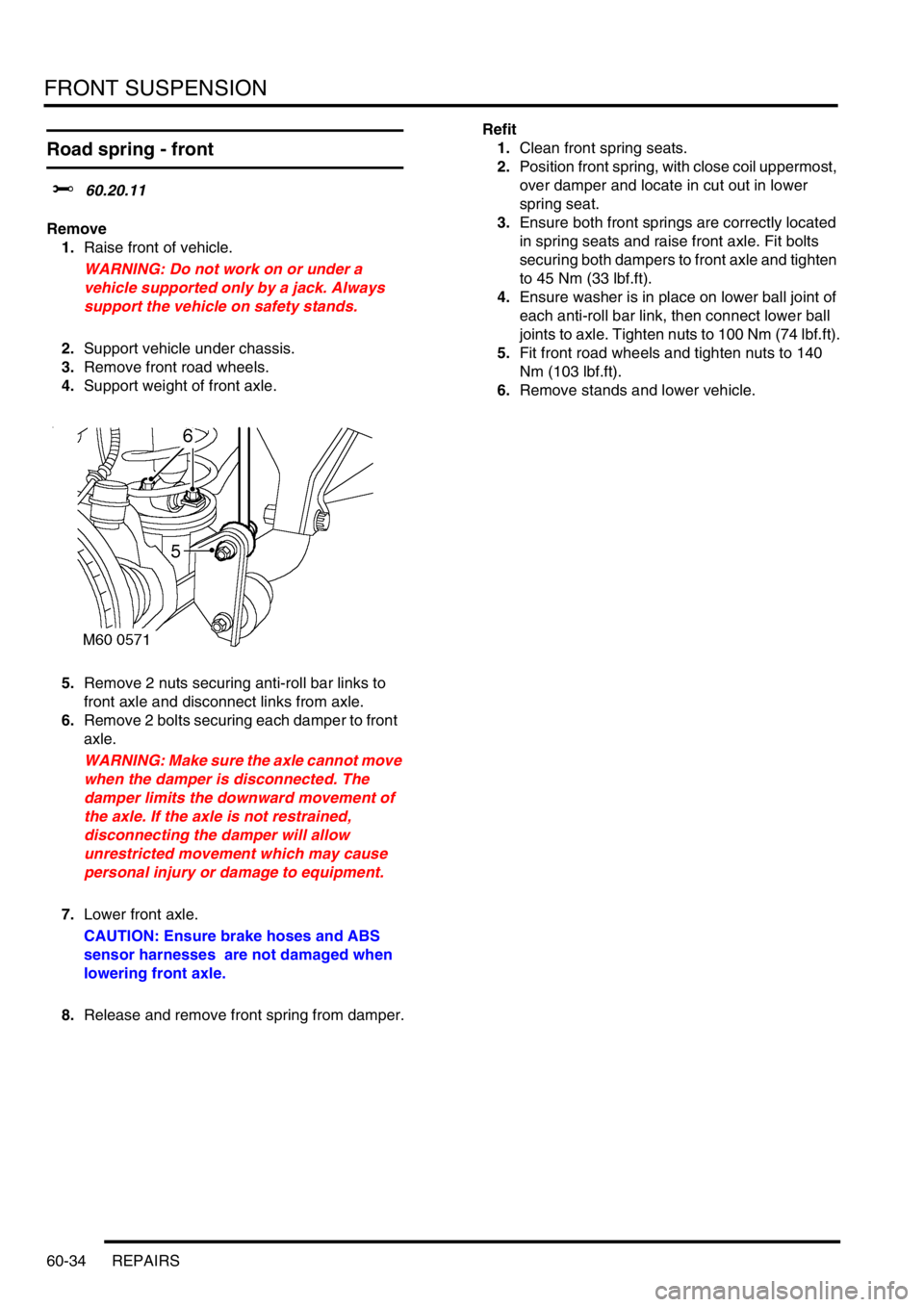
5.Remove 2 nuts securing anti-roll bar links to
front axle and disconnect links from axle.
6.Remove 2 bolts securing each damper to front
axle.
WARNING: Make sure the axle cannot move
when the damper is disconnected. The
damper limits the downward movement of
the axle. If the axle is not restrained,
disconnecting the damper will allow
unrestricted movement which may cause
personal injury or damage to equipment.
7.Lower front axle.
CAUTION: Ensure brake hoses and ABS
sensor harnesses are not damaged when
lowering front axle.
8.Release and remove front spring from damper.Refit
1.Clean front spring seats.
2.Position front spring, with close coil uppermost,
over damper and locate in cut out in lower
spring seat.
3.Ensure both front springs are correctly located
in spring seats and raise front axle. Fit bolts
securing both dampers to front axle and tighten
to 45 Nm (33 lbf.ft).
4.Ensure washer is in place on lower ball joint of
each anti-roll bar link, then connect lower ball
joints to axle. Tighten nuts to 100 Nm (74 lbf.ft).
5.Fit front road wheels and tighten nuts to 140
Nm (103 lbf.ft).
6.Remove stands and lower vehicle.
Page 974 of 1672

FRONT SUSPENSION
REPAIRS 60-35
Wheel hub
$% 60.25.01
Remove
1.Release ABS sensor harness grommet from
inner wing valance and disconnect multiplug.
2.Raise front of vehicle.
WARNING: Do not work on or under a
vehicle supported only by a jack. Always
support the vehicle on safety stands.
3.Remove road wheel.4.Pull ABS sensor harness through aperture into
wheel arch.
5.Release harness from brackets on inner wing
valance, suspension turret and front hub.
6.Release stake from drive shaft nut.
7.With assistance, remove drive shaft nut.
Discard the nut.
8.Remove front brake disc.
+ BRAKES, REPAIRS, Brake disc -
front.