fuel pressure LAND ROVER DISCOVERY 2002 Repair Manual
[x] Cancel search | Manufacturer: LAND ROVER, Model Year: 2002, Model line: DISCOVERY, Model: LAND ROVER DISCOVERY 2002Pages: 1672, PDF Size: 46.1 MB
Page 550 of 1672

FUEL DELIVERY SYSTEM - TD5
DESCRIPTION AND OPERATION 19-1-5
The fuel pump is a 'self priming', wet type, two stage pump which is immersed in fuel in the tank and operates at all
times when the ignition switch is in position II. If the engine is not started, the ECU will 'time-out' after three minutes
and de-energise the fuel pump relay. The pump receives a feed from the battery via fuse 10 in the engine
compartment fusebox and the fuel pump relay. The relay is energised by the ECM when the ignition switch is moved
to position II.
The fuel pump assembly is retained with a locking ring and sealed with a rubber seal. The locking ring requires a
special tool for removal and refitment. An access panel for the fuel pump is located in the loadspace floor below the
carpet. The access panel is sealed to the floor with a rubber seal and retained by six self-tapping screws. A four pin
electrical connector is located on the top cover and provides power feed and earth for the fuel pump and also inputs
and outputs for the fuel gauge sender operation.
The fuel gauge sender is integral with the fuel pump. The sender is submerged in the fuel and is operated by a float
which moves with the fuel level in the tank.
Fuel pump
The fuel pump assembly comprises a top cover which locates the electrical connector, fuel burning heater connection
and four fuel pipe couplings. The top cover is attached to a plastic cup shaped housing and retained on three sliding
clips. Two coil springs are located between the cover and the housing and ensure that the fuel pump remains seated
positively at the bottom of the tank when installed.
The housing locates the two stage fuel pump and also the fuel gauge sender unit. The lower part of the housing is the
swirl pot which maintains a constant level of fuel at the fuel pick-up. A coarse filter is located in the base of the housing
and prevents the ingress of contaminants into the pump and the fuel system from the fuel being drawn into the pump.
A fine filter is located in the intake to the low pressure stage to protect the pump from contaminants. Flexible pipes
connect the couplings on the top cover to the pump.
A non-return valve is located in the base of the housing. When the fuel tank is full, fuel pressure keeps the valve lifted
from its seat allowing fuel to flow into the swirl pot. As the tank level reduces, the fuel pressure in the tank reduces
causing the valve to close. When the valve is closed fuel is retained in the swirl pot, ensuring that the swirl pot remains
full and maintains a constant supply to the fuel pump.
The two stage pump comprises a high and a low pressure stage. The low pressure stage draws fuel from the swirl
pot through the filter. The low pressure stage pumps fluid at a pressure of 0.75 bar (10.9 lbf.in
2) and a flow of 30 litres/
hour (8 US Gallons/hour) to the fuel filter. A proportion of the fuel from the low pressure stage also passes, via a
restrictor, through a jet pump which keeps fuel circulating in the swirl pot. The high pressure stage draws the low
pressure fuel from the fuel filter and pressurises it to a pressure of 4.0 bar (58 lbf.in
2). The pressurised fuel is then
passed from the pump to the injectors at a flow of 180 litres/hour (47.6 US Gallons/hour). A fuel pressure regulator is
located at the rear of the engine and ensures that the delivery pressure remains at 4.0 bar (58 lbf.in
2) by controlling
the amount of fuel returning to the fuel tank.
The fuel pump has a maximum current draw of 15 Amps at 12.5 V and is protected by a 20 Amp fuse in the engine
compartment fusebox.
Page 551 of 1672
FUEL DELIVERY SYSTEM - TD5
19-1-6 DESCRIPTION AND OPERATION
Fuel gauge sender
The fuel gauge sender unit comprises a rotary potentiometer operated by a float. The float rises and falls with the fuel
level in the tank and moves the potentiometer accordingly.
A voltage of 5 V is supplied to the potentiometer from the instrument pack. The output voltage from the potentiometer
varies according to the resistance through the potentiometer in relation to the fuel level. The output voltage is
connected to the fuel gauge in the instrument pack. The fuel gauge receives a battery voltage input and this is
compared with the output voltage from the rotary potentiometer. The difference between the two voltages determines
the deflection of the fuel gauge pointer.
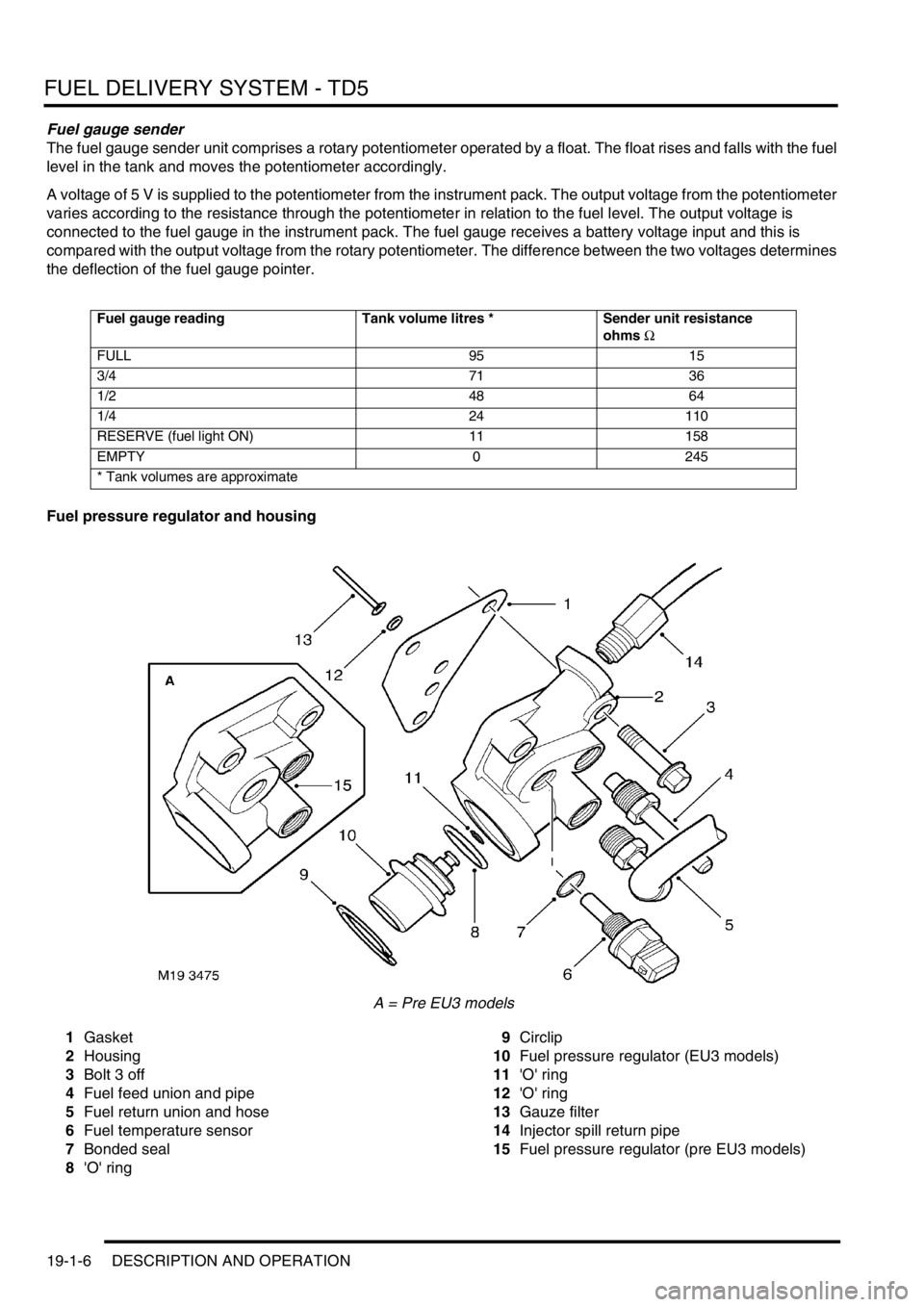
Fuel pressure regulator and housing
A = Pre EU3 models
1Gasket
2Housing
3Bolt 3 off
4Fuel feed union and pipe
5Fuel return union and hose
6Fuel temperature sensor
7Bonded seal
8'O' ring9Circlip
10Fuel pressure regulator (EU3 models)
11'O' ring
12'O' ring
13Gauze filter
14Injector spill return pipe
15Fuel pressure regulator (pre EU3 models)
Fuel gauge reading Tank volume litres * Sender unit resistance
ohms Ω
FULL 95 15
3/4 71 36
1/2 48 64
1/4 24 110
RESERVE (fuel light ON) 11 158
EMPTY 0 245
* Tank volumes are approximate
Page 552 of 1672
FUEL DELIVERY SYSTEM - TD5
DESCRIPTION AND OPERATION 19-1-7
The fuel pressure regulator is located in a cast alloy housing which is attached to the rear right hand corner of the
cylinder head with three flanged bolts and sealed with a metal gasket. On pre EU3 models there are two ports in the
housing that connect with ports in the cylinder head for fuel pressure feed and return. On EU3 models there is a port
in the housing that connects with a port in the cylinder head for fuel pressure feed and a single external port for fuel
return. A gauze filter is located in the pressure feed port in the cylinder head and filters the fuel before it reaches the
injectors. The filter is a fit for life item but can be changed if required. An 'O' ring is located in a recess in the cylinder
head and provides additional sealing for the pressure feed port between the gauze filter, the cylinder head and the
housing.
A union and pipe is attached to the feed port in the housing and connects with a quick release coupling to the fuel
pressure feed pipe from the fuel pump. A second union and hose is located in the return port and provides the fuel
return connection to the fuel cooler. A third port provides location for the fuel temperature sensor which is sealed to
the housing with a bonded seal. The fuel temperature sensor is used by the Engine Control Module (ECM) for engine
management.
The fuel pressure regulator is located in a machined port in the lower part of the housing. The regulator is sealed in
the housing with two 'O' rings and secured with an internal circlip.
The regulator maintains the fuel pump delivery pressure at 4 bar (58 lbf.in
2). When the fuel pressure exceeds 4 bar
(58 lbf.in2), the regulator opens and allows fuel to return to the fuel tank via the fuel cooler. The fuel returned from the
regulator is directed back into the fuel filter before being drawn by the high pressure stage of the fuel pump and
directed back to the injectors. A special tool can be attached to the regulator housing fuel feed port and allows for the
fitment of a suitable gauge to measure fuel pump delivery pressure.
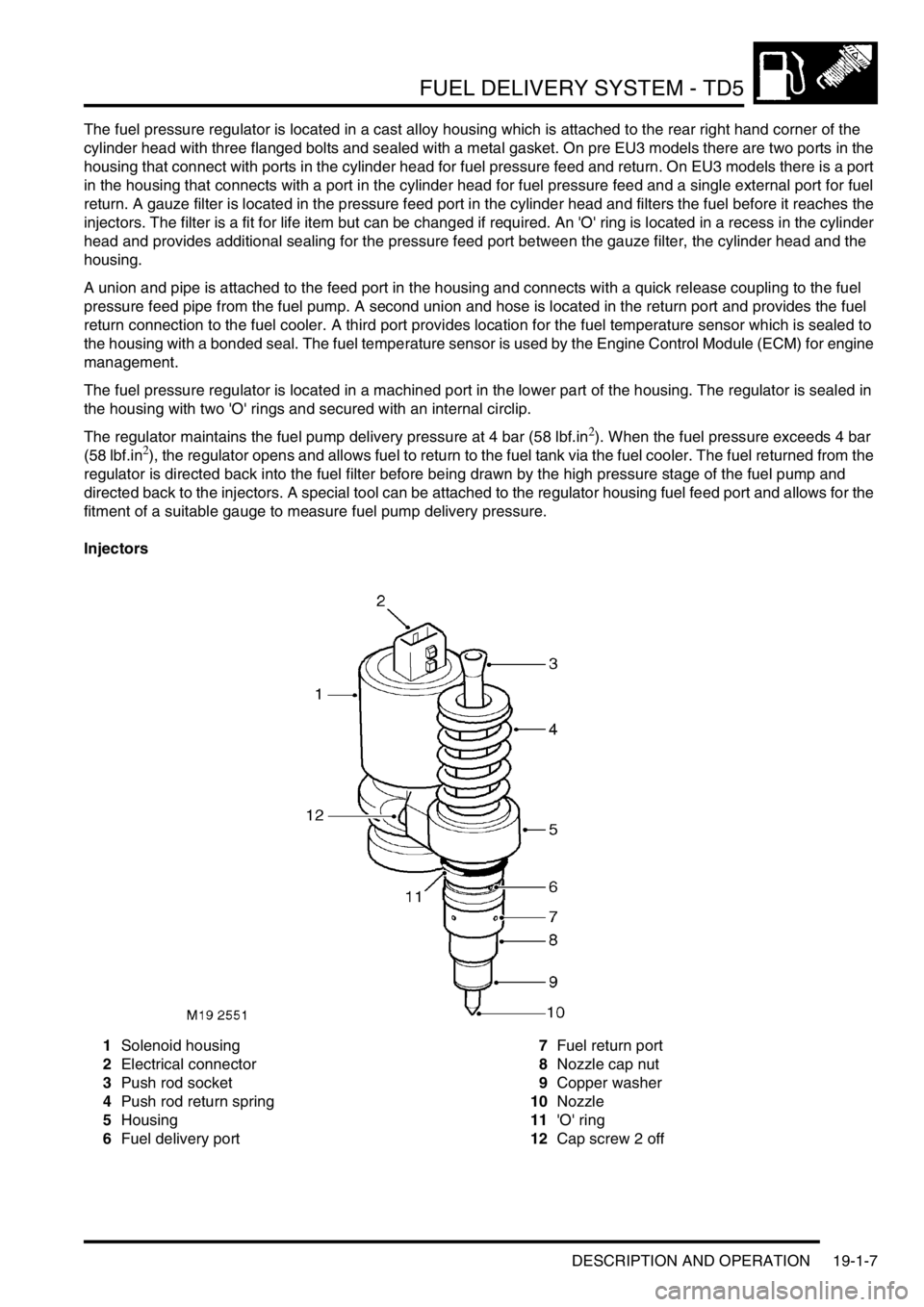
Injectors
1Solenoid housing
2Electrical connector
3Push rod socket
4Push rod return spring
5Housing
6Fuel delivery port7Fuel return port
8Nozzle cap nut
9Copper washer
10Nozzle
11'O' ring
12Cap screw 2 off
Page 553 of 1672

FUEL DELIVERY SYSTEM - TD5
19-1-8 DESCRIPTION AND OPERATION
The five injectors are located in the cylinder head, adjacent to the camshaft, with the nozzle of each injector protruding
directly into the cylinder. Each injector is sealed into the cylinder head with an 'O' ring and a copper washer and
secured with a clamp and bolt.
Each injector is operated mechanically by an overhead camshaft and rocker and electrically by a solenoid controlled
by the ECM. Each injector is supplied with pressurised fuel from the pump via the regulator housing and internal
drillings in the cylinder head.
+ ENGINE MANAGEMENT SYSTEM - Td5, DESCRIPTION AND OPERATION, Description.
The solenoid housing is secured to the injector body with two cap screws and is a sealed unit with a two pin electrical
connector on its top face.
The injector body is machined from a forging. The body has a machined central bore which locates the push rod. A
thread on the outer diameter provides the attachment for the nozzle cap nut. The body also provides attachment for
the solenoid housing.
The injector push rod is operated from the rocker and cam assembly by a socket. The push rod is located in the
housing bore and retained in its extended position by a push rod return spring. The powerful spring ensures that the
push rod socket is always in contact with the rocking lever and the cam.
The lower part of the injector housing locates the spring loaded nozzle. The nozzle is retained in the housing by a
nozzle cap nut which is screwed onto the housing. The nozzle cap nut has four holes around its circumference which
connect to the fuel return drilling in the cylinder head. The injector housing has ports located above the nozzle cap
nut which connect with the fuel delivery drilling in the cylinder head. An 'O' ring seals the injector in the machined
location in the cylinder head and a copper washer seals the injector from the combustion chamber.
The injectors are supplied with pressurised fuel from the fuel pump, via the pressure regulator housing and internal
drillings in the cylinder head. Each injector sprays fuel directly into the cylinder at approximately, 1500 bar (22000
lbf.in
2) on pre EU3 models and 1750 bar (25500 lbf.in2) on EU3 models, atomising the fuel and mixing it with intake
air prior to combustion.
The camshaft and rocker arrangement depresses the push rod which pressurises the fuel within the injector. When
the injector is required to inject fuel into the cylinder, the ECM energises the solenoid which closes a valve within the
solenoid housing. The closure of the valve stops the fuel entering the return line to the pump, trapping it in the injector.
The compression of the fuel by the push rod causes rapid pressurisation of the fuel which lifts the injector nozzle,
forcing the fuel into the cylinder at high pressure. The ECM controls the injection timing by altering the time at which
the solenoid is energised and the injection period by controlling the period for which the solenoid is energised.
+ ENGINE MANAGEMENT SYSTEM - Td5, DESCRIPTION AND OPERATION, Description.
Page 554 of 1672
FUEL DELIVERY SYSTEM - TD5
DESCRIPTION AND OPERATION 19-1-9
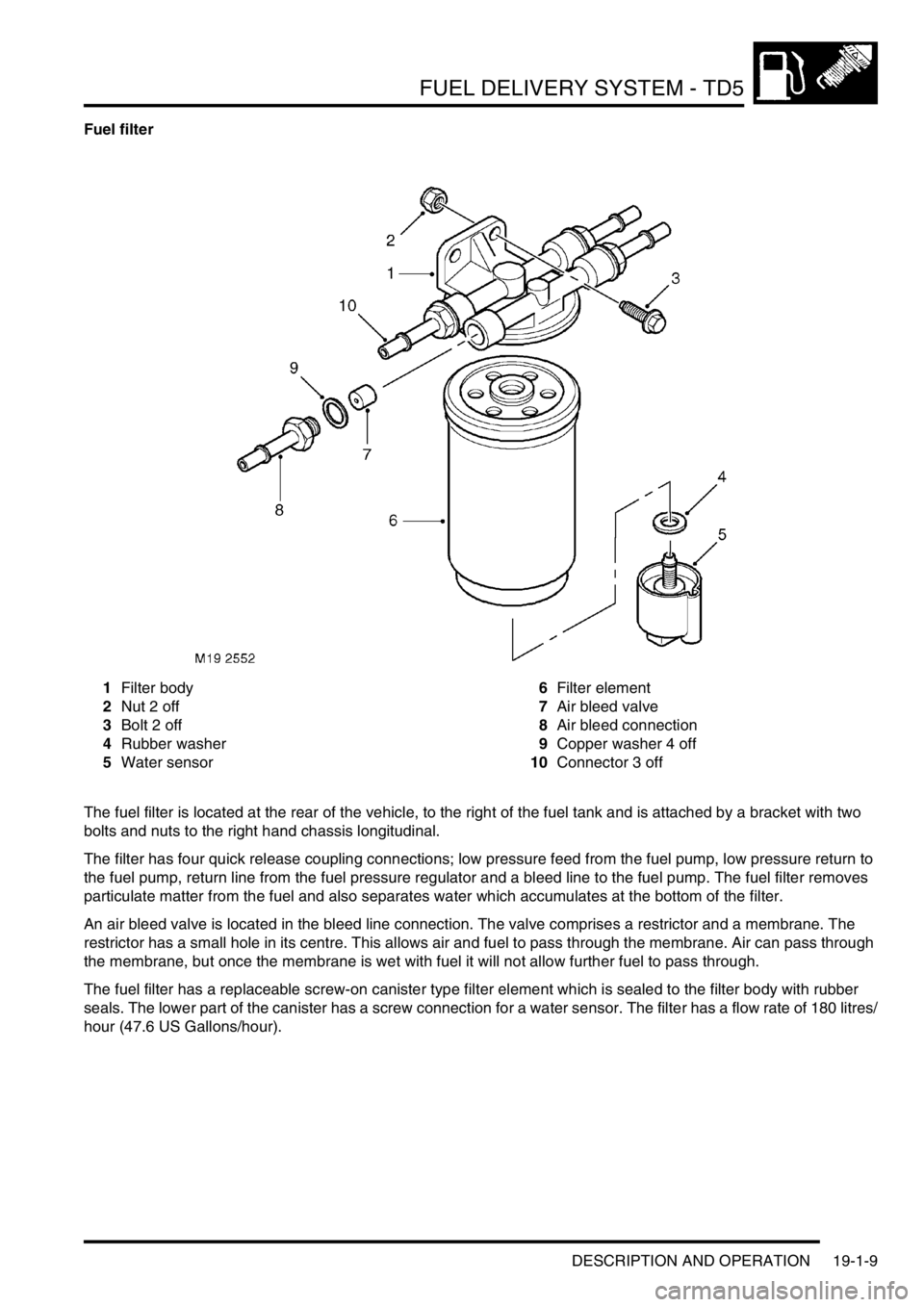
Fuel filter
1Filter body
2Nut 2 off
3Bolt 2 off
4Rubber washer
5Water sensor6Filter element
7Air bleed valve
8Air bleed connection
9Copper washer 4 off
10Connector 3 off
The fuel filter is located at the rear of the vehicle, to the right of the fuel tank and is attached by a bracket with two
bolts and nuts to the right hand chassis longitudinal.
The filter has four quick release coupling connections; low pressure feed from the fuel pump, low pressure return to
the fuel pump, return line from the fuel pressure regulator and a bleed line to the fuel pump. The fuel filter removes
particulate matter from the fuel and also separates water which accumulates at the bottom of the filter.
An air bleed valve is located in the bleed line connection. The valve comprises a restrictor and a membrane. The
restrictor has a small hole in its centre. This allows air and fuel to pass through the membrane. Air can pass through
the membrane, but once the membrane is wet with fuel it will not allow further fuel to pass through.
The fuel filter has a replaceable screw-on canister type filter element which is sealed to the filter body with rubber
seals. The lower part of the canister has a screw connection for a water sensor. The filter has a flow rate of 180 litres/
hour (47.6 US Gallons/hour).
Page 556 of 1672

FUEL DELIVERY SYSTEM - TD5
DESCRIPTION AND OPERATION 19-1-11
Operation
When the ignition switch is moved to position II, the fuel pump relay in the engine compartment fusebox is energised
by the ECM. Battery voltage is supplied from the fuel pump relay to the fuel pump which operates. If engine cranking
is not detected by the ECM within a three minute period, the ECM will 'time-out', de-energising the fuel pump relay.
When the ignition is turned off the ECM timer will reset.
The low pressure stage of the fuel pump draws fuel from the swirl pot and pumps it into the fuel filter. The high
pressure stage of the fuel pump draws the fuel from the fuel filter and pumps it along the fuel feed pipe to the cylinder
head.
The fuel enters the cylinder head through a connection on the fuel pressure regulator housing and supplies each
injector with pressurised fuel. The fuel pressure regulator maintains the fuel pressure at the injectors at 4 bar (58
lbf.in
2) by returning excess fuel back to the fuel filter. The returned fuel passes through the fuel cooler in the engine
compartment before it passes to the fuel filter.
When the engine is running, each injector is operated by an overhead camshaft which depresses a push rod in each
injector at a timed interval. When the cam has depressed the push rod and the push rod is returning to its extended
position, fuel is drawn from the fuel supply drilling into the injector.
When the ECM determines that injection is required, the ECM transmits an electrical pulse which energises the fast
acting solenoid, closing the spill valve on the injector and locking fuel in the injector body. As the cam begins to
depress the push rod, the fuel in the injector is rapidly pressurised. When the pressure exceeds the nozzle spring
pressure, the nozzle opens and injects fuel at very high pressure into the cylinder.
When the ECM determines that the injection period should end, the solenoid is rapidly de-energised, opening the spill
valve on the injector and allowing fuel to pass into the return circuit.
The ECM controls the injection timing by altering the time at which the solenoid is energised and the injection period
by controlling the period for which the solenoid is energised.
Page 566 of 1672
FUEL DELIVERY SYSTEM - V8
DESCRIPTION AND OPERATION 19-2-1
FUEL DELIVERY SYST EM - V8 DESCRIPTION AND OPERAT ION
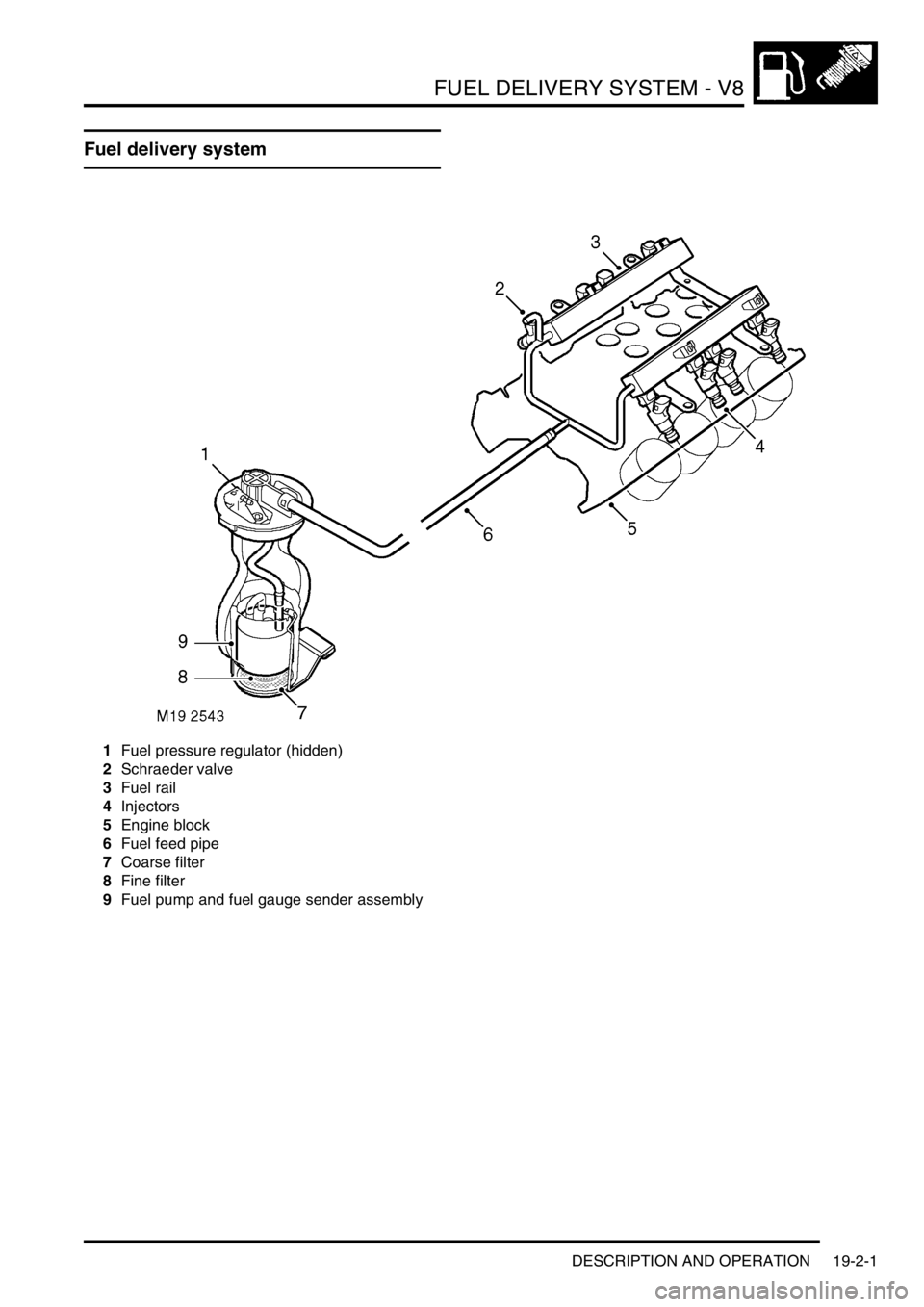
Fuel delivery system
1Fuel pressure regulator (hidden)
2Schraeder valve
3Fuel rail
4Injectors
5Engine block
6Fuel feed pipe
7Coarse filter
8Fine filter
9Fuel pump and fuel gauge sender assembly
Page 568 of 1672
FUEL DELIVERY SYSTEM - V8
DESCRIPTION AND OPERATION 19-2-3
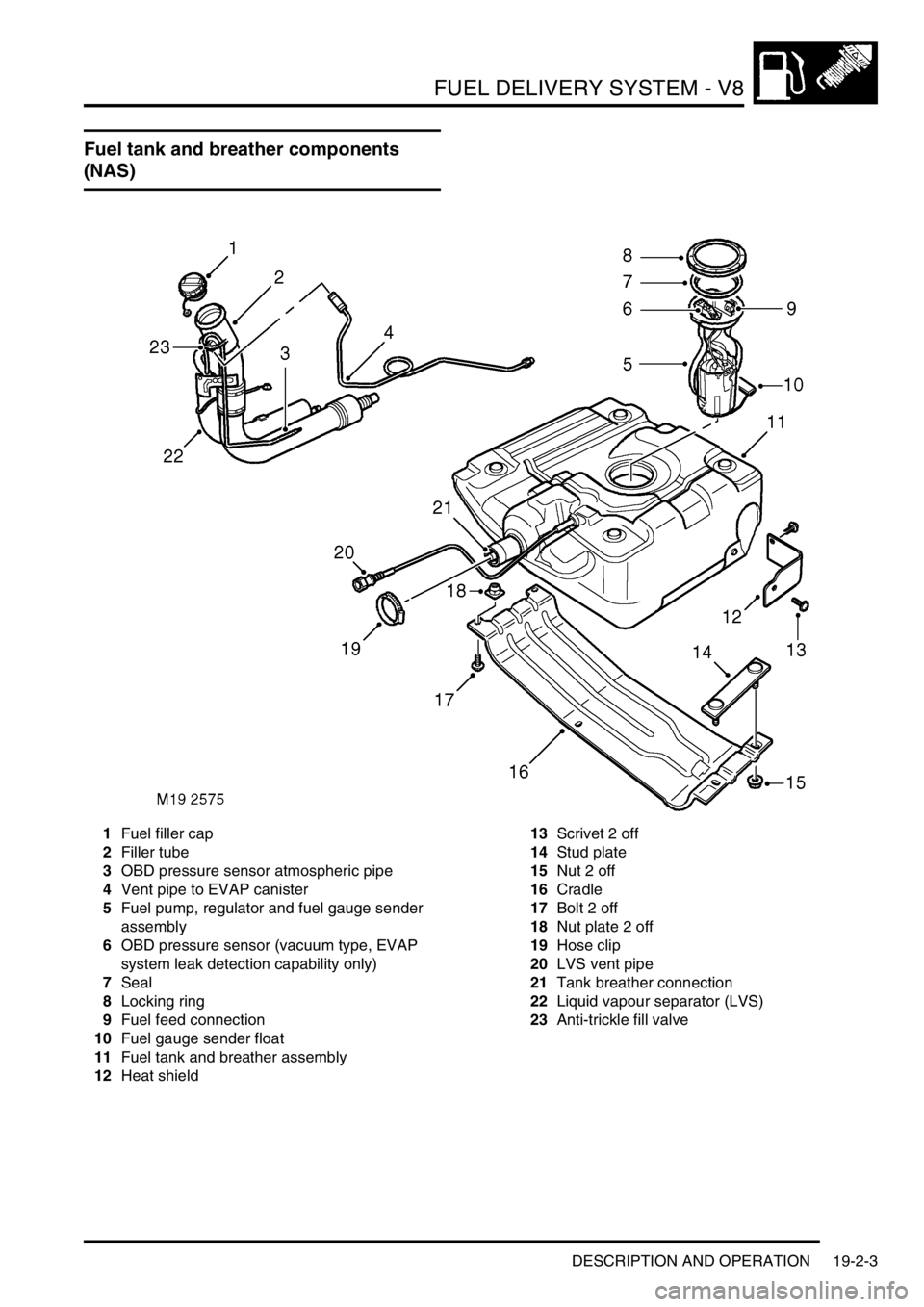
Fuel tank and breather components
(NAS)
1Fuel filler cap
2Filler tube
3OBD pressure sensor atmospheric pipe
4Vent pipe to EVAP canister
5Fuel pump, regulator and fuel gauge sender
assembly
6OBD pressure sensor (vacuum type, EVAP
system leak detection capability only)
7Seal
8Locking ring
9Fuel feed connection
10Fuel gauge sender float
11Fuel tank and breather assembly
12Heat shield13Scrivet 2 off
14Stud plate
15Nut 2 off
16Cradle
17Bolt 2 off
18Nut plate 2 off
19Hose clip
20LVS vent pipe
21Tank breather connection
22Liquid vapour separator (LVS)
23Anti-trickle fill valve
Page 569 of 1672

FUEL DELIVERY SYSTEM - V8
19-2-4 DESCRIPTION AND OPERATION
Description
General
The fuel delivery system comprises a fuel tank, fuel pump and regulator and eight injectors. The system is controlled
by the Engine Control Module (ECM) which energises the fuel pump relay and controls the operation and timing of
each injector solenoid.
+ ENGINE MANAGEMENT SYSTEM - V8, DESCRIPTION AND OPERATION, Description - engine
management.
The multiport fuel injection system is a returnless system with the fuel pressure maintained at a constant level by a
fuel pressure regulator. The regulator is located in the fuel pump housing and returns excess fuel directly from the
pump to the tank.
An electrically operated fuel pump is located in the top of the fuel tank and supplies fuel at pressure to two fuel rails
via a flexible hose. The hose is attached to the feed pipe on the fuel rail at the rear of the engine and the fuel pump
with sealed quick release couplings.
A moulded fuel tank is located at the rear underside of the vehicle between the chassis longitudinals. The tank
provides the attachment for the fuel pump and fuel gauge sender unit which is located inside the tank. The fuel system
is pressurised permanently with pressurised fuel vapour venting to an EVAP canister.
+ EMISSION CONTROL - V8, DESCRIPTION AND OPERATION, Emission Control Systems.
Fuel tank and breather
The fuel tank and breather system is a major part of the fuel delivery system. The fuel tank and breathers are located
at the rear of the vehicle between the chassis longitudinals.
Fuel tank
The moulded fuel tank is made from High Molecular Weight (HMW) High Density Polyethylene (HDPE). Continuous
layers of nylon additive are used during the moulding process. The nylon layers give an improved limit of fuel
permeation through the tank wall and are also resistant to alcohol based fuels used in the NAS market.
The tank is retained in position by a metal cradle which is secured to the chassis with two nut plates and bolts at the
rear and a stud plate and two nuts at the front. A strap above the tank is bolted to the chassis and restrains the tank
from moving upwards. The fuel tank has a useable capacity of approximately 95 litres (25 US Gallons).
An aperture in the top surface of the tank allows for the fitment of the fuel pump, regulator and fuel gauge sender unit
which is retained with a locking ring.
A reflective metallic covering is attached to the tank with two scrivets to shield the tank from heat generated by the
exhaust system.
The fuel filler is located in the right hand rear quarter panel, behind an access flap. The flap is opened electrically
using a switch on the fascia.
The filler is closed by a threaded plastic cap which screws into the filler neck. The cap has a ratchet mechanism to
prevent over tightening and seals against the filler neck to prevent the escape of fuel vapour. The filler cap has a valve
which relieves fuel pressure to atmosphere at approximately 0.12 to 0.13 bar (1.8 to 2.0 lbf.in
2) and opens in the
opposite direction at approximately 0.04 bar (0.7 lbf.in2) vacuum.
All markets except NAS: A moulded filler tube, made from HMW HDPE with no additional additives, connects the
filler to the tank via a flexible rubber hose. The filler tube is connected at its top end behind the filler flap.
Page 570 of 1672

FUEL DELIVERY SYSTEM - V8
DESCRIPTION AND OPERATION 19-2-5
NAS markets: A fabricated filler tube, made from stainless steel, connects the filler to the tank via a flexible rubber
hose. The filler tube is connected at it's top end behind the filler flap.
On all vehicles that use unleaded fuel, the filler neck is fitted with an inhibitor. The inhibitor is a tapered nozzle in the
mouth of the filler neck which will only allow the use of a standard unleaded fuel filler gun. A spring loaded flap valve
prevents the incorrect fuel from being trickle filled from an incorrect filler gun.
Fuel tank breather system (all markets except NAS)
The filler tube incorporates a tank vent which allows air and fuel vapour displaced from the tank when filling to vent to
atmosphere via the filler neck. A relief valve in the vent line to the EVAP canister prevents vapour escaping through
the canister during filling. This prevents the customer overfilling the tank and maintains the correct fuel cut-off level.
The filler tube also incorporates an integral Liquid Vapour Separator (LVS). During normal driving excess fuel vapour
is passed via the vent line into the EVAP canister. To prevent the canister from being overloaded with fuel vapour,
especially in hot climates, the vapour is given the opportunity to condense in the LVS. Fuel which condenses in the
LVS flows back into the tank through the ROV's.
A breather spout within the tank controls the tank 'full' height. When fuel covers the spout it prevents fuel vapour and
air from escaping from the tank. This causes the fuel to 'back-up' in the filler tube and shuts off the filler gun. The
position of the spout ensures that when the filler gun shuts off, a vapour space of approximately 10% of the tanks total
capacity remains. This vapour space ensures that Roll Over Valves (ROV's) are always above the fuel level and the
vapour can escape and allow the tank to breathe.
The pressure relief valve fitted in the vent line to the EVAP canister prevents the customer trickle filling the tank.
Trickle filling greatly reduces the vapour space in the tank which in turn affects the tank's ability to breathe properly,
reducing engine performance and safety. When filling the tank, the pressures created are too low to open the pressure
relief valve, preventing the customer from trickle filling the tank. Vapour pressures created during driving are higher
and will open the valve allowing vapour to vent to the EVAP canister.
Four ROV's are welded onto the top surface of the tank. Each ROV is connected by a tube to the main vent line to
the EVAP canister. The ROV's allow fuel vapour to pass through them during normal vehicle operation. In the event
of the vehicle being overturned the valves shut-off, sealing the tank and preventing fuel from spilling from the vent line.
Fuel tank breather system (NAS)
The filler tube incorporates a tank vent which allows air and fuel vapour displaced from the tank when filling to vent to
atmosphere via the filler neck. A filler cap operated valve within the fuel filler neck prevents vapour escaping through
the EVAP canister during filling. This prevents the customer overfilling the tank and maintains the correct fuel cut-off
level.
The filler tube also has an 'L' shaped, stainless steel Liquid Vapour Separator (LVS). During normal driving excess
fuel vapour is passed via the vent line into the EVAP canister. To prevent the canister from being overloaded with fuel
vapour, especially in hot climates, the vapour is given the opportunity to condense in the LVS. Fuel which condenses
in the LVS flows back into the tank via the LVS vent line and through the Roll Over Valves (ROV's).
For NAS vehicles with vacuum type EVAP system leak detection capability, a small tube is located alongside the filler
tube and terminates near to the filler neck. The tube is connected to the On Board Diagnostics (OBD) pressure sensor
in the fuel pump and provides the sensor with a reading of atmospheric pressure to compare against the tank
pressure.
+ EMISSION CONTROL - V8, DESCRIPTION AND OPERATION, Emission Control Systems.
A breather spout within the tank controls the tank 'full' height. When fuel covers the spout it prevents fuel vapour and
air from escaping from the tank. This causes the fuel to 'back-up' in the filler tube and shuts off the filler gun. The
position of the spout ensures that when the filler gun shuts off, a vapour space of approximately 10% of the tanks total
capacity remains. This vapour space ensures that the ROV's are always above the fuel level and the vapour can
escape to the LVS and allow the tank to breathe.