ABS LAND ROVER FREELANDER 2001 User Guide
[x] Cancel search | Manufacturer: LAND ROVER, Model Year: 2001, Model line: FREELANDER, Model: LAND ROVER FREELANDER 2001Pages: 1007, PDF Size: 23.47 MB
Page 45 of 1007
GENERAL INFORMATION
03-14
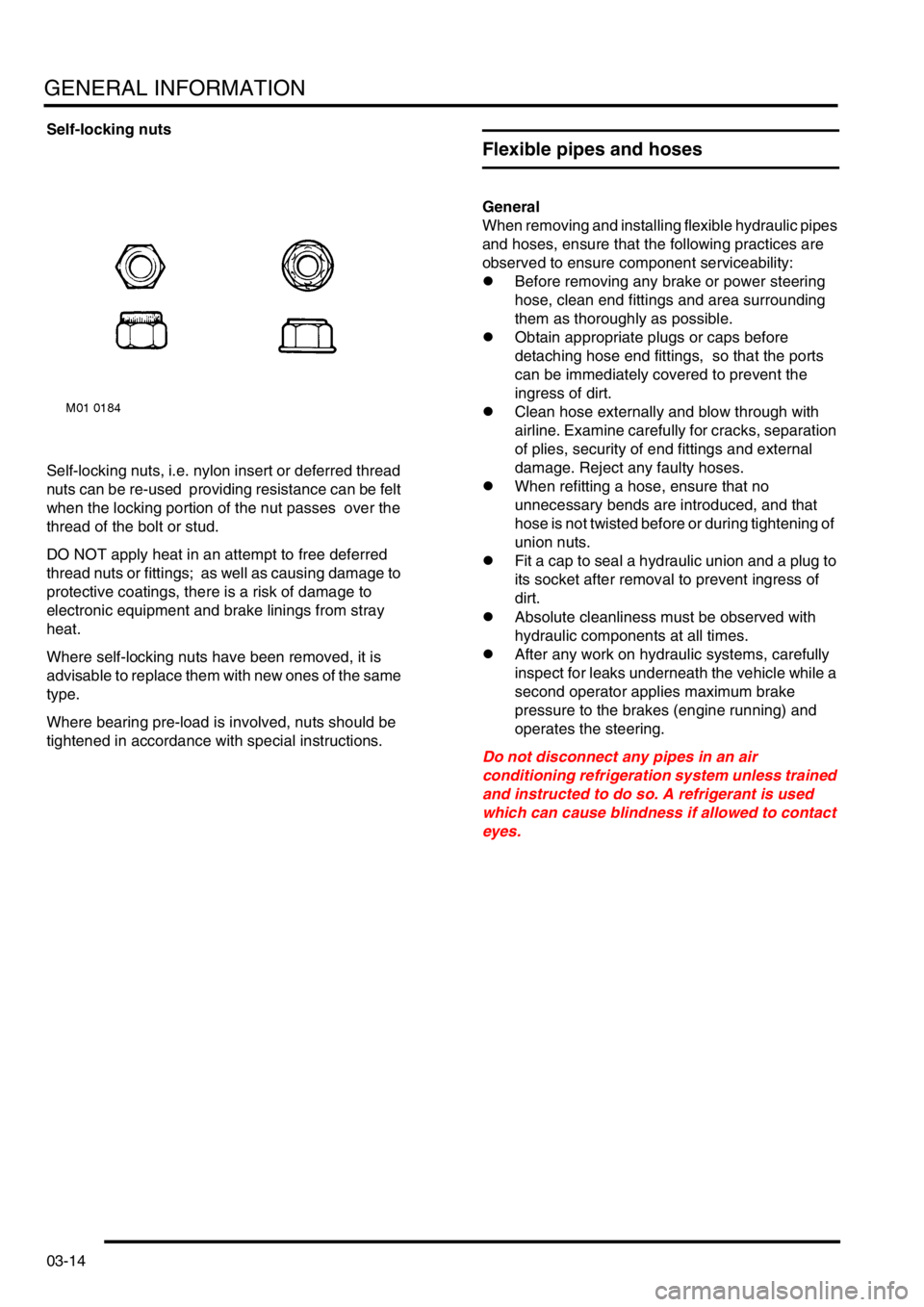
Self-locking nuts
Self-locking nuts, i.e. nylon insert or deferred thread
nuts can be re-used providing resistance can be felt
when the locking portion of the nut passes over the
thread of the bolt or stud.
DO NOT apply heat in an attempt to free deferred
thread nuts or fittings; as well as causing damage to
protective coatings, there is a risk of damage to
electronic equipment and brake linings from stray
heat.
Where self-locking nuts have been removed, it is
advisable to replace them with new ones of the same
type.
Where bearing pre-load is involved, nuts should be
tightened in accordance with special instructions.
Flexible pipes and hoses
General
When removing and installing flexible hydraulic pipes
and hoses, ensure that the following practices are
observed to ensure component serviceability:
lBefore removing any brake or power steering
hose, clean end fittings and area surrounding
them as thoroughly as possible.
lObtain appropriate plugs or caps before
detaching hose end fittings, so that the ports
can be immediately covered to prevent the
ingress of dirt.
lClean hose externally and blow through with
airline. Examine carefully for cracks, separation
of plies, security of end fittings and external
damage. Reject any faulty hoses.
lWhen refitting a hose, ensure that no
unnecessary bends are introduced, and that
hose is not twisted before or during tightening of
union nuts.
lFit a cap to seal a hydraulic union and a plug to
its socket after removal to prevent ingress of
dirt.
lAbsolute cleanliness must be observed with
hydraulic components at all times.
lAfter any work on hydraulic systems, carefully
inspect for leaks underneath the vehicle while a
second operator applies maximum brake
pressure to the brakes (engine running) and
operates the steering.
Do not disconnect any pipes in an air
conditioning refrigeration system unless trained
and instructed to do so. A refrigerant is used
which can cause blindness if allowed to contact
eyes.
Page 48 of 1007

GENERAL INFORMATION
03-17
SPX Corporation,
665, Eisenhower Drive,
Owatonna,
MN 55060,
USA
( 0018 772979110
) 0018 005787375
Australia
SPX Australia,
28, Clayton Road,
Notting Hill,
Victoria 3168,
Australia
( 00 (61) 00395446222
) 00 (61) 0395445222
e-mail: [email protected]
Japan and East Asia
Jatek Ltd.,
5 - 53, Minawacho 2-chome,
Kohoku-ku,
Yokohama,
Kanagawa 223-0051,
Japan
( 0081 455627700
) 0081 455627800
Rolling road testing
General
IMPORTANT: Use a four wheel rolling road for
brake testing if possible.
The front and rear wheels cannot be driven
independently due to the viscous coupling. This
eliminates the need for differential lock by
progressively applying more torque to the rear
wheels if the front wheels start to slip.
DO NOT attempt to drive individual wheels with
vehicle supported on floor jacks or stands.
Four wheel rolling road
Provided that front and rear rollers are rotating at
identical speeds and that normal workshop safety
standards are applied, there is no speed restriction
during testing, except any that may apply to the tyres.
Before testing a vehicle with anti-lock brakes on a
four wheel rolling road, disconnect the ABS
modulator. The ABS function will not work, the ABS
warning light will illuminate. Normal braking will be
available.
Two wheel rolling road
ABS will not function on a two wheel rolling road. The
ABS light will illuminate during testing. Normal
braking will be available.
If brake testing on a two wheel rolling road is
necessary, the following precautions should be
taken:
lpropeller shaft to the rear axle is removed/
disconnected;
lneutral selected in gearbox;
lhill descent control not selected.
When checking brakes, run engine at idle speed to
maintain servo vacuum.
Page 50 of 1007
GENERAL INFORMATION
03-19
Electrical precautions
General
The following guidelines are intended to ensure the
safety of the operator and ensure the prevention of
damage to the electrical and electronic components
fitted to the vehicle. Where necessary, specific
precautions are detailed in the individual procedures
of this manual.
Equipment
Prior to commencing any test procedure on the
vehicle, ensure that the relevant test equipment is
working correctly and any harness or connectors are
in good condition. It is particularly important to check
the condition of the lead and plugs of mains operated
equipment.
Polarity
Never reverse connect the vehicle battery and
always ensure the correct polarity when connecting
test equipment.
High Voltage Circuits
Whenever disconnecting live ht circuits, always use
insulated pliers and never allow the open end of the
ht lead to contact other components, particularly
ECU's.
Exercise caution when measuring the voltage on the
coil terminals while the engine is running, high
voltage spikes can occur on these terminals.
Connectors and harnesses
The engine compartment of a vehicle is a particularly
hostile environment for electrical components and
connectors:
lAlways ensure electrically related items are dry
and oil free before disconnecting and
connecting test equipment.
lEnsure disconnected multiplugs and sensors
are protected from being contaminated with oil,
coolant or other solutions. Contamination could
impair performance or result in catastrophic
failure.
lNever force connectors apart using tools to
prise apart or by pulling on the wiring harness.
lAlways ensure locking tabs are disengaged
before disconnection, and match orientation to
enable correct reconnection.
lEnsure that any protection (covers, insulation
etc.) is replaced if disturbed.Having confirmed a component to be faulty:
lSwitch off the ignition and disconnect the
battery.
lRemove the component and support the
disconnected harness.
lWhen replacing the component, keep oily hands
away from electrical connection areas and push
connectors home until any locking tabs fully
engage.
Battery disconnection
Before disconnecting the battery, disable the alarm
system and switch off all electrical equipment. If the
radio is to be serviced, ensure the security code has
been deactivated.
CAUTION: To prevent damage to electrical
components, always disconnect the battery
when working on the vehicle's electrical system.
The ground lead must be disconnected first and
reconnected last.
CAUTION: Always ensure that battery leads are
routed correctly and are not close to any
potential chafing points.
Battery charging
Only recharge the battery with it removed from the
vehicle. Always ensure any battery charging area is
well ventilated and that every precaution is taken to
avoid naked flames and sparks.
Ignition system safety precautions
The vehicle's ignition system produces high voltages
and the following precautions should be observed
before carrying out any work on the system:
WARNING: Before commencing work on an
ignition system, ensure all high tension
terminals, adapters and diagnostic equipment
are adequately insulated and shielded to prevent
accidental personal contacts and minimise the
risk of shock. Wearers of surgically implanted
pacemaker devices should not be in close
proximity of ignition circuits or diagnostic
equipment.
Page 61 of 1007

GENERAL INFORMATION
03-30
Remedial actions
If an accident involving R134a should occur, conduct
the following remedial actions:
lIf liquid R134a enters the eye, do not rub it.
Gently run large quantities of eye wash over
affected eye to raise the temperature. If an eye
wash is not available, cool clean water may be
used to flush the eye. After rinsing, cover the
eye with a clean pad and seek immediate
medical attention.
lIf liquid R134a is splashed onto the skin, run
large quantities of water over the affected area
to raise the temperature. Implement the same
action if the skin comes in contact with
discharging cylinders. Wrap the contaminated
body parts in blankets (or similar materials) and
seek immediate medical attention.
lIf the debilitating effects of inhalation of R134a
vapour is suspected, seek fresh air. If the
affected person is unconscious, move them
away from the contaminated area to fresh air
and apply artificial respiration and/or oxygen
and seek immediate medical attention.
Service precautions
Observe the following precautions when handling
components used in the air conditioning system:
lAir conditioning units must not be lifted by their
hoses, pipes or capillary lines.
lHoses and lines must not be subjected to any
twist or stress - the efficiency of the system will
be impaired by kinks or restrictions. Ensure that
hoses are correctly positioned before tightening
couplings, and ensure that all clips and supports
are utilised.
lFlexible hoses should not be positioned close to
the exhaust manifold (less than 100mm) unless
protected by heat shielding.
lCompleted assemblies must be checked for
refrigeration lines touching metal panels. Any
direct contact of components and panels may
transmit noise and so must be eliminated.
lThe appropriate torque wrench must be used
when tightening refrigerant connections to the
stipulated value. An additional spanner must be
used to hold the union to prevent twisting of the
pipe when tightening connections.
lBefore connecting any hose or pipe, ensure that
refrigerant oil is applied to the seat of the new
'O' ring seals, BUT NOT to the threads of the
connection.
lAll protective plugs must remain in place to seal
the component until immediately prior to
connection.
lEnsure components are at room temperature
before uncapping, to prevent condensation of
moisture from the air that enters it.
lComponents must not remain uncapped for
longer than 15 minutes. In the event of a delay,
the caps must be fitted.
lWhen disconnecting, immediately cap all air
conditioning pipes to prevent ingress of dirt and
moisture into the system.
lThe modulator (receiver/drier) contains
desiccant which absorbs moisture. It must be
positively sealed at all times. A modulator that
has been left uncapped must not be used, fit a
new unit.
lThe modulator should be the last component
connected to the system to ensure optimum
dehydration and maximum moisture protection
of the system.
lWhenever the refrigerant system is opened, the
modulator must be renewed immediately before
evacuating and recharging the system.
lUse alcohol and a clean lint-free cloth to clean
dirty connections.
lEnsure that all new parts fitted are marked for
use with R134a.
Page 62 of 1007
GENERAL INFORMATION
03-31
When a major repair has been completed, a leak test
should be conducted; refer to the air conditioning
section of this manual for the correct procedure.
Refrigerant oil
Use an approved refrigerant lubricating oil:
ND Oil 8
CAUTION: Do not use any other type of
refrigerant oil.
CAUTION: Refrigerant oil easily absorbs water
and must not be stored for long periods. Do not
pour unused oil back into the container.
When renewing system components, add the
quantities of refrigerant oil recommended in the Air
Conditioning section of this manual.
Compressor
A new compressor is sealed and pressurised with
Nitrogen gas. When fitting a new compressor, slowly
release the sealing cap; gas pressure should be
heard to vent as the seal is broken.
CAUTION: A new compressor should always be
sealed and could be pressurised with nitrogen
gas. To avoid possible oil loss, release the
sealing cap(s) slowly. Do not remove the cap(s)
until immediately prior to connecting the air
conditioning pipes to the compressor.
Rapid refrigerant discharge
If the air conditioning system is involved in accident
damage and the system is punctured, the refrigerant
will discharge rapidly. The rapid discharge of
refrigerant will also result in the loss of most of the
oil from the system. The compressor must be
removed and all the remaining oil in the compressor
drained and refilled in accordance with the 'Air
Conditioning Compressor Replacement Procedure'.
Air conditioning compressor
replacement
A new compressor is supplied filled with a full charge
of (X cm3) of refrigerant oil.
A new compressor is supplied with an oil fill (X cm) of
120 cm
3.
A calculated quantity of oil must be drained from the
new compressor before fitting. To calculate the
quantity of oil to be drained:
1Remove the drain plug from the old
compressor.
2Invert the compressor and gravity drain the oil
into a calibrated measuring cylinder. Rotate the
compressor clutch to ensure the compressor is
completely drained.
3Note the quantity of oil drained (Y cm
3).
4Calculate the quantity of oil to be drained from
the new compressor using the following
formula:
X cm
3 – (Y cm3 + 20 cm3) = Q cm3
5Remove the drain plug from the new
compressor and drain Q cm3 of oil.
6Fit and tighten the compressor drain plug.
System components
When renewing system components, add the
following quantities of refrigerant oil:
lCondenser = 40 cm
3
lEvaporator = 30 cm 3
lReceiver drier = 15 cm 3
lPipe or hose = 5 cm 3
Page 94 of 1007

GENERAL DATA
04-31
Brakes
Front disc brakes
Type Pin-slider caliper with ventilated disc, self-adjusting
Disc diameter 262 mm (10.31 in)
Disc thickness:
⇒ New
⇒ Service limit20.8 - 21.00 mm (0.818 - 0.826 in)
18.00 mm (0.708 in)
Disc run-out (maximum) 0.040 mm (0.0016 in), with wheel on
Pad minimum thickness 3.00 mm (0.118 in)
Rear drum brakes
Drum inside diameter 254 mm (10.00 in)
Drum wear limit 255.49 mm (10.059 in), discard drum
Lining minimum thickness 2.00 mm (0.079 in)
Drum ovality limit 0.012 mm (0.0005 in)
Master cylinder
Bore diameter 23.80 mm (0.937 in)
Brake servo
Servo boost ratio 4.5 : 1
Parking brake
Type Mechanically operated via twin cables on rear drum brakes
Anti-lock braking system
Circuit type Diagonal split, dual circuit, 4-sensor ABS
ABS type TEVES MK20 with ABS, Hill Descent Control (HDC), Electronic
Traction Control (ETC) and Electronic Brakeforce Distribution (EBD)
Page 116 of 1007

TORQUE WRENCH SETTINGS
06-13
Fuel delivery system – Petrol
1 Tighten in sequence using the procedure defined in 'Repairs' section.
+ ENGINE MANAGEMENT SYSTEM - SIEMENS, REPAIRS, Sensor - combined - manifold absolute
pressure/Intake air temperature (MAP/IAT).
TORQUE DESCRIPTION METRIC IMPERIAL
Air cleaner to battery tray bolts 9 Nm 7 lbf.ft
Fuel filler neck to body nuts and bolt 9 Nm 7 lbf.ft
Fuel pump/sender unit to tank locking ring 35 Nm 26 lbf.ft
Fuel rail to inlet manifold bolt 8 Nm 6 lbf.ft
Fuel tank to body bolts 40 Nm 29 lbf.ft
Heated Oxygen (HO
2S) Sensor 40 Nm 29 lbf.ft
Ignition coils to LH inlet manifold nuts and bolts - KV6 - Up to 03 Model Year 9 Nm 7 lbf.ft
Inertia (fuel cut-off) switch 2 Nm 1.5 lbf.ft
Intake Air Control Valve (IACV) to throttle body Allen screws 6 Nm 4.5 lbf.ft
Subframe to body bolts 190 Nm 140 lbf.ft
Throttle housing to inlet manifold bolts
1 (K1.8)
⇒1st. stage4 Nm 3 lbf.ft
⇒2nd. stage9 Nm 7 lbf.ft
Throttle body to inlet manifold chamber Torx screws (KV6) 8 Nm 6 lbf.ft
Throttle actuator support bracket to throttle body Torx screws (vehicles with cruise
control only)9 Nm 7 lbf.ft
Throttle position sensor to housing Torx screws 1.5 Nm 1.1 lbf.ft
VIS motor to inlet manifold chamber screws (KV6 only) 8 Nm 6 lbf.ft
Page 131 of 1007

TORQUE WRENCH SETTINGS
06-28
Brakes
1 Use NEW bolts
TORQUE DESCRIPTION METRIC IMPERIAL
ABS ECU pipe unions 17 Nm 12 lbf.ft
ABS modulator to mounting bracket bolts 9 Nm 7 lbf.ft
ABS modulator mounting bracket to inner wing:
⇒ Nuts
⇒ Bolts13 Nm
8 Nm10 lbf.ft
6 lbf.ft
Bleed screw - front calipers 10 Nm 7.5 lbf.ft
Brake servo to bulkhead nuts 22 Nm 16 lbf.ft
EGR cooler to mounting bolts 25 Nm 18 lbf.ft
EGR pipe support bracket to engine lifting bracket bolts 25 Nm 18 lbf.ft
Front caliper brake hose banjo bolt 28 Nm 21 lbf.ft
Front caliper guide pin bolts 27 Nm 20 lbf.ft
Front caliper mounting bolts 100 Nm 74 lbf.ft
Front disc shield to hub screw 8.5 Nm 6.3 lbf.ft
Front disc to drive flange screws 5 Nm 3.7 lbf.ft
Fuel rail to support bracket bolt 10 Nm 7.5 lbf.ft
Handbrake cable to body and subframe bolts 22 Nm 16 lbf.ft
Handbrake cable retaining plate bolts 22 Nm 16 lbf.ft
Handbrake lever assembly to body bolts 22 Nm 16 lbf.ft
Hill Descent Control (HDC) switch bolt 5 Nm 3.5 lbf.ft
Master cylinder to servo nuts 25 Nm 18 lbf.ft
PAS oil cooler pipe bolts 10 Nm 7.5 lbf.ft
Primary and secondary brake pipe union nuts 17 Nm 12 lbf.ft
Rear wheel cylinder pipe union nut 17 Nm 12 lbf.ft
Rear wheel cylinder to backplate bolts 8 Nm 6 lbf.ft
Reservoir to master cylinder (LHD) Torx bolt 8 Nm 6 lbf.ft
Reservoir to master cylinder (LHD) Torx bolt 6 Nm 4.5 lbf.ft
Road wheel nuts 115 Nm 85 lbf.ft
Turbocharger intercooler pipe to support bracket bolt 10 Nm 7.5 lbf.ft
Turbocharger pipe to coolant rail bolt 25 Nm 18 lbf.ft
Vacuum pump bolts
122 Nm 16 lbf.ft
Vacuum reservoir to mounting bracket nut 10 Nm 7.5 lbf.ft
Page 180 of 1007
ENGINE - K SERIES KV6
REPAIRS 12-3-3
REPAIRS
Camshafts - LH cylinder head
$% 12.13.02
Remove
1.Disconnect battery earth lead.
2.Remove camshaft timing belt.
+ ENGINE - K SERIES KV6, REPAIRS,
Camshaft timing belt.
3.Remove LH camshaft rear timing belt.
+ ENGINE - K SERIES KV6, REPAIRS,
Camshaft rear timing belt - LH cylinder
head.
4.Remove LH camshaft cover gasket.
+ ENGINE - K SERIES KV6, REPAIRS,
Camshaft cover gasket - LH - Up to 03MY.
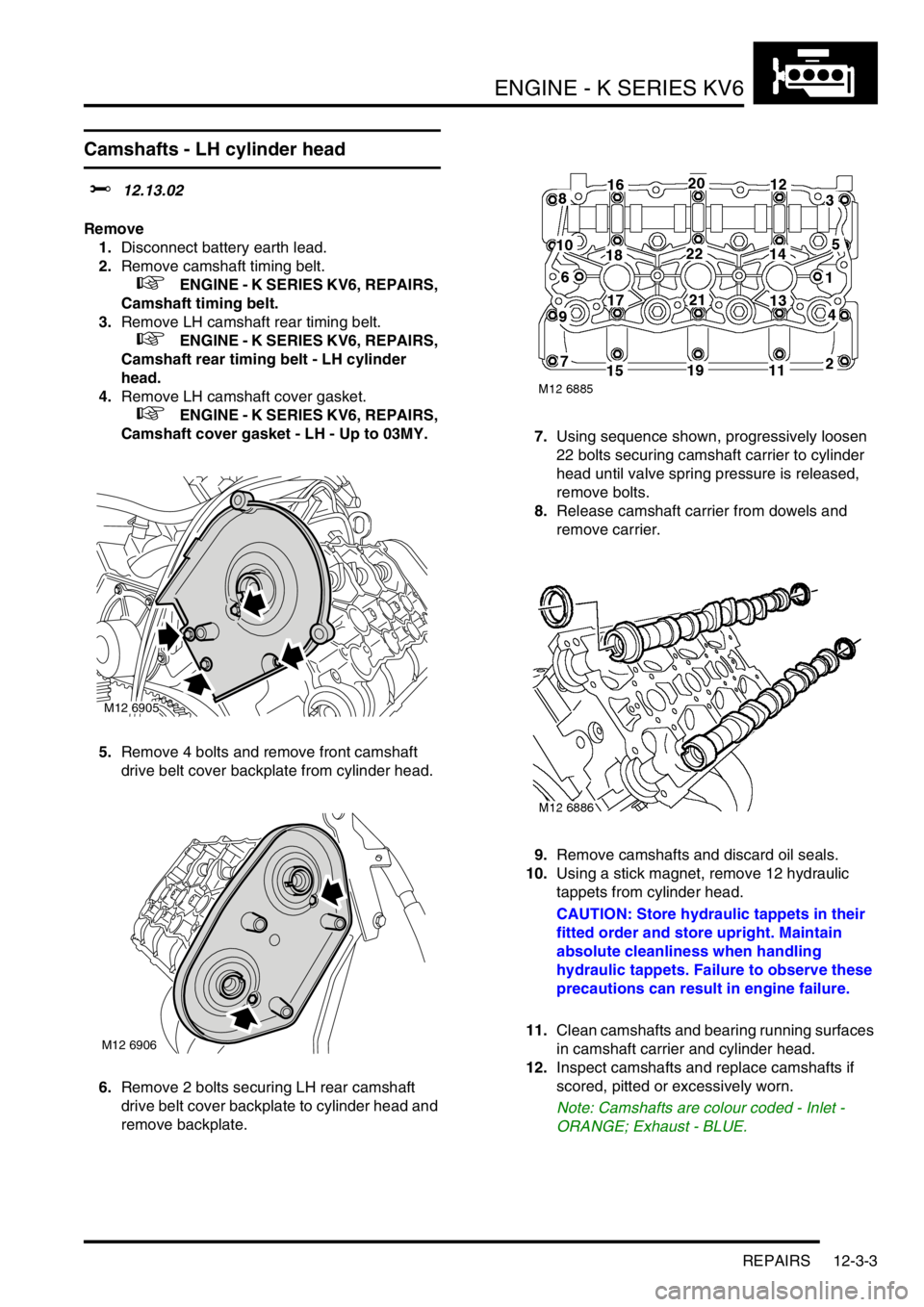
5.Remove 4 bolts and remove front camshaft
drive belt cover backplate from cylinder head.
6.Remove 2 bolts securing LH rear camshaft
drive belt cover backplate to cylinder head and
remove backplate.7.Using sequence shown, progressively loosen
22 bolts securing camshaft carrier to cylinder
head until valve spring pressure is released,
remove bolts.
8.Release camshaft carrier from dowels and
remove carrier.
9.Remove camshafts and discard oil seals.
10.Using a stick magnet, remove 12 hydraulic
tappets from cylinder head.
CAUTION: Store hydraulic tappets in their
fitted order and store upright. Maintain
absolute cleanliness when handling
hydraulic tappets. Failure to observe these
precautions can result in engine failure.
11.Clean camshafts and bearing running surfaces
in camshaft carrier and cylinder head.
12.Inspect camshafts and replace camshafts if
scored, pitted or excessively worn.
Note: Camshafts are colour coded - Inlet -
ORANGE; Exhaust - BLUE.
M12 6905
M12 6906
Page 183 of 1007
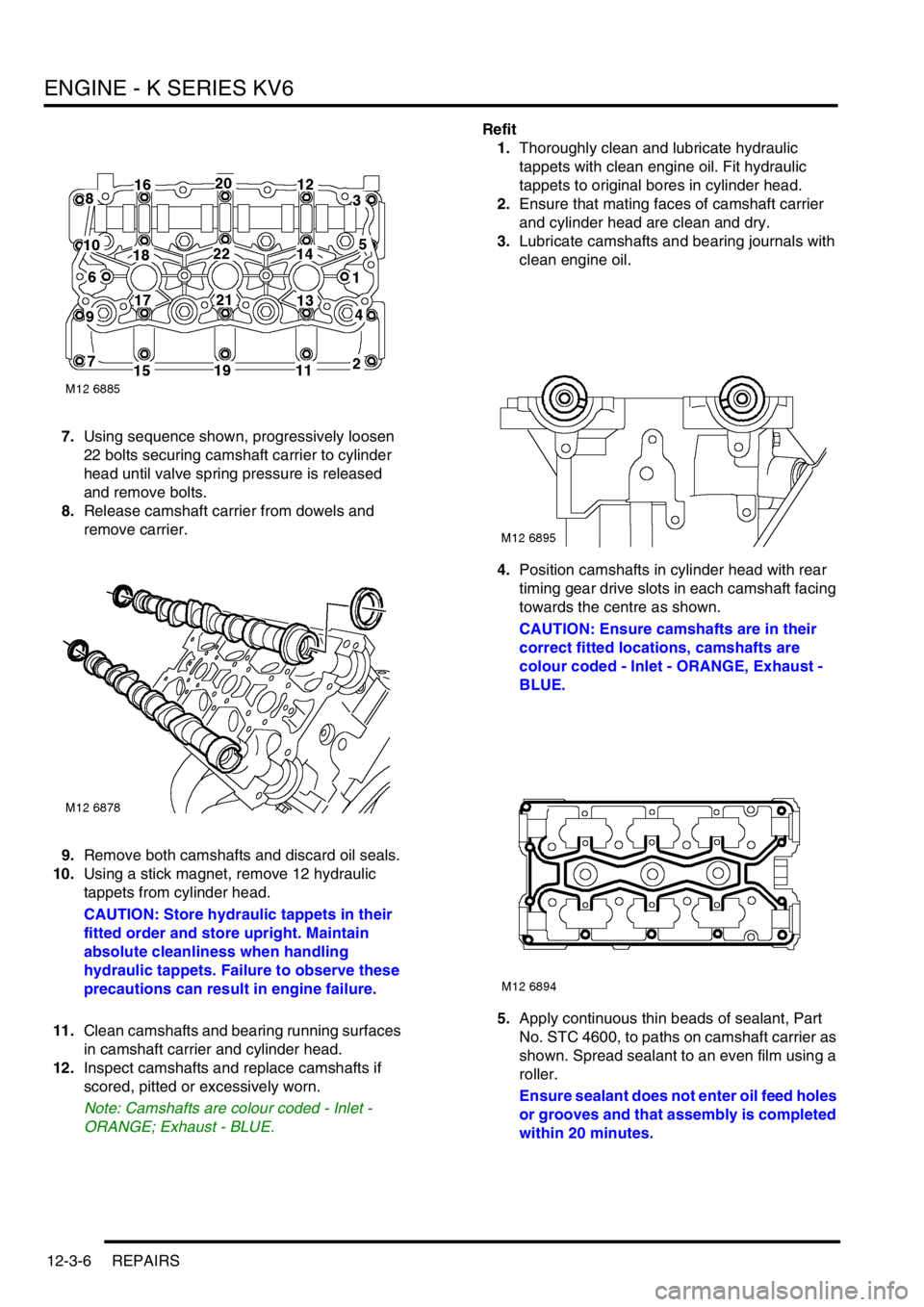
ENGINE - K SERIES KV6
12-3-6 REPAIRS
7.Using sequence shown, progressively loosen
22 bolts securing camshaft carrier to cylinder
head until valve spring pressure is released
and remove bolts.
8.Release camshaft carrier from dowels and
remove carrier.
9.Remove both camshafts and discard oil seals.
10.Using a stick magnet, remove 12 hydraulic
tappets from cylinder head.
CAUTION: Store hydraulic tappets in their
fitted order and store upright. Maintain
absolute cleanliness when handling
hydraulic tappets. Failure to observe these
precautions can result in engine failure.
11.Clean camshafts and bearing running surfaces
in camshaft carrier and cylinder head.
12.Inspect camshafts and replace camshafts if
scored, pitted or excessively worn.
Note: Camshafts are colour coded - Inlet -
ORANGE; Exhaust - BLUE.Refit
1.Thoroughly clean and lubricate hydraulic
tappets with clean engine oil. Fit hydraulic
tappets to original bores in cylinder head.
2.Ensure that mating faces of camshaft carrier
and cylinder head are clean and dry.
3.Lubricate camshafts and bearing journals with
clean engine oil.
4.Position camshafts in cylinder head with rear
timing gear drive slots in each camshaft facing
towards the centre as shown.
CAUTION: Ensure camshafts are in their
correct fitted locations, camshafts are
colour coded - Inlet - ORANGE, Exhaust -
BLUE.
5.Apply continuous thin beads of sealant, Part
No. STC 4600, to paths on camshaft carrier as
shown. Spread sealant to an even film using a
roller.
Ensure sealant does not enter oil feed holes
or grooves and that assembly is completed
within 20 minutes.