battery LAND ROVER FREELANDER 2001 User Guide
[x] Cancel search | Manufacturer: LAND ROVER, Model Year: 2001, Model line: FREELANDER, Model: LAND ROVER FREELANDER 2001Pages: 1007, PDF Size: 23.47 MB
Page 58 of 1007
GENERAL INFORMATION
03-27
SRS component manual deployment
If a vehicle is to be scrapped and contains an
undeployed airbag module, the module must be
manually deployed. Always observe the following
precautions:
WARNING: Only personnel who have undergone
the appropriate training should undertake
deployment of airbag and seat belt pre-tensioner
modules.
WARNING: A deployed airbag or seatbelt pre-
tensioner is very hot, DO NOT return to a
deployed airbag module until at least 30 minutes
have elapsed since deployment.
WARNING: Only use approved deployment
equipment, and only deploy SRS components in
a well ventilated designated area. Ensure SRS
components are not damaged or ruptured before
deployment. Notify the relevant authorities.
WARNING: If a vehicle is to be scrapped,
undeployed airbag modules and pre-tensioner
units must be deployed in accordance with the
instructions in this manual.
WARNING: Contact with chemicals from
deployed and damaged SRS components could
present a health hazard, wear protective clothing
when handling. DO NOT eat, drink or smoke
when handling SRS components.
WARNING: Deployment of airbag modules and
seatbelt pre-tensioners can cause injury to
personnel in the close vicinity of the deploying
unit. In case of injury seek urgent medical advice.
Possible sources of injury include:
limpact - due to inflating airbag or pre-
tensioner operation causing component
'kick'.
l hearing - due to noise produced by
deploying airbags and seatbelt pre-
tensioner units.
l burns - hot component parts and gases.
l irritation to eyes and lungs - from deploying
gases or combustion residue.
WARNING: Ensure the SRS component to be
deployed is securely fastened to its mounting.WARNING: Deployment procedures detailed in
this manual should be strictly adhered to.
Compliance with the following precautions
MUST be ensured:
lOnly use deployment equipment approved
for the intended purpose.
lBefore commencing deployment procedure,
ensure the deployment tool functions
properly by performing the self test
procedure detailed in the SRS Repairs
section of this manual.
lDeployment of airbag/pre-tensioner
modules should be performed in a well
ventilated area which has been designated
for the purpose.
lEnsure airbag/pre-tensioner modules are
not damaged or ruptured before attempting
to deploy.
lNotify the relevant authorities of intention to
deploy airbag and pre-tensioner units.
lWhen deploying airbag and seatbelt pre-
tensioner units, ensure that all personnel are
at least 15 metres away from the deployment
zone.
lEnsure deployment tool is connected
correctly, in compliance with the
instructions detailed in this manual. In
particular, ensure deployment tool is NOT
connected to battery supply before
connecting to the airbag or seatbelt pre-
tensioner module connector.
lWhen deploying seatbelt pre-tensioners in
the vehicle, ensure the pre-tensioner unit is
fully secured to its fixing point.
lWhen removing deployed airbag and
seatbelt pre-tensioner modules, wear
protective clothing. Use gloves and seal
deployed units in a plastic bag.
lFollowing deployment of any component of
the SRS system within the vehicle, all SRS
components must be replaced. DO NOT re-
use or salvage any parts of the SRS system.
lDo not lean over airbag modules or seatbelt
pre-tensioner units when connecting
deployment equipment.
WARNING: During deployment parts of the
airbag module become hot enough to burn you.
Wait 30 minutes after deployment before
touching the airbag module.
Page 97 of 1007

GENERAL DATA
04-34
Electrical - Td4 engine
Electrical - K1.8 engine
Electrical - KV6 engine
System 12 volt, negative earth
Battery:
⇒ Type
⇒ CapacityH6, sealed for life
75 amp /hour
⇒ Type
⇒ CapacityH7, sealed for life (cold climates)
80 amp /hour
Alternator:
⇒ Type
⇒ Maximum output
⇒ Maximum output (models with PTC heater)Nippon Denso K-frame
105 amp
150 amp
System 12 volt, negative earth
Battery:
⇒ Type
⇒ CapacityH5, sealed for life
55 amp/hour
Alternator
⇒ Type
⇒ Maximum outputNippon Denso K-frame
105 amp
System 12 volt, negative earth
Battery:
⇒ Type
⇒ CapacityH6, sealed for life
75 amp/hour
Alternator:
⇒ Type
⇒ Maximum outputNippon Denso L-frame
120 amp
Page 116 of 1007

TORQUE WRENCH SETTINGS
06-13
Fuel delivery system – Petrol
1 Tighten in sequence using the procedure defined in 'Repairs' section.
+ ENGINE MANAGEMENT SYSTEM - SIEMENS, REPAIRS, Sensor - combined - manifold absolute
pressure/Intake air temperature (MAP/IAT).
TORQUE DESCRIPTION METRIC IMPERIAL
Air cleaner to battery tray bolts 9 Nm 7 lbf.ft
Fuel filler neck to body nuts and bolt 9 Nm 7 lbf.ft
Fuel pump/sender unit to tank locking ring 35 Nm 26 lbf.ft
Fuel rail to inlet manifold bolt 8 Nm 6 lbf.ft
Fuel tank to body bolts 40 Nm 29 lbf.ft
Heated Oxygen (HO
2S) Sensor 40 Nm 29 lbf.ft
Ignition coils to LH inlet manifold nuts and bolts - KV6 - Up to 03 Model Year 9 Nm 7 lbf.ft
Inertia (fuel cut-off) switch 2 Nm 1.5 lbf.ft
Intake Air Control Valve (IACV) to throttle body Allen screws 6 Nm 4.5 lbf.ft
Subframe to body bolts 190 Nm 140 lbf.ft
Throttle housing to inlet manifold bolts
1 (K1.8)
⇒1st. stage4 Nm 3 lbf.ft
⇒2nd. stage9 Nm 7 lbf.ft
Throttle body to inlet manifold chamber Torx screws (KV6) 8 Nm 6 lbf.ft
Throttle actuator support bracket to throttle body Torx screws (vehicles with cruise
control only)9 Nm 7 lbf.ft
Throttle position sensor to housing Torx screws 1.5 Nm 1.1 lbf.ft
VIS motor to inlet manifold chamber screws (KV6 only) 8 Nm 6 lbf.ft
Page 138 of 1007

TORQUE WRENCH SETTINGS
06-35
Electrical
TORQUE DESCRIPTION METRIC IMPERIAL
Alternator drive belt tensioner bolt 25 Nm 18 lbf.ft
Alternator mounting bracket bolts (K1.8) 25 Nm 18 lbf.ft
Alternator pivot and adjustment bracket bolts (K1.8) 25 Nm 18 lbf.ft
Alternator to front mounting plate nut and bolts (KV6) 45 Nm 33 lbf.ft
Alternator support bracket bolts (K1.8) 25 Nm 18 lbf.ft
Alternator pivot and adjustment bracket bolts (K1.8) 25 Nm 18 lbf.ft
Alternator to mounting bracket bolts (Td4):
⇒ M825 Nm 18 lbf.ft
⇒ M1045 Nm 9.5 lbf.ft
Alternator upper and lower bolts (K1.8 with A/C) 45 Nm 33 lbf.ft
Ancillary drive belt idler pulley to mounting Allen bolt (Td4) 25 Nm 18 lbf.ft
Battery cable to alternator terminal nut (Td4 & KV6) 10 Nm 7.5 lbf.ft
Battery cable to starter motor solenoid nut (K1.8) 8 Nm 6 lbf.ft
Battery cable to starter motor solenoid nut (K1.8) 13 Nm 9.5 lbf.ft
Battery clamp bolt 12 Nm 9 lbf.ft
Battery and starter motor lead to underbonnet fusebox bolts 8 Nm 6 lbf.ft
'E' box mounting nut 9 Nm 7 lbf.ft
Passenger compartment fusebox mounting plate to body bolts 8 Nm 6 lbf.ft
Passenger compartment fusebox to mounting plate bolts 8 Nm 6 lbf.ft
Starter motor mounting bolts (Td4) 45 Nm 33 lbf.ft
Starter motor to engine upper and lower nuts and bolts (K1.8) 45 Nm 33 lbf.ft
Starter motor to engine upper and lower nuts and bolts (K1.8) 80 Nm 59 lbf.ft
Page 142 of 1007
LIFTING AND TOWING
08-3
If the front of the vehicle is to be trailed, turn ignition
key to position 'I' to release steering lock.
WARNING: Do not turn the starter switch to
position '0' or remove the ignition key while the
vehicle is being towed.
CAUTION: If it is considered unsafe to turn the
starter switch to position '1' due to accident
damage or an electrical fault; disconnect the
battery before turning the ignition switch.
CAUTION: The steering wheel and/or linkage
must be secured in a straight ahead position. DO
NOT use the steering lock mechanism for this
purpose.
CAUTION: Under no circumstances should the
vehicle be towed or recovered by means of
lashing to the rear subframe. Serious damage to
the subframe and body could result.
CAUTION: Only use the rear towing eye for
towing another vehicle.
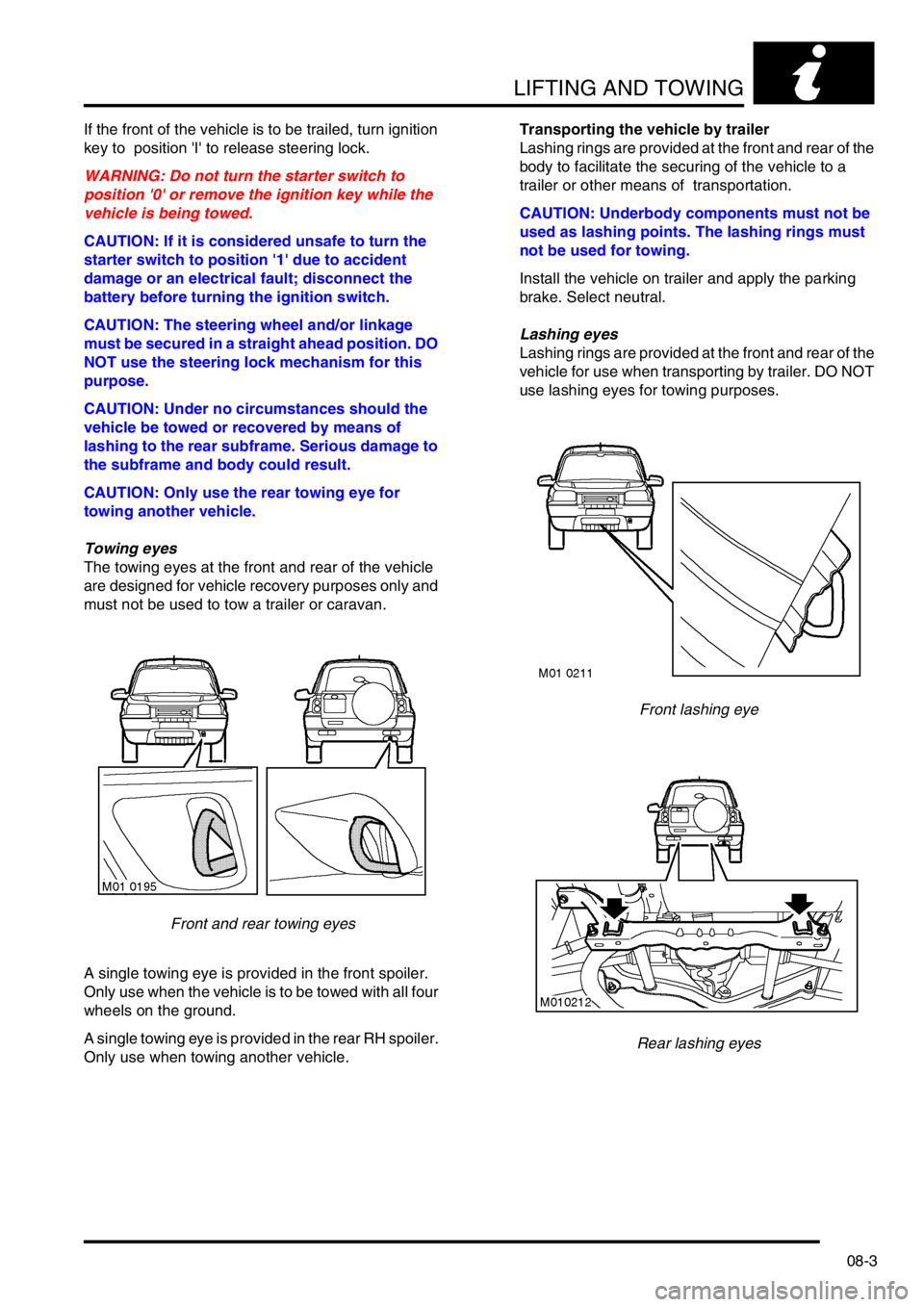
Towing eyes
The towing eyes at the front and rear of the vehicle
are designed for vehicle recovery purposes only and
must not be used to tow a trailer or caravan.
Front and rear towing eyes
A single towing eye is provided in the front spoiler.
Only use when the vehicle is to be towed with all four
wheels on the ground.
A single towing eye is provided in the rear RH spoiler.
Only use when towing another vehicle.Transporting the vehicle by trailer
Lashing rings are provided at the front and rear of the
body to facilitate the securing of the vehicle to a
trailer or other means of transportation.
CAUTION: Underbody components must not be
used as lashing points. The lashing rings must
not be used for towing.
Install the vehicle on trailer and apply the parking
brake. Select neutral.
Lashing eyes
Lashing rings are provided at the front and rear of the
vehicle for use when transporting by trailer. DO NOT
use lashing eyes for towing purposes.
Front lashing eye
Rear lashing eyes
Page 143 of 1007
LIFTING AND TOWING
08-4
Emergency starting
WARNING: Battery fluid (electrolyte) contains
sulphuric acid. It may cause severe burns if it
gets on your skin or in your eyes. Wear
protective clothing and a face shield.
If electrolyte gets on your skin or clothes,
immediately rinse it off with water.
If electrolyte gets in your eyes, immediately flush
eyes with water for at least 15 minutes and seek
medical help.
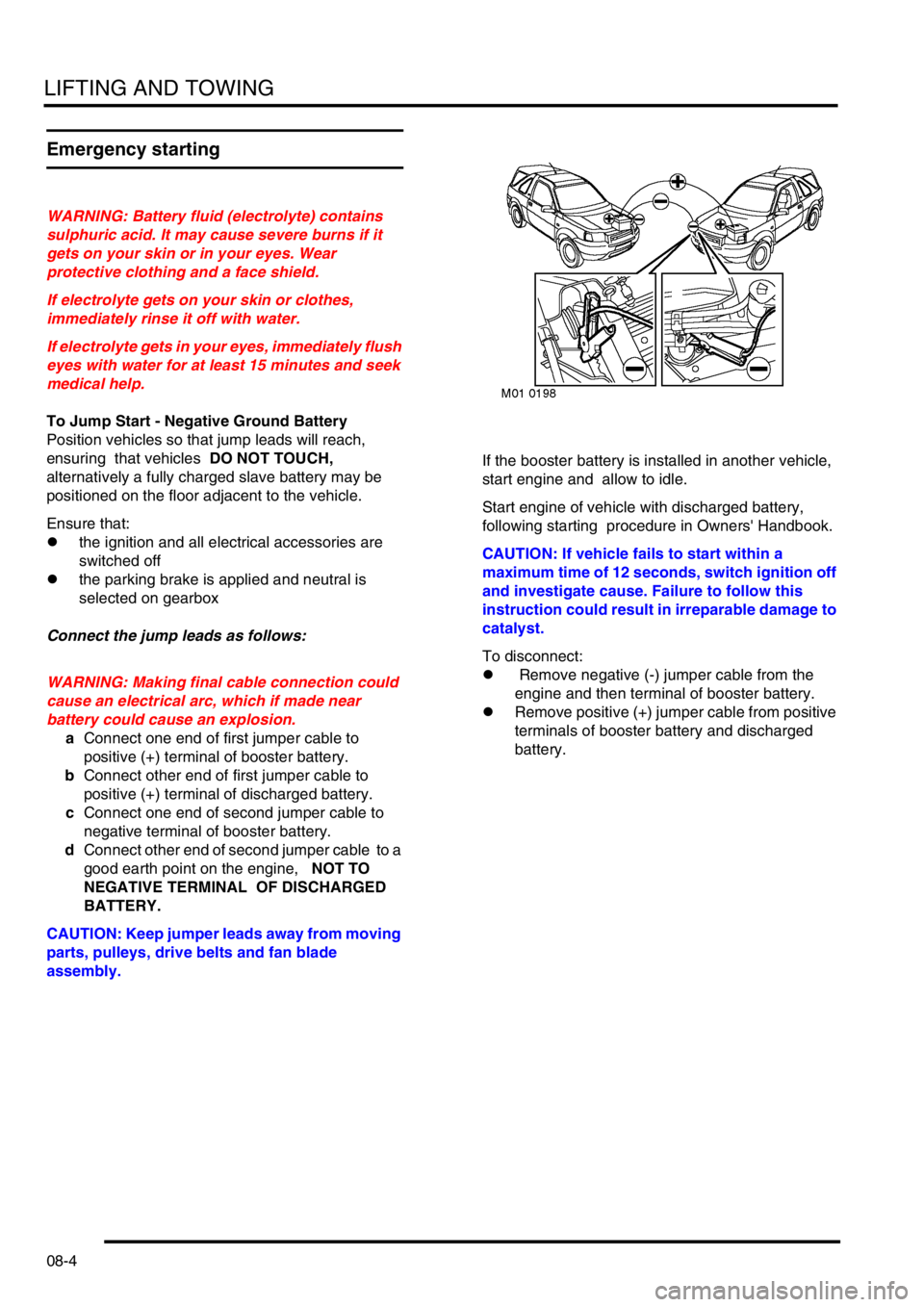
To Jump Start - Negative Ground Battery
Position vehicles so that jump leads will reach,
ensuring that vehicles DO NOT TOUCH,
alternatively a fully charged slave battery may be
positioned on the floor adjacent to the vehicle.
Ensure that:
lthe ignition and all electrical accessories are
switched off
lthe parking brake is applied and neutral is
selected on gearbox
Connect the jump leads as follows:
WARNING: Making final cable connection could
cause an electrical arc, which if made near
battery could cause an explosion.
aConnect one end of first jumper cable to
positive (+) terminal of booster battery.
bConnect other end of first jumper cable to
positive (+) terminal of discharged battery.
cConnect one end of second jumper cable to
negative terminal of booster battery.
dConnect other end of second jumper cable to a
good earth point on the engine, NOT TO
NEGATIVE TERMINAL OF DISCHARGED
BATTERY.
CAUTION: Keep jumper leads away from moving
parts, pulleys, drive belts and fan blade
assembly.If the booster battery is installed in another vehicle,
start engine and allow to idle.
Start engine of vehicle with discharged battery,
following starting procedure in Owners' Handbook.
CAUTION: If vehicle fails to start within a
maximum time of 12 seconds, switch ignition off
and investigate cause. Failure to follow this
instruction could result in irreparable damage to
catalyst.
To disconnect:
l Remove negative (-) jumper cable from the
engine and then terminal of booster battery.
lRemove positive (+) jumper cable from positive
terminals of booster battery and discharged
battery.
Page 148 of 1007
MAINTENANCE
MAINTENANCE 10-1
MAINTENANCE MAINTENANCE
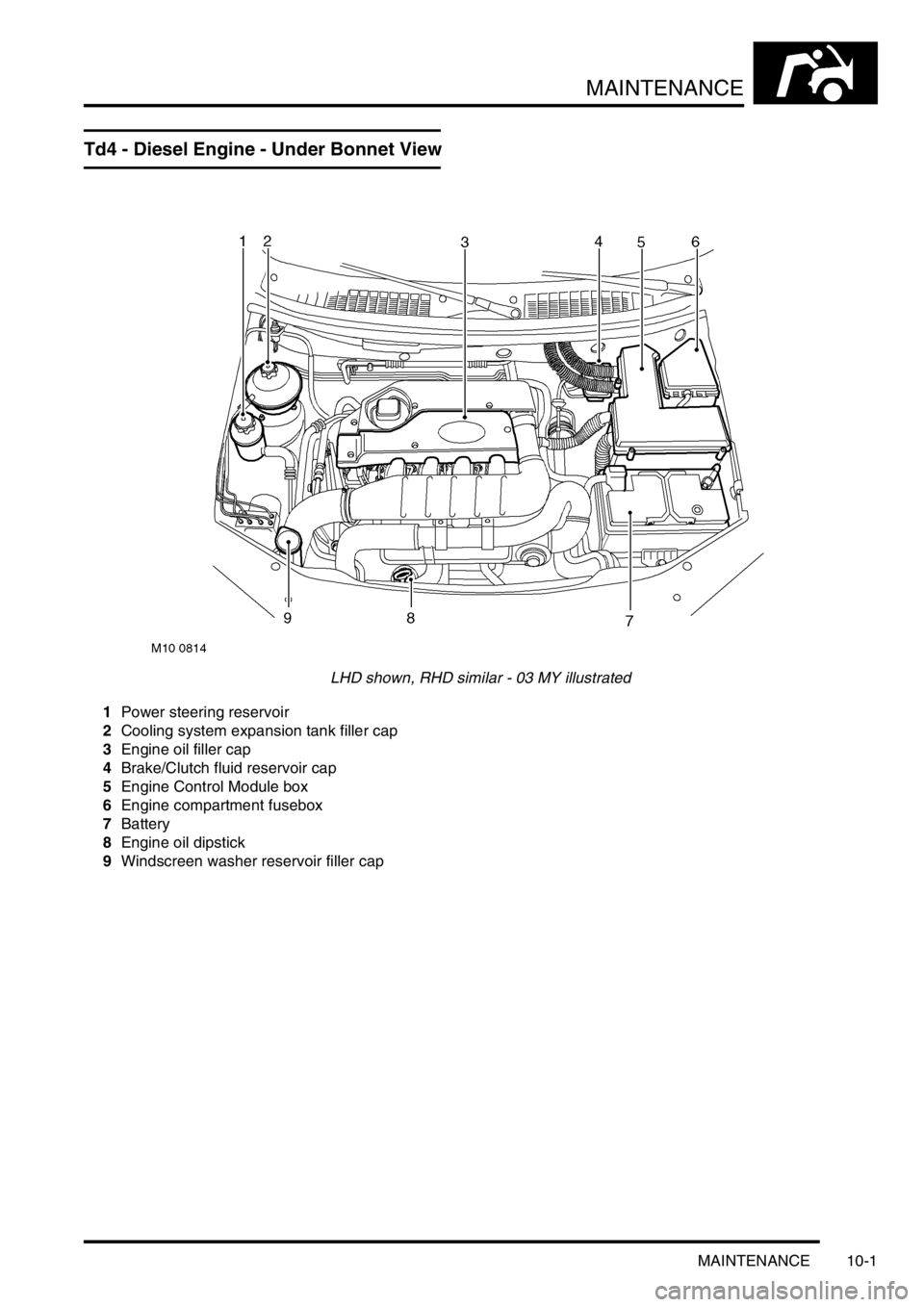
Td4 - Diesel Engine - Under Bonnet View
LHD shown, RHD similar - 03 MY illustrated
1Power steering reservoir
2Cooling system expansion tank filler cap
3Engine oil filler cap
4Brake/Clutch fluid reservoir cap
5Engine Control Module box
6Engine compartment fusebox
7Battery
8Engine oil dipstick
9Windscreen washer reservoir filler cap
Page 149 of 1007
MAINTENANCE
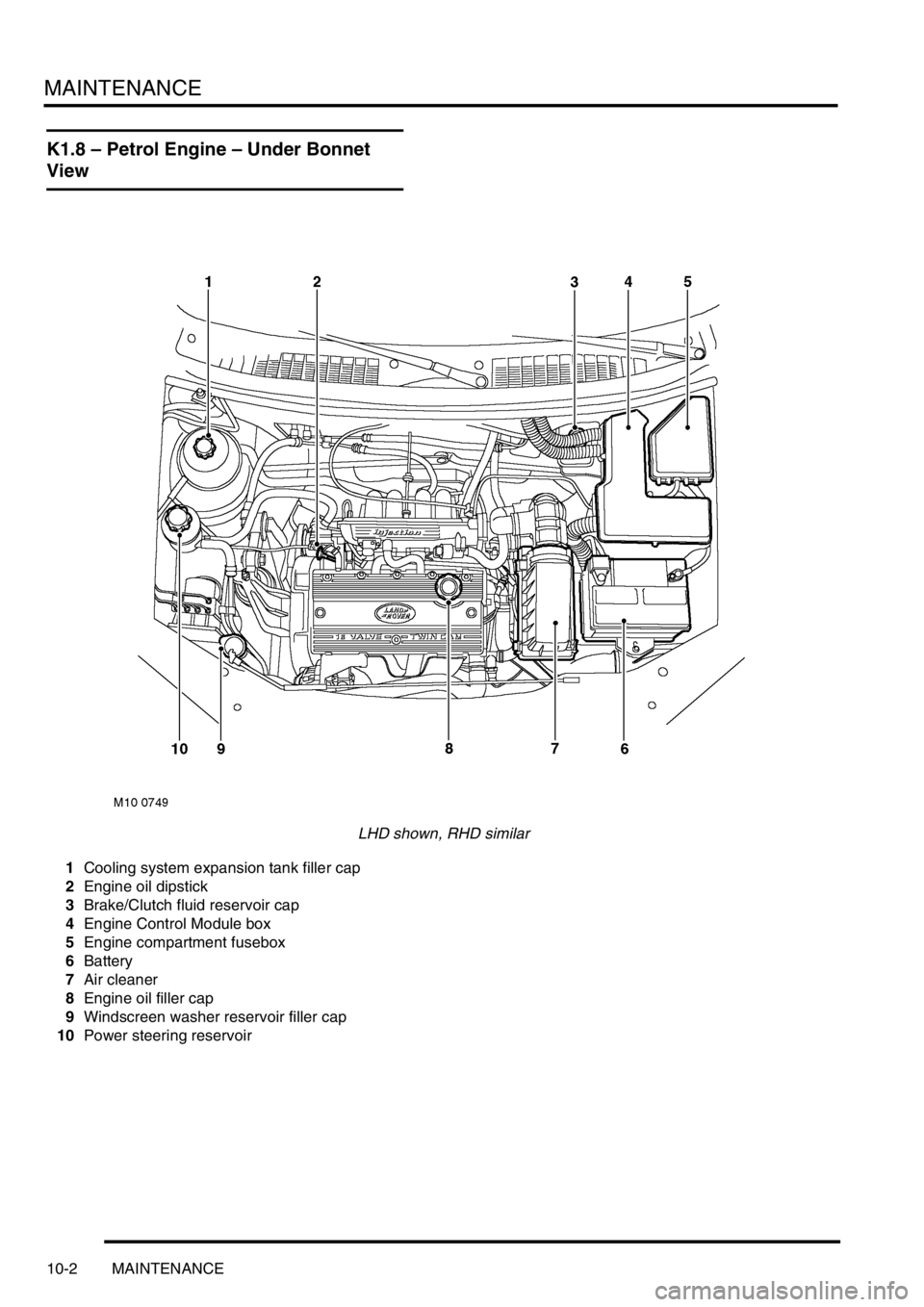
10-2 MAINTENANCE
K1.8 – Petrol Engine – Under Bonnet
View
LHD shown, RHD similar
1Cooling system expansion tank filler cap
2Engine oil dipstick
3Brake/Clutch fluid reservoir cap
4Engine Control Module box
5Engine compartment fusebox
6Battery
7Air cleaner
8Engine oil filler cap
9Windscreen washer reservoir filler cap
10Power steering reservoir
Page 150 of 1007
MAINTENANCE
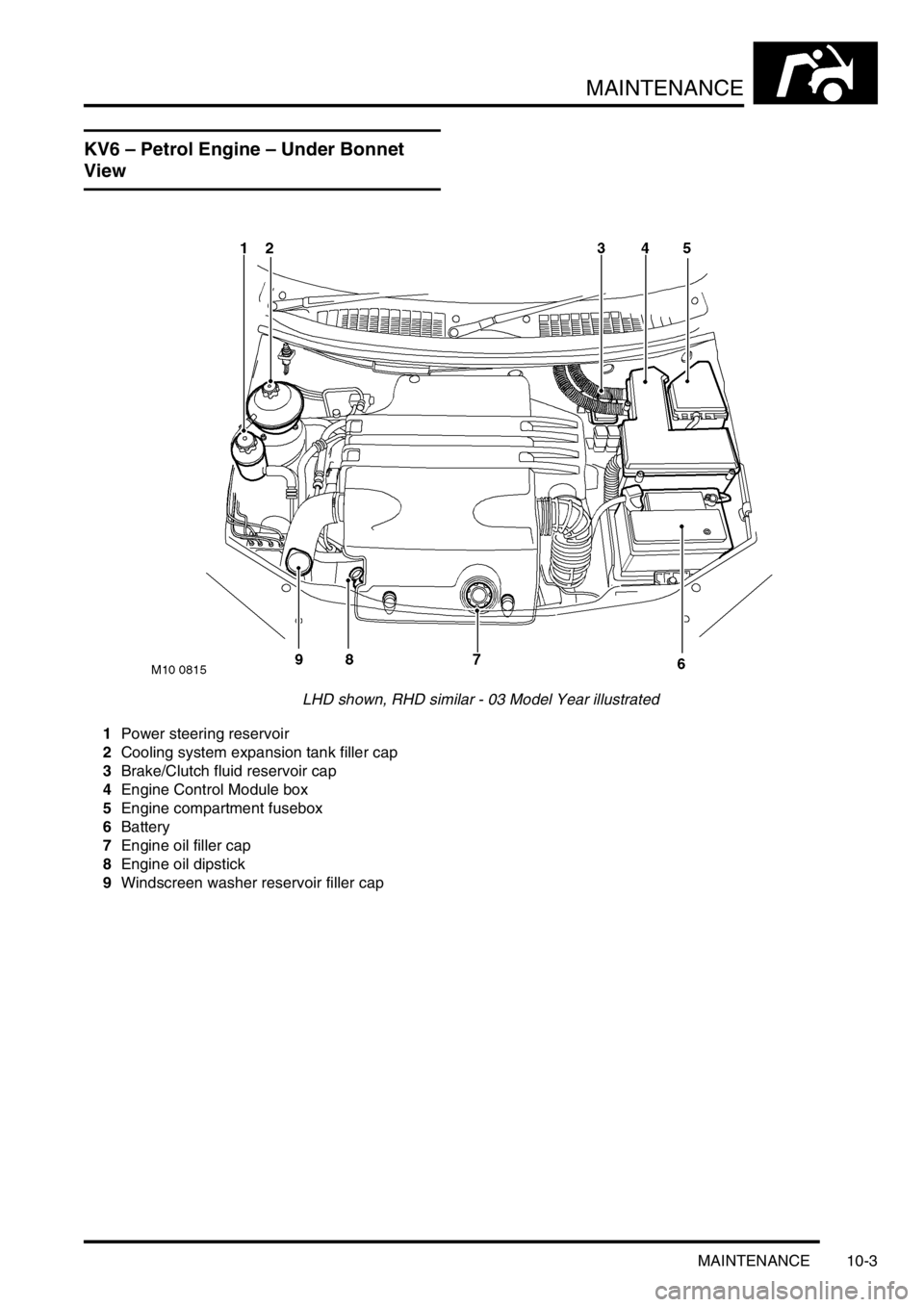
MAINTENANCE 10-3
KV6 – Petrol Engine – Under Bonnet
View
LHD shown, RHD similar - 03 Model Year illustrated
1Power steering reservoir
2Cooling system expansion tank filler cap
3Brake/Clutch fluid reservoir cap
4Engine Control Module box
5Engine compartment fusebox
6Battery
7Engine oil filler cap
8Engine oil dipstick
9Windscreen washer reservoir filler cap
Page 153 of 1007
MAINTENANCE
10-6 MAINTENANCE
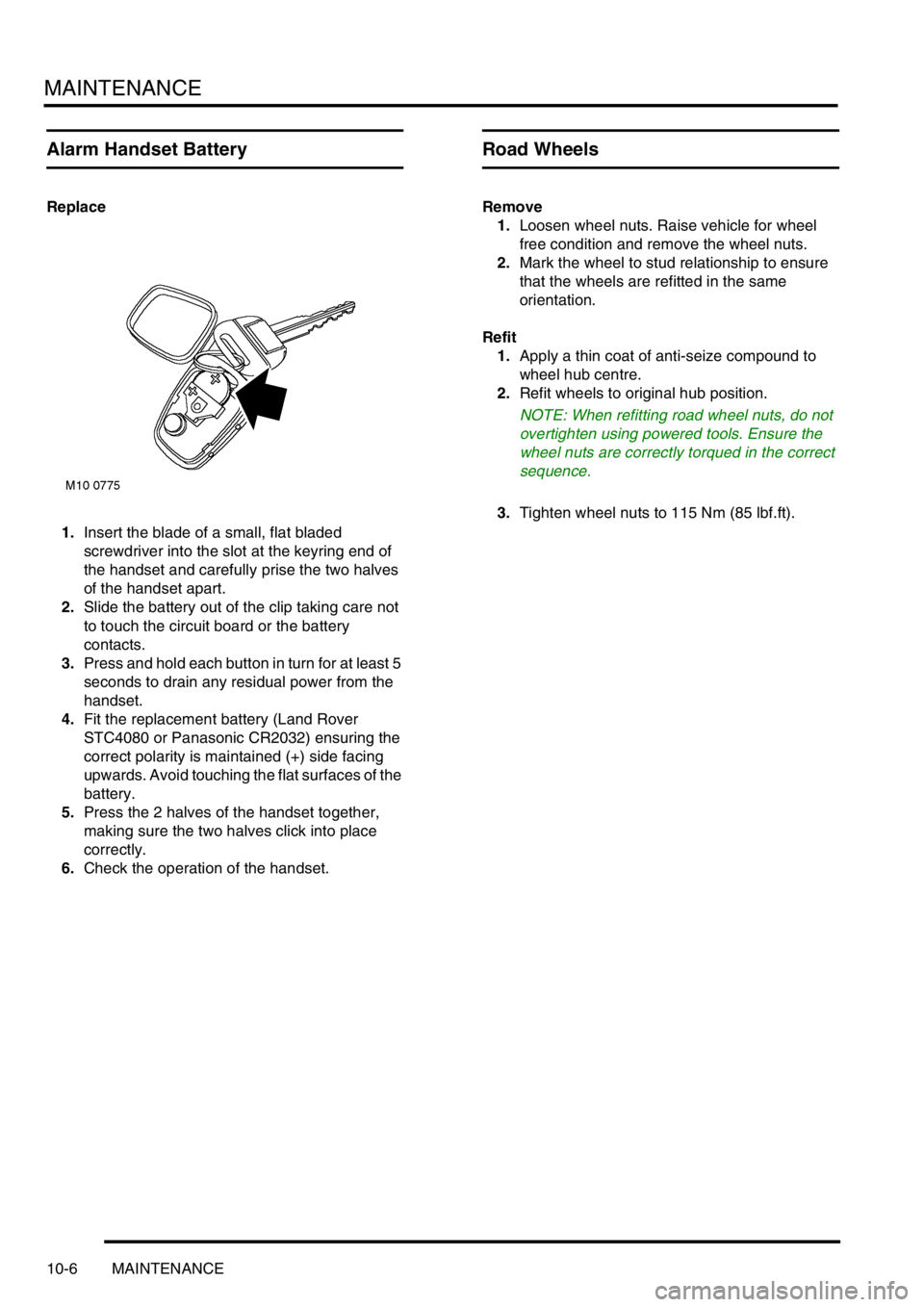
Alarm Handset Battery
Replace
1.Insert the blade of a small, flat bladed
screwdriver into the slot at the keyring end of
the handset and carefully prise the two halves
of the handset apart.
2.Slide the battery out of the clip taking care not
to touch the circuit board or the battery
contacts.
3.Press and hold each button in turn for at least 5
seconds to drain any residual power from the
handset.
4.Fit the replacement battery (Land Rover
STC4080 or Panasonic CR2032) ensuring the
correct polarity is maintained (+) side facing
upwards. Avoid touching the flat surfaces of the
battery.
5.Press the 2 halves of the handset together,
making sure the two halves click into place
correctly.
6.Check the operation of the handset.
Road Wheels
Remove
1.Loosen wheel nuts. Raise vehicle for wheel
free condition and remove the wheel nuts.
2.Mark the wheel to stud relationship to ensure
that the wheels are refitted in the same
orientation.
Refit
1.Apply a thin coat of anti-seize compound to
wheel hub centre.
2.Refit wheels to original hub position.
NOTE: When refitting road wheel nuts, do not
overtighten using powered tools. Ensure the
wheel nuts are correctly torqued in the correct
sequence.
3.Tighten wheel nuts to 115 Nm (85 lbf.ft).