brake pads LAND ROVER FREELANDER 2001 User Guide
[x] Cancel search | Manufacturer: LAND ROVER, Model Year: 2001, Model line: FREELANDER, Model: LAND ROVER FREELANDER 2001Pages: 1007, PDF Size: 23.47 MB
Page 786 of 1007
PANEL REPAIRS
REPAIRS 77-2-31
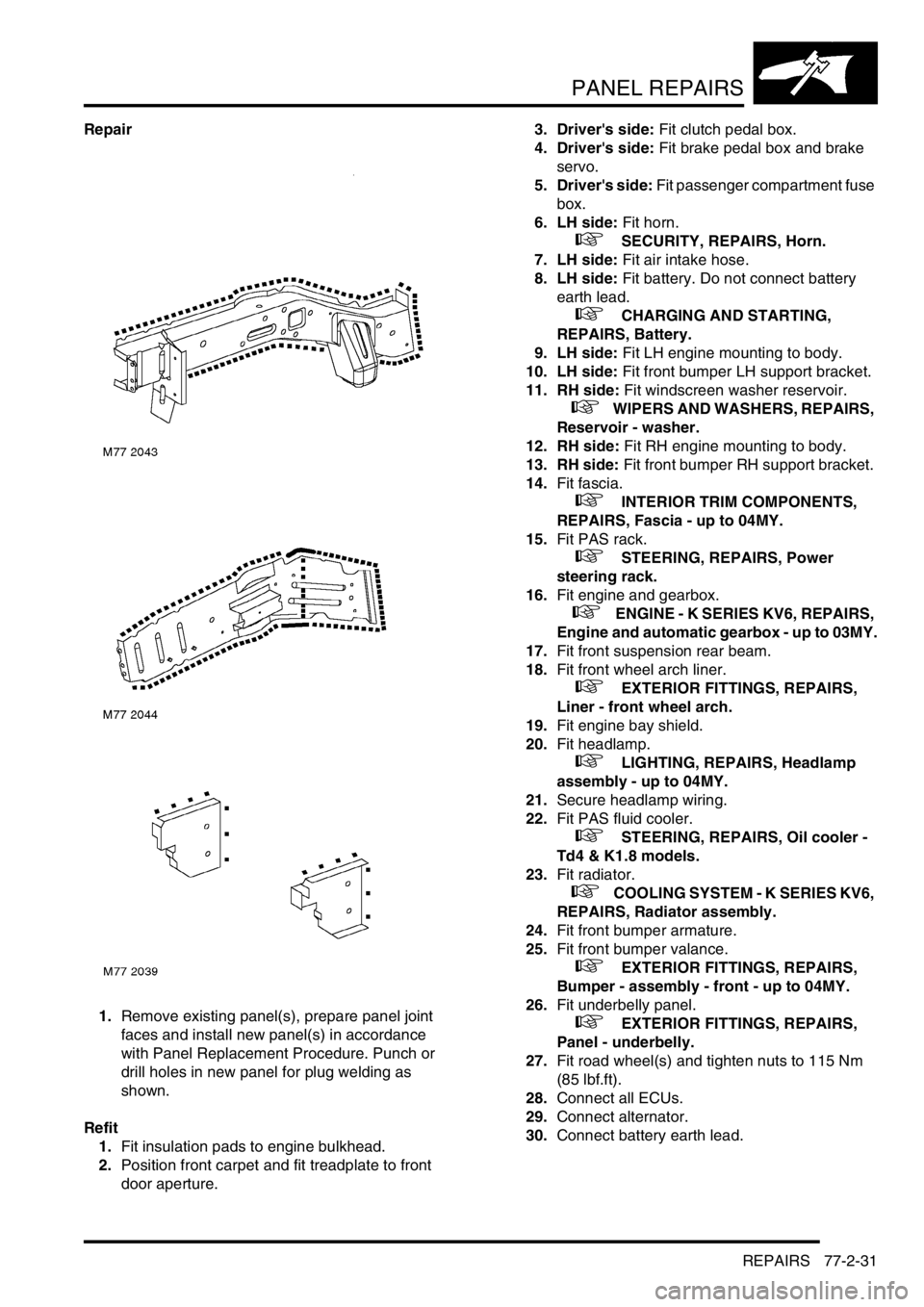
Repair
1.Remove existing panel(s), prepare panel joint
faces and install new panel(s) in accordance
with Panel Replacement Procedure. Punch or
drill holes in new panel for plug welding as
shown.
Refit
1.Fit insulation pads to engine bulkhead.
2.Position front carpet and fit treadplate to front
door aperture. 3. Driver's side: Fit clutch pedal box.
4. Driver's side: Fit brake pedal box and brake
servo.
5. Driver's side: Fit passenger compartment fuse
box.
6. LH side: Fit horn.
+ SECURITY, REPAIRS, Horn.
7. LH side: Fit air intake hose.
8. LH side: Fit battery. Do not connect battery
earth lead.
+ CHARGING AND STARTING,
REPAIRS, Battery.
9. LH side: Fit LH engine mounting to body.
10. LH side: Fit front bumper LH support bracket.
11. RH side: Fit windscreen washer reservoir.
+ WIPERS AND WASHERS, REPAIRS,
Reservoir - washer.
12. RH side: Fit RH engine mounting to body.
13. RH side: Fit front bumper RH support bracket.
14.Fit fascia.
+ INTERIOR TRIM COMPONENTS,
REPAIRS, Fascia - up to 04MY.
15.Fit PAS rack.
+ STEERING, REPAIRS, Power
steering rack.
16.Fit engine and gearbox.
+ ENGINE - K SERIES KV6, REPAIRS,
Engine and automatic gearbox - up to 03MY.
17.Fit front suspension rear beam.
18.Fit front wheel arch liner.
+ EXTERIOR FITTINGS, REPAIRS,
Liner - front wheel arch.
19.Fit engine bay shield.
20.Fit headlamp.
+ LIGHTING, REPAIRS, Headlamp
assembly - up to 04MY.
21.Secure headlamp wiring.
22.Fit PAS fluid cooler.
+ STEERING, REPAIRS, Oil cooler -
Td4 & K1.8 models.
23.Fit radiator.
+ COOLING SYSTEM - K SERIES KV6,
REPAIRS, Radiator assembly.
24.Fit front bumper armature.
25.Fit front bumper valance.
+ EXTERIOR FITTINGS, REPAIRS,
Bumper - assembly - front - up to 04MY.
26.Fit underbelly panel.
+ EXTERIOR FITTINGS, REPAIRS,
Panel - underbelly.
27.Fit road wheel(s) and tighten nuts to 115 Nm
(85 lbf.ft).
28.Connect all ECUs.
29.Connect alternator.
30.Connect battery earth lead.
Page 789 of 1007
PANEL REPAIRS
77-2-34 REPAIRS
26. LH side: Remove LH engine mounting from
body.
27. LH side: On models with Diesel engines,
remove fuel filter.
+ FUEL DELIVERY SYSTEM - DIESEL,
REPAIRS, Filter - main - up to 03MY.
28. LH side: Remove LH front brake pipe.
29. RH side: Remove front bumper RH support
bracket.
30. RH side: Remove windscreen washer
reservoir.
+ WIPERS AND WASHERS, REPAIRS,
Reservoir - washer.
31. RH side: Remove coolant expansion tank.
32. RH side: Remove RH engine mounting from
body.
33. RH side: Remove PAS fluid reservoir.
34. RH side: Remove RH front brake pipe.
35. Driver's side: Remove passenger
compartment fuse box.
36.Remove brake pedal box and brake servo.
37.Remove clutch pedal box.
38.Release vehicle harness from valance and
position aside.
39.Remove treadplate from front door aperture.
Release front carpet and position aside.
40.Remove insulation pads from engine bulkhead.
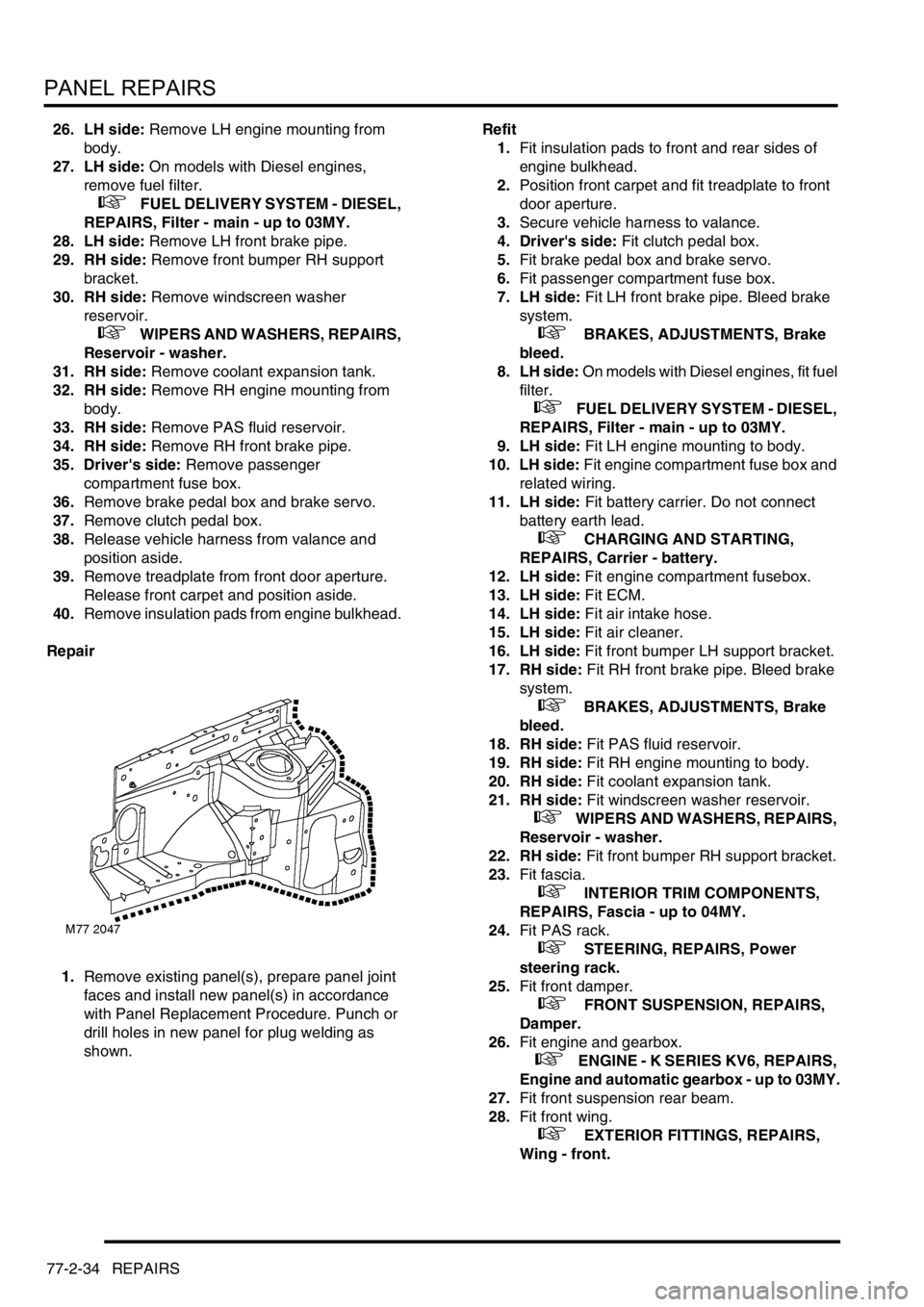
Repair
1.Remove existing panel(s), prepare panel joint
faces and install new panel(s) in accordance
with Panel Replacement Procedure. Punch or
drill holes in new panel for plug welding as
shown. Refit
1.Fit insulation pads to front and rear sides of
engine bulkhead.
2.Position front carpet and fit treadplate to front
door aperture.
3.Secure vehicle harness to valance.
4. Driver's side: Fit clutch pedal box.
5.Fit brake pedal box and brake servo.
6.Fit passenger compartment fuse box.
7. LH side: Fit LH front brake pipe. Bleed brake
system.
+ BRAKES, ADJUSTMENTS, Brake
bleed.
8. LH side: On models with Diesel engines, fit fuel
filter.
+ FUEL DELIVERY SYSTEM - DIESEL,
REPAIRS, Filter - main - up to 03MY.
9. LH side: Fit LH engine mounting to body.
10. LH side: Fit engine compartment fuse box and
related wiring.
11. LH side: Fit battery carrier. Do not connect
battery earth lead.
+ CHARGING AND STARTING,
REPAIRS, Carrier - battery.
12. LH side: Fit engine compartment fusebox.
13. LH side: Fit ECM.
14. LH side: Fit air intake hose.
15. LH side: Fit air cleaner.
16. LH side: Fit front bumper LH support bracket.
17. RH side: Fit RH front brake pipe. Bleed brake
system.
+ BRAKES, ADJUSTMENTS, Brake
bleed.
18. RH side: Fit PAS fluid reservoir.
19. RH side: Fit RH engine mounting to body.
20. RH side: Fit coolant expansion tank.
21. RH side: Fit windscreen washer reservoir.
+ WIPERS AND WASHERS, REPAIRS,
Reservoir - washer.
22. RH side: Fit front bumper RH support bracket.
23.Fit fascia.
+ INTERIOR TRIM COMPONENTS,
REPAIRS, Fascia - up to 04MY.
24.Fit PAS rack.
+ STEERING, REPAIRS, Power
steering rack.
25.Fit front damper.
+ FRONT SUSPENSION, REPAIRS,
Damper.
26.Fit engine and gearbox.
+ ENGINE - K SERIES KV6, REPAIRS,
Engine and automatic gearbox - up to 03MY.
27.Fit front suspension rear beam.
28.Fit front wing.
+ EXTERIOR FITTINGS, REPAIRS,
Wing - front.
Page 841 of 1007

CORROSION PREVENTION AND SEALING
77-4-10 SEALING
Underbody protection repairs
Whenever body repairs are carried out, ensure that full sealing and corrosion protection treatments are reinstated.
This applies both to the damaged areas and also to areas where protection has been indirectly impaired, as a result
either of accident damage or repair operations.
Remove corrosion protection from the damaged area before straightening or panel beating. This applies in particular
to panels coated with wax, PVC underbody sealer, sound deadening pads etc.
warn : DO NOT use oxy-acetylene gas equipment to remove corrosion prevention materials. Large volumes of fumes
and gases are liberated by these materials when they burn.
Equipment for the removal of tough anti-corrosion sealers offers varying degrees of speed and effectiveness. The
compressed air-operated scraper (NOT an air chisel) offers a relatively quiet mechanical method using an extremely
rapid reciprocating action. Move the operating end of the tool along the work surface to remove the material.
The most common method of removal is by means of a hot air blower with integral scraper.
High temperatures can be generated with this equipment which may cause fumes. Take care during its use.
Another tool, and one of the most efficient methods, is the rapid-cutting 'hot knife'. This tool uses a wide blade and is
quick and versatile, able to be used easily in profiled sections where access is otherwise difficult.
Use the following procedure when repairing underbody coatings:
1Remove existing underbody coatings.
2After panel repair, clean the affected area with a solvent wipe, and treat bare metal with an etch phosphate
material.
3Re-prime the affected area.
caut: DO NOT, under any circumstances, apply underbody sealer directly to bare metal surfaces.
lReplace all heat-fusible plugs which have been disturbed. Where such plugs are not available use rubber
grommets of equivalent size, ensuring that they are embedded in sealer.
lMask off all mounting faces from which mechanical components, hoses and pipe clips, have been removed.
Underbody sealer must be applied before such components are refitted.
lBrush sealer into all exposed seams.
lSpray the affected area with an approved service underbody sealer.
lRemove masking from component mounting faces, and touch-in where necessary. Allow adequate drying time
before applying underbody wax.
After refitting mechanical components, including hoses and pipes and other fixtures, mask off the brake discs and
apply a coat of approved underbody wax.
note : Where repairs include the application of finish paint coats in the areas requiring underbody wax, carry out paint
operations before applying wax.
STRUCTURAL ADHESIVES
Metal-to-metal adhesive is applied to critical joint areas during factory assembly. The material used is a high-
temperature, heat cured, nitrile phenolic which serves to bond two metal surfaces and also to seal the joint against
ingress of dust, moisture and fumes. This material is not suitable for service use and, during repair, should be
substituted by an approved Structural Adhesive.
Those joints which require the application of structural adhesive are detailed in the following Figures. Only joints
applicable to service panels are included. Apply structural adhesive where indicated or to the mating panel surface.
caut : When separating a joint treated with metal-to-metal adhesive, it is important to avoid distortion. Heat the joint
gradually until the bond weakens sufficiently to permit panel separation.
note : When spot welding through metal-to-metal adhesive, take particular care to adjust the transformer setting to
ensure a reliable weld.