wheel LAND ROVER FREELANDER 2001 User Guide
[x] Cancel search | Manufacturer: LAND ROVER, Model Year: 2001, Model line: FREELANDER, Model: LAND ROVER FREELANDER 2001Pages: 1007, PDF Size: 23.47 MB
Page 48 of 1007

GENERAL INFORMATION
03-17
SPX Corporation,
665, Eisenhower Drive,
Owatonna,
MN 55060,
USA
( 0018 772979110
) 0018 005787375
Australia
SPX Australia,
28, Clayton Road,
Notting Hill,
Victoria 3168,
Australia
( 00 (61) 00395446222
) 00 (61) 0395445222
e-mail: [email protected]
Japan and East Asia
Jatek Ltd.,
5 - 53, Minawacho 2-chome,
Kohoku-ku,
Yokohama,
Kanagawa 223-0051,
Japan
( 0081 455627700
) 0081 455627800
Rolling road testing
General
IMPORTANT: Use a four wheel rolling road for
brake testing if possible.
The front and rear wheels cannot be driven
independently due to the viscous coupling. This
eliminates the need for differential lock by
progressively applying more torque to the rear
wheels if the front wheels start to slip.
DO NOT attempt to drive individual wheels with
vehicle supported on floor jacks or stands.
Four wheel rolling road
Provided that front and rear rollers are rotating at
identical speeds and that normal workshop safety
standards are applied, there is no speed restriction
during testing, except any that may apply to the tyres.
Before testing a vehicle with anti-lock brakes on a
four wheel rolling road, disconnect the ABS
modulator. The ABS function will not work, the ABS
warning light will illuminate. Normal braking will be
available.
Two wheel rolling road
ABS will not function on a two wheel rolling road. The
ABS light will illuminate during testing. Normal
braking will be available.
If brake testing on a two wheel rolling road is
necessary, the following precautions should be
taken:
lpropeller shaft to the rear axle is removed/
disconnected;
lneutral selected in gearbox;
lhill descent control not selected.
When checking brakes, run engine at idle speed to
maintain servo vacuum.
Page 52 of 1007
GENERAL INFORMATION
03-21
It should be noted that these precautions are not
restricted to operations performed when servicing
the SRS system, the same care should be exercised
when working on ancillary systems and components
located in the vicinity of SRS components; these
include but are not limited to:
lSteering system – steering wheel airbag,
rotary coupler.
lFront fascia – passenger front airbag (where
fitted); SRS DCU behind centre console, on
transmission tunnel under the HeVAC system.
lFront seats – seat belt pre-tensioners, integral
with seat belt buckle assembly.
lElectrical system – SRS harnesses, link leads
and connectors.
Making the SRS system safe
Before working on or in the vicinity of SRS
components, ensure the system is rendered safe by
performing the following procedures:
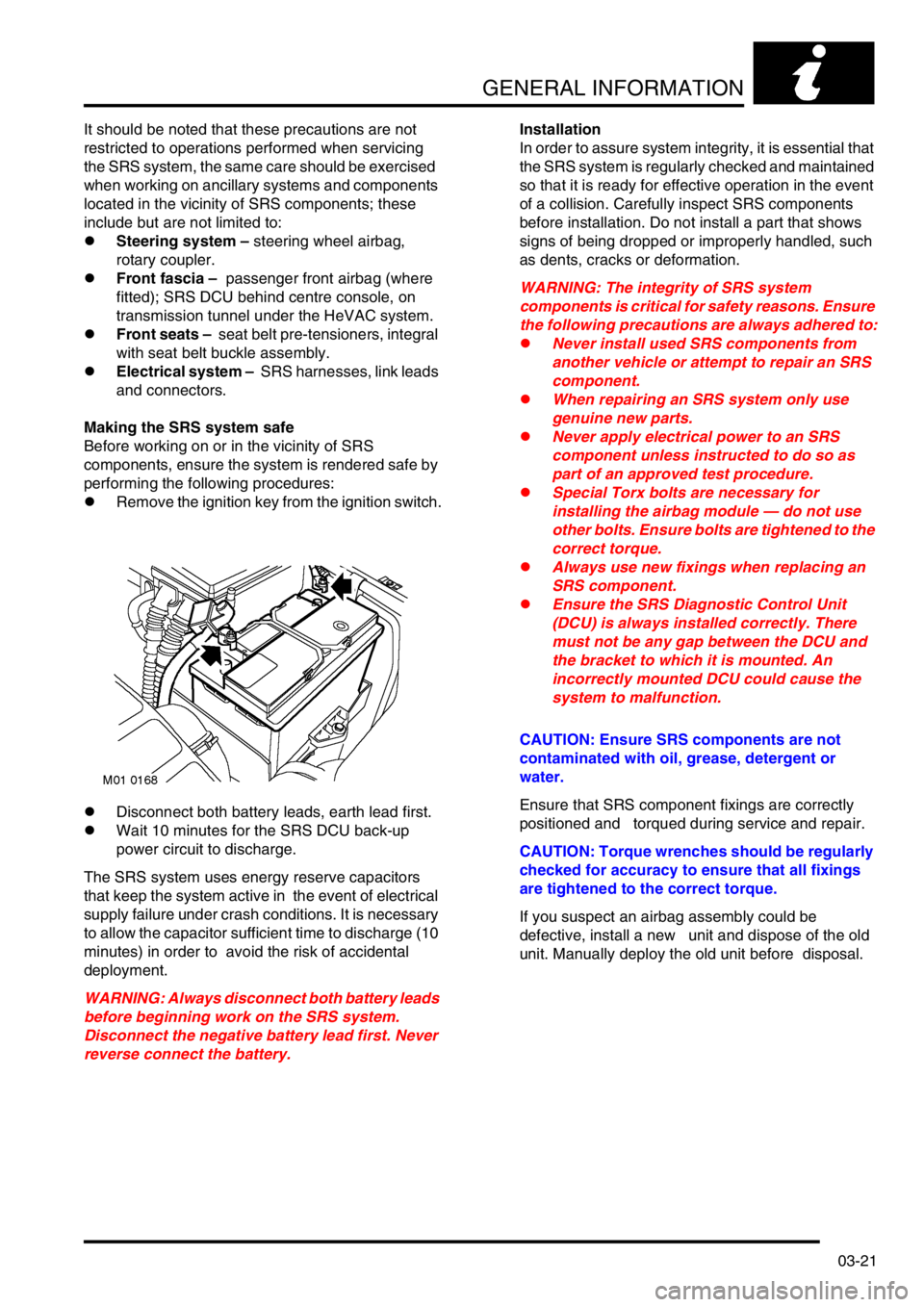
lRemove the ignition key from the ignition switch.
lDisconnect both battery leads, earth lead first.
lWait 10 minutes for the SRS DCU back-up
power circuit to discharge.
The SRS system uses energy reserve capacitors
that keep the system active in the event of electrical
supply failure under crash conditions. It is necessary
to allow the capacitor sufficient time to discharge (10
minutes) in order to avoid the risk of accidental
deployment.
WARNING: Always disconnect both battery leads
before beginning work on the SRS system.
Disconnect the negative battery lead first. Never
reverse connect the battery.Installation
In order to assure system integrity, it is essential that
the SRS system is regularly checked and maintained
so that it is ready for effective operation in the event
of a collision. Carefully inspect SRS components
before installation. Do not install a part that shows
signs of being dropped or improperly handled, such
as dents, cracks or deformation.
WARNING: The integrity of SRS system
components is critical for safety reasons. Ensure
the following precautions are always adhered to:
lNever install used SRS components from
another vehicle or attempt to repair an SRS
component.
lWhen repairing an SRS system only use
genuine new parts.
lNever apply electrical power to an SRS
component unless instructed to do so as
part of an approved test procedure.
lSpecial Torx bolts are necessary for
installing the airbag module — do not use
other bolts. Ensure bolts are tightened to the
correct torque.
lAlways use new fixings when replacing an
SRS component.
lEnsure the SRS Diagnostic Control Unit
(DCU) is always installed correctly. There
must not be any gap between the DCU and
the bracket to which it is mounted. An
incorrectly mounted DCU could cause the
system to malfunction.
CAUTION: Ensure SRS components are not
contaminated with oil, grease, detergent or
water.
Ensure that SRS component fixings are correctly
positioned and torqued during service and repair.
CAUTION: Torque wrenches should be regularly
checked for accuracy to ensure that all fixings
are tightened to the correct torque.
If you suspect an airbag assembly could be
defective, install a new unit and dispose of the old
unit. Manually deploy the old unit before disposal.
Page 55 of 1007
GENERAL INFORMATION
03-24
SRS Harnesses and Connectors
CAUTION: Always observe the following
precautions with regards to SRS system
electrical wiring:
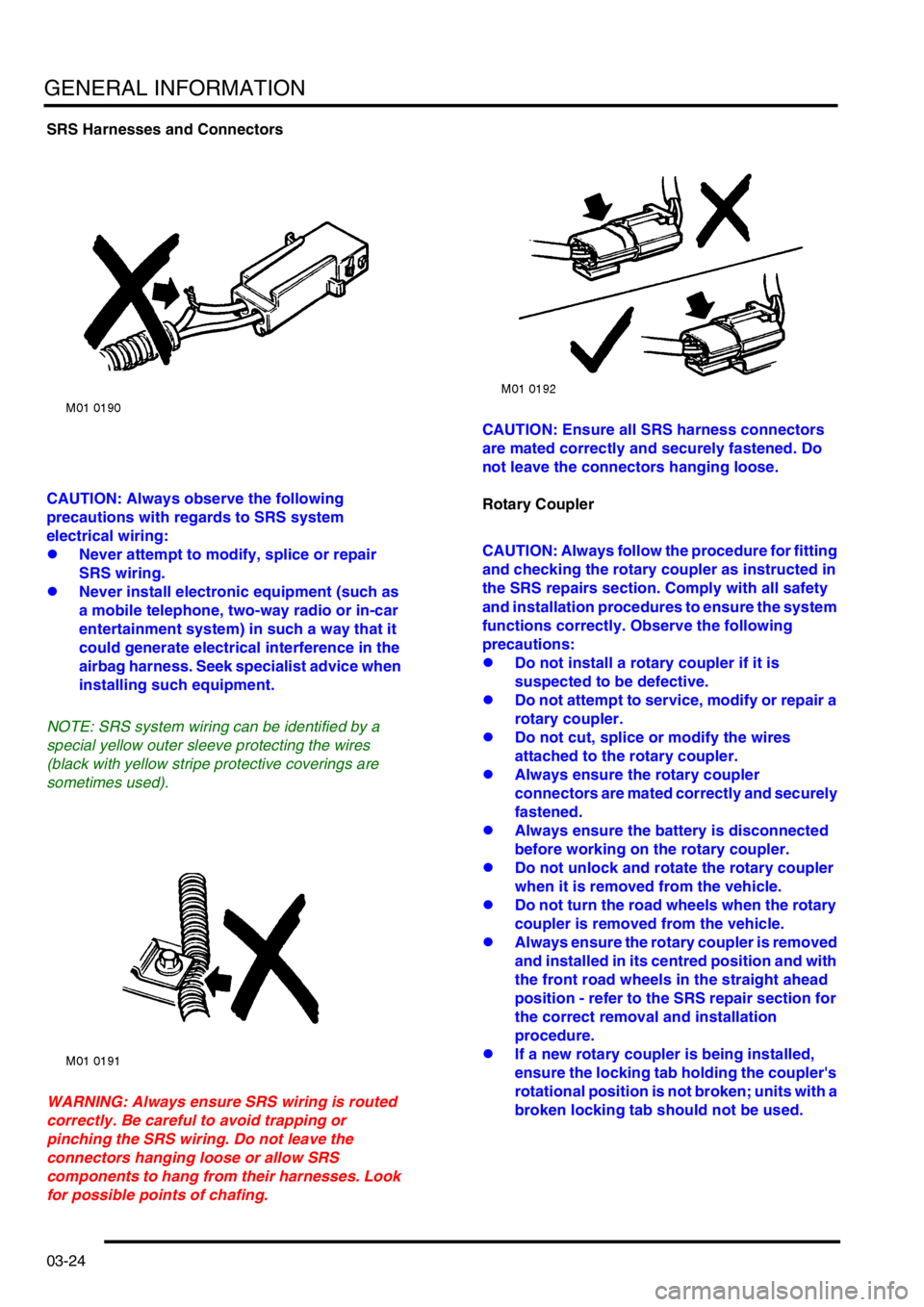
lNever attempt to modify, splice or repair
SRS wiring.
lNever install electronic equipment (such as
a mobile telephone, two-way radio or in-car
entertainment system) in such a way that it
could generate electrical interference in the
airbag harness. Seek specialist advice when
installing such equipment.
NOTE: SRS system wiring can be identified by a
special yellow outer sleeve protecting the wires
(black with yellow stripe protective coverings are
sometimes used).
WARNING: Always ensure SRS wiring is routed
correctly. Be careful to avoid trapping or
pinching the SRS wiring. Do not leave the
connectors hanging loose or allow SRS
components to hang from their harnesses. Look
for possible points of chafing.CAUTION: Ensure all SRS harness connectors
are mated correctly and securely fastened. Do
not leave the connectors hanging loose.
Rotary Coupler
CAUTION: Always follow the procedure for fitting
and checking the rotary coupler as instructed in
the SRS repairs section. Comply with all safety
and installation procedures to ensure the system
functions correctly. Observe the following
precautions:
lDo not install a rotary coupler if it is
suspected to be defective.
lDo not attempt to service, modify or repair a
rotary coupler.
lDo not cut, splice or modify the wires
attached to the rotary coupler.
lAlways ensure the rotary coupler
connectors are mated correctly and securely
fastened.
lAlways ensure the battery is disconnected
before working on the rotary coupler.
lDo not unlock and rotate the rotary coupler
when it is removed from the vehicle.
lDo not turn the road wheels when the rotary
coupler is removed from the vehicle.
lAlways ensure the rotary coupler is removed
and installed in its centred position and with
the front road wheels in the straight ahead
position - refer to the SRS repair section for
the correct removal and installation
procedure.
lIf a new rotary coupler is being installed,
ensure the locking tab holding the coupler's
rotational position is not broken; units with a
broken locking tab should not be used.
Page 57 of 1007
GENERAL INFORMATION
03-26
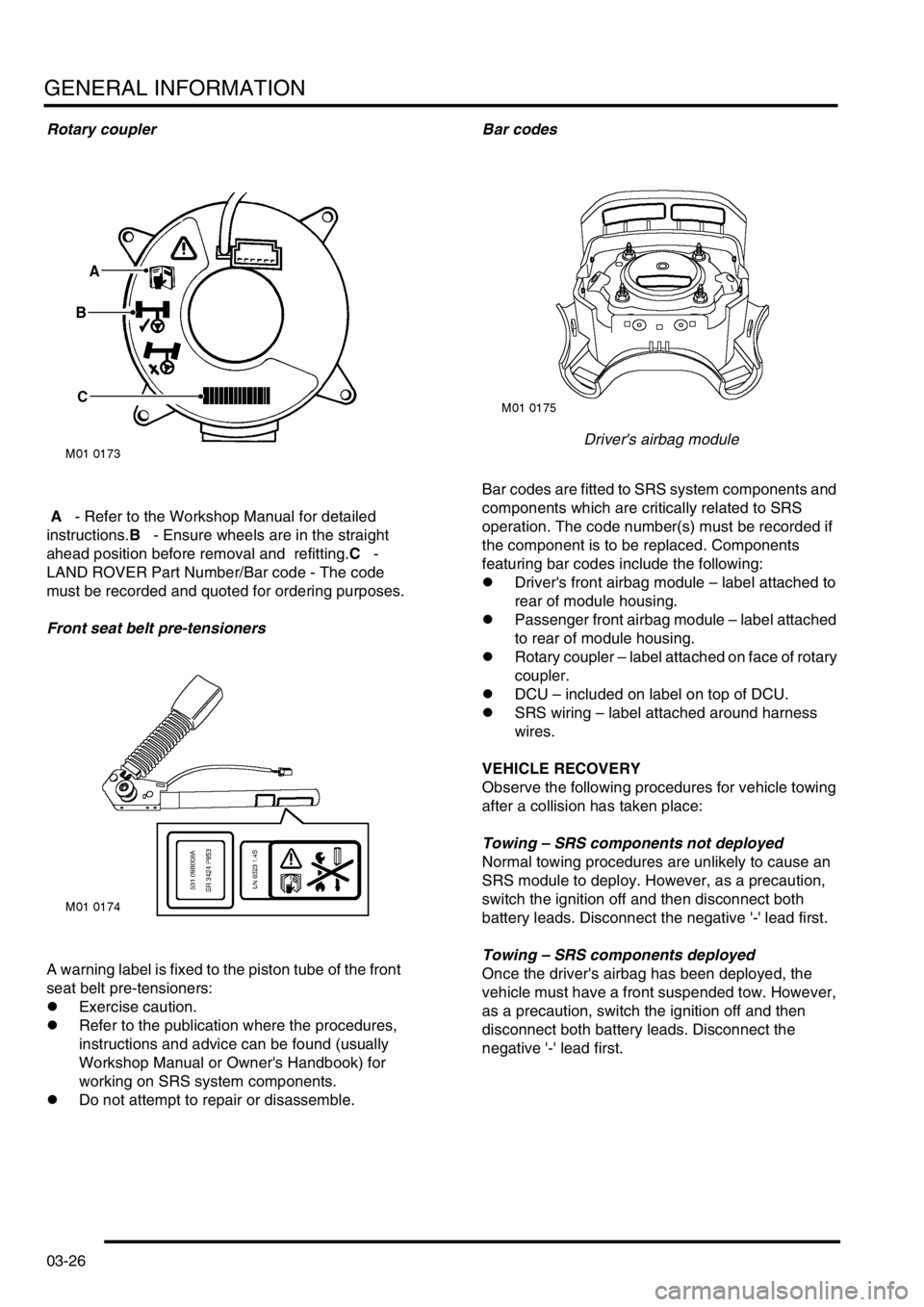
Rotary coupler
A - Refer to the Workshop Manual for detailed
instructions.B - Ensure wheels are in the straight
ahead position before removal and refitting.C -
LAND ROVER Part Number/Bar code - The code
must be recorded and quoted for ordering purposes.
Front seat belt pre-tensioners
A warning label is fixed to the piston tube of the front
seat belt pre-tensioners:
lExercise caution.
lRefer to the publication where the procedures,
instructions and advice can be found (usually
Workshop Manual or Owner's Handbook) for
working on SRS system components.
lDo not attempt to repair or disassemble.Bar codes
Driver's airbag module
Bar codes are fitted to SRS system components and
components which are critically related to SRS
operation. The code number(s) must be recorded if
the component is to be replaced. Components
featuring bar codes include the following:
lDriver's front airbag module – label attached to
rear of module housing.
lPassenger front airbag module – label attached
to rear of module housing.
lRotary coupler – label attached on face of rotary
coupler.
lDCU – included on label on top of DCU.
lSRS wiring – label attached around harness
wires.
VEHICLE RECOVERY
Observe the following procedures for vehicle towing
after a collision has taken place:
Towing – SRS components not deployed
Normal towing procedures are unlikely to cause an
SRS module to deploy. However, as a precaution,
switch the ignition off and then disconnect both
battery leads. Disconnect the negative '-' lead first.
Towing – SRS components deployed
Once the driver's airbag has been deployed, the
vehicle must have a front suspended tow. However,
as a precaution, switch the ignition off and then
disconnect both battery leads. Disconnect the
negative '-' lead first.
Page 59 of 1007

GENERAL INFORMATION
03-28
SRS component replacement policy
The following information details the policy for
replacement of SRS components; either as a result
of a vehicle accident or as a result of vehicle age.
Impacts which do not deploy the airbags or seat
belt pre-tensioners
Check for structural damage in the area of the
impact, paying particular attention to bumper
armatures, longitudinals, crash cans and bracketry.
Impacts which deploy the airbags and/or seat
belt pre-tensioners
The inspection and replacement policy is dependent
on the type and severity of the crash condition. The
following guidelines are the minimum that should be
exercised as a result of the deployment of specific
SRS components.
Front airbag/ seat belt pre-tensioner deployment
(driver and passenger)
If the front airbags and/or seat belt pre-tensioners are
deployed as a result of a front, front angled or side
impact, the following parts must be replaced:
lDriver airbag module
lPassenger airbag module (where fitted)
lSRS flyleads
lSRS DCU
lRotary coupler
lFront seat belt pre-tensioners
In addition, the following should be inspected for
damage and replaced as necessary:
lFront seat belt and buckle tongue (anchorage
points, webbing etc.)
lFascia moulding adjacent to passenger airbag
module (where fitted)
lSteering wheel (if damage is evident)
lFront seat frames and head restraints (if there is
evidence of damage to the seat frame or
cushion pan)
lSteering column (if adjustment is lost or there
are signs of collapse)
lFront seat belt height adjusters on 'BC' posts (5
door models only)
lRear seat belts and seat belt buckles (webbing,
buckle covers, body anchorage and tongue
latching function)Rear Impact
If the seat belt pre-tensioners are deployed during a
rear impact, the following components must be
replaced:
lSeat belt pre-tensioners
lFront and rear automatic seat belt assemblies
used during an impact.
lSRS DCU
In addition, the following components should be
inspected for damage and replaced as necessary:
lFront seat frames
lFront seat belts and buckle (retractors,
webbing, tongue latching, buckle covers, body
anchorages and 'D' loops)
lSeat belt height adjusters (5 door models only)
lRear seat belts and seat belt buckles (webbing,
buckle covers, body anchorage and tongue
latching function)
Periodic replacement of SRS components
The performance of the propellants within airbags
and seat belt pre-tensioners will deteriorate over a
period of time. As a result, it is essential that the
airbags and seat belt pre-tensioners are periodically
replaced to maintain occupant safety. Airbags, seat
belt pre-tensioners and the rotary coupler should be
replaced at the recommended intervals.
Page 73 of 1007

GENERAL DATA
04-10
Sensors:
Crankshaft sensor Siemens NSC 100630, Hall effect acting on profiled target on flywheel
Camshaft sensor:
⇒ Make / Type ITT NSC 100610 +0, Hall effect acting on camshaft reluctor ring
⇒ Ring TGN 100050
Oxygen sensor:
⇒ Make / Type NTK - MHK 100720
⇒ Heating element (nominal) 7 Watts
⇒ Sensor voltage - High≈ 900 mV
⇒ Sensor voltage - Low≈ 40 mV
Throttle potentiometer:
⇒ Make / Type CTS - MJC 100020
⇒ Total track resistance 4 kΩ ± 20%
⇒ Sensor supply voltage 5V ± 4%
TMAP sensor:
⇒ Make / Type Motorola - MHK 100820
⇒ Sensor supply voltage 5V ± 4%
Coolant temperature sensor:
⇒ Make / Type AB Electronik - MEK 100170; NTC thermistor bead
Oil temperature sensor
⇒ Make / Type AB Elektronik - MEK100170; NTC thermistor bead General
Page 79 of 1007

GENERAL DATA
04-16
Fuel system - Td4 Diesel
System Common rail, direct injection
Fuel specification EN590 diesel*
⇒ Pump output 250 kPa (2.5 bar, 36.3 lbf.in
2)
Fuel pump
⇒ Up to 03 MY
⇒ Pump output
⇒ 03 MY onwardsElectric - submersible in fuel tank
250 kPa (2.5 bar, 36.3 lbf.in
2)
Fuel tank pump deleted, replaced by auxiliary delivery pump located
in RH rear wheel arch
Auxiliary delivery pump
⇒ Up to 03 MY
⇒ 03 MY onwardsElectrical - in line, located in engine compartment
Electrical - in line, located in RH rear wheel arch
Maximum delivery volume 240 litres per hour (52.75 imp. gallons) @ 12V
Fuel high pressure pump Bosch Cp1 mechanical high pressure, 3 radial piston
⇒ Drive Chain driven from crankshaft at 0.75 x engine speed
⇒ Pressure control Mounted on CP1, controlled by DDE 4.0
Pressure regulator
⇒ Up to 03 MY
⇒ 03 MY onwardsLocated in engine compartment between fuel filter and injection pump
Incorporated with in-tank suction and sender module
⇒ Pressure (nominal) 2.4 to 2.8 bar (34.8 to 40.6 lbf.in
2)
Injectors:
⇒ Make
⇒ Nozzle type
⇒ Position
⇒ Impedance
⇒ Injector operating pressureBosch CRI 0445 110 030
DSLA 145P 868
Central
14.5 Ω ± 5% @ 20%
250 - 1350 bar (3625 - 19575 lbf.in
2)
Injection begins:
⇒ Pre-injection (maximum) 60° BTDC
⇒ Main injection (maximum) 25° BTDC
⇒ Post injection 100 - 200° crank ATDC
Injection timing Controlled by Bosch DDE 4.0 engine management system for
common rail injection
Injection quantity 1 - 80 mm
3
Pre-delivery fuel pressure sensor
⇒ Up to 03 MY
⇒ 03 MY onwardsBosch / DS-K-400/50, located in filter head
Bosch /DS-K-400kPa, in-line, located in engine compartment
⇒ Pressure 400 kPa (58.0 lbf/in
2)
Fuel rail pressure sensor:
⇒ Measuring range 0 - 1500 bar (0-21750 lbf/in
⇒ Over pressure (max.) 1800 bar (26100 lbf/in
2)
⇒ Burst pressure 3000 bar (43500 lbf/in
2)
⇒ Temperature range -40°C to +120°C (-40°F to +248°F)
Fuel filter
⇒ Up to 03 MY
⇒ From 03 MYIn-line between auxiliary fuel pump and high-pressure fuel injection
pump, located in engine compartment
In-line, located in RH rear wheel arch
Page 90 of 1007

GENERAL DATA
04-27
Steering
* The steering geometry settings are given in degrees and minutes, decimal parts of a degree and millimetres.
Steering and suspension geometry settings are for a vehicle at unladen weight.
Type Power assisted rack and pinion
Steering column Height adjustable by 3.5° or 30 mm vertical movement of steering
wheel
Turns - lock to lock 3.20
Turning circle: 11.38 m (37 ft 1.2 in) - with a 215/65 tyre
Overall ratio 19.5: 1
Wheel alignment*
Front
⇒ Camber angle (negative): -0° 15' ± 0° 45' (-0.25° ± 0.75°)
⇒ Cross camber angle 1° (1°) Maximum
⇒ Castor angle: 3° 30' ± 1° (3.92° ± 1.0°)
⇒ Cross castor angle 1° (1°) Maximum
⇒ King pin inclination 12° 18' (12.3°)
⇒ Front wheel alignment - total toe-out: - 0° 14' ± 0° 14' (- 0.23° ± 0.23°)
Rear
⇒ Camber angle (negative): -0° 30' ± 0° 45' (0.5° ± 0.75°)
⇒ Cross camber angle 1° (1°) Maximum
⇒ Thrust angle: 0° 0' ± 0° 6' (0° ± 0.10°)
⇒ Rear wheel alignment - total toe-in: 0° 20' ± 0° 15' (0.3° ± 0.25°)
Power assisted steering
Maximum Operating Pressure ( limited by pressure
relief valve in pump):
⇒ K1.8 90 - 100 bar (1305 - 1450 lbf/in
2)
⇒ KV6 & Td4 90 - 100 bar (1305 - 1450 lbf/in
2)
Pressure at idle 5 - 7 bar (72.5 - 101.5 lbf/in
2)
Maximum flow 5.5 ± 0.5 litres/min. (1.45 ± 0.13 US gal/min), limited by flow control
valve in pump
Page 91 of 1007

GENERAL DATA
04-28
Front Suspension
Type Independent, MacPherson struts with coil springs, lower "L" shaped
arms and anti-roll bar
Nominal height to wheel arch from hub centre* 453 mm (17.83 in)
Road spring identification (colour code):
Td4 with manual gearbox
⇒ Colour code YELLOW / BLUE
⇒ Total coils 6
⇒ Active coils 5
⇒ Wire diameter 14.87 mm (0.585 in)
⇒ Free length 367 mm (14.45 in)
Td4 with automatic gearbox, non air conditioning
⇒ Colour code YELLOW / WHITE
⇒ Total coils 6
⇒ Active coils 5
⇒ Wire diameter 14.87 mm (0.585 in)
⇒ Free length 367 mm (14.445 in)
Td4 with automatic gearbox and air conditioning
⇒ Colour code YELLOW / BROWN
⇒ Total coils 6
⇒ Active coils 5
⇒ Wire diameter 14.866 mm (0.5853 in)
⇒ Free length 375 mm (14.76 in)
K1.8 without air conditioning
⇒ Colour code YELLOW / PINK
⇒ Total coils 5.5
⇒ Active coils 4.5
⇒ Wire diameter 14.03 mm (0.552 in)
⇒ Free length 359 mm (14.13 in)
K1.8 with air conditioning
⇒ Colour code YELLOW / GREY
⇒ Total coils 5.5
⇒ Active coils 4.5
⇒ Wire diameter 14.03 mm (0.552 in)
⇒ Free length 359 mm (14.13 in)
KV6 without air conditioning
⇒ Colour code YELLOW / BLUE
⇒ Total coils 6
⇒ Active coils 5
⇒ Wire diameter 14.87 mm (0.585 in)
⇒ Free length 367 mm (14.45 in)
KV6 with air conditioning
⇒ Colour code YELLOW / WHITE
⇒ Total coils 6
⇒ Active coils 5
⇒ Wire diameter 14.87 mm (0.585 in)
⇒ Free length 371 mm (14.61 in)
Page 93 of 1007

GENERAL DATA
04-30
Rear Suspension
* At unladen weight
Type Independent, MacPherson struts with coil springs and lower
"trapezoidal links"
All models, except those with Sports
Suspension:Nominal height to wheel arch from hub
centre*463 mm (18.228 in) ± 10 mm (0.39)
Models with Sports Suspension only:Nominal height
to wheel arch from hub centre*433 mm (17.047 in)
Road spring identification:
All models except Sports Suspension
⇒ Colour code WHITE / GREEN
Total coils 6.42
Active coils 4.7
Wire diameter 13.825 mm (0.5443 in)
Free length 349.86 (13.774 in)
Models with Sports Suspension, (fitted from 04MY)
⇒ Colour code ORANGE / ORANGE
⇒ Total coils 6.8
⇒ Active coils 5.6
⇒ Wire diameter 13.97
⇒ Free length 311