bonnet LAND ROVER FREELANDER 2001 Service Manual
[x] Cancel search | Manufacturer: LAND ROVER, Model Year: 2001, Model line: FREELANDER, Model: LAND ROVER FREELANDER 2001Pages: 1007, PDF Size: 23.47 MB
Page 839 of 1007

CORROSION PREVENTION AND SEALING
77-4-8 SEALING
Underbody sealer
Underfloor areas and sill outer panels are treated with a Plastisol PVC underbody sealer. This material is not suitable
for re-treatment. When repairing areas of underbody sealer, strip the factory-applied underbody sealer back to a
suitable break point. Ensure that a clean metal surface is exposed and that the edge of the existing sealer adheres
soundly to the panel.
Apply new underbody sealer between primer and surfacer paint operations. Apply seam sealer as necessary before
application of underbody sealer. Ensure that blanking plugs and grommets in the floor pan (except those used for wax
injection) are fitted before underbody sealer application. Refit any heat-fusible plugs which have been disturbed in
repair with the aid of a hot air blower, or replace with rubber grommets.
caut : Ensure that suspension units, wheels, tyres, power unit, driveshafts, exhaust and brakes (including all mounting
points) are shielded prior to application of fresh underbody sealer.
Underbody wax
The underbody wax must be reinstated following all repairs affecting floor panels. The wax is applied over paints and
underbody sealers.
caut : Remove old underbody wax completely from a zone extending at least 200mm beyond the area where new
underbody sealer is to be applied.
Engine bay wax
Reinstate all protective engine bay wax disturbed during repairs using an approved material.
Where repairs have involved replacement of engine bay panels, treat the entire engine compartment including all
components, clips and other fixtures with an approved underbonnet lacquer or wax.
Precautions during body repairs and handling
Take care when handling the vehicle in the workshop. Underbody sealers, seam sealers, underbody wax and body
panels may be damaged if the vehicle is carelessly lifted.
Proprietary anti-corrosion treatments
The application of proprietary anti-corrosion treatments in addition to the factory-applied treatment could invalidate
the Corrosion Warranty and should be discouraged. This does not apply to approved, compatible, preservative waxes
which may be applied on top of existing coatings.
Fitting approved accessories
When fitting accessories ensure that the vehicle's corrosion protection is not affected, either by breaking the protective
coating or by introducing a moisture trap.
Do not screw self-tapping screws directly into body panels. Fit suitable plastic inserts to the panel beforehand. Always
ensure that the edges of holes drilled into panels, chassis members and other body parts are protected with a suitable
zinc rich or acid etch primer, and follow with a protective wax coating brushed onto the surrounding area.
Do not attach painted metal surfaces of any accessory directly to the vehicle's bodywork unless suitably protected.
Where metal faces are bolted together always interpose a suitable interface material such as weldable zinc rich
primer, extruded strip, or zinc tape.
Steam cleaning and dewaxing
Due to the high temperatures generated by steam cleaning equipment, there is a risk that certain trim components
could be damaged and some adhesives and corrosion prevention materials softened or liquified.
Adjust the equipment so that the nozzle temperature does not exceed 90°C (194°F). Take care not to allow the steam
jet to dwell on one area, and keep the nozzle at least 300mm from panel surfaces.
DO NOT remove wax or lacquer from underbody or underbonnet areas during repairs. Should it be necessary to
steam clean these areas, apply a new coating of wax or underbody protection as soon as possible.
Page 840 of 1007

CORROSION PREVENTION AND SEALING
SEALING 77-4-9
Inspections during maintenance servicing
It is a requirement of the Corrosion Warranty that the vehicle body is checked for corrosion by an authorised Land
Rover Dealer at least once a year, to ensure that the factory-applied protection remains effective.
Service Job Sheets include the following operations to check bodywork for corrosion:
lWith the vehicle on a lift, carry out visual check of underbody sealer for damage.
lWith the vehicle lowered, inspect exterior paintwork for damage and body panels for corrosion.
The vehicle must be washed and free from deposits prior to inspection. It is part of the owner's responsibility to ensure
that the vehicle is kept free of accumulations of mud which could accelerate the onset of corrosion. It will be necessary
for the vehicle to be washed by the Dealer prior to inspection of bodywork if the customer has offered the vehicle in
a dirty condition. Particular attention should be paid to areas where access is difficult.
The checks described above are intended to be visual only. It is not intended that the operator should remove trim
panels, finishers, rubbing strips or sound-deadening materials when checking the vehicle for corrosion and paint
damage.
With the vehicle on a lift, and using an inspection or spot lamp, visually check for the following:
lCorrosion damage and damaged paintwork, condition of underbody sealer on front and rear lower panels, sills
and wheel arches.
lDamage to underbody sealer. Corrosion in areas adjacent to suspension mountings and fuel tank fixings.
The presence of small blisters in underbody sealer is acceptable, providing they do not expose bare metal.
Pay special attention to signs of damage caused to panels or corrosion protection material by incorrect jack
positioning.
caut : It is essential to follow the correct jacking and lifting procedures.
With the vehicle lowered, visually check for evidence of damage and corrosion on all visible painted areas, in
particular the following:
lFront edge of bonnet.
lVisible flanges in engine compartment.
lLower body and door panels.
Rectify any bodywork damage or evidence of corrosion found during inspection as soon as is practicable, both to
minimise the extent of the damage and to ensure the long term effectiveness of the factory-applied corrosion
prevention treatment. Where the cost of rectification work is the owner's responsibility, the Dealer must advise the
owner and endorse the relevant documentation accordingly.
Where corrosion has become evident and is emanating from beneath a removable component (e.g. trim panel,
window glass, seat etc.), remove the component as required to permit effective rectification.
Page 851 of 1007
CORROSION PREVENTION AND SEALING
77-4-20 SEALING
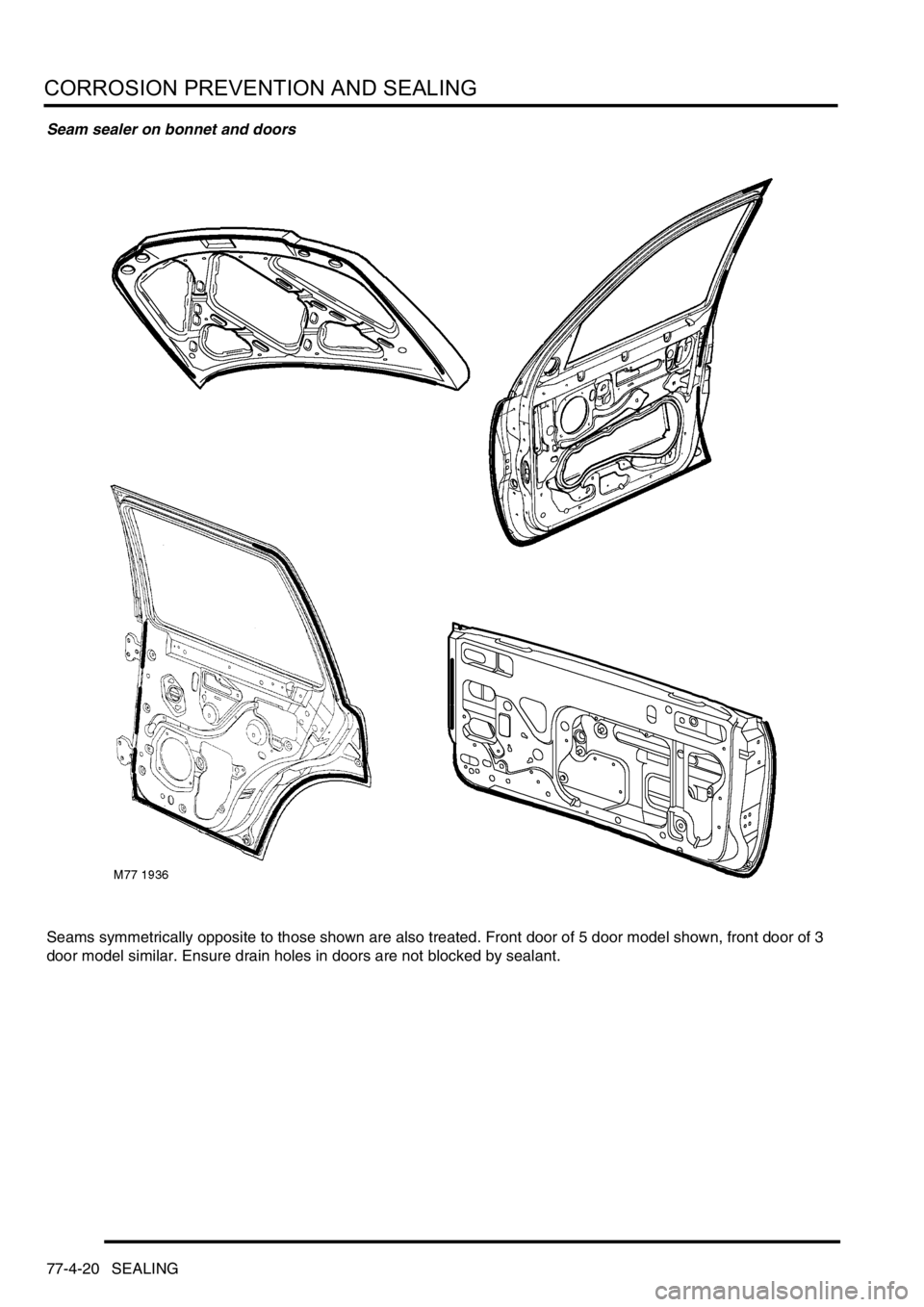
Seam sealer on bonnet and doors
Seams symmetrically opposite to those shown are also treated. Front door of 5 door model shown, front door of 3
door model similar. Ensure drain holes in doors are not blocked by sealant.
Page 871 of 1007
HEATING AND VENTILATION
80-6REPAIRS
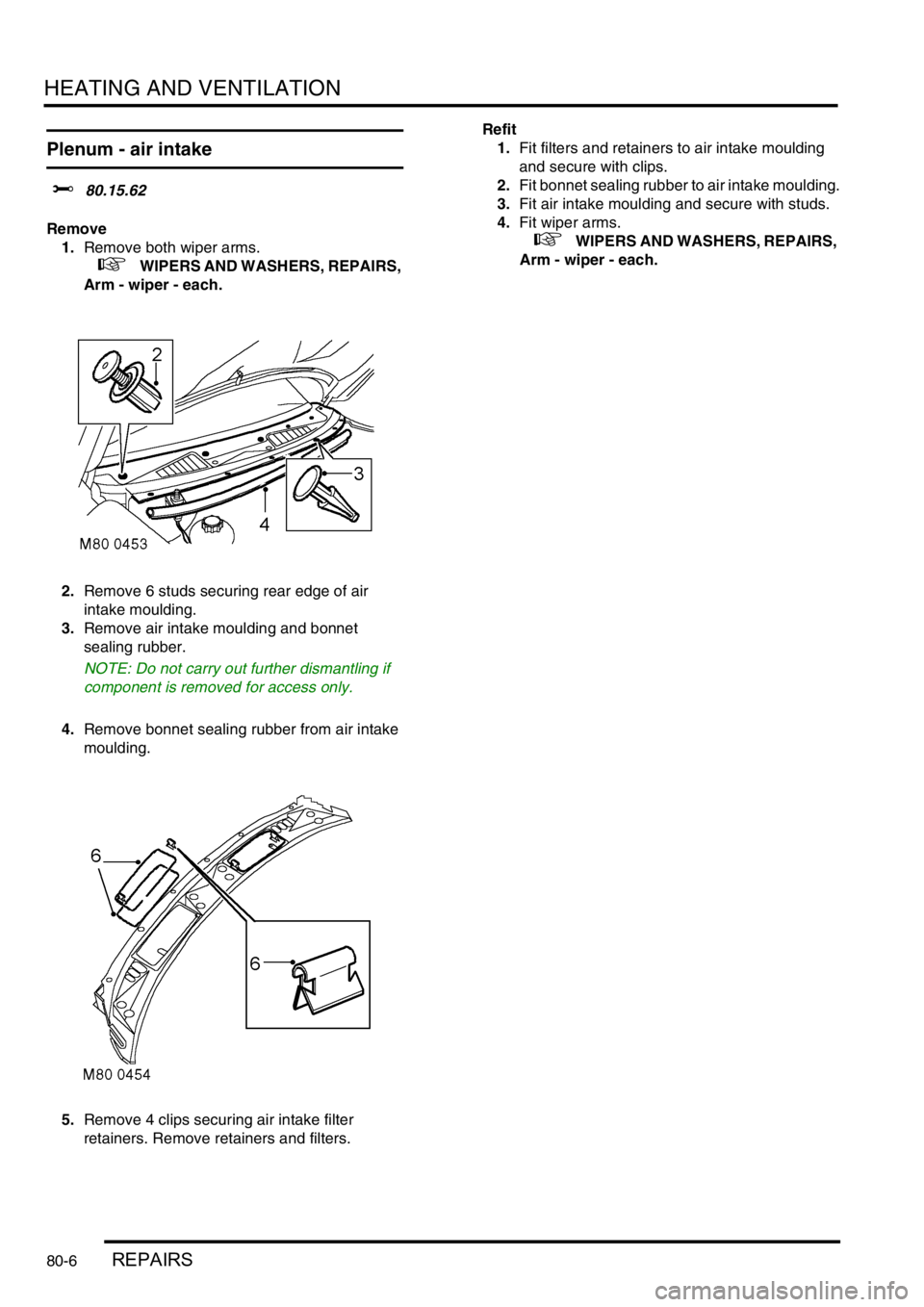
Plenum - air intake
$% 80.15.62
Remove
1.Remove both wiper arms.
+ WIPERS AND WASHERS, REPAIRS,
Arm - wiper - each.
2.Remove 6 studs securing rear edge of air
intake moulding.
3.Remove air intake moulding and bonnet
sealing rubber.
NOTE: Do not carry out further dismantling if
component is removed for access only.
4.Remove bonnet sealing rubber from air intake
moulding.
5.Remove 4 clips securing air intake filter
retainers. Remove retainers and filters.Refit
1.Fit filters and retainers to air intake moulding
and secure with clips.
2.Fit bonnet sealing rubber to air intake moulding.
3.Fit air intake moulding and secure with studs.
4.Fit wiper arms.
+ WIPERS AND WASHERS, REPAIRS,
Arm - wiper - each.
Page 881 of 1007
HEATING AND VENTILATION
80-16REPAIRS
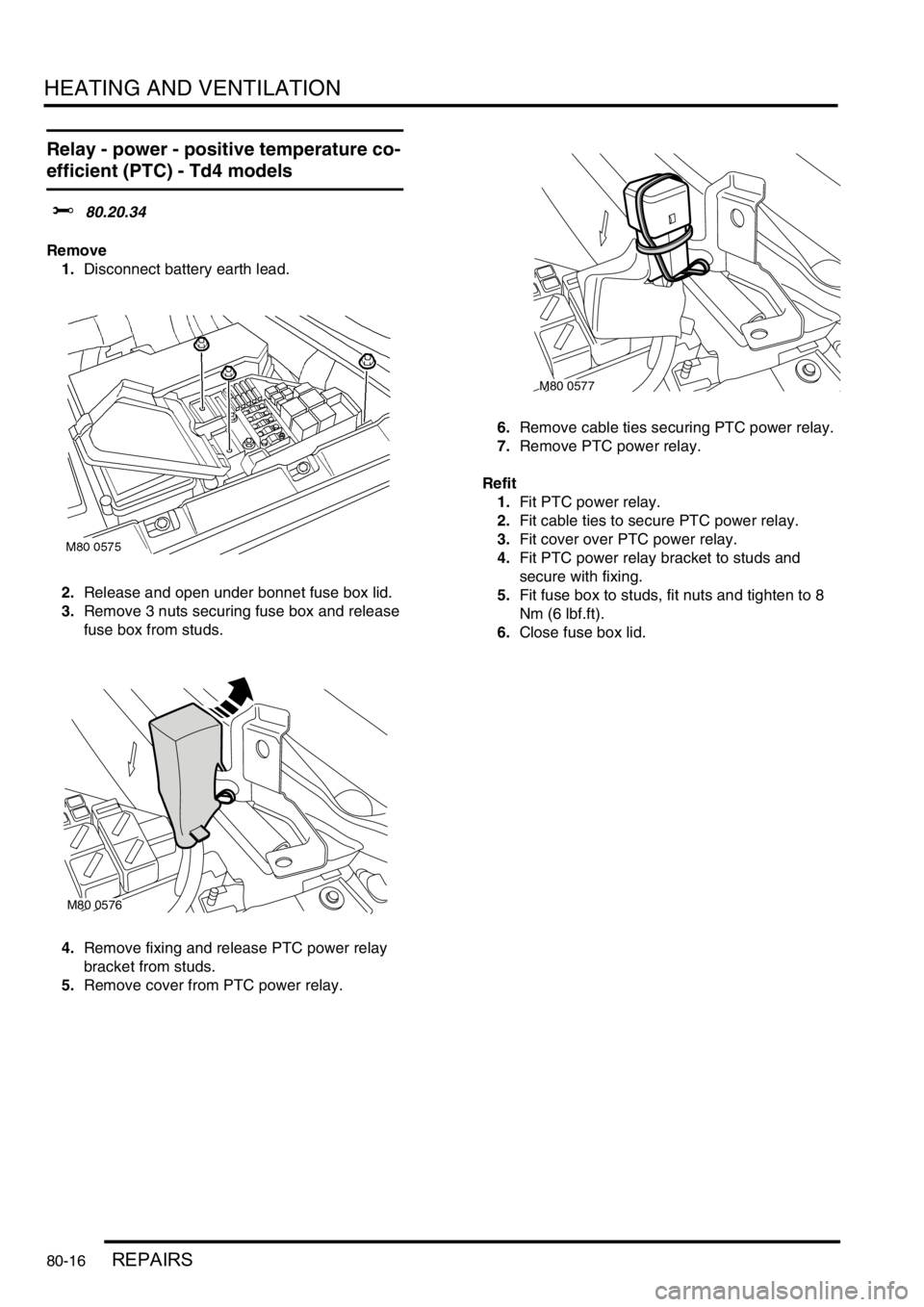
Relay - power - positive temperature co-
efficient (PTC) - Td4 models
$% 80.20.34
Remove
1.Disconnect battery earth lead.
2.Release and open under bonnet fuse box lid.
3.Remove 3 nuts securing fuse box and release
fuse box from studs.
4.Remove fixing and release PTC power relay
bracket from studs.
5.Remove cover from PTC power relay.6.Remove cable ties securing PTC power relay.
7.Remove PTC power relay.
Refit
1.Fit PTC power relay.
2.Fit cable ties to secure PTC power relay.
3.Fit cover over PTC power relay.
4.Fit PTC power relay bracket to studs and
secure with fixing.
5.Fit fuse box to studs, fit nuts and tighten to 8
Nm (6 lbf.ft).
6.Close fuse box lid.
M80 0576
M80 0577
Page 907 of 1007
WIPERS AND WASHERS
84-2 REPAIRS
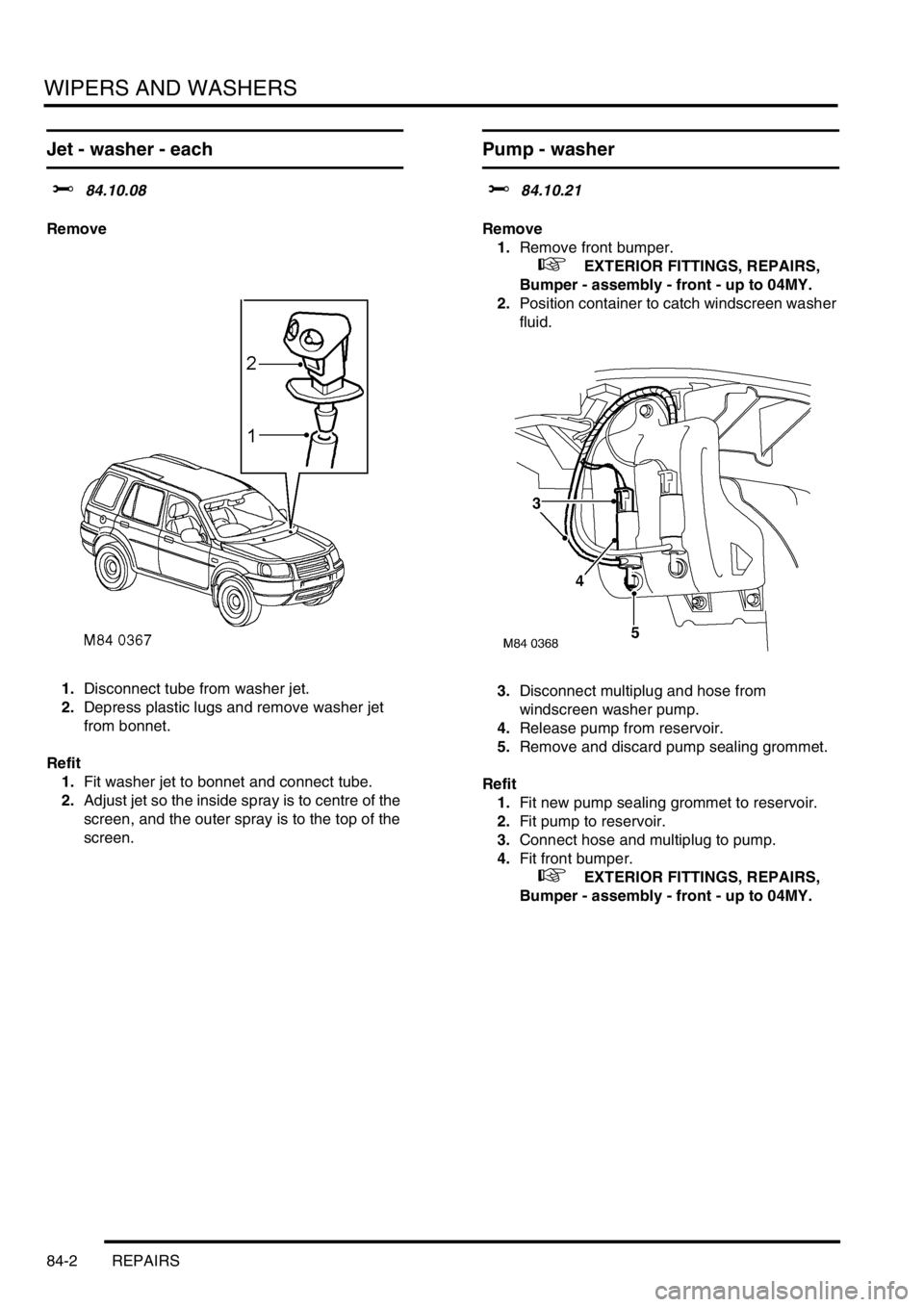
Jet - washer - each
$% 84.10.08
Remove
1.Disconnect tube from washer jet.
2.Depress plastic lugs and remove washer jet
from bonnet.
Refit
1.Fit washer jet to bonnet and connect tube.
2.Adjust jet so the inside spray is to centre of the
screen, and the outer spray is to the top of the
screen.
Pump - washer
$% 84.10.21
Remove
1.Remove front bumper.
+ EXTERIOR FITTINGS, REPAIRS,
Bumper - assembly - front - up to 04MY.
2.Position container to catch windscreen washer
fluid.
3.Disconnect multiplug and hose from
windscreen washer pump.
4.Release pump from reservoir.
5.Remove and discard pump sealing grommet.
Refit
1.Fit new pump sealing grommet to reservoir.
2.Fit pump to reservoir.
3.Connect hose and multiplug to pump.
4.Fit front bumper.
+ EXTERIOR FITTINGS, REPAIRS,
Bumper - assembly - front - up to 04MY.
Page 977 of 1007

HARNESSES
86-7-2 REPAIRS
Harness - main
$% 86.70.07
Remove
1.Make the SRS system safe.
+ GENERAL INFORMATION,
Supplementary restraint system
precautions.
2.Remove carpet.
3.Remove engine acoustic cover.
+ ENGINE - Td4, REPAIRS, Cover -
engine acoustic - Up to 02.5 Model Year.
4.Remove windscreen washer reservoir.
+ WIPERS AND WASHERS, REPAIRS,
Reservoir - washer.
5.Pull reservoir harness and washer tubes into
engine bay.
6.Remove nut and release earth header from RH
inner wing.
7.Disconnect multiplug from ABS modulator.
8.Disconnect multiplug from RH ABS speed
sensor and release harness from clips.
9.Disconnect 2 multiplugs from RH headlamp
and headlamp levelling motor.10.Disconnect multiplugs from horn, refrigerant
pressure sensor and compressor.
11.Remove jack from holder in engine bay.
12.Disconnect multiplug from brake fluid low level
indicator switch.
13.Disconnect multiplug from bonnet switch.
14.Remove bolt and 2 nuts securing PAS and
coolant reservoir support bracket and position
aside.
15.Release 5 harness retaining clips.
16.Release front screen wash tube from harness
and position aside.
17.Remove nut securing earth header to bulk head
and remove earth header.
Page 978 of 1007

HARNESSES
REPAIRS 86-7-3
18.With assistance feed harness through bulk
head into vehicle.
19.Remove battery carrier.
+ CHARGING AND STARTING,
REPAIRS, Carrier - battery.
20.Remove 3 cable ties and release bonnet
release cable from harness.
21.Disconnect multiplug from cooling fan pack and
2 multiplugs from cooling fans.
22.Release 4 clips securing harness to cooling
fans and release harness from cooling fans.
23.Disconnect 2 multiplugs from LH headlamp and
headlamp levelling motor.
24.Disconnect multiplug from harness.25.Remove nut securing LH earth header and
release header.
26.Disconnect multiplug from front LH ABS speed
sensor.
27.Disconnect Lucar connector from starter motor.
28. Models with cruise control:Disconnect
multiplug from cruise control vacuum pump.
29.Release 5 harness retaining clips.
30.Disconnect 2 engine harness to main harness
multiplugs.
31.Release 5 Allen screws securing 'E' box cover
to 'E' box.
32.Remove 'E' box cover
Page 986 of 1007

HARNESSES
REPAIRS 86-7-11
41.Position fuse box to body and connect
multiplugs.
42.Fit relays to fuse box bracket.
43.Connect coaxial cable.
44.Fit and connect multiplug to RH 'A' post.
45.Fit passenger compartment fuse box and
secure with bolts.
46.Position side repeater lamps, connect
multiplugs and fit to wings.
47.Secure rear edge of front wheel arch liners.
48.Fit front mud flaps and secure with screws.
49.With assistance feed harness through bulk
head into engine bay.
50.Position harness to wiper motor and connect
multiplug.
51.Fit air intake plenum.
+ HEATING AND VENTILATION,
REPAIRS, Plenum - air intake.
52.Secure harness to LH side of engine bay and
secure fixings.
53.Connect multiplug to inertia switch.
54.Connect multiplugs to underside of fuse box.
55.Fit nuts securing fuse box to brackets.
56.Fit battery connections and multiplug to fuse
box.
57.Fit fuse box cover.
58.Connect 'E' box cooling fan multiplug.
59.Connect 'E' box temperature sensor multiplug.
60.Connect engine harness multiplugs to main
harness.
61. Automatic gearbox only:Connect multiplug to
gearbox ECU.
62.Fit 'E' box cover and secure with Allen screws.
63.Connect engine harness multiplugs to main
harness.
64.Fit harness retaining clips.
65. Models with cruise control: Connect
multiplug to vacuum pump.
66.Connect Lucar connector to starter motor.
67.Connect multiplug to LH ABS speed sensor.
68.Fit LH earth header and secure with nut.
69.Connect multiplug to harness.
70.Connect multiplugs to LH headlamp and
headlamp levelling motor.
71.Secure harness to cooling fan clips.
72.Connect multiplugs to cooling fan pack and
cooling fans.
73.Position bonnet release cable to harness and
secure with cable ties.
74.Fit battery carrier.
+ CHARGING AND STARTING,
REPAIRS, Carrier - battery.
75.With assistance feed harness through bulk
head into engine bay.
76.Fit earth header to bulk head and secure with
nut.
77.Fit front screen washer tube to harness.
78.Fit harness retaining clips.79.Fit PAS and coolant reservoir support bracket
and secure with bolt and nuts.
80.Connect multiplug to bonnet switch.
81.Connect multiplug to brake fluid low level
indicator switch.
82.Fit jack to holder in engine bay.
83.Connect multiplugs to horn, refrigerant
pressure sensor and compressor.
84.Connect multiplugs to RH headlamp and
headlamp levelling motor.
85.Connect multiplug to RH ABS speed sensor
and secure to clips.
86.Connect multiplug to ABS modulator.
87.Fit earth header to RH inner wing and secure
with nut.
88.Position harness to windscreen washer
reservoir.
89.Fit windscreen washer reservoir.
+ WIPERS AND WASHERS, REPAIRS,
Reservoir - washer.
90.Fit engine acoustic cover.
+ ENGINE - Td4, REPAIRS, Cover -
engine acoustic - Up to 02.5 Model Year.
91.Fit carpet.