four wheel drive LAND ROVER FRELANDER 2 2006 User Guide
[x] Cancel search | Manufacturer: LAND ROVER, Model Year: 2006, Model line: FRELANDER 2, Model: LAND ROVER FRELANDER 2 2006Pages: 3229, PDF Size: 78.5 MB
Page 1403 of 3229
Publi s hed: 11-May-2011
Manual Transmission/Transaxle and Clutch - General Information - Manual
Transaxle and Clutch
Diagnosi s and Tes ti ng
Principles of Operation
For a detail ed descripti on of the manual t rans mis s ion/t rans axl e and clut ch, refer to the relevant Des cri pti on and Operati ons ect ion i n t he works hop manual . REFER to:
Manual Trans mis s ion and Cl utch (308-00 Manual Trans mi s si on/Trans axl e and Clut ch - General Informat ion,Descri pti on and Operat ion),Clutch Cont rols (308-02 Cl utch Controls , Descripti on and Operat ion),Ext ernal Cont rol s (308-06 Manual Trans mi ss ion/Transaxle Ext ernal Cont rol s , Des cri pti on and Operati on),Four-W heel Drive Syst ems (308-07A Four-W heel Drive Sys tems , Des cript ion and Operat ion),Transfer Case (308-07B Trans fer Cas e, Descripti on and Operat ion).
Inspection and Verification
1. Verify t he cus t omer concern.1.
2. Vis ually ins pect for obvious s igns of mechani cal or electrical damage.2.
Visual Inspection
MechanicalElectrical
Trans mi ss ion fl ui d l eaksClut ch fl uid l eaksMi ss i ng fi xi ngsSwit chesShift mechanis ms
W iring harnes s esSwi tches
3. If an obvious cause for an obs erved or report ed concern is found, correct t he caus e (if pos s ible) beforeproceeding t o t he next s t ep.3.
4. If t he caus e is not vis ually evi dent , verify t he sympt om and refer t o t he Sympt om Chart.4.
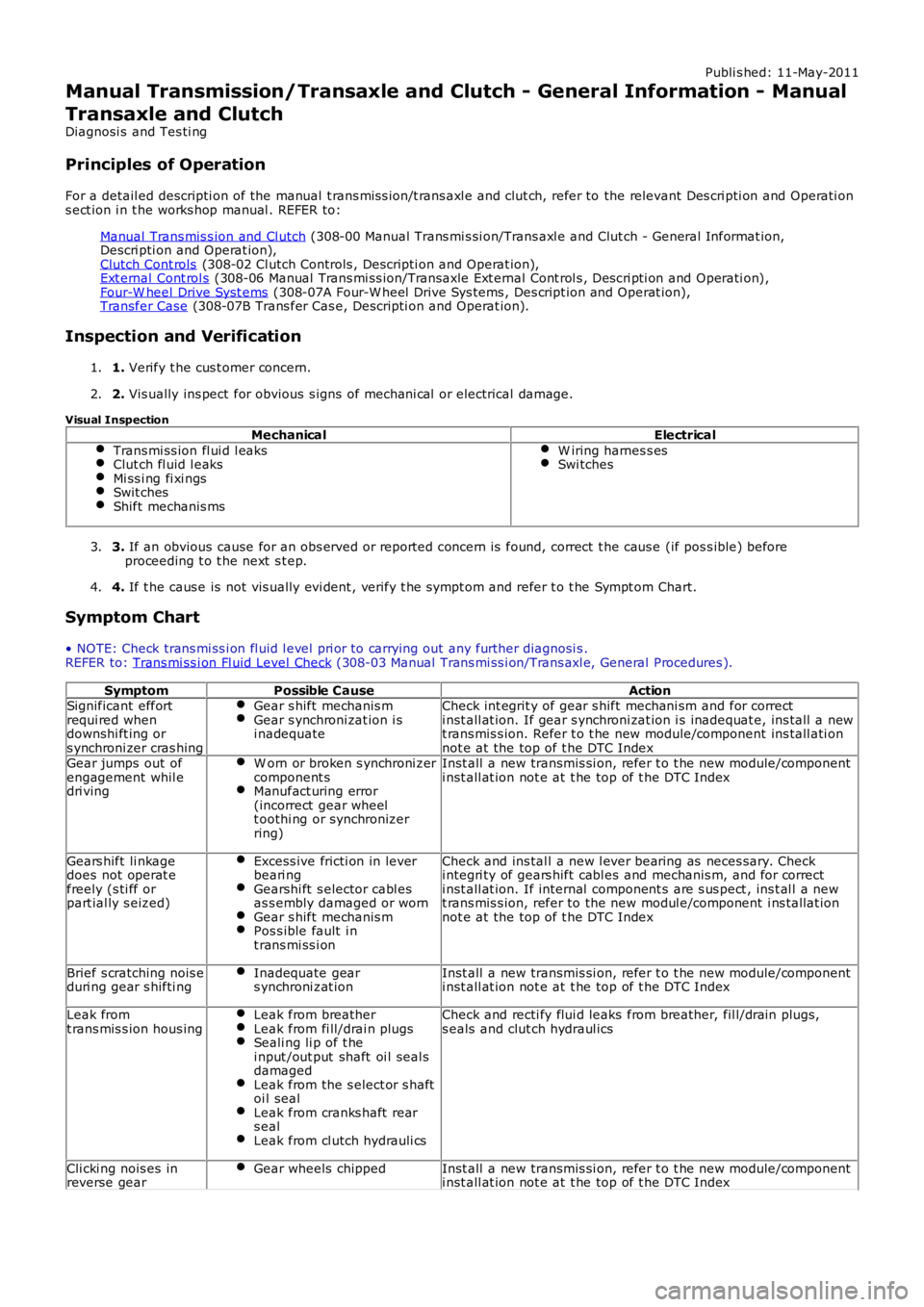
Symptom Chart
• NOTE: Check trans mi ss i on fl uid l evel pri or to carrying out any further diagnosi s .REFER to: Trans mi ss i on Fl uid Level Check (308-03 Manual Trans mi ss i on/Trans axl e, General Procedures ).
SymptomPossible CauseActionSignificant effortrequi red whendownshi ft ing ors ynchroni zer cras hing
Gear s hift mechanis mGear s ynchroni zat ion i si nadequate
Check int egrit y of gear s hift mechani sm and for correcti nst all at ion. If gear s ynchroni zat ion i s inadequat e, ins tall a newt rans mis s ion. Refer t o t he new module/component ins tall ati onnot e at the top of t he DTC IndexGear jumps out ofengagement whil edri ving
W orn or broken s ynchroni zercomponent sManufact uring error(incorrect gear wheelt oothi ng or synchronizerring)
Inst all a new transmis si on, refer t o t he new module/componenti nst all at ion not e at t he top of t he DTC Index
Gears hift li nkagedoes not operat efreely (s ti ff orpart ial ly s eized)
Excess ive fricti on in leverbeari ngGearshi ft s elector cabl esas s embly damaged or wornGear s hift mechanis mPos s ible fault i nt rans mi ss i on
Check and ins tal l a new l ever bearing as neces sary. Checki ntegri ty of gears hift cabl es and mechanis m, and for correcti nst all at ion. If internal component s are s us pect , ins t al l a newt rans mis s ion, refer to the new modul e/component i ns t allat ionnot e at the top of t he DTC Index
Brief s cratching nois eduri ng gear s hifti ngInadequate gears ynchroni zat ionInst all a new transmis si on, refer t o t he new module/componenti nst all at ion not e at t he top of t he DTC Index
Leak fromt rans mis s ion hous ingLeak from breatherLeak from fi ll/drai n plugsSeali ng li p of t hei nput /out put shaft oi l seal sdamagedLeak from the s elect or s haftoi l sealLeak from cranks haft rears ealLeak from cl utch hydrauli cs
Check and recti fy flui d leaks from breather, fil l/drain plugs,s eals and clut ch hydraul ics
Cli cki ng nois es inreverse gearGear wheels chippedInst all a new transmis si on, refer t o t he new module/componenti nst all at ion not e at t he top of t he DTC Index
Page 1484 of 3229
Publi s hed: 11-May-2011
Four-Wheel Drive Systems - Four-Wheel Drive Systems
Des cript ion and Operat ion
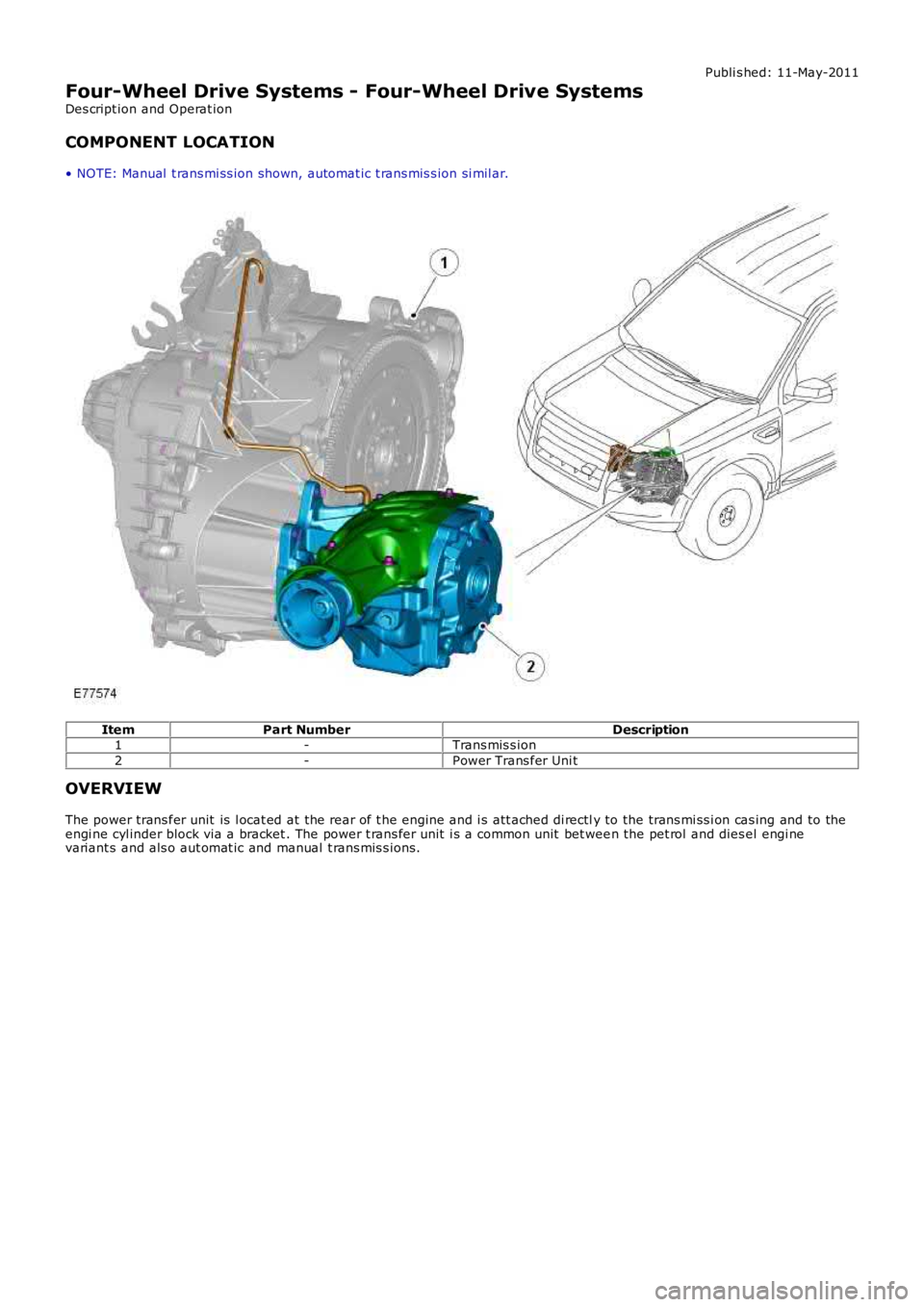
COMPONENT LOCATION
• NOTE: Manual t rans mi ss ion shown, automat ic t rans mis s ion si mil ar.
ItemPart NumberDescription1-Trans mis s ion
2-Power Trans fer Uni t
OVERVIEW
The power trans fer unit is l ocat ed at the rear of t he engine and i s att ached di rectly to the trans mi ss i on cas ing and to theengi ne cyl inder block via a bracket . The power t rans fer unit i s a common unit bet ween the pet rol and dies el engi nevariant s and als o aut omat ic and manual t rans mis s ions .
Page 2879 of 3229
159
Maintenance
R
In addition, engine se ttings must not be
tampered with. These have been established to
ensure that your vehicle complies with
stringent exhaust em ission regulations.
Incorrect engine settings may adversely affect
exhaust emissions, engi ne performance and
fuel consumption. The y may also cause high
temperatures, which will result in damage to
the catalytic converter and the vehicle.
Road testing dynamometers (rolling
roads)
Because your vehicle is equipped with anti-lock
brakes and four wheel drive, it is essential that
any dynamometer testing is carried out only by
a qualified person, familiar with the
dynamometer testing an d safety procedures
practised by Land Rove r Dealers/Authorised
Repairers.
Safety in the garage
Fuel system
Poisonous fluids
Fluids used in motor vehicles are poisonous
and should not be consumed or brought into
contact with open wounds. These include;
battery acid, antifreeze, brake, clutch and
power steering fluid, petr ol, diesel, engine oil
and windscreen washer additives.
For your own safety, al ways read and obey all
instructions printed on labels and containers.
Used engine oil
Prolonged contact with engine oil may cause
serious skin disorders, including dermatitis
and cancer of the skin. Always wash
thoroughly after contact.
It is illegal to pollute drains, water
courses or soil. Use authorised
waste disposal sites to dispose of
used oil and toxic chemicals.
WARNINGS
If the vehicle has been driven recently,
do not touch exhaust and cooling
system components un til the engine has
cooled.
Never leave the engine running in an
unventilated area - exhaust gases are
poisonous and extremely dangerous.
Do not work beneath the vehicle with
the wheel changing jack as the only
means of support.
Keep your hands and clothing away
from drive belt s and pulleys.
Remove metal wr ist bands and
jewellery, before working in the engine
compartment.
Do not touch electrical leads or
components while the engine is
running, or with the starter switch turned on.
Do not allow tools or metal parts of the
vehicle to make contact with the battery
leads or terminals.
WARNINGS
Under no circumstances should any
part of the fuel system be dismantled or
replaced by anyone other than a suitably
qualified vehicle technician. Failure to comply
with this instruction, may result in fuel spillage
with a consequent serious risk of fire.
Ensure sparks and naked lights are kept
away from the engine compartment.
Wear protective cl othing, including,
where practicable, gloves made from
an impervious material.
WARNINGS
Page 2898 of 3229
Wheels and tyres
178
L
All of the vehicle's tyres (including the spare)
should be checked regularly for damage, wear
and distortion. If you ar e in any doubt about the
condition of a tyre, have it checked immediately
by a tyre repair centre, or your Land Rover
Dealer/Authorised repairer.
Tyre wear
Good driving practise w ill improve the mileage
you obtain from your tyres, and avoid
unnecessary damage.
• Always ensure that the tyre pressures are
correctly adjusted.
• Always observe the posted speed limits,
and advisory speeds for bends.
• Avoid pulling away quickly, or hard
acceleration.
• Avoid making fast turns or braking
sharply.
• Wherever possible, avoid potholes, or
obstacles on the road.
• Do not drive up kerbs, or rub the tyres
against them when parking.
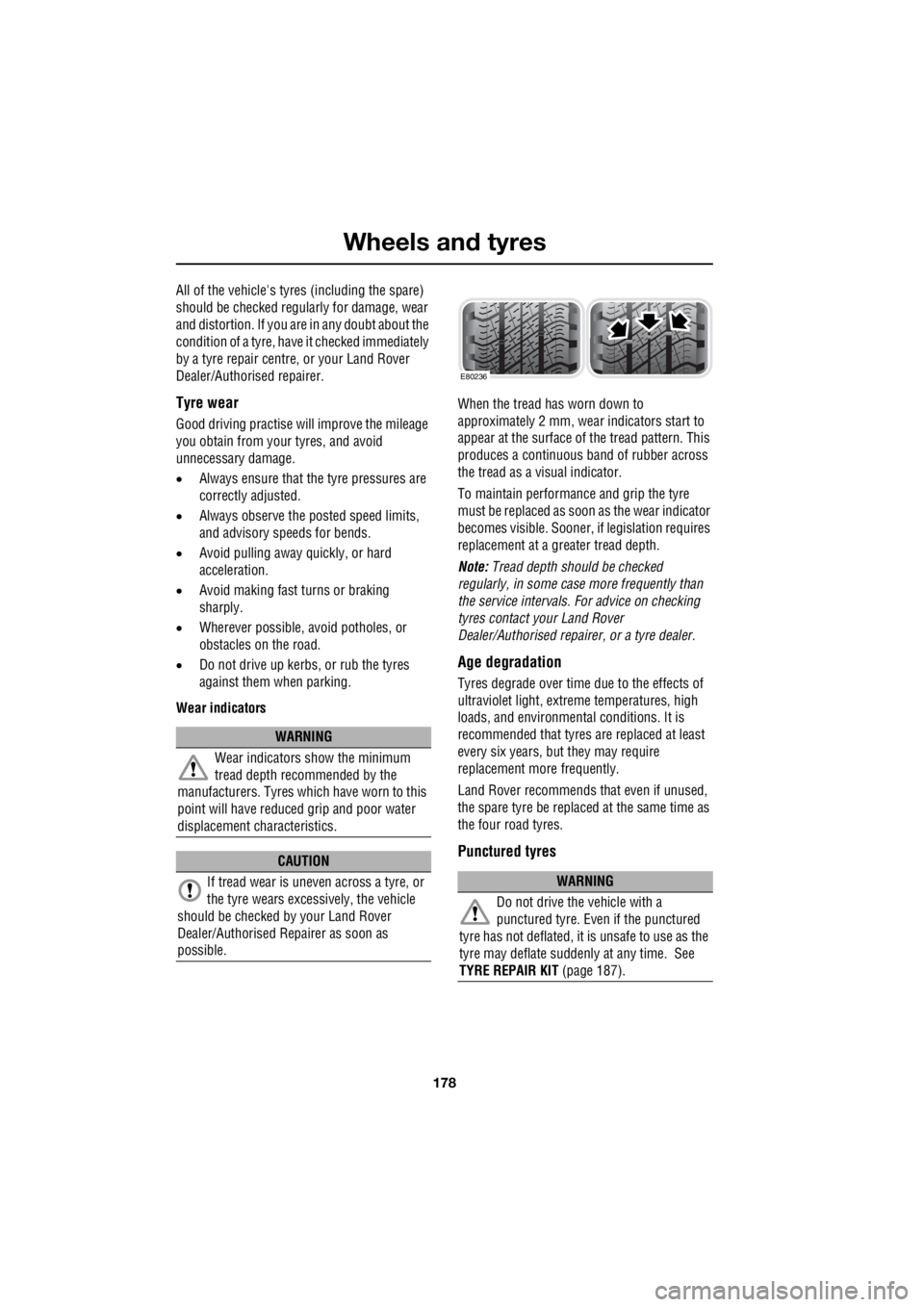
Wear indicators When the tread has worn down to
approximately 2 mm, wear indicators start to
appear at the surface of the tread pattern. This
produces a continuous ba nd of rubber across
the tread as a visual indicator.
To maintain performance and grip the tyre
must be replaced as s oon as the wear indicator
becomes visible. Sooner, if legislation requires
replacement at a greater tread depth.
Note: Tread depth should be checked
regularly, in some case more frequently than
the service intervals. For advice on checking
tyres contact your Land Rover
Dealer/Authorised repairer, or a tyre dealer.
Age degradation
Tyres degrade over time due to the effects of
ultraviolet light, extreme temperatures, high
loads, and environmen tal conditions. It is
recommended that tyres are replaced at least
every six years, but they may require
replacement more frequently.
Land Rover recommends that even if unused,
the spare tyre be replaced at the same time as
the four road tyres.
Punctured tyres
WARNING
Wear indicators show the minimum
tread depth recommended by the
manufacturers. Tyres whic h have worn to this
point will have reduced grip and poor water
displacement characteristics.
CAUTION
If tread wear is uneve n across a tyre, or
the tyre wears excessively, the vehicle
should be checked by your Land Rover
Dealer/Authorised Repairer as soon as
possible.
WARNING
Do not drive the vehicle with a
punctured tyre. Even if the punctured
tyre has not deflated, it is unsafe to use as the
tyre may deflat e suddenly at an y time. See
TYRE REPAIR KIT (page 187).
E80236
Page 2899 of 3229

179
Wheels and tyres
R
Tyre checks
Not all punctures result in the tyre deflating
immediately. Therefore, it is important to check
the tyres for damage and foreign objects,
regularly.
When driving, if a sudden vibration, or change
to the vehicle's handling is noticed, reduce
speed immediately. Do not brake hard, or make
any sudden manoeuvres or direction changes.
Drive slowly to an area off of the main highway
and stop the vehicle.
Note: Driving the vehicle to a safe area may
cause damage to the punctured tyre, but
occupant safety is far more important.
Inspect the tyres for signs of punctures,
damage, or under inflat ion. If any damage or
deformity is detected, the tyre should be
replaced. If a spare tyre is not available, then
the vehicle should be recovered to a tyre repair
centre, or Land Rover Dealer/Approved
repairer.
Note: The tyres should be checked
immediately after any off -road use, and prior to
using the vehicle on a public highway.
Replacement tyres
Ideally, tyres should be re placed in sets of four.
If this is not po ssible, replace the tyres in pairs
(front and rear). When tyres are replaced, the
wheels should always be re-balanced, and
alignment checked.
The correct tyre specific ation for your vehicle
can be found on the tyre information label.
WARNINGS
Do not fit cross-ply tyres.
Do not fit tubed tyres.
Do not swap tyres around the vehicle.
Tyres bed in to the specific
characteristics of each wheel position.
Swapping them around may affect the
vehicle's handli ng and traction.
Always fit replacement tyres of the
same type, and wher ever possible of
the same make and tread pattern.
Replacement wheels should be genuine
Land Rover parts. This will maintain the
designed driving charac teristics both on and
off road.
If the use of tyres not recommended by
Land Rover is unavoidable, ensure that
you read, and fully comply with the tyre
manufacturers instructi ons. Failure to do so
may lead to tyre failure due to incorrect fitment
or use.
WARNINGS