airbag LAND ROVER FRELANDER 2 2006 Owner's Manual
[x] Cancel search | Manufacturer: LAND ROVER, Model Year: 2006, Model line: FRELANDER 2, Model: LAND ROVER FRELANDER 2 2006Pages: 3229, PDF Size: 78.5 MB
Page 2756 of 3229
Introduction
36
L
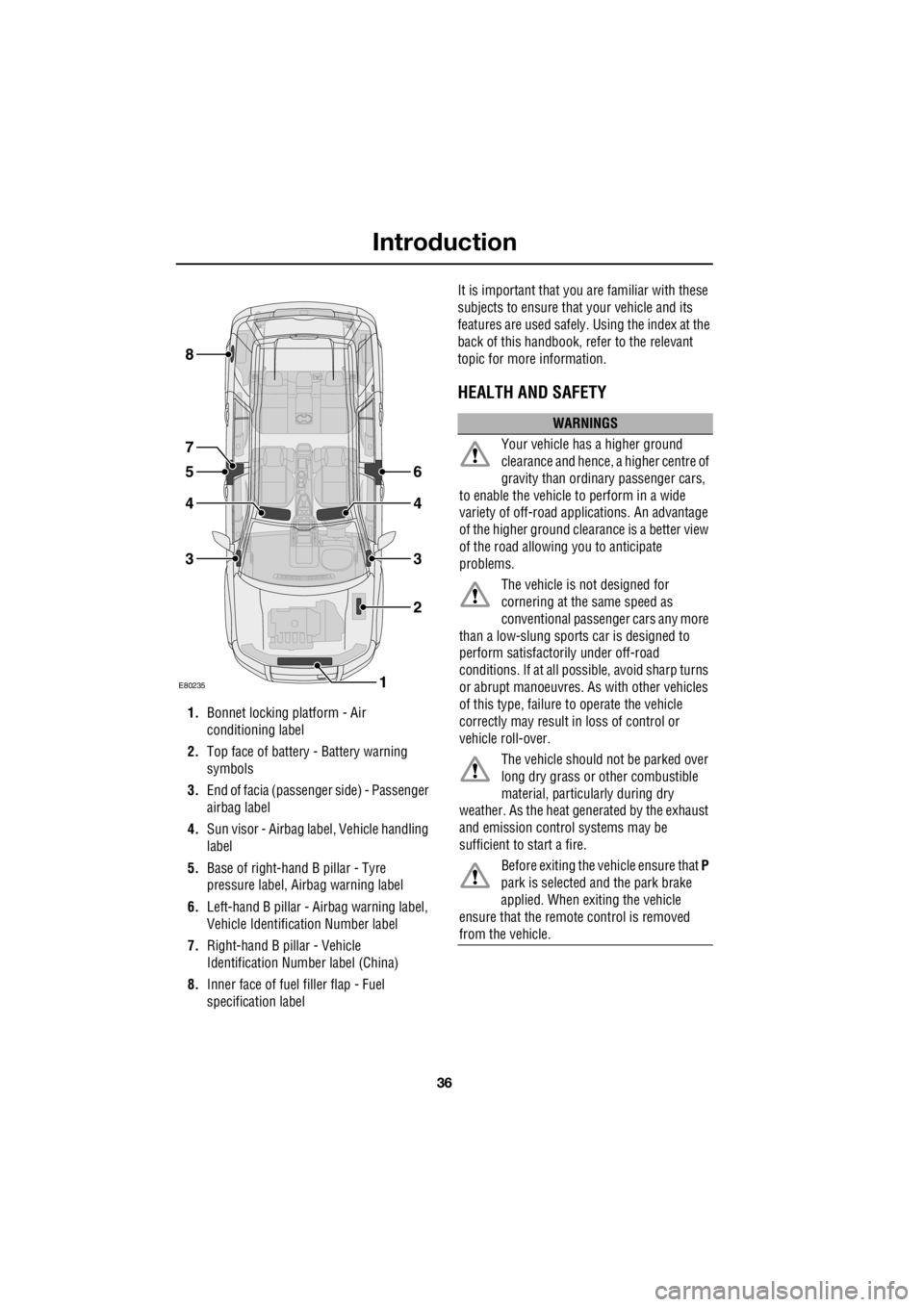
1. Bonnet locking platform - Air
conditioning label
2. Top face of battery - Battery warning
symbols
3. End of facia (passenger side) - Passenger
airbag label
4. Sun visor - Airbag label, Vehicle handling
label
5. Base of right-hand B pillar - Tyre
pressure label, Ai rbag warning label
6. Left-hand B pillar - Airbag warning label,
Vehicle Identification Number label
7. Right-hand B pillar - Vehicle
Identification Number label (China)
8. Inner face of fuel filler flap - Fuel
specification label It is important that you are familiar with these
subjects to ensure that your vehicle and its
features are used safely. Using the index at the
back of this handbook, re fer to the relevant
topic for more information.
HEALTH AND SAFETY
E80235
6
4
3
2
1
5
4
3
8
7
WARNINGS
Your vehicle has a higher ground
clearance and hence, a higher centre of
gravity than ordina ry passenger cars,
to enable the vehicle to perform in a wide
variety of off-road app lications. An advantage
of the higher ground clea rance is a better view
of the road allowing you to anticipate
problems.
The vehicle is not designed for
cornering at the same speed as
conventional passenge r cars any more
than a low-slung sports car is designed to
perform satisfactori ly under off-road
conditions. If at all possible, avoid sharp turns
or abrupt manoeuvres. As with other vehicles
of this type, failure to operate the vehicle
correctly may result in loss of control or
vehicle roll-over.
The vehicle should no t be parked over
long dry grass or other combustible
material, particul arly during dry
weather. As the heat ge nerated by the exhaust
and emission control systems may be
sufficient to start a fire.
Before exiting the vehicle ensure that P
park is selected and the park brake
applied. When exiting the vehicle
ensure that the remote control is removed
from the vehicle.
Page 2759 of 3229
39
Introduction
R
Airbag system
To prevent malfunction of the airbag system
always consult a Land Rover Dealer/
Authorised Repairer before fitting any of the
following:
• Electronic equipment such as a mobile
phone, two-way radio or in-car
entertainment system.
• Accessories attached to the front of the
vehicle.
• Any modification to the front of the vehicle.
• Any modification involving the removal or
repair of any wiring or component in the
vicinity of any of the airbag system
components, including the steering wheel,
steering column, instrument or facia
panels.
• Any modification to th e facia panels or
steering wheel.
After-sales service
The After Sales Parts service is of paramount
importance, both in th e UK and across the
world. In the UK there are over 100 authorised
Land Rover Dealers/Authorised Repairers, all
computer linked for rapid ordering of parts and
accessories.
In addition, with franch ised representation in
over 100 countries worldwide, Land Rover are
able to support your vehicle wherever you go.
Travelling abroad
In certain countries, it is a legal requirement to
fit parts made to the vehicle manufacturers'
specification.
Owners should ensure that any parts or
accessories fitted to the vehicle while travelling
abroad will also conform to the legal
requirements of their own country when they
return home.
WARNING
The components that make up the
airbag system are sensitive to
electrical or physical interference,
either of which coul d easily damage the
system and cause inadvertent operation or a
malfunction of th e airbag module.
E84193
Page 2767 of 3229
47
Seats
R
SeatsSITTING IN THE CORRECT POSITION
The seat, head restraint, seat belt and airbags,
all contribute to the protection of the user.
Correct use of these components will give you
greater protection, therefore you should
observe the following points:
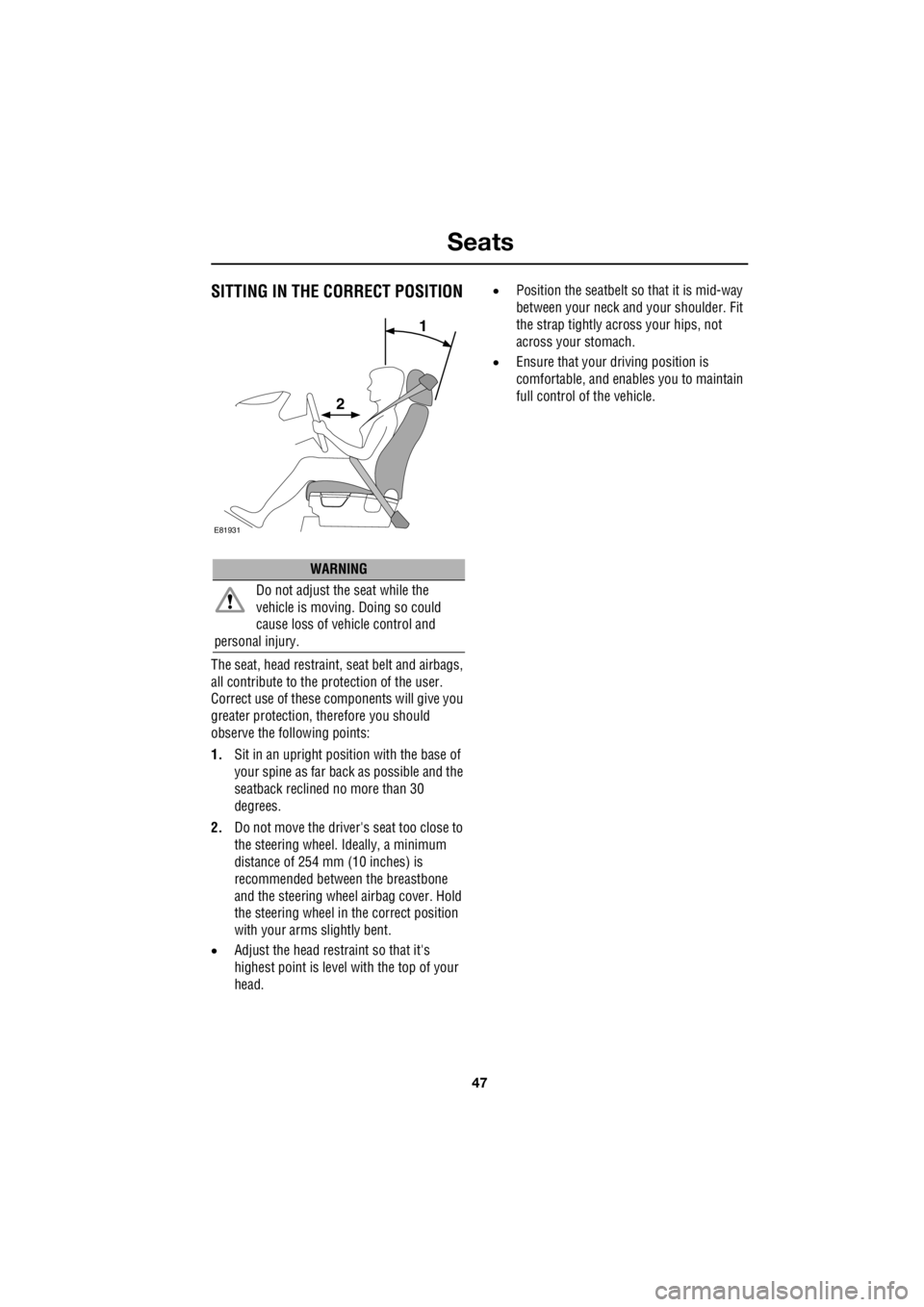
1. Sit in an upright position with the base of
your spine as far back as possible and the
seatback reclined no more than 30
degrees.
2. Do not move the driver's seat too close to
the steering wheel. Ideally, a minimum
distance of 254 mm (10 inches) is
recommended betwee n the breastbone
and the steering wheel airbag cover. Hold
the steering wheel in the correct position
with your arms slightly bent.
• Adjust the head restraint so that it's
highest point is level with the top of your
head. •
Position the seatbelt so that it is mid-way
between your neck an d your shoulder. Fit
the strap tightly across your hips, not
across your stomach.
• Ensure that your driving position is
comfortable, and enab les you to maintain
full control of the vehicle.
WARNING
Do not adjust the seat while the
vehicle is moving. Doing so could
cause loss of vehicle control and
personal injury.
1
E81931
2
Page 2778 of 3229

Supplementary restraints system
58
L
Supplementary restraints systemPRINCIPLE OF OPERATION
Introduction
In the event of a collision the airbag control unit
monitors the rate of de celeration caused by the
collision. This information is then used to
determine whether airbags should be
deployed.
Airbag deployment is de pendent on the rate at
which the passenger compartment changes
speed following the collision. The
circumstances affecting different collisions
(vehicle speed, angle of impact, type and size
of object hit, etc) vary considerably, and will
affect the rate of de celeration accordingly.
The Supplementary Restraint System (SRS)
components include :-
• SRS warning indicator.
• Rotary coupler.
• Airbag modules.
• Seat belt pr e-tensioners.
• Airbag diagnostic control unit.
• Crash sensors.
• Airbag wiring harnesses.
• Seat occupancy sensor.
Note: The SRS is not designe d to operate as a
result of:
• Rear impacts.
• Minor front impacts.
• Minor side impacts.
• Heavy braking.
• Driving over bumps and pot holes.
Therefore, it follows that considerable
superficial damage to the vehicle can occur
without causing the airbags to deploy.
Page 2779 of 3229
59
Supplementary restraints system
R
Airbags
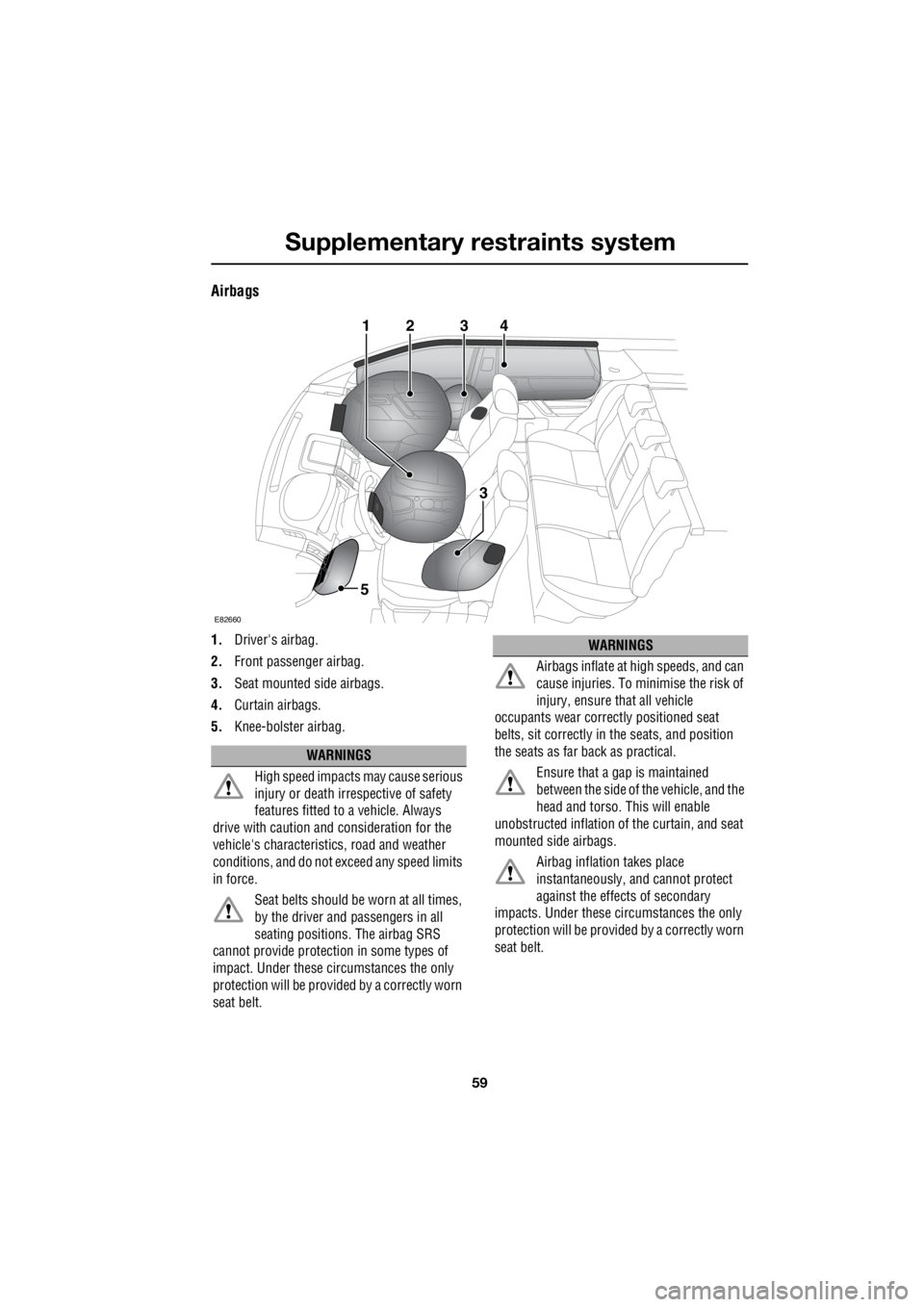
1. Driver's airbag.
2. Front passenger airbag.
3. Seat mounted side airbags.
4. Curtain airbags.
5. Knee-bolster airbag.
E82660
34
3
5
21
WARNINGS
High speed impacts may cause serious
injury or death irre spective of safety
features fitted to a vehicle. Always
drive with caution and consideration for the
vehicle's characteristics, road and weather
conditions, and do not exceed any speed limits
in force.
Seat belts should be worn at all times,
by the driver and passengers in all
seating positions. The airbag SRS
cannot provide protection in some types of
impact. Under these circumstances the only
protection will be provided by a correctly worn
seat belt.
Airbags inflate at high speeds, and can
cause injuries. To minimise the risk of
injury, ensure that all vehicle
occupants wear correct ly positioned seat
belts, sit correctly in the seats, and position
the seats as far back as practical.
Ensure that a gap is maintained
between the side of the vehicle, and the
head and torso. This will enable
unobstructed inflation of the curtain, and seat
mounted side airbags.
Airbag inflation takes place
instantaneously, a nd cannot protect
against the effects of secondary
impacts. Under these circumstances the only
protection will be provided by a correctly worn
seat belt.
WARNINGS
Page 2780 of 3229

Supplementary restraints system
60
L
Note: The location points of airbags fitted to
the vehicle are marked by the word AIRBAG
embossed into the trim.
Always contact your Land Rover
Dealer/Authorised repairer if :-
• An airbag inflates.
• The front or sides of the vehicle are
damaged.
• Any part of the SRS shows signs of
cracking or damage, including trim
covering airbags.
Airbag operation
Airbags cannot deploy co rrectly if they are
obstructed. Examples of obstructions are :-
• Any part of an occupa nts body in contact
with, or close to, an airbag cover. •
Objects placed on, or close to, an airbag
cover.
• Clothing, sun screens, or other material
hanging from grab handles.
• Clothing, cushions, or other material,
covering seat mounted airbags.
• Seat covers which are not approved by
Land Rover, or specifically designed for
use with seat mounted airbags.
This list is not exhaustive, and it remains the
responsibility of the driv er and passengers to
ensure that the airbags are not obstructed in
any way.
Deployment and deflation
In the event of a collision the airbag control
system monitors the ra te, and direction of
deceleration. If required to supplement the seat
belts, airbags will be deployed as appropriate.
Front airbags
The front passenger's, and driver's airbags are
able to deploy in two stages depending on the
severity of the frontal impact. In a severe
impact the airbags inflate fully to offer
maximum protection. In a lesser impact full
deployment is not require d, so the airbags are
partially inflated.
Side and curtain airbags
Side and curtain airbag s are designed to offer
increased protection for the torso and head in
a side impact. The curtain airbags deflate at a
slower rate than the front, or side airbags to
afford greater protection from serious head
injuries.
Phone systems should only be
installed by qualified persons familiar
with the operation of, and
requirements for, vehicles fitted with SRS. If
you are in any doubt, seek advice from your
Land Rover Dealer/Authorised repairer.
WARNINGS
For the airbags to operate correctly the
roof lining and door post trims must
be in good condition, correctly fitted,
and free from obstructi on. Any damage, wear,
or incorrect fitment shoul d be referred to your
Land Rover Dealer/Aut horised repairer as
soon as possible for ex amination and repair.
Do not allow passe ngers to obstruct
the operation of the airbags by placing
any part of their person, or any
objects, in contact with, or close to, an airbag
module. Airbags deploy at very high speeds,
and can cause serious inju ry or death if objects
or occupants are within the area of
deployment.
WARNINGS
Page 2781 of 3229

61
Supplementary restraints system
R
Airbag deployment effectsAIRBAG WARNING LAMP
The airbag warning indicator is
mounted in the instrument pack,
and will illuminate as a bulb check
when the ignition is turned on.
If any of the following warning indicator
conditions occur, the vehicle should be
checked by your Land Ro ver Dealer/Authorised
repairer immediately.
• The warning indicator fails to illuminate
when the ignition is turned on.
• The warning indicator fails to extinguish
within six seconds of the ignition being
turned on.
• The warning indicator illuminates at any
time other than the bulb check, when the
ignition is turned on.WARNINGS
When an airbag inflates a fine powder
is released. This is normal, and not an
indication of a malf unction. However,
the powder may cause irritation to the skin,
and should be throughly flushed from eyes,
and any cuts or abrasions.
After inflation some airbag
components are at high temperatures.
To prevent injury, do no touch the
airbag components until they have cooled.
In order to react with sufficient speed,
airbags are deployed by an explosive
charge. Consequently airbag
deployment is accompan ied by a very loud
noise which may cause discomfort and
temporary loss of hearing.
WARNING
If the warning indicator signals that a
fault is present in the system, do not
use a child restraint on the front
passenger seat. Doing so will increase the risk
of death or serious injury to the child.
Page 2782 of 3229
Supplementary restraints system
62
L
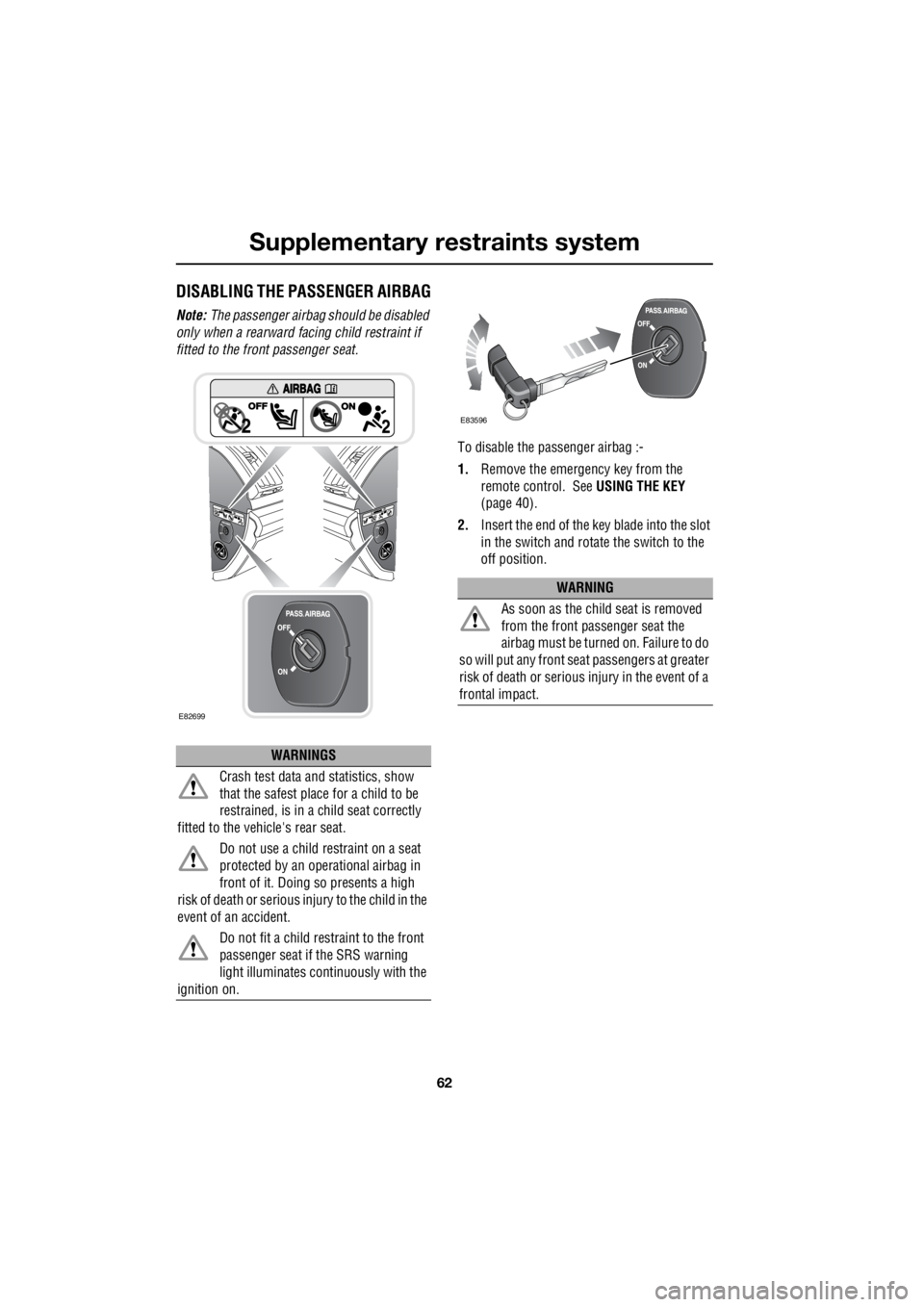
DISABLING THE PASSENGER AIRBAG
Note: The passenger airbag should be disabled
only when a rearward fa cing child restraint if
fitted to the front passenger seat.
To disable the passenger airbag :-
1. Remove the emergency key from the
remote control. See USING THE KEY
(page 40).
2. Insert the end of the key blade into the slot
in the switch and rotate the switch to the
off position.
WARNINGS
Crash test data and statistics, show
that the safest place for a child to be
restrained, is in a child seat correctly
fitted to the vehicle's rear seat.
Do not use a child restraint on a seat
protected by an ope rational airbag in
front of it. Doing so presents a high
risk of death or serious injury to the child in the
event of an accident.
Do not fit a child restraint to the front
passenger seat if the SRS warning
light illuminates co ntinuously with the
ignition on.
E82699
WARNING
As soon as the child seat is removed
from the front passenger seat the
airbag must be turned on. Failure to do
so will put any front seat passengers at greater
risk of death or serious injury in the event of a
frontal impact.
E83596
Page 2783 of 3229
63
Supplementary restraints system
R
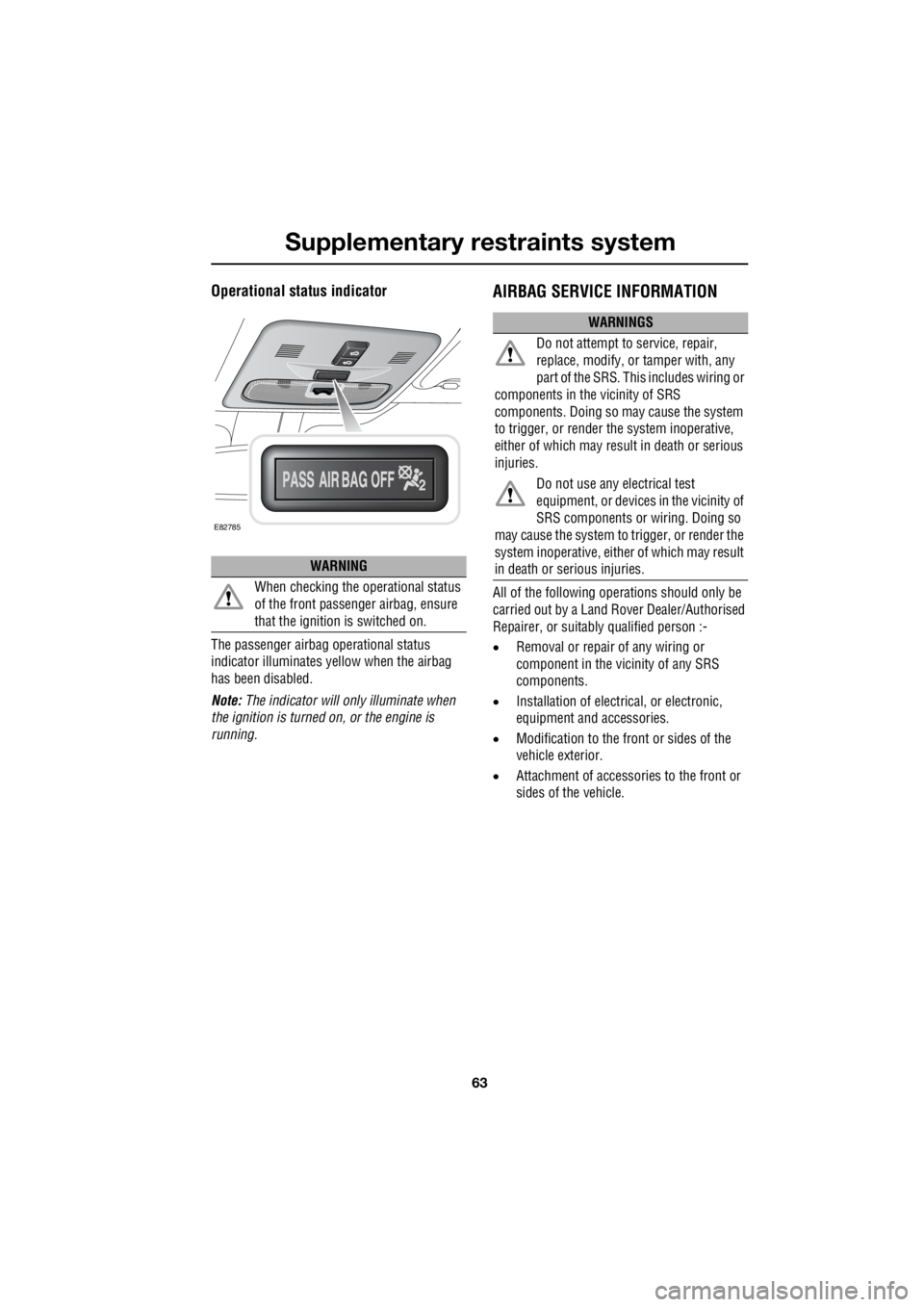
Operational status indicator
The passenger airbag operational status
indicator illuminates yellow when the airbag
has been disabled.
Note: The indicator will on ly illuminate when
the ignition is turned on, or the engine is
running.
AIRBAG SERVICE INFORMATION
All of the following opera tions should only be
carried out by a Land Rover Dealer/Authorised
Repairer, or suitably qualified person :-
• Removal or repair of any wiring or
component in the vicinity of any SRS
components.
• Installation of electr ical, or electronic,
equipment and accessories.
• Modification to the front or sides of the
vehicle exterior.
• Attachment of accessor ies to the front or
sides of the vehicle.
WARNING
When checking the operational status
of the front passenger airbag, ensure
that the ignition is switched on.
E82785
WARNINGS
Do not attempt to service, repair,
replace, modify, or tamper with, any
part of the SRS. Thi s includes wiring or
components in the vicinity of SRS
components. Doing so may cause the system
to trigger, or render the system inoperative,
either of which may resu lt in death or serious
injuries.
Do not use any electrical test
equipment, or devices in the vicinity of
SRS components or wiring. Doing so
may cause the system to trigger, or render the
system inoperative , either of which may result
in death or serious injuries.
Page 2784 of 3229
Child safety
64
L
Child safetyCHILD SEATS
It is very important for all infants and children
under 12 years of age to be restrained in a
suitable child safety seat appropriate to their
age and size. If it is essential that a child travels in the front
passenger seat, Land Ro ver recommends that
the following preparations are made before
fitting the child restraint.
• Disable the front pass enger airbag. See
DISABLING THE PASSENGER AIRBAG
(page 62).
• Adjust the front passenger seat fully
rearwards.
• Adjust the lumbar support to its minimum
support position.
• Adjust the seat cushion to its highest
position. If cushion rake adjustment is
possible, adjust it to its lowest position.
• Adjust the seat be lt adjustable upper
anchorage to its lowest position.
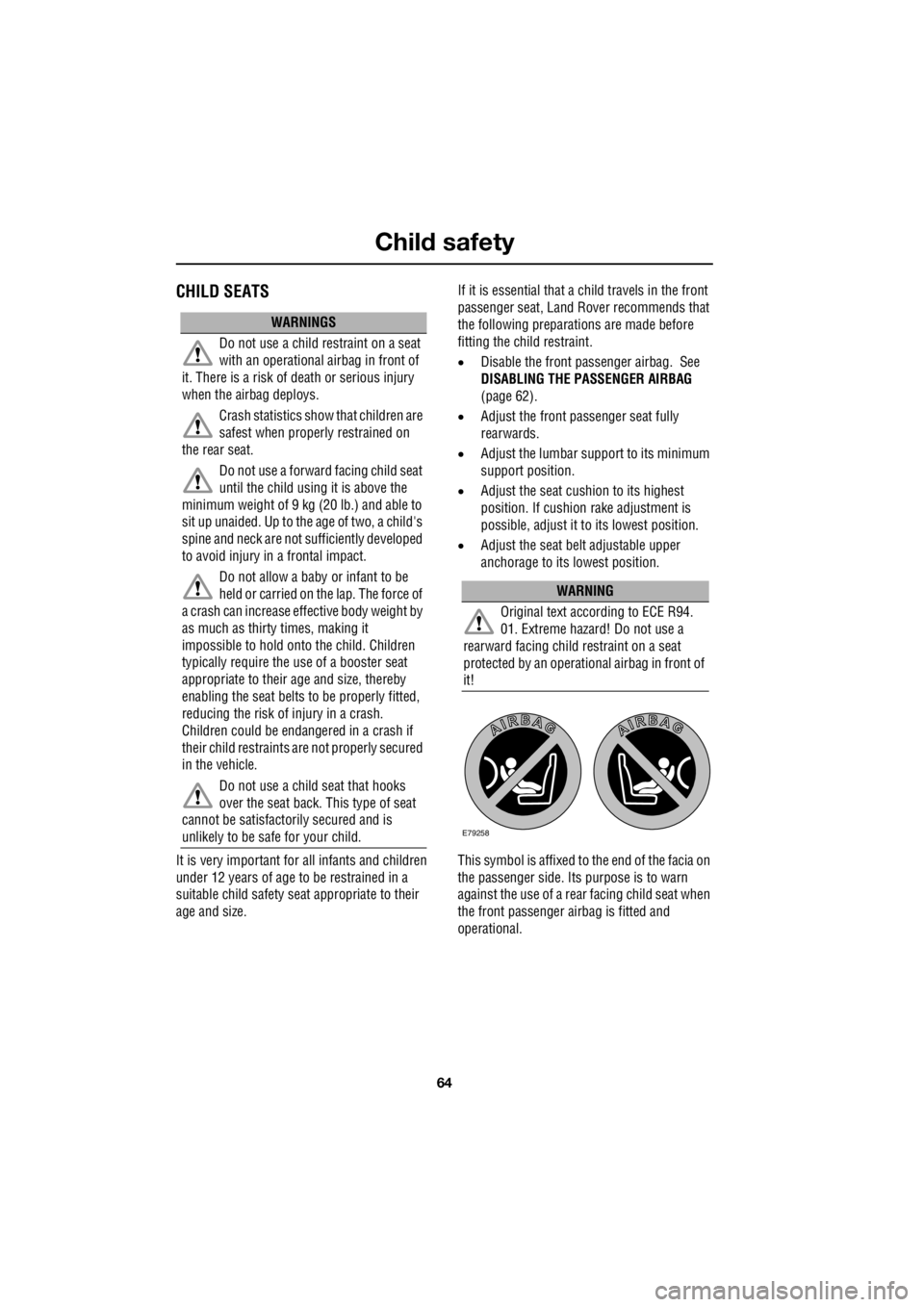
This symbol is affixed to the end of the facia on
the passenger side. Its purpose is to warn
against the use of a rear facing child seat when
the front passenger ai rbag is fitted and
operational.
WARNINGS
Do not use a child restraint on a seat
with an operational airbag in front of
it. There is a risk of death or serious injury
when the airbag deploys.
Crash statistics show that children are
safest when properly restrained on
the rear seat.
Do not use a forward facing child seat
until the child using it is above the
minimum weight of 9 kg (20 lb.) and able to
sit up unaided. Up to the age of two, a child's
spine and neck are not sufficiently developed
to avoid injury in a frontal impact.
Do not allow a baby or infant to be
held or carried on the lap. The force of
a crash can increase effective body weight by
as much as thirty times, making it
impossible to hold onto the child. Children
typically require the use of a booster seat
appropriate to their age and size, thereby
enabling the seat belts to be properly fitted,
reducing the risk of injury in a crash.
Children could be enda ngered in a crash if
their child restraints are not properly secured
in the vehicle.
Do not use a child seat that hooks
over the seat back. This type of seat
cannot be satisfactorily secured and is
unlikely to be safe for your child.
WARNING
Original text according to ECE R94.
01. Extreme hazard! Do not use a
rearward facing child restraint on a seat
protected by an operational airbag in front of
it!
E79258