brake fluid LAND ROVER FRELANDER 2 2006 Repair Manual
[x] Cancel search | Manufacturer: LAND ROVER, Model Year: 2006, Model line: FRELANDER 2, Model: LAND ROVER FRELANDER 2 2006Pages: 3229, PDF Size: 78.5 MB
Page 19 of 3229
CAUTION: Service t ools have been devel oped for ins tal ling the majori ty of beari ngs ; t hese must al ways be usedwhere specified.
In the cas e of greas e l ubricated beari ngs , fil l t he s pace bet ween t he bearing and out er s eal wit h t he recommendedgrade of greas e before ins t al li ng the seal.
CAUTION: W hen a waxed oil s eal (ins tal led dry) t ype of oil s eal i s to be ins t al led, take great care that greas e doesnot cont aminate the runni ng s urface of t he s eal .
Always make s uit able reference marks bet ween t he components of s eparable bearings e.g. t aper roller beari ngswhen dis as sembl ing t o make s ure correct locati on of components when as s embli ng. Never ins tall new roll ers i n anouter ring, al ways ins tal l a new beari ng ass embly.
Brake Pads and Linings
Always i ns t all t he correct grade and s peci fi cat ion of brake pads and li nings . W hen repl acing thes e it ems , always repl ace ascomplete axl e s ets .
Brake Hydraulics
Always obs erve t he fol lowing recommendat ions when worki ng on t he braking s ys tem:
W ARNING: Do not int ermi x brake fluid of di fferent specificati ons .
Always us e t wo s panners when loos eni ng or ti ght ening brake pi pes or hos e connect ions.Make s ure t hat hos es run in a natural curve and are not kinked or twi st ed.Ins t all brake pipes and hos es s ecurel y in their retaini ng clips and make sure t hat they cannot cont act a pot enti alchafing point .Containers used for brake fluid must be kept abs ol utel y cl ean.Do not s tore brake fluid in uns ealed containers, t he fluid will abs orb wat er which wi ll lower t he boili ng point of thefl uid.Do not all ow brake flui d to be cont aminat ed wit h ot her fluids such as mi neral oil and do not put brake fl uid i n acont ainer which has previous ly been us ed for s t oring ot her fl ui ds.Do not reus e brake flui d which has been bled from t he s ys t em.Always us e brake flui d or a s uit abl e brake cleaning flui d t o clean hydraulic component s .Unles s s tat ed otherwis e, us e onl y clean brake fluid to lubri cat e hydraulic seals and components .Always i ns t all blanking plugs t o hos es, pi pes or component s immediatel y aft er dis connect ion.Check t hread compati bili ty of origi nal equipment wit h repl acement component s.Obs erve absol ute cl eanli ness when working wi th hydraul ic component s .
Pipes and Hoses
W hen removing or ins t al li ng fl exi ble hydrauli c pipes and hoses , make s ure that t he foll owing procedures are observed tomake s ure component servi ceabil it y:
Pri or to removal , clean area around hos e or pipe end which is to be dis connect ed.Obtai n appropri at e bl anking pl ugs or caps before dis connecti ng hose or pi pe end fi ttings i n order t hat connect ionscan be plugged immedi atel y fol lowing di sconnect ion.Always i ns t all blanking plugs or caps to pipes and unions immedi atel y fol lowing di sconnect ion.Clean hos e or pipe and bl ow t hrough wit h an ai r line.
W ARNING: Sui table eye protecti on mus t be worn.
Check hos es external ly for cracks , separat ion of pl ies , securi ty of end fit ti ngs and ext ernal damage; repl ace fault yhoses .Check pi pes for s igns of corros ion and chafi ng, replace as neces s ary.
CAUTION: If pipes are found to be chafed, rect ify cli ps, mount ing point s etc., to prevent furt her probl ems in service.
W hen i nst all ing hos es , make s ure that no unneces s ary bends are i ntroduced and t hat hos es are not ki nked, twi s tedor pos i ti oned cl os e t o pot ent ial chafing poi nt s .W hen i nst all ing pipes , make s ure t hat pipes are pos it ioned and cli pped cl ear of potent ial chafing point s .Always repl ace seali ng was hers i ns t alled to banjo bol ts , s ealing pl ugs etc.Always us e a backing s panner when t ightening uni ons and do not overt ight en union nuts or banjo bol ts .Aft er any work on hydraul ic s yst ems , always check for flui d leaks whil s t a s econd operat or appli es worki ng pres suret o the brake pedal or operates t he s yst em that has been worked on.
Fuel s ys tem hos es
Page 31 of 3229
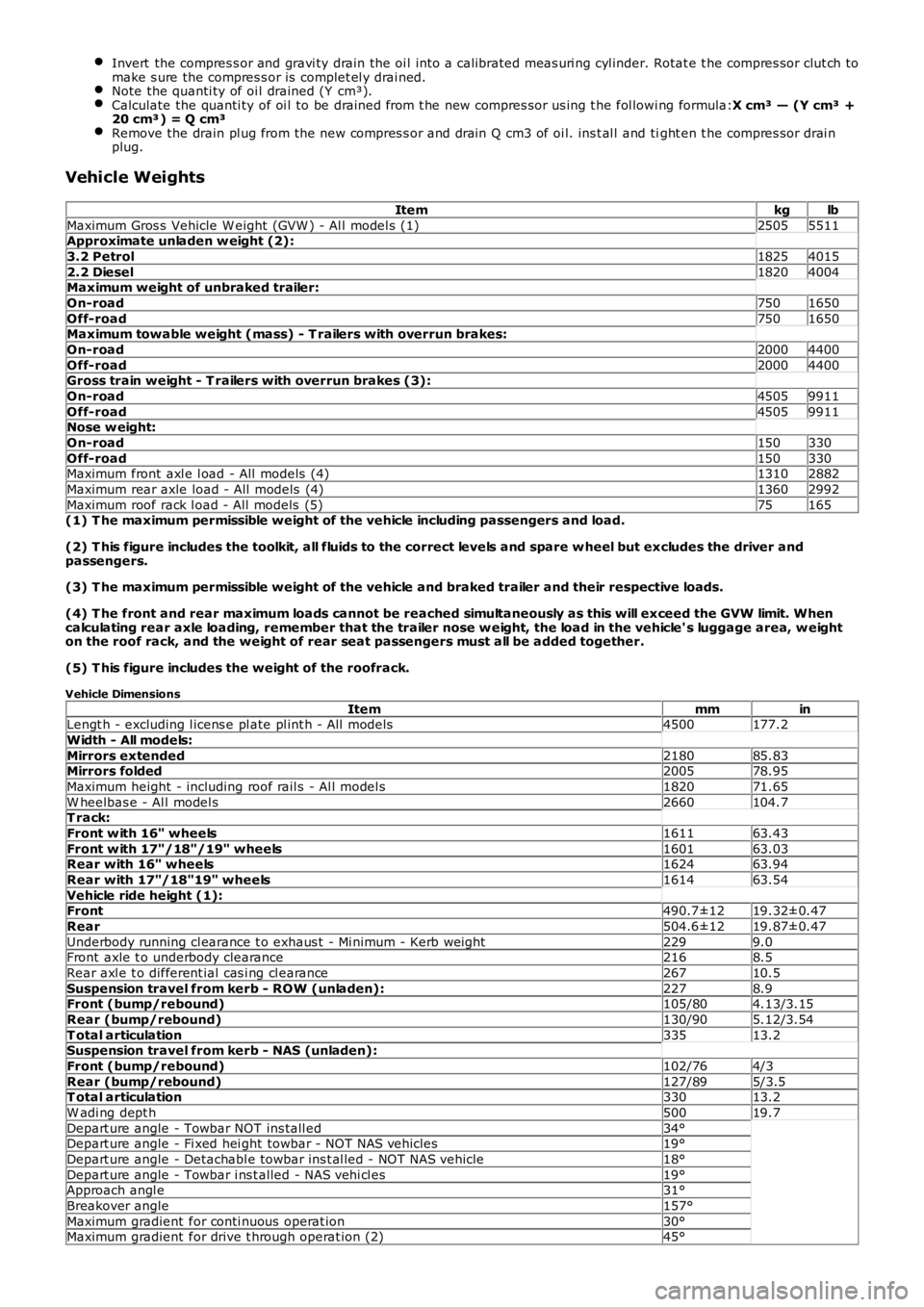
Invert the compres s or and gravi ty drain the oi l into a calibrated meas uri ng cyl inder. Rotat e t he compres sor clut ch tomake s ure the compres s or is complet el y drai ned.Note the quanti ty of oi l drained (Y cm³).Calculate the quanti ty of oi l to be drained from t he new compres sor us ing t he fol lowi ng formula:X cm³ — (Y cm³ +20 cm³) = Q cm³Remove the drain pl ug from the new compres s or and drain Q cm3 of oi l. ins t al l and tight en t he compres sor drai nplug.
Vehicle Weights
Itemkglb
Maximum Gros s Vehicle W eight (GVW ) - Al l model s (1)25055511Approximate unladen w eight (2):
3.2 Petrol18254015
2.2 Diesel18204004Maximum weight of unbraked trailer:
On-road7501650
Off-road7501650Maximum towable weight (mass) - T railers with overrun brakes:
On-road20004400
Off-road20004400Gross train weight - T railers with overrun brakes (3):
On-road45059911
Off-road45059911Nose w eight:
On-road150330
Off-road150330Maximum front axl e l oad - All models (4)13102882
Maximum rear axle load - All models (4)13602992
Maximum roof rack l oad - All models (5)75165(1) T he maximum permissible weight of the vehicle including passengers and load.
(2) T his figure includes the toolkit, all fluids to the correct levels and spare w heel but excludes the driver andpassengers.
(3) T he maximum permissible weight of the vehicle and braked trailer and their respective loads.
(4) T he front and rear maximum loads cannot be reached simultaneously as this will exceed the GVW limit. Whencalculating rear axle loading, remember that the trailer nose w eight, the load in the vehicle' s luggage area, w eighton the roof rack, and the weight of rear seat passengers must all be added together.
(5) T his figure includes the weight of the roofrack.
Vehicle Dimensions
ItemmminLengt h - excluding l icens e pl ate pl int h - All models4500177.2
Width - All models:
Mirrors extended218085.83Mirrors folded200578.95
Maximum height - including roof rail s - Al l model s182071.65
W heelbas e - Al l model s2660104.7T rack:
Front w ith 16" wheels161163.43
Front w ith 17"/18"/19" wheels160163.03Rear with 16" wheels162463.94
Rear with 17"/18"19" wheels161463.54
Vehicle ride height (1):Front490.7±1219.32±0.47
Rear504.6±1219.87±0.47
Underbody running cl earance t o exhaus t - Mi nimum - Kerb wei ght2299.0Front axle t o underbody clearance2168.5
Rear axl e t o different ial cas i ng cl earance26710.5
Suspension travel from kerb - ROW (unladen):2278.9Front (bump/rebound)105/804.13/3.15
Rear (bump/rebound)130/905.12/3.54
T otal articulation33513.2Suspension travel from kerb - NAS (unladen):
Front (bump/rebound)102/764/3
Rear (bump/rebound)127/895/3.5T otal articulation33013.2
W adi ng dept h50019.7
Depart ure angle - Towbar NOT ins tall ed34°Depart ure angle - Fi xed hei ght towbar - NOT NAS vehicles19°
Depart ure angle - Detachabl e towbar ins t al led - NOT NAS vehicle18°
Depart ure angle - Towbar i ns t alled - NAS vehi cl es19°Approach angl e31°
Breakover angle157°
Maximum gradient for conti nuous operat ion30°Maximum gradient for drive t hrough operat ion (2)45°
Page 35 of 3229
Any s praying s houl d preferably be carri ed out in venti lat ed boot hs which i ncorporat e faci li ti es for removi ng vapors ands pray dropl et s from the breathing zone.
W ear appropri at e gl oves , eye and res pirat ory protecti on.
Antifreeze
May be flammabl e when undilut ed.
Vapors may be gi ven off from coolant anti freeze when heat ed. Avoid breathi ng thes e vapors .
Anti freeze may be absorbed through t he s kin i n t oxi c or harmful quanti ti es. Ant ifreeze, i f s wal lowed, can be fat al; SEEKIMMEDIAT E MEDICAL AT T ENT ION.
Battery Acids
See als o Al kal is and Acids .
Gas es releas ed duri ng bat t ery charging are expl osi ve. Al ways remove t he batt ery from t he vehi cl e pri or to chargi ng. Neverus e naked flames or al low s parks near charging or recentl y charged bat t eries . NEVER add aci d t o a bat tery, t he chemicalreacti on produced wil l be vi olent and expl os i ve. In cases of eye contact, was h affected area wit h copious amount s of wat erand SEEK IMMEDIAT E MEDICAL AT T ENT ION.
Make s ure t here i s adequat e vent il ati on during bat tery charging, obs erve NO SMOKING POLICY .
Brake Pads and Linings
Always fit t he correct grade and s peci fi cat ion of brake pads and l inings . W hen renewi ng pads and lini ngs , always repl aceas complete axl e s ets .
Brake and Clutch Fluid
Splas hes to t he s kin and eyes are irri tat ing and i n t he long t erm can be damagi ng, avoid prolonged s ki n cont act. In casesof eye cont act , wash affect ed area wi th copious amount s of water and SEEK IMMEDIATE MEDICAL ATTENTION.
Chemical Materials
All chemical materials should al ways be used wit h caut ion and st ored and handled wi th care. They may be toxic, harmful,corros ive, irri tant or highly fl ammable and gi ve ri se to hazardous fumes and dus t s.
The effect s of exces s ive expos ure to chemi cal s may be i mmediat e or delayed; briefl y experienced or permanent ;cumulati ve; s uperficial; life t hreatening; or may reduce l ife expect ancy.
Chemical Materials - Do's
Do careful ly read and observe hazard and precaut ion warnings given on material cont ai ners (labels ) and in anyaccompanyi ng leaflets , pos ters or ot her ins truct ions . Material heal th and safet y data s heet s can be obtained frommanufacturers .Do remove chemi cal mat eri al s from the s kin and cl othing as soon as pract icable after s oil ing. Change heavily soi ledclothi ng and have it cleaned.Do organi se work pract ices and prot ect ive clot hing t o avoi d s oil ing of t he s ki n and eyes .Do avoid breat hing vapors , aeros ols , dus t s or fumes ; inadequat e container labell ing; fi re and expl os i on hazards .Do was h before job breaks, before eati ng, s moking, dri nki ng or usi ng t oi let faci lit ies when handli ng chemicalmat erial s.Do keep work areas clean, unclut tered and free of s pi ll s.Do s t ore chemical materials according to nat ional and local regul at ions .Do keep chemical materi als out of t he reach of chi ldren.
Chemical Materials - Do Not
Do Not mi x chemical materials except under the manufact urers ins truct ions ; s ome chemicals can form ot her toxic orharmful chemi cal s, gi ve off t oxi c or harmful fumes or become explos ive when mixed t oget her.Do Not s pray chemical materials , part icularly t hose bas ed on s olvents , i n confined spaces , for example when peopleare ins ide a vehicle.Do Not apply heat or fl ame t o chemical materi als except under the manufact urers ins truct ions . Some are hi ghlyfl ammable and some may rel ease toxic or harmful fumes .Do Not l eave contai ners open. Fumes given off can bui ld up to t oxic, harmful or explos ive concentrati ons . Somefumes are heavier than ai r and wil l accumulate in confi ned areas s uch as pi ts .Do Not t rans fer chemical materi als t o unlabell ed cont ainers .Do Not clean hands or cl othing wit h chemicals . Chemical s , parti cul arly sol vent s and fuel s, wi ll dry ski n and maycaus e i rrit ati on leading t o dermat it is or be abs orbed t hrough t he s ki n i n t oxi c or harmful quanti ti es .Do Not us e empt ied containers for ot her mat eri al s except when t hey have been cleaned under s upervis edcondi ti ons .Do Not s niff or smel l chemi cal mat eri al s , even brief expos ure to hi gh concentrat ions of fumes can be toxic orharmful.
Corrosion Protection Materials
Some corrosi on prot ect ion mat eri als are highly flammabl e – obs erve NO SMOKING POLICY.
Thes e materials are vari ed and the manufact urers ins truct ions mus t always be foll owed. The mat eri als may contai ns olvent s , res ins or petroleum product s. Skin and eye cont act s houl d be avoided. They s hould only be s prayed in condit ionsof adequate vent il at ion and not i n confined s paces .
Page 38 of 3229
Flammabl e - OBSERVE NO SMOKING POLICY .
Irrit at ion of t he mout h and t hroat may res ult from s wallowi ng. The main hazard from s wallowi ng ari ses if li qui d as pirat ionint o t he lungs occurs.
Liquid contact dri es the ski n and can caus e i rrit at ion or dermati ti s. Splas hes in the eye may be s light ly i rrit ati ng.
In normal circums t ances t he low vol ati lit y does not give ris e t o harmful vapors . Expos ure to mis t s and vapors fromkeros ene at el evat ed t emperature s houl d be avoi ded (mis ts may ari s e in dewaxing). Avoi d s ki n and eye cont act and makes ure t here i s adequat e vent il ati on.
If sw allow ed, DO NOT induce vomiting - SEEK IMMEDIAT E MEDICAL AT T ENT ION.
Gas Cylinders
Gas es such as oxygen, acet ylene, argon and propane are normall y s tored in cyli nders at pres s ures of up t o 138 bar (13800kPa) (2000 lbf/i n²) and great care should be taken i n handl ing t hese cyli nders t o avoi d mechani cal damage t o t hem or t ot he val ve gear at tached. The contents of each cylinder s houl d be clearl y ident ifi ed by appropri ate markings .
Cylinders should be s tored in wel l vent il at ed encl osures, and protected from ice and s now or direct sunli ght . Fuel gas es,for example acetyl ene and propane should not be st ored i n clos e proximit y t o oxygen cylinders .
Care should be exerci sed to prevent l eaks from gas cyl inders and l ines and als o t o avoid s ources of ignit ion.
Only trai ned pers onnel s houl d undertake work involving gas cyli nders .
General Workshop Tools and Equipment
It is es s ent ial t hat al l tools and equipment are maint ained in good condit ion and t he correct s afet y equi pment is us edwhere required.
Never us e t ools or equipment for any purpos e other t han that for whi ch they were desi gned. Never overl oad equi pments uch as hoi st s , jacks, axle and chas si s s tands or li ft ing sl ings . Damage caus ed by overloading i s not always immediatel yapparent and may res ult i n a fatal fai lure the next t ime that t he equi pment is us ed.
Do not us e damaged or defect ive t ools or equipment, part icularly hi gh s peed equipment s uch as gri ndi ng wheel s . Adamaged grindi ng wheel can dis int egrate wit hout warning and cause serious i njury.
W ear s uit abl e eye prot ect ion when us ing grinding, chis elli ng or s and bl ast ing equi pment .
W ear a s uit able breat hing mas k when us i ng abrasi ve blas ti ng equi pment or us i ng sprayi ng equi pment.
Make s ure t here i s adequat e vent il ati on to cont rol dust s , mis t s and fumes .
High Pressure Air, Lubrication and Oil Test Equipment
Always keep high press ure equi pment i n good condi ti on, and regul arly maint ai ned, parti cularly at joint s and uni ons.
Never di rect a high press ure nozzle, for example dies el i njector, at t he s kin as the fluid may penet rat e t o t he underlyingt is sue and caus e s eri ous i njury.
Jacking
Always refer to the Jacki ng and Lifti ng s ect ion of t hi s manual prior t o rai s ing t he vehi cl e off the ground.
W hen vehicle is t o be rais ed by means of a jack, ensure t hat i t is st andi ng on l evel ground, that parking brake is appli edand wheels are chocked. ALW AY S us e t he recommended jacking poi nt s and ens ure t hat vehi cl e jack has s ufficient loadcapacit y for t he weight of t he vehi cl e.
W ARNING: Do not work on or under a vehi cle s upported onl y by a jack. Always s upport t he vehi cl e on s afet y s tands .
Ensure t hat hois t s have s uffi ci ent load capacit y for t he wei ght of t he vehi cl e.
Legal Aspects
There are many l aws and regulat ions rel at ing to healt h and s afet y i n the us e and di spos al of materials and equipment i n aworks hop.
For a s afe worki ng envi ronment and t o avoi d environment al poll uti on, workshops s hould be famil iar, i n detai l, wi th t hemany healt h and s afety laws and regul ati ons wit hi n t hei r count ry, publ is hed by both nat ional and local aut horit ies .
Lubricants and Greases
Avoi d all prolonged and repeat ed contact wit h mi neral oils . All l ubricants and greases may be irri tat ing t o t he eyes ands ki n.
Used Engine Oil
Prol onged and repeat ed cont act wi th engi ne oil wil l res ult i n t he removal of nat ural fat s from the s kin, leading to drynes s ,irri tat ion and dermati ti s. In addit ion, used engi ne oil cont ains potent iall y harmful cont aminants whi ch may caus e s kincancer. Adequat e means of s kin protecti on and washi ng facil it ies mus t be provi ded.
Do not employ us ed engine oi ls as l ubricants or for any appli cat ion where appreciable s kin cont act i s li kel y t o occur.
Page 44 of 3229
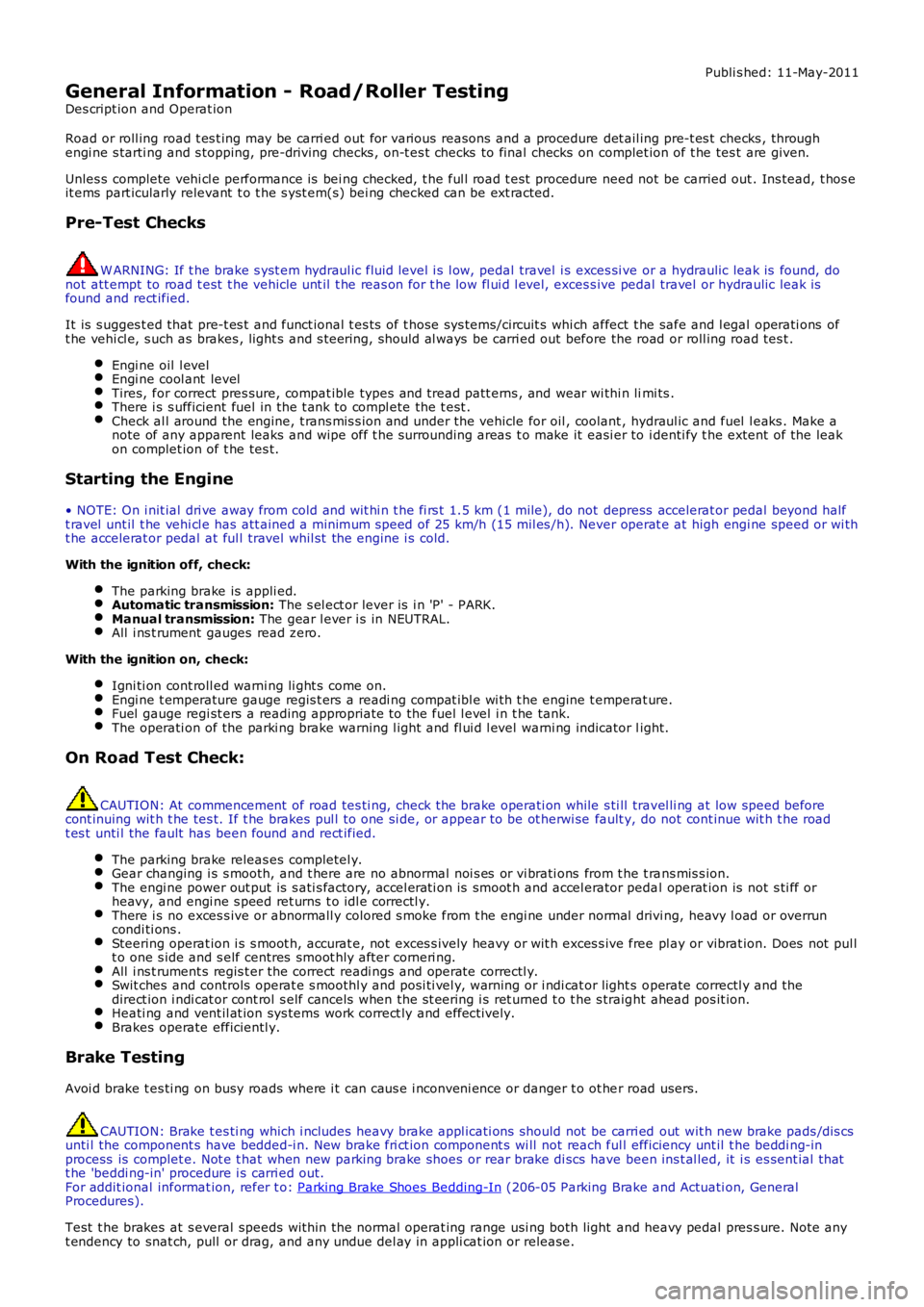
Publi s hed: 11-May-2011
General Information - Road/Roller Testing
Des cript ion and Operat ion
Road or roll ing road t es t ing may be carri ed out for various reasons and a procedure det ail ing pre-t es t checks , throughengi ne s tarti ng and s topping, pre-driving checks , on-t es t checks to final checks on complet ion of t he tes t are given.
Unles s complete vehi cl e performance is bei ng checked, t he ful l road t est procedure need not be carried out . Ins tead, t hos eit ems part icularly relevant t o t he s yst em(s) bei ng checked can be ext racted.
Pre-Test Checks
W ARNING: If t he brake s yst em hydraul ic fluid level i s l ow, pedal travel i s exces si ve or a hydraulic leak is found, donot att empt to road t est t he vehicle unt il t he reas on for t he low fl ui d l evel, excess ive pedal travel or hydraulic leak isfound and rect ified.
It is s ugges t ed that pre-t es t and funct ional t es ts of t hose sys tems/circuit s whi ch affect t he safe and l egal operati ons oft he vehi cl e, s uch as brakes , light s and s teeri ng, should al ways be carri ed out before the road or roll ing road tes t .
Engi ne oil l evelEngi ne cool ant levelTires, for correct pres sure, compat ible types and tread patt erns , and wear wi thi n limi ts .There i s s ufficient fuel in the t ank to compl ete the t est .Check al l around the engine, t rans mis s ion and under the vehicle for oil , coolant , hydraul ic and fuel l eaks . Make anote of any apparent leaks and wipe off t he surrounding areas t o make it easi er to identi fy t he extent of the leakon complet ion of t he tes t.
Starting the Engine
• NOTE: On i nit ial dri ve away from cold and wit hi n t he fi rs t 1.5 km (1 mile), do not depress accelerat or pedal beyond halft ravel unt il t he vehi cl e has att ained a minimum s peed of 25 km/h (15 mil es /h). Never operat e at high engi ne speed or wi tht he accelerat or pedal at ful l travel whil st the engine i s cold.
With the ignition off, check:
The parking brake is appli ed.Automatic transmission: The s el ect or lever is i n 'P' - PARK.Manual transmission: The gear l ever i s in NEUTRAL.All i ns t rument gauges read zero.
With the ignition on, check:
Igni ti on cont roll ed warni ng li ght s come on.Engi ne t emperature gauge regis t ers a readi ng compat ibl e wi th t he engine t emperat ure.Fuel gauge regi st ers a reading appropriate to the fuel l evel i n t he tank.The operati on of the parki ng brake warning l ight and fl ui d l evel warni ng indicator light.
On Road Test Check:
CAUTION: At commencement of road tes ti ng, check the brake operati on while s ti ll travel li ng at low speed beforecont inuing wit h t he tes t. If t he brakes pul l to one si de, or appear to be ot herwi se fault y, do not cont inue wit h t he roadt es t unti l the fault has been found and rect ified.
The parking brake releas es completel y.Gear changing i s s mooth, and t here are no abnormal noi s es or vi brati ons from t he t rans mis s ion.The engi ne power out put is s ati s factory, accel erati on is smoot h and accel erator pedal operat ion is not s ti ff orheavy, and engi ne s peed ret urns t o idl e correctl y.There i s no exces s ive or abnormall y colored s moke from t he engi ne under normal driving, heavy l oad or overruncondi ti ons .Steering operat ion i s s moot h, accurat e, not exces s ively heavy or wit h exces s ive free pl ay or vibrat ion. Does not pul lt o one s ide and s elf centres smoot hly after corneri ng.All i ns t rument s regis t er the correct readi ngs and operate correctl y.Swit ches and controls operat e s moothl y and posi ti vel y, warning or i ndi cat or light s operate correctl y and thedirect ion i ndi cat or cont rol s elf cancels when the s t eering i s ret urned t o t he s traight ahead pos it ion.Heati ng and vent il at ion sys tems work correct ly and effect ively.Brakes operate efficientl y.
Brake Testing
Avoi d brake t es ti ng on busy roads where i t can caus e i nconveni ence or danger t o ot her road users.
CAUTION: Brake t es ti ng which i ncludes heavy brake appl icati ons should not be carri ed out wit h new brake pads /dis csunti l the component s have bedded-i n. New brake fri ct ion component s wi ll not reach ful l efficiency unt il t he beddi ng-inprocess is complet e. Not e t hat when new parking brake shoes or rear brake di scs have been ins t al led, it i s es sent ial thatt he 'beddi ng-in' procedure i s carri ed out.For addit ional informat ion, refer t o: Parking Brake Shoes Bedding-In (206-05 Parking Brake and Actuati on, GeneralProcedures).
Test t he brakes at s everal speeds wit hin the normal operat ing range usi ng both light and heavy pedal pres s ure. Note anyt endency to snat ch, pull or drag, and any undue del ay in appli cat ion or release.
Page 147 of 3229
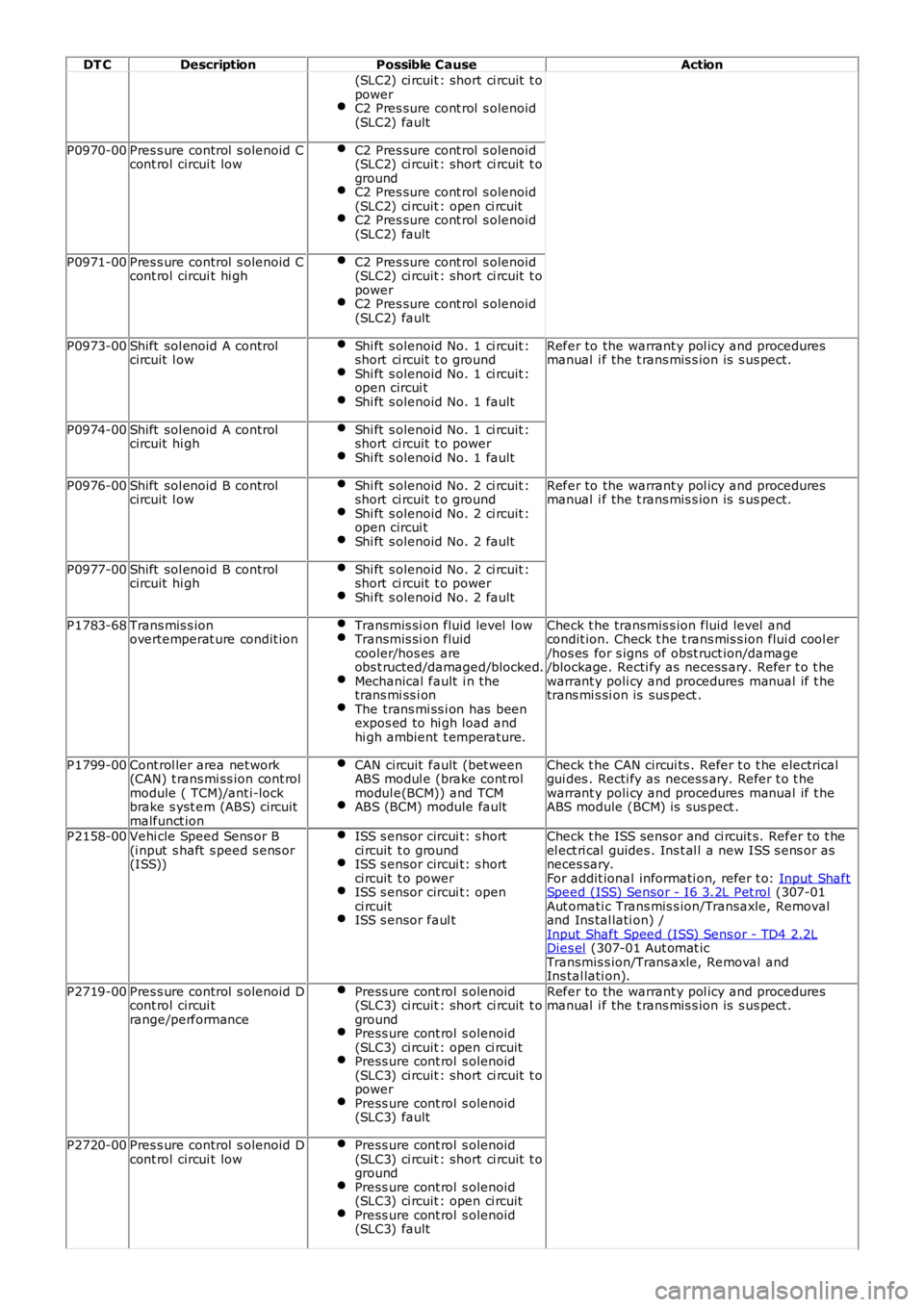
DT C
Description Possible Cause Action
(SLC2) ci rcuit : short ci rcuit t o
power
C2 Pres sure cont rol s olenoid
(SLC2) fault P0970-00
Pres s ure control s olenoid C
cont rol circui t low C2 Pres sure cont rol s olenoid
(SLC2) ci rcuit : short ci rcuit t o
ground C2 Pres sure cont rol s olenoid
(SLC2) ci rcuit : open ci rcuit C2 Pres sure cont rol s olenoid
(SLC2) fault P0971-00
Pres s ure control s olenoid C
cont rol circui t hi gh C2 Pres sure cont rol s olenoid
(SLC2) ci rcuit : short ci rcuit t o
power C2 Pres sure cont rol s olenoid
(SLC2) fault P0973-00
Shift sol enoid A control
circuit l ow Shi ft s olenoid No. 1 ci rcuit :
short ci rcuit t o ground Shi ft s olenoid No. 1 ci rcuit :
open circui t Shi ft s olenoid No. 1 fault Refer to the warrant y pol icy and procedures
manual i f the t rans mis s ion is s us pect.
P0974-00 Shift sol enoid A control
circuit hi gh Shi ft s olenoid No. 1 ci rcuit :
short ci rcuit t o power Shi ft s olenoid No. 1 fault
P0976-00
Shift sol enoid B control
circuit l ow Shi ft s olenoid No. 2 ci rcuit :
short ci rcuit t o ground Shi ft s olenoid No. 2 ci rcuit :
open circui t Shi ft s olenoid No. 2 fault Refer to the warrant y pol icy and procedures
manual i f the t rans mis s ion is s us pect.
P0977-00 Shift sol enoid B control
circuit hi gh Shi ft s olenoid No. 2 ci rcuit :
short ci rcuit t o power Shi ft s olenoid No. 2 fault
P1783-68
Trans mis s ion
overtemperat ure condit ion Transmis si on fluid level l ow Transmis si on fluid
cooler/hos es are
obs t ructed/damaged/blocked. Mechanical fault i n the
trans mi ss i on The trans mi ss i on has been
expos ed to hi gh load and
hi gh ambient t emperature. Check t he transmis s ion fluid level and
condit ion. Check t he t rans mis s ion flui d cool er
/hos es for s igns of obst ruct ion/damage
/blockage. Recti fy as necess ary. Refer t o t he
warrant y poli cy and procedures manual if t he
trans mi s si on is sus pect .
P1799-00 Cont rol ler area net work
(CAN) t rans mi ss ion cont rol
module ( TCM)/ant i-lock
brake s yst em (ABS) circuit
malfunct ion CAN circuit fault (bet ween
ABS modul e (brake cont rol
modul e(BCM)) and TCM ABS (BCM) module fault Check t he CAN circui ts . Refer t o t he electrical
gui des . Recti fy as necess ary. Refer t o t he
warrant y poli cy and procedures manual if t he
ABS module (BCM) is sus pect .
P2158-00 Vehi cle Speed Sens or B
(i nput s haft s peed s ens or
(ISS)) ISS s ensor circui t: s hort
ci rcuit t o ground ISS s ensor circui t: s hort
ci rcuit t o power ISS s ensor circui t: open
ci rcuit ISS s ensor faul t Check t he ISS sens or and ci rcuit s. Refer to t he
el ect ri cal guides . Ins t al l a new ISS s ens or as
neces sary.
For addit ional informati on, refer t o: Input Shaft Speed (ISS) Sensor - I6 3.2L Pet rol (307-01
Aut omati c Trans mis s ion/Transaxle, Removal
and Ins tal lati on) /
Input Shaft Speed (ISS) Sens or - TD4 2.2L Dies el (307-01 Aut omat ic
Transmis s ion/Trans axle, Removal and
Ins tal lati on).
P2719-00 Pres s ure control s olenoid D
cont rol circui t
range/performance Press ure cont rol s olenoid
(SLC3) ci rcuit : short ci rcuit t o
ground Press ure cont rol s olenoid
(SLC3) ci rcuit : open ci rcuit Press ure cont rol s olenoid
(SLC3) ci rcuit : short ci rcuit t o
power Press ure cont rol s olenoid
(SLC3) fault Refer to the warrant y pol icy and procedures
manual i f the t rans mis s ion is s us pect.
P2720-00 Pres s ure control s olenoid D
cont rol circui t low Press ure cont rol s olenoid
(SLC3) ci rcuit : short ci rcuit t o
ground Press ure cont rol s olenoid
(SLC3) ci rcuit : open ci rcuit Press ure cont rol s olenoid
(SLC3) fault
Page 178 of 3229
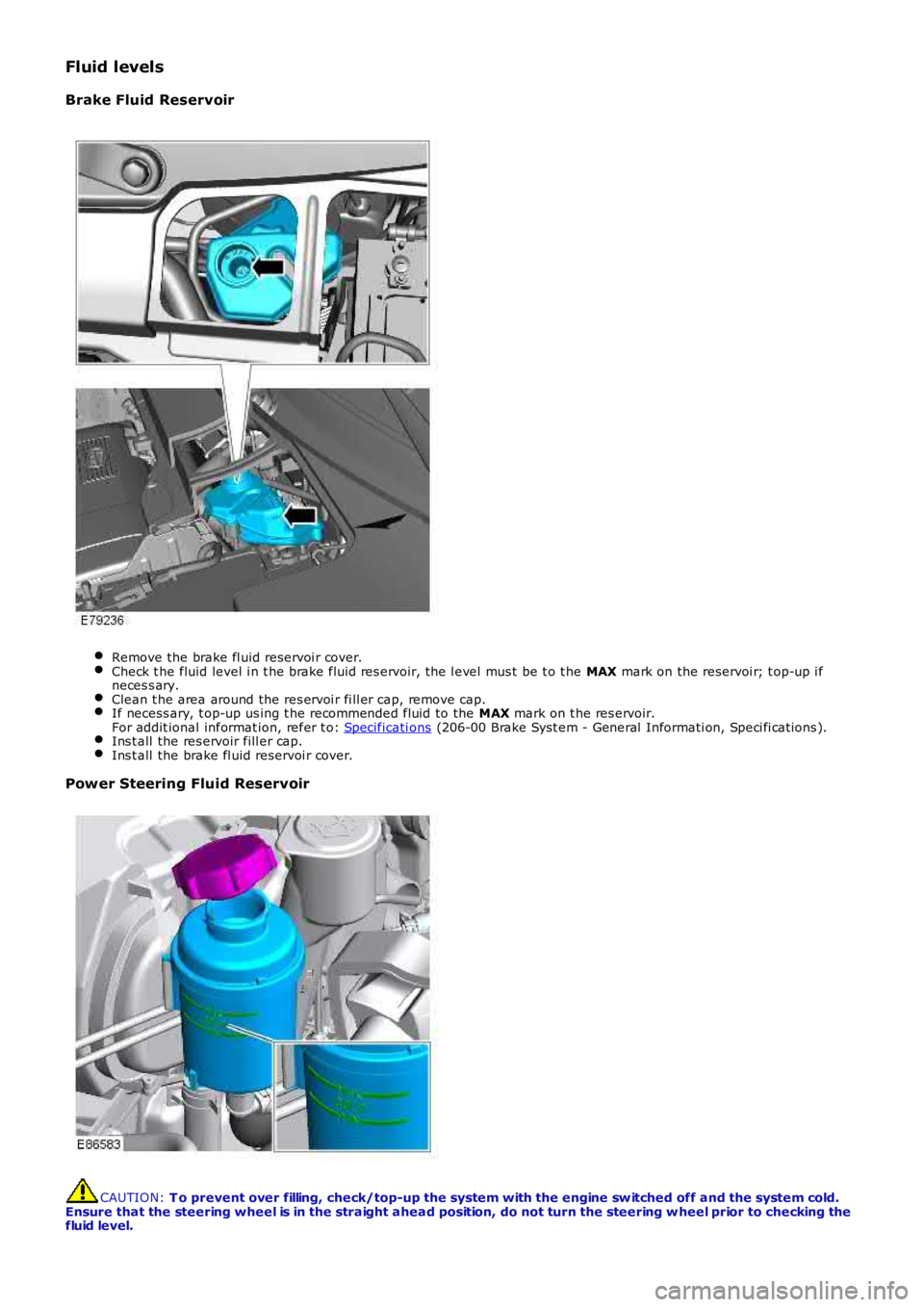
Fluid levels
Brake Fluid Reservoir
Remove the brake fl uid reservoi r cover.Check t he fluid level i n t he brake fluid res ervoir, the l evel mus t be t o t he MAX mark on the reservoi r; t op-up i fneces s ary.Clean t he area around the res ervoi r fi ll er cap, remove cap.If necess ary, t op-up us ing t he recommended fluid to the MAX mark on t he res ervoir.For addit ional informat ion, refer t o: Specificati ons (206-00 Brake Syst em - General Informati on, Speci fi cat ions ).Ins t all the res ervoir fill er cap.Ins t all the brake fl uid reservoi r cover.
Power Steering Fluid Reservoir
CAUTION: T o prevent over filling, check/top-up the system with the engine sw itched off and the system cold.Ensure that the steering wheel is in the straight ahead position, do not turn the steering w heel prior to checking thefluid level.
Page 180 of 3229
1. Check for free play i n all s uspens ion and body mounti ng rubbers .
2. Check condit ion of s uspens ion rubber boot s and gait ers .
Fuel System
Check fuel sys tem pipes , hos es and unions for chafi ng, l eaks and corros ion.
Electrical Harnesses
Check al l el ect ri cal harnes s es for chafing.
Oil/Fluid Leaks
Check for oil/fluid leaks .
Power Steering
Check power s teering rod bal l joi nt fixi ngs , gait ers and condi ti on of bal l joi nt s and dus t covers .Check power s teering pipes , hos es and unions for chafi ng, leaks and corros ion.
Exhaust System
Check exhaust s ys tem for l eaks , securi ty and damage.
Fault Lamp(s)
If fault l amp(s ) are ill uminat ed, t est the as s oci at ed s yst em us i ng T4 and report findings .
Road Test
Carry out road t est of vehicle.For addit ional informat ion, refer t o: Road/Roller Tes ti ng (100-00 General Informati on, Des cri pt ion and Operati on).
General
Endors e Service Record.Report any unus ual features of vehi cl e condi ti on and any addi ti onal work required.
Vehicles Operating Under Arduous Conditions
Service i ntervals for vehi cles operati ng under arduous condi ti ons are det ailed bel ow.
Braking system
CAUTION: When vehicles are operating under arduous conditions, the following service items must be carriedout every 3 months or 3,750 miles (6,000 km).
Ins pect front brake pads for wear.Ins pect rear pads for wear.Check brake cal ipers for s igns of fl ui d l eaks .Check brake dis cs for condi ti on.Check al l brake boos t er and brake s ys t em pipes and hos es for condi ti on, chafi ng and leaks.Clean road wheel hub s pigot s and appl y greas e, Land Rover Part Number RY L 105020 t o t he wheel mat ing surfaceof each s pigot .
Brake Fluid Replacement
CAUTION: When vehicles are operating under arduous conditions, the following service item must be carried outevery 2 Years or 30,000 miles (48,000 km).
Replace brake fluid.
Road Wheel Speed Sensors
CAUTION: When vehicles are operating under arduous conditions, the following service item must be carried outevery 3 months or 3,750 miles (6,000 km).
Ins pect the road wheel s peed s ens or harness es for damage.
Engine Oil and Filter
CAUTION: When vehicles are operating under arduous conditions, the following service item must be carried outevery 3 months or 3,750 miles (6,000 km).
Renew engi ne oil and fil ter.
Page 189 of 3229
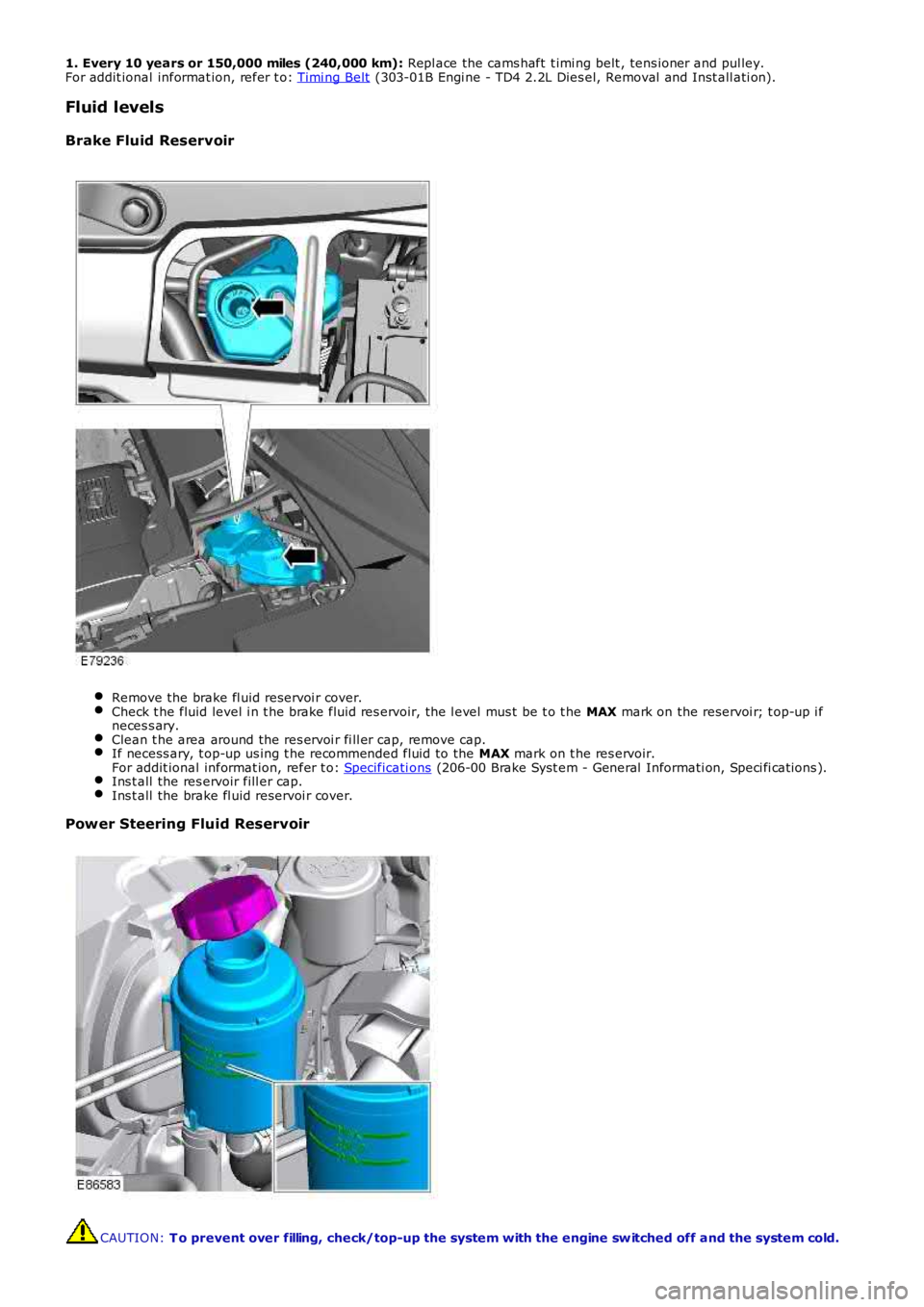
1. Every 10 years or 150,000 miles (240,000 km): Repl ace the cams haft t imi ng belt , tens ioner and pul ley.
For addit ional informat ion, refer t o:
Timi ng Belt (303-01B Engi ne - TD4 2.2L Dies el, Removal and Inst all ati on).
Fluid levels
Brake Fluid Reservoir Remove the brake fl uid reservoi r cover.
Check t he fluid level i n t he brake fluid res ervoir, the l evel mus t be t o t he
MAX mark on the reservoi r; t op-up i f
neces s ary. Clean t he area around the res ervoi r fi ll er cap, remove cap.
If necess ary, t op-up us ing t he recommended fluid to the
MAX mark on t he res ervoir.
For addit ional informat ion, refer t o: Specificati ons (206-00 Brake Syst em - General Informati on, Speci fi cat ions ).
Ins t all the res ervoir fill er cap.
Ins t all the brake fl uid reservoi r cover.
Power Steering Fluid Reservoir
CAUTION:
T o prevent over filling, check/top-up the system with the engine sw itched off and th e system cold.
Page 191 of 3229
For addit ional informat ion, refer t o: Specificati ons (307-01 Aut omati c Trans mis s ion/Transaxle, Speci fi cat ions ).
Manual Transmission
Every 10 years or 150,000 miles (240,000 km): Renew manual t rans mi ss ion fl ui d.
For addit ional informat ion, refer t o: Specificati ons (308-00 Manual Trans mis s ion/Transaxle and Clutch - General
Informat ion, Speci ficat ions).
Power Transfer Unit
Every 10 years or 150,000 miles (240,000 km): Renew power t rans fer unit oi l. For addi ti onal informat ion, refer to:
(308-07B Transfer Case)
Power Trans fer Uni t - TD4 2.2L Di esel , Vehi cl es W i th: M66 6-Speed Manual Trans mis s io n AW D (Removal and
Ins tal lat ion),
Power Trans fer Uni t - TD4 2.2L Di esel , Vehi cl es W i th: M66 6-Speed Manual Trans mis s io n AW D (Removal and
Ins tal lat ion).
Differential Assembly - Rear
Every 10 years or 150,000 miles (240,000 km): Renew rear different ial oil .
For addit ional informat ion, refer t o: Specificati ons (205-02 Rear Drive Axle/Different ial, Specifi cat ions ).
Suspension and Body Mountings Check for free play i n all s us pens ion and body mounti ng rubbers . Check condit ion of s uspens ion rubber boots and gait ers .
Fuel System
Check fuel sys tem pipes , hos es and unions for chafi ng, l eaks and corros ion. Electrical Harnesses
Check al l el ect ri cal harnes s es for chafing. Oil/Fluid Leaks
Check for oil/fluid leaks . Power Steering
Check power s teering rod bal l joi nt fixi ngs , gait ers and condi ti on of bal l joi nt s an d dus t covers .Check power s teering pipes , hos es and unions for chafi ng, leaks and corros ion.
Exhaust System
Check exhaust s ys tem for l eaks , securi ty and damage. Clutch
1. Check clut ch pipes and unions for chafi ng, l eaks and corrosi on.
Fault Lamp(s) If fault l amp(s ) are ill uminat ed, t est the as s oci at ed s yst em us i ng Land Rover approv ed di agnos ti c equipment and
report findi ngs . Road Test
Carry out road t est of vehicle.
For addit ional informat ion, refer t o: Road/Roller Tes ti ng (100-00 General Informati on, Des cri pt ion and Operati on).
General
Endors e Service Record. Report any unus ual features of vehi cl e condi ti on and any addi ti onal work required.
Vehicles Operating Under Arduous Conditions
Recommended s ervi ce interval s for vehicles operat ing under arduous condit ions are de t ail ed below.
Braking System CAUTION:
When vehicles are operating under arduous conditions, the following service items mu st be carried
out every 3 months or 3,750 miles (6,000 km).
Ins pect front brake pads for wear.