fuel pressure Lexus CT200h 2014 Owner's Manual (in English)
[x] Cancel search | Manufacturer: LEXUS, Model Year: 2014, Model line: CT200h, Model: Lexus CT200h 2014Pages: 622
Page 15 of 622
15Pictorial index
CT200h_OM_OM76135E_(EE)
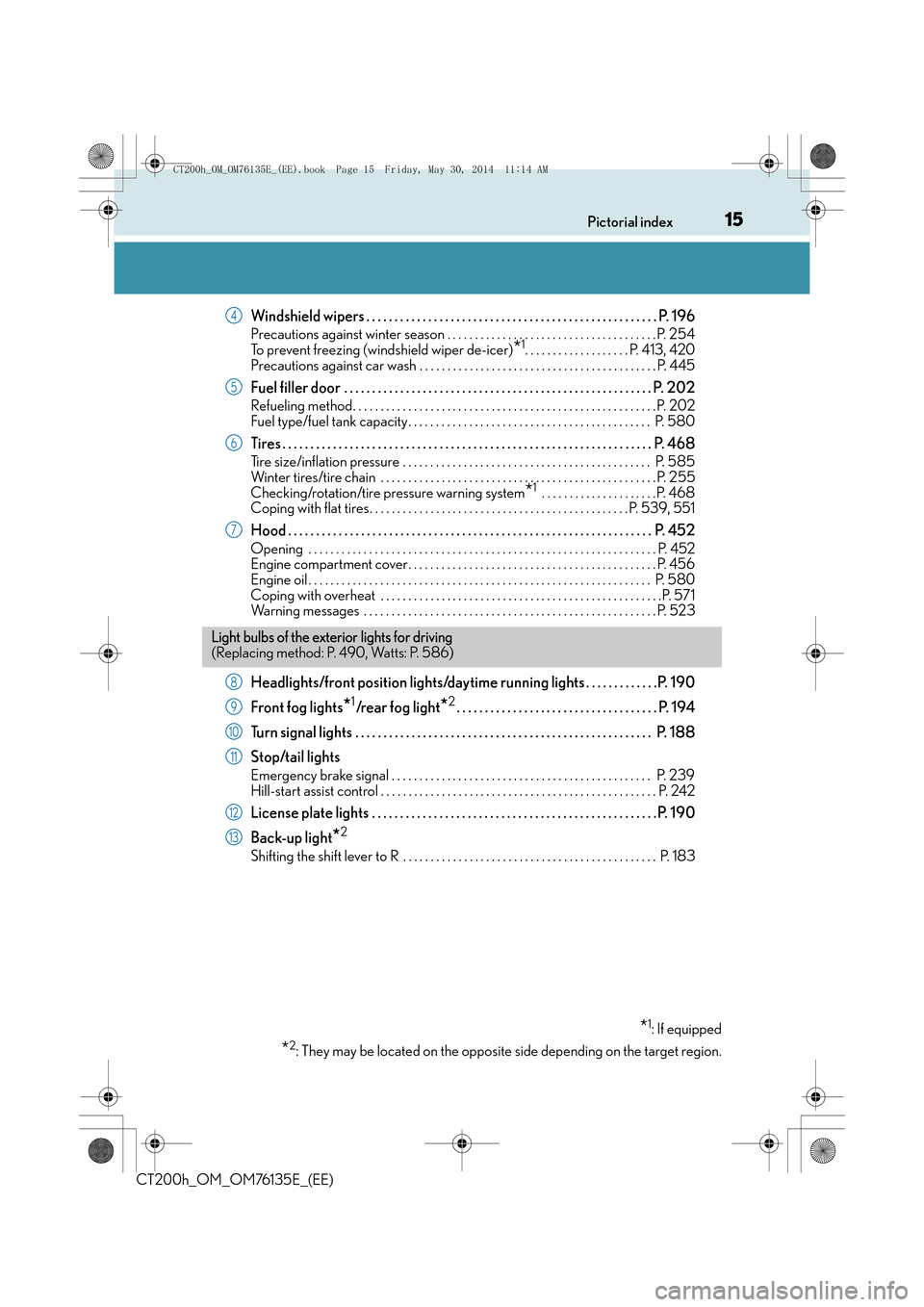
Windshield wipers . . . . . . . . . . . . . . . . . . . . . . . . . . . . . . . . . . . . . . . . . . . . . . . . . . . . P. 196
Precautions against winter season . . . . . . . . . . . . . . . . . . . . . . . . . . . . . . . . . . . . . . P. 254
To prevent freezing (windshield wiper de-icer)
*1. . . . . . . . . . . . . . . . . . . P. 413, 420
Precautions against car wash . . . . . . . . . . . . . . . . . . . . . . . . . . . . . . . . . . . . . . . . . . . P. 445
Fuel filler door . . . . . . . . . . . . . . . . . . . . . . . . . . . . . . . . . . . . . . . . . . . . . . . . . . . . . . . P . 202
Refueling method. . . . . . . . . . . . . . . . . . . . . . . . . . . . . . . . . . . . . . . . . . . . . . . . . . . . . . . P. 202
Fuel type/fuel tank capacity . . . . . . . . . . . . . . . . . . . . . . . . . . . . . . . . . . . . . . . . . . . . P. 580
Tires . . . . . . . . . . . . . . . . . . . . . . . . . . . . . . . . . . . . . . . . . . . . . . . . . . . . . . . . . . . . . . . . . . P. 468
Tire size/inflation pressure . . . . . . . . . . . . . . . . . . . . . . . . . . . . . . . . . . . . . . . . . . . . . P. 585
Winter tires/tire chain . . . . . . . . . . . . . . . . . . . . . . . . . . . . . . . . . . . . . . . . . . . . . . . . . . P. 2 55
Checking/rotation/tire pressure warning system
*1 . . . . . . . . . . . . . . . . . . . . .P. 468
Coping with flat tires. . . . . . . . . . . . . . . . . . . . . . . . . . . . . . . . . . . . . . . . . . . . . . . P. 539, 551
Hood . . . . . . . . . . . . . . . . . . . . . . . . . . . . . . . . . . . . . . . . . . . . . . . . . . . . . . . . . . . . . . . . . P. 452
Opening . . . . . . . . . . . . . . . . . . . . . . . . . . . . . . . . . . . . . . . . . . . . . . . . . . . . . . . . . . . . . . . P. 452
Engine compartment cover. . . . . . . . . . . . . . . . . . . . . . . . . . . . . . . . . . . . . . . . . . . . . P. 456
Engine oil . . . . . . . . . . . . . . . . . . . . . . . . . . . . . . . . . . . . . . . . . . . . . . . . . . . . . . . . . . . . . . P. 580
Coping with overheat . . . . . . . . . . . . . . . . . . . . . . . . . . . . . . . . . . . . . . . . . . . . . . . . . . .P. 57 1
Warning messages . . . . . . . . . . . . . . . . . . . . . . . . . . . . . . . . . . . . . . . . . . . . . . . . . . . . . P. 52 3
Headlights/front position lights/daytime running lights . . . . . . . . . . . . .P. 190
Front fog lights
*1/rear fog light*2. . . . . . . . . . . . . . . . . . . . . . . . . . . . . . . . . . . . P. 194
Turn signal lights . . . . . . . . . . . . . . . . . . . . . . . . . . . . . . . . . . . . . . . . . . . . . . . . . . . . . P. 188
Stop/tail lights
Emergency brake signal . . . . . . . . . . . . . . . . . . . . . . . . . . . . . . . . . . . . . . . . . . . . . . . P. 239
Hill-start assist control . . . . . . . . . . . . . . . . . . . . . . . . . . . . . . . . . . . . . . . . . . . . . . . . . . P. 242
License plate lights . . . . . . . . . . . . . . . . . . . . . . . . . . . . . . . . . . . . . . . . . . . . . . . . . . .P. 190
Back-up light
*2
Shifting the shift lever to R . . . . . . . . . . . . . . . . . . . . . . . . . . . . . . . . . . . . . . . . . . . . . . P. 18 3
4
5
6
7
Light bulbs of the exterior lights for driving
(Replacing method: P. 490, Watts: P. 586)
*1: If equipped
*2: They may be located on the opposite side depending on the target region.
8
9
10
11
12
13
CT200h_OM_OM76135E_(EE).book Page 15 Friday, May 30, 2014 11 :14 AM
Page 93 of 622
932. Instrument cluster
2
Instrument cluster
CT200h_OM_OM76135E_(EE)
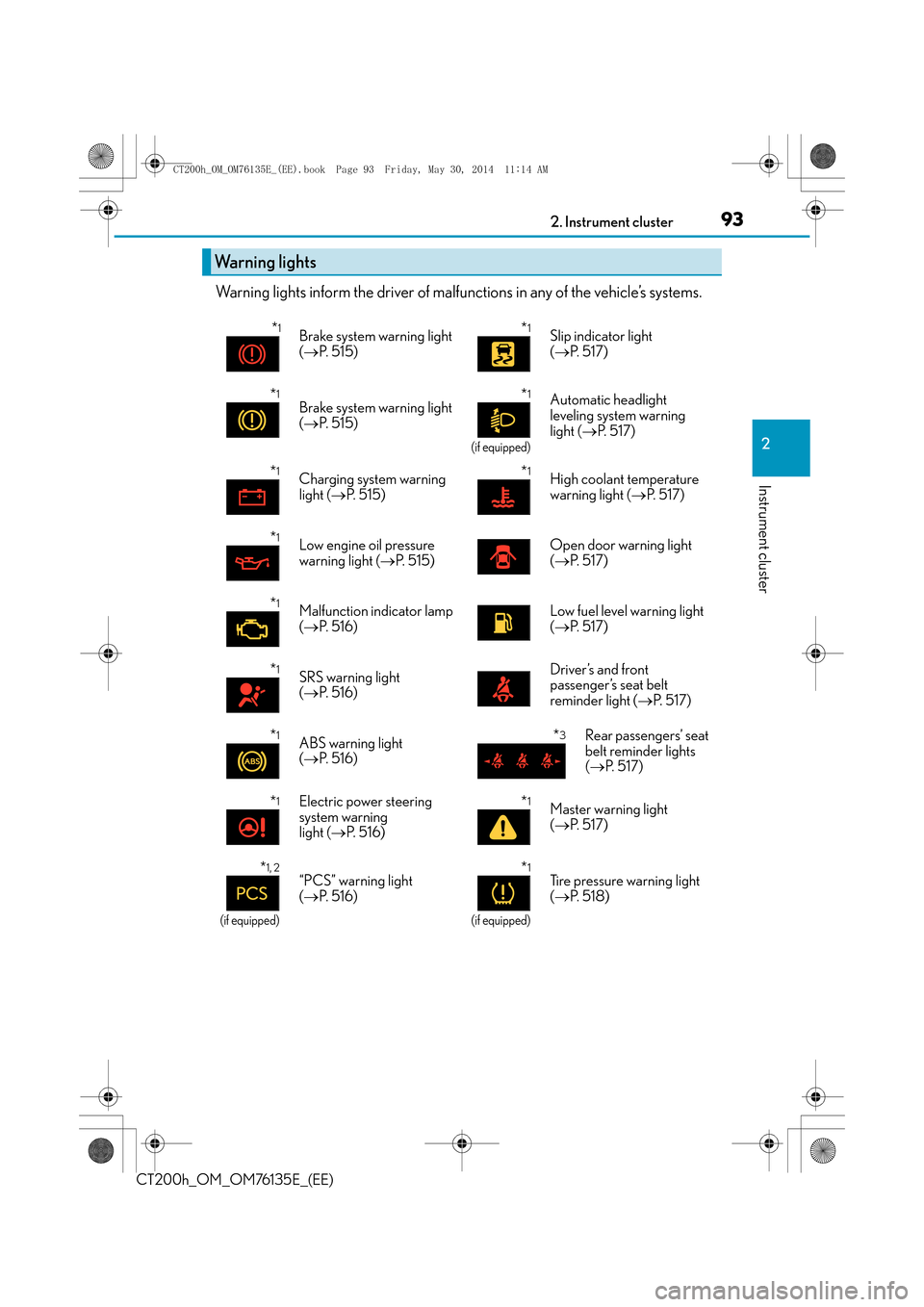
Warning lights inform the driver of malfunctions in any of the vehicle’s systems.
Wa r n i n g l i g h t s
*1Brake system warning light
(→ P. 5 1 5 )*1Slip indicator light
(→ P. 5 1 7 )
*1Brake system warning light
(→ P. 5 1 5 )*1
(if equipped)
Automatic headlight
leveling system warning
light ( →P. 5 1 7 )
*1Charging system warning
light ( →P. 5 1 5 )*1High coolant temperature
warning light ( →P. 5 1 7 )
*1Low engine oil pressure
warning light ( →P. 5 1 5 ) Open door warning light
(
→ P. 5 1 7 )
*1Malfunction indicator lamp
(→ P. 5 1 6 ) Low fuel level warning light
(
→ P. 5 1 7 )
*1SRS warning light
(→ P. 5 1 6 ) Driver’s and front
passenger’s seat belt
reminder light (
→P. 5 1 7 )
*1ABS warning light
(→ P. 5 1 6 )*3Rear passengers’ seat
belt reminder lights
(→ P. 5 1 7 )
*1Electric power steering
system warning
light ( →P. 5 1 6 )*1Master warning light
(→ P. 5 1 7 )
*1, 2
(if equipped)
“PCS” warning light
(→ P. 5 1 6 )*1
(if equipped)
Tire pressure warning light
(→ P. 5 1 8 )
CT200h_OM_OM76135E_(EE).book Page 93 Friday, May 30, 2014 11 :14 AM
Page 252 of 622

2524-6. Driving tips
CT200h_OM_OM76135E_(EE)
◆Delays
Repeated acceleration and deceleration, as well as long waits at traffic lights,
will lead to bad fuel economy. Check traffic reports before leaving and avoid
delays as much as possible. When driving in a traffic jam, gently release the
brake pedal to allow the vehicle to move forward slightly while avoiding over-
use of the accelerator pedal. Doing so can help control excessive gasoline
consumption.
◆Highway driving
Control and maintain the vehicle at a constant speed. Before stopping at a toll
booth or similar, allow plenty of time to release the accelerator and gently
apply the brakes. A greater amount of electrical energy can be regenerated
when slowing down.
◆Air conditioning
Use the air conditioning only when necessary. Doing so can help reduce
excessive gasoline consumption.
In summer: When the ambient temperature is high, use the recirculated air
mode. Doing so will help to reduce the burden on the air conditioning system
and reduce fuel consumption as well.
In winter: Because the gasoline engine will not automatically cut out until it
and the interior of the vehicle are warm, it will consume fuel. Fuel consumption
can be improved by avoiding overuse of the heater.
◆Checking tire inflation pressure
Make sure to check the tire inflation pressure frequently. Improper tire infla-
tion pressure can cause poor fuel economy.
Also, as snow tires can cause large amounts of friction, their use on dry roads
can lead to poor fuel economy. Use tires that are appropriate for the season.
◆Luggage
Carrying heavy luggage will lead to poor fuel economy. Avoid carrying
unnecessary luggage. Installing a large roof rack will also cause poor fuel
economy.
CT200h_OM_OM76135E_(EE).book Page 252 Friday, May 30, 2014 1 1:14 AM
Page 442 of 622

4427-1. Maintenance and care
CT200h_OM_OM76135E_(EE)
Cleaning and protecti ng the vehicle exterior
●Working from top to bottom, liberally apply water to the vehicle body, wheel
wells and underside of the vehicle to remove any dirt and dust.
●Wash the vehicle body using a sponge or soft cloth, such as a chamois.
●For hard-to-remove marks, use car wash soap and rinse thoroughly with
water.
●Wipe away any water.
●Wax the vehicle when the waterproof coating deteriorates.
If water does not bead on a clean surface, apply wax when the vehicle body is cool.
■Self-restoring coat
The vehicle body has a self-restoring coating that is resistant to small surface scratches
caused in a car wash etc.
●The coating lasts for 5 to 8 years from when the vehicle is delivered from the plant.
●The restoration time differs depending on the depth of the scratch and outside temper-
ature. The restoration time may become shorter when the coating is warmed by apply-
ing warm water.
●Deep scratches caused by keys, coins, etc. cannot be restored.
●Do not use wax that contain abrasives.
■Automatic car washes
●Fold the mirrors before washing the vehicle. Start washing from the front of the vehicle.
Make sure to extend the mirrors before driving.
●Brushes used in automatic car washes may scratch the vehicle surface and harm your
vehicle’s paint.
●Rear spoiler may not be washable in some automatic car washes. There may also be an
increased risk of damage to vehicle.
■High pressure car washes
●Do not allow the nozzles of the car wash to come within close proximity of the windows.
●Before using the car wash, check that the fuel filler door on your vehicle is closed prop-
erly.
Perform the following to protect the vehicle and maintain it in prime condi-
tion:
CT200h_OM_OM76135E_(EE).book Page 442 Friday, May 30, 2014 1 1:14 AM
Page 477 of 622

4777-3. Do-it-yourself maintenance
CT200h_OM_OM76135E_(EE)
7
Maintenance and care
Tire inflation pressure
■Effects of incorrect tire inflation pressure
Driving with incorrect tire inflation pressure may result in the following:
●Reduced fuel efficiency
●Reduced driving comfort and tire life
●Reduced safety
●Damage to the drive train
If a tire needs frequent inflating, have it checked by any authorized Lexus dealer or
repairer, or another duly qualified and equipped professional.
■Instructions for checking tire inflation pressure
When checking tire inflation pressure, observe the following:
●Check only when the tires are cold.
If your vehicle has been parked for at least 3 hours or has not been driven for more than
1.5 km or 1 mile, you will get an accurate cold tire inflation pressure reading.
●Always use a tire pressure gauge.
The appearance of the tire can be misleading. In addition, tire inflation pressure that is
even just a few pounds off can affect ride quality and handling.
●Do not reduce tire inflation pressure after driving. It is normal for tire inflation pressure
to be higher after driving.
●Never exceed the vehicle capacity weight.
Passengers and luggage weight should be pl aced so that the vehicle is balanced.
Make sure to maintain proper tire inflation pressure. Tire inflation pressure
should be checked at least once per month. However, Lexus recommends
that tire inflation pressure be checked once every two weeks. ( →P. 585)
WA R N I N G
■Proper inflation is critical to save tire performance
Keep your tires properly inflated. Otherwise, the following conditions may occur and
result in an accident causing death or serious injury:
●Excessive wear
●Uneven wear
●Poor handling
●Possibility of blowouts resulting from overheated tires
●Poor sealing of the tire bead
●Wheel deformation and/or tire separation
●A greater possibility of tire damage from road hazards
CT200h_OM_OM76135E_(EE).book Page 477 Friday, May 30, 2014 1 1:14 AM
Page 519 of 622
5198-2. Steps to take in an emergency
CT200h_OM_OM76135E_(EE)
8
When trouble arises
■If the malfunction indicator lamp comes on while driving
The malfunction indicator lamp will come on if the fuel tank becomes completely empty.
If the fuel tank is empty, refuel the vehicle immediately. The malfunction indicator lamp
will go off after several trips.
If the malfunction indicator lamp does not go off, contact any authorized Lexus dealer or
repairer, or another duly qualified and equipped professional as soon as possible.
■When the tire pressure warning light comes on (vehicles with the tire pressure warning
system)
Inspect the appearance of the tire to check that the tire is not punctured.
If the tire is punctured: →P. 539, 551
If the tire is not punctured:
Carry out the following procedure after the tire temperature has lowered sufficiently.
●Check the tire inflation pressure and adjust to the appropriate level.
●If the warning light does not go out even after several minutes, check that the tire infla-
tion pressure is at the specified level and carry out initialization. (→P. 4 6 9 )
The warning light may come on again if the above operations are conducted without first
allowing the tire temperature to lower sufficiently.
■The tire pressure warning light may come on due to natural causes (vehicles with the
tire pressure warning system)
The tire pressure warning light may turn on du e to natural causes such as natural air leaks
or tire inflation pressure changes caused by temperature. In this case, adjusting the tire
inflation pressure will turn off the warning light (after a few minutes).
■When a tire is replaced with a spare tire (vehicles with a compact spare tire and the tire
pressure warning system)
The compact spare tire is not equipped with a tire pressure warning valve and transmit-
ter. If a tire goes flat, the tire pressure warning light will not turn off even though the flat
tire has been replaced with the spare tire. Replace the spare tire with the repaired tire
and adjust the tire inflation pressure. The tire pressure warning light will go off after a few
minutes.
■Conditions that the tire pressure warning system may not function properly (vehicles
with the tire pressure warning system)
→ P. 4 7 1
■If the tire pressure warning light frequently comes on after blinking for 1 minute (vehi-
cles with the tire pressure warning system)
If the tire pressure warning light frequently comes on after blinking for 1 minute when the
power switch is turned to ON mode, have it checked by any authorized Lexus dealer or
repairer, or another duly qualified and equipped professional.
■Warning buzzer
In some cases, the buzzer may not be heard due to being in a noisy location or audio
sound.
CT200h_OM_OM76135E_(EE).book Page 519 Friday, May 30, 2014 1 1:14 AM
Page 585 of 622
585
9
9-1. Specifications
Vehicle specifications
CT200h_OM_OM76135E_(EE)
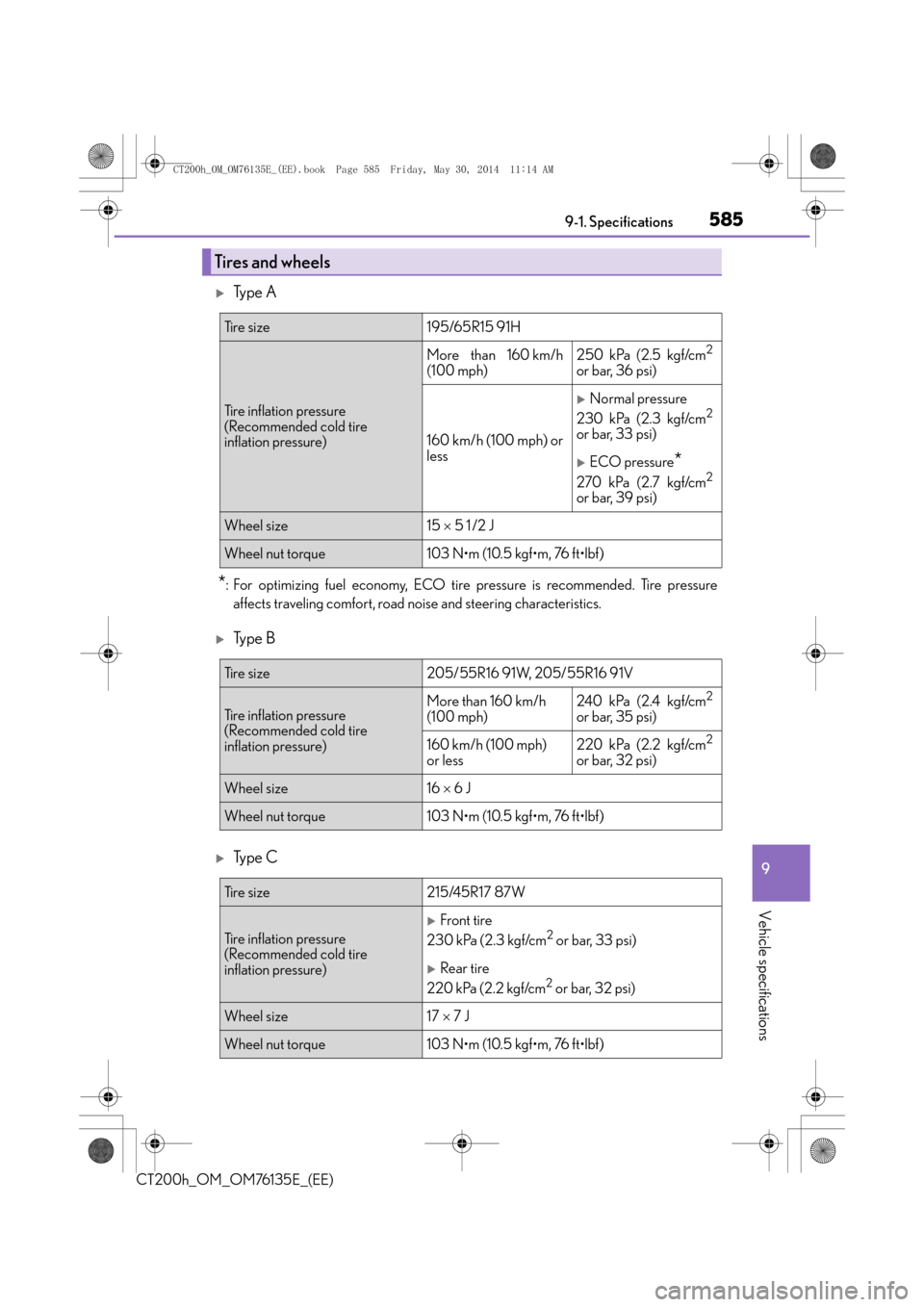
XTy p e A
*: For optimizing fuel economy, ECO tire pressure is recommended. Tire pressure
affects traveling comfort, road noise and steering characteristics.
XTy p e B
XTy p e C
Tires and wheels
Ti r e s i z e195/65R15 91H
Tire inflation pressure
(Recommended cold tire
inflation pressure)
More than 160 km/h
(100 mph)250 kPa (2.5 kgf/cm2
or bar, 36 psi)
160 km/h (100 mph) or
less
XNormal pressure
230 kPa (2.3 kgf/cm2
or bar, 33 psi)
XECO pressure*
270 kPa (2.7 kgf/cm2
or bar, 39 psi)
Wheel size15 × 5 1 /2 J
Wheel nut torque103 N•m (10.5 kgf•m, 76 ft•lbf)
Ti r e s i z e205/ 55R16 91W, 205/55R16 91V
Tire inflation pressure
(Recommended cold tire
inflation pressure)More than 160 km/h
(100 mph)240 kPa (2.4 kgf/cm2
or bar, 35 psi)
160 km/h (100 mph)
or less220 kPa (2.2 kgf/cm2
or bar, 32 psi)
Wheel size16 × 6 J
Wheel nut torque103 N•m (10.5 kgf•m, 76 ft•lbf)
Ti r e s i z e215/45R17 87W
Tire inflation pressure
(Recommended cold tire
inflation pressure)
XFront tire
230 kPa (2.3 kgf/cm2 or bar, 33 psi)
XRear tire
220 kPa (2.2 kgf/cm2 or bar, 32 psi)
Wheel size17 × 7 J
Wheel nut torque103 N•m (10.5 kgf•m, 76 ft•lbf)
CT200h_OM_OM76135E_(EE).book Page 585 Friday, May 30, 2014 1 1:14 AM
Page 621 of 622
621Alphabetical index
CT200h_OM_OM76135E_(EE)
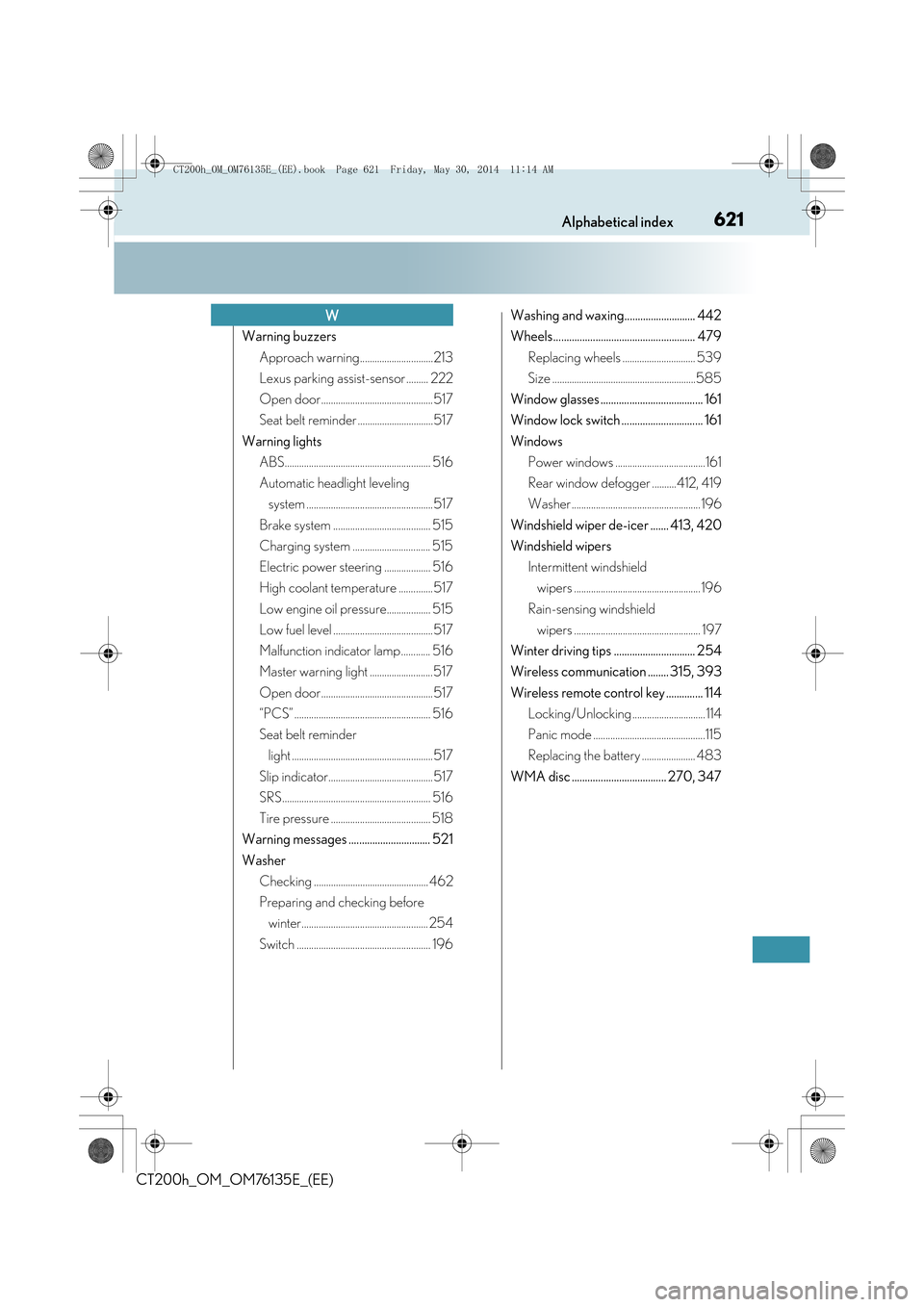
Warning buzzersApproach warning..............................213
Lexus parking assist-sensor ......... 222
Open door..............................................517
Seat belt reminder ...............................517
Warning lights ABS............................................................ 516
Automatic headlight leveling system ....................................................517
Brake system ........................................ 515
Charging system ................................ 515
Electric power steering ................... 516
High coolant temperature ..............517
Low engine oil pressure.................. 515
Low fuel level .........................................517
Malfunction indicator lamp ............ 516
Master warning light ..........................517
Open door..............................................517
“PCS” ........................................................ 516
Seat belt reminder light ..........................................................517
Slip indicator...........................................517
SRS............................................................. 516
Tire pressure ......................................... 518
Warning messages ............................... 521
Washer Checking ............................................... 462
Preparing and checking before winter.................................................... 254
Switch ....................................................... 196 Washing and waxing........................... 442
Wheels...................................................... 479
Replacing wheels .............................. 539
Size ...........................................................585
Window glasses ....................................... 161
Window lock switch ............................... 161
Windows Power windows .....................................161
Rear window defogger ..........412, 419
Washer ..................................................... 196
Windshield wiper de-icer ....... 413, 420
Windshield wipers Intermittent windshield wipers .................................................... 196
Rain-sensing windshield wipers .................................................... 197
Winter driving tips ............................... 254
Wireless communication ........ 315, 393
Wireless remote control key .............. 114 Locking/Unlocking .............................. 114
Panic mode ..............................................115
Replacing the battery ...................... 483
WMA disc .................................... 270, 347
W
CT200h_OM_OM76135E_(EE).book Page 621 Friday, May 30, 2014 1 1:14 AM
Page 622 of 622
622
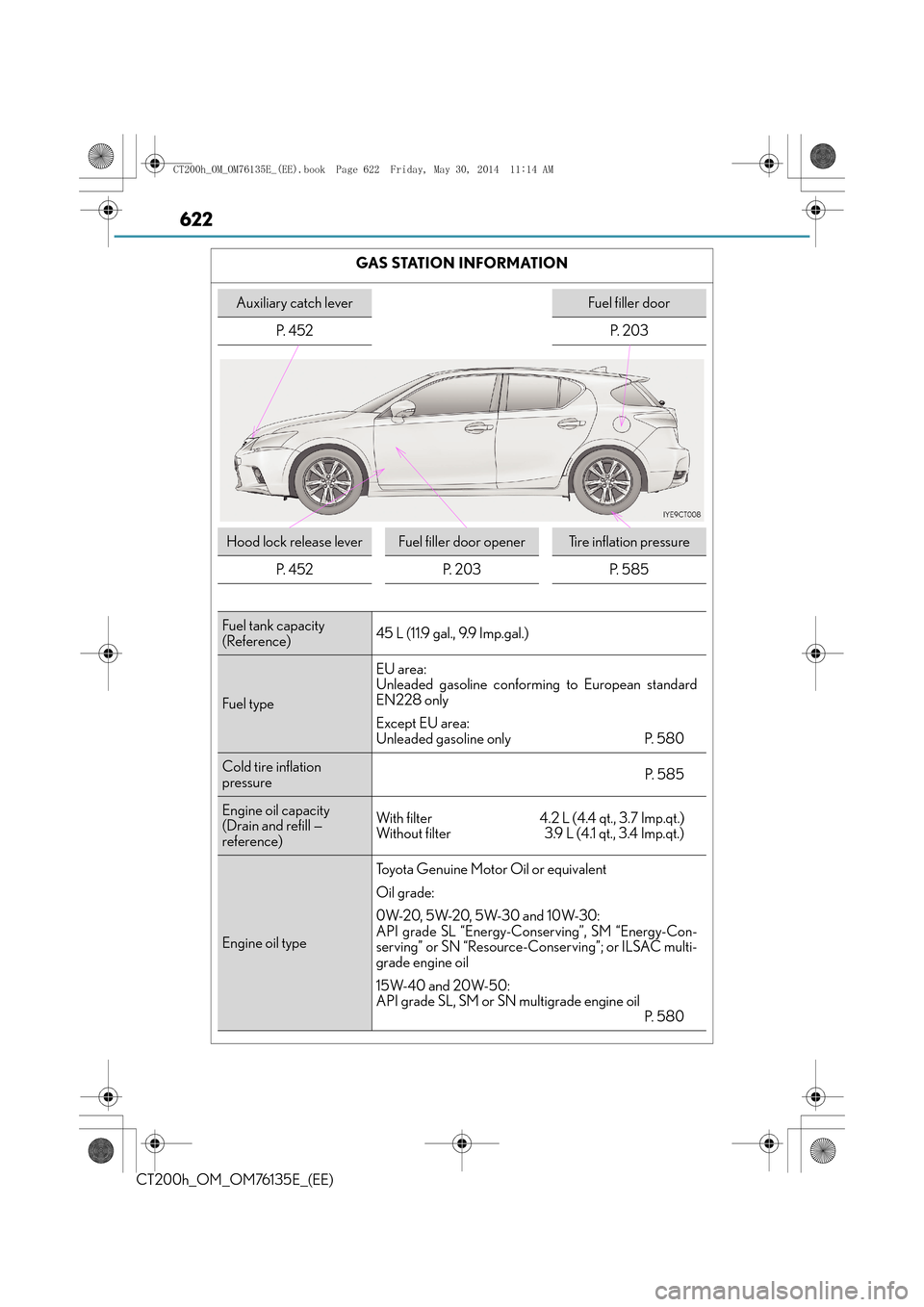
CT200h_OM_OM76135E_(EE)GAS STATION INFORMATION
Auxiliary catch leverFuel filler door
P. 4 5 2 P. 2 0 3
Hood lock release leverFuel filler door openerTi r e i n f l a t i o n p r e s s u r e
P. 452 P. 203 P. 585
Fuel tank capacity
(Reference) 45 L (11.9 gal., 9.9 Imp.gal.)
Fuel typeEU area:
Unleaded gasoline conforming to European standard
EN228 only
Except EU area:
Unleaded gasoline only P. 580
Cold tire inflation
pressure
P. 5 8 5
Engine oil capacity
(Drain and refill —
reference)With filter 4.2 L (4.4 qt., 3.7 Imp.qt.)
Without filter 3.9 L (4.1 qt., 3.4 Imp.qt.)
Engine oil typeToyota Genuine Motor Oil or equivalent
Oil grade:
0W-20, 5W-20, 5W-30 and 10W-30:
API grade SL “Energy-Conserving”, SM “Energy-Con-
serving” or SN “Resource-Conserving”; or ILSAC multi-
grade engine oil
1 5 W- 4 0 a n d 2 0 W- 5 0 :
API grade SL, SM or SN multigrade engine oil
P. 5 8 0
CT200h_OM_OM76135E_(EE).book Page 622 Friday, May 30, 2014 1 1:14 AM