Arm Lexus ES300h 2020 Owner's Manual
[x] Cancel search | Manufacturer: LEXUS, Model Year: 2020, Model line: ES300h, Model: Lexus ES300h 2020Pages: 462, PDF Size: 9.98 MB
Page 2 of 462
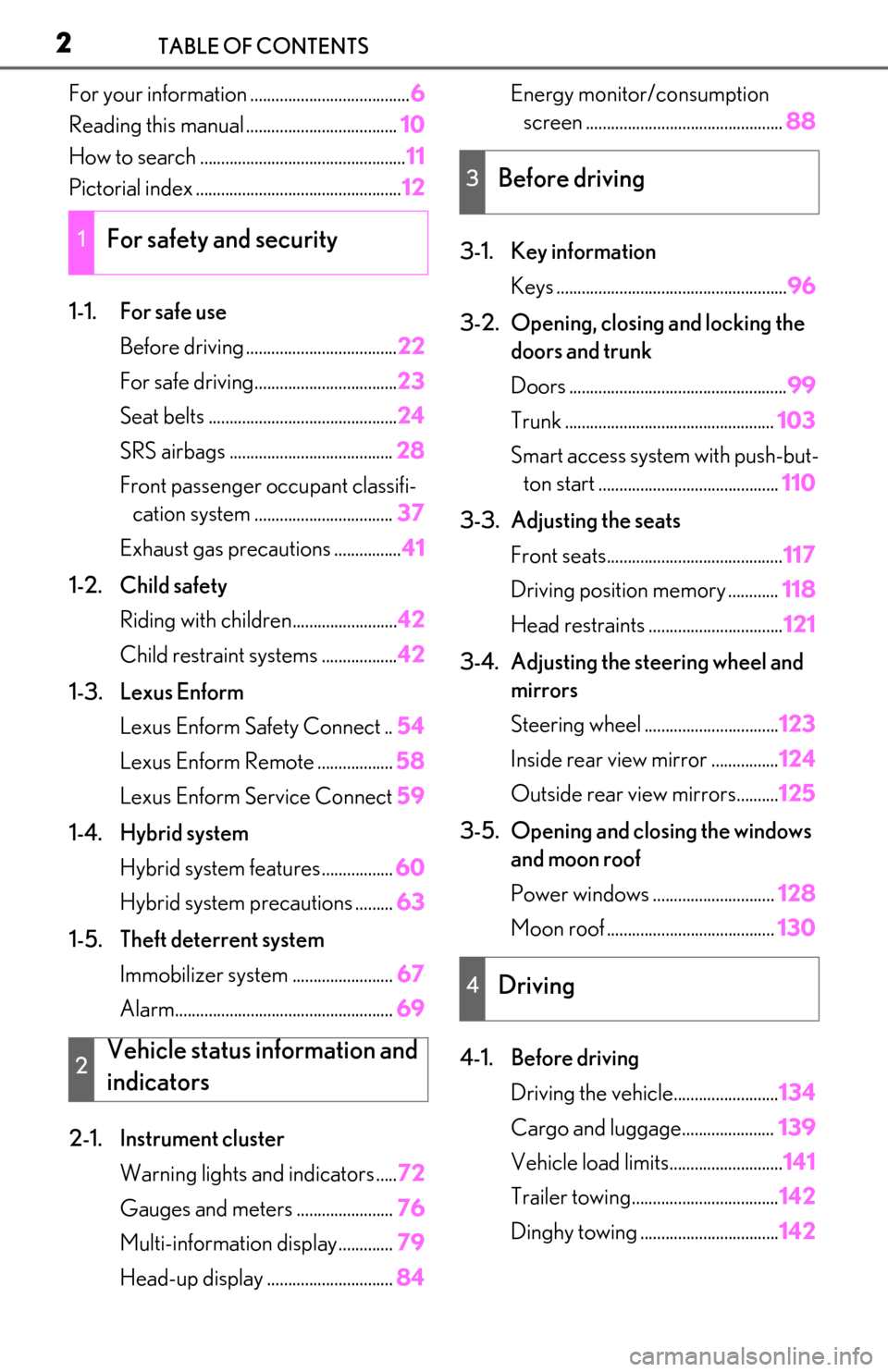
2TABLE OF CONTENTS
For your information ......................................6
Reading this manual .................................... 10
How to search ................................................. 11
Pictorial index ................................................. 12
1-1. For safe use Before driving .................................... 22
For safe driving.................................. 23
Seat belts ............................................. 24
SRS airbags ....................................... 28
Front passenger occupant classifi- cation system ................................. 37
Exhaust gas precautions ................ 41
1-2. Child safety Riding with children......................... 42
Child restraint systems .................. 42
1-3. Lexus Enform Lexus Enform Safety Connect .. 54
Lexus Enform Remote .................. 58
Lexus Enform Service Connect 59
1-4. Hybrid system Hybrid system features ................. 60
Hybrid system precautions ......... 63
1-5. Theft deterrent system Immobilizer sy stem ........................ 67
Alarm.................................................... 69
2-1. Instrument cluster Warning lights and indicators ..... 72
Gauges and meters ....................... 76
Multi-information display............. 79
Head-up display .............................. 84Energy monitor/consumption
screen ............................................... 88
3-1. Key information Keys ....................................................... 96
3-2. Opening, closing and locking the doors and trunk
Doors .................................................... 99
Trunk .................................................. 103
Smart access system with push-but- ton start ........................................... 110
3-3. Adjusting the seats Front seats.......................................... 117
Driving position memory ............ 118
Head restraints ................................ 121
3-4. Adjusting the steering wheel and mirrors
Steering wheel ................................ 123
Inside rear view mirror ................ 124
Outside rear view mirrors.......... 125
3-5. Opening and closing the windows and moon roof
Power windows ............................. 128
Moon roof ........................................ 130
4-1. Before driving Driving the vehicle......................... 134
Cargo and luggage...................... 139
Vehicle load limits........................... 141
Trailer towing................................... 142
Dinghy towing ................................. 142
1For safety and security
2Vehicle status information and
indicators
3Before driving
4Driving
Page 21 of 462

21
1
1
For safety and security
For safety and security
1-1. For safe useBefore driving ................................. 22
For safe driving.............................. 23
Seat belts .......................................... 24
SRS airbags .................................... 28
Front passenger occupant classifi- cation system .............................. 37
Exhaust gas precautions ............. 41
1-2. Child safety Riding with children...................... 42
Child restraint systems ............... 42
1-3. Lexus Enform Lexus Enform Safety Connect 54
Lexus Enform Remote ............... 58
Lexus Enform Service Connect ........................................................... 59
1-4. Hybrid system Hybrid system features .............. 60
Hybrid system precautions ...... 63
1-5. Theft deterrent system Immobilizer sy stem ..................... 67
Alarm................................................. 69
Page 23 of 462
231-1. For safe use
1
For safety and security
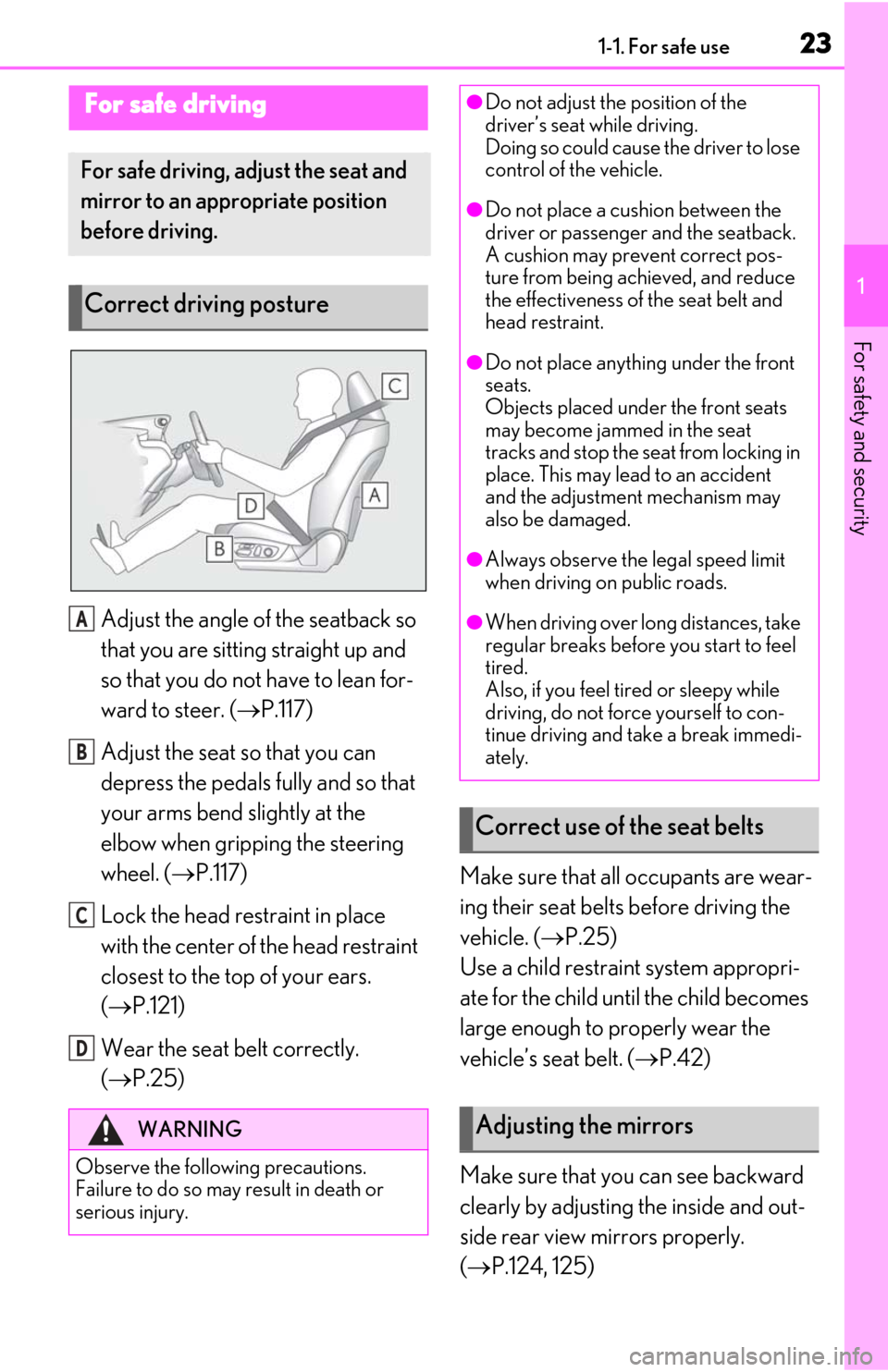
Adjust the angle of the seatback so
that you are sitting straight up and
so that you do not have to lean for-
ward to steer. (P.117)
Adjust the seat so that you can
depress the pedals fully and so that
your arms bend slightly at the
elbow when gripping the steering
wheel. ( P.117)
Lock the head restraint in place
with the center of the head restraint
closest to the top of your ears.
( P.121)
Wear the seat belt correctly.
( P.25) Make sure that all occupants are wear-
ing their seat belts before driving the
vehicle. (
P.25)
Use a child restraint system appropri-
ate for the child until the child becomes
large enough to properly wear the
vehicle’s seat belt. ( P.42)
Make sure that you can see backward
clearly by adjusting the inside and out-
side rear view mirrors properly.
( P.124, 125)
For safe driving
For safe driving, adjust the seat and
mirror to an appropriate position
before driving.
Correct driving posture
WARNING
Observe the following precautions.
Failure to do so may result in death or
serious injury.
A
B
C
D
●Do not adjust the position of the
driver’s seat while driving.
Doing so could cause the driver to lose
control of the vehicle.
●Do not place a cushion between the
driver or passenger and the seatback.
A cushion may prevent correct pos-
ture from being achieved, and reduce
the effectiveness of the seat belt and
head restraint.
●Do not place anything under the front
seats.
Objects placed under the front seats
may become jammed in the seat
tracks and stop the seat from locking in
place. This may lead to an accident
and the adjustment mechanism may
also be damaged.
●Always observe the legal speed limit
when driving on public roads.
●When driving over long distances, take
regular breaks before you start to feel
tired.
Also, if you feel tired or sleepy while
driving, do not force yourself to con-
tinue driving and take a break immedi-
ately.
Correct use of the seat belts
Adjusting the mirrors
Page 24 of 462
241-1. For safe use
Seat belts
Make sure that all occupants are
wearing their seat belts before driv-
ing the vehicle.
WARNING
Observe the following precautions to
reduce the risk of injury in the event of
sudden braking, sudden swerving or an
accident.
Failure to do so may cause death or seri-
ous injury.
■Wearing a seat belt
●Ensure that all passengers wear a seat
belt.
●Always wear a seat belt properly.
●Each seat belt should be used by one
person only. Do not use a seat belt for
more than one person at once, includ-
ing children.
●Lexus recommends that children be
seated in the rear seat and always use
a seat belt and/or an appropriate child
restraint system.
●To achieve a proper seating position,
do not recline the seat more than nec-
essary. The seat belt is most effective
when the occupants are sitting up
straight and well back in the seats.
●Do not wear the shoulder belt under
your arm.
●Always wear your seat belt low and
snug across your hips.
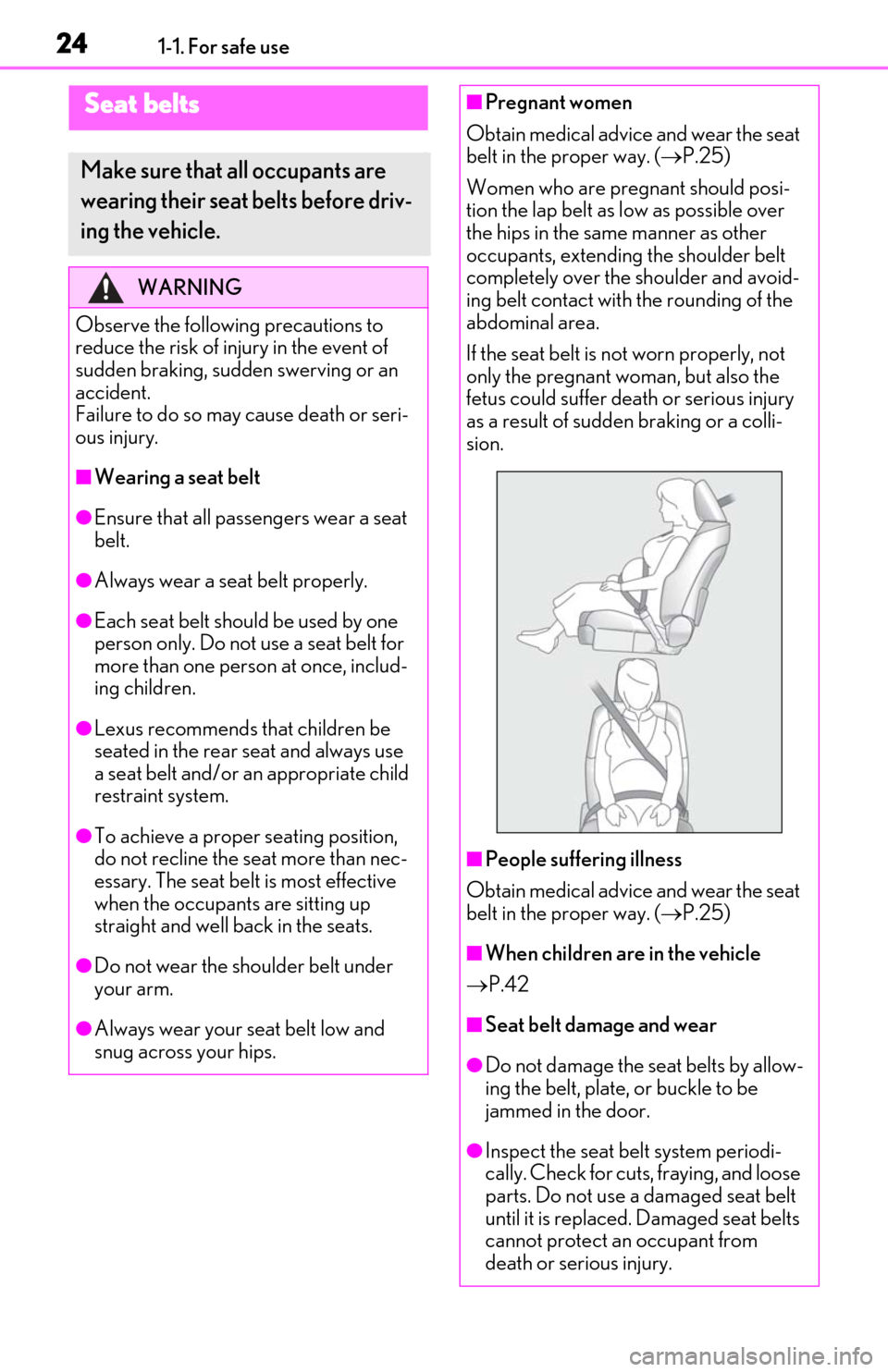
■Pregnant women
Obtain medical advice and wear the seat
belt in the proper way. ( P.25)
Women who are pregnant should posi-
tion the lap belt as low as possible over
the hips in the same manner as other
occupants, extending the shoulder belt
completely over the shoulder and avoid-
ing belt contact with the rounding of the
abdominal area.
If the seat belt is not worn properly, not
only the pregnant woman, but also the
fetus could suffer death or serious injury
as a result of sudden braking or a colli-
sion.
■People suffering illness
Obtain medical advice and wear the seat
belt in the proper way. ( P.25)
■When children are in the vehicle
P.42
■Seat belt damage and wear
●Do not damage the seat belts by allow-
ing the belt, plate, or buckle to be
jammed in the door.
●Inspect the seat belt system periodi-
cally. Check for cuts, fraying, and loose
parts. Do not use a damaged seat belt
until it is replaced. Damaged seat belts
cannot protect an occupant from
death or serious injury.
Page 41 of 462

411-1. For safe use
1
For safety and security
Exhaust gas precautions
Harmful substance to the human
body is included in exhaust gases if
inhaled.
WARNING
Exhaust gases include harmful carbon
monoxide (CO), which is colorless and
odorless. Observe the following precau-
tions.
Failure to do so may cause exhaust gases
enter the vehicle and may lead to an
accident caused by light-headedness, or
may lead to death or a serious health
hazard.
■Important points while driving
●Keep the trunk lid closed.
●If you smell exhaust gases in the vehi-
cle even when the trunk lid is closed,
open the windows and have the vehi-
cle inspected at your Lexus dealer as
soon as possible.
■When parking
●If the vehicle is in a poorly ventilated
area or a closed area, such as a
garage, stop the hybrid system.
●Do not leave the vehicle with the
hybrid system operating for a long
time.
If such a situation cannot be avoided,
park the vehicle in an open space and
ensure that exhaust fumes do not enter
the vehicle interior.
●Do not leave the hybrid system operat-
ing in an area with snow build-up, or
where it is snowing. If snowbanks build
up around the vehicle while the hybrid
system is operating, exhaust gases
may collect and enter the vehicle.
■Exhaust pipe
The exhaust system needs to be checked
periodically. If there is a hole or crack
caused by corrosion, damage to a joint
or abnormal exhaust noise, be sure to
have the vehicle inspected and repaired
by your Lexus dealer.
Page 43 of 462
431-2. Child safety
1
For safety and security
tions for child restraint systems.
Use a child restraint system until the
child becomes large enough to
properly wear the vehicle’s seat belt.
Choose a child restraint system that
suits your vehicle and is appropriate
to the age and size of the child.
■Types of child restraint system installation methods
Confirm with the operation manual enclosed with the child restraint system about
the installation of the child restraint system.
WARNING
■When a child is riding
Observe the following precautions.
Failure to do so may result in death or
serious injury.
●For effective protection in automobile
accidents and sudden stops, a child
must be properly restrained, using a
seat belt or child restraint system
which is correctly installed. For installa-
tion details, refer to the operation man-
ual enclosed with the child restraint
system. General insta llation instruction
is provided in this manual.
●Lexus strongly urges the use of a
proper child restraint system that con-
forms to the weight and size of the
child, installed on the rear seat.
According to accident statistics, the
child is safer when properly restrained
in the rear seat than in the front seat.
●Holding a child in your or someone
else’s arms is not a substitute for a child
restraint system. In an accident, the
child can be crushe d against the wind-
shield or between the holder and the
interior of the vehicle.
■Handling the child restraint system
If the child re straint system is not prop-
erly fixed in place, the child or other pas-
sengers may be seriously injured or even
killed in the event of sudden braking, sud-
den swerving, or an accident.
●If the vehicle were to receive a strong
impact from an accident, etc., it is pos-
sible that the child restraint system has
damage that is not readily visible. In
such cases, do not reuse the restraint
system.
●Make sure you have complied with all
installation instructions provided with
the child restraint system manufac-
turer and that the system is properly
secured.
●Keep the child rest raint system prop-
erly secured on the seat even if it is not
in use. Do not store the child restraint
system unsecured in the passenger
compartment.
●If it is necessary to detach the child
restraint system, remove it from the
vehicle or store it securely in the trunk.
Child restraint system
Page 45 of 462

451-2. Child safety
1
For safety and security
Adjust the lumbar support to the
lowest position.
Adjust the pelvic support
* to the
lowest position.
If the head restraint interferes with
the child restraint system installa-
tion and the head restraint can be
removed, remove the head restraint.
Otherwise, put the head restraint in
the upper most position.
*: If equipped
WARNING
■When using a child restraint system
Observe the following precautions.
Failure to do so may result in death or
serious injury.
●Never install a rear-facing child
restraint system on the front passenger
seat even if the “AIR BAG OFF” indi-
cator light is illuminated. In the event of
an accident, the force of the rapid infla-
tion of the front passenger airbag can
cause death or serious injury to the
child if the rear-facing child restraint
system is installed on the front passen-
ger seat.
●A forward-facing child restraint system
may be installed on the front passen-
ger seat only when it is unavoidable. A
child restraint system that requires a
top tether strap should not be used in
the front passenger seat since there is
no top tether strap anchor for the front
passenger seat.
●A forward-facing child restraint system
may be installed on the front passen-
ger seat only when it is unavoidable.
When installing a forward-facing child
restraint system on the front passenger
seat, adjust the seatback angle to the
most upright position, move the seat to
the rearmost position, and raise the
seat to the upper most position, even if
the “AIR BAG OFF” indicator light is
illuminated.
●Do not allow the child to lean his/her
head or any part of his/her body
against the door or th e area of the seat,
front or rear pillars, or roof side rails
from which the SRS side airbags or
SRS curtain shield airbags deploy even
if the child is seated in the child
restraint system. It is dangerous if the
SRS side and curtain shield airbags
inflate, and the impact could cause
death or serious injury to the child.
Page 60 of 462
601-4. Hybrid system
1-4.Hybrid system
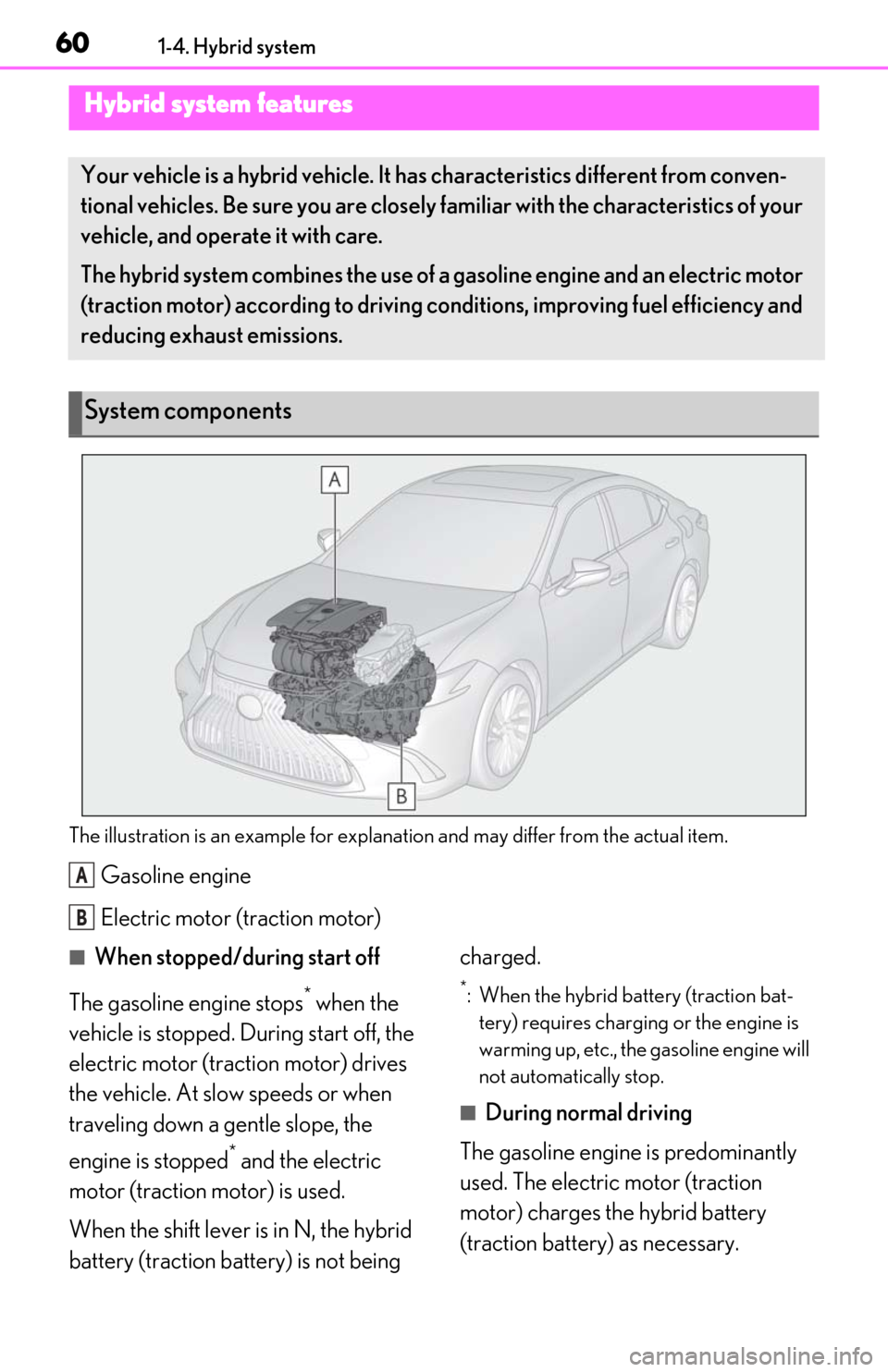
The illustration is an example for explanation and may differ from the actual item.
Gasoline engine
Electric motor (traction motor)
■When stopped/during start off
The gasoline engine stops
* when the
vehicle is stopped. During start off, the
electric motor (traction motor) drives
the vehicle. At slow speeds or when
traveling down a gentle slope, the
engine is stopped
* and the electric
motor (traction motor) is used.
When the shift lever is in N, the hybrid
battery (traction battery) is not being charged.
*: When the hybrid battery (traction bat-
tery) requires charging or the engine is
warming up, etc., the gasoline engine will
not automatically stop.
■During normal driving
The gasoline engine is predominantly
used. The electric motor (traction
motor) charges the hybrid battery
(traction battery) as necessary.
Hybrid system features
Your vehicle is a hybrid vehicle. It has characteristics different from conven-
tional vehicles. Be sure you are closely familiar with the characteristics of your
vehicle, and operate it with care.
The hybrid system combines the use of a gasoline engine and an electric motor
(traction motor) according to driving conditions, improving fuel efficiency and
reducing exhaust emissions.
System components
A
B
Page 61 of 462
611-4. Hybrid system
1
For safety and security
■When accelerating sharply
When the accelerator pedal is
depressed heavily, the power of the
hybrid battery (traction battery) is
added to that of the gasoline engine via
the electric motor (traction motor).
■When braking (regenerative brak-
ing)
The wheels operate the electric motor
(traction motor) as a power generator,
and the hybrid battery (traction bat-
tery) is charged.
■Regenerative braking
In the following situations, kinetic energy is
converted to electric energy and decelera-
tion force can be obta ined in conjunction
with the recharging of the hybrid battery
(traction battery).
●The accelerator pedal is released while
driving with the shift lever in D or S.
●The brake pedal is depressed while driv-
ing with the shift lever in D or S.
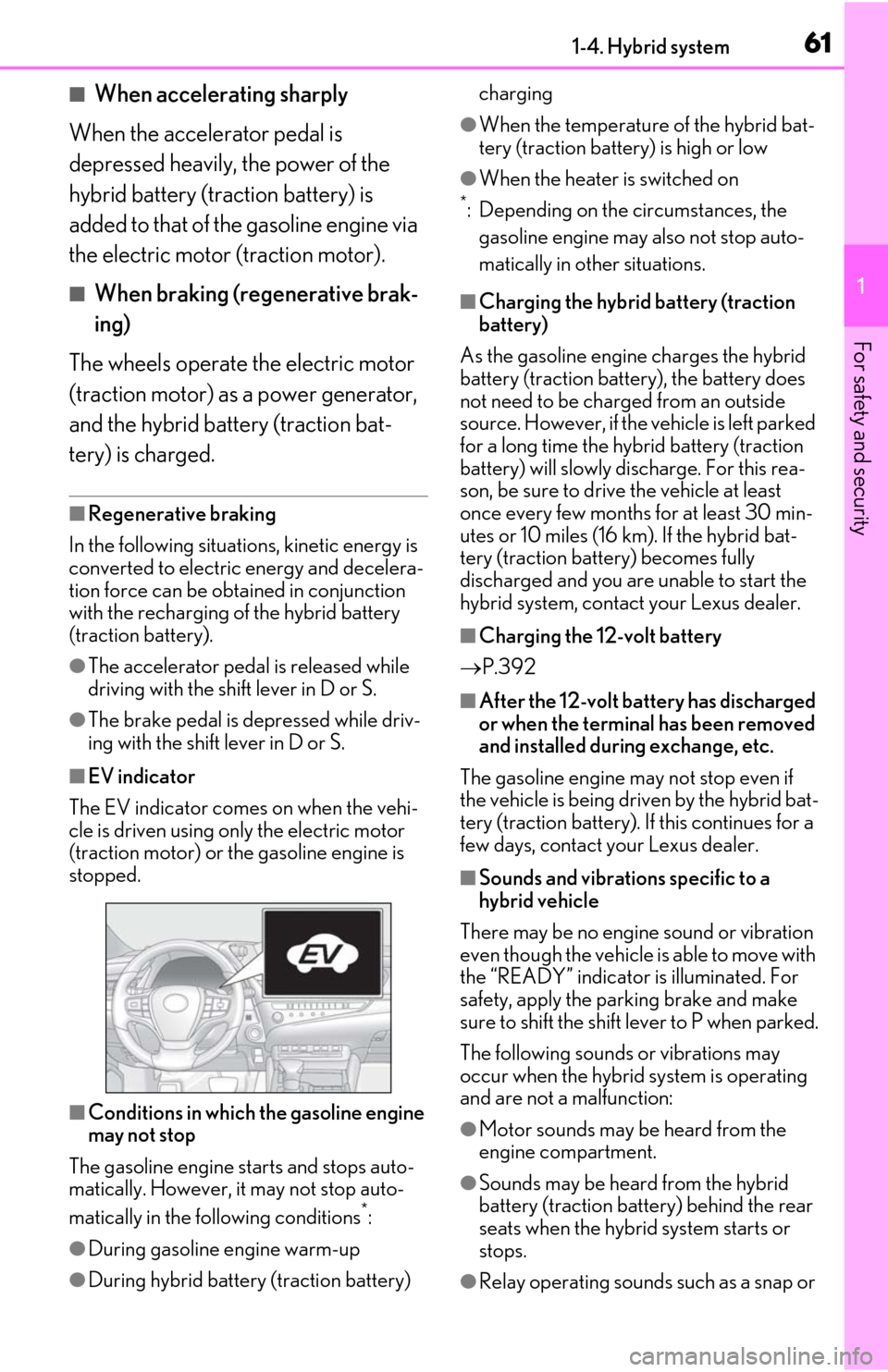
■EV indicator
The EV indicator comes on when the vehi-
cle is driven using only the electric motor
(traction motor) or th e gasoline engine is
stopped.
■Conditions in which the gasoline engine
may not stop
The gasoline engine starts and stops auto-
matically. However, it may not stop auto-
matically in the following conditions
*:
●During gasoline engine warm-up
●During hybrid battery (traction battery) charging
●When the temperature of the hybrid bat-
tery (traction battery) is high or low
●When the heater is switched on*: Depending on the circumstances, the
gasoline engine may also not stop auto-
matically in other situations.
■Charging the hybrid battery (traction
battery)
As the gasoline engine charges the hybrid
battery (traction battery), the battery does
not need to be charged from an outside
source. However, if the vehicle is left parked
for a long time the hybrid battery (traction
battery) will slowly discharge. For this rea-
son, be sure to drive the vehicle at least
once every few months for at least 30 min-
utes or 10 miles (16 km ). If the hybrid bat-
tery (traction battery) becomes fully
discharged and you are unable to start the
hybrid system, contact your Lexus dealer.
■Charging the 12-volt battery
P.392
■After the 12-volt battery has discharged
or when the terminal has been removed
and installed during exchange, etc.
The gasoline engine may not stop even if
the vehicle is being driven by the hybrid bat-
tery (traction battery). If this continues for a
few days, contact your Lexus dealer.
■Sounds and vibrations specific to a
hybrid vehicle
There may be no engine sound or vibration
even though the vehicle is able to move with
the “READY” indicator is illuminated. For
safety, apply the parking brake and make
sure to shift the shift lever to P when parked.
The following sounds or vibrations may
occur when the hybrid system is operating
and are not a malfunction:
●Motor sounds may be heard from the
engine compartment.
●Sounds may be heard from the hybrid
battery (traction battery) behind the rear
seats when the hybrid system starts or
stops.
●Relay operating sounds such as a snap or
Page 69 of 462
691-5. Theft deterrent system
1
For safety and security
■Items to check before locking the
vehicle
To prevent unexpected triggering of
the alarm and vehicle theft, make sure
of the following:
Nobody is in the vehicle.
The windows and moon roof are
closed before the alarm is set.
No valuables or other personal
items are left in the vehicle.
■Setting
Close the doors, trunk and hood, and
lock all the doors. The system will be
set automatically after 30 seconds.
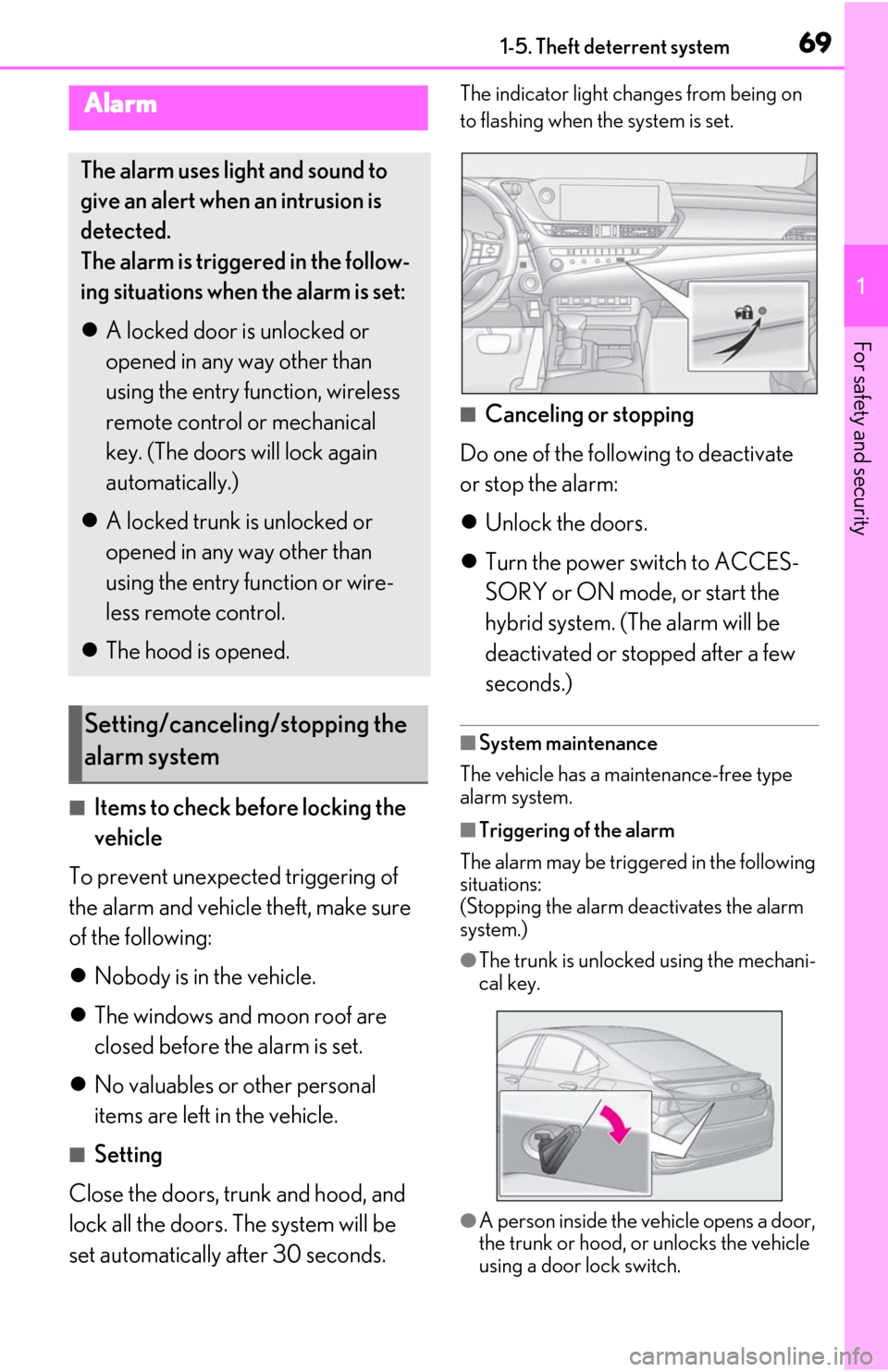
The indicator light changes from being on
to flashing when the system is set.
■Canceling or stopping
Do one of the following to deactivate
or stop the alarm:
Unlock the doors.
Turn the power switch to ACCES-
SORY or ON mode, or start the
hybrid system. (The alarm will be
deactivated or stopped after a few
seconds.)
■System maintenance
The vehicle has a maintenance-free type
alarm system.
■Triggering of the alarm
The alarm may be triggered in the following
situations:
(Stopping the alarm deactivates the alarm
system.)
●The trunk is unlocked using the mechani-
cal key.
●A person inside the vehicle opens a door,
the trunk or hood, or unlocks the vehicle
using a door lock switch.
Alarm
The alarm uses light and sound to
give an alert when an intrusion is
detected.
The alarm is triggered in the follow-
ing situations when the alarm is set:
A locked door is unlocked or
opened in any way other than
using the entry function, wireless
remote control or mechanical
key. (The doors will lock again
automatically.)
A locked trunk is unlocked or
opened in any way other than
using the entry function or wire-
less remote control.
The hood is opened.
Setting/canceling/stopping the
alarm system