ECU Lexus ES350 2008 Service Manual
[x] Cancel search | Manufacturer: LEXUS, Model Year: 2008, Model line: ES350, Model: Lexus ES350 2008Pages: 459, PDF Size: 5.93 MB
Page 354 of 459
352
ES350_U_(L/O_0708)
5-1. Essential information
If your vehicle needs to be towed
Before towingThe following may indicate a problem with your transmission. Contact
your Lexus dealer before towing.
● The engine is running, but the vehicle will not move.
● The vehicle makes an abnormal sound.
Emergency towing
If a tow truck is not available, in an emergency your vehicle may be tem-
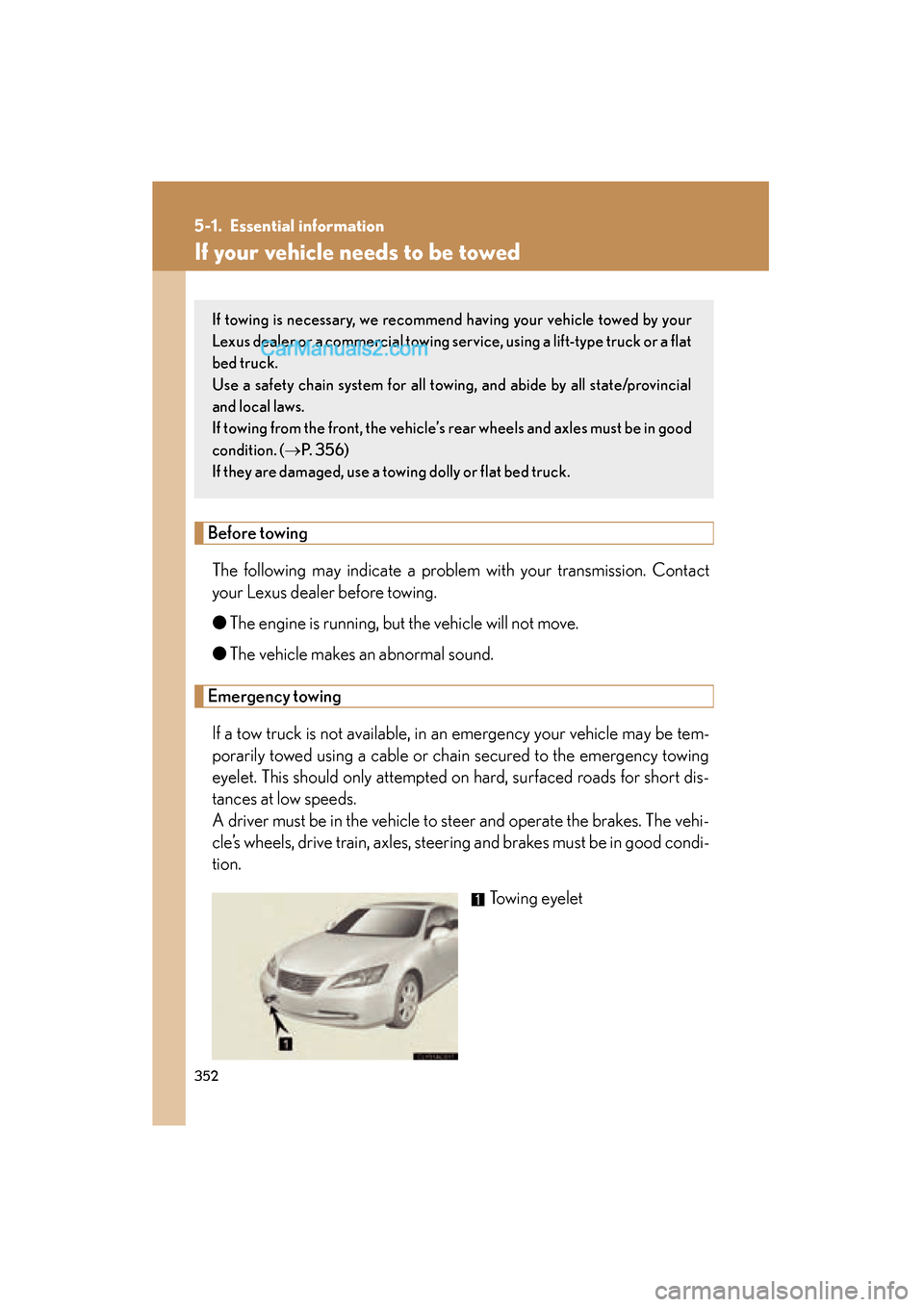
porarily towed using a cable or chain secured to the emergency towing
eyelet. This should only attempted on hard, surfaced roads for short dis-
tances at low speeds.
A driver must be in the vehicle to steer and operate the brakes. The vehi-
cle’s wheels, drive train, axles, steer ing and brakes must be in good condi-
tion.
Towing eyelet
If towing is necessary, we recommend having your vehicle towed by your
Lexus dealer or a commercial towing se rvice, using a lift-type truck or a flat
bed truck.
Use a safety chain system for all towing, and abide by all state/provincial
and local laws.
If towing from the front, the vehicle’s rear wheels and axles must be in good
condition. ( →P. 3 5 6 )
If they are damaged, use a towing dolly or flat bed truck.
Page 356 of 459
354
5-1. Essential information
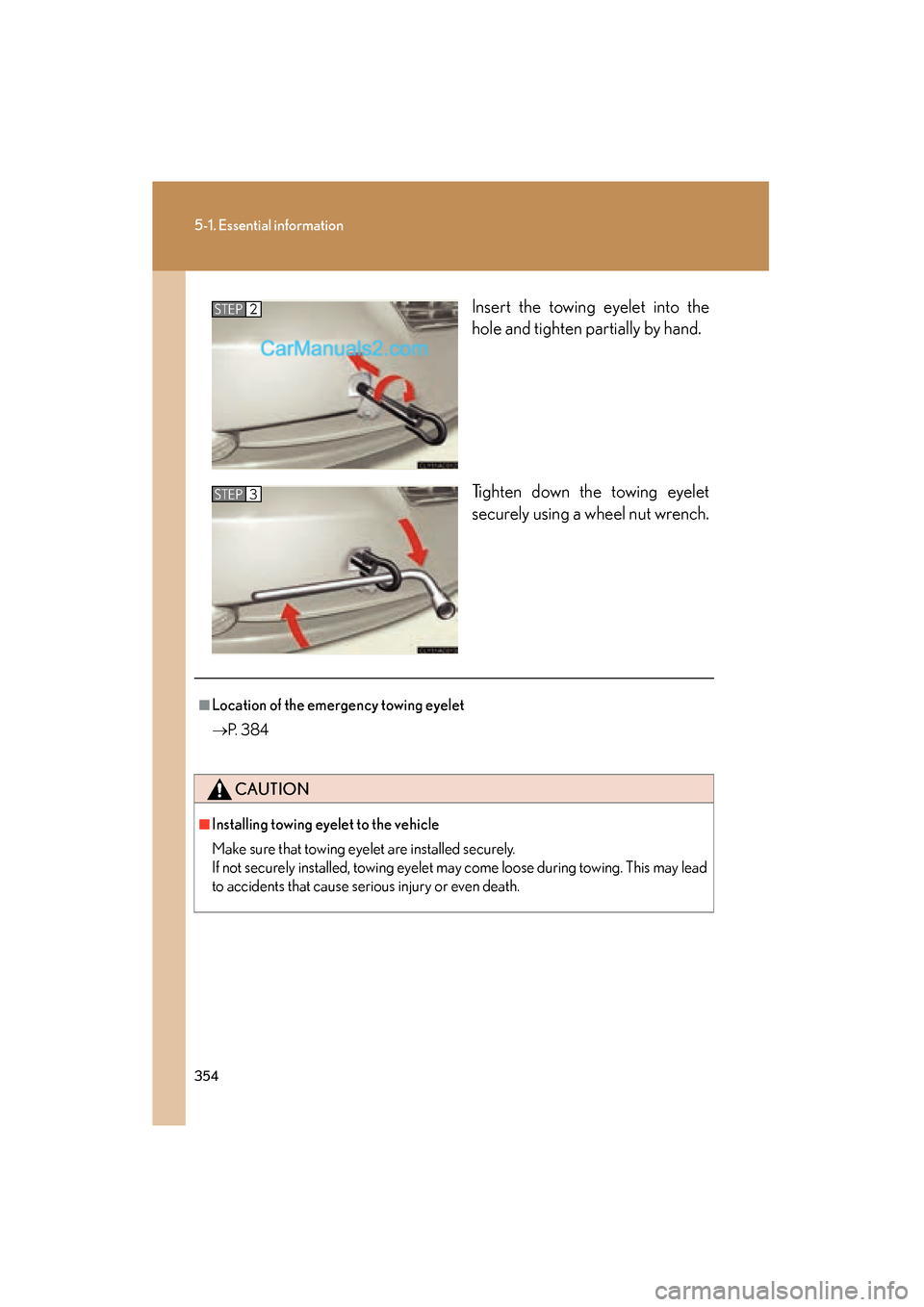
ES350_U_(L/O_0708)Insert the towing eyelet into the
hole and tighten partially by hand.
Tighten down the towing eyelet
securely using a wheel nut wrench.
STEP2
STEP3
■Location of the emergency towing eyelet
→
P. 3 8 4
CAUTION
■Installing towing eyelet to the vehicle
Make sure that towing eyelet are installed securely.
If not securely installed, towing eyelet may come loose during towing. This may lead
to accidents that cause serious injury or even death.
Page 362 of 459
360
5-1. Essential information
ES350_U_(L/O_0708)
Event data recorder
In a crash or a near car crash eventThe SRS airbag sensor assembly contains the EDR. In a crash or a near
car crash event, this device may record some or all of the following infor-
mation:
● Engine speed
● Whether the brake pedal was applied or not
● Vehicle speed
● To what extent the accelerator pedal was depressed
● Position of the transmission shift lever
● Whether the driver and front passenger wore seat belts or not
● Driver's seat position
● Front passenger's occupant classification
● SRS airbag deployment data
● SRS airbag system diagnostic data
The VSC Electronic Control Unit (ECU) may contain another EDR. In
case the VSC or brake assist system is activated, or the lateral accelera-
tion is beyond a certain valve, this device may record some or all of the
following information:
● Behavior of the vehicle
● Steering wheel angle
Your vehicle has computers that monitor and control certain aspects of
your vehicle. These computers assist in driving and maintaining optimal
vehicle performance.
Besides storing data useful for troubleshooting, there is a system to
that record data in a crash or a near car crash event.
Page 363 of 459
5
When trouble arises
361
5-1. Essential information
ES350_U_(L/O_0708)●
Vehicle speed
● To what extent the accelerator pedal was depressed
● To what extent the brake pedal was applied
● To what extent the ECU controlled the condition of the 4 wheels
● Vehicle stability control system diagnostic data
The information above is intended to be used for the purpose of improv-
ing vehicle safety performance. Unlike general data recorders, the EDR
does not record sound data such as conversation between passengers.
Disclosure of the data
Lexus will not disclose the data recorded in an EDR to a third party
except when:
● An agreement from the vehicle's owner (or the leasing company for a
leased vehicle) is obtained
● Officially requested by the police or other authorities
● Used as a defense for Lexus in a law suit
● Ordered by a court law
However, if necessary Lexus will:
● Use the data for research on Lexus vehicle safety performance
● Disclose the data to a third party for research purposes without dis-
closing details of the vehicle owner, and only when it is deemed neces-
sary
● Disclose summarized data cleared of vehicle identification information
to a non-Lexus organization for research purposes
Page 368 of 459
366
5-2. Steps to take in an emergency
ES350_U_(L/O_0708)
*1: Open door warning buzzer:
→P. 3 76
*2: Driver's and front passenger’s seat belt reminders:
The driver’s and front passenger’s seat belts reminder sounds to alert the
driver and front passenger that his or he r sear belt is not fastened. The buzzer
sounds intermittently for 10 seconds after the vehicle has reached a speed of
at least 12 mph (20 km/h). Then, if the seat belt is still unfastened, the buzzer
will sound in a different tone for 20 more seconds.
Master warning light
A buzzer sounds and the
warning light comes on and
flashes to indicate that the
master warning system has
detected a malfunction.
→ P. 3 7 3
■First check when the malfunction indicator lamp comes on while driving
Check the following:
●Is the fuel tank empty?
If it is, fill the fuel tank immediately.
●Is the fuel tank cap loose?
If it is, tighten it securely.
The lamp will go off after taking several driving trips.
If the lamp does not go off even after several trips, contact your Lexus dealer as
soon as possible.
Warning lightWarning light/DetailsCorrection procedure
Page 369 of 459
5
When trouble arises
367
5-2. Steps to take in an emergency
ES350_U_(L/O_0708)
■SRS warning light
This warning light system monitors the following:
• The airbag sensor assembly
• The front airbag sensors
• The side and curtain shield airbag sensor assemblies
• The curtain shield airbag sensor assemblies
• The driver’s seat position sensor
• The driver’s seat belt buckle switch
• Occupant detection system (ECU and sensors)
• AIR BAG ON and AIR BAG OFF indicator lights
• Front passenger’s seat belt buckle switch
• The seat belt pretensioner assemblies
• The inflators
• The interconnecting wiring and power sources
■Front passenger detection sensor and passenger seat belt reminder
If luggage or other load is placed on the front passenger seat, depending on its
weight, the reminder light may flash and buzzer may sound.
■When the tire pressure warning light comes on
Check the tire inflation pressure and adjust to the appropriate level. Pushing the tire
pressure warning reset switch does not turn off the tire pressure warning light.
■The tire pressure warning light may turn on due to natural causes
The tire pressure warning light may turn on due to natural causes such as natural air
leaks or tire inflation pressure changes caused by temperature. In this case, adjust-
ing the tire inflation pressure will turn off the warning light (after a few minutes).
Page 387 of 459
5
When trouble arises
385
5-2. Steps to take in an emergency
ES350_U_(L/O_0708)
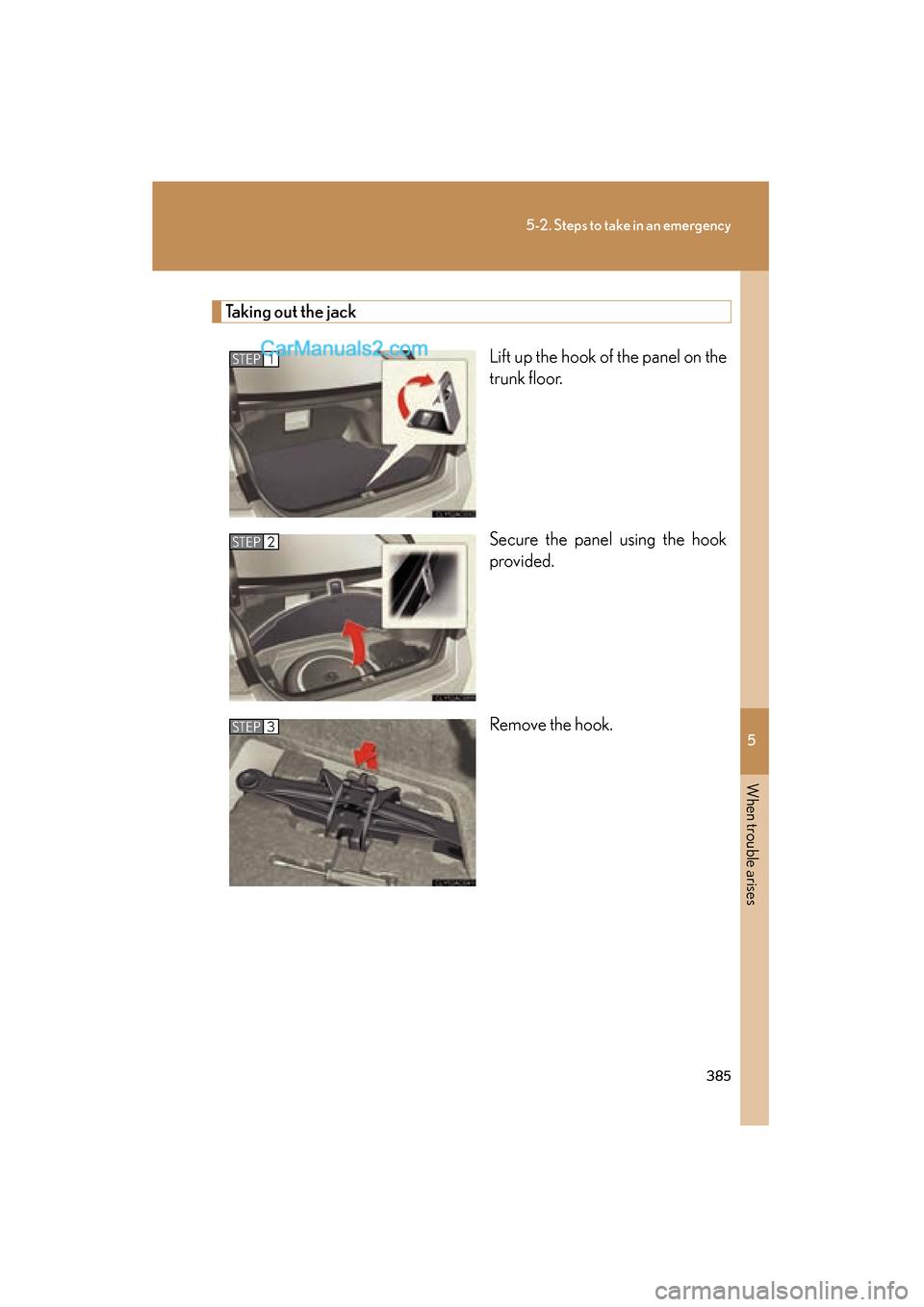
Taking out the jackLift up the hook of the panel on the
trunk floor.
Secure the panel using the hook
provided.
Remove the hook.
STEP1
STEP2
STEP3
Page 388 of 459
386
5-2. Steps to take in an emergency
ES350_U_(L/O_0708)
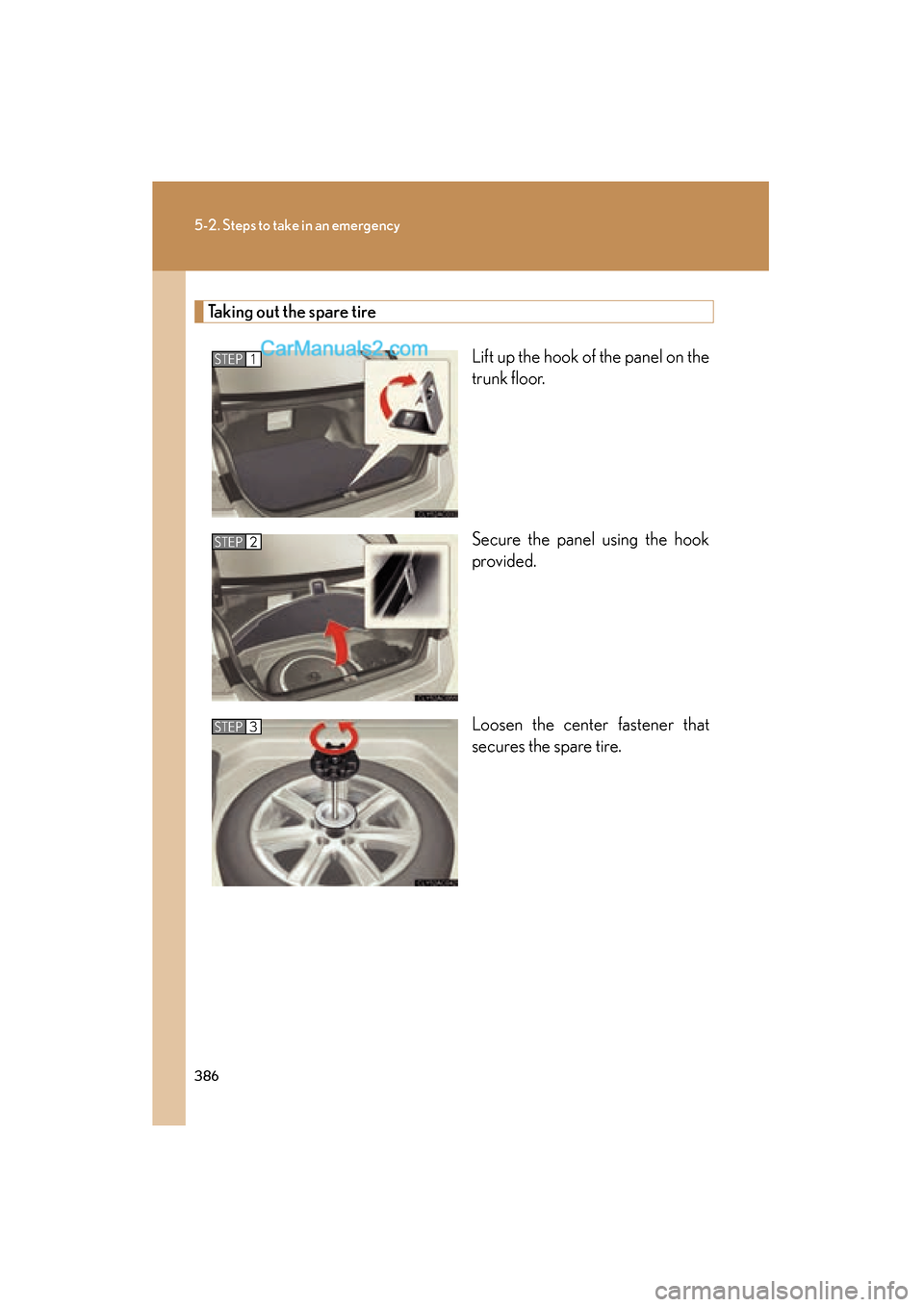
Taking out the spare tireLift up the hook of the panel on the
trunk floor.
Secure the panel using the hook
provided.
Loosen the center fastener that
secures the spare tire.
STEP1
STEP2
STEP3
Page 393 of 459

5
When trouble arises
391
5-2. Steps to take in an emergency
ES350_U_(L/O_0708)
CAUTION
■Using the tire jack
Improper use of the tire jack may lead to death or injuries due to the vehicle sud-
denly falling off the jack.
●Do not use the tire jack for any purpose other than replacing tires or installing and
removing tire chains.
●Only use the tire jack that comes with this vehicle for replacing a flat tire.
Do not use it on other vehicles, and do not use other tire jacks for replacing tires
on this vehicle.
●Always check that the tire jack is securely set to the jack point.
●Do not put any part of your body under the vehicle supported by a jack.
●Do not start or run the engine while your vehicle is supported by the jack.
●Do not raise the vehicle while someone is in it.
●When raising the vehicle, do not put an object on or under the jack.
●Do not raise the vehicle to a height greater than that required to replace the tire.
●Use a jack stand if it is necessary to get under the vehicle.
Take particular care when lowering the vehicle to ensure that no one working on or
near the vehicle may be injured.
■Replacing a flat tire
Observe the following precautions to reduce the risk of death or serious injury.
●Never use oil or grease on the wheel bolts or wheel nuts.
The oil or grease can cause the wheel nuts to loosen, causing a serious accident.
Remove any oil or grease on the wheel bolts or wheel nuts.
●Have the wheel nuts tightened with a torque wrench to 10.5 kgf•m (103 N•m, 76
ft•lbf) as soon as possible after changing wheels.
Failure to follow these precautions could cause the nuts to loosen and the wheels
may fall off, which could lead to an accident causing death or serious injury.
Page 433 of 459
431
6-1. Specifications
6
Vehicle specifications
ES350_U_(L/O_0708)
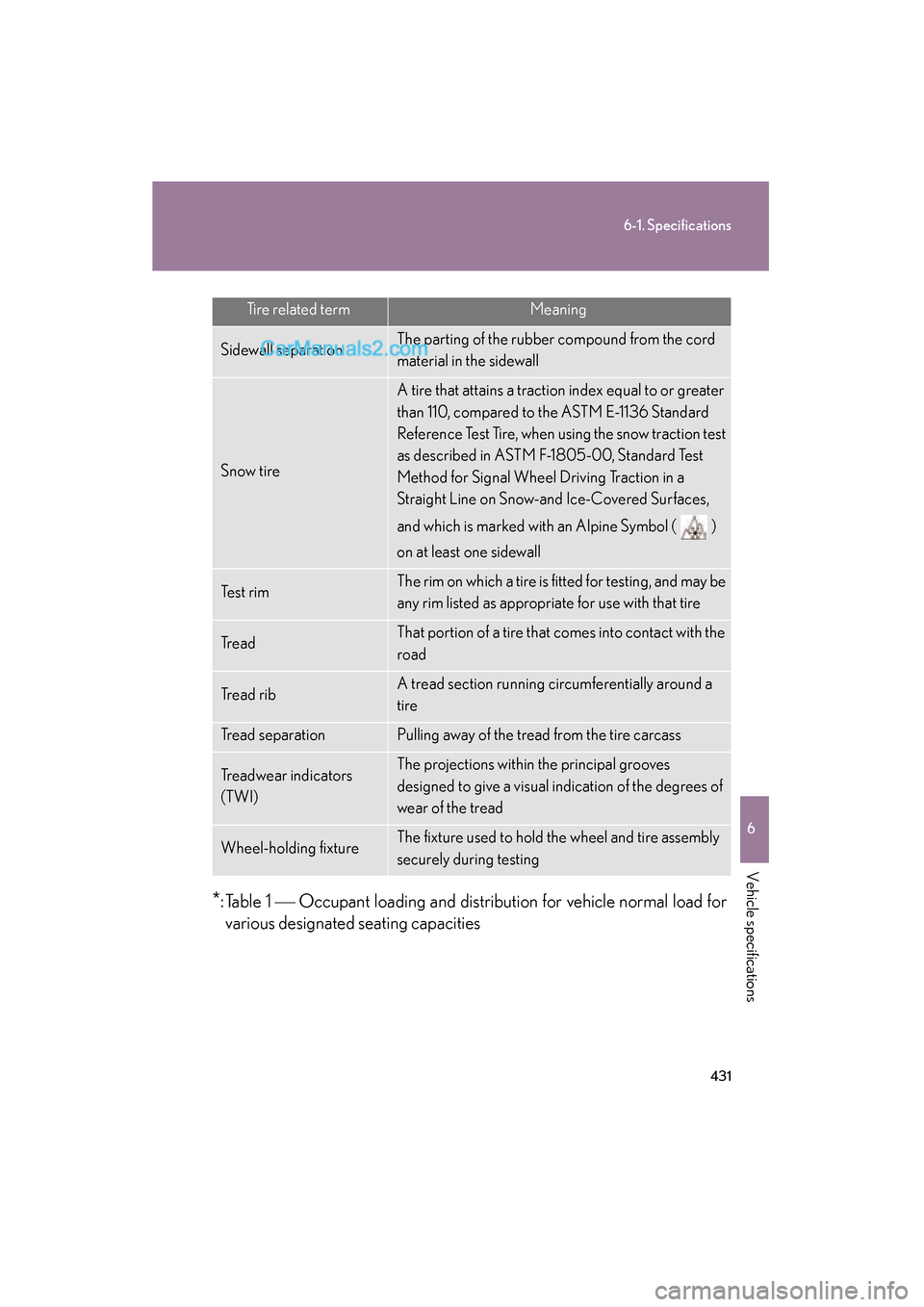
*: Ta b l e 1 Occupant loading and distribution for vehicle normal load forvarious designated seating capacities
Sidewall separationThe parting of the rubber compound from the cord
material in the sidewall
Snow tire
A tire that attains a traction index equal to or greater
than 110, compared to the ASTM E-1136 Standard
Reference Test Tire, when using the snow traction test
as described in ASTM F-1805-00, Standard Test
Method for Signal Wheel Driving Traction in a
Straight Line on Snow-and Ice-Covered Surfaces,
and which is marked with an Alpine Symbol (
)
on at least one sidewall
Te s t r i mThe rim on which a tire is fitted for testing, and may be
any rim listed as appropriate for use with that tire
Tr e a dThat portion of a tire that comes into contact with the
road
Tr e a d r i bA tread section running circumferentially around a
tire
Tread separationPulling away of the tread from the tire carcass
Treadwear indicators
(TWI)The projections within the principal grooves
designed to give a visual indication of the degrees of
wear of the tread
Wheel-holding fixtureThe fixture used to hold the wheel and tire assembly
securely during testing
Tire related termMeaning