wheel Lexus ES350 2016 Owner's Manuals /
[x] Cancel search | Manufacturer: LEXUS, Model Year: 2016, Model line: ES350, Model: Lexus ES350 2016Pages: 576, PDF Size: 8.3 MB
Page 493 of 576
4938-2. Steps to take in an emergency
ES350_OM_OM33B64U_(U)
8
When trouble arises
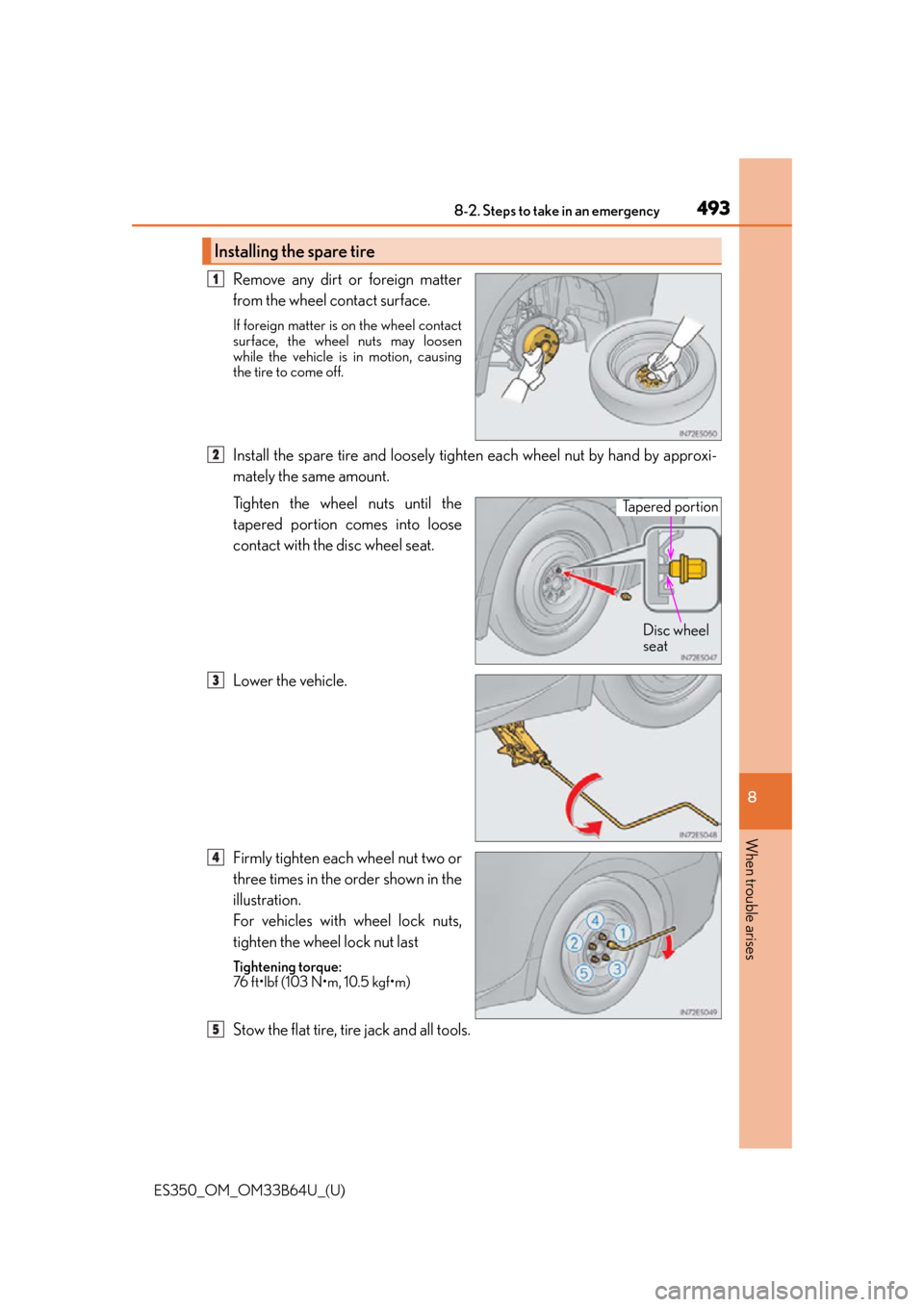
Remove any dirt or foreign matter
from the wheel contact surface.
If foreign matter is on the wheel contact
surface, the wheel nuts may loosen
while the vehicle is in motion, causing
the tire to come off.
Install the spare tire and loosely tighten each wheel nut by hand by approxi-
mately the same amount.
Tighten the wheel nuts until the
tapered portion comes into loose
contact with the disc wheel seat.
Lower the vehicle.
Firmly tighten each wheel nut two or
three times in the order shown in the
illustration.
For vehicles with wheel lock nuts,
tighten the wheel lock nut last
Tightening torque:
76 ft•lbf (103 N•m, 10.5 kgf•m)
Stow the flat tire, tire jack and all tools.
Installing the spare tire
1
2
Tapered portion Disc wheel
seat
3
4
5
Page 494 of 576

4948-2. Steps to take in an emergency
ES350_OM_OM33B64U_(U)
■The compact spare tire
●The compact spare tire is identified by the label “TEMPORARY USE ONLY” on the
tire sidewall.
Use the compact spare tire temporarily, and only in an emergency.
●Make sure to check the tire inflation pressure of the compact spare tire. ( P. 5 1 8 )
■When using the compact spare tire
As the compact spare tire is not equipped wi th a tire pressure warning valve and trans-
mitter, low inflation pressure of the spare ti re will not be indicated by the tire pressure
warning system. Also, if you replace the compact spare tire after the tire pressure warn-
ing light comes on, th e light remains on.
■When the compact spare tire is equipped
The vehicle becomes lower when driving with the compact spare tire compared to when
driving with standard tires.
■If you have a flat front tire on a road covered with snow or ice
Install the compact spare tire on one of the rear wheels of the vehicle. Perform the follow-
ing steps and fit tire chains to the front tires:
Replace a rear tire with the compact spare tire.
Replace the flat front tire with the tire removed from the rear of the vehicle.
Fit tire chains to the front tires.
1
2
3
Page 495 of 576
4958-2. Steps to take in an emergency
ES350_OM_OM33B64U_(U)
8
When trouble arises
WA R N I N G
■When using the compact spare tire
●Remember that the compact spare tire provid ed is specifically designed for use with
your vehicle. Do not use your compact spare tire on another vehicle.
●Do not use more than one compact spare tire simultaneously.
●Replace the compact spare tire with a standard tire as soon as possible.
●Avoid sudden acceleration, ab rupt steering, sudden braking and shifting operations
that cause sudden engine braking.
■When the compact spare tire is attached
The vehicle speed may not be correctly detected, and the following systems may not
operate correctly:
■Speed limit when using the compact spare tire
Do not drive at speeds in excess of 50 mph (80 km/h) when a compact spare tire is
installed on the vehicle.
The compact spare tire is not designed for driving at high speeds. Failure to observe
this precaution may lead to an accident causing death or serious injury.
■After using the tools and jack
Before driving, make sure all the tools and jack are securely in place in their storage
location to reduce the possibility of personal injury during a collision or sudden brak-
ing.
NOTICE
■Driving with tire chains and the compact spare tire
Do not fit tire chains to the compact spare tire.
Tire chains may damage the vehicle body and adversely affect driving performance.
■When replacing the tires
When removing or fitting the wheels, tires or the tire pressure warning valve and trans-
mitter, contact your Lexus dealer as the tire pressure warning valve and transmitter
may be damaged if not handled correctly.
• ABS & Brake assist
•VSC
•TRAC
•Cruise control
• Dynamic radar cruise control
(if equipped)
• PCS (if equipped)
•EPS • LDA (Lane Departure Alert with
steering control) (if equipped)
• Rear view monitor system
(if equipped)
• Intuitive parking assist (if equipped)
• Navigation system (if equipped)
Page 508 of 576
508
ES350_OM_OM33B64U_(U)8-2. Steps to take in an emergency
If the vehicle becomes stuck
Stop the engine. Set the parking brake and shift the shift lever to P.
Remove the mud, snow or sand from around the front wheels.
Place wood, stones or some other material under the front wheels to help pro-
vide traction.
Restart the engine.
Shift the shift lever to D or R and release the parking brake. Then, while exer-
cising caution, depress the accelerator pedal.
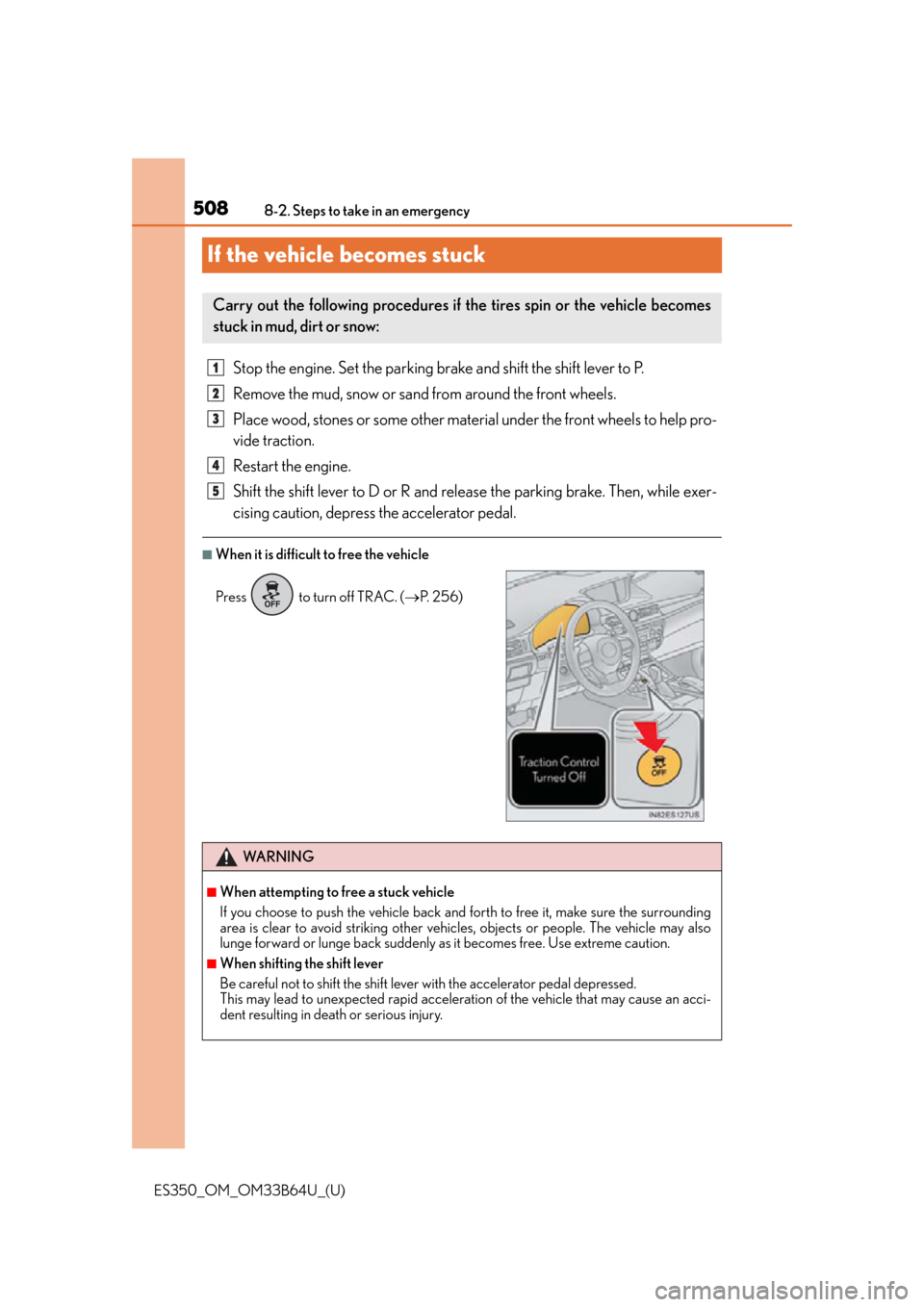
■When it is difficult to free the vehicle
Carry out the following procedures if
the tires spin or the vehicle becomes
stuck in mud, dirt or snow:
Press to turn off TRAC. ( P. 2 5 6 )
WA R N I N G
■When attempting to free a stuck vehicle
If you choose to push the vehicle back and forth to free it, make sure the surrounding
area is clear to avoid striking other vehicl es, objects or people. The vehicle may also
lunge forward or lunge back suddenly as it becomes free. Use extreme caution.
■When shifting the shift lever
Be careful not to shift the shift lever with the accelerator pedal depressed.
This may lead to unexpected rapid accelerati on of the vehicle that may cause an acci-
dent resulting in death or serious injury.
1
2
3
4
5
Page 509 of 576
5098-2. Steps to take in an emergency
ES350_OM_OM33B64U_(U)
8
When trouble arises
NOTICE
■To avoid damaging the transmission and other components
●Avoid spinning the front wheels and depressing the accelerator pedal more than nec-
essary.
●If the vehicle remains stuck even after th ese procedures are performed, the vehicle
may require towing to be freed.
Page 512 of 576
512
ES350_OM_OM33B64U_(U)9-1. Specifications
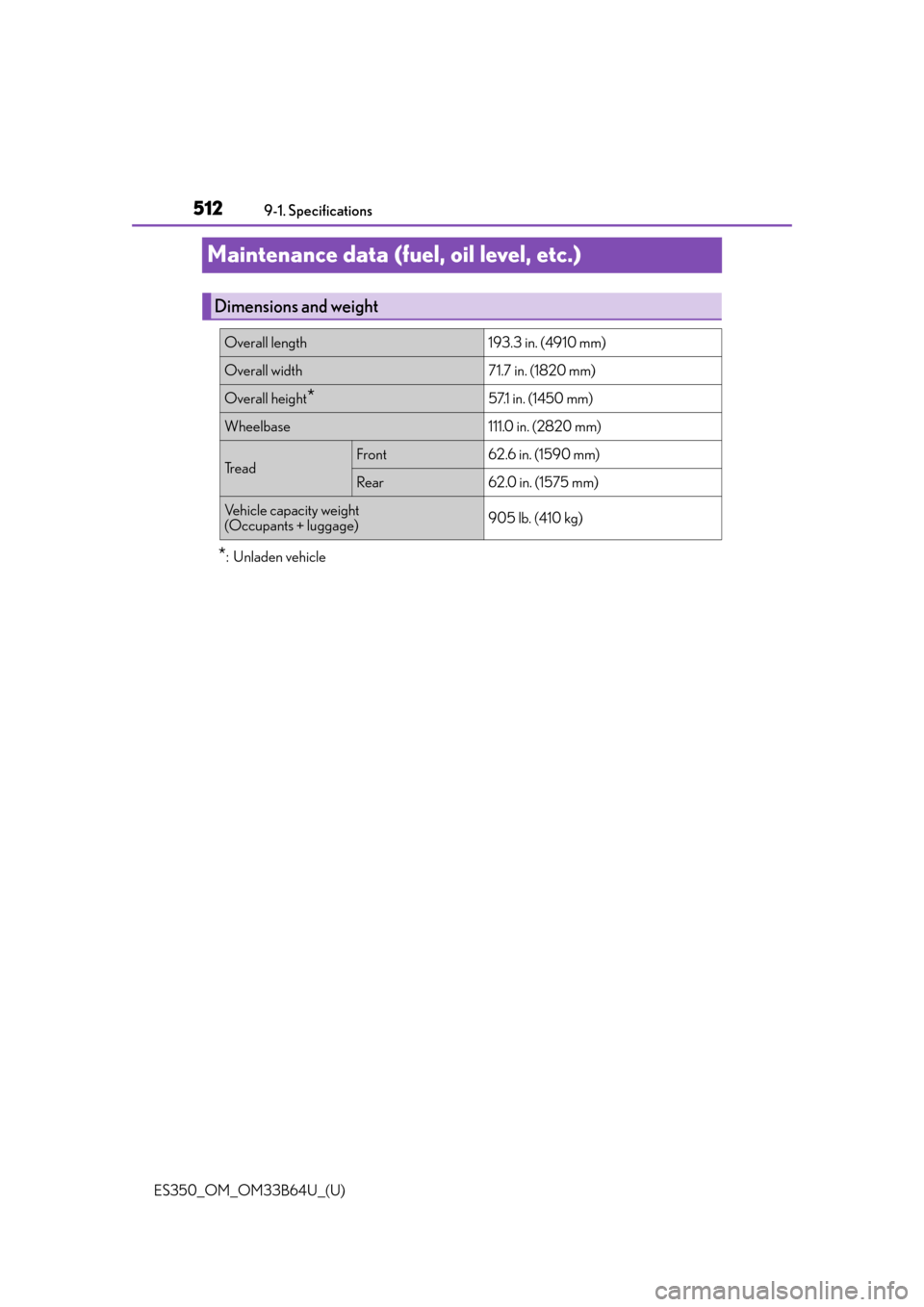
Maintenance data (fuel, oil level, etc.)
*: Unladen vehicle
Dimensions and weight
Overall length193.3 in. (4910 mm)
Overall width71.7 in. (1820 mm)
Overall height*57.1 in. (1450 mm)
Wheelbase111.0 in. (2820 mm)
Tr e a dFront62.6 in. (1590 mm)
Rear62.0 in. (1575 mm)
Vehicle capacity weight
(Occupants + luggage)905 lb. (410 kg)
Page 518 of 576
518
ES350_OM_OM33B64U_(U)9-1. Specifications
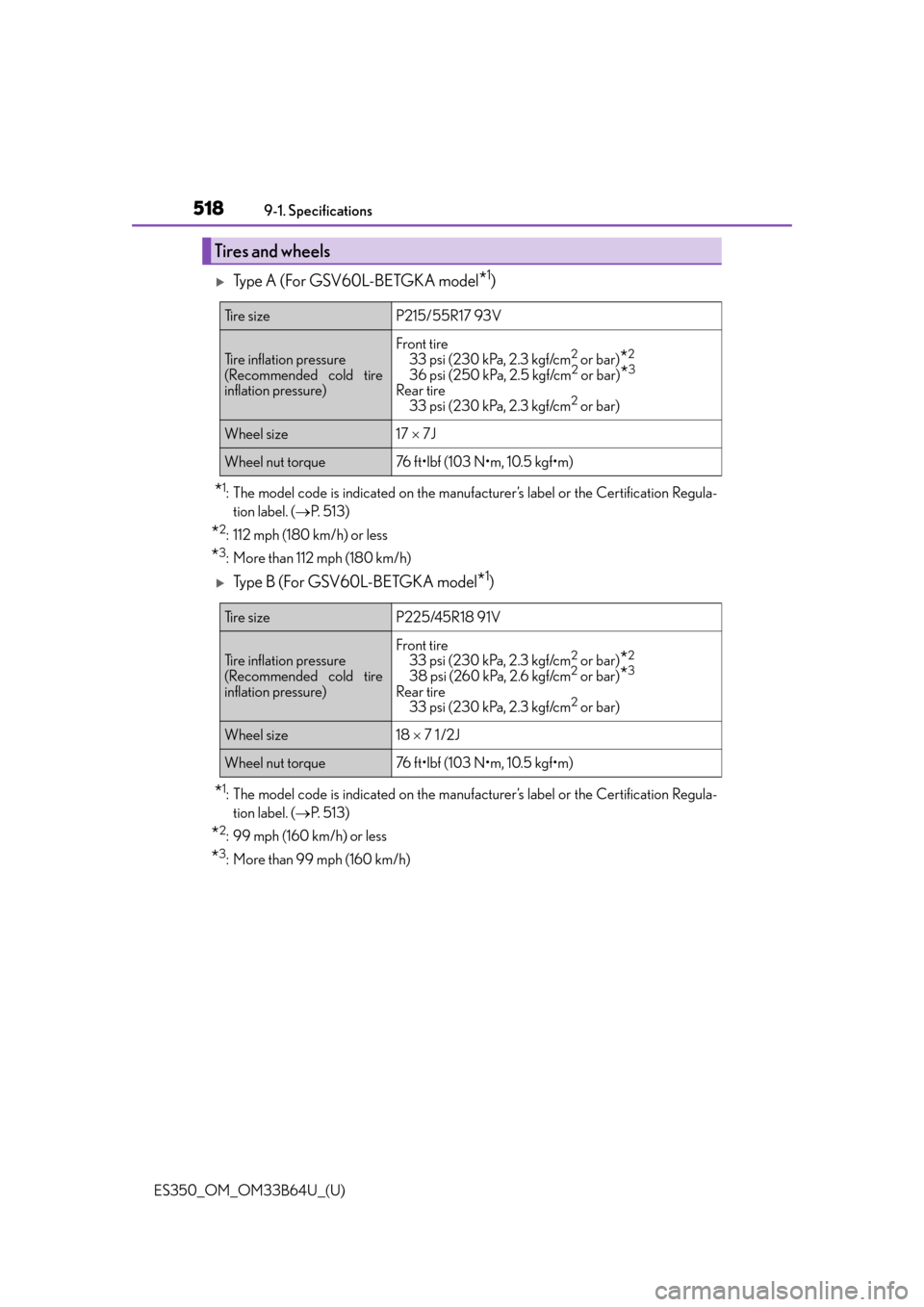
Type A (For GSV60L-BETGKA model*1)
*1: The model code is indicated on the manufa
cturer’s label or the Certification Regula-
tion label. ( P. 5 1 3 )
*2: 112 mph (180 km/h) or less
*3: More than 112 mph (180 km/h)
Type B (For GSV60L-BETGKA model*1)
*1: The model code is indicated on the manufa cturer’s label or the Certification Regula-
tion label. ( P. 5 1 3 )
*2: 99 mph (160 km/h) or less
*3: More than 99 mph (160 km/h)
Tires and wheels
Ti r e s i z eP215/55R17 93V
Tire inflation pressure
(Recommended cold tire
inflation pressure)
Front tire
33 psi (230 kPa, 2.3 kgf/cm2 or bar)*2
36 psi (250 kPa, 2.5 kgf/cm2 or bar)*3
Rear tire33 psi (230 kPa, 2.3 kgf/cm2 or bar)
Wheel size17 7J
Wheel nut torque76 ft•lbf (103 N•m, 10.5 kgf•m)
Ti r e s i z eP225/45R18 91V
Tire inflation pressure
(Recommended cold tire
inflation pressure)Front tire
33 psi (230 kPa, 2.3 kgf/cm2 or bar)*2
38 psi (260 kPa, 2.6 kgf/cm2 or bar)*3
Rear tire33 psi (230 kPa, 2.3 kgf/cm2 or bar)
Wheel size18 7 1 /2J
Wheel nut torque76 ft•lbf (103 N•m, 10.5 kgf•m)
Page 519 of 576
ES350_OM_OM33B64U_(U)
5199-1. Specifications
9
Vehicle specifications
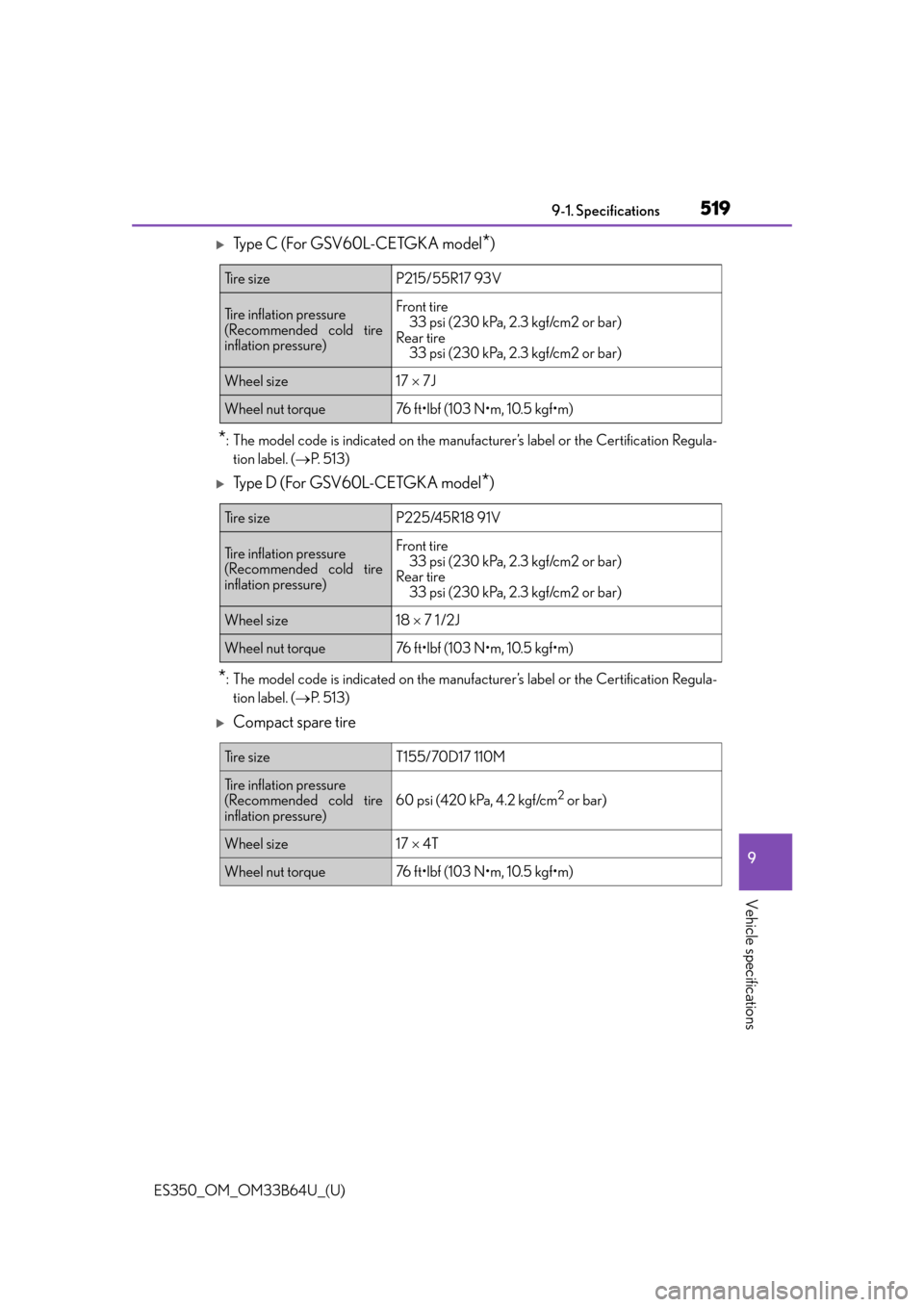
Type C (For GSV60L-CETGKA model*)
*: The model code is indicated on the manufacturer’s label or the Certification Regula-
tion label. ( P. 5 1 3 )
Ty p e D ( F o r G S V 6 0 L - C E T G K A m o d e l*)
*: The model code is indicated on the manufa cturer’s label or the Certification Regula-
tion label. ( P. 5 1 3 )
Compact spare tire
Ti r e s i z eP215/55R17 93V
Tire inflation pressure
(Recommended cold tire
inflation pressure)Front tire
33 psi (230 kPa, 2.3 kgf/cm2 or bar)
Rear tire 33 psi (230 kPa, 2.3 kgf/cm2 or bar)
Wheel size17 7J
Wheel nut torque76 ft•lbf (103 N•m, 10.5 kgf•m)
Ti r e s i z eP225/45R18 91V
Tire inflation pressure
(Recommended cold tire
inflation pressure)Front tire
33 psi (230 kPa, 2.3 kgf/cm2 or bar)
Rear tire
33 psi (230 kPa, 2.3 kgf/cm2 or bar)
Wheel size18 7 1 /2J
Wheel nut torque76 ft•lbf (103 N•m, 10.5 kgf•m)
Ti r e s i z eT155/70D17 110M
Tire inflation pressure
(Recommended cold tire
inflation pressure)60 psi (420 kPa, 4.2 kgf/cm2 or bar)
Wheel size17 4T
Wheel nut torque76 ft•lbf (103 N•m, 10.5 kgf•m)
Page 526 of 576
526
ES350_OM_OM33B64U_(U)9-1. Specifications
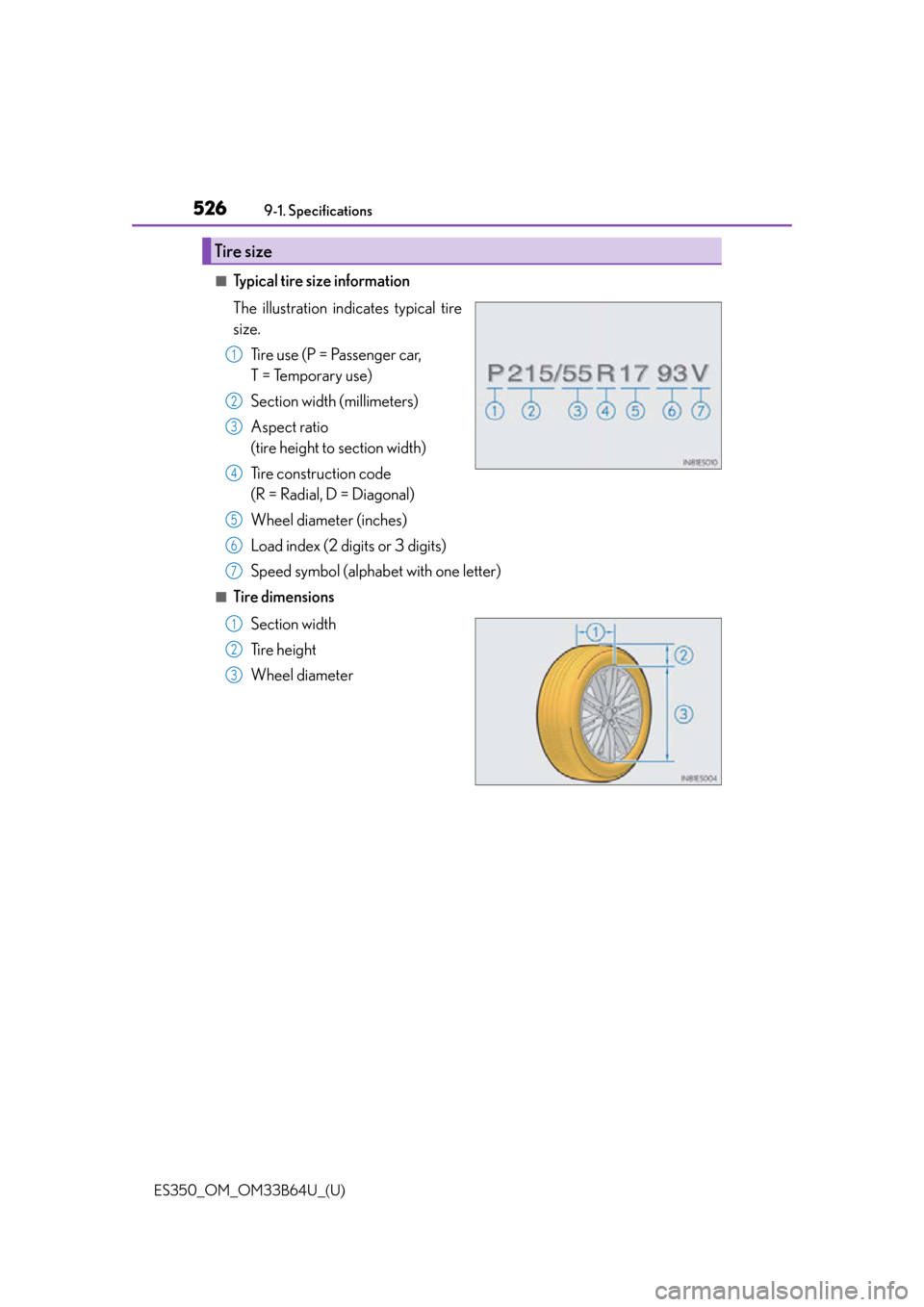
■Typical tire size information
The illustration indicates typical tire
size.
Tire use (P = Passenger car,
T = Temporary use)
Section width (millimeters)
Aspect ratio
(tire height to section width)
Tire construction code
(R = Radial, D = Diagonal)
Wheel diameter (inches)
Load index (2 digits or 3 digits)
Speed symbol (alphabet with one letter)
■Tire dimensions
Section width
Tire height
Wheel diameter
Tire size
1
2
3
4
5
6
7
1
2
3
Page 528 of 576

528
ES350_OM_OM33B64U_(U)9-1. Specifications
■Tr a c t i o n A A , A , B , C
The traction grades, from highest to lowest, are AA, A, B and C, and they rep-
resent the tire’s ability to stop on we
t pavement as measured under controlled
conditions on specified government te st surfaces of asphalt and concrete.
A tire marked C may have poor traction performance.
Warning: The traction grade assigned to this tire is based on braking (straight
ahead) traction tests and does not include cornering (turning) traction.
■Temperature A, B, C
The temperature grades are A (the highes t), B, and C, representing the tire’s
resistance to the generation of heat and its ability to dissipate heat when
tested under controlled conditions on a specified indoor laboratory test
wheel.
Sustained high temperature can cause the material of the tire to degenerate and
reduce tire life, and excessive temperature can lead to sudden tire failure.
Grade C corresponds to a level of perfor mance which all passenger car tires must
meet under the Federal Motor Vehicle Safety Standard No. 109.
Grades B and A represent higher levels of performance on the laboratory test
wheel than the minimum required by law.
Warning: The temperature grades of a tire assume that it is properly inflated and
not overloaded.
Excessive speed, underinflation, or excessiv e loading, either separately or in com-
bination, can cause heat buildup and possible tire failure.