flat tire LEXUS GS300H 2019 Service Manual
[x] Cancel search | Manufacturer: LEXUS, Model Year: 2019, Model line: GS300H, Model: LEXUS GS300H 2019Pages: 600, PDF Size: 55.99 MB
Page 517 of 600
5177-2. Steps to take in an emergency
7
When trouble arises
GS450h_300h_OM_OM30F92E_(EE)
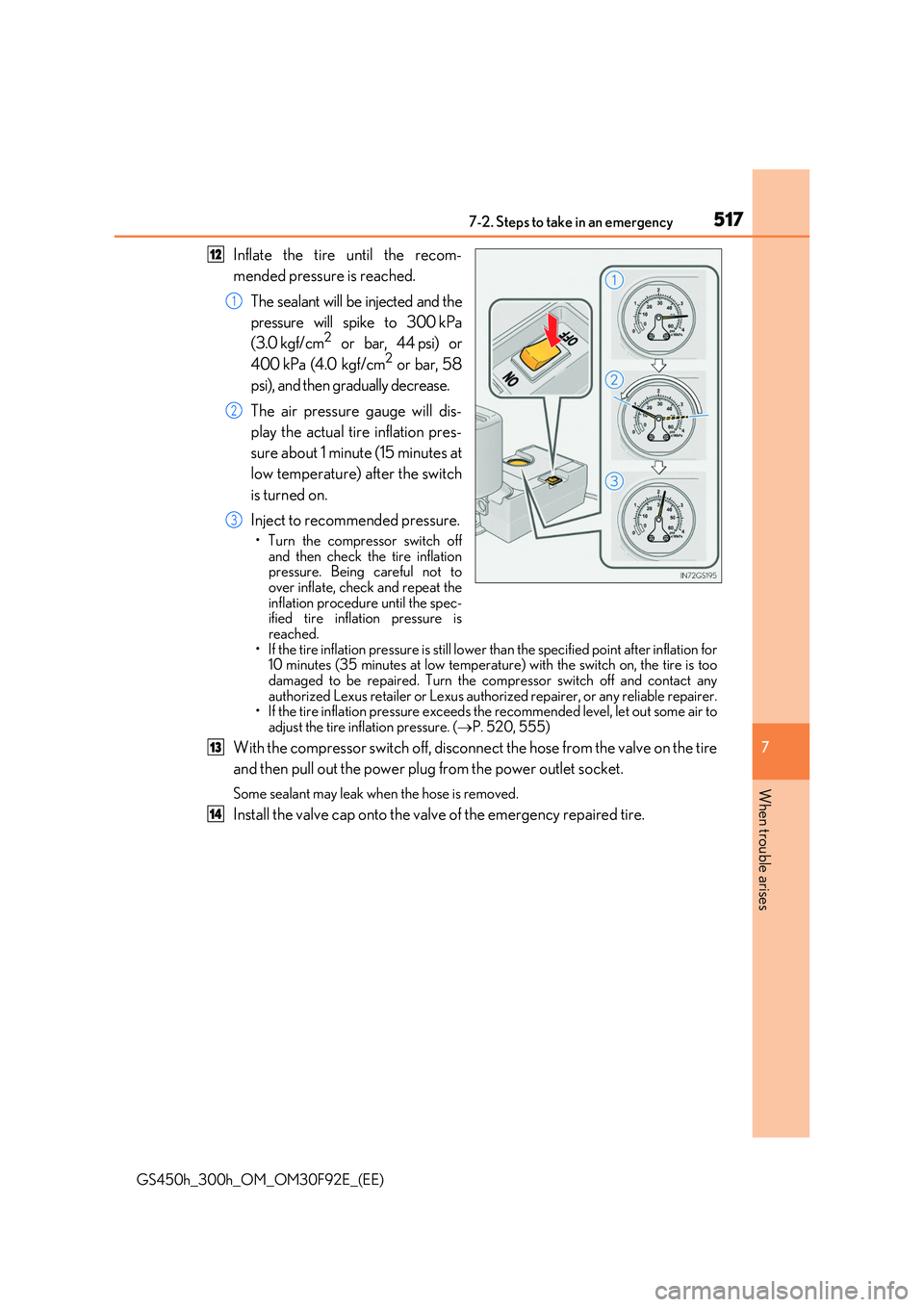
Inflate the tire until the recom-
mended pressure is reached.
The sealant will be injected and the
pressure will spike to 300 kPa
(3.0 kgf/cm2 or bar, 44 psi) or
400 kPa (4.0 kgf/cm2 or bar, 58
psi), and then gradually decrease.
The air pressure gauge will dis-
play the actual tire inflation pres-
sure about 1 minute (15 minutes at
low temperature) after the switch
is turned on.
Inject to recommended pressure.
• Turn the compressor switch off
and then check the tire inflation pressure. Being careful not toover inflate, check and repeat the
inflation procedure until the spec- ified tire inflation pressure isreached.
• If the tire inflation pressure is still lowe r than the specified point after inflation for 10 minutes (35 minutes at low temperature) with the switch on, the tire is toodamaged to be repaired. Turn the compressor switch off and contact any
authorized Lexus retailer or Lexus author ized repairer, or any reliable repairer. • If the tire inflation pressure exceeds th e recommended level, let out some air to adjust the tire inflation pressure. ( P. 520, 555)
With the compressor switch off, disconnect the hose from the valve on the tire
and then pull out the power plug from the power outlet socket.
Some sealant may leak wh en the hose is removed.
Install the valve cap onto the valve of the emergency repaired tire.
12
1
2
3
13
14
Page 518 of 600
5187-2. Steps to take in an emergency
GS450h_300h_OM_OM30F92E_(EE)
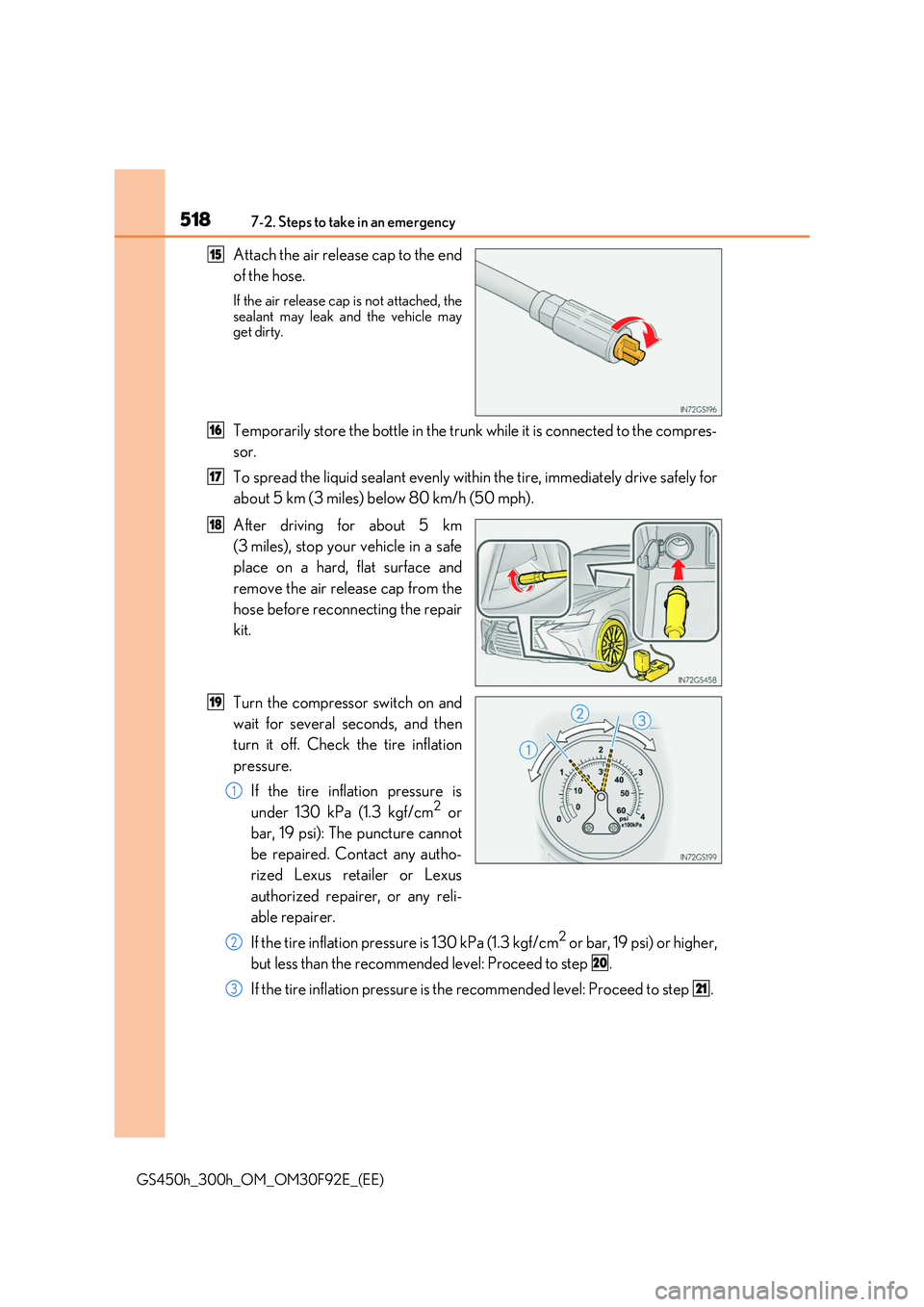
Attach the air release cap to the end
of the hose.
If the air release cap is not attached, the sealant may leak and the vehicle mayget dirty.
Temporarily store the bottle in the trunk while it is connected to the compres-
sor.
To spread the liquid sealant evenly within the tire, immediately drive safely for
about 5 km (3 miles) below 80 km/h (50 mph).
After driving for about 5 km
(3 miles), stop your vehicle in a safe
place on a hard, flat surface and
remove the air release cap from the
hose before reconnecting the repair
kit.
Turn the compressor switch on and
wait for several seconds, and then
turn it off. Check the tire inflation
pressure.
If the tire inflation pressure is
under 130 kPa (1.3 kgf/cm2 or
bar, 19 psi): The puncture cannot
be repaired. Contact any autho-
rized Lexus retailer or Lexus
authorized repairer, or any reli-
able repairer.
If the tire inflation pressure is 130 kPa (1.3 kgf/cm2 or bar, 19 psi) or higher,
but less than the recommended level: Proceed to step .
If the tire inflation pressure is the recommended level: Proceed to step .
15
16
17
18
19
1
2
20
321
Page 519 of 600
5197-2. Steps to take in an emergency
7
When trouble arises
GS450h_300h_OM_OM30F92E_(EE)
Turn the compressor switch on to inflate the tire until the recommended tire
inflation pressure is reached. Drive for about 5 km (3 miles) and then perform
step .
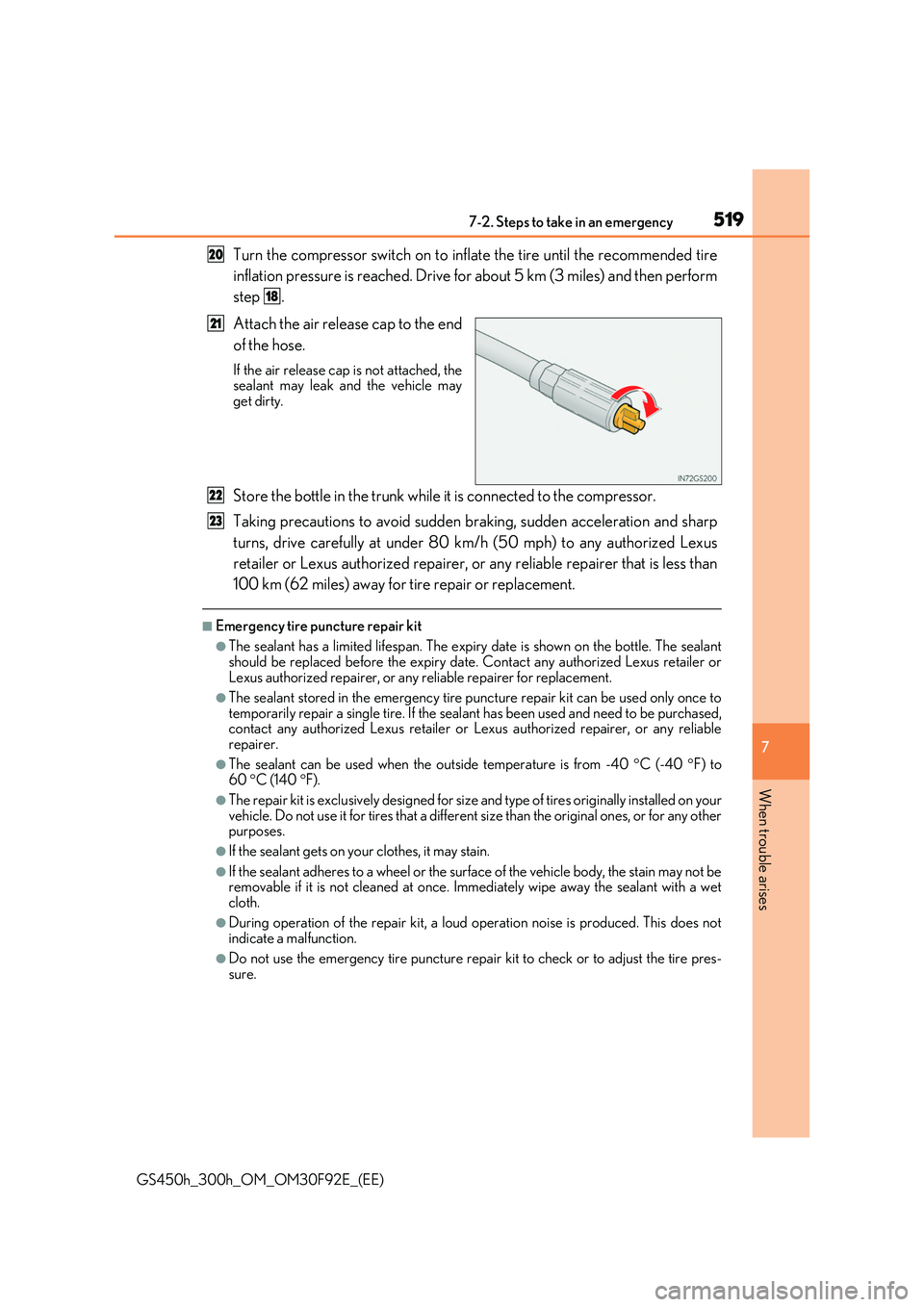
Attach the air release cap to the end
of the hose.
If the air release cap is not attached, the sealant may leak and the vehicle mayget dirty.
Store the bottle in the trunk while it is connected to the compressor.
Taking precautions to avoid sudden braking, sudden acceleration and sharp
turns, drive carefully at under 80 km /h (50 mph) to any authorized Lexus
retailer or Lexus authorized repairer, or any reliable repairer that is less than
100 km (62 miles) away for tire repair or replacement.
■Emergency tire puncture repair kit
●The sealant has a limited lifespa n. The expiry date is shown on the bottle. The sealant
should be replaced before the expiry date. Contact any authorized Lexus retailer or Lexus authorized repairer, or any reliable repairer for replacement.
●The sealant stored in the emergency tire puncture repair kit can be used only once to
temporarily repair a single tire. If the sealant has been used and need to be purchased, contact any authorized Lexus retailer or Lexus authorized repairer, or any reliable repairer.
●The sealant can be used when the outside temperature is from -40 C (-40 F) to 60 C (140 F).
●The repair kit is exclusively designed for size and type of tires originally installed on your
vehicle. Do not use it for tires that a different size than the original ones, or for any other purposes.
●If the sealant gets on your clothes, it may stain.
●If the sealant adheres to a wheel or the surface of the vehicle body, the stain may not beremovable if it is not cleaned at once. Immediately wipe away the sealant with a wetcloth.
●During operation of the repair kit, a loud operation noise is produced. This does not indicate a malfunction.
●Do not use the emergency tire puncture repair kit to check or to adjust the tire pres-
sure.
20
18
21
22
23
Page 520 of 600
5207-2. Steps to take in an emergency
GS450h_300h_OM_OM30F92E_(EE)
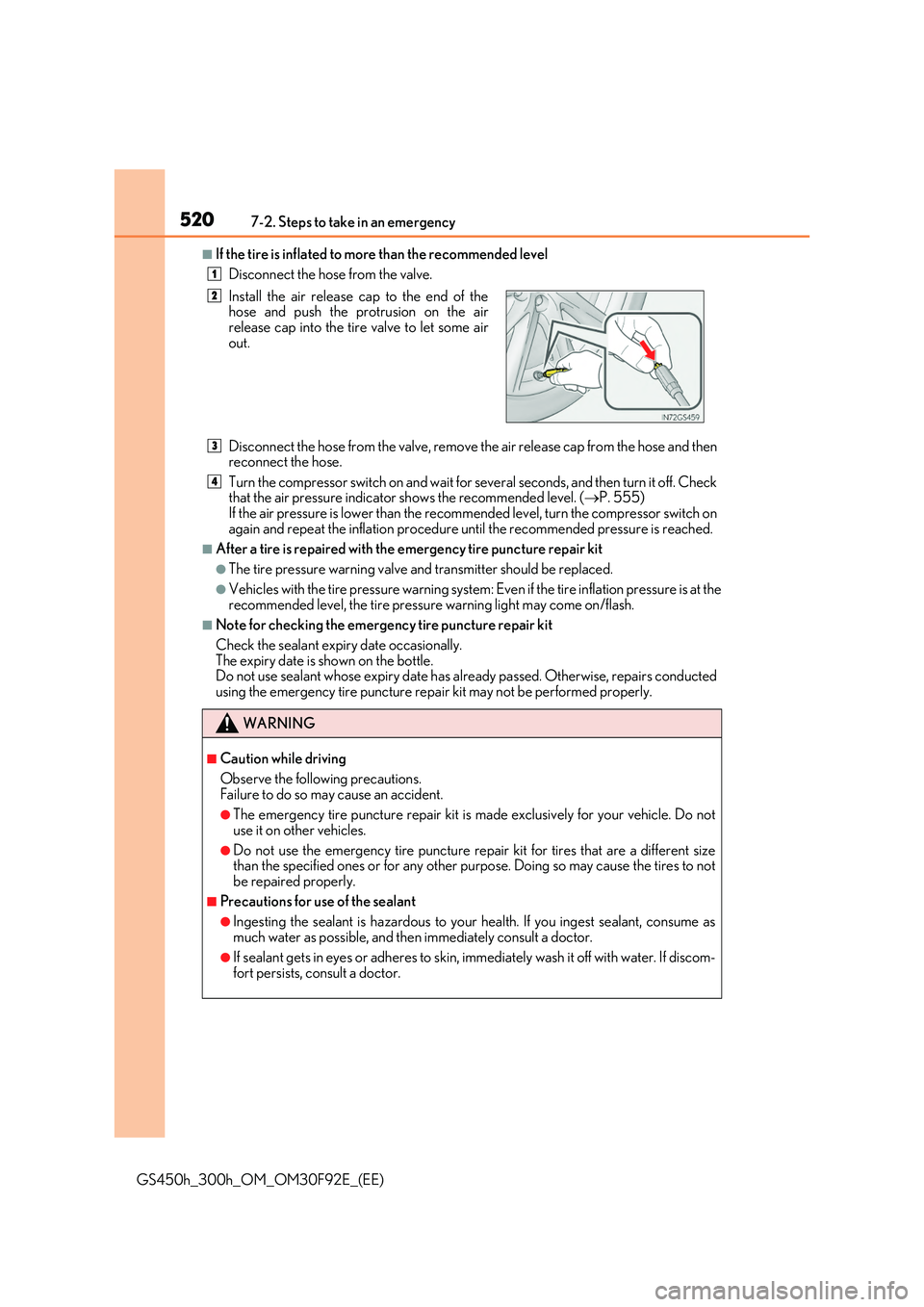
■If the tire is inflated to more than the recommended level
Disconnect the hose from the valve.
Disconnect the hose from the valve, remove the air release cap from the hose and then reconnect the hose.
Turn the compressor switch on and wait for se veral seconds, and then turn it off. Check that the air pressure indicator shows the recommended level. ( P. 555) If the air pressure is lower than the reco mmended level, turn the compressor switch on
again and repeat the inflation procedure un til the recommended pressure is reached.
■After a tire is repaired with the emergency tire puncture repair kit
●The tire pressure warning valve and transmitter should be replaced.
●Vehicles with the tire pressure warning system: Even if the tire inflation pressure is at the recommended level, the ti re pressure warning light may come on/flash.
■Note for checking the emergency tire puncture repair kit
Check the sealant expiry date occasionally. The expiry date is shown on the bottle.Do not use sealant whose expiry date has already passed. Otherwise, repairs conducted
using the emergency tire puncture repair kit may not be performed properly.
Install the air release cap to the end of the hose and push the protrusion on the airrelease cap into the tire valve to let some air
out.
WARNING
■Caution while driving
Observe the following precautions. Failure to do so may cause an accident.
●The emergency tire puncture repair kit is made exclusively for your vehicle. Do not
use it on other vehicles.
●Do not use the emergency tire puncture repair kit for tires that are a different size than the specified ones or fo r any other purpose. Doing so may cause the tires to not
be repaired properly.
■Precautions for use of the sealant
●Ingesting the sealant is hazardous to your health. If you ingest sealant, consume as
much water as possible, and then immediately consult a doctor.
●If sealant gets in eyes or adheres to skin, i mmediately wash it off with water. If discom- fort persists, consult a doctor.
1
2
3
4
Page 521 of 600
5217-2. Steps to take in an emergency
7
When trouble arises
GS450h_300h_OM_OM30F92E_(EE)
WARNING
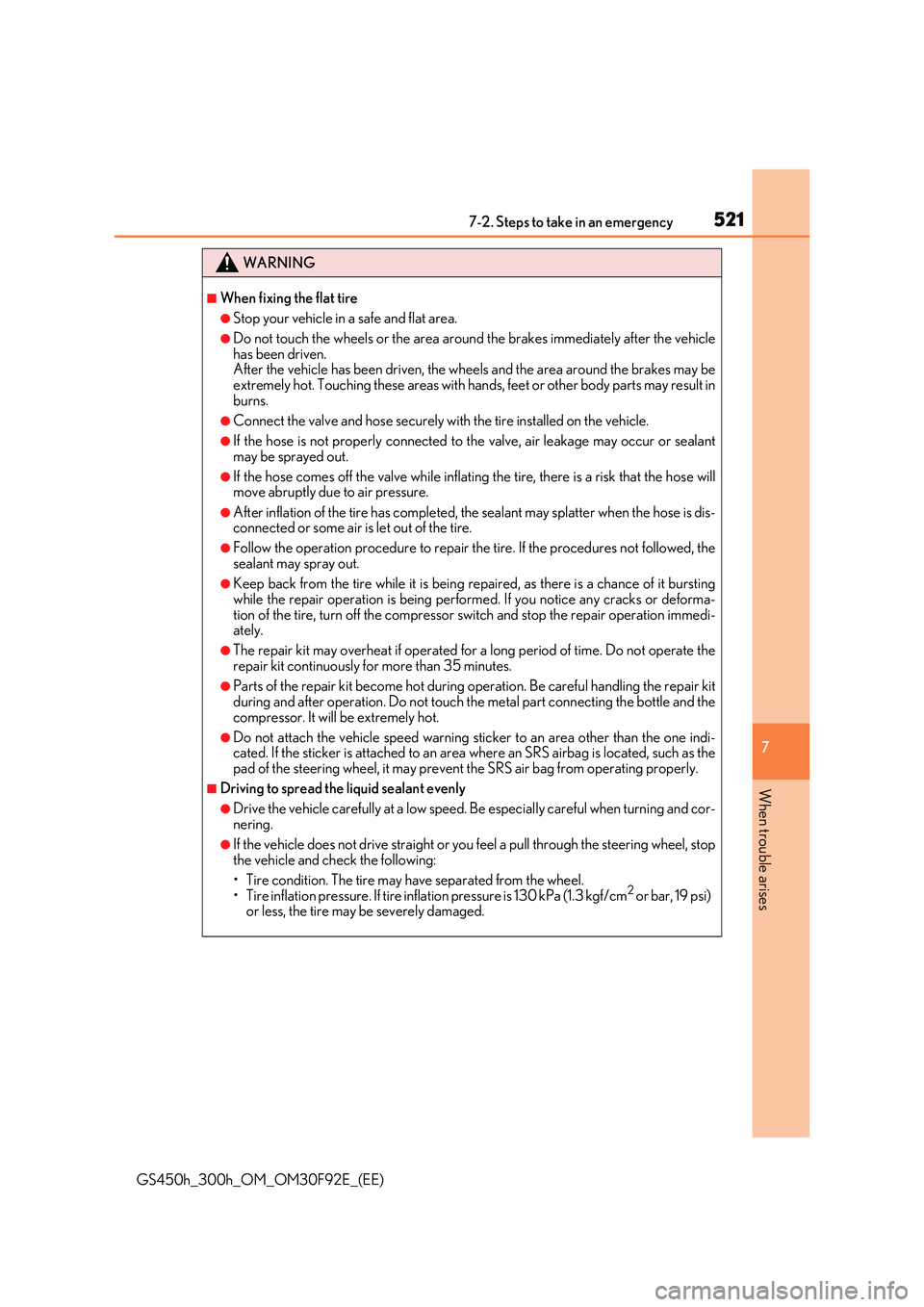
■When fixing the flat tire
●Stop your vehicle in a safe and flat area.
●Do not touch the wheels or the area around the brakes immediately after the vehicle
has been driven. After the vehicle has been driven, the wheels and the area around the brakes may beextremely hot. Touching these areas with hands, feet or other body parts may result in
burns.
●Connect the valve and hose securely with the tire installed on the vehicle.
●If the hose is not properly connected to the valve, air leakage may occur or sealant
may be sprayed out.
●If the hose comes off the valve while inflating the tire, there is a risk that the hose will move abruptly due to air pressure.
●After inflation of the tire has completed, the sealant may splatter when the hose is dis-connected or some air is let out of the tire.
●Follow the operation procedure to repair the tire. If the procedures not followed, the
sealant may spray out.
●Keep back from the tire while it is being repaired, as there is a chance of it bursting while the repair operation is being performe d. If you notice any cracks or deforma-
tion of the tire, turn off the compressor switch and stop the repair operation immedi- ately.
●The repair kit may overheat if operated for a long period of time. Do not operate the
repair kit continuously for more than 35 minutes.
●Parts of the repair kit become hot during op eration. Be careful handling the repair kit during and after operation. Do not touch the metal part connecting the bottle and the
compressor. It will be extremely hot.
●Do not attach the vehicle speed warning sticker to an area other than the one indi- cated. If the sticker is attached to an area where an SRS airbag is located, such as the
pad of the steering wheel, it may prevent the SRS air bag from operating properly.
■Driving to spread the liquid sealant evenly
●Drive the vehicle carefully at a low speed. Be especially careful when turning and cor-
nering.
●If the vehicle does not drive straight or you feel a pull through the steering wheel, stop the vehicle and check the following:
• Tire condition. The tire may have separated from the wheel. • Tire inflation pressure. If tire inflation pressure is 130 kPa (1.3 kgf/cm2 or b ar, 1 9 p si)or less, the tire may be severely damaged.
Page 555 of 600
555
8
8-1. Specifications
Vehicle specifications
GS450h_300h_OM_OM30F92E_(EE)
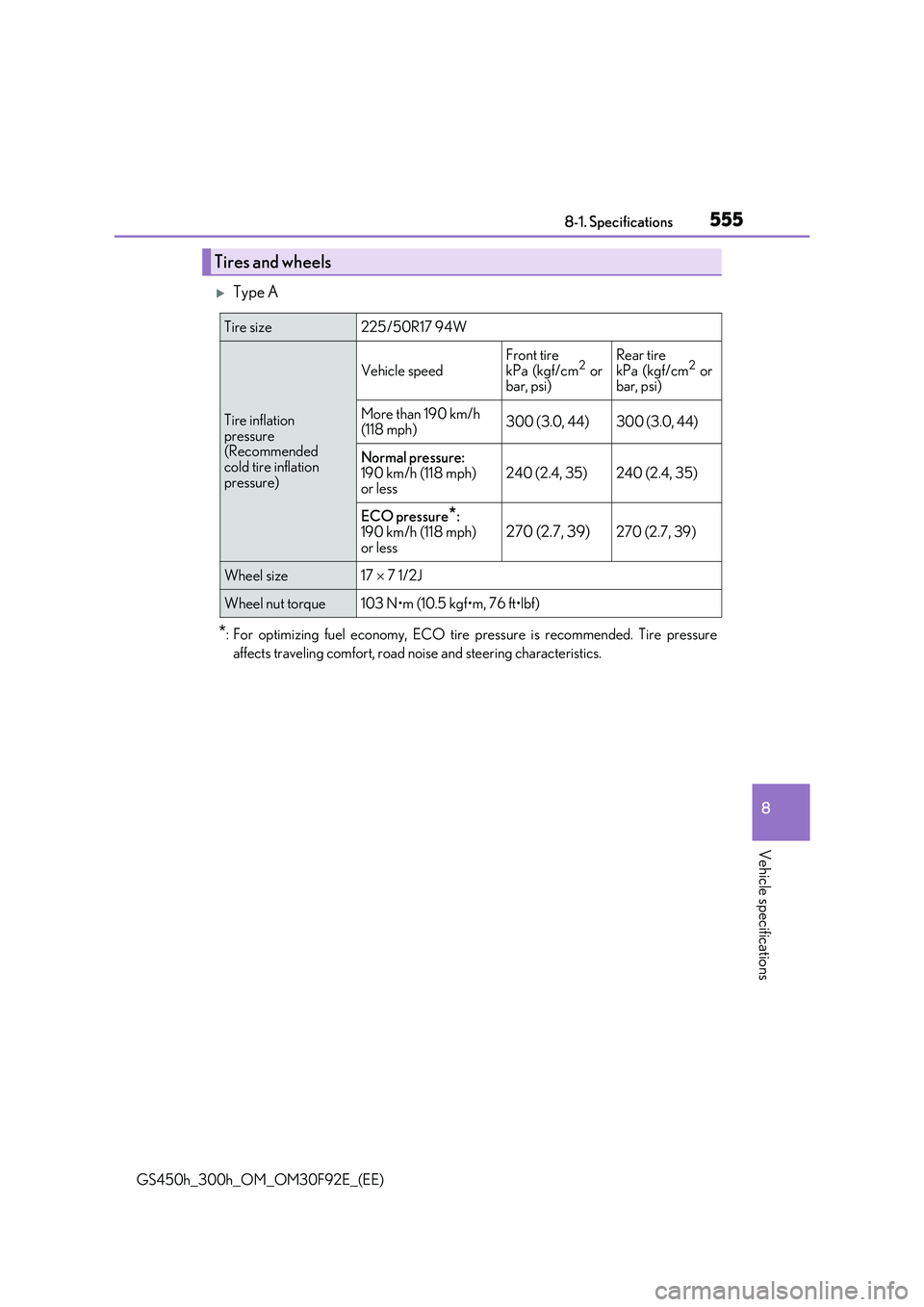
Type A
*: For optimizing fuel economy, ECO tire pressure is recommended. Tire pressure
affects traveling comfort, road noise and steering characteristics.
Tires and wheels
Tire size225/50R17 94W
Tire inflation
pressure (Recommended cold tire inflation
pressure)
Vehicle speed
Front tire
kPa (kgf/cm2 or bar, psi)
Rear tire
kPa (kgf/cm2 or bar, psi)
More than 190 km/h(118 mph)300 (3.0, 44)300 (3.0, 44)
Normal pressure:
190 km/h (118 mph) or less240 (2.4, 35)240 (2.4, 35)
ECO pressure*:190 km/h (118 mph)
or less270 (2.7, 39)270 (2.7, 39)
Wheel size17 7 1/2J
Wheel nut torque103 N•m (10.5 kgf•m, 76 ft•lbf)
Page 556 of 600
5568-1. Specifications
GS450h_300h_OM_OM30F92E_(EE)
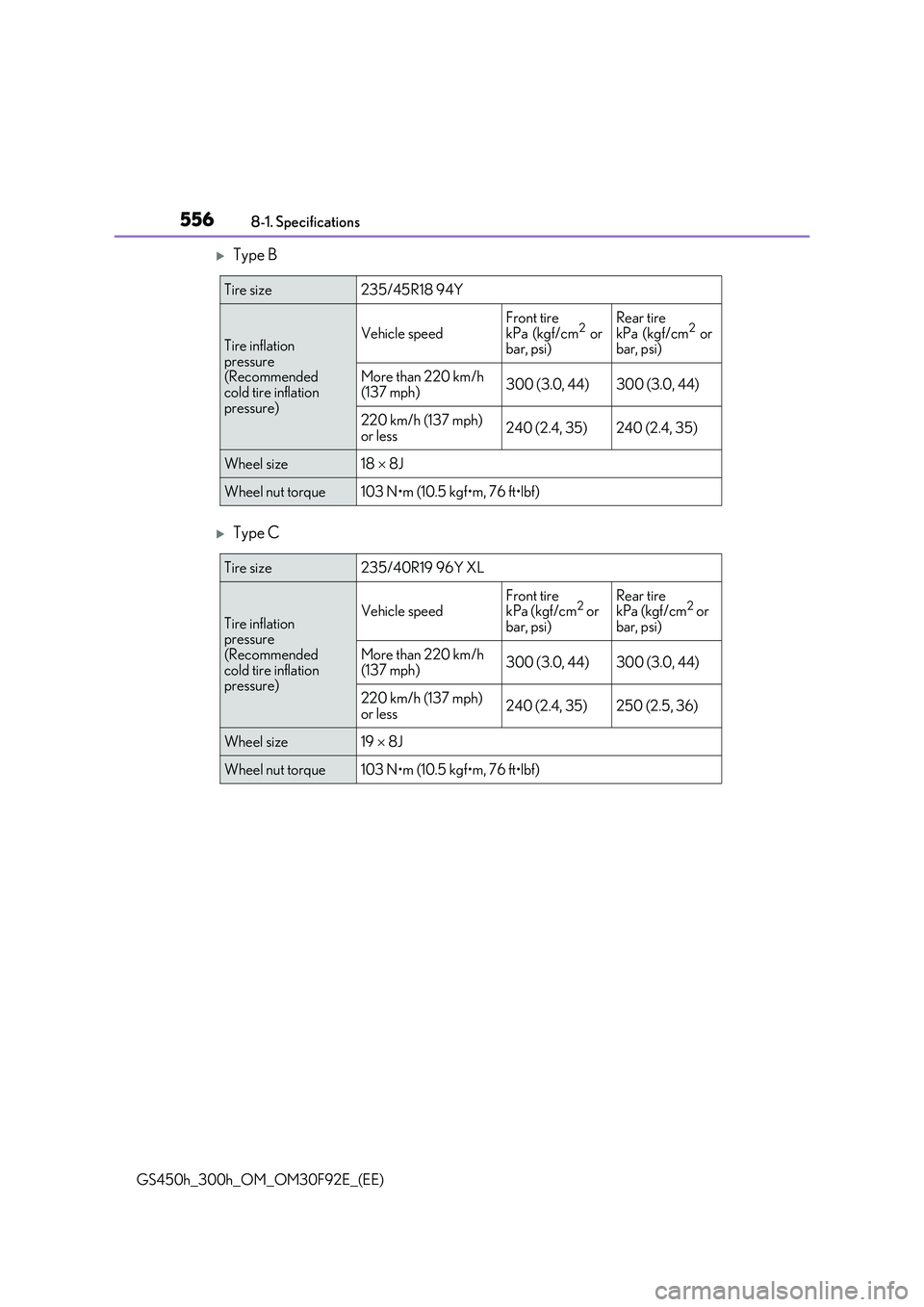
Type B
Type C
Tire size235/45R18 94Y
Tire inflation
pressure (Recommended cold tire inflation
pressure)
Vehicle speed
Front tire
kPa (kgf/cm2 or bar, psi)
Rear tire
kPa (kgf/cm2 or bar, psi)
More than 220 km/h (137 mph)300 (3.0, 44)300 (3.0, 44)
220 km/h (137 mph)
or less240 (2.4, 35)240 (2.4, 35)
Wheel size18 8J
Wheel nut torque103 N•m (10.5 kgf•m, 76 ft•lbf)
Tire size235/40R19 96Y XL
Tire inflation pressure
(Recommended cold tire inflation pressure)
Vehicle speedFront tire kPa (kgf/cm2 or
bar, psi)
Rear tire kPa (kgf/cm2 or
bar, psi)
More than 220 km/h (137 mph)300 (3.0, 44)300 (3.0, 44)
220 km/h (137 mph)
or less240 (2.4, 35)250 (2.5, 36)
Wheel size19 8J
Wheel nut torque103 N•m (10.5 kgf•m, 76 ft•lbf)
Page 557 of 600
557
8
8-1. Specifications
Vehicle specifications
GS450h_300h_OM_OM30F92E_(EE)
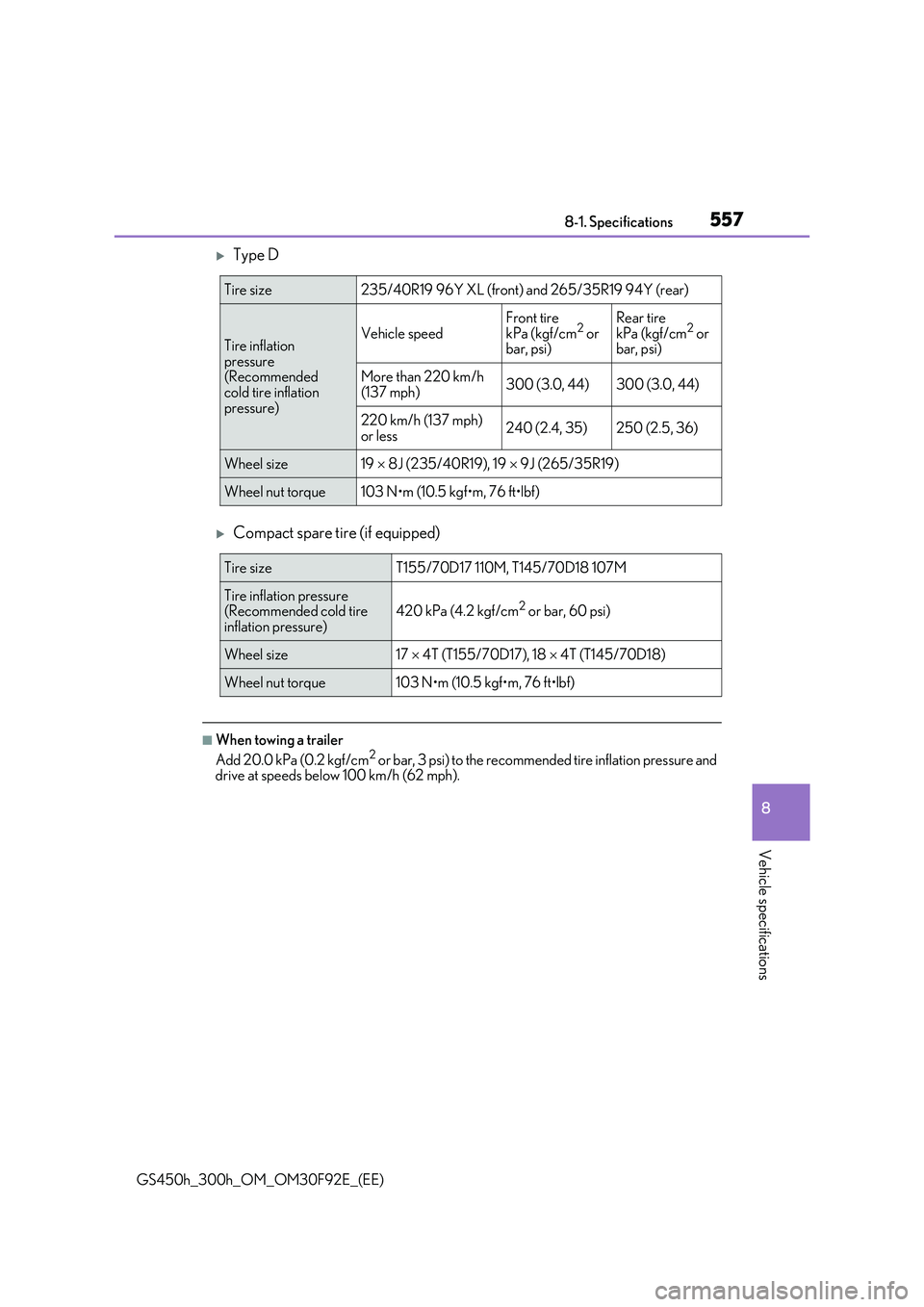
Type D
Compact spare tire (if equipped)
■When towing a trailer
Add 20.0 kPa (0.2 kgf/cm2 or bar, 3 psi) to the recommend ed tire inflation pressure and drive at speeds below 100 km/h (62 mph).
Tire size235/40R19 96Y XL (front) and 265/35R19 94Y (rear)
Tire inflation
pressure (Recommended cold tire inflation
pressure)
Vehicle speed
Front tire
kPa (kgf/cm2 or bar, psi)
Rear tire
kPa (kgf/cm2 or bar, psi)
More than 220 km/h (137 mph)300 (3.0, 44)300 (3.0, 44)
220 km/h (137 mph)
or less240 (2.4, 35)250 (2.5, 36)
Wheel size19 8J (235/40R19), 19 9J (265/35R19)
Wheel nut torque103 N•m (10.5 kgf•m, 76 ft•lbf)
Tire sizeT155/70D17 110M, T145/70D18 107M
Tire inflation pressure (Recommended cold tire
inflation pressure)
420 kPa (4.2 kgf/cm2 or bar, 60 psi)
Wheel size17 4T (T155/70D17), 18 4T (T145/70D18)
Wheel nut torque103 N•m (10.5 kgf•m, 76 ft•lbf)
Page 576 of 600
5768-3. Initialization
GS450h_300h_OM_OM30F92E_(EE)
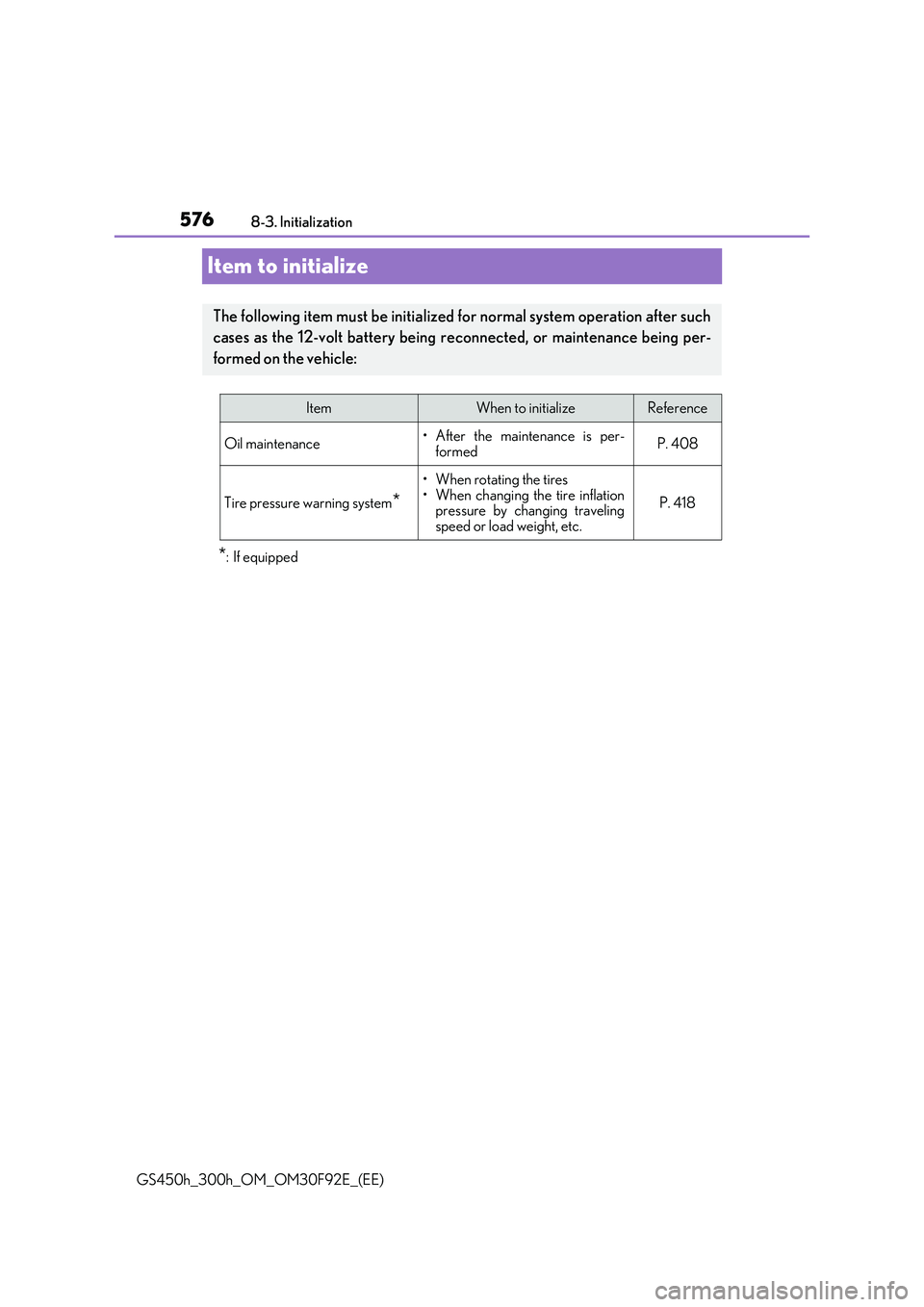
Item to initialize
*: If equipped
The following item must be initialized for normal system operation after such
cases as the 12-volt battery being re connected, or maintenance being per-
formed on the vehicle:
ItemWhen to initializeReference
Oil maintenance• After the maintenance is per-
formedP. 408
Tire pressure warning system*
• When rotating the tires • When changing the tire inflationpressure by changing traveling
speed or load weight, etc.
P. 418
Page 581 of 600
581What to do if... (Troubleshooting)
GS450h_300h_OM_OM30F92E_(EE)
●When a warning light turns on or a warning message is displayed, refer to
P. 460, 466.
●Vehicles with spare tire
Stop the vehicle in a safe place and replace the flat tire with the spare tire.
( P. 498)
●Vehicles without spare tire
Stop the vehicle in a safe place and repair the flat tire temporarily with the
emergency tire puncture repair kit. ( P. 509)
●Try the procedure for when the vehicle becomes stuck in mud, dirt, or snow.
( P. 542)
A warning light turns on or a warning message is displayed
When a problem has occurred
If you have a flat tire
The vehicle becomes stuck