Heat Lexus GS350 2011 Owner's Manual
[x] Cancel search | Manufacturer: LEXUS, Model Year: 2011, Model line: GS350, Model: Lexus GS350 2011Pages: 654, PDF Size: 11.03 MB
Page 5 of 654
TABLE OF CONTENTSIndex
4
GS_G_U (OM30C11U)
May 21, 2010 12:06 pm
3-2. Using the air conditioning system and defogger
Automatic air conditioning system ............................................ 246
Rear window and outside rear view mirror defoggers ............ 255
Windshield wiper de-icer ......... 256
3-3. Using the audio system Audio system type ....................... 257
Using the radio ............................. 260
Using the CD/DVD player.............................................. 269
Playing an audio CD................... 272
Playing MP3 and WMA discs.................................. 276
Playing DVD video/audio (with DVD player).................... 280
Playing a video CD (with DVD player)..................... 294
CD/DVD player and DVD video disc information ............. 297
Listening to Bluetooth
®
audio .............................................. 308
Listening to a USB memory/iPod .............................. 316
Optimal use of the audio/video system .................. 326
Using the AUX port................... 328
Using the steering switches ......................................... 329 3-4. Using the hands-free system
(for cellular phone)
Hands-free system (for cellular phone) ................... 332
Using a Bluetooth
®
phone ............................................ 338
Setting the hands-free system (for cellular phone) .................. 353
3-5. Using the interior lights Interior lights list........................... 382
3-6. Using the storage features List of storage features.............. 385
3-7. Other interior features Sun visors......................................... 393
Vanity mirrors................................ 394
Clock ................................................ 395
Outside temperature display ............................................ 396
Ashtrays ........................................... 397
Cigarette lighter .......................... 398
Power outlet ................................... 399
Seat heaters/ventilators ........... 400
Armrest ............................................ 402
Rear sunshade .............................. 403
Floor mats....................................... 406
Trunk features............................... 408
Garage door opener..................... 411
Compass........................................... 418
Safety Connect ............................. 422
Page 7 of 654
TABLE OF CONTENTSIndex
6
GS_G_U (OM30C11U)
May 21, 2010 12:06 pm
5-2. Steps to take in an emergencyIf a warning light turns on or a warning buzzer
sounds... ......................................... 534
If a warning message is displayed ....................................... 544
If you have a flat tire (Vehicles with standard
tires) ................................................ 557
If you have a flat tire (Vehicles with run-flat
tires) ................................................ 567
If the engine will not start ......... 568
If the shift lever cannot be shifted from “P”.......................... 569
If you lose your keys .................... 570
If the electronic key does not operate properly ........................ 571
If the 12 volt battery is discharged ................................... 574
If your vehicle overheats ........... 578
If the vehicle becomes stuck................................................. 581
If your vehicle has to be stopped in an
emergency .................................. 582 6-1. Specifications
Maintenance data (fuel, oil level, etc.).................... 584
Fuel information ........................... 599
Tire information............................. 602
6-2. Customization Customizable features................ 616
6-3. Initialization Items to initialize ........................... 622
Reporting safety defects for U.S. owners........................... 624
Seat belt instructions for Canadian owners
(in French) .................................... 625
SRS airbag instructions for Canadian owners
(in French) .................................... 627
6Vehicle specifications
7For owners
Page 14 of 654
13
GS_G_U (OM30C11U)
October 28, 2011 5:15 pm
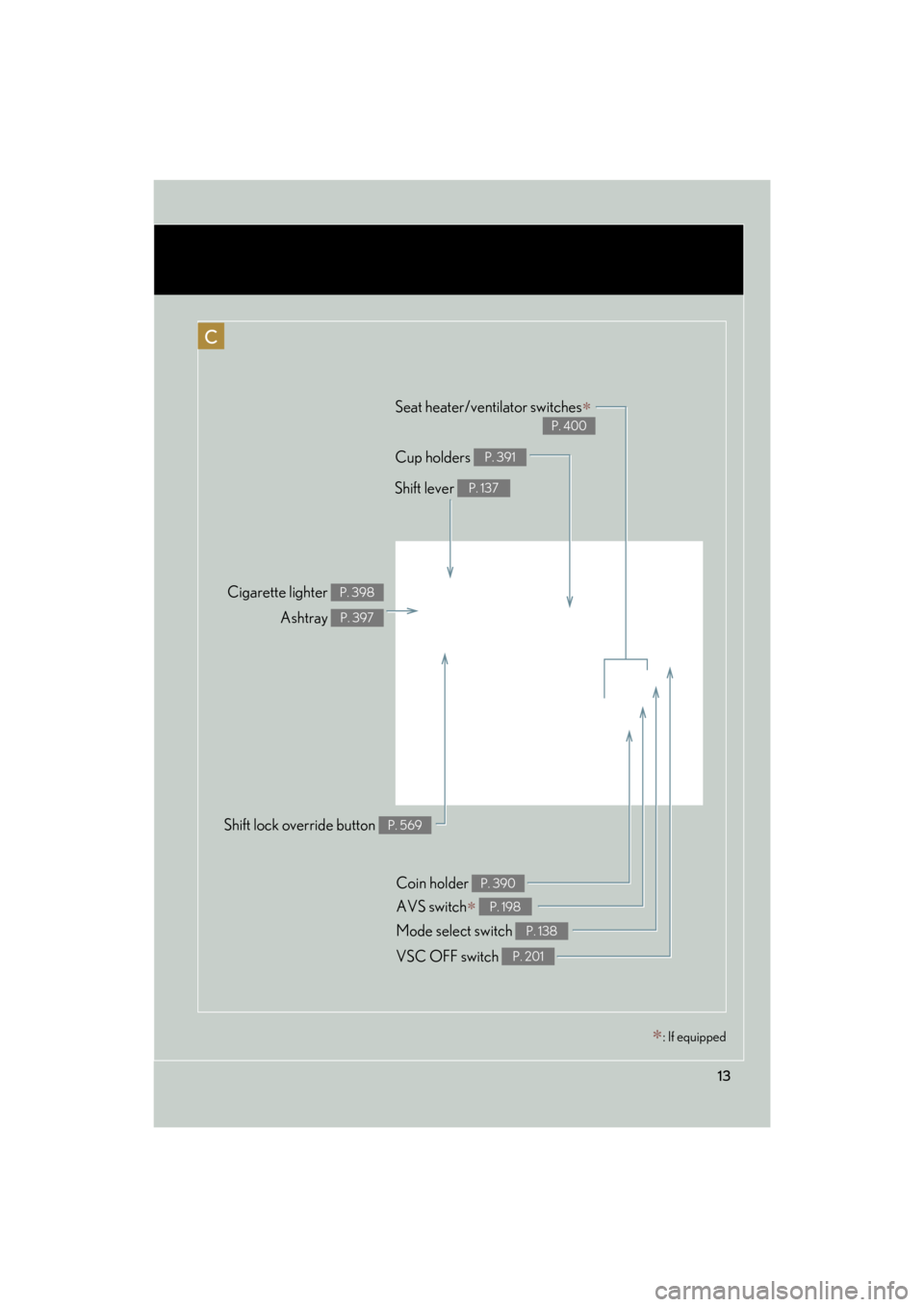
Shift lever P. 137
Cigarette lighter P. 398
Ashtray P. 397
Shift lock override button P. 569
Cup holders P. 391
C
∗: If equipped
Seat heater/ventilator switches∗
P. 400
VSC OFF switch P. 201
Coin holder P. 390
Mode select switch P. 138
AVS switch∗ P. 198
Page 21 of 654
20
GS_G_U (OM30C11U)
May 21, 2010 12:06 pm
CAUTION
■General precautions while driving
Driving under the influence: Never drive your vehicle when under the influence of
alcohol or drugs that have impaired your ability to operate your vehicle. Alcohol
and certain drugs delay reaction time, impair judgment and reduce coordination,
which could lead to an accident that could result in death or serious injury.
Defensive driving: Always drive defensively. Anticipate mistakes that other drivers
or pedestrians might make and be ready to avoid accidents.
Driver distraction: Always give your full attention to driving. Anything that distracts
the driver, such as adjusting controls, talking on a cellular phone or reading can
result in a collision with resulting death or serious injury to you, your occupants or
others.
■General precautions regarding children’s safety
Never leave children unattended in the vehicle, and never allow children to have or
use the key.
Children may be able to start the vehicle or shift the vehicle into neutral. There is
also a danger that children may injure themselves by playing with the cigarette
lighter, the windows, the moon roof, or other features of the vehicle. In addition, heat
build-up or extremely cold temperatures inside the vehicle can be fatal to children.
Page 51 of 654
50
1-2. Opening, closing and locking the doors and trunk
GS_G_U (OM30C11U)
October 28, 2011 5:15 pm
■Using the mechanical key
The trunk can be also opened using the mechanical key. (→P. 5 7 1 )
■Which key to the vehicle is to leave with a parking attendant after disabling the
trunk opener main switch
→ P. 2 6
CAUTION
■Caution while driving
●Keep the trunk lid closed while driving.
If the trunk lid is left open, it may hit near-by objects while driving or luggage in
the trunk may be unexpectedly thrown out, causing an accident.
In addition, exhaust gases may enter the vehicle, causing death or a serious
health hazard. Make sure to close the trunk lid before driving.
●Before driving the vehicle, make sure that the trunk lid is fully closed. If the trunk
lid is not fully closed, it may open unexpectedly while driving, causing an accident.
●Never let anyone sit in the trunk. In the event of sudden braking or a collision, they
are susceptible to death or serious injury.
■When children are in the vehicle
Observe the following precautions.
Failure to do so may result in death or serious injury.
●Do not allow children to enter the trunk.
If a child is accidentally locked in the trunk, they could overheat or suffocate.
●Do not allow a child to open or close the trunk lid.
Doing so may cause the trunk lid operate unexpectedly, or cause the child’s
hands, head, or neck to be caught by the closing trunk lid.
Page 75 of 654
74
1-3. Adjustable components (seats, mirrors, steering wheel)
GS_G_U (OM30C11U)
October 28, 2011 5:15 pm
■When the mirrors are fogged up
Turn on the mirror heaters to defog the mirrors. ( →P. 2 5 5 )
■Auto anti-glare function
When the inside rear view mirror is set to auto mode, the outside rear view mirrors
will activate in conjunction with the inside rear view mirror to reduce reflected light.
(→ P. 7 1 )
■Linked mirror function when reversing
The outside rear view mirrors will automatically angle downwards when the vehicle
is reversing in order to give a better view of the ground. However, this function will
not operate when the mirror select switch is in the neutral position (neither “L” nor
“R” selected).
■One-touch adjustment of the mirror angle
A desired mirror face angle can be entered to memory and adjusted with the touch
of a button. (→ P. 5 5 )
CAUTION
■While driving
Observe the following precautions.
Failing to do so may result in losing control of the vehicle and cause an accident,
resulting in death or serious injury.
●Do not adjust the mirrors.
●Do not drive with the mirrors folded back.
●Before driving, be sure to extend mirrors and make an adjustment properly.
■When a mirror is moving
To avoid injury and mirror malfunction, be careful not to get your hand caught by
the moving mirror.
■When the mirror heaters are operating
Do not touch the rear view mirror surfaces, as they can become very hot and burn
you.
Page 126 of 654
125
2-1. Driving procedures
2
When driving
GS_G_U (OM30C11U)
October 28, 2011 5:15 pm
■Driving in the rain
●Drive carefully when it is raining, because visibility will be reduced, the windows
may become fogged-up, and the road will be slippery.
●Drive carefully when it starts to rain, because the road surface will be especially
slippery.
●Refrain from high speeds when driving on an expressway in the rain, because
there may be a layer of water between the tires and the road surface, preventing
the steering and brakes from operating properly.
■Breaking in your new Lexus
To extend the life of the vehicle, the following precautions are recommended to
observe:
●For the first 186 miles (300 km):
Avoid sudden stops.
●For the first 621 miles (1000 km):
• Do not drive at extremely high speeds.
• Avoid sudden acceleration.
• Do not drive continuously in the low range in the “S” position.
• Do not drive at a constant speed for extended periods.
■Drum-in-disc type parking brake system
Your vehicle has a drum-in-disc type parking brake system.
This type of brake system needs bedding-down of the brake shoes periodically or
whenever the parking brake shoes and/or drums are replaced.
Have your Lexus dealer perform the bedding-down.
■Operating your vehicle in a foreign country
Comply with the relevant vehicle registration laws and confirm the availability of the
correct fuel. (→P. 5 8 7 )
■When starting on an incline
The hill-start assist control may operate. ( →P. 199)
■Overheating
Your vehicle may overheat under the following extreme driving conditions:
●When driving on a long uphill road in hot weather
●Suddenly decelerating or stopping the vehicle immediately after high-speed
driving
Page 128 of 654
127
2-1. Driving procedures
2
When driving
GS_G_U (OM30C11U)
October 28, 2011 5:15 pm
CAUTION
■When driving the vehicle
●Do not shift the shift lever to “D” while the vehicle is moving backward.
Doing so can damage the transmission and may result in a loss of vehicle control.
●Moving the shift lever to “N” while the vehicle is moving will disengage the engine
from the transmission. Engine braking is not available when “N” is selected.
●During normal driving, do not turn off the engine. Turning the engine off while
driving will not cause loss of steering or braking control, but the power assist to
these systems will be lost. This will make it more difficult to steer and brake, so you
should pull over and stop the vehicle as soon as it is safe to do so.
However, in the event of an emergency, such as if it becomes impossible to stop
the vehicle in the normal way: → P. 5 8 2
●Use engine braking (downshift) to maintain a safe speed when driving down a
steep hill.
Using the brakes continuously may cause the brakes to overheat and lose effec-
tiveness. (→P. 1 3 9 )
●When stopped on an inclined surface, use the brake pedal and parking brake to
prevent the vehicle from rolling backward or forward and causing an accident.
●Be careful when driving on slippery surfaces, as the vehicle may spin or skid when
downshifting, rapidly accelerating, braking or turning.
●Do not adjust the position of the steering wheel, the seat, or the inside or outside
rear view mirrors while driving.
Doing so may result in a loss of vehicle control that can cause accidents that may
result in death or serious injury.
●Always check that all passengers’ arms, heads or other parts of their bodies are
not outside the vehicle, as this may result in death or serious injury.
●Do not drive in excess of the speed limit. Even if the legal speed limit permits it, do
not drive over 85 mph (140 km/h) unless your vehicle has high-speed capability
tires. Driving over 85 mph (140 km/h) may result in tire failure, loss of control and
possible injury. Be sure to consult a tire dealer to determine whether the tires on
your vehicle are high-speed capability tires or not before driving at such speeds.
Page 129 of 654
128
2-1. Driving procedures
GS_G_U (OM30C11U)
October 28, 2011 5:15 pm
CAUTION
■When driving on slippery road surfaces
●Sudden braking, acceleration and steering may cause tire slippage and reduce
your ability to control the vehicle, resulting in an accident.
●Sudden changes in engine speed, such as engine braking caused by up-shifting
or down-shifting, may cause the vehicle to skid, resulting in an accident.
●After driving through a puddle, lightly depress the brake pedal to make sure that
the brakes are functioning properly. Wet brake pads may prevent the brakes from
functioning properly. If the brakes on only one side are wet and not functioning
properly, steering control may be affected, resulting in an accident.
■When shifting the shift lever
Be careful not to shift the shift lever with the accelerator pedal depressed.
This may lead to unexpected rapid acceleration of the vehicle that may cause an
accident and result in death or serious injury.
■When the vehicle is stopped
●Do not race the engine.
If the vehicle is in any positions other than “P” or “N” the vehicle may accelerate
suddenly and unexpectedly, and may cause an accident.
●Do not leave the vehicle with the engine on for a long time.
If such a situation cannot be avoided, park the vehicle in an open space and
check that exhaust fumes do not enter the vehicle interior.
●In order to prevent accidents due to the vehicle rolling away, always keep
depressing the brake pedal while the engine is running, and apply the parking
brake as necessary.
●If the vehicle is stopped on an incline, in order to prevent accidents caused by the
vehicle rolling forward or backward, always depress the brake pedal and securely
apply the parking brake as needed.
●Avoid revving or racing the engine. Running the engine at high speed while the
vehicle is stopped may cause the exhaust system to overheat, which could result
in a fire if combustible material is nearby.
Page 131 of 654
130
2-1. Driving procedures
GS_G_U (OM30C11U)
October 28, 2011 5:15 pm
CAUTION
■When taking a nap in the vehicle
Always turn the engine off. Otherwise, you may accidentally move the shift lever or
depress the accelerator pedal, which could cause an accident or fire due to engine
overheating. Additionally, if the vehicle is parked in a poorly ventilated area, exhaust
gases may collect and enter the vehicle, leading to death or a serious health hazard.
■When braking the vehicle
●When the brakes are wet, drive more cautiously.
Braking distance increases when the brakes are wet, and may cause one side of
the vehicle to brake differently than the other side. Also the parking brake may
not securely hold the vehicle.
●If the brake actuator (GS460) or brake booster (GS350) does not operate, do
not follow other vehicles closely and avoid hills or sharp turns that require brak-
ing.
In this case, braking is still possible, but it will require more force on the pedal than
usual. Braking distance may also increase.
●Do not pump the brake pedal if turning the engine off.
Each push on the brake pedal uses up the reserve for the power-assisted brakes.
●The brake system consists of 3 (GS460) or 2 (GS350) individual hydraulic sys-
tems: If one of the systems fails, the other will still operate. In this case, the brake
pedal should be depressed more firmly than usual and braking distance becomes
longer.
Do not drive your vehicle with only a single brake system. Have your brakes fixed
immediately.
■If the vehicle becomes stuck or bogged (4WD models)
Do not spin the wheels recklessly when any of the tires is up in the air, or stuck in
sand or mud, etc. This may damage the drive system components or propel the
vehicle forward (or in another direction) and cause an accident.