towing Lexus GX460 2010 Owner's Manual
[x] Cancel search | Manufacturer: LEXUS, Model Year: 2010, Model line: GX460, Model: Lexus GX460 2010Pages: 830, PDF Size: 17.01 MB
Page 4 of 830
1
2
3
4
5
6
7
3
GX460_CANADA (OM60F29U)
2-1. Driving proceduresDriving the vehicle ........................ 168
Engine (ignition) switch .............. 179
Automatic transmission.............. 186
Turn signal lever ............................ 192
Parking brake ................................. 193
Horn.................................................... 194
2-2. Instrument cluster Gauges and meters ..................... 195
Indicators and warning lights................................................. 198
Multi-information display (Optitron meters) ..................... 204
Multi-information display (Accessory meters)................... 212
2-3. Operating the lights and windshield wipers
Headlight switch ........................... 220
Automatic High Beam ............... 226
Fog light switch ............................. 233
Windshield wipers and washer............................................ 235
Rear window wiper and washer............................................ 239
Headlight cleaner switch ........... 241 2-4. Using other driving systems
Cruise control ............................... 242
Dynamic radar cruise control............................................ 246
Intuitive parking assist ................ 259
LDA (Lane Departure Alert) .......... 268
Rear view monitor system ........ 274
Wide view front & side monitor................................. 279
Multi-terrain Select ..................... 290
Multi-terrain Monitor ................. 298
Rear height control air suspension .................................... 310
AVS (Adaptive Variable Suspension System) .................. 316
Four-wheel drive system............ 317
Crawl Control ............................... 323
DAC (Downhill Assist Control system)........................................... 327
Driving assist systems................ 330
PCS (Pre-Collision System) .......... 338
2-5. Driving information Off-road precautions ................ 348
Cargo and luggage ..................... 353
Vehicle load limits........................ 359
Winter driving tips ........................ 361
Trailer towing ................................. 365
Dinghy towing .............................. 380
2When driving
GX460_CANADA.book Page 3 Thursday, February 4, 2010 11:54 AM
Page 76 of 830
75
1-3. Adjustable components (seats, mirrors, steering wheel, etc.)
1
Before driving
GX460_CANADA (OM60F29U)■
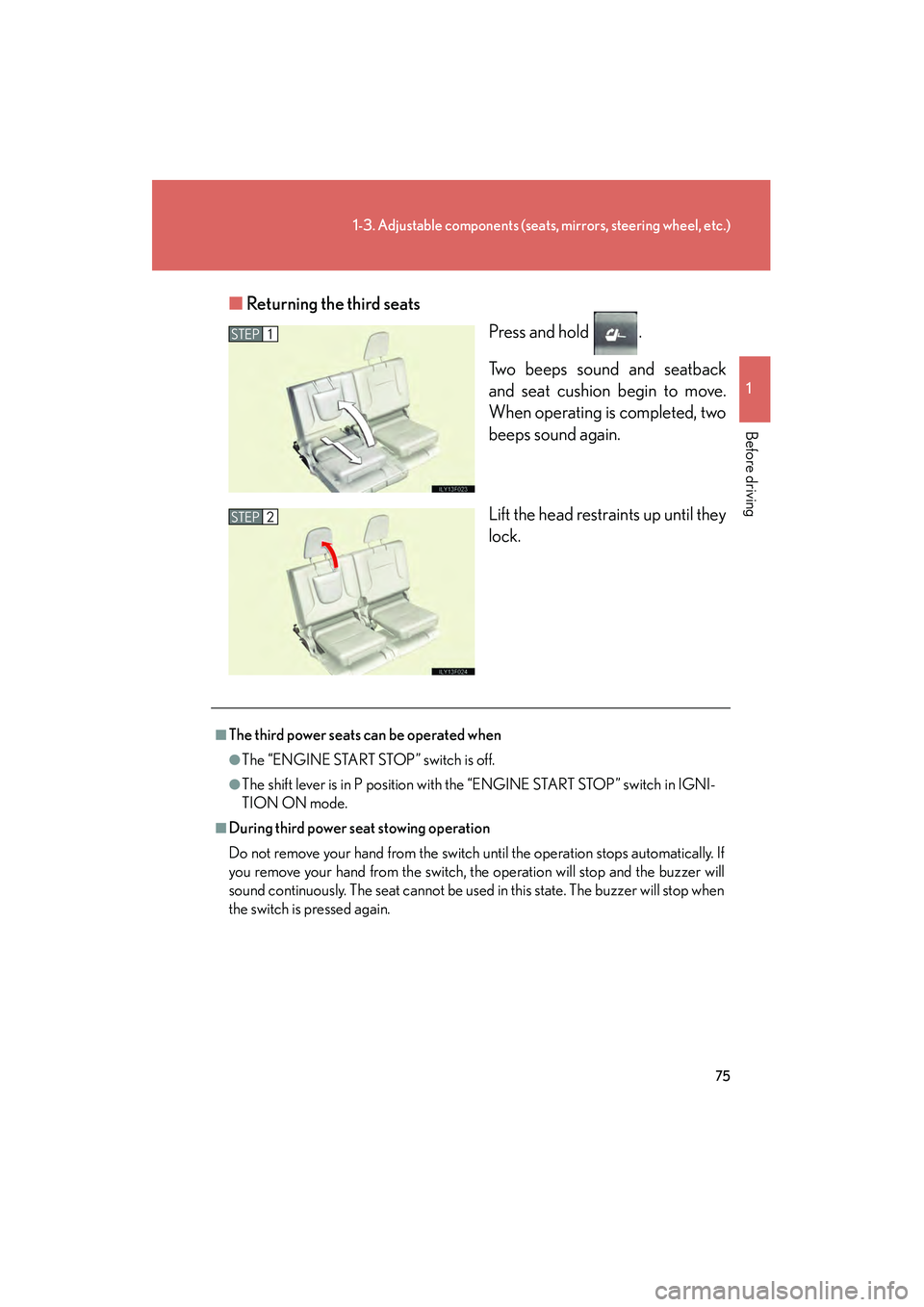
Returning the third seats
Press and hold .
Two beeps sound and seatback
and seat cushion begin to move.
When operating is completed, two
beeps sound again.
Lift the head restraints up until they
lock.
STEP1
STEP2
■The third power seats can be operated when
●The “ENGINE START STOP” switch is off.
●The shift lever is in P position with the “ENGINE START STOP” switch in IGNI-
TION ON mode.
■During third power seat stowing operation
Do not remove your hand from the switch until the operation stops automatically. If
you remove your hand from the switch, th e operation will stop and the buzzer will
sound continuously. The seat cannot be used in this state. The buzzer will stop when
the switch is pressed again.
GX460_CANADA.book Page 75 Thursday, February 4, 2010 11:54 AM
Page 79 of 830
78
1-3. Adjustable components (seats, mirrors, steering wheel, etc.)
GX460_CANADA (OM60F29U)
CAUTION
■When stowing the third seats
Observe the following precautions. Failure to do so may result in death or serious
injury.
●Check that there is no luggage and that there are no other people around the
seat before stowing operation.
●Do not insert hands or feet into the moving parts of the seat.
●Do not allow children to operate the seat.
■After returning the seatbacks to the upright position
Observe the following precautions. Failure to do so may result in death or serious
injury.
●Make sure the seatback is securely locked by pushing it forward and rearward on
the top.
●Check that the seat belts are not twisted or caught in the seatback.
NOTICE
■When returning the third seat (vehicles with a luggage cover)
If the luggage cover is installed in the luggage compartment, make sure you remove
it before returning the third seat. (→P. 561) The luggage cover may be damaged by
the seat.
GX460_CANADA.book Page 78 Thursday, February 4, 2010 11:54 AM
Page 168 of 830
When driving2
167
GX460_CANADA (OM60F29U)
2-4. Using other driving systemsCruise control ......................... 242
Dynamic radar cruise control .................................... 246
Intuitive parking assist .......... 259
LDA (Lane Departure Alert) ..... 268
Rear view monitor system ...................................... 274
Wide view front & side monitor ................................... 279
Multi-terrain Select .............. 290
Multi-terrain Monitor.......... 298
Rear height control air suspension .............................. 310
AVS (Adaptive Variable Suspension System)............. 316
Four-wheel drive system ....... 317
Crawl Control ........................ 323
DAC (Downhill Assist Control system) ................... 327
Driving assist systems .......... 330
PCS (Pre-Collision System)...... 338 2-5. Driving information
Off-road precautions ........... 348
Cargo and luggage ............... 353
Vehicle load limits .................. 359
Winter driving tips .................. 361
Trailer towing .......................... 365
Dinghy towing......................... 380
GX460_CANADA.book Page 167 Thursday, February 4, 2010 11:54 AM
Page 246 of 830

245
2-4. Using other driving systems
2
When driving
GX460_CANADA (OM60F29U)
CAUTION
■To avoid operating the cruise control by mistake
Switch the cruise control off using the “ON-OFF” button when not in use.
■Situations unsuitable for cruise control
Do not use cruise control in any of the following situations.
Doing so may result in loss of control and could cause an accident resulting in death
or serious injury.
●In heavy traffic
●On roads with sharp bends
●On winding roads
●On slippery roads, such as those covered with rain, ice or snow
●On steep hills
Vehicle speed may exceed the set speed when driving down a steep hill.
●When towing a trailer or emergency towing
GX460_CANADA.book Page 245 Thursday, February 4, 2010 11:54 AM
Page 257 of 830

256
2-4. Using other driving systems
GX460_CANADA (OM60F29U)
CAUTION
■To avoid inadvertent cruise control activation
Switch the cruise control off using the “ON-OFF” button when not in use.
■Situations unsuitable for the dynamic radar cruise control
Do not use dynamic radar cruise control in any of the following situations.
Doing so may result in inappropriate speed control and could cause an accident
resulting in death or serious injury.
●In heavy traffic
●On roads with sharp bends
●On winding roads
●On slippery roads, such as those covered with rain, ice and snow
●On steep downhills, or where there are sudden changes between sharp up and
down gradients
●At entrances to expressways
●When weather conditions are bad enough that they may prevent the sensors
from functioning correctly (fog, snow, sandstorm, etc.)
●When a buzzer is heard often
●When towing a trailer or emergency towing
●In traffic conditions where the vehicle is repeatedly sped up and slowed down at
frequent intervals
GX460_CANADA.book Page 256 Thursday, February 4, 2010 11:54 AM
Page 267 of 830
266
2-4. Using other driving systems
GX460_CANADA (OM60F29U)
■Sensor detection information
●Certain vehicle conditions and the surrounding environment may affect the
ability of a sensor to correctly detect an obstacle. Particular instances where this
may occur are listed below.
• There is dirt, snow or ice on a sensor.
• A sensor is frozen.
• A sensor is covered in any way.
• The vehicle is leaning considerably to one side.
• On an extremely bumpy road, on an incline, on gravel, or on grass.
• The vicinity of the vehicle is noisy due to vehicle horns, motorcycle engines,air brakes of large vehicles, or other loud noises producing ultrasonic waves.
• There is another vehicle equipped with parking assist sensors in the vicinity.
• A sensor is coated with a sheet of spray or heavy rain.
• The vehicle is equipped with a fender pole or radio antenna.
• Towing eyelets are installed.
• A bumper or sensor receives a strong impact.
• The vehicle is approaching a tall or right-angled curb.
• In harsh sunlight or intense cold weather.
• A non-genuine Lexus suspension (lowered suspension etc.) is installed.
In addition to the examples above, there are instances in which, because of their
shape, signs and other objects may be judged by a sensor to be closer than they
are.
●The shape of the obstacle may prevent a sensor from detecting it. Pay particular
attention to the following obstacles:
• Wires, fences, ropes, etc.
• Cotton, snow and other materials that absorb sound waves
• Sharply-angled objects
• Low obstacles
• Tall obstacles with upper sections projecting outwards in the direction of your vehicle
GX460_CANADA.book Page 266 Thursday, February 4, 2010 11:54 AM
Page 272 of 830
271
2-4. Using other driving systems
2
When driving
GX460_CANADA (OM60F29U)
CAUTION
■Turn the LDA off while driving in any of the following situations
Do not use LDA in any of the following situations.
Otherwise, the system may not function correctly and could result in an accident.
●When driving with snow tires, tire chains, a spare tire, or similar equipment.
●When driving with non-standard parts or aftermarket equipment installed
(including modified tires and suspensions, etc.).
●When towing a trailer.
●When there are objects or structures along the roadside that might be misinter-
preted as lane markers (such as guardrails, curbs, reflector posts, etc.).
●When there is snow in the wheel tracks of the road.
●When there are shadows on the road running parallel with lane markers, or if a
shadow is covering the lane markers.
●When there are visible lines on the pavement from road repairs, or if the remains
of old lane markers are still visible on the road.
●When driving in a lane other than the driving or passing lanes on a freeway or
highway.
●When driving on a road with lane closures due to maintenance, or when driving
in a temporary lane.
GX460_CANADA.book Page 271 Thursday, February 4, 2010 11:54 AM
Page 355 of 830
354
2-5. Driving information
GX460_CANADA (OM60F29U)
Capacity and distributionCargo capacity depends on the total weight of the occupants.
(Cargo capacity) = (Total load cap acity) — (Total weight of occupants)
Steps for Determining Correct Load Limit —
(1) Locate the statement “The combined weight of occupants and cargo should never exceed XXX kg or XXX lbs.” on your vehicle’s
placard.
(2) Determine the combined weight of the driver and passengers that will be riding in your vehicle.
(3) Subtract the combined weight of the driver and passengers from XXX kg or XXX lbs.
(4) The resulting figure equals the available amount of cargo and lug- gage load capacity.
For example, if the “XXX” amount equals 1400 lbs. and there will be
five 150 lb passengers in your vehicle, the amount of available cargo
and luggage load capacity is 650 lbs. (1400 - 750 (5 × 150) = 650
lbs.)
(5) Determine the combined weight of luggage and cargo being loaded on the vehicle. That weight may not safely exceed the avail-
able cargo and luggage load capacity calculated in Step 4.
(6) If your vehicle will be towing a trailer, load from your trailer will be transferred to your vehicle. Consult this manual to determine how
this reduces the available cargo and luggage load capacity of your
vehicle. ( →P. 359)
GX460_CANADA.book Page 354 Thursday, February 4, 2010 11:54 AM
Page 360 of 830
359
2-5. Driving information
2
When driving
GX460_CANADA (OM60F29U)
Vehicle load limits
Vehicle load limits include total load capacity, seating capacity, towing
capacity and cargo capacity.
■Total load capacity:
Vehicles without rear height control air suspension
With third seats — 1315 lb. (595 kg)
Without third seats — 1525 lb. (690 kg)
Vehicles with rear height control air suspension 1280 lb. (580 kg)
Total load capacity means the combined weight of occupants, cargo
and luggage.
■ Seating capacity:
With third seats — 7 occupants (Front 2, Rear 5)
Without third seats — 5 occupants (Front 2, Rear 3)
Seating capacity means the maximu m number of occupants whose
estimated average weight is 150 lb. (68 kg) per person.
■ Towing capacity: 6500 lb. (2948 kg)
Towing capacity means the maximum gross trailer weight (trailer
weight plus its cargo weight) that your vehicle is able to tow.
■ Cargo capacity
Cargo capacity may increase or decrease depending on the weight
and the number of occupants.
GX460_CANADA.book Page 359 Thursday, February 4, 2010 11:54 AM