tires Lexus GX460 2020 / LEXUS 2020 GX460 (OM60R27U) Service Manual
[x] Cancel search | Manufacturer: LEXUS, Model Year: 2020, Model line: GX460, Model: Lexus GX460 2020Pages: 620, PDF Size: 12.41 MB
Page 518 of 620
5187-2. Steps to take in an emergency
GX460_OM_OM60R27U_(U)
WARNING
■Maintenance of the tires
Each tire, including the spare (if provided), should be checked monthly when cold and
inflated to the inflation pressure recomm ended by the vehicle manufacturer on the
vehicle placard or tire inflation pressure label (tire and load information label). (If your
vehicle has tires of a different size than the size indicated on the vehicle placard or tire
inflation pressure label [tire and load in formation label], you should determine the
proper tire inflation pressure for those tires.)
As an added safety feature, your vehicle ha s been equipped with a tire pressure moni-
toring system (TPMS-tire pressure warning system) that illuminates a low tire pressure
telltale (tire pressure warning light) when on e or more of your tires is significantly
under-inflated. Accordingly, when the low ti re pressure telltale (tire pressure warning
light) illuminates, you should stop and check your tires as soon as possible, and inflate
them to the proper pressure. Driving on a si gnificantly under-inflated tire causes the
tire to overheat and can lead to tire failure . Under-inflation also reduces fuel efficiency
and tire tread life, and may affect the vehicle’s handling and stopping ability.
Please note that the TPMS (tire pressure wa rning system) is not a substitute for proper
tire maintenance, and it is th e driver’s responsibility to ma intain correct tire pressure,
even if under-inflation has not reached the le vel to trigger illumination of the TPMS low
tire pressure telltale (tir e pressure warning light).
Your vehicle has also been equipped with a TPMS (tire pressure warning system) mal-
function indicator to indicate when the system is not operating properly. The TPMS
(tire pressure warning system) malfunction indi cator is combined with the low tire pres-
sure telltale (tire pressure warning light). When the system detects a malfunction, the
telltale will flash for approximately one mi nute and then remain continuously illumi-
nated. This sequence will cont inue upon subsequent vehicle start-ups as long as the
malfunction exists. When the malfunction in dicator is illuminated, the system may not
be able to detect or signal low tire pressure as intended.
TPMS (tire pressure warning system) malfun ctions may occur for a variety of reasons,
including the installation of replacement or alternate tires or wheels on the vehicle that
prevent the TPMS (tire pressure warning system) from functioning properly. Always
check the TPMS (tire pressure warning system) malfunction telltale after replacing one
or more tires or wheels on your vehicle to ensure that the replacement or alternate
tires and wheels allow the TPMS (tire pressu re warning system) to continue to function
properly.
Page 519 of 620
5197-2. Steps to take in an emergency
GX460_OM_OM60R27U_(U)
7
When trouble arises
NOTICE
■To ensure the tire pressure warning system operates properly
Do not install tires with different specifications or makers, as the tire pressure warning
system may not operate properly.
Page 524 of 620
524
GX460_OM_OM60R27U_(U)7-2. Steps to take in an emergency
If you have a flat tire
●Stop the vehicle in a safe pl
ace on a hard, flat surface.
●Set the parking brake.
●Shift the shift lever to P.
●Turn off the rear height control air suspension (if equipped). (P. 335)
●Stop the engine.
●Turn on the emergency flashers. ( P. 500)
Your vehicle is equipped with a spare tire. The flat tire can be replaced with
the spare tire.
For details about tires: P. 464
WARNING
■If you have a flat tire
Do not continue driving with a flat tire.
Driving even a short distance with a flat ti re can damage the tire and the wheel beyond
repair, which could re sult in an accident.
Before jacking up the vehicle
Page 526 of 620
5267-2. Steps to take in an emergency
GX460_OM_OM60R27U_(U)
WARNING
■Using the tire jack
Improper use of the tire jack may cause the vehicle to suddenly fall off the jack, leading
to death or serious injury.
●Do not use the tire jack for any purpose ot her than replacing tires or installing and
removing tire chains.
●Only use the tire jack that comes with this vehicle for replacing a flat tire.
Do not use it on other vehicles, and do no t use other tire jacks for replacing tires on
this vehicle.
●Always check that the tire jack is securely set to the jack point.
●Do not put any part of your body under the vehicle while it is supported by the jack.
●Do not start or run the engine while your vehicle is supported by the jack.
●Do not raise the vehicle while someone is inside.
●When raising the vehicle, do not put an object on or under the jack.
●Do not raise the vehicle to a height greater than that required to replace the tire.
●Use a jack stand if it is necessary to get under the vehicle.
●Vehicles with rear height control air suspensi on: Be sure to turn off the height control
and stop the engine.
Take particular care when lowering the ve hicle to ensure that no one working on or
near the vehicle will be injured.
■Using the jack handle
Tighten all the jack handle bo lts securely using a Phillips-head screwdriver, to prevent
the extension parts from co ming apart unexpectedly.
Page 530 of 620
5307-2. Steps to take in an emergency
GX460_OM_OM60R27U_(U)
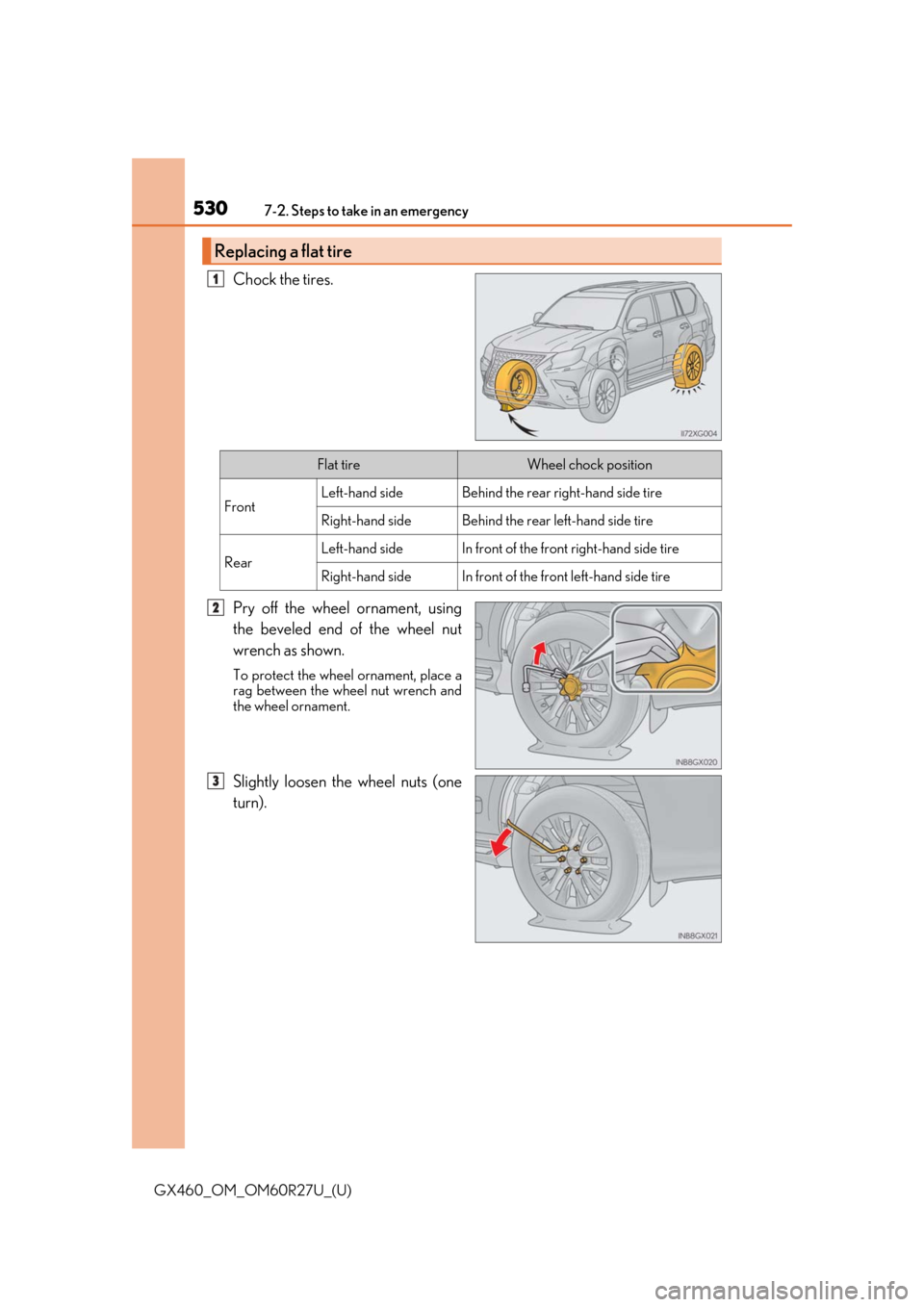
Chock the tires.
Pry off the wheel ornament, using
the beveled end of the wheel nut
wrench as shown.
To protect the wheel ornament, place a
rag between the wheel nut wrench and
the wheel ornament.
Slightly loosen the wheel nuts (one
turn).
Replacing a flat tire
1
Flat tireWheel chock position
FrontLeft-hand sideBehind the rear right-hand side tire
Right-hand sideBehind the rear left-hand side tire
RearLeft-hand sideIn front of the front right-hand side tire
Right-hand sideIn front of the front left-hand side tire
2
3
Page 549 of 620
549
GX460_OM_OM60R27U_(U)
7
When trouble arises
7-2. Steps to take in an emergency
If the vehicle becomes stuck
Stop the engine. Set the parking brake and shift the shift lever to P.
Remove the mud, snow or sand from around the stuck tire.
Place wood, stones or some other mate rial under the tires to help provide
traction.
Restart the engine.
Lock the center differential. ( P. 341)
Shift the shift lever to the D or R positi on and release the parking brake. Then,
while exercising caution, depress the accelerator pedal.
■When it is difficult to free the vehicle
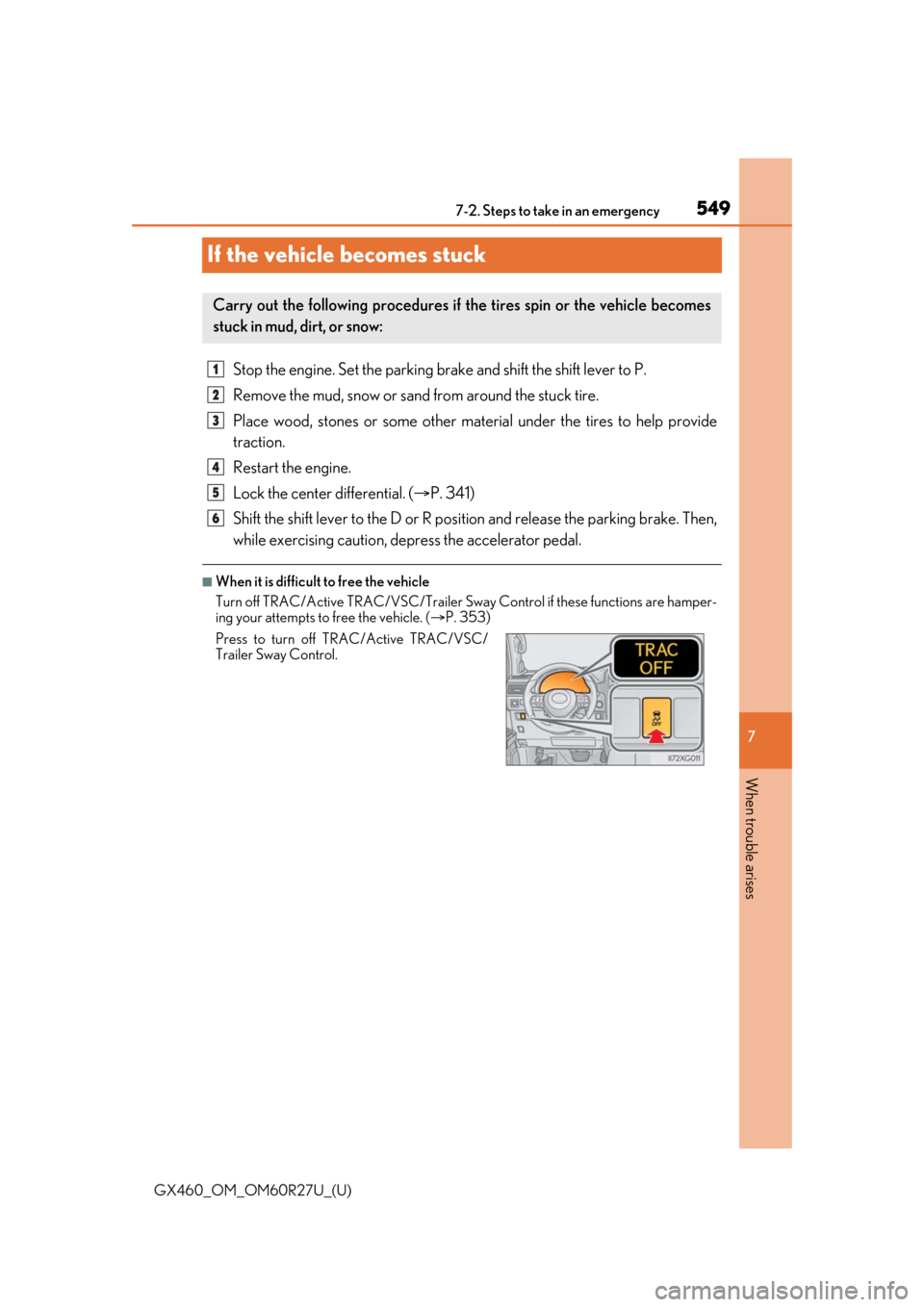
Turn off TRAC/Active TRAC/VSC/Trailer Sway Control if these functions are hamper-
ing your attempts to free the vehicle. ( P. 353)
Carry out the following procedures if the tires spin or the vehicle becomes
stuck in mud, dirt, or snow:
Press to turn off TRAC/Active TRAC/VSC/
Trailer Sway Control.
1
2
3
4
5
6
Page 560 of 620
560
GX460_OM_OM60R27U_(U)8-1. Specifications
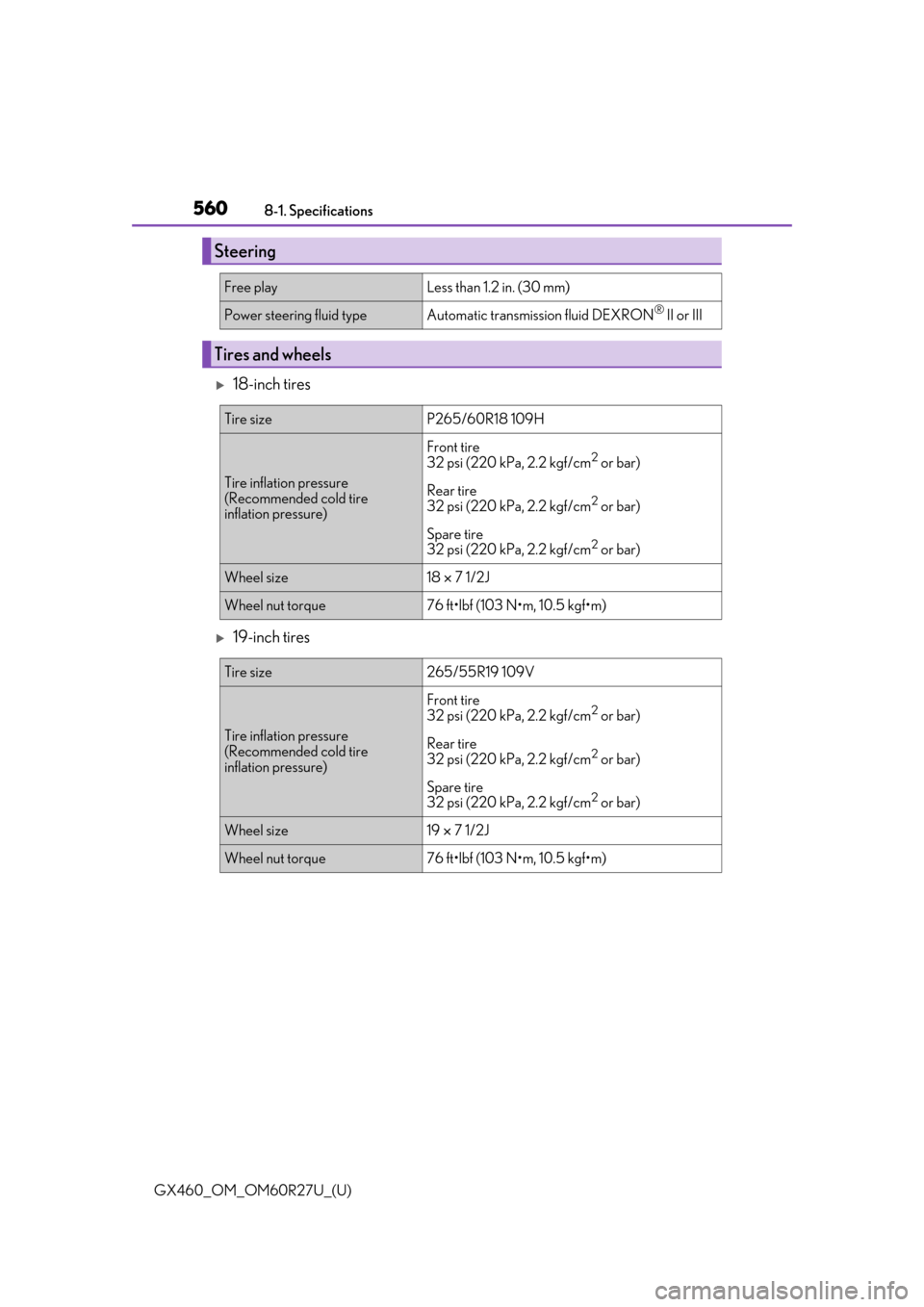
18-inch tires
19-inch tires
Steering
Free playLess than 1.2 in. (30 mm)
Power steering fluid typeAutomatic transmission fluid DEXRON® II or III
Tires and wheels
Tire sizeP265/60R18 109H
Tire inflation pressure
(Recommended cold tire
inflation pressure)
Front tire
32 psi (220 kPa, 2.2 kgf/cm2 or bar)
Rear tire
32 psi (220 kPa, 2.2 kgf/cm2 or bar)
Spare tire
32 psi (220 kPa, 2.2 kgf/cm2 or bar)
Wheel size18
7 1/2J
Wheel nut torque76 ft•lbf (103 N•m, 10.5 kgf•m)
Tire size265/55R19 109V
Tire inflation pressure
(Recommended cold tire
inflation pressure)
Front tire
32 psi (220 kPa, 2.2 kgf/cm2 or bar)
Rear tire
32 psi (220 kPa, 2.2 kgf/cm2 or bar)
Spare tire
32 psi (220 kPa, 2.2 kgf/cm2 or bar)
Wheel size19 7 1/2J
Wheel nut torque76 ft•lbf (103 N•m, 10.5 kgf•m)
Page 565 of 620
565
GX460_OM_OM60R27U_(U)8-1. Specifications
8
Vehicle specifications
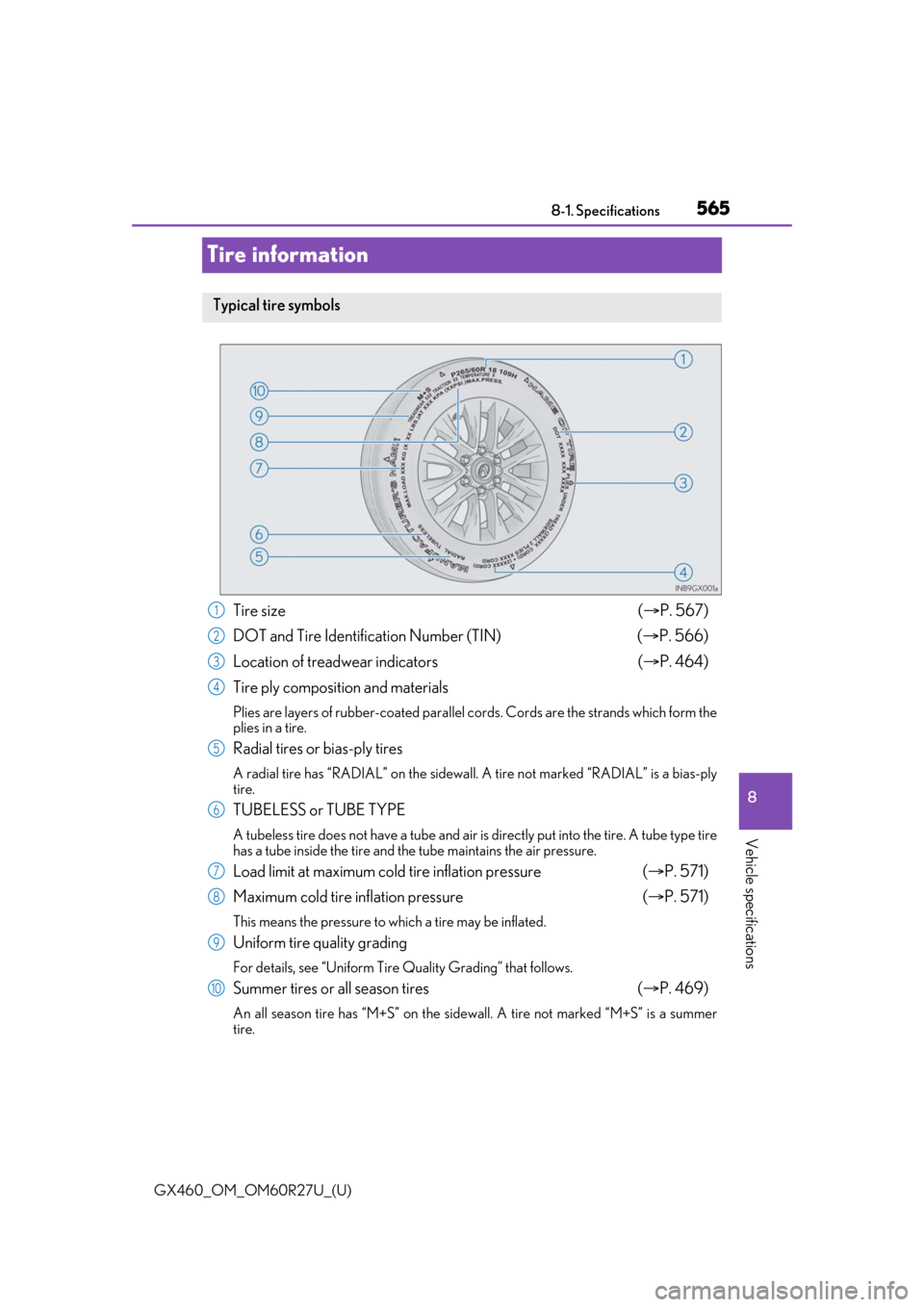
Tire information
Tire size
( P. 567)
DOT and Tire Identification Number (TIN) ( P. 566)
Location of trea dwear indicators ( P. 464)
Tire ply composition and materials
Plies are layers of rubber-c oated parallel cords. Cords are the strands which form the
plies in a tire.
Radial tires or bias-ply tires
A radial tire has “RADIAL” on the sidewall. A tire not marked “RADIAL” is a bias-ply
tire.
TUBELESS or TUBE TYPE
A tubeless tire does not have a tube and air is directly put into the tire. A tube type tire
has a tube inside the tire and the tube maintains the air pressure.
Load limit at maximum cold tire inflation pressure ( P. 571)
Maximum cold tire inflation pressure ( P. 571)
This means the pressure to which a tire may be inflated.
Uniform tire quality grading
For details, see “Uniform Tire Quality Grading” that follows.
Summer tires or all season tires ( P. 469)
An all season tire has “M+S” on the side wall. A tire not marked “M+S” is a summer
tire.
Typical tire symbols
1
2
3
4
5
6
7
8
9
10
Page 569 of 620
GX460_OM_OM60R27U_(U)
5698-1. Specifications
8
Vehicle specifications
This information has been prepared in accordance with regulations issued by the
National Highway Traffic Safety Administra tion of the U.S. Department of Trans-
portation.
It provides the purchasers and/or prospe ctive purchasers of Lexus vehicles with
information on uniform tire quality grading.
Your Lexus dealer will help answer any ques tions you may have as you read this infor-
mation.
■DOT quality grades
All passenger vehicle tires must conform to Federal Safety Requirements in
addition to these grades. Quality grades can be found where applicable on
the tire sidewall between tread shoulder and maximum section width.
For example: Treadwear 200 Traction AA Temperature A
■Treadwear
The treadwear grade is a comparative rati ng based on the wear rate of the tire
when tested under controlled conditio ns on a specified government test
course.
For example, a tire graded 150 would wear one and a half (1 - 1/2) times as well on
the government course as a tire graded 100.
The relative performance of tires depends upon the actua l conditions of their use.
Performance may differ significantly from the norm due to variations in driving
habits, service practices and difference s in road characteristics and climate.
■Traction AA, A, B, C
The traction grades, from highest to lowest, are AA, A, B and C, and they rep-
resent the tire’s ability to stop on wet pavement as measured under controlled
conditions on specified government test surfaces of asphalt and concrete.
A tire marked C may have poor traction performance.
Warning: The traction grade assigned to this tire is based on braking (straight
ahead) traction tests and does not include cornering (turning) traction.
Uniform Tire Quality Grading
Page 570 of 620
570
GX460_OM_OM60R27U_(U)8-1. Specifications
■Temperature A, B, C
The temperature grades are A (the highes
t), B, and C, representing the tire’s
resistance to the generation of heat and its ability to dissipate heat when
tested under controlled conditions on a specified indoor laboratory test
wheel.
Sustained high temperature can cause the ma terial of the tire to degenerate and
reduce tire life, and excessive temperature can lead to sudden tire failure.
Grade C corresponds to a level of perfor mance which all passenger car tires must
meet under the Federal Motor Vehicle Safety Standard No. 109.
Grades B and A represent higher levels of performance on the laboratory test
wheel than the minimum required by law.
Warning: The temperature grades of a tire assume that it is properly inflated and
not overloaded.
Excessive speed, underi nflation, or excessive loading, either separately or in com-
bination, can cause heat buildup and possible tire failure.