lug Lexus GX470 2007 Instrument cluster / LEXUS 2007 GX470 OWNER'S MANUAL (OM60C64U)
[x] Cancel search | Manufacturer: LEXUS, Model Year: 2007, Model line: GX470, Model: Lexus GX470 2007Pages: 436, PDF Size: 11.52 MB
Page 2 of 436

TABLE OF CONTENTSIndex
ii
1-1. Key information .............................. 2Keys ......................................................... 2
1-2. Opening, closing and locking the doors......................................... 4
Wireless remote control ................. 4
Side doors ............................................. 6
Back door .............................................. 11
1-3. Adjustable components ............. 13 Front seats ........................................... 13
Rear seats ............................................ 15
Driving position memory system ............................................... 24
Head restraints................................. 26
Seat belts ............................................ 28
Steering wheel.................................. 35
Inside rear view mirror.................. 36
Outside rear view mirrors ........... 37
Roof luggage carrier ..................... 39
1-4. Opening and closing the windows and moon roof ........... 41
Power windows................................. 41
Moon roof .......................................... 43
1-5. Refueling ........................................ 46 Opening the fuel tank cap........... 46 1-6. Theft deterrent system............... 49
Engine immobilizer system ......... 49
Alarm..................................................... 51
Theft prevention labels (U.S.A.) ............................................. 53
1-7. Safety information ....................... 54 Correct driving posture ............... 54
SRS airbags ....................................... 56
Front passenger occupant classification system .................... 69
Child restraint sy stems ................. 74
Installing child restraints ............... 77
2-1. Driving procedures.................... 88 Driving the vehicle ......................... 88
Starting the engine ......................... 95
Automatic transmission................ 98
Turn signal lever.............................. 101
Parking brake ................................. 102
2-2. Instrument cluster ..................... 103 Gauges and meters ..................... 103
Indicators and warning lights................................................. 105
Trip information display .............. 108
1Before driving
2When driving
Page 3 of 436
1
2
3
4
5
6
7
iii
2-3. Operating the lights and windshield wipers ...................... 111
Headlight switch ............................... 111
Fog light switch ................................ 113
Windshield wipers and washer............................................... 114
Rear window wiper and washer............................................... 117
2-4. Using other driving systems..... 118 Cruise control ................................. 118
Four-wheel drive system.............. 121
Rear height control air suspension..................................... 123
Electronic modulated suspension..................................... 129
DAC (Downhill Assist Control system)............................................ 130
Driving assist systems.................. 132
2-5. Driving information .................. 135 Off-road precautions .................. 135
Cargo and luggage ...................... 140
Vehicle load limits ......................... 144
Winter driving tips ........................ 146
Trailer towing .................................. 150
Dinghy towing ................................ 160 3-1. Using the air conditioning
system and defogger .............. 162
Automatic air conditioning system (without navigation
system)............................................ 162
Rear cooler system....................... 168
Rear window and outside rear view mirror defoggers ............. 169
3-2. Using the audio system.............. 171 Audio system type .......................... 171
Using the radio............................... 173
Using the CD player..................... 181
Playing MP3 and WMA discs ................................................. 188
Optimal use of the audio system ............................................. 194
Using the AUX adapter ............. 197
Using the steering switches ...... 198
3-3. Using the rear audio system ....................................... 200
Rear seat entertainment system features ......................... 200
Using the DVD player (DVD video)............................... 205
Using the DVD player (video CD) .................................... 212
Using the DVD player (audio CD/CD text) ................. 214
3Interior features
Page 4 of 436
TABLE OF CONTENTSIndex
iv
Using the DVD player (MP3 discs) .................................. 215
Using the video mode ................. 217
Changing the initial setting ....... 218
3-4. Using the interior lights .......... 225 Interior lights list............................ 225
3-5. Using the storage features ..................................... 228
List of storage fe atures............... 228
3-6. Other interior features........... 233 Sun visors......................................... 233
Vanity mirror .................................. 234
Clock ................................................. 235
Outside temperature display ............................................ 236
Ashtrays ........................................... 237
Cigarette lighter .......................... 238
Power outlet ................................... 239
Seat heaters ..................................... 241
Armrest ............................................ 243
Floor mats........................................ 244
Luggage compartment features .......................................... 245
Garage door opener ................. 248
Compass.......................................... 253
Lexus Link System ....................... 257 4-1. Maintenance and care............ 272
Cleaning and protecting the vehicle exterior .......................... 272
Cleaning and protecting the vehicle interior............................ 274
4-2. Maintenance.............................. 277 Maintenance requirements ..... 277
General maintena nce ................ 279
Emission inspection and maintenance (I/M)
programs ...................................... 282
4-3. Do-it-yourself maintenance........................... 283
Do-it-yourself service precautions ................................. 283
Hood.................................................. 286
Engine compartment.................. 287
Tires .................................................. 302
Tire inflation pressure................ 309
Wheels............................................... 313
Air conditioning filter................... 315
Wireless remote control battery ............................................. 317
Rear seat entertainment system controller ........................ 319
Checking and replacing fuses ................................................. 321
Light bulbs ........................................ 331
4Maintenance and care
Page 16 of 436
xvi
A
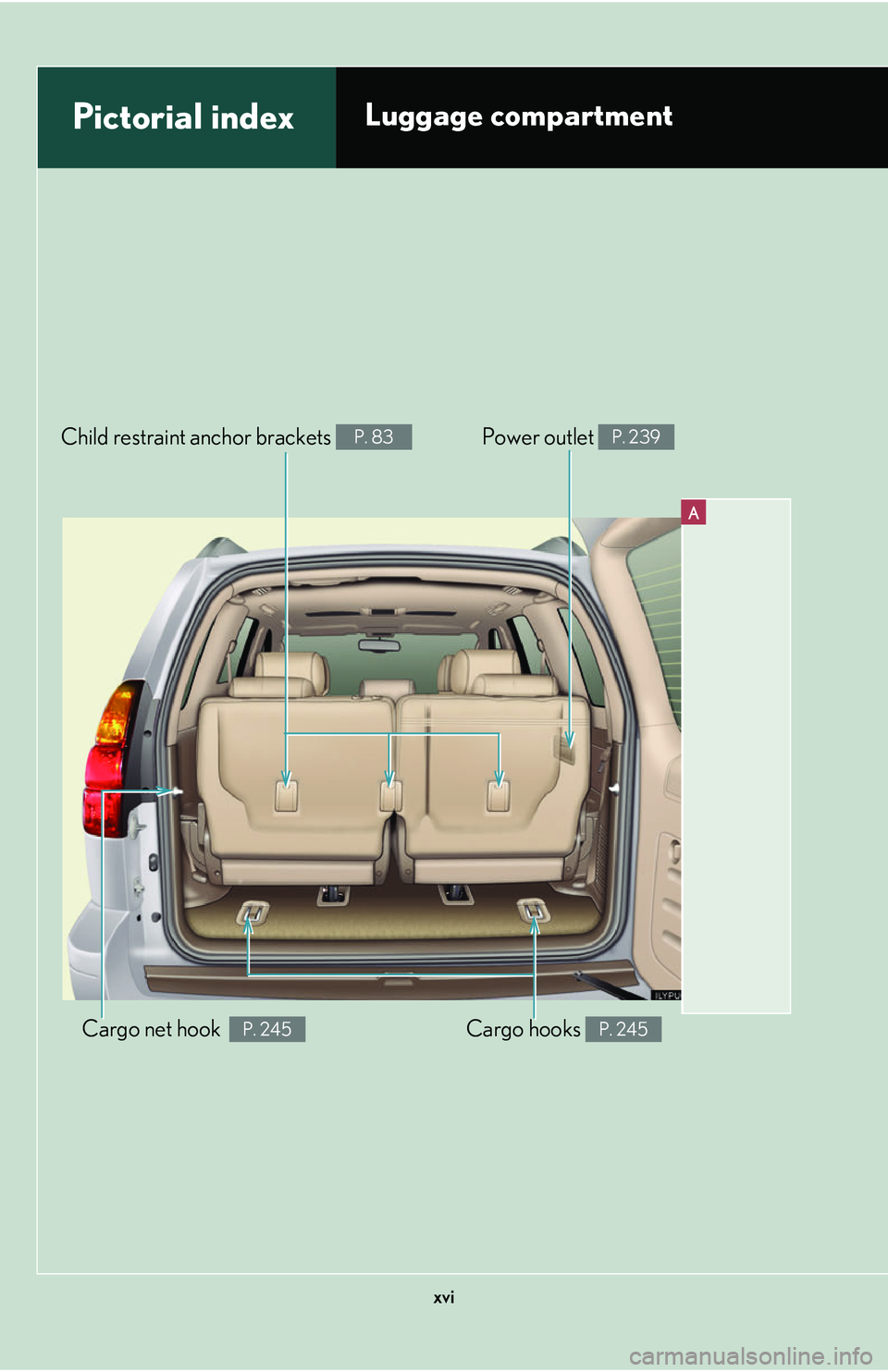
Pictorial indexLuggage compartment
Cargo hooks P. 245Cargo net hook P. 245
Child restraint anchor brackets P. 83Power outlet P. 239
Page 19 of 436

xix
Scrapping of your Lexus
The SRS airbag and seat belt pretensioner devices in your Lexus contain explosive
chemicals. If the vehicle is scrapped with the airbags and seat belt pretensioners left
as they are, this may cause an accident such as fire. Be sure to have the systems of
the SRS airbag and seat belt pretensioner removed and disposed of by a qualified
service shop or by your Lexus deal er before you scrap your vehicle.
Leak detection pump (for the U.S.A. and Canada)
This pump performs fuel evaporation leakage check. This check is conducted sev-
eral hours after the engine is turned off. You may hear a sound coming from under-
neath the luggage compartment for several minutes, however this does not indicate
a malfunction.
CAUTION
■General precautions while driving
Driving under the influence: Never drive your vehicle when under the influence of
alcohol or drugs that have impaired your ability to operate your vehicle. Alcohol
and certain drugs delay reaction time, impair judgment and reduce coordination,
which could lead to an accident that will hurt or kill you, your occupants or others.
Defensive driving: Always drive defensively. Anticipate mistakes that other drivers
or pedestrians might make and be ready to avoid accidents.
Driver distraction: Always give your full at tention to driving. Anything that distracts
the driver, such as adjusting controls, ta lking on a cellular phone or reading can
result in a collision with resulting death or serious injury to you, your occupants or
others.
■When children are in the vehicle
Never leave children unattended in the vehicle.
When left unattended, children may be able to start the vehicle or shift the vehicle
into neutral. There is also a danger that children may injure themselves by playing
with the cigarette lighter, the windows, the moon roof, or other features of the vehi-
cle. In addition, heat build-up or extremel y cold temperatures inside the vehicle can
be fatal to children.
Page 21 of 436
Before driving1
1
1-1. Key information............................ 2Keys....................................................... 2
1-2. Opening, closing and locking the doors ...................................... 4
Wireless remote control............... 4
Side doors .......................................... 6
Back door ........................................... 11
1-3. Adjustable components ........... 13 Front seats ........................................ 13
Rear seats ......................................... 15
Driving position memory system ............................................ 24
Head restraints.............................. 26
Seat belts ......................................... 28
Steering wheel............................... 35
Inside rear view mirror ............... 36
Outside rear view mirrors ........ 37
Roof luggage carrier................... 39 1-4. Opening and closing the
windows and moon roof ........ 41
Power windows ............................... 41
Moon roof ....................................... 43
1-5. Refueling ..................................... 46 Opening the fuel tank cap ....... 46
1-6. Theft deterrent system............ 49 Engine immobilizer system ...... 49
Alarm .................................................. 51
Theft prevention labels (U.S.A.) .......................................... 53
1-7. Safety information .................... 54 Correct driving posture ............ 54
SRS airbags .................................... 56
Front passenger occupant classification system................. 69
Child restraint systems ............... 74
Installing child restraints ............. 77
Page 59 of 436

39
1
1-3. Adjustable components
Before driving
Roof luggage carrier (if equipped)
Adjusting the position of cross railsTurn the knobs counterclockwise
to loosen the cross rails.
Slide the cross rails to the appro-
priate position for loading luggage.
After adjusting, be sure to tighten
the cross rails by turning knobs
clockwise.
Cross rails
Roof rails
STEP1
STEP2
Page 60 of 436

40
1-3. Adjustable components
CAUTION
■Cross rail adjustment
Make sure the cross rails are locked securely by applying pressure forward and
rearward.
Failure to do so may cause an accident, deat h or serious injury in the event of emer-
gency braking or a collision.
■When loading cargo
Observe the following precautions:
●Place the cargo so that its weight is di stributed evenly between the front and rear
axles.
●If loading long or wide cargo, never exceed the vehicle overall length or width.
( P. 3 7 8 )
●Before driving, make sure the cargo is se curely fastened to the roof luggage car-
rier.
●Loading cargo on the roof luggage carrier will raise the vehicle’s center of gravity.
Avoid high speeds, sudden starts, sharp tu rns, sudden braking or abrupt maneu-
vers, otherwise unexpected loss of co ntrol or vehicle rollover may occur.
●If driving for a long distance, on rough ro ads, or at high speeds, stop the vehicle
occasionally during the trip to make su re the cargo remains securely fastened.
●Do not exceed 130 lb. (58 kg) cargo weight on the roof luggage carrier.
NOTICE
■When loading the luggage
Be careful not to scratch the surface of the moon roof.
■Cross rail stoppers
To prevent damage the moon roof, do not remove the cross rail stoppers.
Page 79 of 436

59
1-7. Safety information
1
Before driving
■Operating conditions (front airbags)
●The SRS front airbags will deploy if the severity of the frontal impact is above the
designed threshold level, comparable to an approximate 15 mph (25 km/h) col-
lision when the vehicle impacts straight into a fixed barrier that does not move
or deform.
However, this threshold velocity will be considerably higher if the vehicle strikes
an object, such as a parked vehicle or sign pole, which can move or deform on
impact, or if the vehicle is involved in an underride collision (e.g. a collision in
which the front of the vehicle “underrides”, or goes under, the bed of a truck, etc.).
●It is possible that in some collisions where the forward deceleration of the vehi-
cle is very close to the designed thresh old level, the SRS front airbags and the
seat belt pretensioners ma y not activate together.
●The SRS front passenger airbag will not activate, if there is not passenger sitting
in the front passenger seat. However, th e front passenger airbag may deploy, if
luggage is put in the seat or the seat belt is fastened, even if the seat is unoccu-
pied. ( P. 6 9 )
■Operating conditions (side and curtain shield airbags)
●The SRS side airbags and curtain shield ai rbags are designed to inflate when the
passenger compartment is subjected to a severe impact from the side.
●The SRS side airbag on the passenger seat will not activate if there is no passen-
ger sitting in the front passenger seat. Ho wever, the side airbag on the passen-
ger seat may deploy, if luggage is put in the seat, even if the seat is unoccupied.
( P. 6 9 )
Page 95 of 436

75
1-7. Safety information
1
Before driving
Convertible seat
Booster seat
■When the child restraint system is not in use
Leave the child restraint system properly secured on the seat. Do not store the
restraint loosely on a passenger se at or in the luggage compartment.
■Selecting an appropriate child restraint system
Get an appropriate child restraint system for the child. If a child is too large for a
child restraint system, sit the child on a rear seat and use the vehicle's seat belt.
( P. 2 8 )