air condition Lexus HS250h 2012 User Guide
[x] Cancel search | Manufacturer: LEXUS, Model Year: 2012, Model line: HS250h, Model: Lexus HS250h 2012Pages: 630, PDF Size: 16.1 MB
Page 114 of 630
113
1-8. Safety information
1
Before driving
HS250h_U_75050U
●The SRS front airbags for the front passenger will not activate if there is no pas-
senger sitting in the front passenger seat. However, the SRS front airbags for the
front passenger may deploy if luggage is put in the seat, even if the seat is unoc-
cupied. (→P. 7 7 )
■Operating conditions (SRS side ai rbags and curtain shield airbags)
The SRS side airbags and SRS curtain shield airbags will deploy in the event of an
impact that exceeds the set threshold level (the level of force corresponding to the
impact force produced by an approximately 3300 lb. [1500 kg] vehicle colliding
with the vehicle cabin from a direction perpendicular to the vehicle orientation at an
approximate speed of 12 -18 mph [20 -30 km/h]).
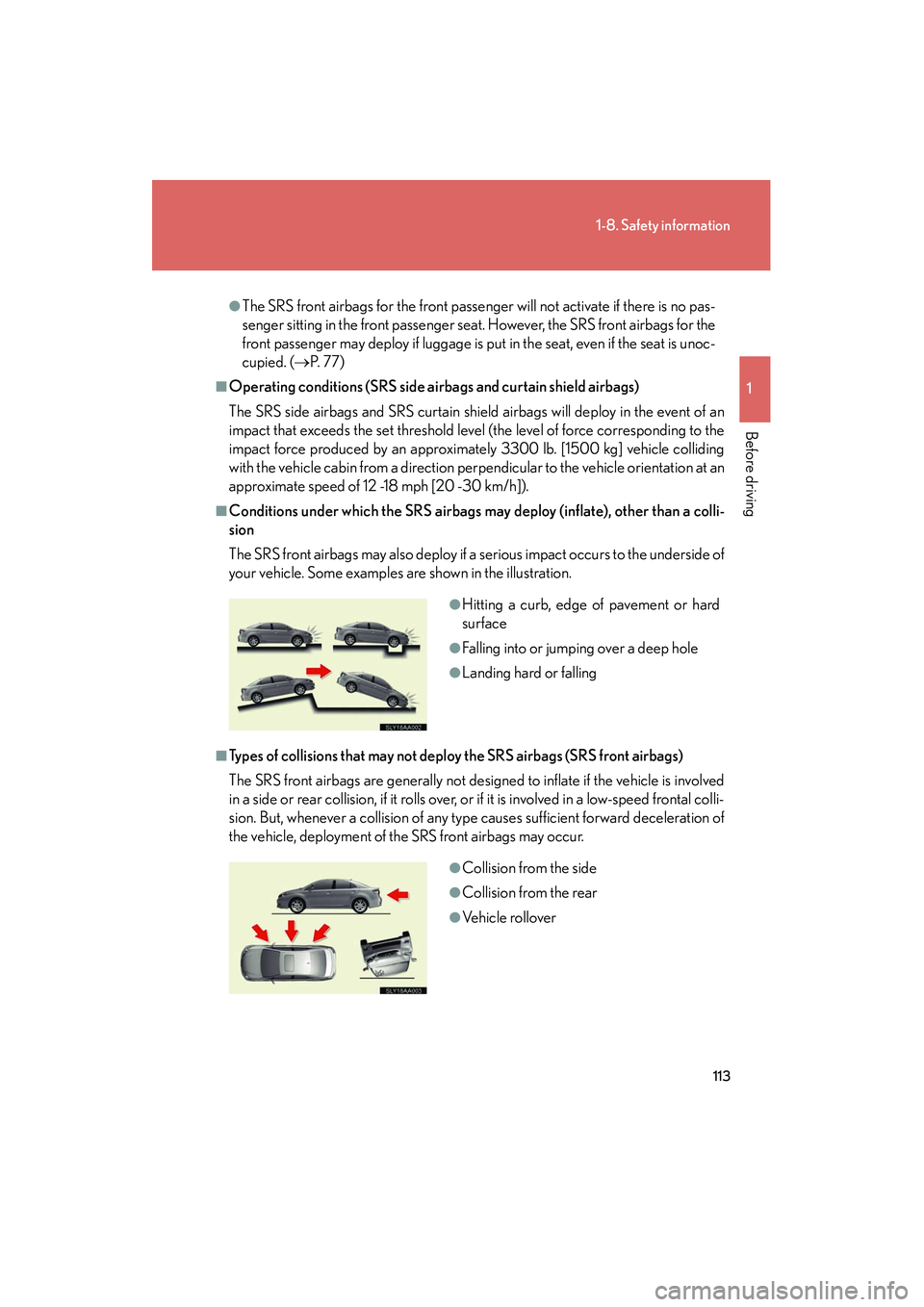
■Conditions under which the SRS airbags may deploy (inflate), other than a colli-
sion
The SRS front airbags may also deploy if a serious impact occurs to the underside of
your vehicle. Some examples are shown in the illustration.
■Types of collisions that may not deploy the SRS airbags (SRS front airbags)
The SRS front airbags are generally not designed to inflate if the vehicle is involved
in a side or rear collision, if it rolls over, or if it is involved in a low-speed frontal colli-
sion. But, whenever a collision of any type causes sufficient forward deceleration of
the vehicle, deployment of the SRS front airbags may occur.
●Hitting a curb, edge of pavement or hard
surface
●Falling into or jumping over a deep hole
●Landing hard or falling
●Collision from the side
●Collision from the rear
●Vehicle rollover
Page 122 of 630
121
1
1-8. Safety information
Before driving
HS250h_U_75050U
Front passenger occupant classification system
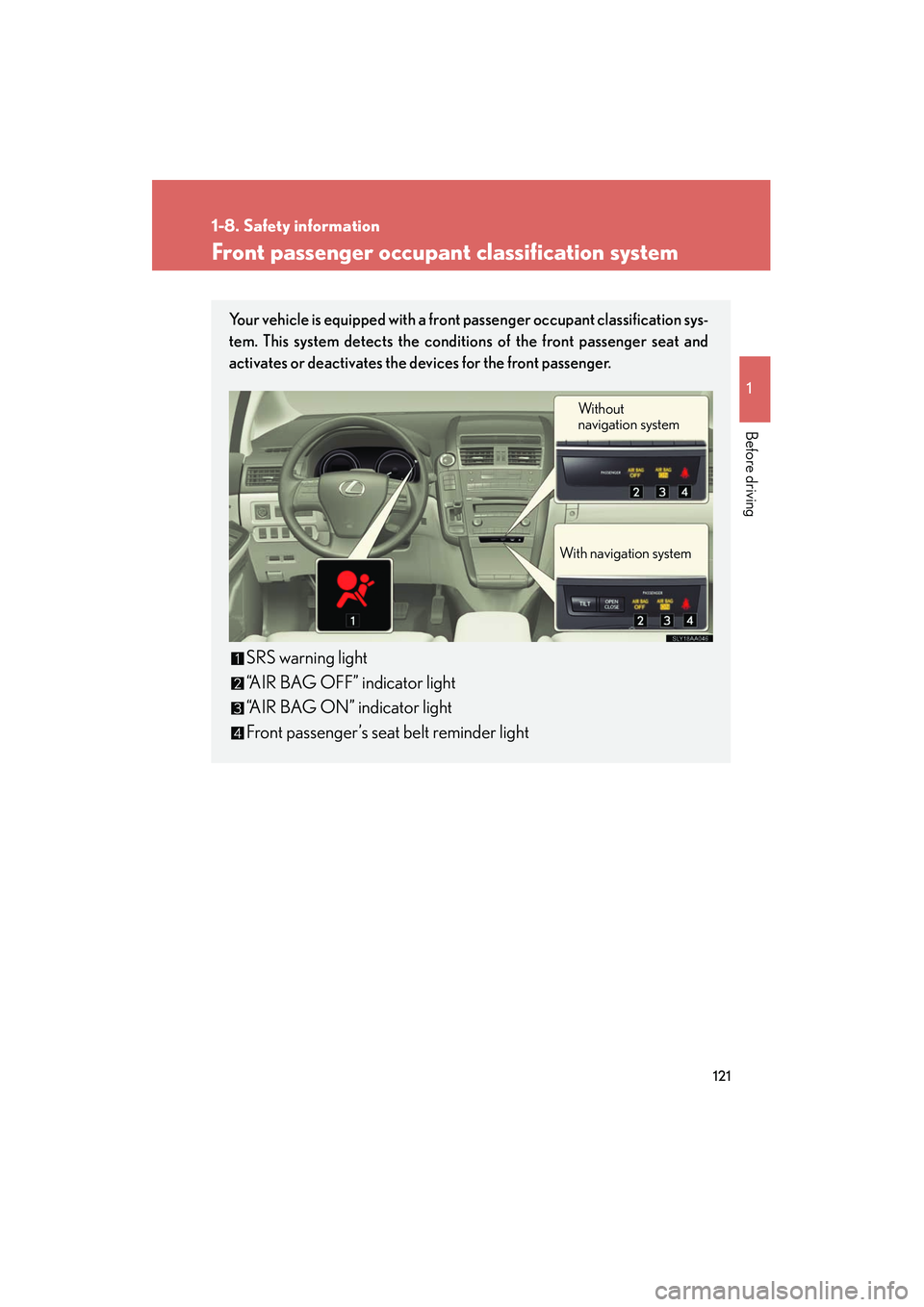
Your vehicle is equipped with a front passenger occupant classification sys-
tem. This system detects the conditions of the front passenger seat and
activates or deactivates the devices for the front passenger.
SRS warning light
“AIR BAG OFF” indicator light
“AIR BAG ON” indicator light
Front passenger’s seat belt reminder light
With out
navigation system
With navigation system
Page 123 of 630
122
1-8. Safety information
HS250h_U_75050U
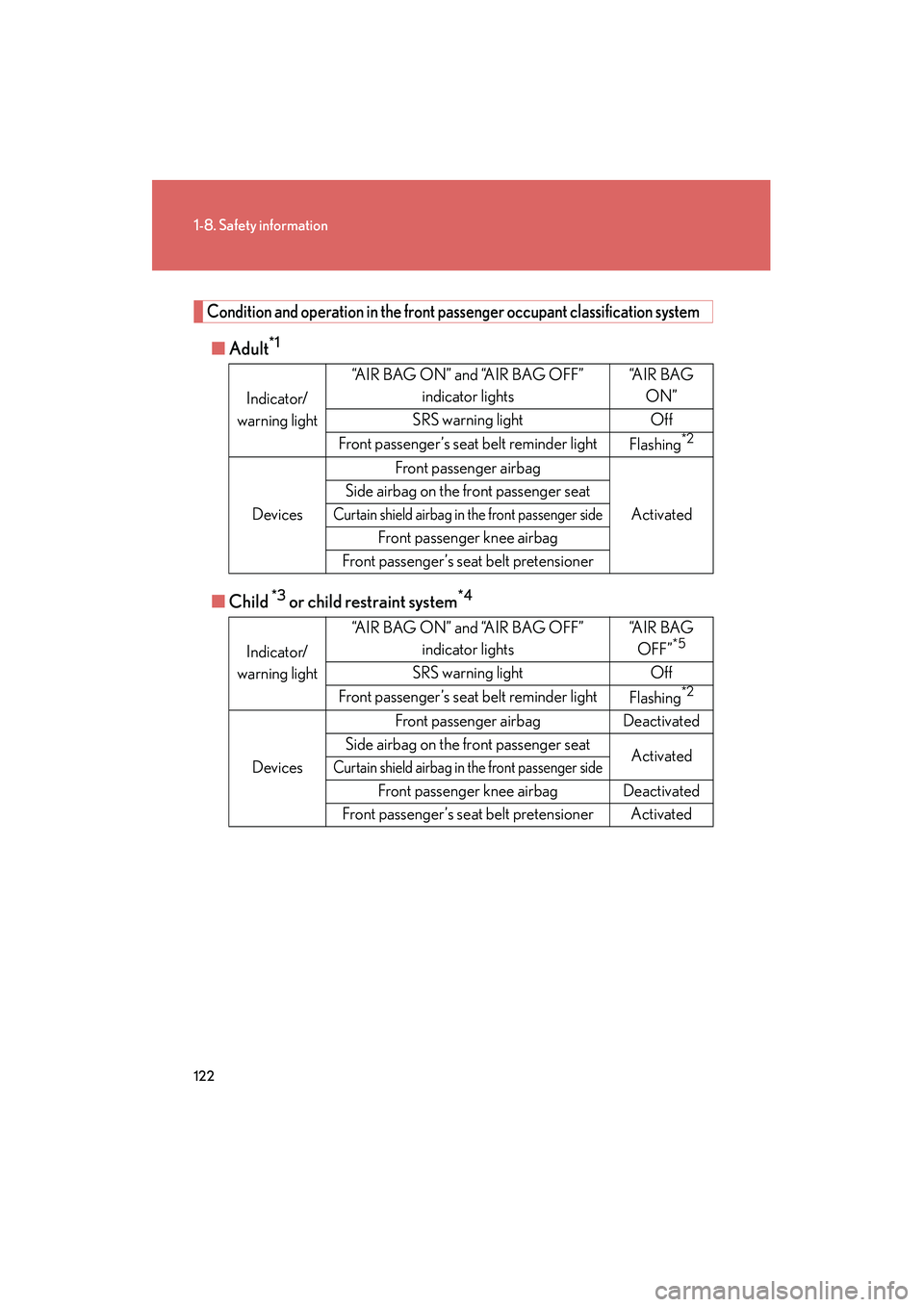
Condition and operation in the front passenger occupant classification system
■Adult*1
■Child *3 or child restraint system*4
Indicator/
warning light “AIR BAG ON” and “AIR BAG OFF”
indicator lights “A I R B A G
ON”
SRS warning light Off
Front passenger’s seat belt reminder light Flashing
*2
DevicesFront passenger airbag
Activated
Side airbag on the front passenger seatCurtain shield airbag in the front passenger side
Front passenger knee airbag
Front passenger’s seat belt pretensioner
Indicator/
warning light “AIR BAG ON” and “AIR BAG OFF”
indicator lights “A I R B A G
OFF”
*5
SRS warning light Off
Front passenger’s seat belt reminder light Flashing
*2
DevicesFront passenger airbag Deactivated
Side airbag on the front passenger seat ActivatedCurtain shield airbag in the front passenger side
Front passenger knee airbag Deactivated
Front passenger’s seat belt pretensioner Activated
Page 163 of 630
162
2-1. Driving procedures
HS250h_U_75050U
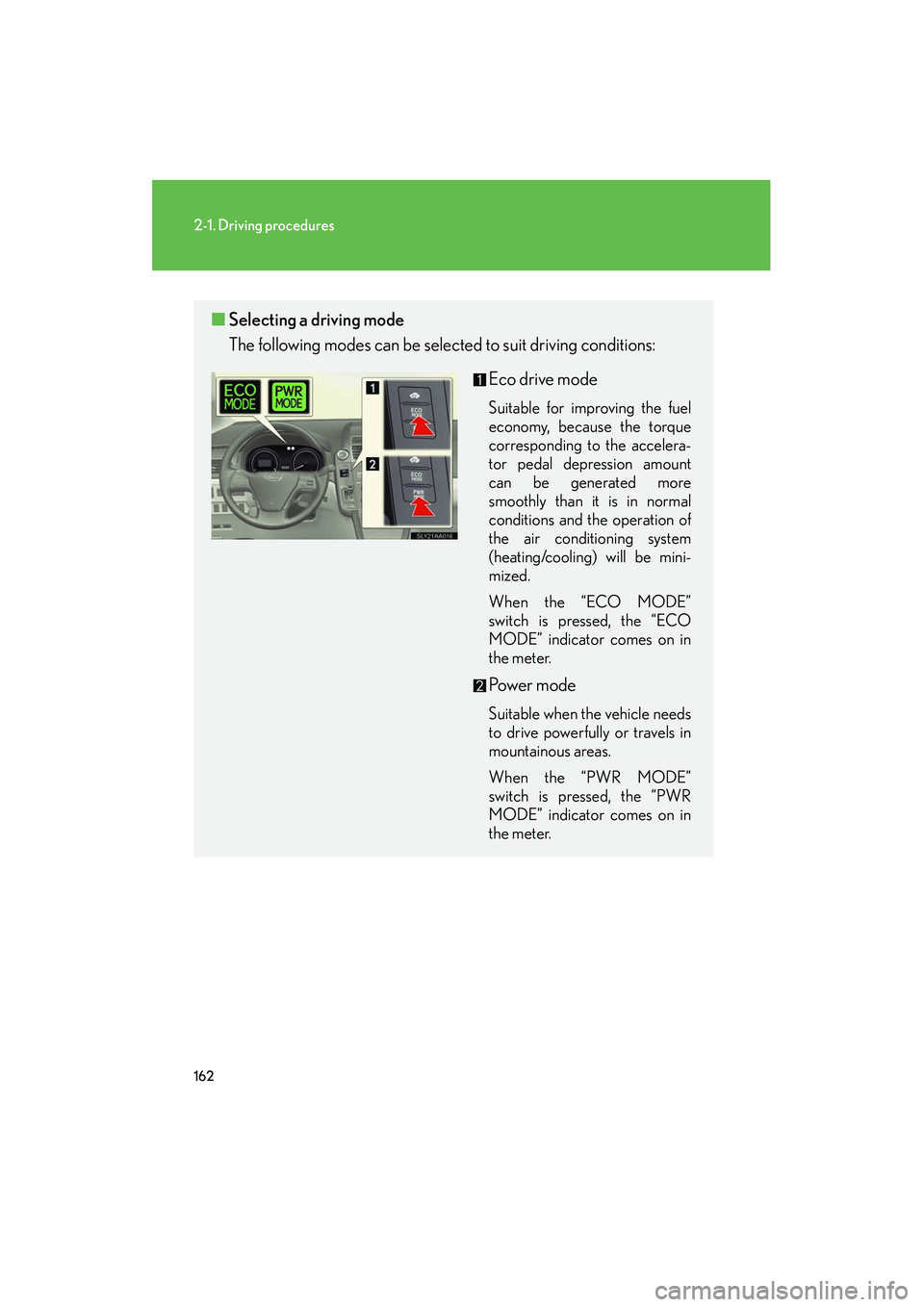
■Selecting a driving mode
The following modes can be sele cted to suit driving conditions:
Eco drive mode
Suitable for improving the fuel
economy, because the torque
corresponding to the accelera-
tor pedal depression amount
can be generated more
smoothly than it is in normal
conditions and the operation of
the air conditioning system
(heating/cooling) will be mini-
mized.
When the “ECO MODE”
switch is pressed, the “ECO
MODE” indicator comes on in
the meter.
Po w e r m o d e
Suitable when the vehicle needs
to drive powerfully or travels in
mountainous areas.
When the “PWR MODE”
switch is pressed, the “PWR
MODE” indicator comes on in
the meter.
Page 165 of 630
164
2-1. Driving procedures
HS250h_U_75050U
■About engine braking
When shift position B is selected, releasing the accelerator pedal will apply engine
braking.
• When the vehicle is driven at high speeds, compared to ordinary gasoline-fueled vehicles, the engine braking deceleration is felt less than that of other
vehicles.
• The vehicle can be accelerated even when shift position B is selected.
If the vehicle is driven continuously in the B position, fuel efficiency will become low.
Usually, select the D position.
■Using air conditioning in Eco drive mode
The Eco drive mode controls heating/cooling and fan speed operation to improve
fuel consumption. When you want to improve the effectiveness of the air condition-
ing system, adjust the fan speed or cancel the Eco drive mode.
For more information, refer to the “Navigation System Owner’s Manual”.
■Power mode automatic deactivation
Power mode is automatically deactivated if the “POWER” switch is turned off after
driving in power mode.
■Customization
Settings (e.g. Reverse warning buzzer) can be changed.
(Customizable features →P. 5 8 4 )
CAUTION
■When driving on slippery road surfaces
Do not accelerate or change the shift position suddenly.
Sudden changes in engine braking may cause the vehicle to spin or skid, resulting in
an accident.
■For the shift lever
Do not hang anything on the shift lever.
Doing so could prevent the shift lever fr om returning to position, causing unex-
pected accidents to occur when the vehicle is in motion.
Page 236 of 630
235
2-4. Using other driving systems
2
When driving
HS250h_U_75050U
CAUTION
■Before using the LKA system
Do not rely on the LKA system to remain within a selected lane. The LKA system is
not designed to enable inattentive driving. The steering wheel should be operated
by the driver to maintain the vehicle in a suitable position within its lane. Always
drive carefully.
■Turn the LKA off while driving in any of the following conditions:
Do not use LKA in any of the following situations.
Otherwise, the system may not function correctly and could result in an accident.
●When driving with snow tires, tire chains, a spare tire, or similar equipment.
●When driving with non-standard parts or aftermarket equipment installed.
(including modified tires and suspensions, etc.)
●When towing a trailer.
●When there are objects or structures along the roadside that might be misinter-
preted as lane markers. (such as guardrails, curb, reflector posts, etc.)
●When there are wheel ruts, icy trademarks, etc. or if snow remains on the road
surface.
●When there are shadows on the road running parallel with lane markers, or if a
shadow covers the lane markers.
●When there are visible lines on the pavement from road repairs, or if the remains
of old lane markers are still visible on the road.
●When driving on slippery roads, such as those covered with rain, ice or snow.
●When driving in a lane other than the driving or passing lanes on a freeway or
highway.
●When driving on a road with lane closures due to maintenance, or when driving
in a temporary lane.
●When driving on winding roads or roads that are rough or uneven.
Page 259 of 630
258
2-5. Driving information
HS250h_U_75050U
Winter driving tips
Carry out the necessary preparations and inspections before driving the
vehicle in winter. Always drive the vehicle in a manner appropriate to the
prevailing weather conditions.
■Pre-winter preparations
●Use fluids that are appropriate to the prevailing outside tempera-
tures.
• Engine oil
• Engine/power control unit coolant
• Washer fluid
● Have the vehicle fitted with four snow tires or purchase a set of
tire chains for the front tires.
Ensure that all tires are the same size and brand, and that chains match
the size of the tires.
■ Before driving the vehicle
Perform the following according to the driving conditions:
●Do not try to forcibly open a window or move a wiper that is fro-
zen. Pour warm water over the frozen area to melt the ice. Wipe
away the water immediately to prevent it from freezing.
● To ensure proper operation of the climate control system fan,
remove any snow that has accumulated on the air inlet vents in
front of the windshield.
● Remove any ice that has accumulated on the vehicle chassis.
● Periodically check for and remove any excess ice or snow that
may have accumulated in the wheel well or on the brakes.
■ When driving the vehicle
Accelerate the vehicle slowly and drive at a reduced speed suitable to the
road conditions.
Page 265 of 630
264
HS250h_U_75050U
3-1. Using the air conditioning system and defogger
Automatic air conditioning system ..................................... 266
Rear window defogger switch ....................................... 274
Windshield wiper de-icer ..... 275
3-2. Using the audio system Audio system............................ 276
Using the radio ........................ 279
Using the CD player ............. 287
Playing MP3 and WMA
discs......................................... 295
Operating an iPod ................. 302
Operating a USB memory................................... 310
Optimal use of the audio system ...................................... 318
Using the AUX port............... 321
Using the steering wheel audio switches...................... 322
Page 267 of 630
266
HS250h_U_75050U
3-1. Using the air conditioning system and defogger
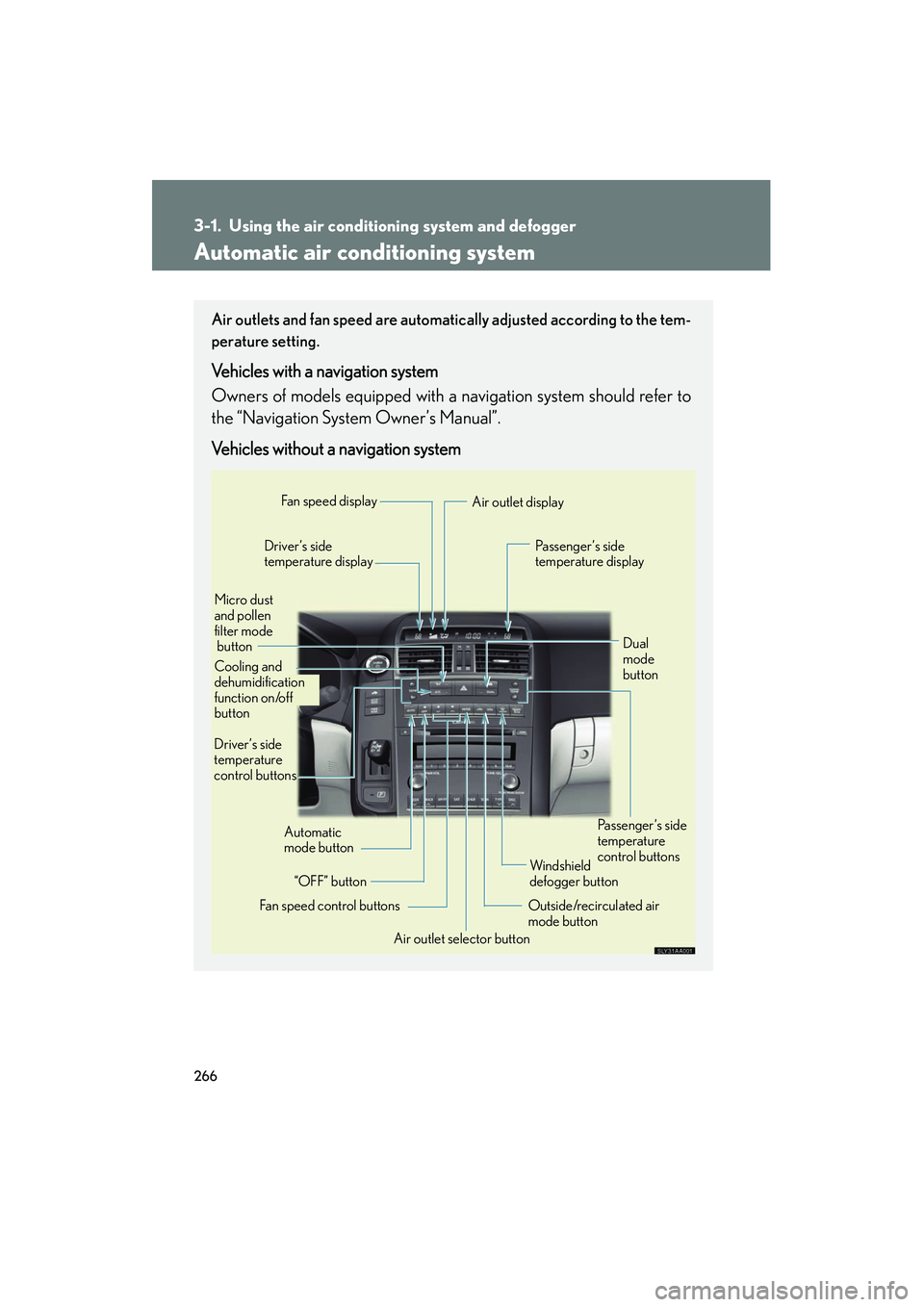
Automatic air conditioning system
Air outlets and fan speed are automatically adjusted according to the tem-
perature setting.
Vehicles with a navigation system
Owners of models equipped with a navigation system should refer to
the “Navigation System Owner’s Manual”.
Vehicles without a navigation system
Automatic
mode button
Driver’s side
temperature display
Dual
mode
button
Fan speed control buttons Air outlet display
Fan speed display
Passenger’s side
temperature display
Driver’s side
temperature
control buttons Outside/recirculated air
mode buttonWindshield
defogger button Passenger’s side
temperature
control buttons
Micro dust
and pollen
filter mode
button
“OFF” button Air outlet selector button
Cooling and
dehumidification
function on/off
button
Page 268 of 630
267
3-1. Using the air conditioning system and defogger
3
Interior features
HS250h_U_75050U
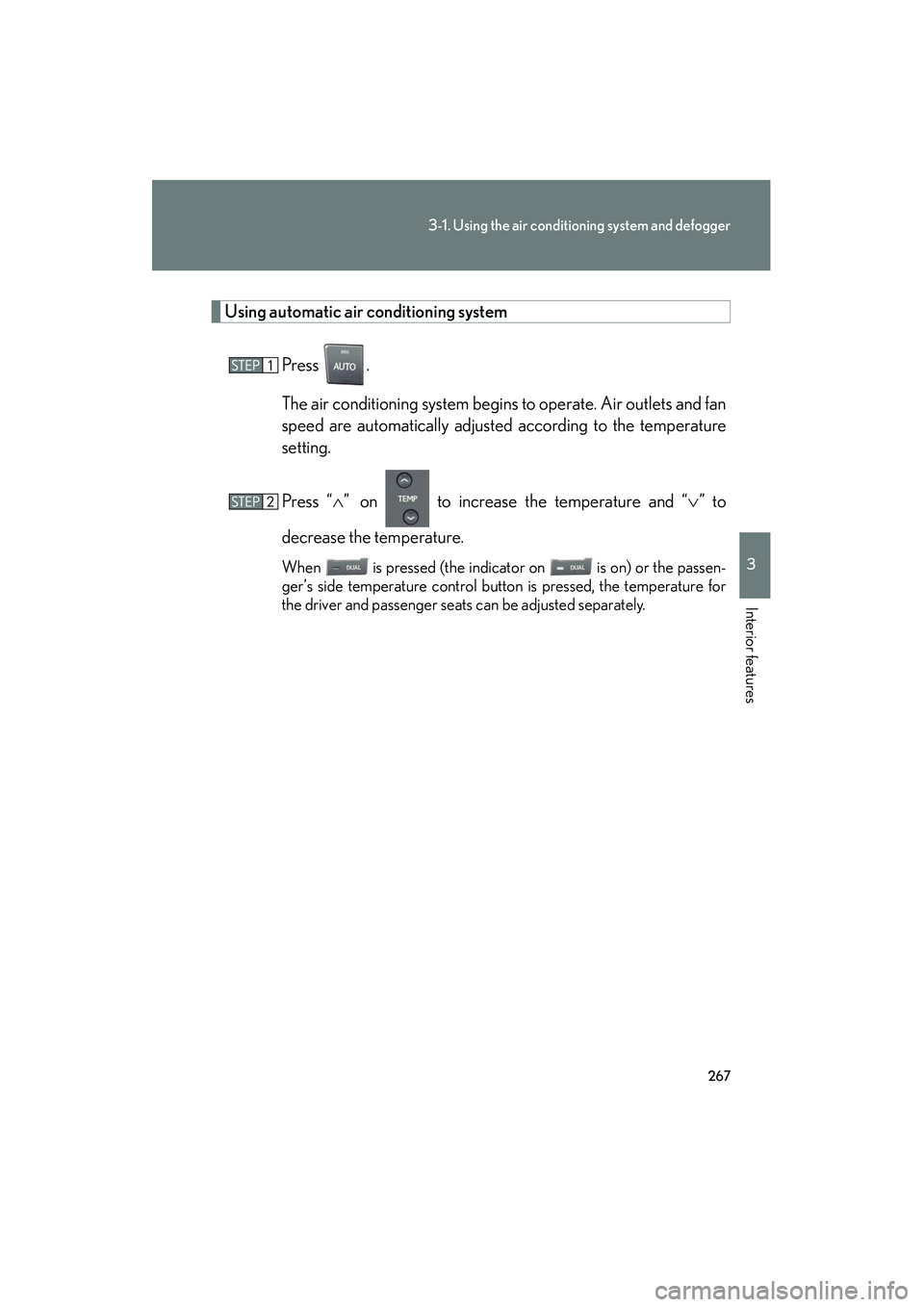
Using automatic air conditioning system
Press .
The air conditioning system begins to operate. Air outlets and fan
speed are automatically adjusted according to the temperature
setting.
Press “∧” on to increase the temperature and “ ∨” to
decrease the temperature.
When is pressed (the indicator on is on) or the passen-
ger’s side temperature control button is pressed, the temperature for
the driver and passenger seats can be adjusted separately.