wheel Lexus HS250h 2012 Manual Online
[x] Cancel search | Manufacturer: LEXUS, Model Year: 2012, Model line: HS250h, Model: Lexus HS250h 2012Pages: 630, PDF Size: 16.1 MB
Page 509 of 630
508
5-2. Steps to take in an emergency
HS250h_U_75050U
■The tire pressure warning light may come on due to natural causes
The tire pressure warning light may come on due to natural causes such as natural
air leaks and tire inflation pressure changes caused by temperature. In this case,
adjusting the tire inflation pressure will turn off the warning light (after a few min-
utes).
■When a tire is replaced with a spare tire
The compact spare tire is not equipped with a tire pressure warning valve and trans-
mitter. If a tire goes flat, the tire pressure warning light will not turn off even though
the flat tire has been replaced with the spare tire. Replace the spare tire with the
repaired tire and adjust the tire inflation pressure. The tire pressure warning light
will go off after a few minutes.
■If the tire pressure warning system is not functioning
The tire pressure warning system will be disabled in the following conditions:
(When the condition becomes normal, the system will work properly.)
●If tires not equipped with tire pressure warning valves and transmitters are used.
●If the ID code on the tire pressure warning valves and transmitters is not regis-
tered in the tire pressure warning computer.
●If the tire inflation pressure is 73 psi (500 kPa, 5.1 kgf/cm2 or bar) or higher.
The tire pressure warning system may be disabled in the following conditions:
(When the condition becomes normal, the system will work properly.)
●If electronic devices or facilities using similar radio wave frequencies are nearby.
●If a radio set at similar frequency is in use in the vehicle.
●If a window tint that affects the radio wave signals is installed.
●If there is a lot of snow or ice on the vehicle, particularly around the wheels or
wheel housings.
●If non-genuine Lexus wheels are used (Even if you use Lexus wheels, the tire
pressure warning system may not work properly with some types of tires.)
●If tire chains are used.
Page 510 of 630
5
When trouble arises
509
5-2. Steps to take in an emergency
HS250h_U_75050U
■If the tire pressure warning light frequently comes on after blinking for 1 minute
If the tire pressure warning light frequently comes on after blinking for 1 minute
when the “POWER” switch is turned to ON mode, have it checked by your Lexus
dealer.
■Customization that can be configured at Lexus dealer
The vehicle speed linked seat belt reminder buzzer can be disabled.
(Customizable features →P. 5 8 4 )
CAUTION
■When the electric power steering system warning light comes on
The steering wheel may become extremely heavy.
If the steering wheel becomes heavier than usual when operating, hold firmly and
operate it using more force than usual.
■If the tire pressure warning light comes on
Be sure to observe the following precautions. Failure to do so could cause loss of
vehicle control and result in death or serious injury.
●Stop your vehicle in a safe place as soon as possible. Adjust the tire inflation pres-
sure immediately.
●If the tire pressure warning light comes on even after tire inflation pressure adjust-
ment, it is probable that you have a flat tire. Check the tires. If a tire is flat, change
it with the spare tire and have the flat tire repaired by the nearest Lexus dealer.
●Avoid abrupt maneuvering and braking. If the vehicle tires deteriorate, you could
lose control of the steering wheel or the brakes.
■If a blowout or sudden air leakage should occur
The tire pressure warning system may not activate immediately.
Page 511 of 630
510
5-2. Steps to take in an emergency
HS250h_U_75050U
CAUTION
■Maintenance of the tires
Each tire, including the spare (if provided), should be checked monthly when cold
and inflated to the inflation pressure recommended by the vehicle manufacturer on
the vehicle placard or tire inflation pressure label (tire and load information label).
(If your vehicle has tires of a different size than the size indicated on the vehicle
placard or tire inflation pressure label [tire and load information label], you should
determine the proper tire inflation pressure for those tires.)
As an added safety feature, your vehicle has been equipped with a tire pressure
monitoring system (TPMS-tire pressure warning system) that illuminates a low tire
pressure telltale (tire pressure warning light) when one or more of your tires is sig-
nificantly under-inflated. Accordingly, when the low tire pressure telltale (tire pres-
sure warning light) illuminates, you should stop and check your tires as soon as
possible, and inflate them to the proper pressure. Driving on a significantly under-
inflated tire causes the tire to overheat and can lead to tire failure. Under-inflation
also reduces fuel efficiency and tire tread life, and may affect the vehicle’s handling
and stopping ability.
Please note that the TPMS (tire pressure warning system) is not a substitute for
proper tire maintenance, and it is the driver’s responsibility to maintain correct tire
pressure, even if under-inflation has not reached the level to trigger illumination of
the TPMS low tire pressure telltale (tire pressure warning light).
Your vehicle has also been equipped with a TPMS (tire pressure warning system)
malfunction indicator to indicate when the system is not operating properly. The
TPMS (tire pressure warning system) malfunction indicator is combined with the
low tire pressure telltale (tire pressure warning light). When the system detects a
malfunction, the telltale will flash for approximately one minute and then remain
continuously illuminated. This sequence will continue upon subsequent vehicle
start-ups as long as the malfunction exists. When the malfunction indicator is illumi-
nated, the system may not be able to detect or signal low tire pressure as intended.
TPMS (tire pressure warning system) malfunctions may occur for a variety of rea-
sons, including the installation of replacement or alternate tires or wheels on the
vehicle that prevent the TPMS (tire pressure warning system) from functioning
properly. Always check the TPMS (tire pressure warning system) malfunction tell-
tale after replacing one or more tires or wheels on your vehicle to ensure that the
replacement or alternate tires and wheels allow the TPMS (tire pressure warning
system) to continue to function properly.
Page 515 of 630
514
5-2. Steps to take in an emergency
HS250h_U_75050U
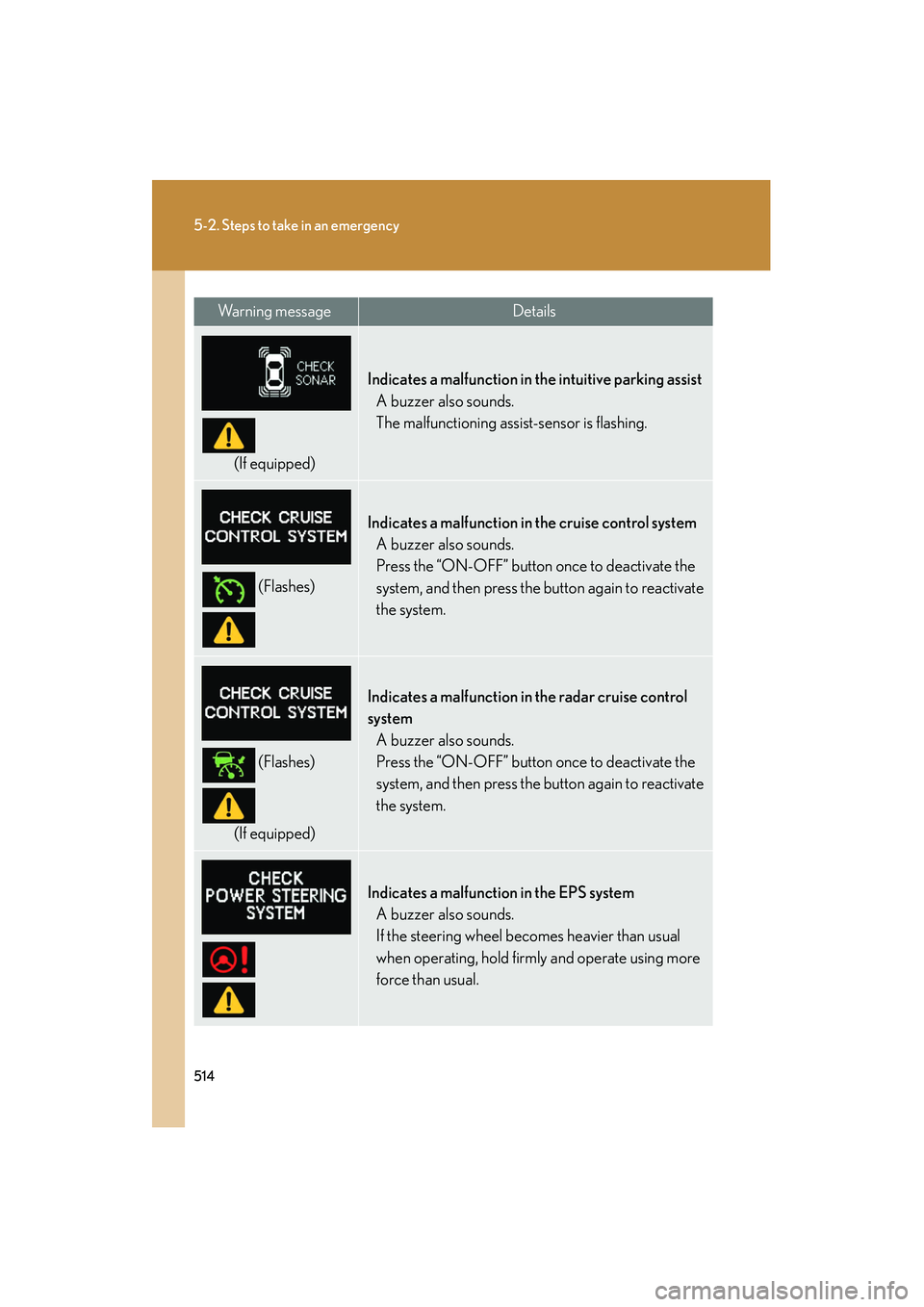
(If equipped)
Indicates a malfunction in the intuitive parking assistA buzzer also sounds.
The malfunctioning assist-sensor is flashing.
(Flashes)
Indicates a malfunction in the cruise control systemA buzzer also sounds.
Press the “ON-OFF” button once to deactivate the
system, and then press the button again to reactivate
the system.
(Flashes)
(If equipped)
Indicates a malfunction in the radar cruise control
system A buzzer also sounds.
Press the “ON-OFF” button once to deactivate the
system, and then press the button again to reactivate
the system.
Indicates a malfunction in the EPS systemA buzzer also sounds.
If the steering wheel becomes heavier than usual
when operating, hold firmly and operate using more
force than usual.
Wa r n i n g m e s s a g eDetails
Page 522 of 630
5
When trouble arises
521
5-2. Steps to take in an emergency
HS250h_U_75050U
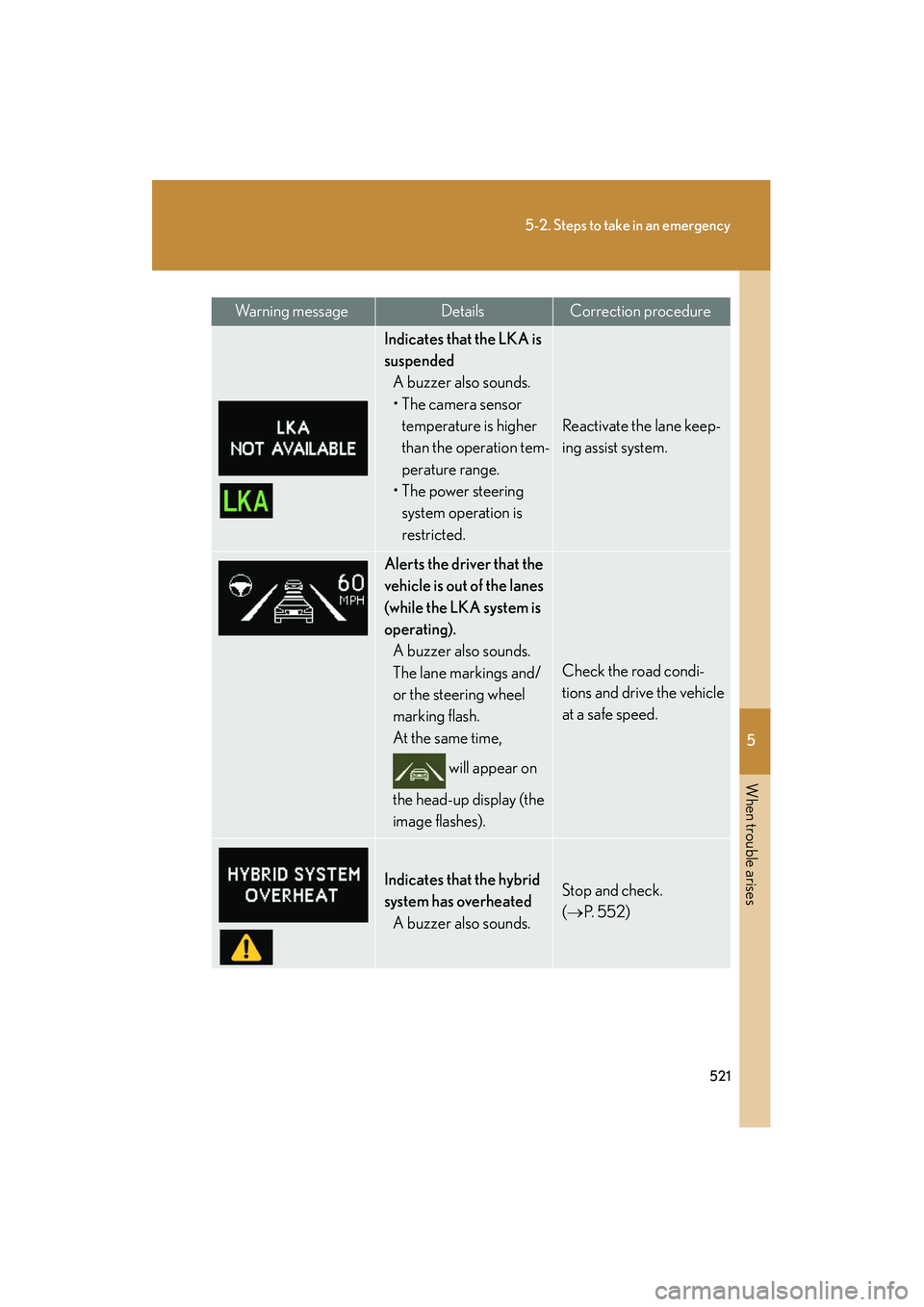
Indicates that the LKA is
suspendedA buzzer also sounds.
•The camera sensor temperature is higher
than the operation tem-
perature range.
• The power steering system operation is
restricted.
Reactivate the lane keep-
ing assist system.
Alerts the driver that the
vehicle is out of the lanes
(while the LKA system is
operating).
A buzzer also sounds.
The lane markings and/
or the steering wheel
marking flash.
At the same time,
will appear on
the head-up display (the
image flashes).
Check the road condi-
tions and drive the vehicle
at a safe speed.
Indicates that the hybrid
system has overheated A buzzer also sounds.Stop and check.
(→ P. 552)
Wa r n i n g m e s s a g eDetailsCorrection procedure
Page 533 of 630
532
5-2. Steps to take in an emergency
HS250h_U_75050U
If you have a flat tire
Remove the flat tire and replace it with the spare provided.
■Before jacking up the vehicle
●Stop the vehicle on a hard, flat surface.
● Set the parking brake.
● Change the shift position to P.
● Stop the hybrid system.
● Turn on the emergency flashers.
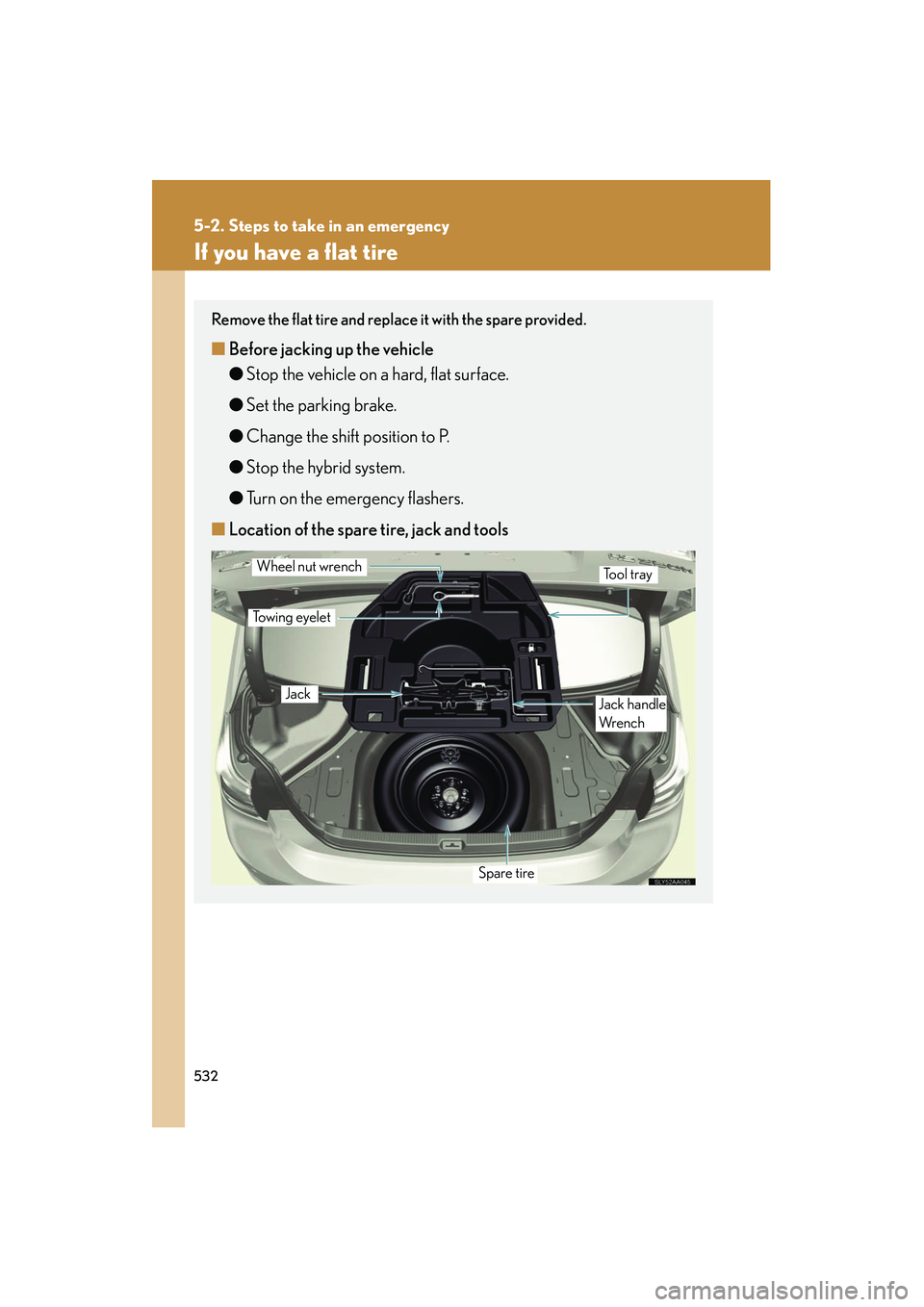
■ Location of the spare tire, jack and tools
To o l t r a y
Towing eyelet
JackJack handle
Wr e n c h
Spare tire
Wheel nut wrench
Page 535 of 630
534
5-2. Steps to take in an emergency
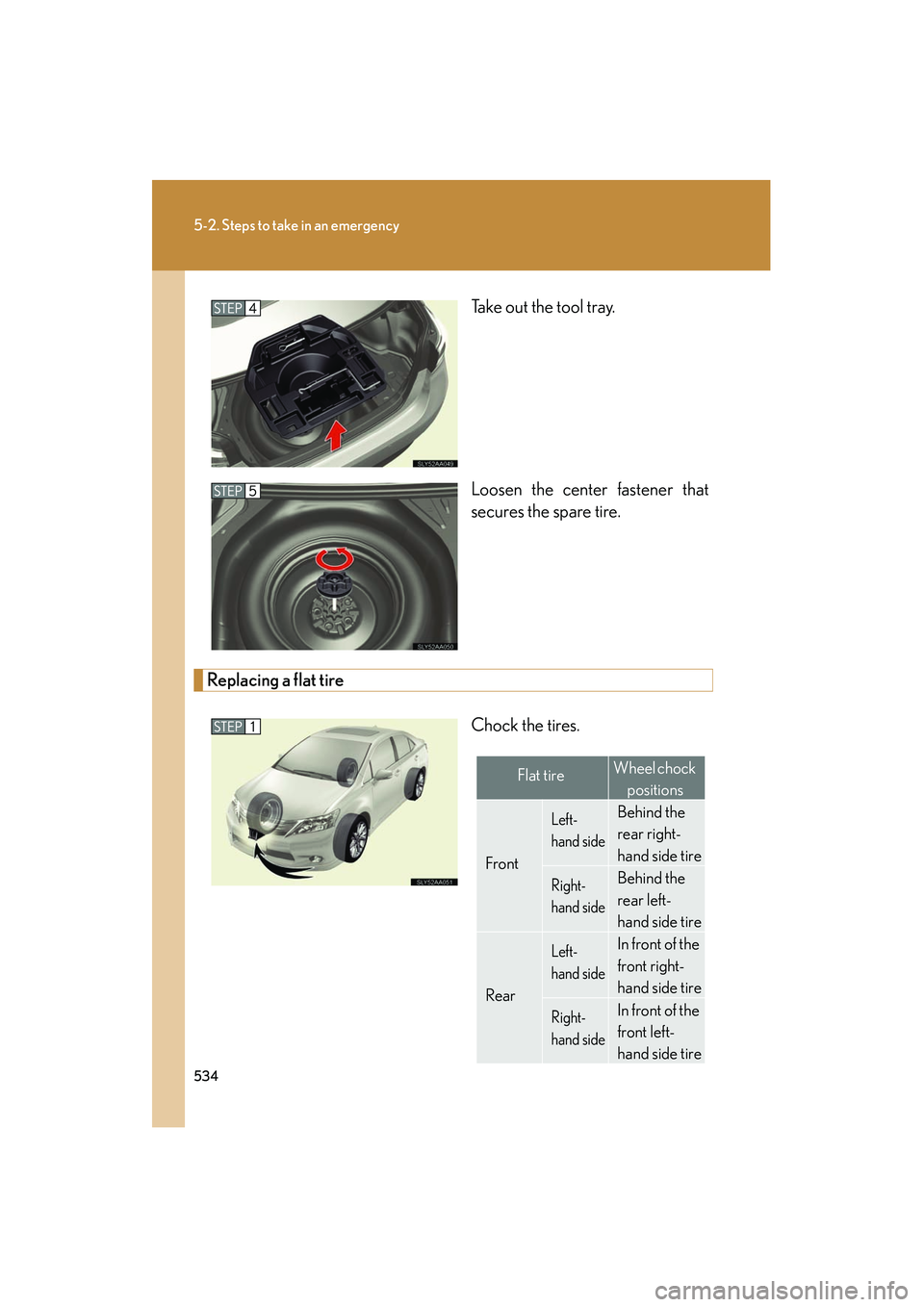
HS250h_U_75050UTake out the tool tray.
Loosen the center fastener that
secures the spare tire.
Replacing a flat tire
Chock the tires.
Flat tireWheel chock positions
Front
Left-
hand sideBehind the
rear right-
hand side tire
Right-
hand sideBehind the
rear left-
hand side tire
Rear
Left-
hand sideIn front of the
front right-
hand side tire
Right-
hand sideIn front of the
front left-
hand side tire
Page 536 of 630
5
When trouble arises
535
5-2. Steps to take in an emergency
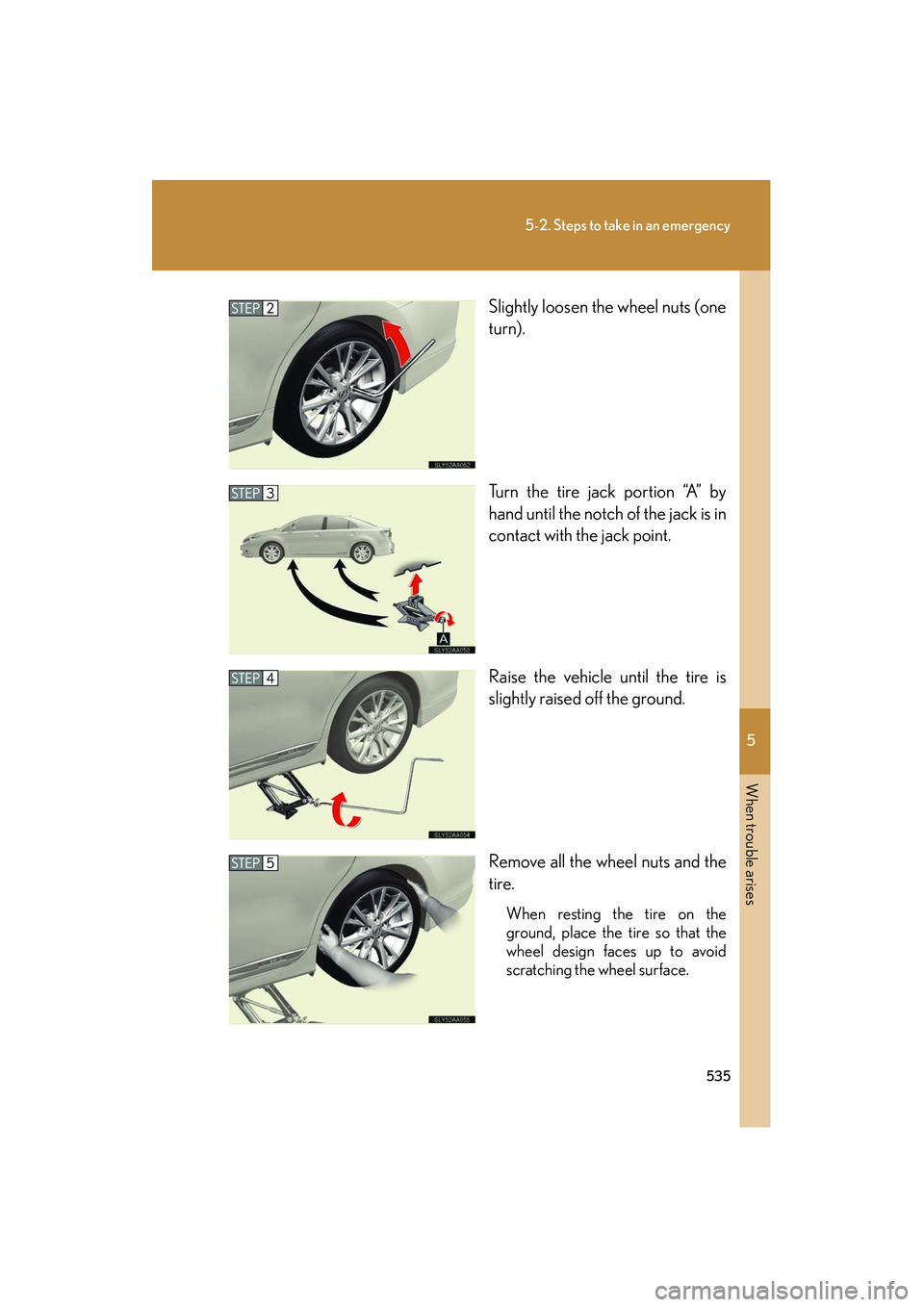
HS250h_U_75050USlightly loosen the wheel nuts (one
turn).
Turn the tire jack portion “A” by
hand until the notch of the jack is in
contact with the jack point.
Raise the vehicle until the tire is
slightly raised off the ground.
Remove all the wheel nuts and the
tire.
When resting the tire on the
ground, place the tire so that the
wheel design faces up to avoid
scratching the wheel surface.
Page 537 of 630
536
5-2. Steps to take in an emergency
HS250h_U_75050U
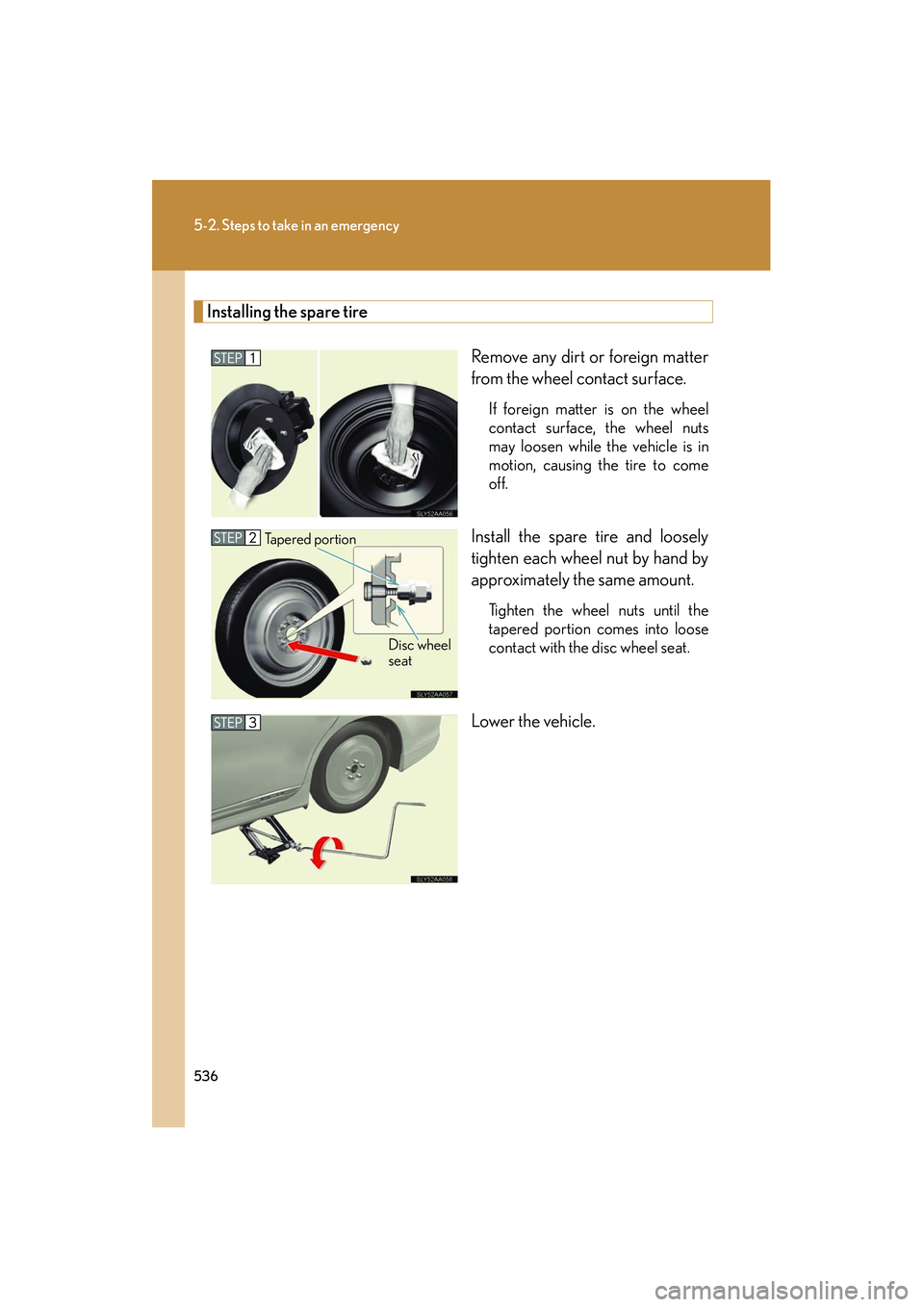
Installing the spare tireRemove any dirt or foreign matter
from the wheel contact surface.
If foreign matter is on the wheel
contact surface, the wheel nuts
may loosen while the vehicle is in
motion, causing the tire to come
off.
Install the spare tire and loosely
tighten each wheel nut by hand by
approximately the same amount.
Tighten the wheel nuts until the
tapered portion comes into loose
contact with the disc wheel seat.
Lower the vehicle.
Disc wheel
seat
Tapered portion
Page 538 of 630
5
When trouble arises
537
5-2. Steps to take in an emergency
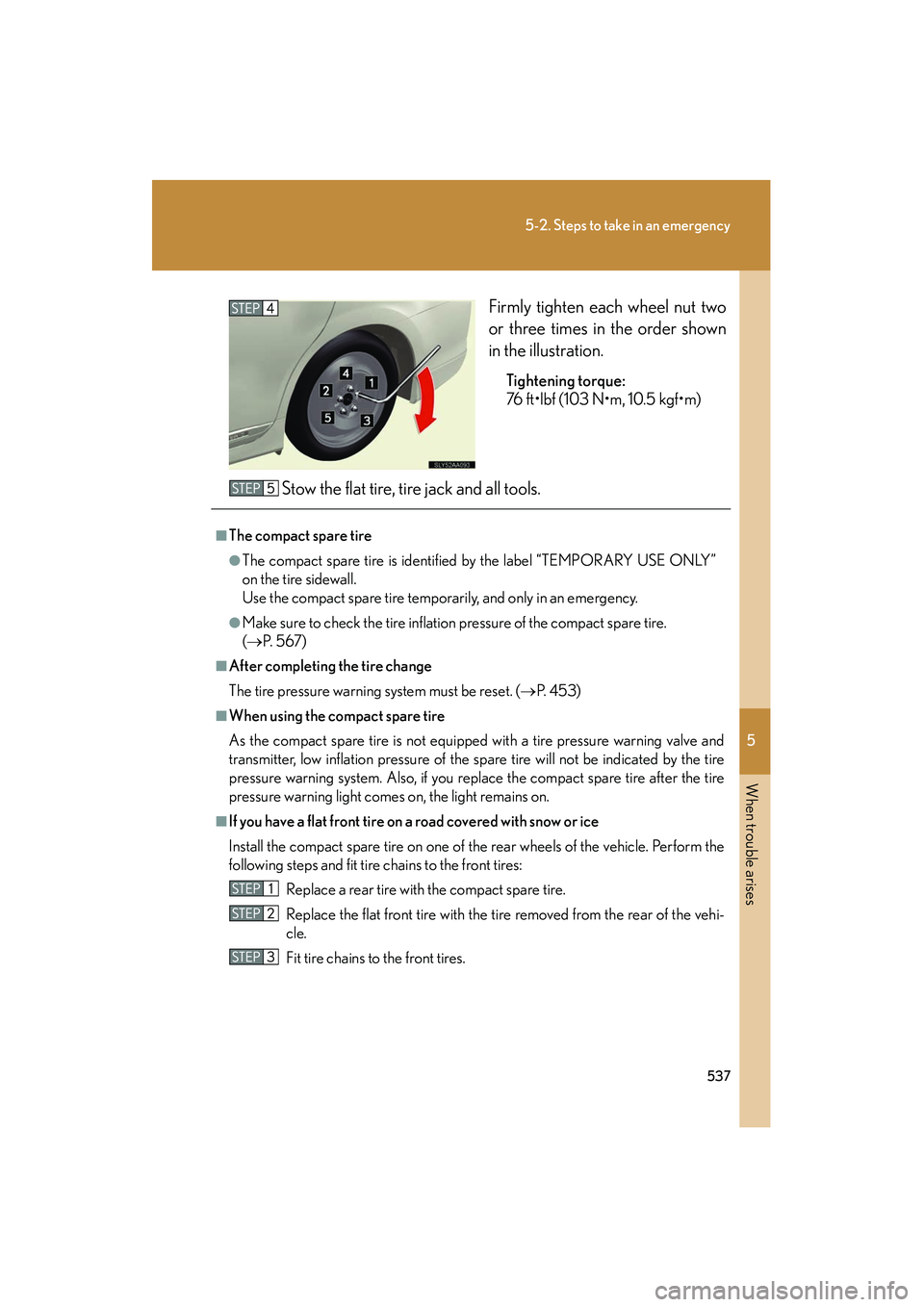
HS250h_U_75050UFirmly tighten each wheel nut two
or three times in the order shown
in the illustration.
Tightening torque:
76 ft•lbf (103 N•m, 10.5 kgf•m)
Stow the flat tire, tire jack and all tools.
■The compact spare tire
●The compact spare tire is identified by the label “TEMPORARY USE ONLY”
on the tire sidewall.
Use the compact spare tire temporarily, and only in an emergency.
●Make sure to check the tire inflation pressure of the compact spare tire.
(
→ P. 5 6 7 )
■After completing the tire change
The tire pressure warning system must be reset. ( →P. 4 5 3 )
■When using the compact spare tire
As the compact spare tire is not equipped with a tire pressure warning valve and
transmitter, low inflation pressure of the spare tire will not be indicated by the tire
pressure warning system. Also, if you replace the compact spare tire after the tire
pressure warning light comes on, the light remains on.
■If you have a flat front tire on a road covered with snow or ice
Install the compact spare tire on one of the rear wheels of the vehicle. Perform the
following steps and fit tire chains to the front tires:
Replace a rear tire with the compact spare tire.
Replace the flat front tire with the tire removed from the rear of the vehi-
cle.
Fit tire chains to the front tires.