tires Lexus IS F 2011 User Guide
[x] Cancel search | Manufacturer: LEXUS, Model Year: 2011, Model line: IS F, Model: Lexus IS F 2011Pages: 529, PDF Size: 13.89 MB
Page 399 of 529

379
4-3. Do-it-yourself maintenance
4
Maintenance and care
IS F_EE
Tires
When to replace your vehicle’s tires
Tires should be replaced if:
You have tire damage such as cuts, splits, cracks deep enough to expose
the fabric, and bulges indicating internal damage
A tire goes flat repeatedly or cannot be properly repaired due to the size
or location of a cut or other damage
If you are not sure, consult with any authorized Lexus dealer or repairer, or
another duly qualified and equipped professional.
Tire life
Any tire over 6 years old must be checked by a qualified technician even if
it has seldom or never been used or damage is not obvious.
If the tread on snow tires wears down below 4 mm (0.16 in.)
The effectiveness of snow tires is lost.
Replace tires when the treadwear indicators show.
Checking tires
New tread
Treadwear indicator
Wo r n t r e a d
The location of treadwear
indicators is shown by the
“TWI” or “ ” marks, etc.,
molded on the sidewall of
each tire.
Page 400 of 529

380
4-3. Do-it-yourself maintenance
IS F_EE
Tire rotation
It is not possible to rotate the tires, as the front and rear tire sizes are differ-
ent.
Tire replacement
P. 3 8 5
Low profile tires
Generally, low profile tires will wear more rapidly and tire grip performance
will be reduced on snowy and/or icy roads when compared to standard tires.
Be sure to use snow tires or tire chains
* on snowy and/or icy roads and
drive carefully at a speed appropriate for road and weather conditions.
*: Tire chains cannot be mounted on 19-inch tires.
CAUTION
When inspecting or replacing tires
Observe the following precautions to prevent accidents.
Failure to do so may cause damage to parts of the drive train, as well as dan-
gerous handling characteristics, which may lead to an accident resulting in
death or serious injury.
Do not mix tires of different makes, models or tread patterns.
Also, do not mix tires of remarkably different treadwear.
Do not use tire sizes other than those recommended by Lexus.
Do not mix differently constructed tires (radial, bias-belted or bias-ply
tires).
Do not mix summer, all season and snow tires.
Do not use tires that have been used on another vehicle.
Do not use tires if you do not know how they were used previously.
Page 401 of 529

381
4-3. Do-it-yourself maintenance
4
Maintenance and care
IS F_EE
NOTICE
Driving on rough roads
Take particular care when driving on roads with loose surfaces or pot holes.
These conditions may cause losses in tire inflation pressure, reducing the
cushioning ability of the tires. In addition driving on rough roads may cause
damage to the tires themselves, as well as the vehicle’s wheels and body.
Low profile tires
Low profile tires may cause greater damage than usual to the tire wheel
when receiving impact from the road surface. Therefore pay attention to the
following:
Be sure to use proper tire inflation pressure. If tires are under-inflated,
they may be damaged more severely.
Avoid pot holes, uneven pavement, curbs and other road hazards.
Failure to do so may lead to severe tire and wheel damage.
If tire inflation pressure becomes low while driving
Do not continue driving, or your tires and/or wheels may be ruined.
Page 402 of 529

382
4-3. Do-it-yourself maintenance
IS F_EE
Tire inflation pressure
Effects of incorrect tire inflation pressure
Driving with incorrect tire inflation pressure may result in the following:
Reduced fuel efficiency
Reduced driving comfort and tire life
Reduced safety
Damage to the drive train
If a tire needs frequent refilling, have it checked by any authorized Lexus
dealer or repairer, or another duly qualified and equipped professional.
Instructions for checking tire pressure
When checking tire inflation pressure, observe the following:
Check only when the tires are cold.
If your vehicle has been parked for at least 3 hours and has not been
driven for more than 1.5 km or 1 mile, you will get an accurate cold tire
inflation pressure reading.
Always use a tire pressure gauge.
The appearance of the tire can be misleading. In addition, tire inflation
pressures that are even just a few pounds off can degrade ride and han-
dling.
Do not bleed or reduce tire inflation pressure after driving. It is normal
for the tire inflation pressure to be higher after driving.
Never exceed the vehicle capacity weight.
Passengers and luggage weight should be placed so that the vehicle is
balanced.
Make sure to maintain the proper tire inflation pressure. Tire inflation
pressure should be checked at least once per month. However, Lexus
recommends that tire inflation pressure be checked once every two
weeks.
Page 403 of 529

383
4-3. Do-it-yourself maintenance
4
Maintenance and care
IS F_EE
CAUTION
Proper inflation is critical to save tire performance
Keep your tires properly inflated. Otherwise, the following conditions may
occur and result in an accident causing death or serious injury.
Excessive wear
Uneven wear
Poor handling
Possibility of blowouts resulting from overheated tires
Poor sealing of the tire bead
Wheel deformation and/or tire separation
A greater possibility of tire damage from road hazards
NOTICE
When inspecting and adjusting tire inflation pressure
Be sure to reinstall the tire valve caps.
Without the valve caps, dirt or moisture could get into the valve and cause
air leakage, which could result in an accident. If the caps have been lost,
replace them as soon as possible.
Page 404 of 529

384
4-3. Do-it-yourself maintenance
IS F_EE
Wheels
If a wheel is bent, cracked or heavily corroded, it should be replaced.
Otherwise, the tire may separate from the wheel or cause loss of han-
dling control.
Wheel selection
When replacing wheels, care should be taken to ensure that
they are equivalent to those removed in load capacity, diame-
ter, rim width, and inset*.
Replacement wheels are available at any authorized Lexus
dealer or repairer, or another duly qualified and equipped pro-
fessional.
*: Conventionally referred to as “offset”.
Lexus does not recommend using:
Wheels of different sizes or types
Used wheels
Bent wheels that have been straightened
Aluminum wheel precautions
Use only Lexus wheel nuts and wrenches designed for use
with your aluminum wheels.
When repairing or changing your tires, check that the wheel
nuts are still tight after driving 1600 km (1000 miles).
Use only Lexus genuine balance weights or equivalent and
Page 405 of 529

385
4-3. Do-it-yourself maintenance
4
Maintenance and care
IS F_EE
Tire and wheel replacement (if equipped)
CAUTION
When replacing wheels
Do not use wheels that are a different size from those recommended in the
Owner’s Manual, as this may result in loss of handling control.
Never use an inner tube in a leaking wheel which is designed for a tube-
less tire. Doing so may result in an accident, causing death or serious
injury.
Each tire and wheel is designed only for
its original position on the vehicle.
Therefore, when replacing tires and
wheels make sure that they are fitted in
the position indicated on the reverse side
of the wheel.
“FR”: Front right-hand side
“FL”: Front left-hand side
“RR”: Rear right-hand side
“RL”: Rear left-hand side
Page 446 of 529

5
423
5-1. Essential information
When trouble arises
IS F_EE
If you think something is wrong
If you notice any of the following symptoms, your vehicle probably
needs adjustment or repair. Contact any authorized Lexus dealer or
repairer, or another duly qualified and equipped professional, as soon
as possible.
Visible symptoms
Fluid leaks under the vehicle
(Water dripping from the air conditioning after use is nor-
mal.)
Flat-looking tires or uneven tire wear
Engine coolant temperature gauge needle continually points
higher than normal
Audible symptoms
Changes in exhaust sound
Excessive tire squeal when cornering
Strange noises related to the suspension system
Pinging or other noises related to the engine
Operational symptoms
Engine missing, stumbling or running rough
Appreciable loss of power
Vehicle pulls heavily to one side when braking
Vehicle pulls heavily to one side when driving on a level
road
Page 469 of 529
446
5-2. Steps to take in an emergency
IS F_EE
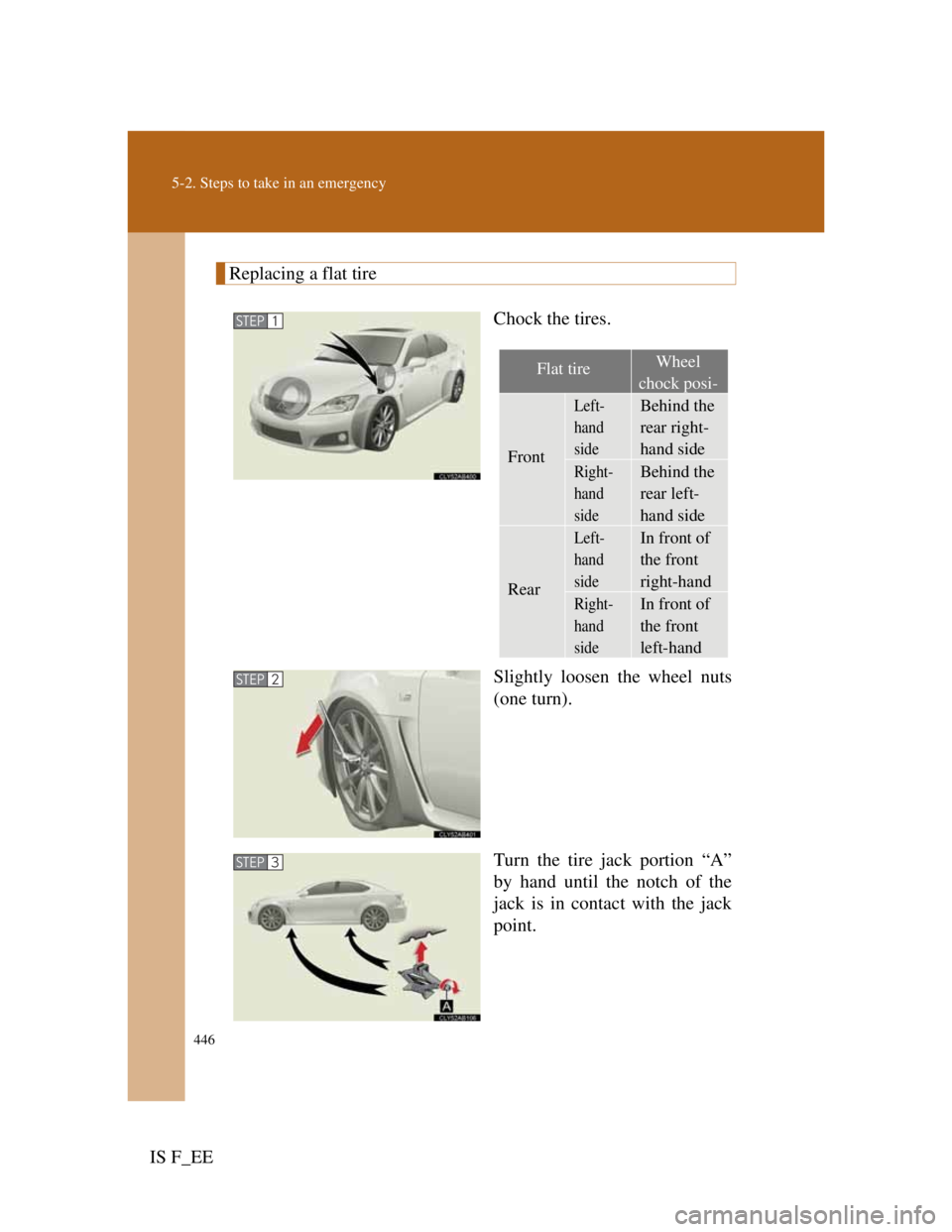
Replacing a flat tire
Chock the tires.
Slightly loosen the wheel nuts
(one turn).
Turn the tire jack portion “A”
by hand until the notch of the
jack is in contact with the jack
point.
STEP1
Flat tireWheel
chock posi-
Front
Left-
hand
sideBehind the
rear right-
hand side
Right-
hand
sideBehind the
rear left-
hand side
Rear
Left-
hand
sideIn front of
the front
right-hand
Right-
hand
sideIn front of
the front
left-hand
STEP2
STEP3
Page 472 of 529

5
449
5-2. Steps to take in an emergency
When trouble arises
IS F_EEStow the flat tire, tire jack and all tools.
The compact spare tire
The compact spare tire is identified by the label “TEMPORARY USE
ONLY” on the tire sidewall.
Use the compact spare tire temporarily only in an emergency.
Make sure to check the tire inflation pressure of the compact spare tire.
(
P. 480)
If you have a flat rear tire on a road covered with snow or ice
Install the compact spare tire on the front of the vehicle. Perform the follow-
ing steps and fit tire chains to the rear tires.
Replace a front tire with the compact spare tire.
Replace the flat rear tire with the tire removed from the front of the
vehicle.
Fit tire chains to the rear tires.
STEP5
STEP1
STEP2
STEP3