wheel Lexus IS200t 2017 s Owners Manual
[x] Cancel search | Manufacturer: LEXUS, Model Year: 2017, Model line: IS200t, Model: Lexus IS200t 2017Pages: 676, PDF Size: 149.78 MB
Page 513 of 676
5137-3. Do-it-yourself maintenance
7
Maintenance and care
IS200t_EE(OM53D77E)
■Situations in which the tire pressure warning system may not operate properly
●In the following cases, the tire pressure warning system may not operate properly.
• If non-genuine Lexus wheels are used.
• A tire has been replaced with a tire that is not an OE (Original Equipment) tire.
• A tire has been replaced with a tire that is not of the specified size.
• Tire chains etc. are equipped.
• An auxiliary-supported run-flat tire is equipped.
• If a window tint that affects the radio wave signals is installed.
• If there is a lot of snow or ice on the vehi cle, particularly around the wheels or wheel
housings.
• If the tire inflation pressure is extr emely higher than the specified level.
• If tires not equipped with tire pressure warning valves and transmitters are used.
• If the ID code on the tire pressure warning valves and transmitters is not registered in the tire pressure warning computer.
●Performance may be affected in the following situations.
• Near a TV tower, electric power plant, gas station, radio station, large display, air-
port or other facility that generates st rong radio waves or electrical noise
• When carrying a portable radio, cellular phone, cordless phone or other wireless communication device
●When the vehicle is parked, the time taken for the warning to start or go off could be
extended.
●When tire inflation pressure declines rapi dly for example when a tire has burst, the
warning may not function.
■The initialization operation
●Make sure to carry out initialization af ter adjusting the tire inflation pressure.
Also, make sure the tires are cold before carrying out initialization or tire inflation pres-
sure adjustment.
●If you have accidentally turned the engine swit ch off during initialization, it is not neces-
sary to press the reset switch again as init ialization will restart automatically when the
engine switch has been turned to IGNITION ON mode for the next time.
●If you accidentally press the reset switch when initialization is not necessary, adjust the
tire inflation pressure to the specified leve l when the tires are cold, and conduct initial-
ization again.
■Warning performance of the tire pressure warning system
The warning of the tire pressure warning syst em will change in accordance with the con-
ditions under which it was initialized. For this reason, the system may give a warning even
if the tire pressure does not reach a low enough level, or if the pressure is higher than the
pressure that was adjusted to when the system was initialized.
Page 514 of 676
5147-3. Do-it-yourself maintenance
IS200t_EE(OM53D77E)
■When initialization of the tire pressure warning system has failed
Initialization can be completed in a few minutes. However, in the following cases, the set-
tings have not been recorded and the system will not operate properly. If repeated
attempts to record tire inflation pressure settings are unsuccessful, have the vehicle
inspected by any authorized Lexus retailer or Lexus authorized repairer, or any reliable
repairer.
●When operating the tire pressure warning re set switch, the tire pressure warning light
does not blink 3 times.
●After carrying out the initializat ion procedure, the tire pressure warning light blinks for 1
minute then stays on after driving for 20 minutes.
■Registering ID codes
The ID codes of the tire pressure warning valve and transmitters for two sets of wheels
can be registered.
It is not necessary to register the ID codes wh en replacing normal tires with snow tires, if
the ID codes for the wheels of both normal tires and snow tires are registered before-
hand.
For information about changing ID codes, ask any authorized Lexus retailer or Lexus
authorized repairer, or any reliable repairer.
Page 520 of 676
5207-3. Do-it-yourself maintenance
IS200t_EE(OM53D77E)
NOTICE
■Repairing or replacing tires, wheels, tire pressure warning valves, transmitters and
tire valve caps
●When removing or fitting the wheels, tires or the tire pressure warning valves and
transmitters, contact any authorized Lexus retailer or Lexus authorized repairer, or
any reliable repairer as the tire pressure warning valves and transmitters may be dam-
aged if not handled correctly.
●Make sure to install the tire valve caps. If the tire valve caps are not installed, water
could enter the tire pressure warning valv es and the tire pressure warning valves
could be bound.
●When replacing tire valve caps, do not use tire valve caps other than those specified.
The cap may become stuck.
■To avoid damage to the tire pressure warning valves and transmitters
When a tire is repaired with liquid sealants, the tire pressure warning valve and trans-
mitter may not operate properly. If a liquid sealant is used, contact any authorized
Lexus retailer or Lexus authorized repairer, or any reliable repairer or other qualified
service shop as soon as possible. After use of liquid sealant, make sure to replace the
tire pressure warning valve and transmitte r when repairing or replacing the tire.
( P. 510)
■Driving on rough roads
Take particular care when driving on roads with loose surfaces or potholes.
These conditions may cause losses in tire inflation pressure, reducing the cushioning
ability of the tires. In addition, driving on rough roads may cause damage to the tires
themselves, as well as the vehicle’s wheels and body.
■Low profile tires
Low profile tires may cause greater damage than usual to the tire wheel when sustain-
ing impact from the road surface. Therefore, pay attention to the following:
●Be sure to use proper tire inflation pressu re. If tires are under-inflated, they may be
damaged more severely.
●Avoid potholes, uneven pavement, curbs an d other road hazards. Failure to do so
may lead to severe tire and wheel damage.
■If tire inflation pressure of ea ch tire becomes low while driving
Do not continue driving, or your tires and/or wheels may be ruined.
Page 522 of 676
5227-3. Do-it-yourself maintenance
IS200t_EE(OM53D77E)
WARNING
■Proper inflation is critical to save tire performance
Keep your tires properly inflated.
If the tires are not properly inflated, the following conditions may occur which could
lead to an accident resulting in death or serious injury:
●Excessive wear
●Uneven wear
●Poor handling
●Possibility of blowouts resulting from overheated tires
●Air leaking from between tire and wheel
●Wheel deformation and/or tire damage
●Greater possibility of tire damage while driving (due to road hazards, expansion
joints, sharp edges in the road, etc.)
NOTICE
■When inspecting and adjusting tire inflation pressure
Be sure to put the tire valve caps back on.
If a valve cap is not installed, dirt or moisture may get into the valve and cause an air
leak, resulting in decrease d tire inflation pressure.
Page 523 of 676
5237-3. Do-it-yourself maintenance
7
Maintenance and care
IS200t_EE(OM53D77E)
When replacing wheels, care should be taken to ensure that they are equivalent
to those removed in load capacity, diameter, rim width and inset
*.
Replacement wheels are available at any authorized Lexus retailer or Lexus
authorized repairer, or any reliable repairer.
*: Conventionally referred to as “offset”.
Lexus does not recommend using the following:
●Wheels of different sizes or types
●Used wheels
●Bent wheels that have been straightened
●Use only Lexus wheel nuts and wrenches designed for use with your alumi-
num wheels.
●When rotating, repairing or changing your tires, check that the wheel nuts are
still tight after driving 1600 km (1000 miles).
●Be careful not to damage the aluminum wheels when using tire chains.
●Use only Lexus genuine balance weights or equivalent and a plastic or rubber
hammer when balancing your wheels.
■When replacing wheels
The wheels of your vehicle are equipped with tire pressure warning valves and transmit-
ters that allow the tire pressure warning sy stem to provide advance warning in the event
of a loss in tire inflation pressure. Whenever wheels are replaced, tire pressure warning
valves and transmitters must be installed. ( P. 510)
Wheels
If a wheel is bent, cracked or heavily corroded, it should be replaced. Other-
wise, the tire may separate from the wheel or cause a loss of handling control.
Wheel selection
Aluminum wheel precautions
Page 524 of 676
5247-3. Do-it-yourself maintenance
IS200t_EE(OM53D77E)
WARNING
■When replacing wheels
●Do not use wheels that are a different size from those recommended in the Owner’s
Manual, as this may result in a loss of handling control.
●Never use an inner tube in a leaking wheel which is designed for a tubeless tire. Doing
so may result in an accident, causing death or serious injury.
NOTICE
■Replacing tire pressure warning valves and transmitters
●Because tire repair or replacement may affe ct the tire pressure warning valves and
transmitters, make sure to have tires se rviced by any authorized Lexus retailer or
Lexus authorized repairer, or any reliable repairer or other qualified service shop. In
addition, make sure to purchase your tire pressure warning valves and transmitters at
any authorized Lexus retailer or Lexus auth orized repairer, or any reliable repairer.
●Ensure that only genuine Lexus wheels are used on your vehicle.
Tire pressure warning valves and transmitte rs may not work properly with non-genu-
ine wheels.
Page 545 of 676
5458-1. Essential information
8
When trouble arises
IS200t_EE(OM53D77E)
Steadily step on the brake pedal with both feet and firmly depress it.
Do not pump the brake pedal repeatedly as this will increase the effort required to
slow the vehicle.
Shift the shift lever to N.
If the shift lever is shifted to N
After slowing down, stop the vehicle in a safe place by the road.
Stop the engine.
If the shift lever cannot be shifted to N
Keep depressing the brake pedal with both feet to reduce vehicle speed as
much as possible.
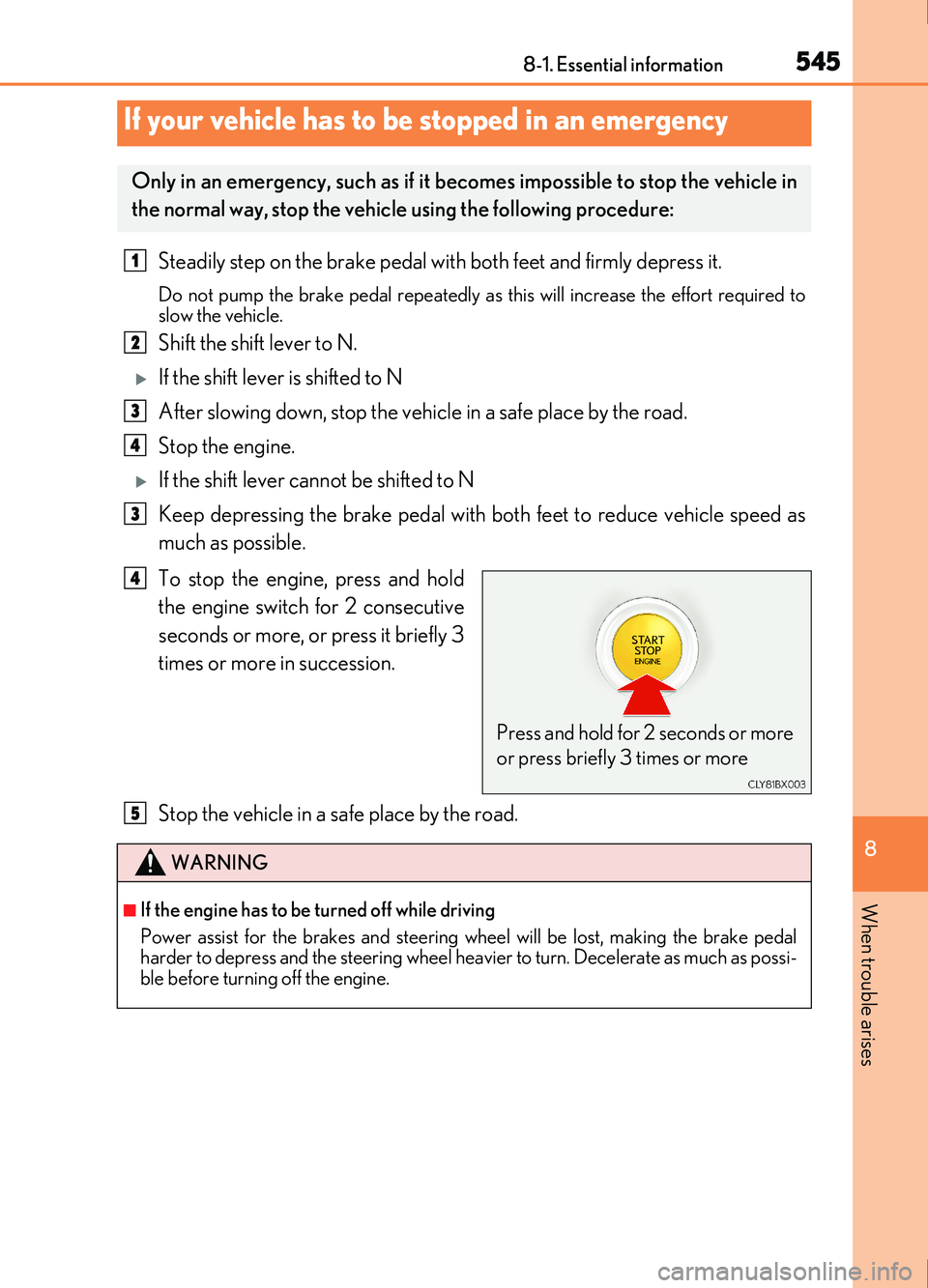
To stop the engine, press and hold
the engine switch for 2 consecutive
seconds or more, or press it briefly 3
times or more in succession.
Stop the vehicle in a safe place by the road.
If your vehicle has to be stopped in an emergency
Only in an emergency, such as if it becomes impossible to stop the vehicle in
the normal way, stop the vehicle using the following procedure:
1
2
3
4
3
Press and hold for 2 seconds or more
or press briefly 3 times or more
4
WARNING
■If the engine has to be turned off while driving
Power assist for the brakes and steering wheel will be lost, making the brake pedal
harder to depress and the steering wheel heavier to turn. Decelerate as much as possi-
ble before turning off the engine.
5
Page 546 of 676
546
IS200t_EE(OM53D77E)8-2. Steps to take in an emergency
The following may indicate a problem with your transmission. Contact any
authorized Lexus retailer or Lexus authorized repairer, or any reliable repairer or
commercial towing service before towing.
●The engine is running but the vehicle does not move.
●The vehicle makes an abnormal sound.
If your vehicle needs to be towed
If towing is necessary, we recommend having your vehicle towed by any
authorized Lexus retailer or Lexus au
thorized repairer, or any reliable
repairer or commercial towing service, using a wheel-lift type truck or flatbed
truck.
Use a safety chain system for all towing , and abide by all state/provincial and
local laws.
Situations when it is necessary to contact dealers before towing
Page 547 of 676
5478-2. Steps to take in an emergency
8
When trouble arises
IS200t_EE(OM53D77E)
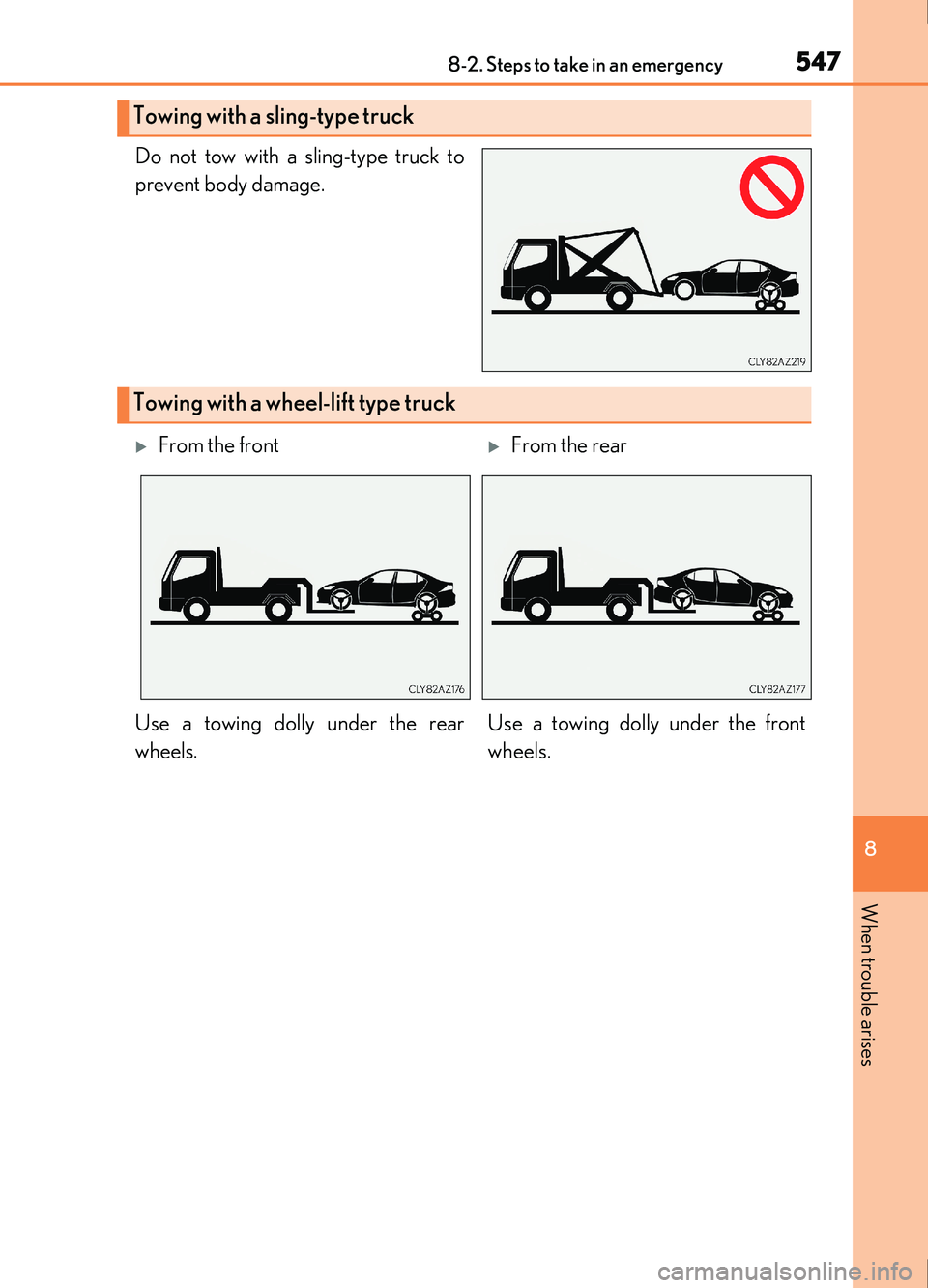
Do not tow with a sling-type truck to
prevent body damage.
Towing with a sling-type truck
Towing with a wheel-lift type truck
From the frontFrom the rear
Use a towing dolly under the rear
wheels. Use a towing dolly under the front
wheels.
Page 548 of 676
5488-2. Steps to take in an emergency
IS200t_EE(OM53D77E)
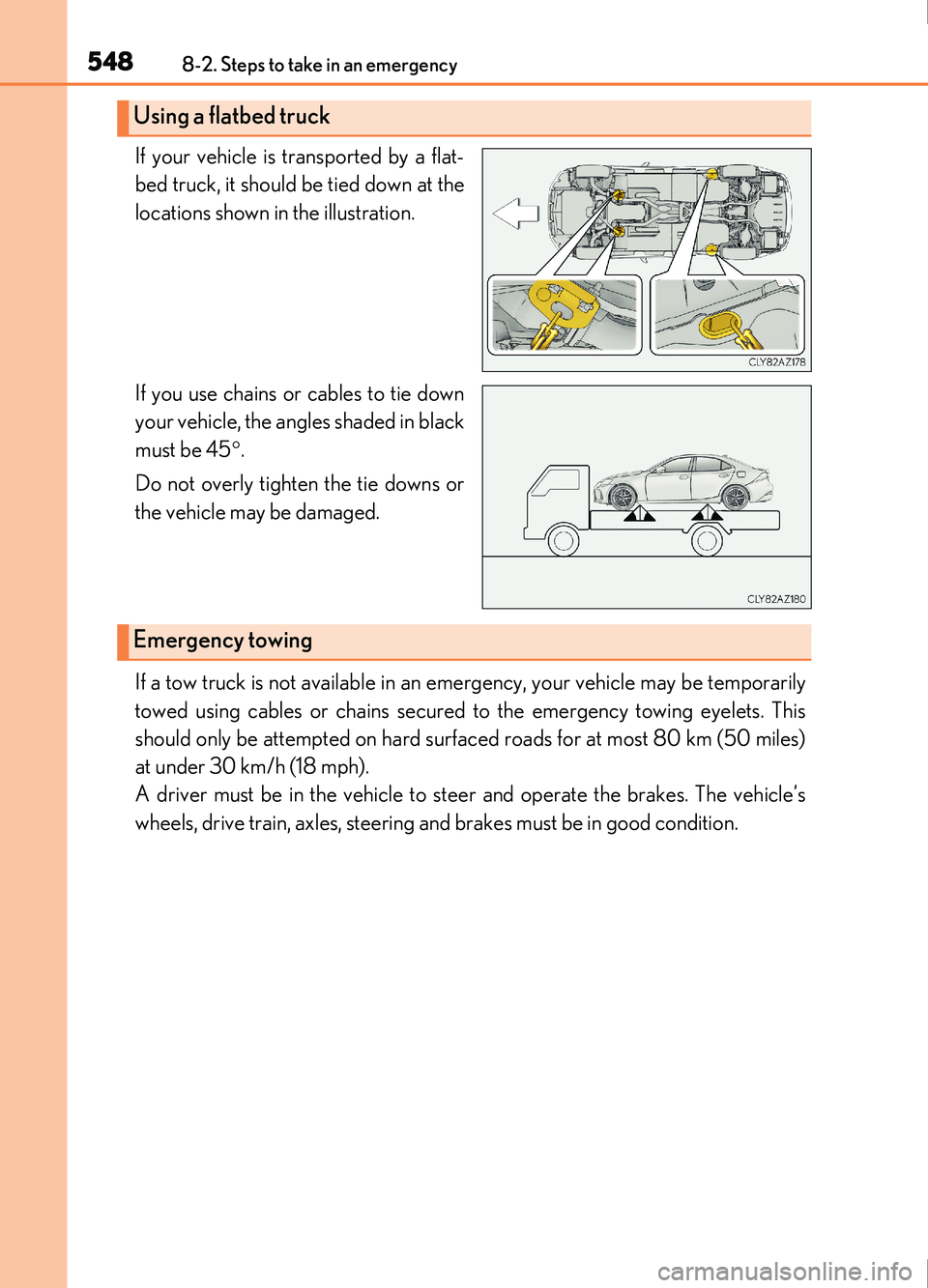
If your vehicle is transported by a flat-
bed truck, it should be tied down at the
locations shown in the illustration.
If you use chains or cables to tie down
your vehicle, the angles shaded in black
must be 45.
Do not overly tighten the tie downs or
the vehicle may be damaged.
If a tow truck is not available in an emergency, your vehicle may be temporarily
towed using cables or chains secured to the emergency towing eyelets. This
should only be attempted on hard surfac ed roads for at most 80 km (50 miles)
at under 30 km/h (18 mph).
A driver must be in the vehicle to steer and operate the brakes. The vehicle’s
wheels, drive train, axles, steering and brakes must be in good condition.
Using a flatbed truck
Emergency towing