manual transmission Lexus IS250 2008 User Guide
[x] Cancel search | Manufacturer: LEXUS, Model Year: 2008, Model line: IS250, Model: Lexus IS250 2008Pages: 462, PDF Size: 25.52 MB
Page 112 of 462

111
2-1. Driving procedures
2
When driving
08_IS350/250_U_(L/O_0708)
CAUTION
■When starting the vehicle
With automatic transmission vehicles, always keep your foot on the brake pedal
while stopped with the engine running. This prevents the vehicle from creeping.
■When driving the vehicle
●Do not drive if you are unfamiliar with the location of the brake and accelerator
pedals to avoid depressing the wrong pedal.
• Accidentally depressing the accelerator pedal instead of the brake pedal willresult in sudden acceleration that may lead to an accident that could result in
death or serious injury.
• When backing up, you may twist your body around, leading to a difficulty in operating the pedals. Make sure to operate the pedals properly.
• Make sure to keep a correct driving posture even when moving the vehicle only slightly, allowing you to depress the brake and accelerator pedals prop-
erly.
• Depress the brake pedal using your right foot. Depressing the brake pedal using your left foot may delay response in an emergency, resulting in an acci-
dent.
●Do not drive the vehicle over or stop the vehicle near flammable materials.
●With automatic transmission vehicles, do not let the vehicle roll backwards while
the shift lever is in a driving position, or roll forward while the shift lever is in R.
Doing so may cause the engine to stall or lead to poor brake and steering perfor-
mance, resulting in an accident or damage to the vehicle.
●If the smell of exhaust is noticed inside the vehicle, open the windows and check
that the trunk is closed. Large amounts of exhaust in the vehicle can cause driver
drowsiness and an accident, resulting in death or a serious health hazard. Have
the vehicle inspected by your Lexus dealer immediately.
●Do not under any circumstances shift the shift lever to P, R or N (automatic trans-
mission vehicles) or R (manual transmission vehicles) while the vehicle is moving.
Doing so can cause significant damage to the transmission system and may result
in a loss of vehicle control.
●Do not shift the shift lever to N while the vehicle is moving.
Doing so may cause the engine brake to not operate properly and lead to an
accident.
Page 116 of 462

115
2-1. Driving procedures
2
When driving
08_IS350/250_U_(L/O_0708)
CAUTION
●The brake system consists of 2 individual hydraulic systems: if one of the systems
fails, the other will still operate. In this case, the brake pedal should be depressed
more firmly than usual and braking distance becomes longer.
Do not drive your vehicle with only a single brake system. Have your brakes fixed
immediately.
■If the vehicle becomes stuck or bogged (AWD models)
Do not spin the wheels recklessly when any of the tires is up in the air, or stuck in
sand or mud, etc. This may damage the drive system components or propel the
vehicle forward (or in another direction) and cause an accident.
NOTICE
■When driving the vehicle
●With manual transmission vehicles, do not rest your foot on the clutch pedal while
driving.
Doing so may cause clutch trouble.
●With manual transmission vehicles, do not use any gears other than the first gear
when starting off and moving forward.
Doing so may damage the clutch.
●With automatic transmission vehicles, do not use the accelerator pedal or
depress accelerator and brake pedals together to hold the vehicle on a hill.
●With manual transmission vehicles, do not use the clutch to hold the vehicle when
stopping on an uphill grade.
■When parking the vehicle
With automatic transmission vehicles, always put the shift lever in P. Failure to do so
may cause the vehicle to move or the vehicle may accelerate suddenly if the accel-
erator pedal is accidentally depressed.
■Avoiding damage to vehicle parts
●Do not turn the steering wheel fully in either direction and hold it there for a long
time.
Doing so may damage the power steering motor.
●When driving over bumps in the road, drive as slowly as possible to avoid damag-
ing the wheels, underside of the vehicle, etc.
Page 119 of 462

118
2-1. Driving procedures
08_IS350/250_U_(L/O_0708)
Manual transmissionCheck that the parking brake is set.
Check that the shift lever is set in N.
Firmly depress the clutch pedal.
The “ENGINE START STOP” switch indicator turns green.
Press the “ENGINE START
STOP” switch.
STEP1
STEP2
STEP3
STEP4
Page 127 of 462

126
2-1. Driving procedures
08_IS350/250_U_(L/O_0708)
Manual Transmission (if equipped)
Snow modeThe snow mode is used for accel-
erating and driving on slippery
road surfaces, such as on snow.
Push the switch once more to
return to normal mode.
■Shifting the shift lever
Fully depress the clutch pedal
before operating the shift lever,
and then release it slowly.
■ Shifting the shift lever into R
Shift the shift lever into the R
position while lifting up the ring
section.
Page 130 of 462

129
2-1. Driving procedures
2
When driving
08_IS350/250_U_(L/O_0708)
Parking brake
NOTICE
■Before driving
Fully release the parking brake.
Driving the vehicle with the parking brake set will lead to brake components over-
heating, which may affect braking performance and increase brake wear.
Automatic transmissionSets the parking brake
*
(Depressing the pedal again
releases the parking brake.)
*: Fully depress the parkingbrake pedal with your left
foot while depressing the
brake pedal with your right
foot.
Manual transmission
Sets
the parking brake
Fully set the parking brake while
depressing the brake pedal.
Releases the parking
brake
CANADAU.S.A.
CANADA U.S.A.
Page 138 of 462
137
2-2. Instrument cluster
2
When driving
08_IS350/250_U_(L/O_0708)
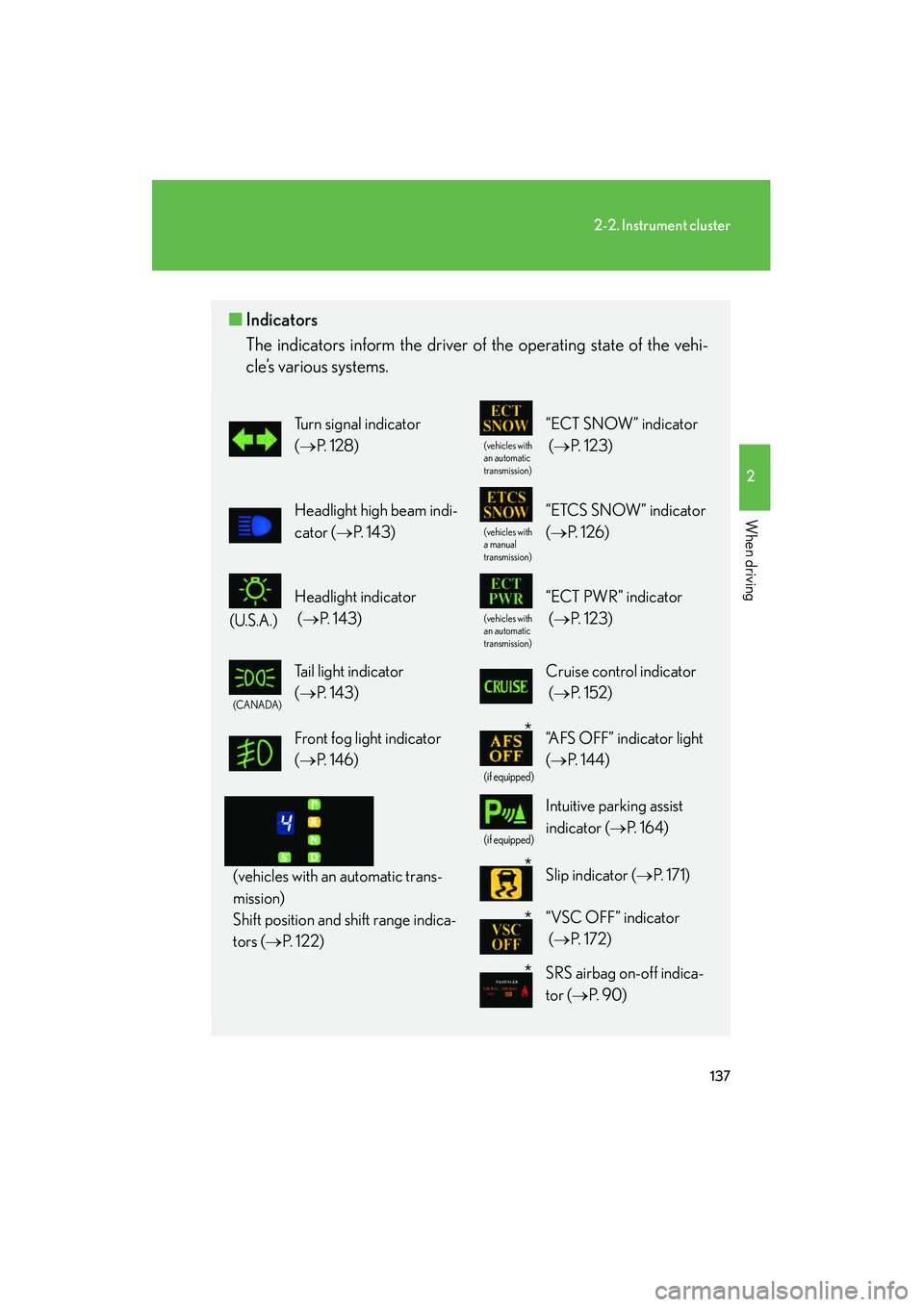
■Indicators
The indicators inform the driver of the operating state of the vehi-
cle’s various systems.
Turn signal indicator
(
→P. 1 2 8 )(vehicles with
an automatic
transmission)
“ECT SNOW” indicator
(
→P. 1 2 3 )
Headlight high beam indi-
cator (
→P. 1 4 3 )(vehicles with
a manual
transmission)
“ETCS SNOW” indicator
(
→P. 1 2 6 )
(U.S.A.)
Headlight indicator
(
→P. 1 4 3 )(vehicles with
an automatic
transmission)
“ECT PWR” indicator
(
→P. 1 2 3 )
(CANADA)
Tail light indicator
(
→P. 1 4 3 )
Cruise control indicator
(
→P. 1 5 2 )
Front fog light indicator
(
→P. 1 4 6 ) (if equipped)
“AFS OFF” indicator light
(
→P. 144)
(vehicles with an automatic trans-
mission)
Shift position and shift range indica-
tors (
→P. 122)
(if equipped)
Intuitive parking assist
indicator (
→P. 1 6 4 )
Slip indicator (→P. 171)
“VSC OFF” indicator
(
→P. 1 7 2 )
SRS airbag on-off indica-
tor (
→P. 9 0 )
*
*
*
*
Page 154 of 462
153
2-4. Using other driving systems
2
When driving
08_IS350/250_U_(L/O_0708)
■Cruise control can be set when
●The shift lever is in the D or 4, 5 or 6 range of S. (vehicles with an automatic
transmission)
●Vehicle speed is between approximately 25 mph (40 km/h) and 125 mph
(200 km/h).
■Accelerating
The vehicle can be accelerated normally.
■Automatic cruise control cancellation
The set speed is automatically cancelled in any of the following situations.
●Actual vehicle speed falls more than 10 mph (16 km/h) below the preset vehicle
speed
At this time, the memorized set speed is not retained.
●Actual vehicle speed is below 25 mph (40km/h)
●VSC is activated
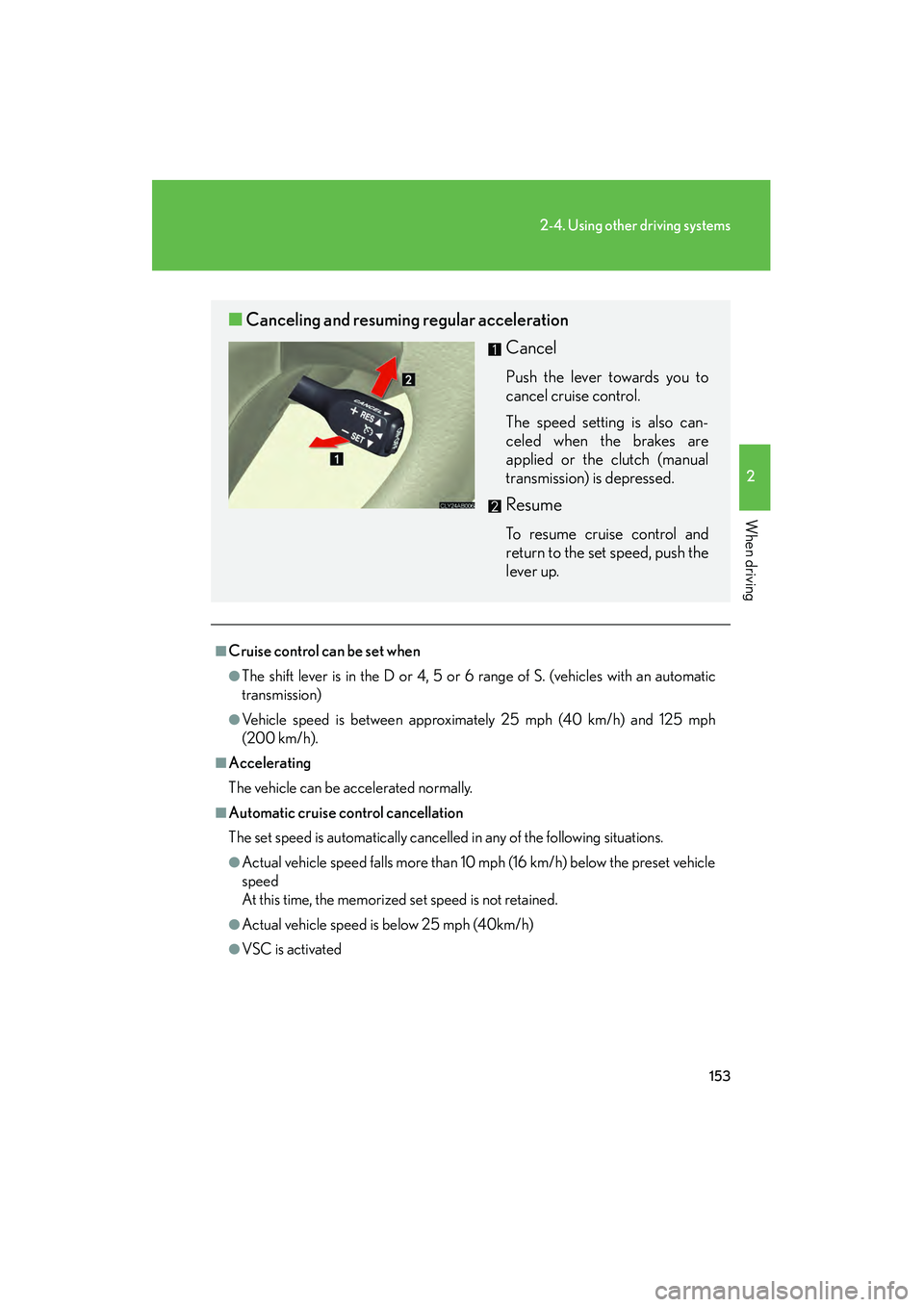
■Canceling and resuming regular acceleration
Cancel
Push the lever towards you to
cancel cruise control.
The speed setting is also can-
celed when the brakes are
applied or the clutch (manual
transmission) is depressed.
Resume
To resume cruise control and
return to the set speed, push the
lever up.
Page 185 of 462
184
2-5. Driving information
08_IS350/250_U_(L/O_0708)
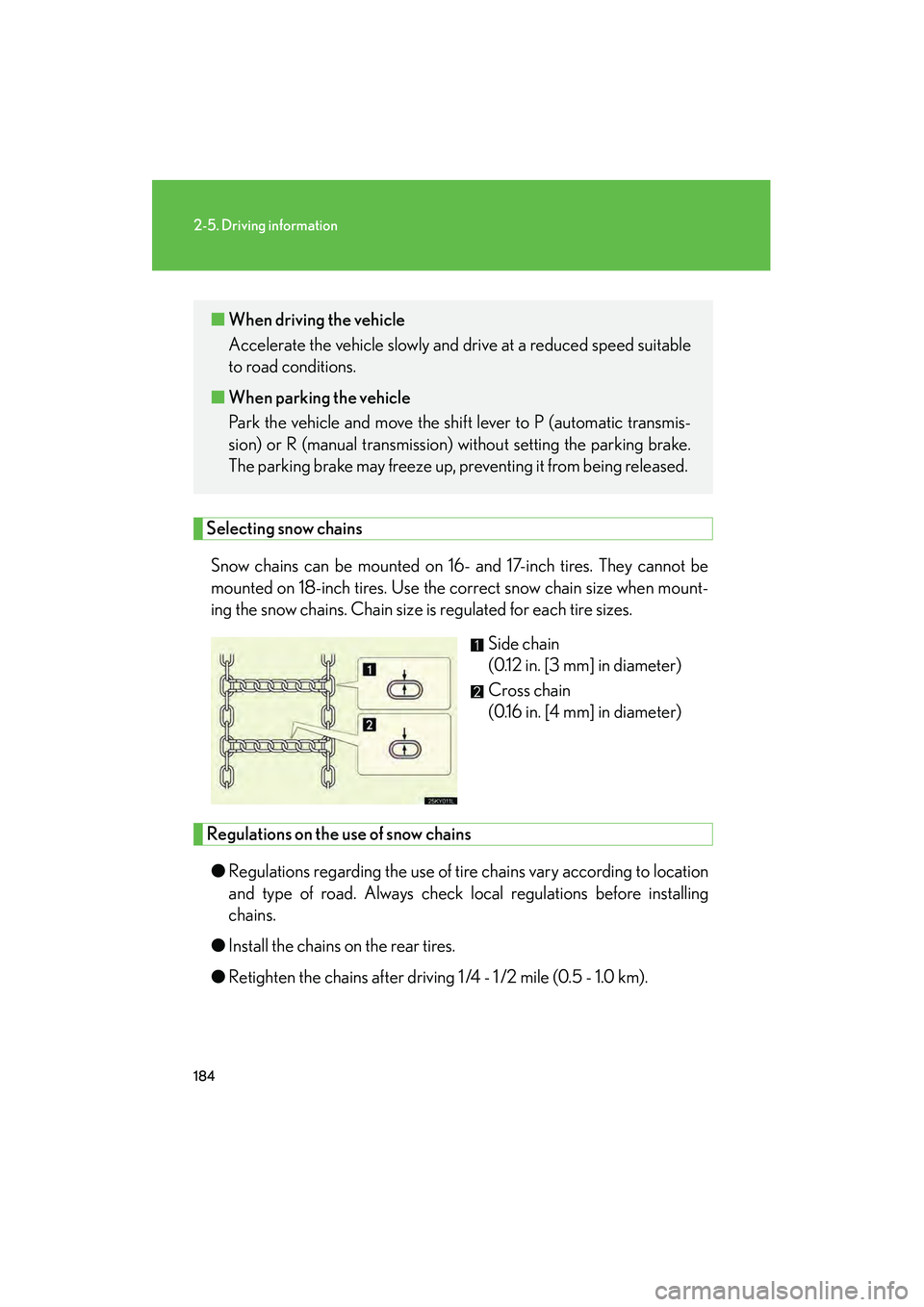
Selecting snow chainsSnow chains can be mounted on 16- and 17-inch tires. They cannot be
mounted on 18-inch tires. Use the correct snow chain size when mount-
ing the snow chains. Chain size is regulated for each tire sizes. Side chain
(0.12 in. [3 mm] in diameter)
Cross chain
(0.16 in. [4 mm] in diameter)
Regulations on the use of snow chains
● Regulations regarding the use of tire chains vary according to location
and type of road. Always check local regulations before installing
chains.
● Install the chains on the rear tires.
● Retighten the chains after driving 1 /4 - 1 /2 mile (0.5 - 1.0 km).
■When driving the vehicle
Accelerate the vehicle slowly and drive at a reduced speed suitable
to road conditions.
■ When parking the vehicle
Park the vehicle and move the shift lever to P (automatic transmis-
sion) or R (manual transmission) without setting the parking brake.
The parking brake may freeze up, preventing it from being released.
Page 190 of 462
189
2-5. Driving information
2
When driving
08_IS350/250_U_(L/O_0708)
Dinghy towing (vehicles with a manual transmission)
Towing your vehicle with 4 wheels on the groundTo prevent damage to your vehicle, perform the following procedures
before towing. Shift the shift lever to neutral.
Switch to ACCESSORY mode. ( →P. 1 1 9 )
Ensure that the audio system and other powered devices have been
turned OFF.
Release the parking brake.
After towing, leave the engine in idle for at least 3 minutes before driv-
ing the vehicle.
■Necessary equipment and accessories
Specialized equipment and accessories are required for dinghy towing. Contact
the service branch of the motor home manufacturer regarding recommended
equipment.
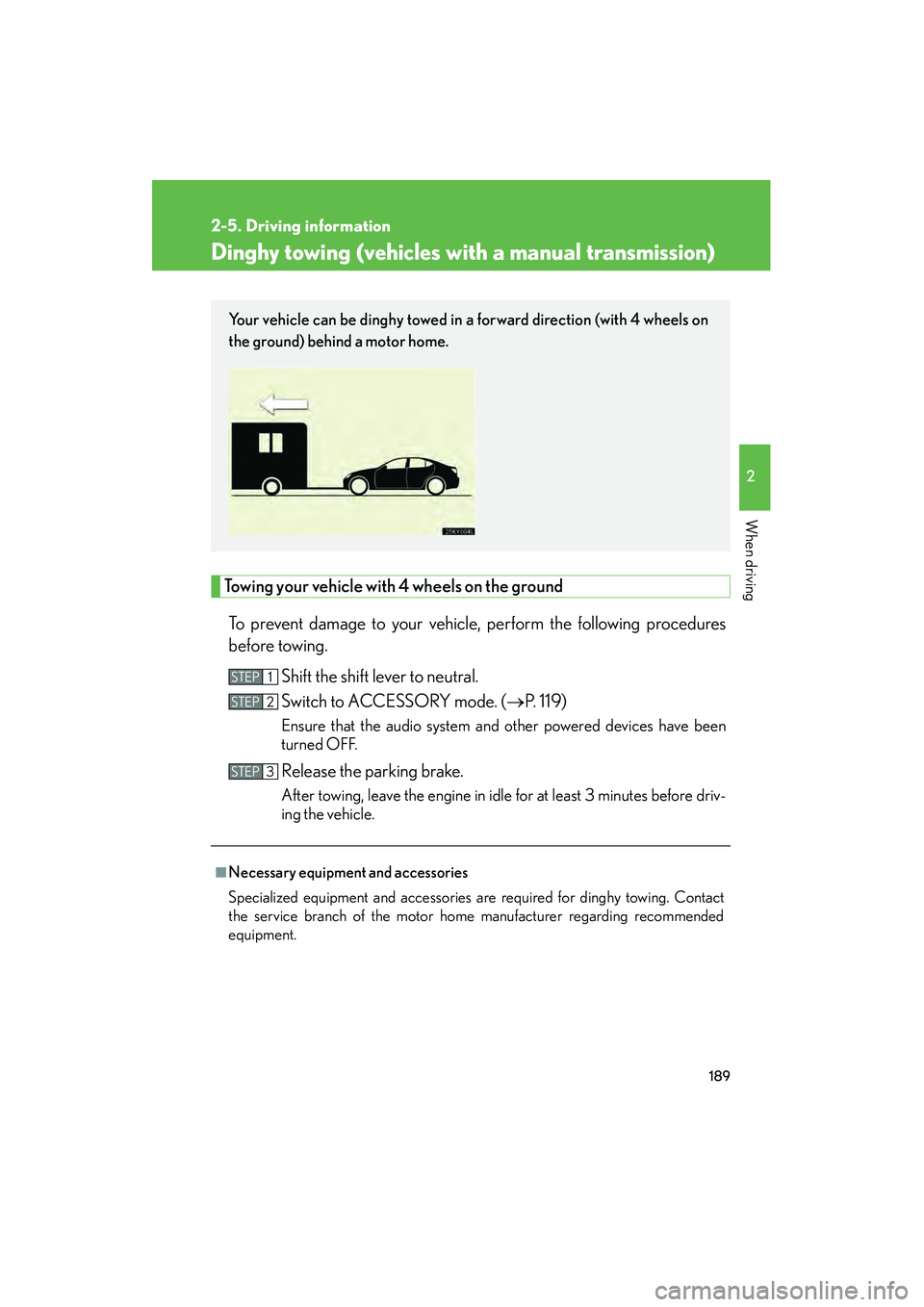
Your vehicle can be dinghy towed in a forward direction (with 4 wheels on
the ground) behind a motor home.
STEP1
STEP2
STEP3
Page 252 of 462
251
3-5. Other interior features
3
Interior features
08_IS350/250_U_(L/O_0708)
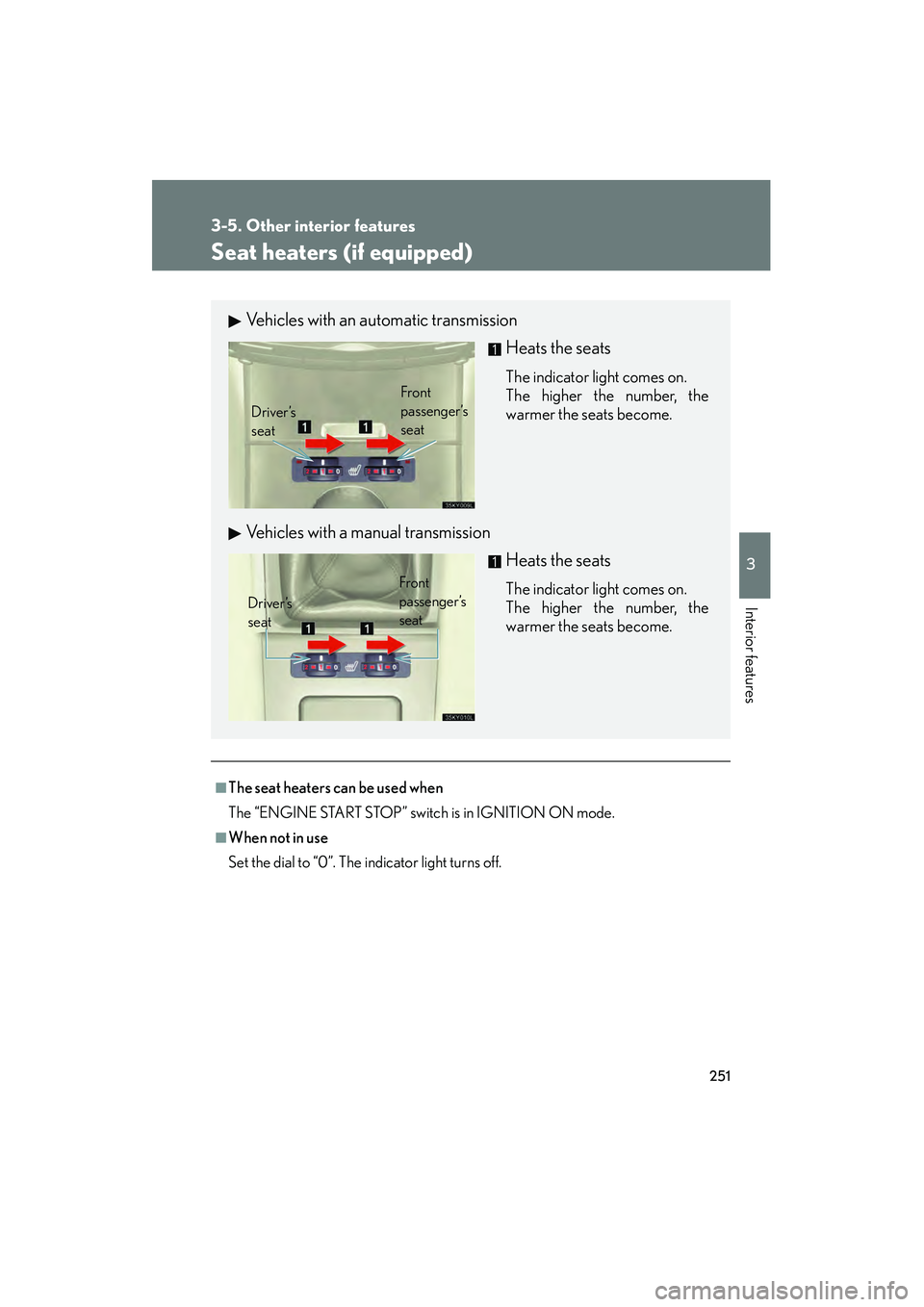
Seat heaters (if equipped)
■The seat heaters can be used when
The “ENGINE START STOP” switch is in IGNITION ON mode.
■When not in use
Set the dial to “0”. The indicator light turns off.
Vehicles with an automatic transmissionHeats the seats
The indicator light comes on.
The higher the number, the
warmer the seats become.
Vehicles with a manual transmissionHeats the seats
The indicator light comes on.
The higher the number, the
warmer the seats become.
Driver’s
seatFront
passenger’s
seat
Driver’s
seat Front
passenger’s
seat