Cd system Lexus IS250 2011 Owner's Manual
[x] Cancel search | Manufacturer: LEXUS, Model Year: 2011, Model line: IS250, Model: Lexus IS250 2011Pages: 578, PDF Size: 31.12 MB
Page 458 of 578
5
When trouble arises
457
5-1. Essential information
IS350/250_U
If you think something is wrong
If you notice any of the following symptoms, your vehicle probably needs
adjustment or repair. Contact your Lexus dealer as soon as possible.
■Visible symptoms
●Fluid leaks under the vehicle
(Water dripping from the air conditioning after use is normal.)
● Flat-looking tires or uneven tire wear
● Engine coolant temperature gauge needle continually points
higher than normal
■ Audible symptoms
●Changes in exhaust sound
● Excessive tire squeal when cornering
● Strange noises related to the suspension system
● Pinging or other noises related to the engine
■ Operational symptoms
●Engine missing, stumbling or running rough
● Appreciable loss of power
● Vehicle pulls heavily to one side when braking
● Vehicle pulls heavily to one side when driving on a level road
● Loss of brake effectiveness, sp ongy feeling, pedal almost touches
the floor
Page 459 of 578
458
5-1. Essential information
IS350/250_U
Fuel pump shut off system
NOTICE
■Before starting the engine
Inspect the ground under the vehicle.
If you find that fuel has leaked on to the ground, the fuel system has been damaged
and is in need of repair. Do not restart the engine.
To minimize the risk of fuel leakage when the engine stalls or an airbag
inflates upon collision, the fuel pump shut off system stops supplying fuel to
the engine.
Follow the procedure below to restart the engine after the system is
activated.
Turn the “ENGINE START STOP” switch to the ACCESSORY
mode or OFF.
Restart the engine.
STEP1
STEP2
Page 460 of 578
5
When trouble arises
459
5-1. Essential information
IS350/250_U
Event data recorder
In a crash or a near car crash eventThe SRS airbag sensor assembly contains the EDR. In a crash or a near
car crash event, this device may record some or all of the following infor-
mation:
● Engine speed
● Whether the brake pedal was applied or not
● Ve h i c l e s p e e d
● To what extent the accelerator pedal was depressed
● Position of the transmission shift lever
● Whether the driver and front passenger wore seat belts or not
● Driver's seat position
● SRS airbag deployment data
● SRS airbag system diagnostic data
● Front passenger’s occupant classification
The information above is intended to be used for the purpose of improv-
ing vehicle safety performance. Unlike general data recorders, the EDR
does not record sound data such as conversation between passengers.
Your vehicle has computers that monitor and control certain aspects of
your vehicle. These computers assist in driving and maintaining optimal
vehicle performance.
Besides storing data useful for troubleshooting, there is an event data
recorder (EDR) that records data in a crash or a near car crash event.
Page 462 of 578
5
When trouble arises
461
IS350/250_U
5-2. Steps to take in an emergency
If a warning light turns on or a warning buzzer sounds...
Stop the vehicle immediately. Continuing to drive the vehicle may be dangerous.
The following warning indicates a possible problem in the brake system.
Immediately stop the vehicle in a safe place and contact your Lexus
dealer.
*: Parking brake engaged warning buzzer:
→P. 4 7 3
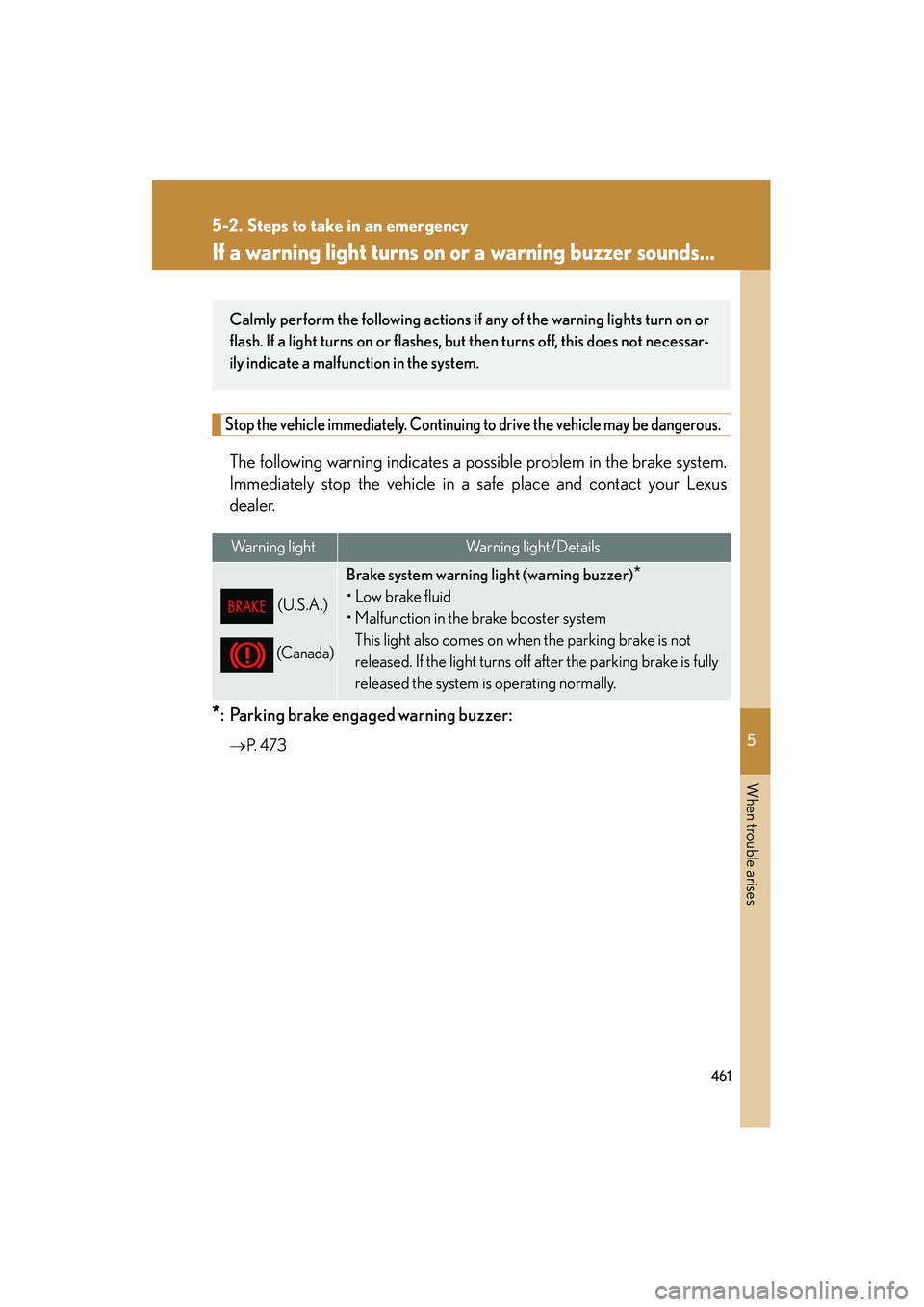
Warning lightWarning light/Details
(U.S.A.)
(Canada)
Brake system warning light (warning buzzer)*
• Low brake fluid
• Malfunction in the brake booster system
This light also comes on when the parking brake is not
released. If the light turns off after the parking brake is fully
released the system is operating normally.
Calmly perform the following actions if any of the warning lights turn on or
flash. If a light turns on or flashes, but then turns off, this does not necessar-
ily indicate a malfunction in the system.
Page 463 of 578
462
5-2. Steps to take in an emergency
IS350/250_U
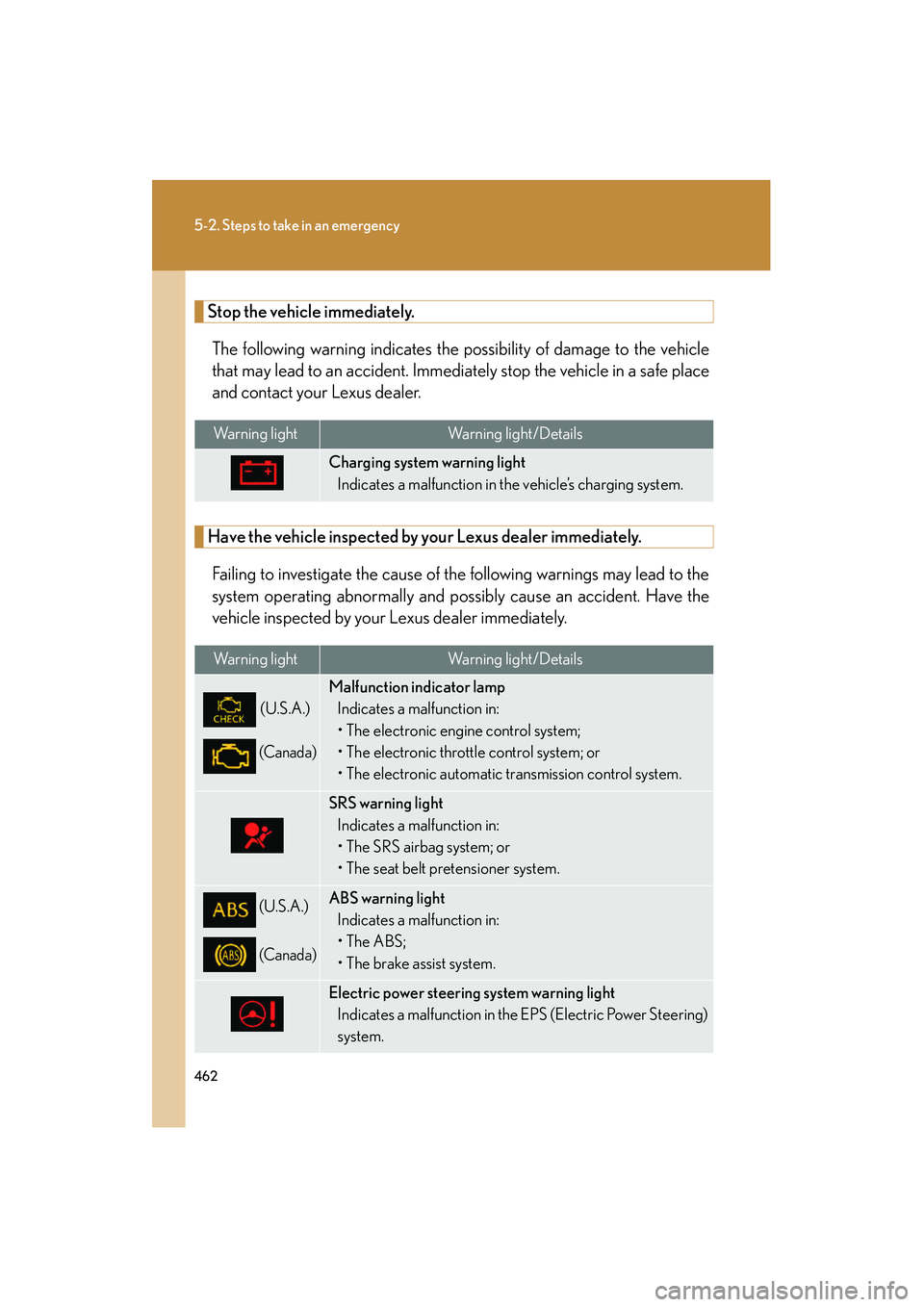
Stop the vehicle immediately.
The following warning indicates the possibility of damage to the vehicle
that may lead to an accident. Immediately stop the vehicle in a safe place
and contact your Lexus dealer.
Have the vehicle inspected by your Lexus dealer immediately. Failing to investigate the cause of the following warnings may lead to the
system operating abnormally and possibly cause an accident. Have the
vehicle inspected by your Lexus dealer immediately.
Warning lightWarning light/Details
Charging system warning light Indicates a malfunction in the vehicle’s charging system.
Warning lightWarning light/Details
(U.S.A.)
(Canada)
Malfunction indicator lampIndicates a malfunction in:
• The electronic engine control system;
• The electronic throttle control system; or
• The electronic automatic transmission control system.
SRS warning lightIndicates a malfunction in:
• The SRS airbag system; or
• The seat belt pretensioner system.
(U.S.A.)
(Canada)
ABS warning lightIndicates a malfunction in:
•The ABS;
• The brake assist system.
Electric power steering system warning light
Indicates a malfunction in the EPS (Electric Power Steering)
system.
Page 464 of 578
5
When trouble arises
463
5-2. Steps to take in an emergency
IS350/250_U
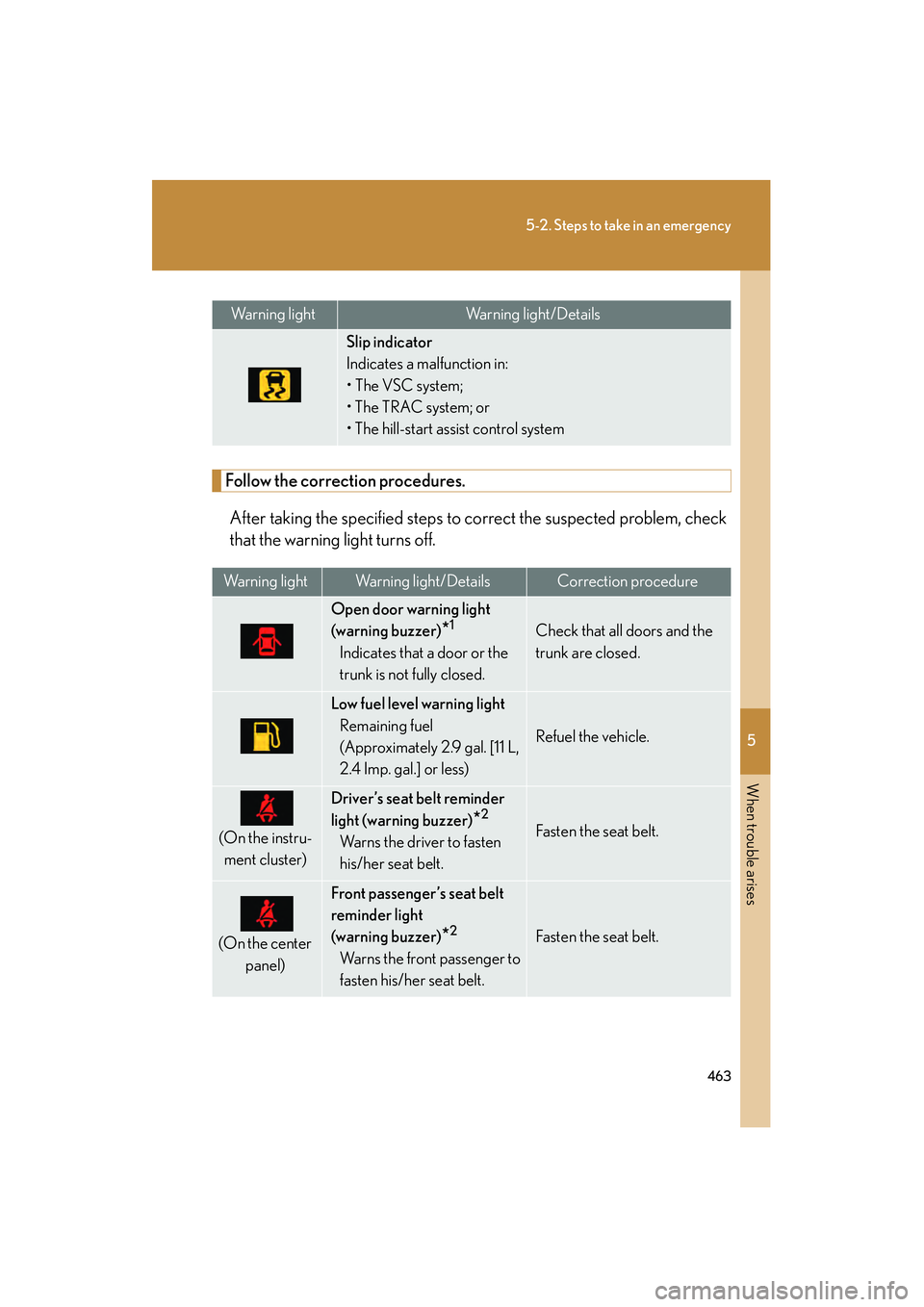
Follow the correction procedures.After taking the specified steps to co rrect the suspected problem, check
that the warning light turns off.
Warning lightWarning light/Details
Slip indicator
Indicates a malfunction in:
• The VSC system;
• The TRAC system; or
• The hill-start assist control system
Warning lightWarning light/DetailsCorrection procedure
Open door warning light
(warning buzzer)
*1
Indicates that a door or the
trunk is not fully closed.
Check that all doors and the
trunk are closed.
Low fuel level warning light
Remaining fuel
(Approximately 2.9 gal. [11 L,
2.4 Imp. gal.] or less)
Refuel the vehicle.
(On the instru-ment cluster)
Driver’s seat belt reminder
light (warning buzzer)
*2
Warns the driver to fasten
his/her seat belt.Fasten the seat belt.
(On the center
panel)
Front passenger’s seat belt
reminder light
(warning buzzer)
*2
Warns the front passenger to
fasten his/her seat belt.
Fasten the seat belt.
Page 465 of 578
464
5-2. Steps to take in an emergency
IS350/250_U
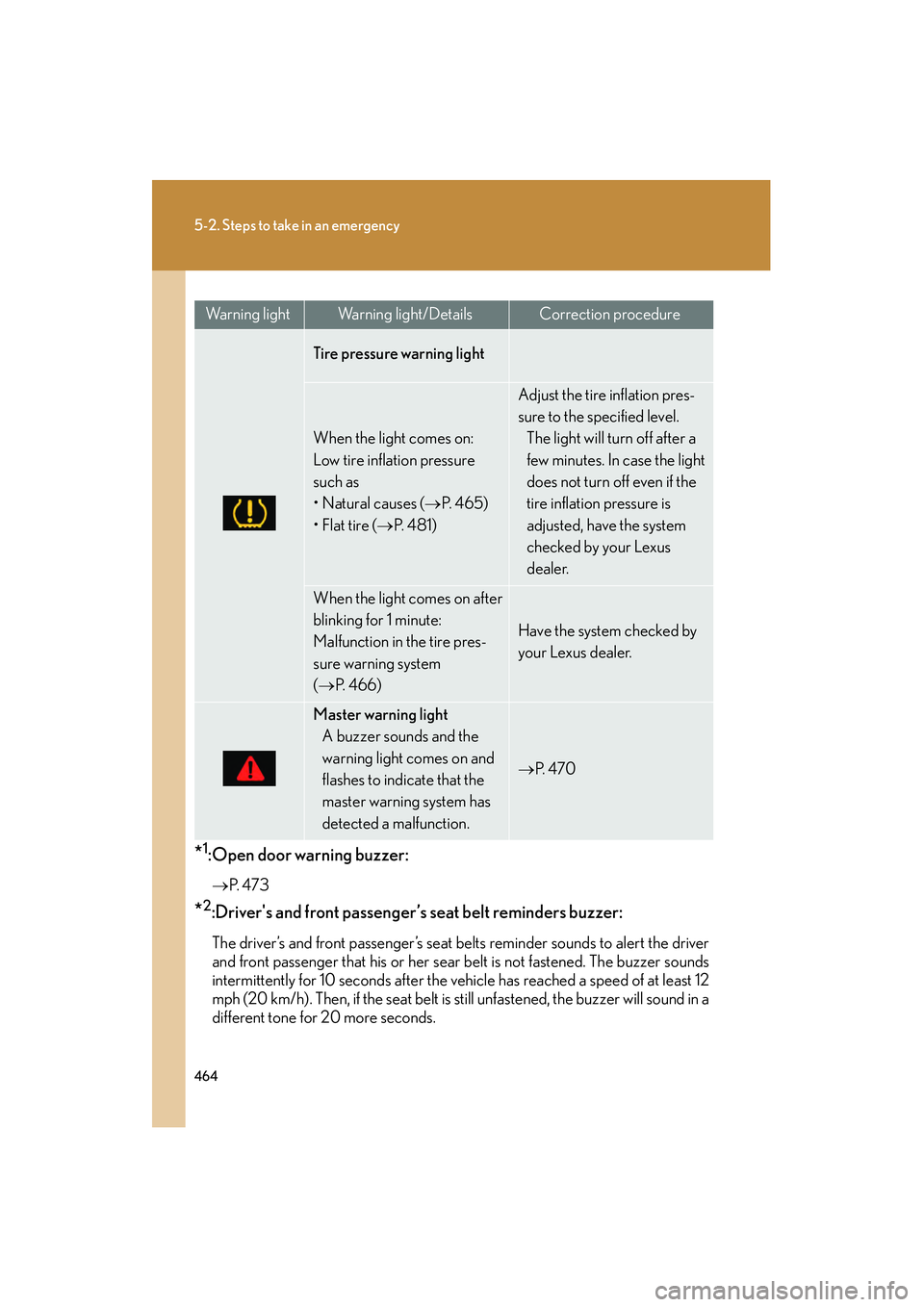
*1:Open door warning buzzer:
→P. 4 7 3
*2:Driver's and front passenger’s seat belt reminders buzzer:
The driver’s and front passenger’s seat belts reminder sounds to alert the driver
and front passenger that his or her sear belt is not fastened. The buzzer sounds
intermittently for 10 seconds after the vehicle has reached a speed of at least 12
mph (20 km/h). Then, if the seat belt is still unfastened, the buzzer will sound in a
different tone for 20 more seconds.
Warning lightWarning light/DetailsCorrection procedure
Tire pressure warning light
When the light comes on:
Low tire inflation pressure
such as
• Natural causes (→ P. 4 6 5 )
• Flat tire ( →P. 4 8 1 )
Adjust the tire inflation pres-
sure to the specified level.
The light will turn off after a
few minutes. In case the light
does not turn off even if the
tire inflation pressure is
adjusted, have the system
checked by your Lexus
dealer.
When the light comes on after
blinking for 1 minute:
Malfunction in the tire pres-
sure warning system
(→ P. 466)
Have the system checked by
your Lexus dealer.
Master warning light
A buzzer sounds and the
warning light comes on and
flashes to indicate that the
master warning system has
detected a malfunction.
→ P. 4 7 0
Page 467 of 578
466
5-2. Steps to take in an emergency
IS350/250_U
■If the tire pressure warning system is inoperative
The tire pressure warning system will be disabled in the following conditions:
(When the condition becomes normal, the system will work properly.)
●If tires not equipped with tire pressure warning valves and transmitters are used
●If the ID code on the tire pressure warning valves and transmitters is not regis-
tered in the tire pressure warning computer
●If a different set of tires has been selected using the satellite switch
●If the tire inflation pressure is 73 psi (500 kPa, 5.1 kgf/cm2 or bar) or higher
The tire pressure warning system may be disabled in the following conditions:
(When the condition becomes normal, the system will work properly.)
●If electronic devices or facilities using similar radio wave frequencies are nearby
●If a radio set at similar frequencies is in use in the vehicle
●If there is a lot of snow or ice on the vehicle, in particular around the wheels or
wheel housings
●If non-genuine Lexus wheels are used (Even if you use Lexus wheels, the tire
pressure warning system may not work properly with some types of tires.)
●If tire chains are used
■If the tire pressure warning light frequently comes on after blinking for 1 minute
If the tire pressure warning light frequently comes on after blinking for 1 minute
when the “ENGINE START STOP” switch is turned to IGNITION ON mode, have
it checked by your Lexus dealer.
■Customization that can be configured at Lexus dealer
The vehicle speed linked seat belt reminder buzzer can be disabled.
(Customizable features →P. 5 4 0 )
Page 468 of 578
5
When trouble arises
467
5-2. Steps to take in an emergency
IS350/250_U
CAUTION
■When the electric power steering warning light comes on
The steering wheel may become extremely heavy.
If the steering wheel becomes heavier than usual when operating, firmly hold and
operate it using more force than usual.
■If the tire pressure warning light comes on
Be sure to observe the following precautions. Failure to do so could cause loss of
vehicle control and result in death or serious injury.
●Stop your vehicle in a safe place as soon as possible. Adjust the tire inflation pres-
sure immediately.
●If the tire pressure warning light comes on even after tire inflation pressure adjust-
ment, it is probable that you have a flat tire. Check the tires. If the tire is flat,
change to the spare tire and have the flat tire repaired by the nearest Lexus
dealer.
●Avoid abrupt maneuvering and braking. If the vehicle tires deteriorate, you could
lose control of the steering wheel or the brakes.
■If a blowout or sudden air leakage should occur
The tire pressure warning system may not activate immediately.
Page 469 of 578

468
5-2. Steps to take in an emergency
IS350/250_U
CAUTION
■Maintenance of the tires
Each tire, including the spare (if provided), should be checked monthly when cold
and inflated to the inflation pressure recommended by the vehicle manufacturer on
the vehicle placard or tire inflation pressure label (tire and load information label).
(If your vehicle has tires of a different size than the size indicated on the vehicle
placard or tire inflation pressure label [tire and load information label], you should
determine the proper tire inflation pressure for those tires.)
As an added safety feature, your vehicle has been equipped with a tire pressure
monitoring system (TPMS-tire pressure warning system) that illuminates a low tire
pressure telltale (tire pressure warning light) when one or more of your tires is sig-
nificantly under-inflated. Accordingly, when the low tire pressure telltale (tire pres-
sure warning light) illuminates, you should stop and check your tires as soon as
possible, and inflate them to the proper pressure. Driving on a significantly under-
inflated tire causes the tire to overheat and can lead to tire failure. Under-inflation
also reduces fuel efficiency and tire tread life, and may affect the vehicle's handling
and stopping ability.
Please note that the TPMS (tire pressure warning system) is not a substitute for
proper tire maintenance, and it is the driver's responsibility to maintain correct tire
pressure, even if under-inflation has not reached the level to trigger illumination of
the TPMS low tire pressure telltale (tire pressure warning light).
Your vehicle has also been equipped with a TPMS (tire pressure warning system)
malfunction indicator to indicate when the system is not operating properly. The
TPMS (tire pressure warning system) malfunction indicator is combined with the
low tire pressure telltale (tire pressure warning light). When the system detects a
malfunction, the telltale will flash for approximately one minute and then remain
continuously illuminated. This sequence will continue upon subsequent vehicle
start-ups as long as the malfunction exists. When the malfunction indicator is illumi-
nated, the system may not be able to detect or signal low tire pressure as intended.
TPMS (tire pressure warning system) malfunctions may occur for a variety of rea-
sons, including the installation of replacement or alternate tires or wheels on the
vehicle that prevent the TPMS (tire pressure warning system) from functioning
properly. Always check the TPMS (tire pressure warning system) malfunction tell-
tale after replacing one or more tires or wheels on your vehicle to ensure that the
replacement or alternate tires and wheels allow the TPMS (tire pressure warning
system) to continue to function properly.