Cd system Lexus IS250 2011 Owner's Manual
[x] Cancel search | Manufacturer: LEXUS, Model Year: 2011, Model line: IS250, Model: Lexus IS250 2011Pages: 578, PDF Size: 31.12 MB
Page 492 of 578
5
When trouble arises
491
5-2. Steps to take in an emergency
IS350/250_U
If the shift lever cannot be shifted from P∗
If the shift lever cannot be shifted with your foot on the brake, there may be
a problem with the shift lock system (a system to prevent accidental opera-
tion of the shift lever). Have the vehicle inspected by your Lexus dealer
immediately.
The following steps may be used as an emergency measure to ensure that
the shift lever can be shifted.
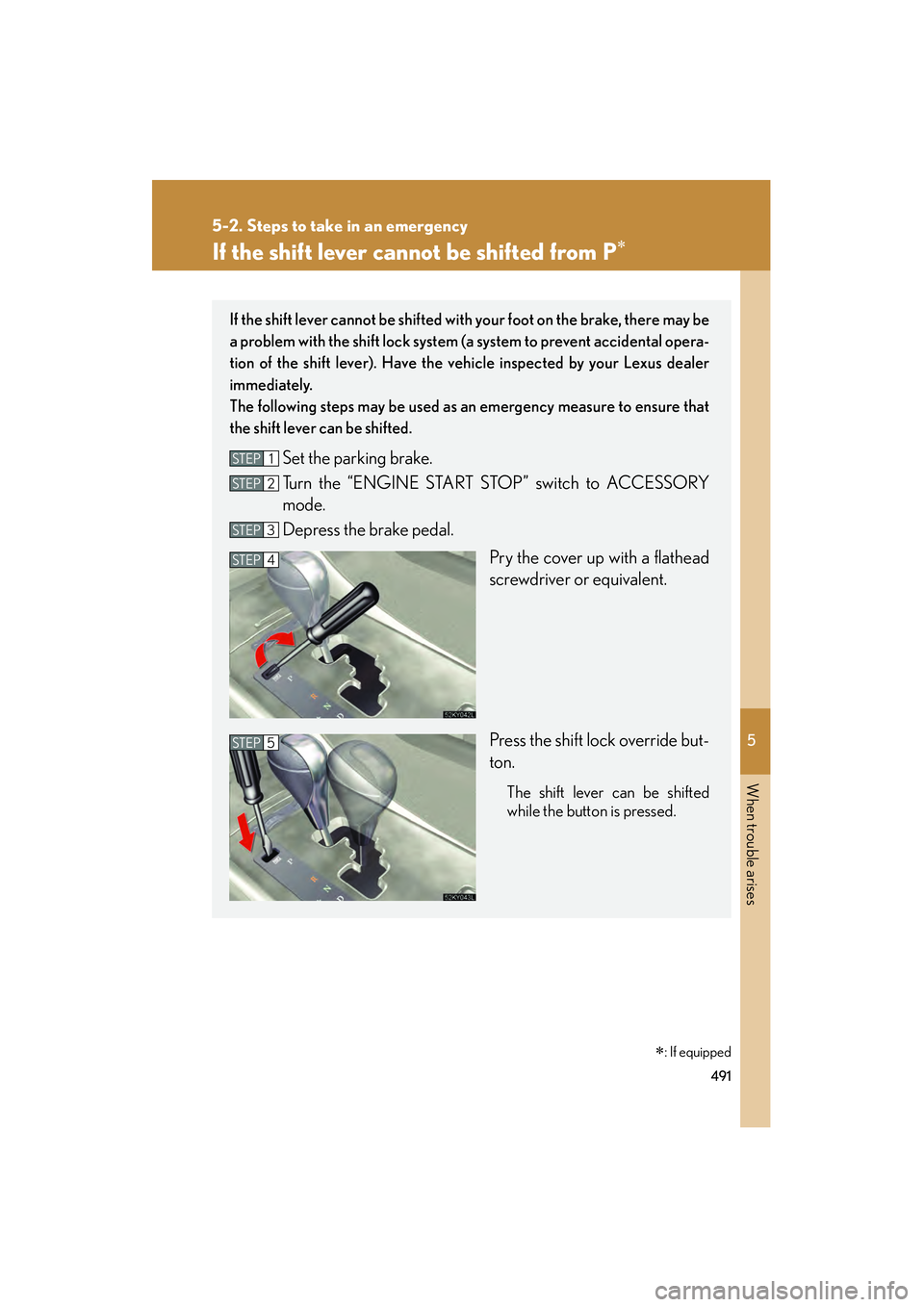
Set the parking brake.
Turn the “ENGINE START STOP” switch to ACCESSORY
mode.
Depress the brake pedal.
Pry the cover up with a flathead
screwdriver or equivalent.
Press the shift lock override but-
ton.
The shift lever can be shifted
while the button is pressed.
STEP1
STEP2
STEP3
STEP4
STEP5
∗: If equipped
Page 494 of 578
5
When trouble arises
493
5-2. Steps to take in an emergency
IS350/250_U
If the electronic key does not operate properly
Locking and unlocking the doors, unlocking the trunk and key linked functions
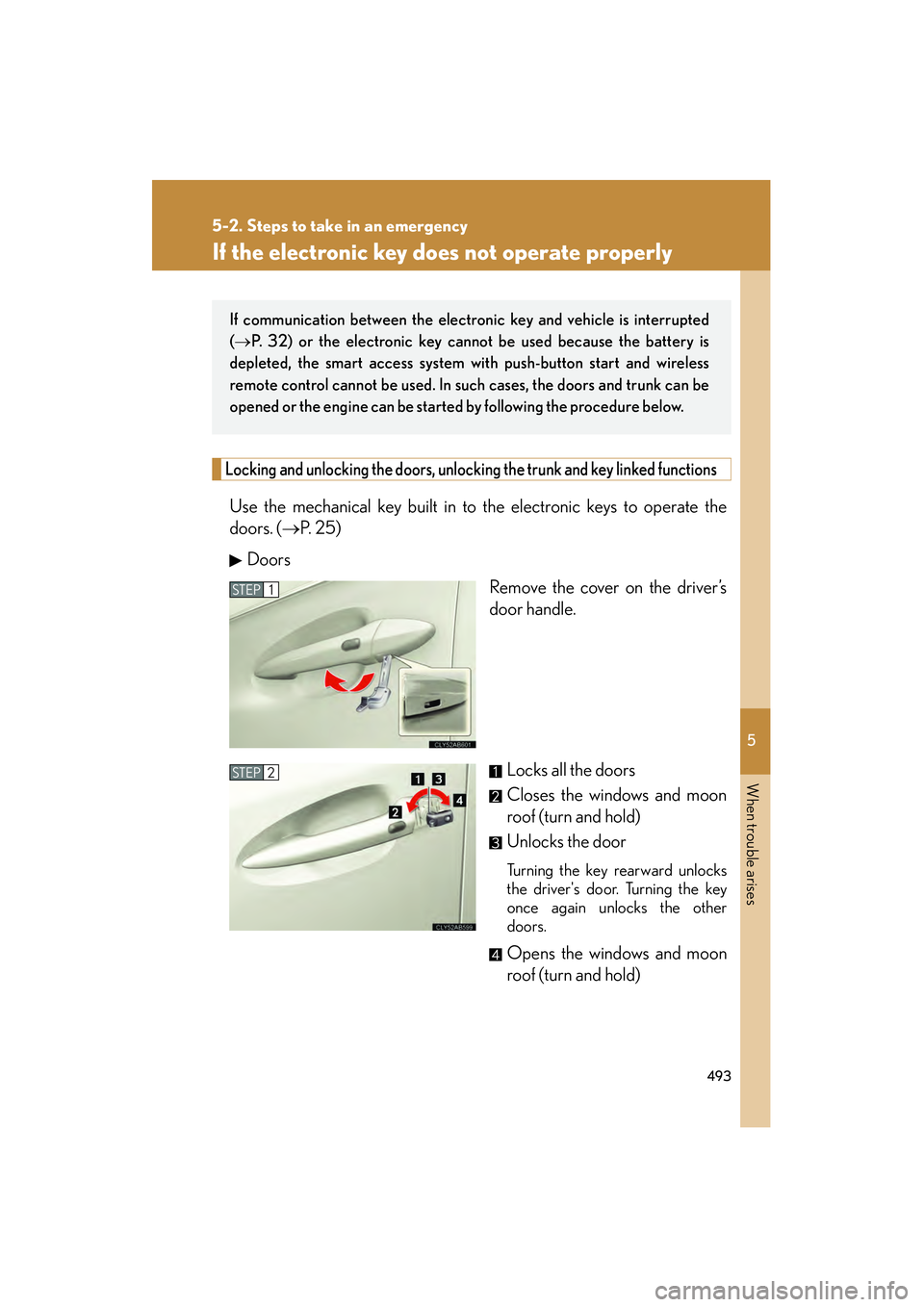
Use the mechanical key built in to the electronic keys to operate the
doors. (→P. 2 5 )
Doors Remove the cover on the driver’s
door handle.
Locks all the doors
Closes the windows and moon
roof (turn and hold)
Unlocks the door
Turning the key rearward unlocks
the driver's door. Turning the key
once again unlocks the other
doors.
Opens the windows and moon
roof (turn and hold)
If communication between the electronic key and vehicle is interrupted
(→ P. 32) or the electronic key cann ot be used because the battery is
depleted, the smart access system with push-button start and wireless
remote control cannot be used. In such cases, the doors and trunk can be
opened or the engine can be started by following the procedure below.
STEP1
STEP2
Page 500 of 578
5
When trouble arises
499
5-2. Steps to take in an emergency
IS350/250_U
■Avoiding a discharged battery
●Turn off the headlights and the audio system while the engine is off.
●Turn off any unnecessary electrical components when the vehicle is running at a
low speed for an extended period, such as in heavy traffic, etc.
CAUTION
■Avoiding battery fires or explosions
Observe the following precautions to prevent accidentally igniting the flammable
gas that may be emitted from the battery.
●Make sure the jumper cable is connected to the correct terminal and that it is not
unintentionally in contact with any part other than the intended terminal.
●Do not allow the jumper cables to come into contact with the “+” and “-” termi-
nals.
●Do not allow open flame or use matches, cigarette lighters or smoke near the
battery.
Maintain the engine speed of the second vehicle and turn the
“ENGINE START STOP” switch to IGNITION ON mode,
then start the vehicle’s engine.
Once the vehicle’s engine has started, remove the jumper
cables in the exact reverse order in which they were con-
nected.
Once the engine starts, have the vehicle checked at your Lexus dealer
as soon as possible.STEP5
STEP6
Page 502 of 578

5
When trouble arises
501
5-2. Steps to take in an emergency
IS350/250_U
If your vehicle overheats
If your engine overheats:
Stop the vehicle in a safe place and turn off the automatic air
conditioning system.
Check to see if steam is coming out from under the hood.
If you see steam: Stop the engine. Carefully lift the hood after the steam sub-
sides and then restart the engine.
If you do not see steam: Leave the engine running and carefully lift the hood.
Remove the engine compartment cover. ( →P. 388)
Check to see if the cooling fans are operating.
If the fans are operating: Wait until the temperature of the engine (shown on the
instrument cluster) begins to fall and then stop the engine.
If the fans are not operating: Stop the engine immediately and call your local Lexus
dealer.
After the engine has cooled
down sufficiently, check the
engine coolant level and inspect
the radiator core (radiator) for
any leaks.STEP1
STEP2
STEP3
STEP4
STEP5
Page 513 of 578
512
6-1. Specifications
IS350/250_U
Lubrication system
IS250
■ Engine oil selection
“Toyota Genuine Motor Oil” is used in your Lexus vehicle. Use Lexus
approved “Toyota Genuine Motor Oil” or equivalent to satisfy the follow-
ing grade and viscosity.
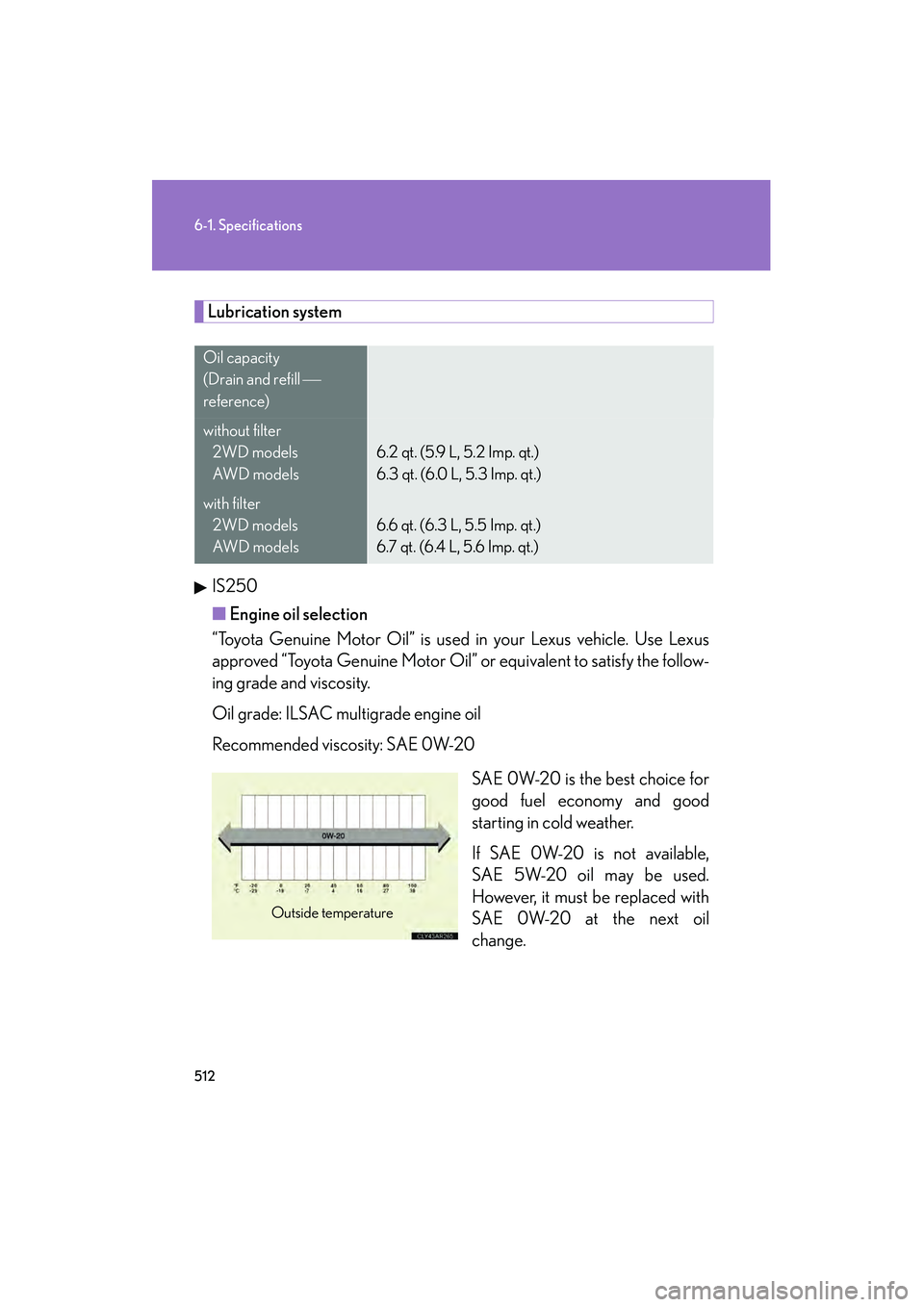
Oil grade: ILSAC multigrade engine oil
Recommended viscosity: SAE 0W-20
SAE 0W-20 is the best choice for
good fuel economy and good
starting in cold weather.
If SAE 0W-20 is not available,
SAE 5W-20 oil may be used.
However, it must be replaced with
SAE 0W-20 at the next oil
change.
Oil capacity
(Drain and refill
reference)
without filter
2WD models
AWD models
6.2 qt. (5.9 L, 5.2 Imp. qt.)
6.3 qt. (6.0 L, 5.3 Imp. qt.)
with filter
2WD models
AWD models
6.6 qt. (6.3 L, 5.5 Imp. qt.)
6.7 qt. (6.4 L, 5.6 Imp. qt.)
Outside temperature
Page 516 of 578

515
6-1. Specifications
6
Vehicle specifications
IS350/250_U
Cooling system
Ignition system
Capacity
IS350
9.6 qt. (9.1 L, 8.0 Imp. qt.)
IS250
10.9 qt. (10.3 L, 9.1 Imp. qt.)
Coolant type
Use either of the following.• “Toyota Super Long Life Coolant”
• Similar high-quality ethylene glycol-based non-sili-cate, non-amine, non-nitrite, and non-borate cool-
ant with long-life hybrid organic acid technology
Do not use plain water alone.
Spark plug
Make
GapDENSO FK20HBR11
0.043 in. (1.1 mm)
NOTICE
■Iridium-tipped spark plugs
Use only iridium-tipped spark plugs. Do not adjust gap when tuning the engine.
Page 517 of 578
516
6-1. Specifications
IS350/250_U
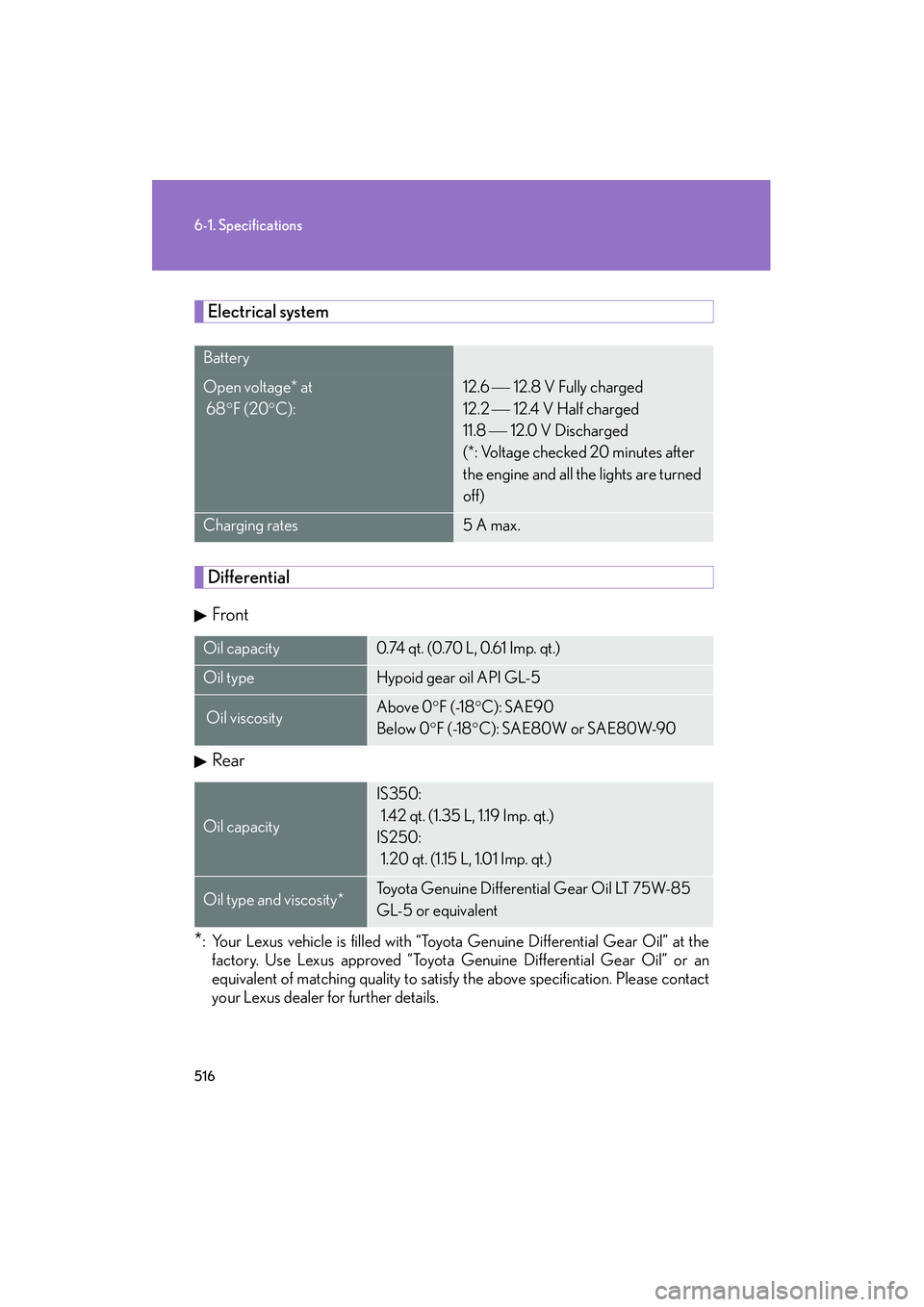
Electrical system
Differential
Front
Rear
*: Your Lexus vehicle is filled with “Toyota Genuine Differential Gear Oil” at the factory. Use Lexus approved “Toyota Genuine Differential Gear Oil” or an
equivalent of matching quality to satisfy the above specification. Please contact
your Lexus dealer for further details.
Battery
Open voltage* at
68 °F (20 °C):12.6 12.8 V Fully charged
12.2
12.4 V Half charged
11.8
12.0 V Discharged
(*: Voltage checked 20 minutes after
the engine and all the lights are turned
off)
Charging rates5 A max.
Oil capacity0.74 qt. (0.70 L, 0.61 Imp. qt.)
Oil typeHypoid gear oil API GL-5
Oil viscosityAbove 0 °F (-18 °C): SAE90
Below 0 °F (-18 °C): SAE80W or SAE80W-90
Oil capacity
IS350:
1.42 qt. (1.35 L, 1.19 Imp. qt.)
IS250:
1.20 qt. (1.15 L, 1.01 Imp. qt.)
Oil type and viscosity*Toyota Genuine Differential Gear Oil LT 75W-85
GL-5 or equivalent
Page 527 of 578
526
6-1. Specifications
IS350/250_U
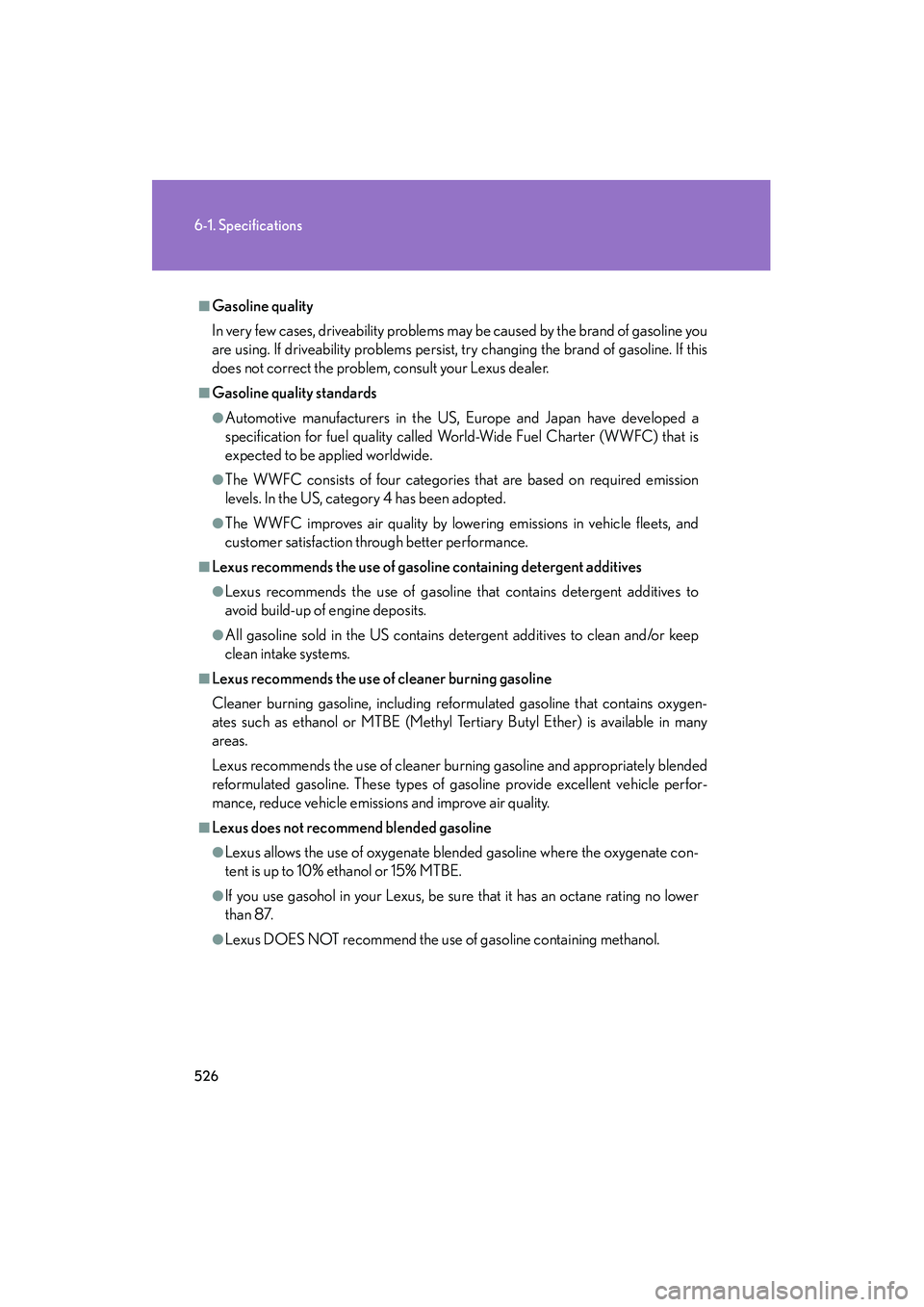
■Gasoline quality
In very few cases, driveability problems may be caused by the brand of gasoline you
are using. If driveability problems persist, try changing the brand of gasoline. If this
does not correct the problem, consult your Lexus dealer.
■Gasoline quality standards
●Automotive manufacturers in the US, Europe and Japan have developed a
specification for fuel quality called World-Wide Fuel Charter (WWFC) that is
expected to be applied worldwide.
●The WWFC consists of four categories that are based on required emission
levels. In the US, category 4 has been adopted.
●The WWFC improves air quality by lowering emissions in vehicle fleets, and
customer satisfaction through better performance.
■Lexus recommends the use of gasoline containing detergent additives
●Lexus recommends the use of gasoline that contains detergent additives to
avoid build-up of engine deposits.
●All gasoline sold in the US contains detergent additives to clean and/or keep
clean intake systems.
■Lexus recommends the use of cleaner burning gasoline
Cleaner burning gasoline, including reformulated gasoline that contains oxygen-
ates such as ethanol or MTBE (Methyl Tertiary Butyl Ether) is available in many
areas.
Lexus recommends the use of cleaner burning gasoline and appropriately blended
reformulated gasoline. These types of gasoline provide excellent vehicle perfor-
mance, reduce vehicle emissions and improve air quality.
■Lexus does not recommend blended gasoline
●Lexus allows the use of oxygenate blended gasoline where the oxygenate con-
tent is up to 10% ethanol or 15% MTBE.
●If you use gasohol in your Lexus, be sure that it has an octane rating no lower
than 87.
●Lexus DOES NOT recommend the use of gasoline containing methanol.
Page 528 of 578

527
6-1. Specifications
6
Vehicle specifications
IS350/250_U
■Lexus does not recommend gasoline containing MMT
Some gasoline contains octane enhancing additive called MMT (Methylcyclopen-
tadienyl Manganese Tricarbonyl).
Lexus DOES NOT recommend the use of gasoline that contains MMT. If fuel con-
taining MMT is used, your emission control system may be adversely affected.
The malfunction indicator lamp on the instrument cluster may come on. If this hap-
pens, contact your Lexus dealer for service.
NOTICE
■Notice on fuel quality
●Do not use improper fuels. If improper fuels are used the engine will be damaged.
●Do not use leaded gasoline.
Leaded gasoline can cause damage to your vehicle’s three-way catalytic convert-
ers causing the emission control system to malfunction.
●Do not use gasohol other than that stated here.
Other gasohol may cause fuel system damage or vehicle performance problems.
●IS250: Use of unleaded gasoline with an octane rating lower than 91 may result
in engine knocking. Persistent knocking can lead to engine damage and should
be corrected by refueling with higher octane unleaded gasoline.
●IS350: Use of unleaded gasoline with an octane rating lower than 91 may result
in engine knocking and significantly reduced performance. Persistent knocking
can lead to engine damage and should be corrected by refueling with higher
octane unleaded gasoline.
■Fuel-related poor driveability
If after using a different type of fuel, poor driveability is encountered (poor hot start-
ing, vaporization, engine knocking, etc.), discontinue the use of that type of fuel.
■When refueling with gasohol
Take care not to spill gasohol. It can damage your vehicle's paint.
Page 537 of 578
536
6-1. Specifications
IS350/250_U
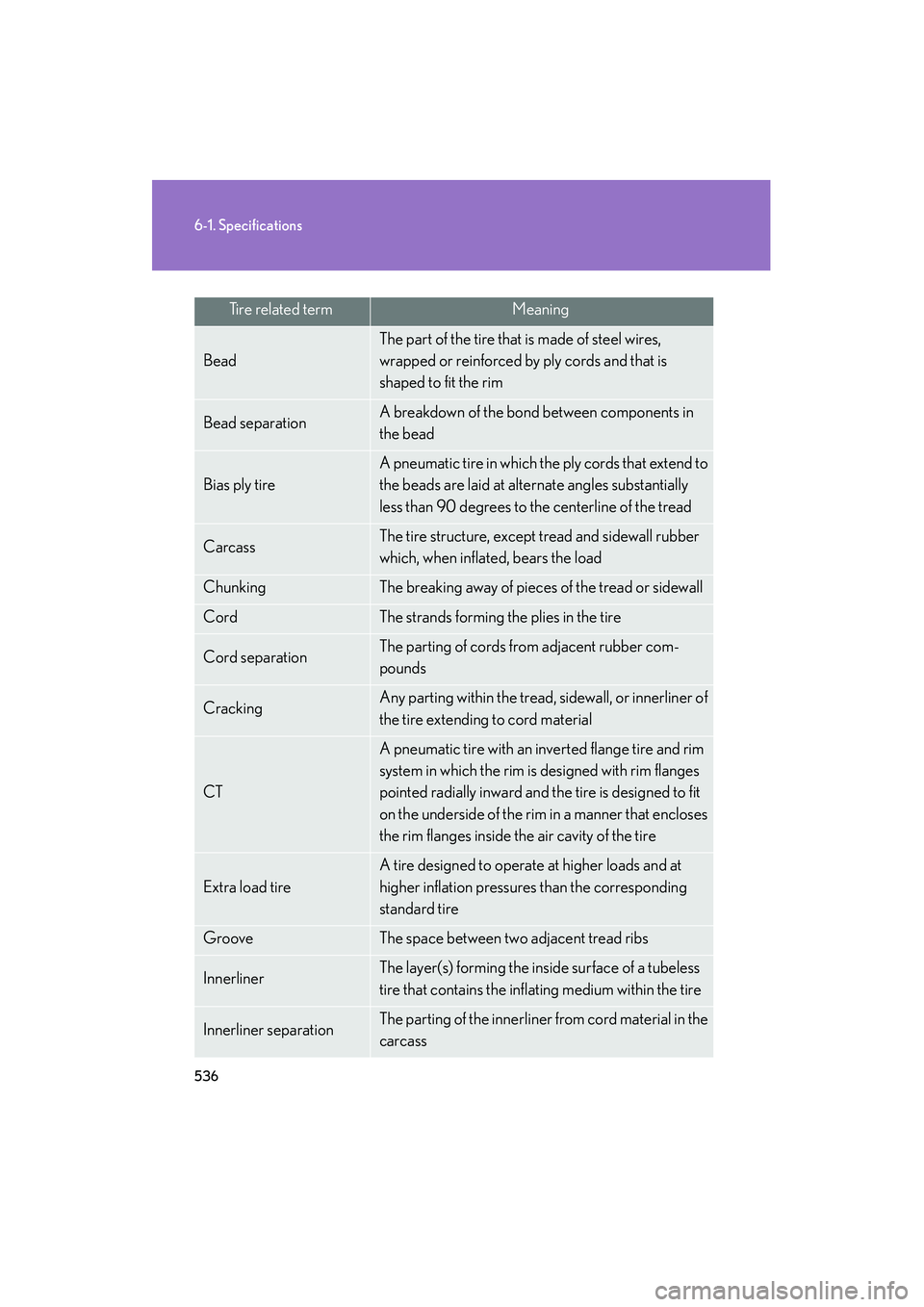
Bead
The part of the tire that is made of steel wires,
wrapped or reinforced by ply cords and that is
shaped to fit the rim
Bead separationA breakdown of the bond between components in
the bead
Bias ply tire
A pneumatic tire in which the ply cords that extend to
the beads are laid at alternate angles substantially
less than 90 degrees to the centerline of the tread
CarcassThe tire structure, except tread and sidewall rubber
which, when inflated, bears the load
ChunkingThe breaking away of pieces of the tread or sidewall
CordThe strands forming the plies in the tire
Cord separationThe parting of cords from adjacent rubber com-
pounds
CrackingAny parting within the tread, sidewall, or innerliner of
the tire extending to cord material
CT
A pneumatic tire with an inverted flange tire and rim
system in which the rim is designed with rim flanges
pointed radially inward and the tire is designed to fit
on the underside of the rim in a manner that encloses
the rim flanges inside the air cavity of the tire
Extra load tire
A tire designed to operate at higher loads and at
higher inflation pressures than the corresponding
standard tire
GrooveThe space between two adjacent tread ribs
InnerlinerThe layer(s) forming the inside surface of a tubeless
tire that contains the inflating medium within the tire
Innerliner separationThe parting of the innerliner from cord material in the
carcass
Tire related termMeaning