ECT Switch Lexus IS250 2011 Owner's Guide
[x] Cancel search | Manufacturer: LEXUS, Model Year: 2011, Model line: IS250, Model: Lexus IS250 2011Pages: 578, PDF Size: 31.12 MB
Page 84 of 578
83
1-5. Refueling
1
Before driving
IS350/250_U
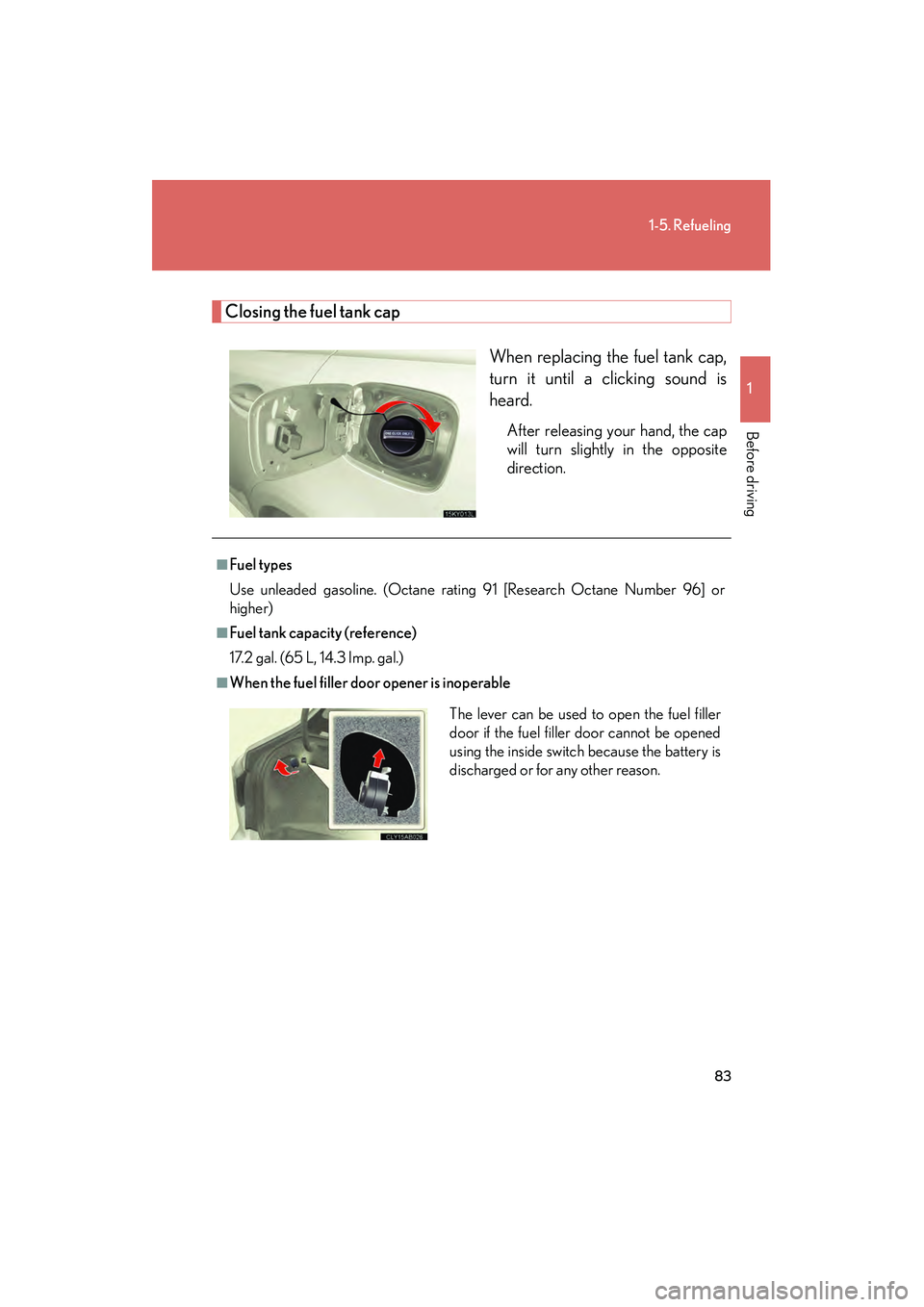
Closing the fuel tank capWhen replacing the fuel tank cap,
turn it until a clicking sound is
heard.
After releasing your hand, the cap
will turn slightly in the opposite
direction.
■Fuel types
Use unleaded gasoline. (Octane rating 91 [Research Octane Number 96] or
higher)
■Fuel tank capacity (reference)
17.2 gal. (65 L, 14.3 Imp. gal.)
■When the fuel filler door opener is inoperableThe lever can be used to open the fuel filler
door if the fuel filler door cannot be opened
using the inside switch because the battery is
discharged or for any other reason.
Page 88 of 578

87
1
1-6. Theft deterrent system
Before driving
IS350/250_U
Alarm
The system sounds the alarm and flashes the lights when forcible entry is
detected.
■Triggering of the alarm
The alarm is triggered in the following situations when the alarm is
set:
●A locked door or trunk is unlocked or opened in any way other
than using the entry function, wireless remote door lock function
or mechanical key.
● The hood is opened.
■ Setting the alarm system
Close the doors, trunk and
hood, and lock all doors.
The system will be set automati-
cally after 30 seconds.
The indicator light changes from
being on to flashing when the
system is set.
■Deactivating or stopping the alarm
Do one of the following to deactivate or stop the alarm.
●Unlock the doors or trunk.
● Turn the “ENGINE START STOP” switch to ACCESSORY or
IGNITION ON mode, or start the engine. (The alarm will be
deactivated or stopped after a few seconds.)
Page 95 of 578
94
1-7. Safety information
IS350/250_U
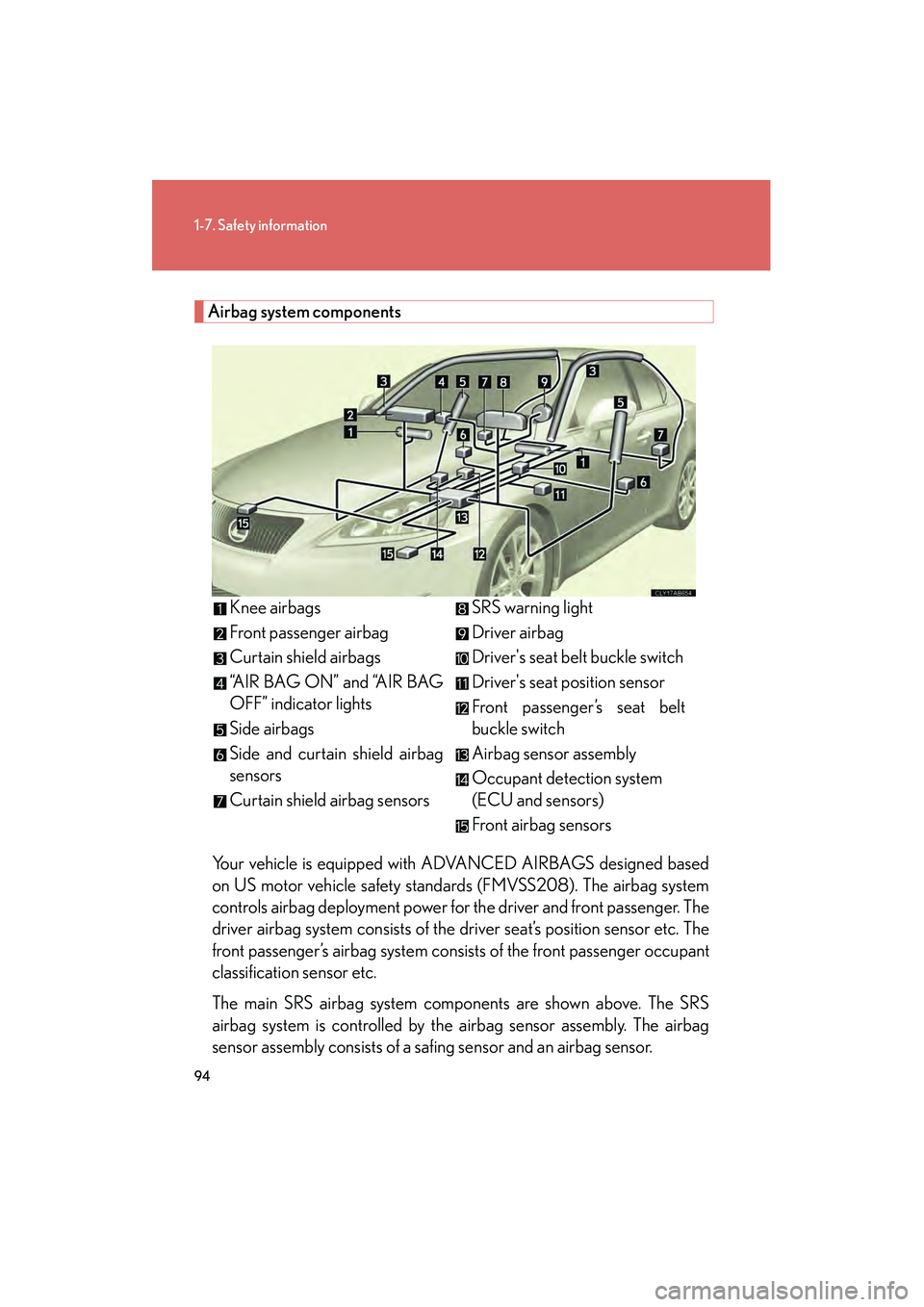
Airbag system componentsYour vehicle is equipped with ADVANCED AIRBAGS designed based
on US motor vehicle safety standards (FMVSS208). The airbag system
controls airbag deployment power for the driver and front passenger. The
driver airbag system consists of the driver seat’s position sensor etc. The
front passenger’s airbag system consists of the front passenger occupant
classification sensor etc.
The main SRS airbag system components are shown above. The SRS
airbag system is controlled by the airbag sensor assembly. The airbag
sensor assembly consists of a sa fing sensor and an airbag sensor.
Knee airbags
Front passenger airbag
Curtain shield airbags
“A I R B A G O N ” a n d “A I R B A G
OFF” indicator lights
Side airbags
Side and curtain shield airbag
sensors
Curtain shield airbag sensors
SRS warning light
Driver airbag
Driver's seat belt buckle switch
Driver's seat position sensor
Front passenger’s seat belt
buckle switch
Airbag sensor assembly
Occupant detection system
(ECU and sensors)
Front airbag sensors
Page 96 of 578

95
1-7. Safety information
1
Before driving
IS350/250_UIn certain types of severe frontal or side impacts, the SRS airbag system
triggers the airbag inflators. A chemical reaction in the inflators quickly
fills the airbags with non-toxic gas to help restrain the motion of the occu-
pants.
■SRS warning light
This warning light system monitors the airbag sensor assembly, front airbag sensors,
side and curtain shield airbag sensor assemblies, curtain shield airbag sensor
assemblies, driver's seat position sensor, driver's seat belt buckle switch, seat belt
pretensioner assemblies, inflators, interconnecting wiring and power sources.
(
→ P. 4 6 2 )
■If the SRS airbags deploy (inflate)
●Bruising and slight abrasions may result from contact with a deploying (inflating)
SRS airbag.
●A loud noise and white powder will be emitted.
●Parts of the airbag module (steering wheel, airbag cover and inflator) as well as
the front seats, and parts of the front pillar, rear pillar and roof side rail, may be
hot for several minutes. The airbag itself may also be hot.
●The windshield may crack.
●For Safety Connect subscribers, if the SRS airbags deploy or in the event of a
severe rear-end collision, the system is designed to send an emergency call to
the response center, notifying them of the vehicle’s location (without needing to
push the “SOS” button) and an agent will attempt to speak with the occupants
to ascertain the level of emergency and assistance required. If the occupants
are unable to communicate, the agent automatically treats the call as an emer-
gency and helps to dispatch the necessary emergency services. ( →P. 360)
Page 126 of 578
125
2-1. Driving procedures
2
When driving
IS350/250_U
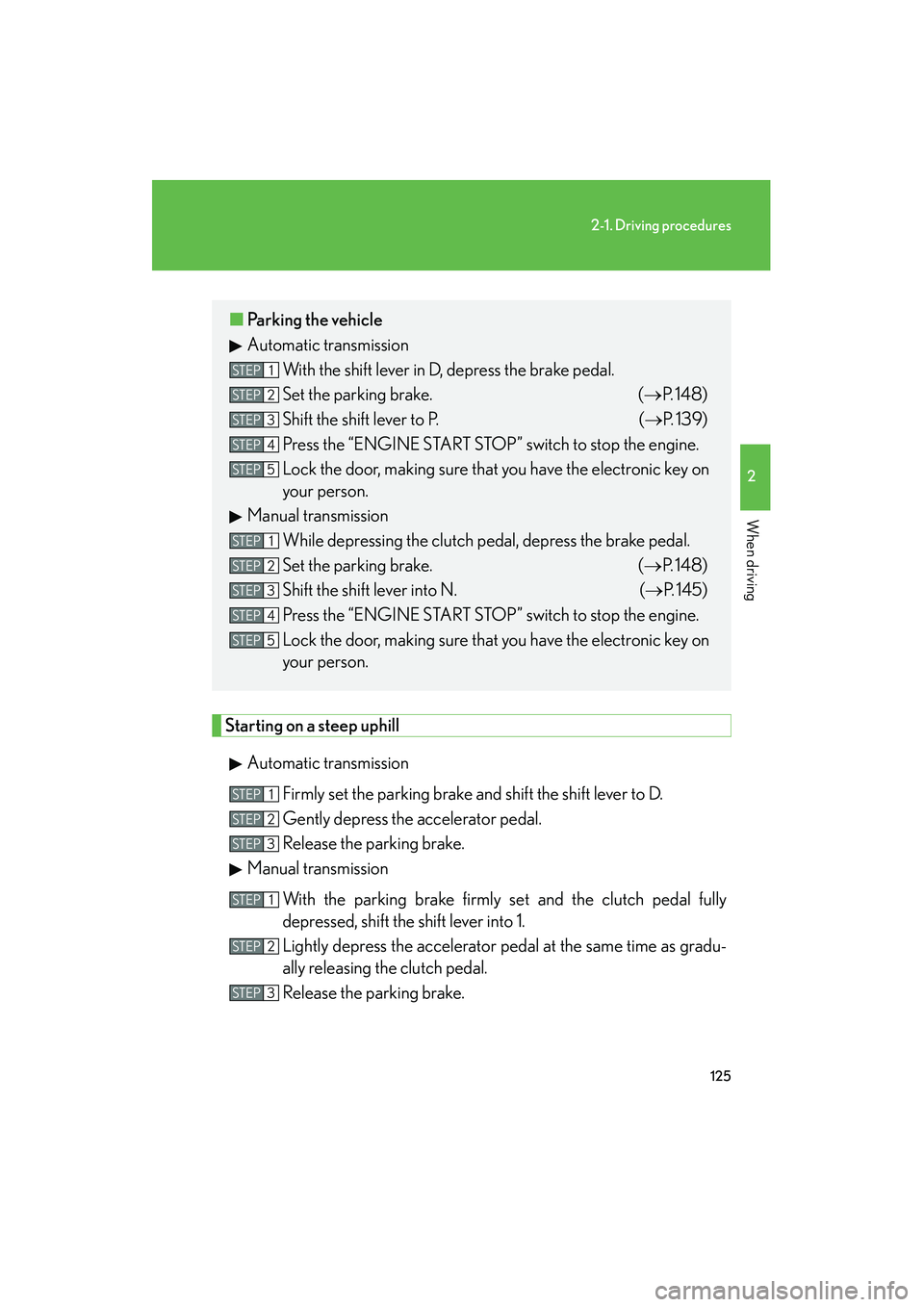
Starting on a steep uphillAutomatic transmission Firmly set the parking brake and shift the shift lever to D.
Gently depress the accelerator pedal.
Release the parking brake.
Manual transmission
With the parking brake firmly set and the clutch pedal fully
depressed, shift the shift lever into 1.
Lightly depress the accelerator pedal at the same time as gradu-
ally releasing the clutch pedal.
Release the parking brake.
■Parking the vehicle
Automatic transmission
With the shift lever in D, depress the brake pedal.
Set the parking brake. (→ P. 1 4 8 )
Shift the shift lever to P. (→ P. 1 3 9 )
Press the “ENGINE START STOP” switch to stop the engine.
Lock the door, making sure that you have the electronic key on
your person.
Manual transmission
While depressing the clutch pedal, depress the brake pedal.
Set the parking brake. (→P. 1 4 8 )
Shift the shift lever into N. (→ P. 145)
Press the “ENGINE START STOP” switch to stop the engine.
Lock the door, making sure that you have the electronic key on
your person.
STEP1
STEP2
STEP3
STEP4
STEP5
STEP1
STEP2
STEP3
STEP4
STEP5
STEP1
STEP2
STEP3
STEP1
STEP2
STEP3
Page 135 of 578
134
2-1. Driving procedures
IS350/250_U
Engine (ignition) switch
Performing the following operations when carrying the electronic key on
your person starts the engine or changes “ENGINE START STOP” switch
modes.
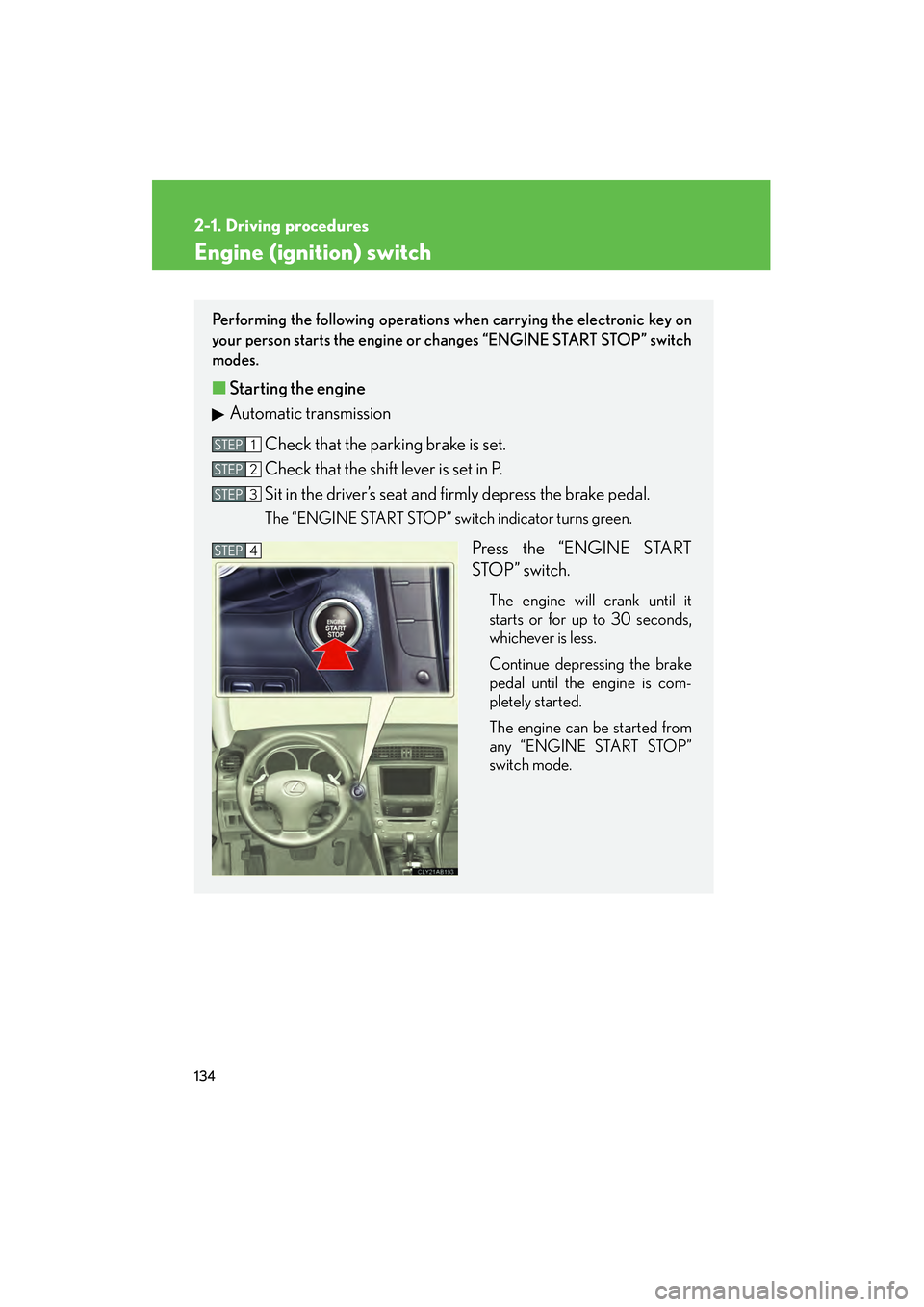
■ Starting the engine
Automatic transmission
Check that the parking brake is set.
Check that the shift lever is set in P.
Sit in the driver’s seat and firmly depress the brake pedal.
The “ENGINE START STOP” switch indicator turns green.
Press the “ENGINE START
STOP” switch.
The engine will crank until it
starts or for up to 30 seconds,
whichever is less.
Continue depressing the brake
pedal until the engine is com-
pletely started.
The engine can be started from
any “ENGINE START STOP”
switch mode.
STEP1
STEP2
STEP3
STEP4
Page 137 of 578
136
2-1. Driving procedures
IS350/250_U
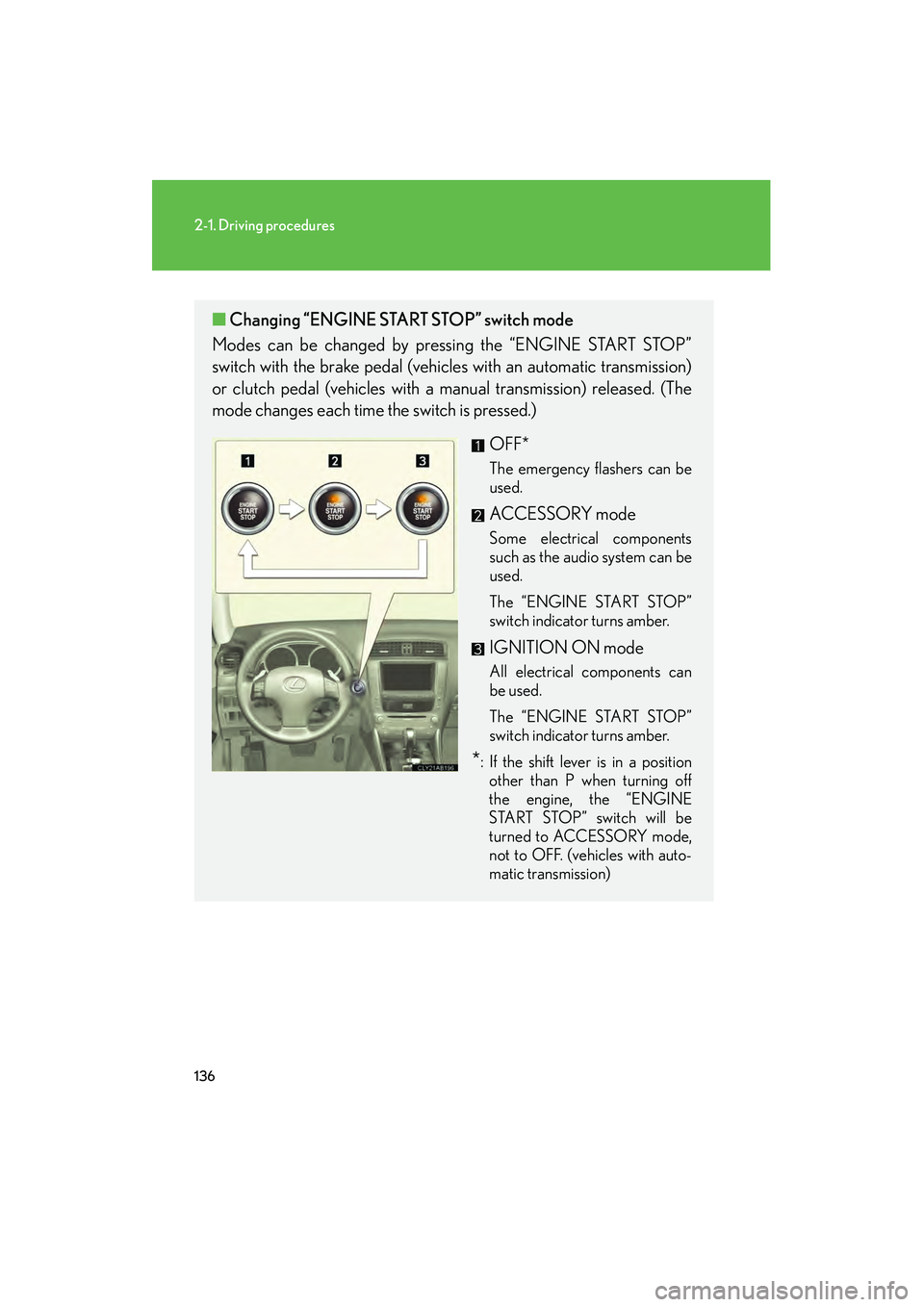
■Changing “ENGINE STAR T STOP” switch mode
Modes can be changed by pressing the “ENGINE START STOP”
switch with the brake pedal (vehicles with an automatic transmission)
or clutch pedal (vehicles with a manual transmission) released. (The
mode changes each time the switch is pressed.)
OFF*
The emergency flashers can be
used.
ACCESSORY mode
Some electrical components
such as the audio system can be
used.
The “ENGINE START STOP”
switch indicator turns amber.
IGNITION ON mode
All electrical components can
be used.
The “ENGINE START STOP”
switch indicator turns amber.
*: If the shift lever is in a positionother than P when turning off
the engine, the “ENGINE
START STOP” switch will be
turned to ACCESSORY mode,
not to OFF. (vehicles with auto-
matic transmission)
Page 138 of 578
137
2-1. Driving procedures
2
When driving
IS350/250_U
■If the engine does not start
The engine immobilizer system may not have been deactivated. (→P. 8 5 )
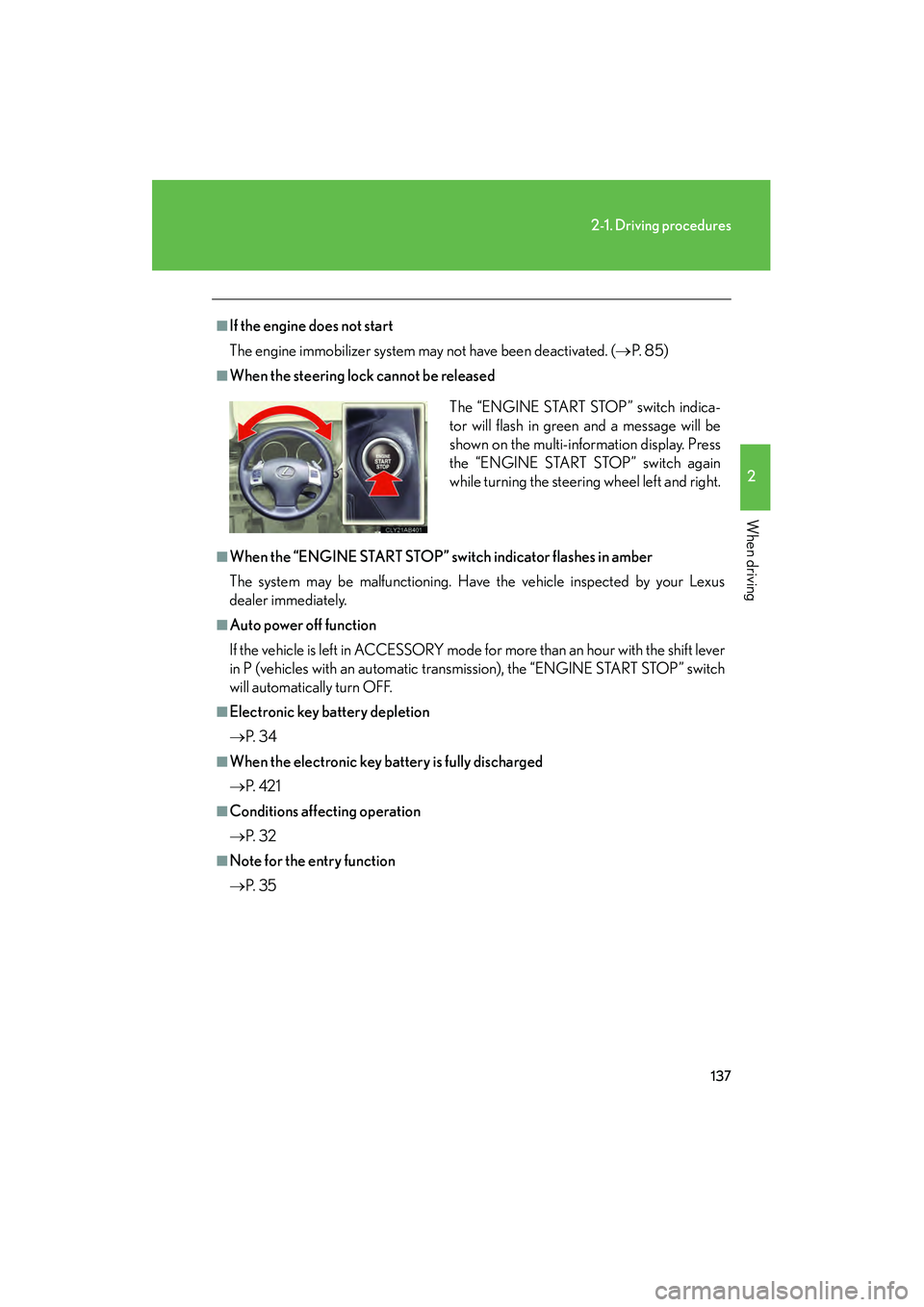
■When the steering lock cannot be released
■When the “ENGINE START STOP” switch indicator flashes in amber
The system may be malfunctioning. Have the vehicle inspected by your Lexus
dealer immediately.
■Auto power off function
If the vehicle is left in ACCESSORY mode for more than an hour with the shift lever
in P (vehicles with an automatic transmission), the “ENGINE START STOP” switch
will automatically turn OFF.
■Electronic key battery depletion
→P. 3 4
■When the electronic key battery is fully discharged
→P. 4 2 1
■Conditions affecting operation
→P. 3 2
■Note for the entry function
→P. 3 5 The “ENGINE START STOP” switch indica-
tor will flash in green and a message will be
shown on the multi-information display. Press
the “ENGINE START STOP” switch again
while turning the steering wheel left and right.
Page 140 of 578
139
2-1. Driving procedures
2
When driving
IS350/250_U
Automatic transmission∗
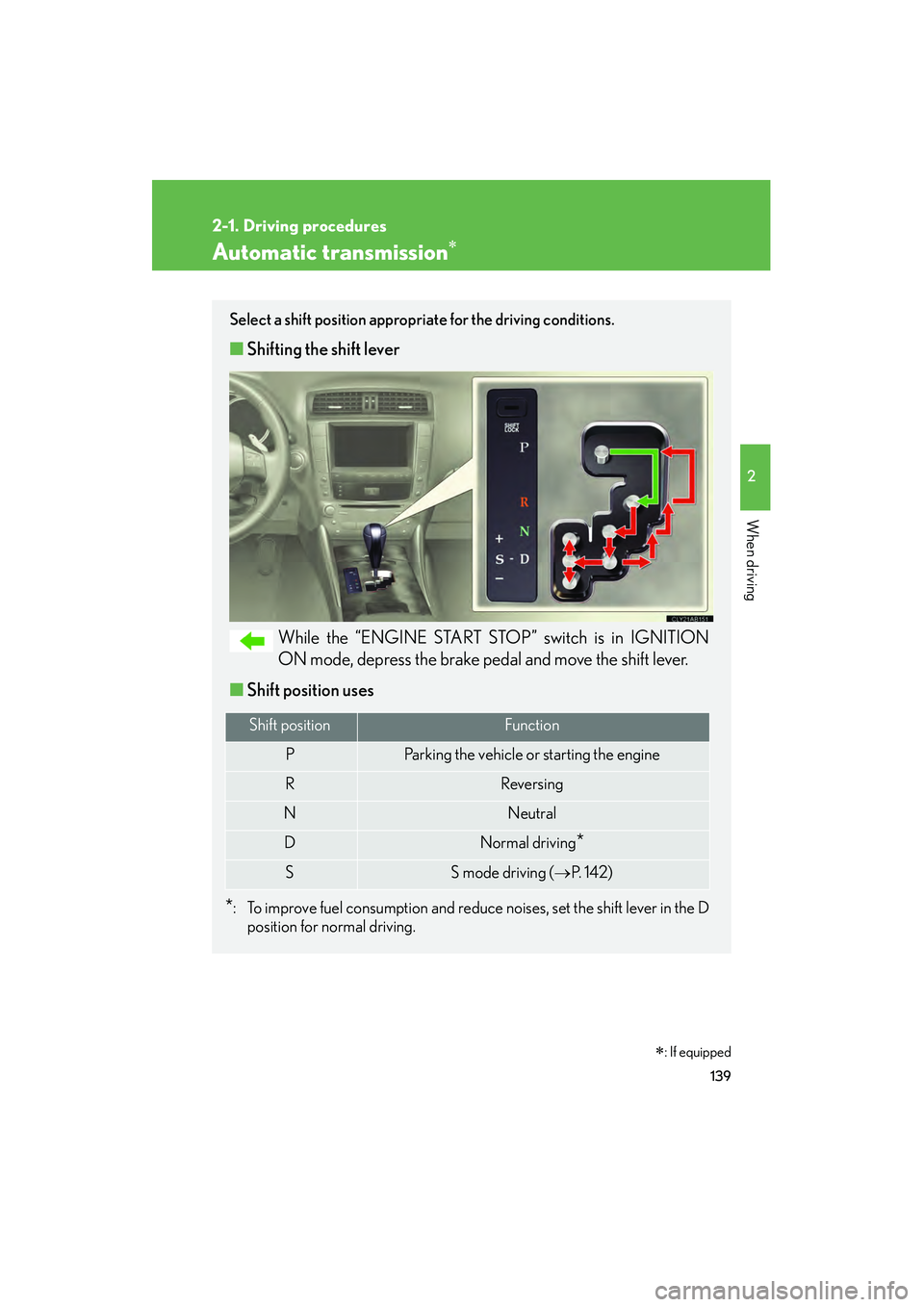
Select a shift position appropriate for the driving conditions.
■Shifting the shift lever
While the “ENGINE START STOP” switch is in IGNITION
ON mode, depress the brake pedal and move the shift lever.
■ Shift position uses
*: To improve fuel consumption and reduce noises, set the shift lever in the D
position for normal driving.
Shift positionFunction
PParking the vehicle or starting the engine
RReversing
NNeutral
DNormal driving*
SS mode driving ( →P. 1 4 2 )
∗: If equipped
Page 141 of 578
140
2-1. Driving procedures
IS350/250_U
Selecting shift ranges in the D position
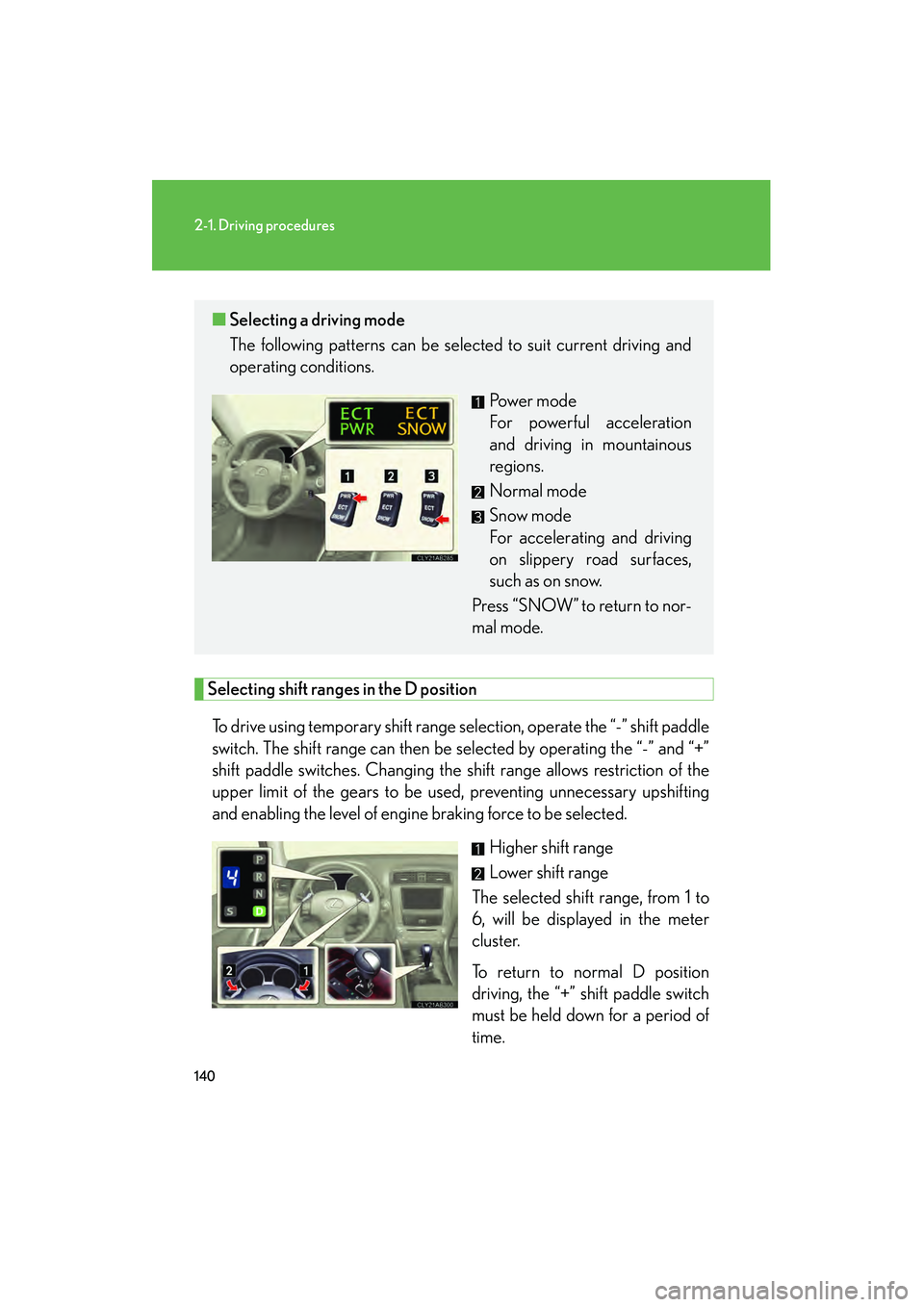
To drive using temporary shift range selection, operate the “-” shift paddle
switch. The shift range can then be selected by operating the “-” and “+”
shift paddle switches. Changing the shift range allows restriction of the
upper limit of the gears to be used , preventing unnecessary upshifting
and enabling the level of engine braking force to be selected.
Higher shift range
Lower shift range
The selected shift range, from 1 to
6, will be displayed in the meter
cluster.
To return to normal D position
driving, the “+” shift paddle switch
must be held down for a period of
time.
■ Selecting a driving mode
The following patterns can be selected to suit current driving and
operating conditions.
Power mode
For powerful acceleration
and driving in mountainous
regions.
Normal mode
Snow mode
For accelerating and driving
on slippery road surfaces,
such as on snow.
Press “SNOW”
to return to nor-
mal mode.