seats Lexus IS300h 2013 User Guide
[x] Cancel search | Manufacturer: LEXUS, Model Year: 2013, Model line: IS300h, Model: Lexus IS300h 2013Pages: 628, PDF Size: 20.23 MB
Page 49 of 628
491-1. For safe use
1
For safety and security
IS300h_EE(OM53B95E)
If the SRS airbags deploy (inflate)
Bruising and slight abrasions may result from contact with a deploying (inflat-
ing) SRS airbag.
A loud noise and white powder will be emitted.
Parts of the airbag module (steering wheel hub, airbag cover and inflator) as
well as the front seats, parts of the front and rear pillars, and roof side rails, may
be hot for several minutes. The airbag itself may also be hot.
The windshield may crack.
SRS airbag deployment conditions (SRS front airbags)
The SRS front airbags will deploy in the event of an impact that exceeds the set
threshold level (the level of force corresponding to an approximately 20 - 30
km/h [12 - 18 mph] frontal collision with a fixed wall that does not move or
deform).
However, this threshold velocity will be considerably higher in the following
situations:
• If the vehicle strikes an object, such as a parked vehicle or sign pole, which
can move or deform on impact
• If the vehicle is involved in an underride collision, such as a collision in
which the front of the vehicle “underrides”, or goes under, the bed of a truck
Depending on the type of collision, it is possible that only the seat belt preten-
sioners will activate.
SRS airbag deployment conditions (SRS side and curtain shield airbags)
The SRS side and curtain shield airbags will deploy in the event of an impact
that exceeds the set threshold level (the level of force corresponding to the
impact force produced by an approximately 1500 kg [3300 lb.] vehicle collid-
ing with the vehicle cabin from a direction perpendicular to the vehicle orienta-
tion at an approximate speed of 20 - 30 km/h [12 - 18 mph]).
The SRS curtain shield airbags may also deploy in the event of a severe frontal
collision.
Page 53 of 628
531-1. For safe use
1
For safety and security
IS300h_EE(OM53B95E)
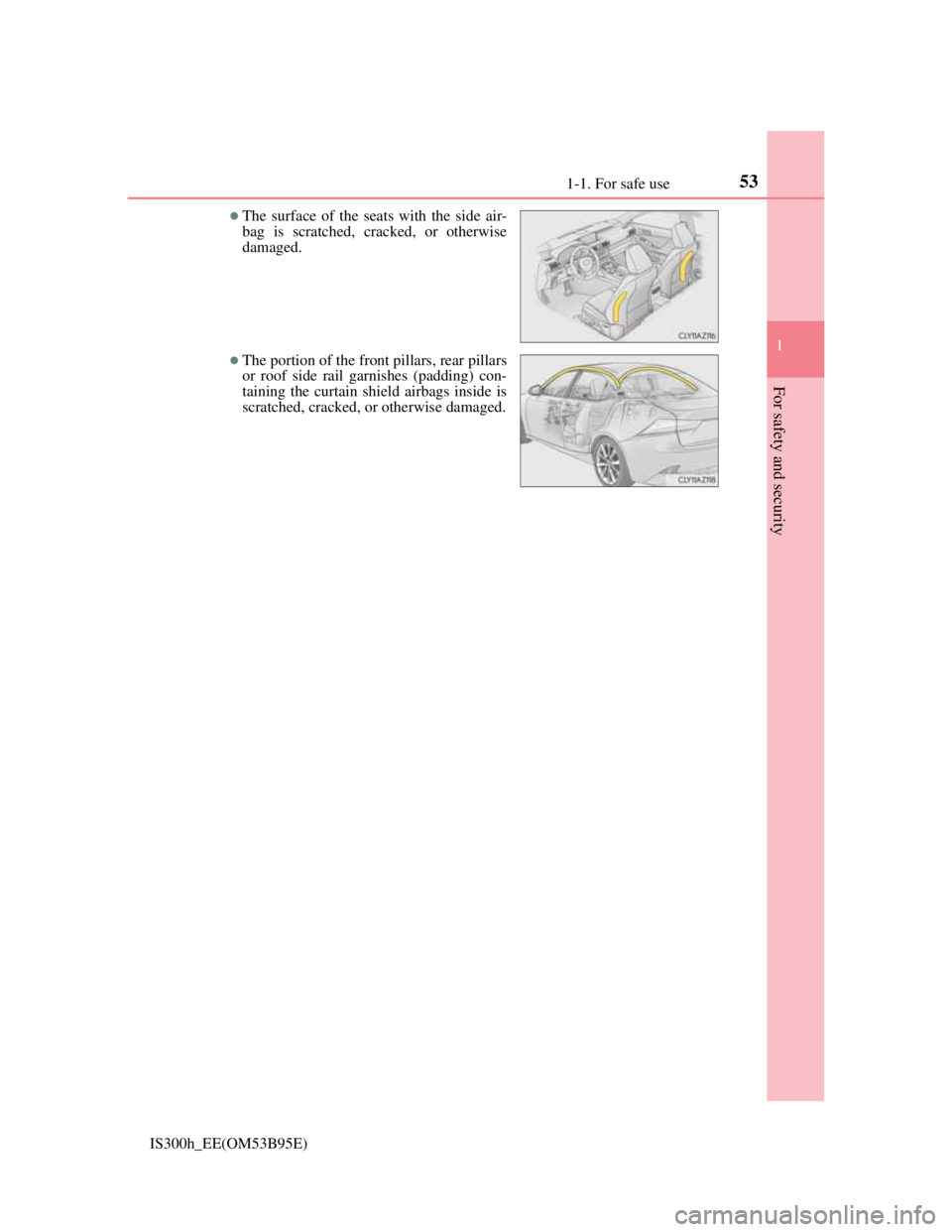
The surface of the seats with the side air-
bag is scratched, cracked, or otherwise
damaged.
The portion of the front pillars, rear pillars
or roof side rail garnishes (padding) con-
taining the curtain shield airbags inside is
scratched, cracked, or otherwise damaged.
Page 60 of 628
601-1. For safe use
IS300h_EE(OM53B95E)
It is recommended that children sit in the rear seats to avoid accidental
contact with the shift lever, wiper switch etc.
Use the rear door child-protector lock or the window lock switch to
avoid children opening the door while driving or operating the power
window accidentally.
Do not let small children operate equipment which may catch or pinch
body parts, such as the power window, hood, trunk, seats etc.
Safety information for children
Observe the following precautions when children are in the vehicle.
Use a child restraint system appropriate for the child, until the child
becomes large enough to properly wear the vehicle’s seat belt.
CAUTION
Never leave children unattended in the vehicle, and never allow children to
have or use the key.
Children may be able to start the vehicle or shift the vehicle into neutral. There
is also a danger that children may injure themselves by playing with the win-
dows, the moon roof or other features of the vehicle. In addition, heat build-up
or extremely cold temperatures inside the vehicle can be fatal to children.
Page 70 of 628
701-1. For safe use
IS300h_EE(OM53B95E)
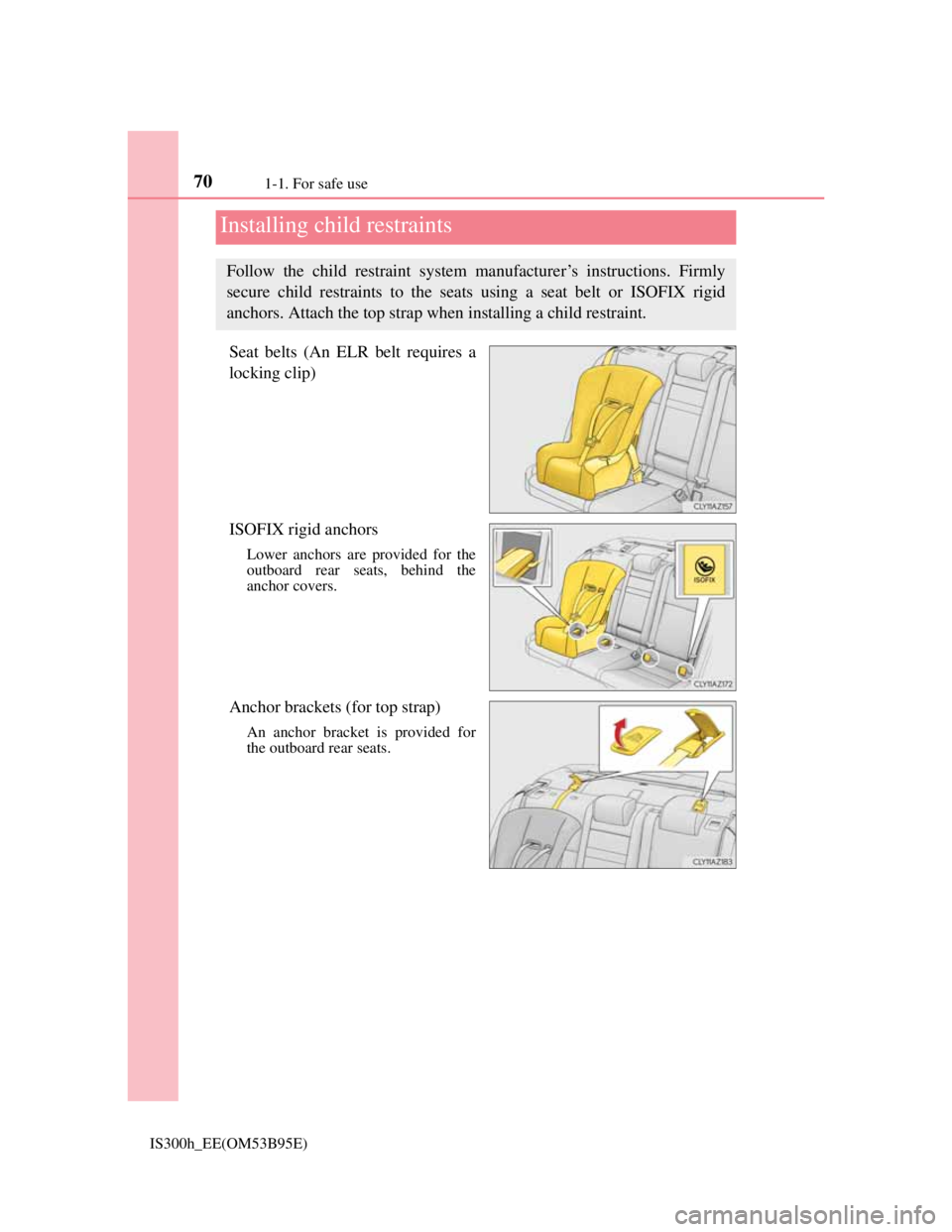
Seat belts (An ELR belt requires a
locking clip)
ISOFIX rigid anchors
Lower anchors are provided for the
outboard rear seats, behind the
anchor covers.
Anchor brackets (for top strap)
An anchor bracket is provided for
the outboard rear seats.
Installing child restraints
Follow the child restraint system manufacturer’s instructions. Firmly
secure child restraints to the seats using a seat belt or ISOFIX rigid
anchors. Attach the top strap when installing a child restraint.
Page 83 of 628
821-2. Hybrid system
IS300h_EE(OM53B95E)
After the 12-volt battery has discharged or has been changed or removed
The gasoline engine may not stop even if the vehicle is being driven by the
hybrid battery (traction battery). If this continues for a few days, contact any
authorized Lexus dealer or repairer, or another duly qualified and equipped pro-
fessional.
Sounds and vibrations specific to a hybrid vehicle
There may be no engine sound or vibration even though the vehicle is able to
move. For safety, apply the parking brake and make sure to shift the shift lever to
P when parked.
The following sounds or vibrations may occur when the hybrid system is operat-
ing and are not a malfunction:
Motor sounds may be heard from under the vehicle.
Sounds may be heard from the hybrid battery (traction battery) behind the rear
seats when the hybrid system starts or stops.
Sounds from the hybrid system may be heard when the trunk lid is open.
Sounds may be heard from the hybrid transmission when the hybrid system
starts or stops.
Engine sounds may be heard when accelerating sharply.
Sounds may be heard due to regenerative braking when the brake pedal is
depressed.
Vibration may be felt when the gasoline engine starts or stops.
Cooling fan sounds may be heard from the air intake vents on the both sides of
the rear seatback.
Maintenance, repair, recycling, and disposal
Contact any authorized Lexus dealer or repairer, or another duly qualified and
equipped professional regarding maintenance, repair, recycling and disposal. Do
not dispose of the vehicle yourself.
Customization
Settings (e.g. on/off operation of the EV indicator) can be changed.
(Customizable features P. 575)
Page 131 of 628
129
3
Operation of
each component
IS300h_EE(OM53B95E)
3-1. Key information
Keys .................................. 130
3-2. Opening, closing and
locking the doors and
trunk
Doors ................................ 136
Trunk................................. 143
Smart entry & start system 149
3-3. Adjusting the seats
Front seats ......................... 164
Rear seats .......................... 166
Driving position memory.. 168
Head restraints .................. 173
3-4. Adjusting the steering
wheel and mirrors
Steering wheel .................. 176
Inside rear view mirror ..... 178
Outside rear view mirrors . 180
3-5. Opening, closing the
windows and moon roof
Power windows................. 184
Moon roof ......................... 187
Page 144 of 628

1423-2. Opening, closing and locking the doors and trunk
IS300h_EE(OM53B95E)
Impact detection door lock release system
In the event that the vehicle is subject to a strong impact, all the doors are
unlocked. Depending on the force of the impact or the type of accident, however,
the system may not operate.
Using the mechanical key
The doors can also be locked and unlocked with the mechanical key. (P. 548)
Conditions affecting the operation of the smart entry & start system or wireless
remote control
P. 151
Customization
Settings (e.g. unlocking function using a key) can be changed.
(Customizable features: P. 575)
CAUTION
To prevent an accident
Observe the following precautions while driving the vehicle.
Failure to do so may result in a door opening and an occupant being thrown out
of the vehicle, resulting in death or serious injury.
Ensure that all doors are properly closed.
Do not pull the inside handle of the doors while driving.
Be especially careful with the front doors, as the doors may be opened even if
the inside lock buttons are in locked position.
Set the rear door child-protector locks when children are seated in the rear
seats.
Page 147 of 628
1453-2. Opening, closing and locking the doors and trunk
3
Operation of each component
IS300h_EE(OM53B95E)
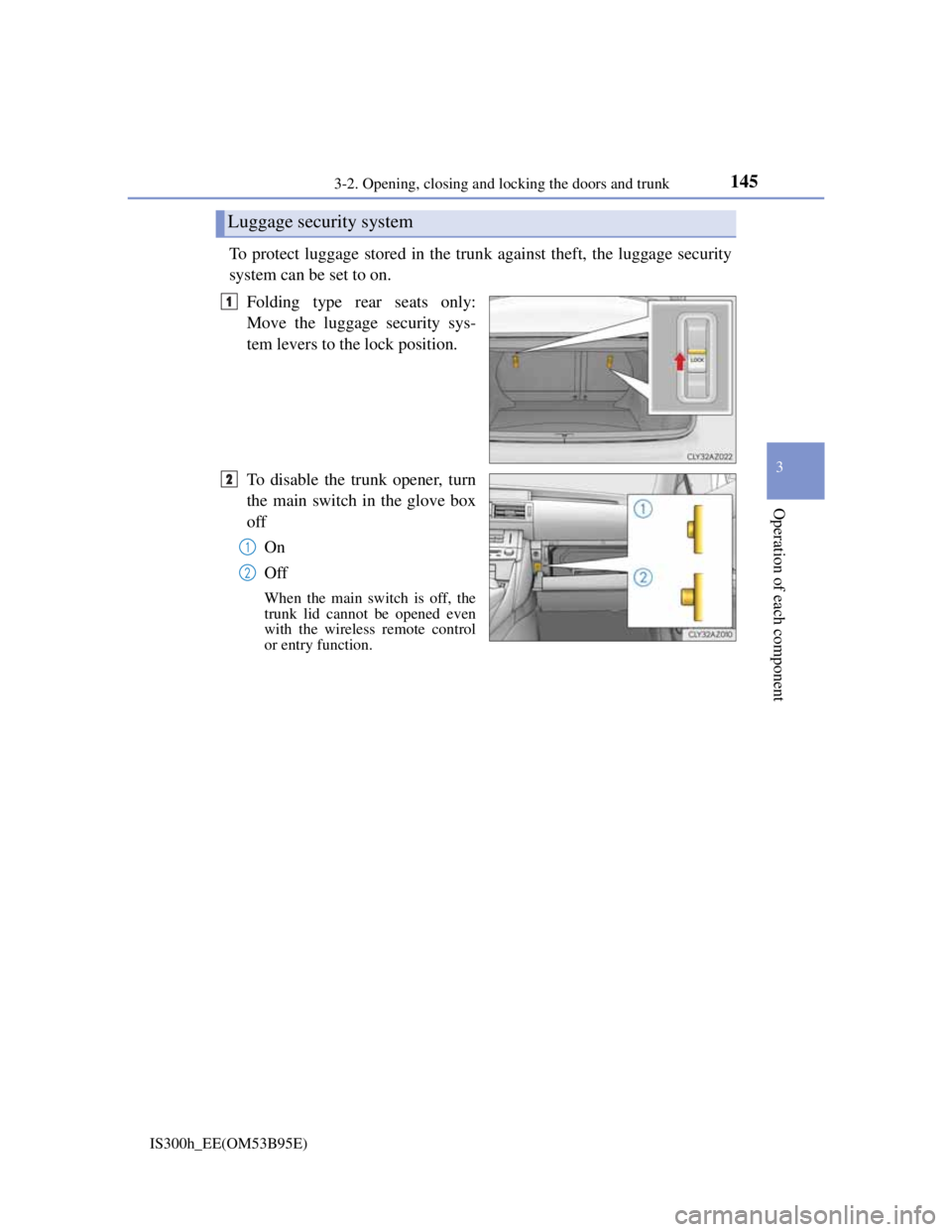
To protect luggage stored in the trunk against theft, the luggage security
system can be set to on.
Folding type rear seats only:
Move the luggage security sys-
tem levers to the lock position.
To disable the trunk opener, turn
the main switch in the glove box
off
On
Off
When the main switch is off, the
trunk lid cannot be opened even
with the wireless remote control
or entry function.
Luggage security system
1
2
1
2
Page 166 of 628
164
IS300h_EE(OM53B95E)3-3. Adjusting the seats
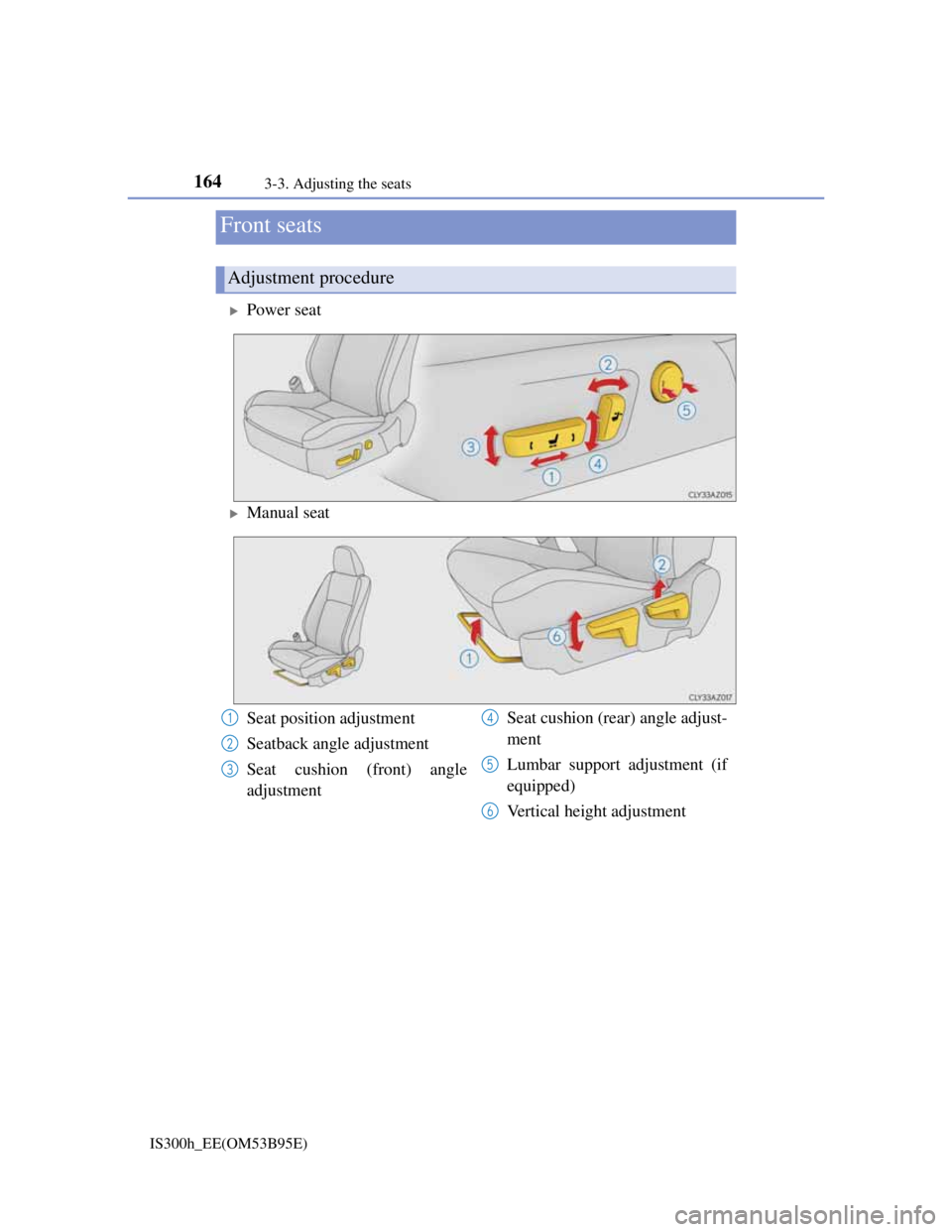
Power seat
Manual seat
Front seats
Adjustment procedure
Seat position adjustment
Seatback angle adjustment
Seat cushion (front) angle
adjustmentSeat cushion (rear) angle adjust-
ment
Lumbar support adjustment (if
equipped)
Vertical height adjustment1
2
3
4
5
6
Page 167 of 628
1653-3. Adjusting the seats
3
Operation of each component
IS300h_EE(OM53B95E)
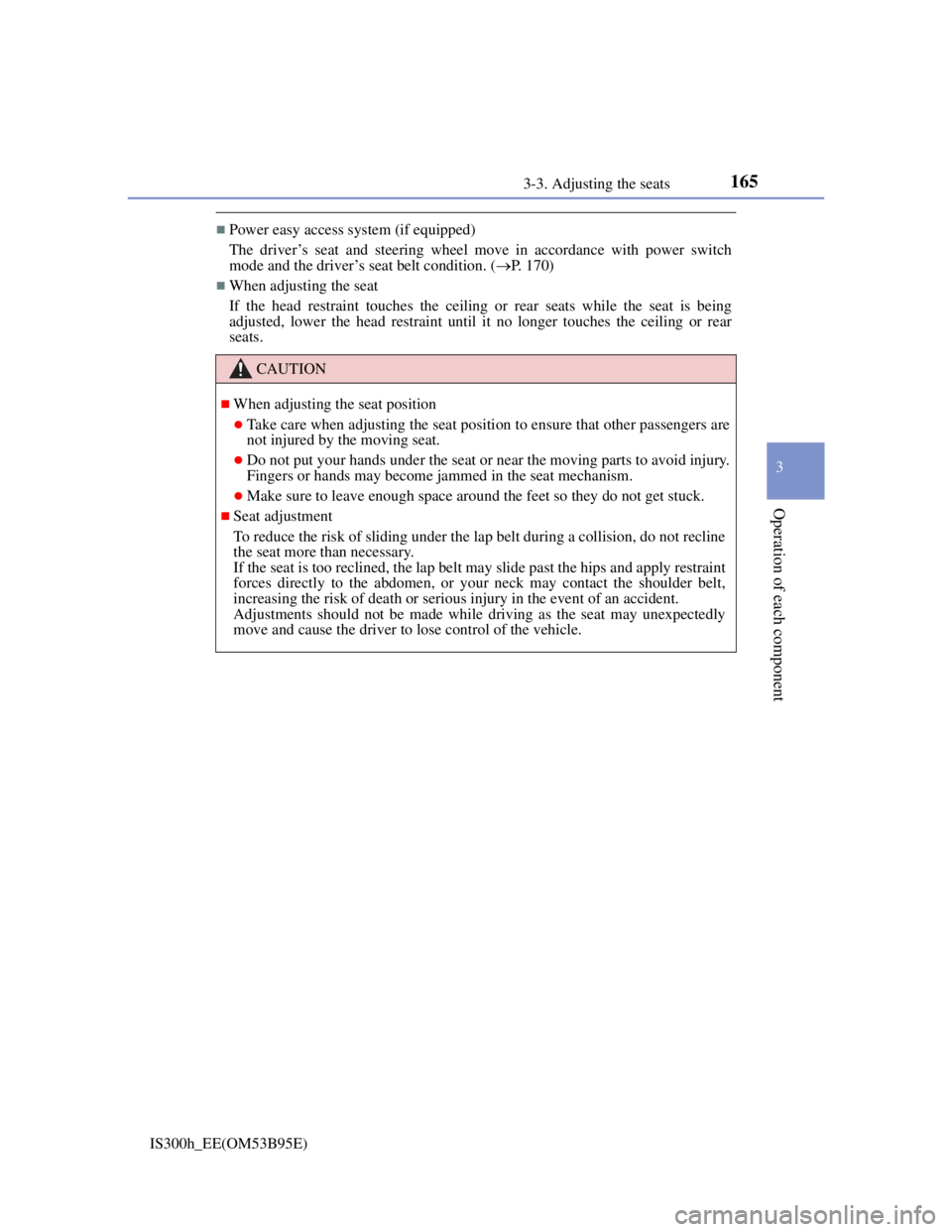
Power easy access system (if equipped)
The driver’s seat and steering wheel move in accordance with power switch
mode and the driver’s seat belt condition. (P. 170)
When adjusting the seat
If the head restraint touches the ceiling or rear seats while the seat is being
adjusted, lower the head restraint until it no longer touches the ceiling or rear
seats.
CAUTION
When adjusting the seat position
Take care when adjusting the seat position to ensure that other passengers are
not injured by the moving seat.
Do not put your hands under the seat or near the moving parts to avoid injury.
Fingers or hands may become jammed in the seat mechanism.
Make sure to leave enough space around the feet so they do not get stuck.
Seat adjustment
To reduce the risk of sliding under the lap belt during a collision, do not recline
the seat more than necessary.
If the seat is too reclined, the lap belt may slide past the hips and apply restraint
forces directly to the abdomen, or your neck may contact the shoulder belt,
increasing the risk of death or serious injury in the event of an accident.
Adjustments should not be made while driving as the seat may unexpectedly
move and cause the driver to lose control of the vehicle.