wheel Lexus IS300h 2013 Repair Manual
[x] Cancel search | Manufacturer: LEXUS, Model Year: 2013, Model line: IS300h, Model: Lexus IS300h 2013Pages: 628, PDF Size: 20.23 MB
Page 441 of 628

4277-1. Maintenance and care
7
Maintenance and care
IS300h_EE(OM53B95E)
Aluminum wheels
Remove any dirt immediately by using a neutral detergent. Do not use hard
brushes or abrasive cleaners. Do not use strong or harsh chemical cleaners.
Use the same mild detergent and wax as used on the paint.
Do not use detergent on the wheels when they are hot, for example after driving
a long distance in hot weather.
Wash detergent from the wheels immediately after use.
Bumpers
Do not scrub with abrasive cleaners.
Front side windows water-repellent coating
The following precautions can extend the effectiveness of the water-repellent
coating.
• Remove any dirt, etc. from the front side windows regularly.
• Do not allow dirt and dust to accumulate on the windows for a long period.
Clean the windows with a soft, damp cloth as soon as possible.
• Do not use wax or glass cleaners that contain abrasives when cleaning the
windows.
• Do not use any metallic objects to remove condensation build up.
When the water-repellent performance has become insufficient, the coating can
be repaired. Contact any authorized Lexus dealer or repairer, or another duly
qualified and equipped professional.
Page 443 of 628

4297-1. Maintenance and care
7
Maintenance and care
IS300h_EE(OM53B95E)
NOTICE
To prevent paint deterioration and corrosion on the body and components (alu-
minum wheels etc.)
Wash the vehicle immediately in the following cases:
• After driving near the sea coast
• After driving on salted roads
• If coal tar or tree sap is present on the paint surface
• If dead insects, insect droppings or bird droppings are present on the paint
surface
• After driving in an area contaminated with soot, oily smoke, mine dust,
iron powder or chemical substances
• If the vehicle becomes heavily soiled with dust or mud
• If liquids such as benzene and gasoline are spilled on the paint surface
If the paint is chipped or scratched, have it repaired immediately.
To prevent the wheels from corroding, remove any dirt and store in a place
with low humidity when storing the wheels.
Cleaning the exterior lights
Wash carefully. Do not use organic substances or scrub with a hard brush.
This may damage the surfaces of the lights.
Do not apply wax to the surfaces of the lights.
Wax may cause damage to the lenses.
When using an automatic car wash (vehicles with rain-sensing windshield wip-
ers)
Set the wipers to the intermittent windshield wipers. (P. 238)
If AUTO mode is selected, the wipers may operate and the wiper blades may
be damaged.
Page 465 of 628

4517-3. Do-it-yourself maintenance
7
Maintenance and care
IS300h_EE(OM53B95E)
Your vehicle is equipped with a tire pressure warning system that uses tire
pressure warning valves and transmitters to detect low tire inflation pres-
sure before serious problems arise.
If the tire pressure drops below a predetermined level, the driver is
warned by a warning light. (P. 509)
Installing tire pressure warning valves and transmitters
When replacing tires or wheels, tire pressure warning valves and trans-
mitters must also be installed.
When new tire pressure warning valves and transmitters are installed,
new ID codes must be registered in the tire pressure warning computer
and the tire pressure warning system must be initialized. Have tire
pressure warning valve and transmitter ID codes registered by any
authorized Lexus dealer or repairer, or another duly qualified and
equipped professional. (P. 452)
Initializing the tire pressure warning system
The tire pressure warning system must be initialized in the following
circumstances:
When rotating the tires.
When the tire inflation pressure is changed such as when changing
traveling speed or load weight.
When changing the tire size.
When the tire pressure warning system is initialized, the current tire
inflation pressure is set as the benchmark pressure.
Tire pressure warning system
Page 467 of 628

4537-3. Do-it-yourself maintenance
7
Maintenance and care
IS300h_EE(OM53B95E)
When to replace your vehicle’s tires
Tires should be replaced if:
You have tire damage such as cuts, splits, cracks deep enough to expose the fab-
ric, and bulges indicating internal damage
A tire goes flat repeatedly or cannot be properly repaired due to the size or loca-
tion of a cut or other damage
If you are not sure, consult any authorized Lexus dealer or repairer, or another
duly qualified and equipped professional.
Replacing tires and wheels
If the ID code of the tire pressure warning valve and transmitter is not registered,
the tire pressure warning system will not work properly. After driving for about
10 minutes, the tire pressure warning light blinks for 1 minute and stays on to
indicate a system malfunction.
Tire life
Any tire over 6 years old must be checked by a qualified technician even if it has
seldom or never been used or damage is not obvious.
Routine tire inflation pressure checks
The tire pressure warning system does not replace routine tire inflation pressure
checks. Make sure to check tire inflation pressure as part of your routine of daily
vehicle checks.
Low profile tires (except 16-inch tires)
Generally, low profile tires will wear more rapidly and tire grip performance will
be reduced on snowy and/or icy roads when compared to standard tires. Be sure
to use snow tires or tire chains
* on snowy and/or icy roads and drive carefully at
a speed appropriate for road and weather conditions.
*: Tire chains cannot be mounted on the 18-inch tires. Snow tires should be used
instead.
If the tread on snow tires wears down below 4 mm (0.16 in.)
The effectiveness of the tires as snow tires is lost.
Page 468 of 628

4547-3. Do-it-yourself maintenance
IS300h_EE(OM53B95E)
Situations in which the tire pressure warning system may not operate properly
In the following cases, the tire pressure warning system may not operate prop-
erly.
• If non-genuine Lexus wheels are used.
• A tire has been replaced with a tire that is not an OE (Original Equipment)
tire.
• A tire has been replaced with a tire that is not of the specified size.
• Tire chains etc. are equipped.
• Lock nuts are equipped.
• An auxiliary-supported run-flat tire is equipped.
• If a window tint that affects the radio wave signals is installed.
• If there is a lot of snow or ice on the vehicle, particularly around the wheels
or wheel housings.
• If the tire inflation pressure is extremely higher than the specified level.
• If tires not equipped with tire pressure warning valves and transmitters are
used.
• If the ID code on the tire pressure warning valves and transmitters is not reg-
istered in the tire pressure warning computer.
Performance may be affected in the following situations.
• Near a TV tower, electric power plant, gas station, radio station, large dis-
play, airport or other facility that generates strong radio waves or electrical
noise
• When carrying a portable radio, cellular phone, cordless phone or other
wireless communication device
When the vehicle is parked, the time taken for the warning to start or go off
could be extended.
When tire inflation pressure declines rapidly for example when a tire has burst,
the warning may not function.
The initialization operation
Make sure to carry out initialization after adjusting the tire inflation pressure.
Also, make sure the tires are cold before carrying out initialization or tire infla-
tion pressure adjustment.
If you have accidentally turned the power switch off during initialization, it is
not necessary to press the reset switch again as initialization will restart auto-
matically when the power switch has been turned to ON mode for the next time.
If you accidentally press the reset switch when initialization is not necessary,
adjust the tire inflation pressure to the specified level when the tires are cold,
and conduct initialization again.
Warning performance of the tire pressure warning system
The warning of the tire pressure warning system will change in accordance with
the conditions under which it was initialized. For this reason, the system may
give a warning even if the tire pressure does not reach a low enough level, or if
the pressure is higher than the pressure that was adjusted to when the system was
initialized.
Page 473 of 628

4597-3. Do-it-yourself maintenance
7
Maintenance and care
IS300h_EE(OM53B95E)
NOTICE
Repairing or replacing tires, wheels, tire pressure warning valves, transmitters
and tire valve caps
When removing or fitting the wheels, tires or the tire pressure warning valves
and transmitters, contact any authorized Lexus dealer or repairer, or another
duly qualified and equipped professional as the tire pressure warning valves
and transmitters may be damaged if not handled correctly.
Make sure to install the tire valve caps. If the tire valve caps are not installed,
water could enter the tire pressure warning valves and the tire pressure warn-
ing valves could be bound.
When replacing tire valve caps, do not use tire valve caps other than those
specified. The cap may become stuck.
To avoid damage to the tire pressure warning valves and transmitters
When a tire is repaired with liquid sealants, the tire pressure warning valve and
transmitter may not operate properly. If a liquid sealant is used, contact any
authorized Lexus dealer or repairer, or another duly qualified and equipped
professional or other qualified service shop as soon as possible. Make sure to
replace the tire pressure warning valve and transmitter when replacing the tire.
(P. 451)
Driving on rough roads
Take particular care when driving on roads with loose surfaces or potholes.
These conditions may cause losses in tire inflation pressure, reducing the cush-
ioning ability of the tires. In addition, driving on rough roads may cause dam-
age to the tires themselves, as well as the vehicle’s wheels and body.
Low profile tires (except 16-inch tires)
Low profile tires may cause greater damage than usual to the tire wheel when
sustaining impact from the road surface. Therefore, pay attention to the follow-
ing:
Be sure to use proper tire inflation pressure. If tires are under-inflated, they
may be damaged more severely.
Avoid potholes, uneven pavement, curbs and other road hazards. Failure to do
so may lead to severe tire and wheel damage.
If tire inflation pressure of each tire becomes low while driving
Do not continue driving, or your tires and/or wheels may be ruined.
Page 474 of 628
4607-3. Do-it-yourself maintenance
IS300h_EE(OM53B95E)
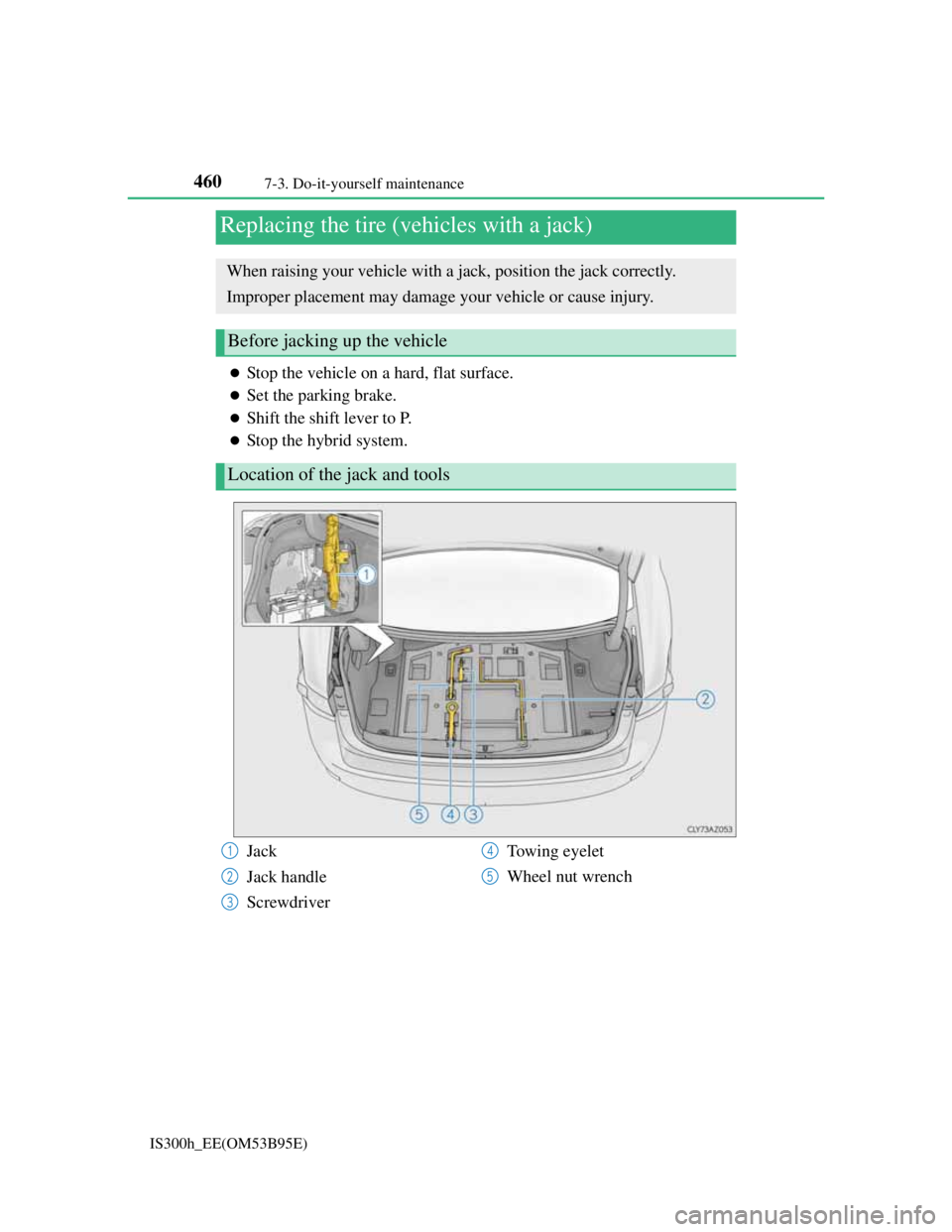
Stop the vehicle on a hard, flat surface.
Set the parking brake.
Shift the shift lever to P.
Stop the hybrid system.
Replacing the tire (vehicles with a jack)
When raising your vehicle with a jack, position the jack correctly.
Improper placement may damage your vehicle or cause injury.
Before jacking up the vehicle
Location of the jack and tools
Jack
Jack handle
ScrewdriverTowing eyelet
Wheel nut wrench1
2
3
4
5
Page 476 of 628
4627-3. Do-it-yourself maintenance
IS300h_EE(OM53B95E)
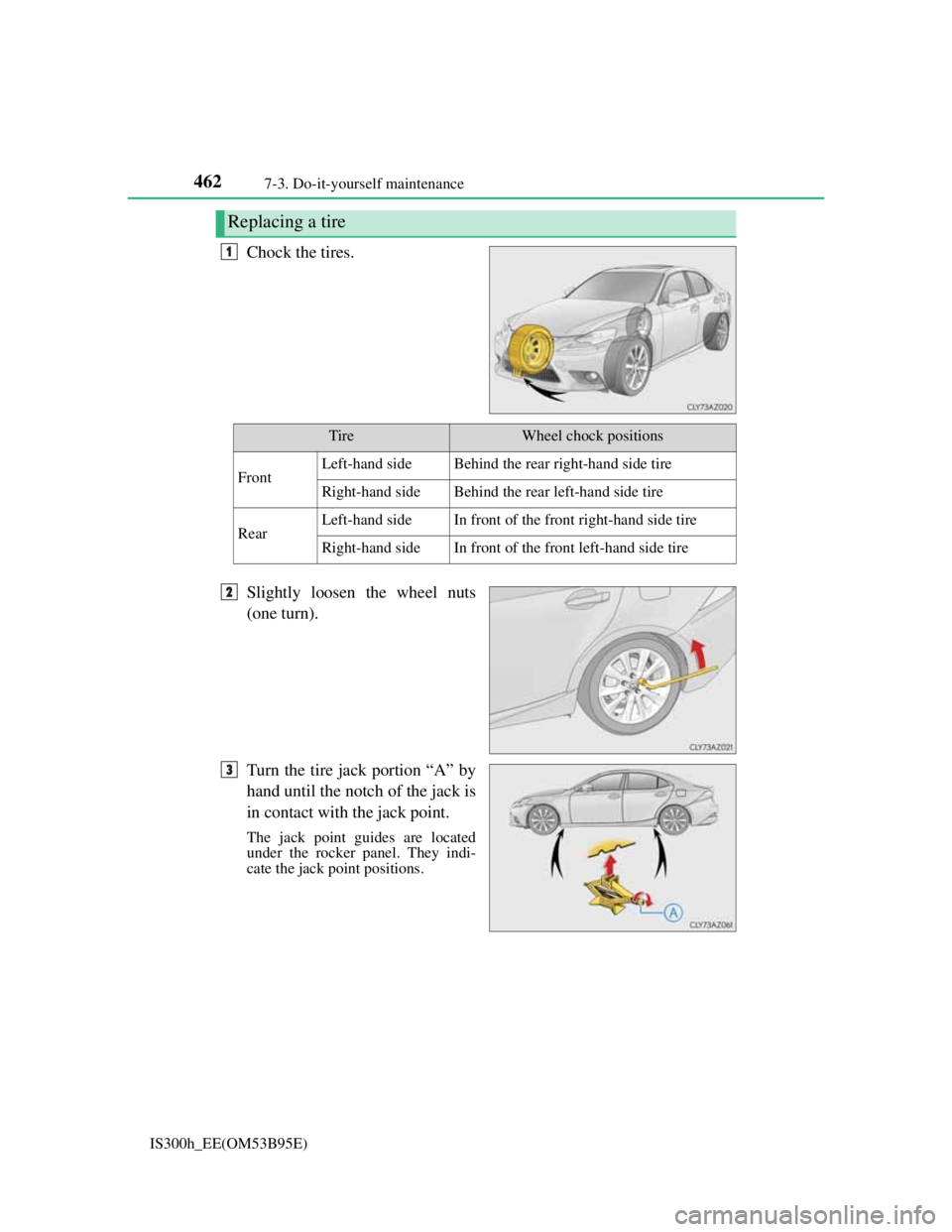
Chock the tires.
Slightly loosen the wheel nuts
(one turn).
Turn the tire jack portion “A” by
hand until the notch of the jack is
in contact with the jack point.
The jack point guides are located
under the rocker panel. They indi-
cate the jack point positions.
Replacing a tire
1
TireWheel chock positions
FrontLeft-hand sideBehind the rear right-hand side tire
Right-hand sideBehind the rear left-hand side tire
RearLeft-hand sideIn front of the front right-hand side tire
Right-hand sideIn front of the front left-hand side tire
2
3
Page 477 of 628
4637-3. Do-it-yourself maintenance
7
Maintenance and care
IS300h_EE(OM53B95E)
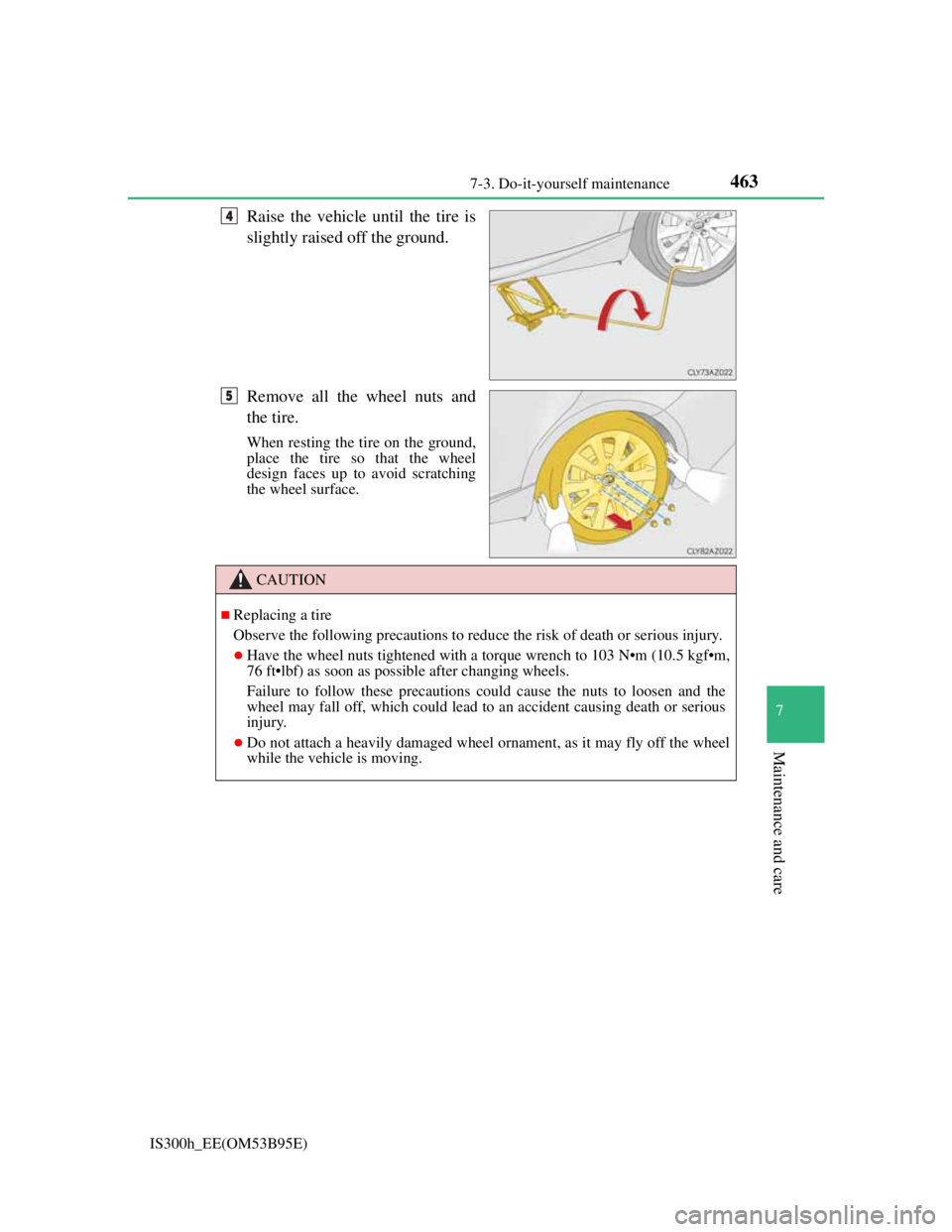
Raise the vehicle until the tire is
slightly raised off the ground.
Remove all the wheel nuts and
the tire.
When resting the tire on the ground,
place the tire so that the wheel
design faces up to avoid scratching
the wheel surface.
4
5
CAUTION
Replacing a tire
Observe the following precautions to reduce the risk of death or serious injury.
Have the wheel nuts tightened with a torque wrench to 103 N•m (10.5 kgf•m,
76 ft•lbf) as soon as possible after changing wheels.
Failure to follow these precautions could cause the nuts to loosen and the
wheel may fall off, which could lead to an accident causing death or serious
injury.
Do not attach a heavily damaged wheel ornament, as it may fly off the wheel
while the vehicle is moving.
Page 478 of 628
4647-3. Do-it-yourself maintenance
IS300h_EE(OM53B95E)
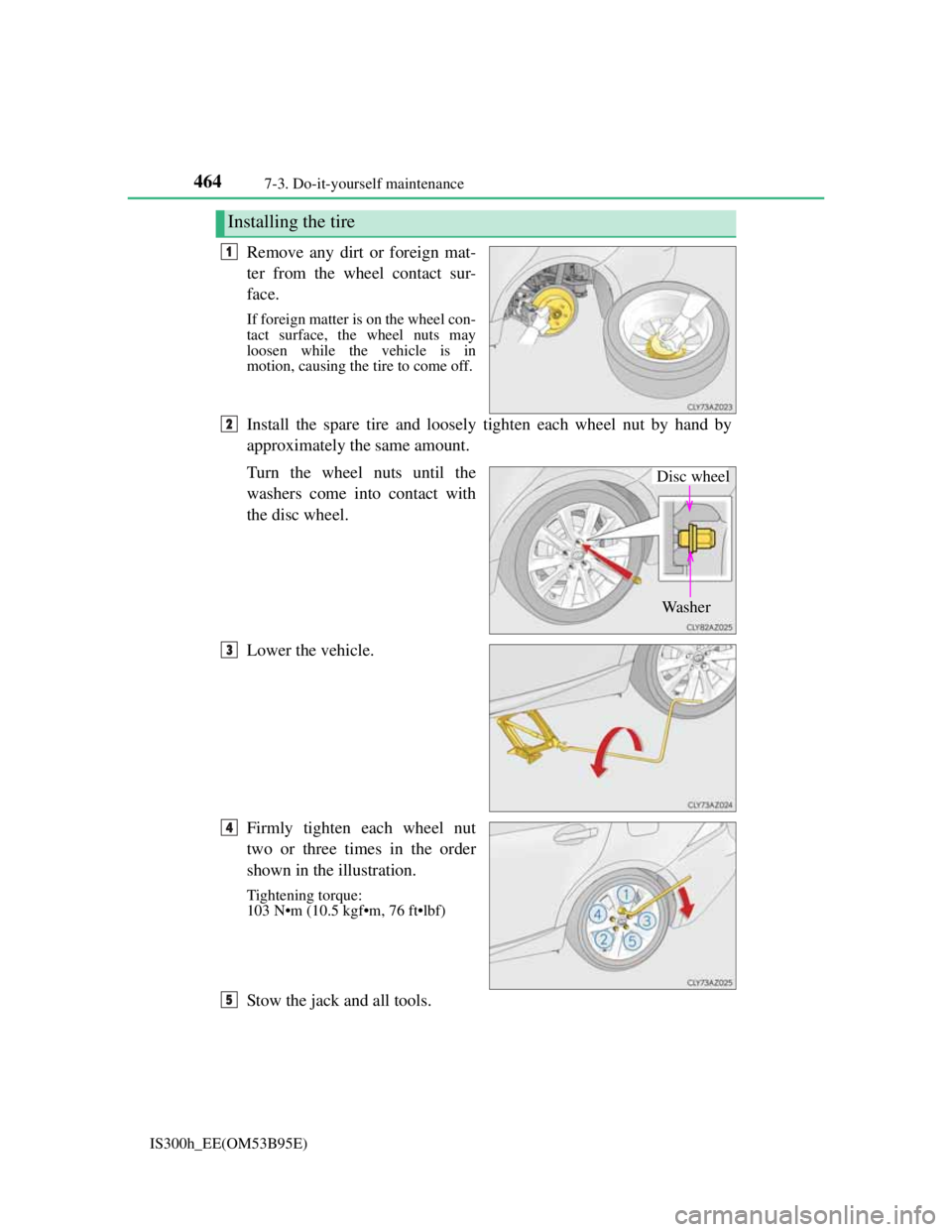
Remove any dirt or foreign mat-
ter from the wheel contact sur-
face.
If foreign matter is on the wheel con-
tact surface, the wheel nuts may
loosen while the vehicle is in
motion, causing the tire to come off.
Install the spare tire and loosely tighten each wheel nut by hand by
approximately the same amount.
Turn the wheel nuts until the
washers come into contact with
the disc wheel.
Lower the vehicle.
Firmly tighten each wheel nut
two or three times in the order
shown in the illustration.
Tightening torque:
103 N•m (10.5 kgf•m, 76 ft•lbf)
Stow the jack and all tools.
Installing the tire
1
2
Disc wheel
Wa s h e r
3
4
5