speed Lexus IS300h 2013 Owner's Manual
[x] Cancel search | Manufacturer: LEXUS, Model Year: 2013, Model line: IS300h, Model: Lexus IS300h 2013Pages: 628, PDF Size: 20.23 MB
Page 35 of 628
351-1. For safe use
1
For safety and security
IS300h_EE(OM53B95E)
CAUTION
Observe the following precautions.
Failure to do so may cause the driver’s floor mat to slip, possibly interfering with
the pedals while driving. An unexpectedly high speed may result or it may
become difficult to stop the vehicle, leading to an accident, or leading to death or
a serious injury.
When installing the driver’s floor mat
Do not use floor mats designed for other models or different model year vehi-
cles, even if they are Lexus Genuine floor mats.
Only use floor mats designed for the driver’s seat.
Always install the floor mat securely using the retaining hooks (clips) pro-
vided.
Do not use two or more floor mats on top of each other.
Do not place the floor mat bottom-side up or upside-down.
Before driving
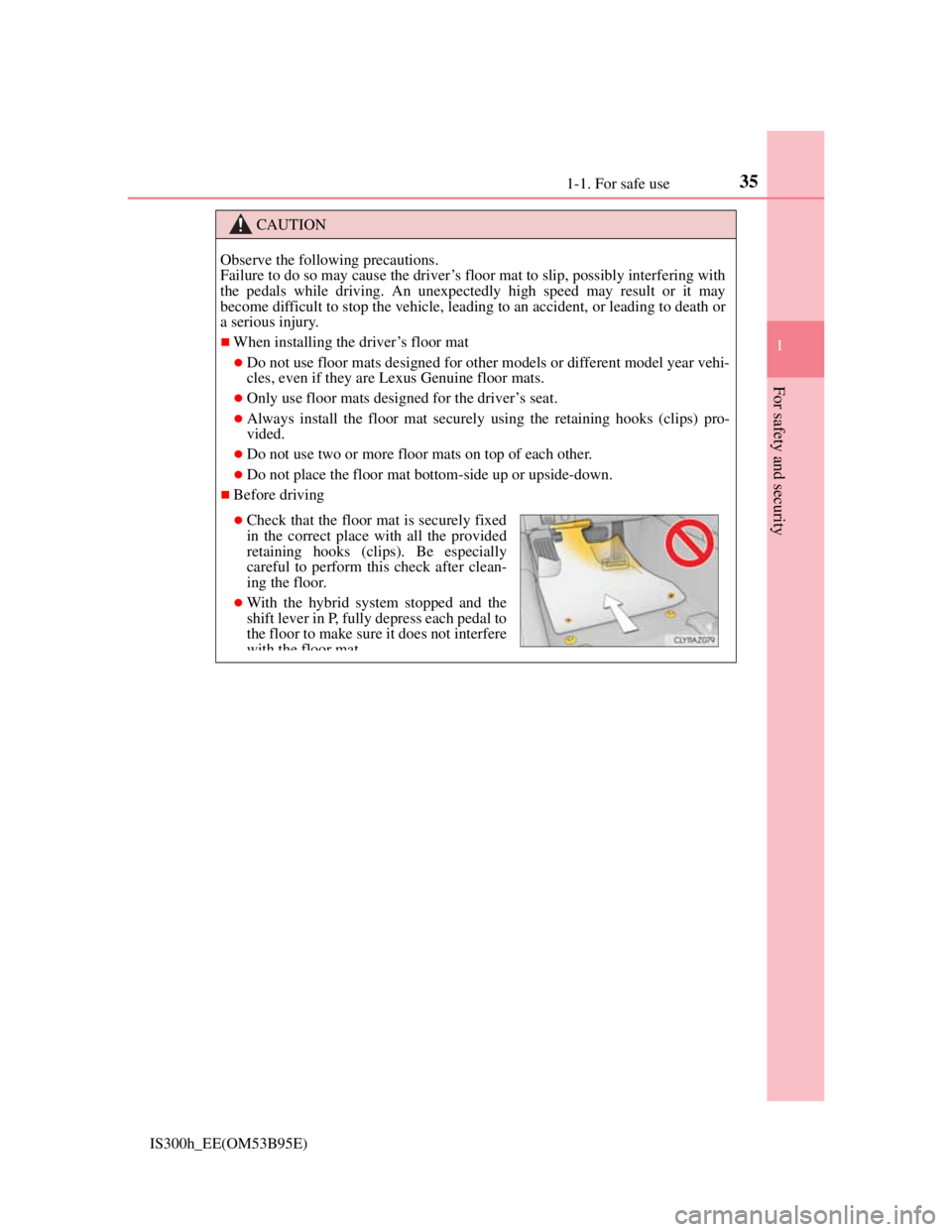
Check that the floor mat is securely fixed
in the correct place with all the provided
retaining hooks (clips). Be especially
careful to perform this check after clean-
ing the floor.
With the hybrid system stopped and the
shift lever in P, fully depress each pedal to
the floor to make sure it does not interfere
with the floor mat
Page 47 of 628
471-1. For safe use
1
For safety and security
IS300h_EE(OM53B95E)
CAUTION
SRS airbag precautions
Do not hang coat hangers or hard objects on the coat hooks. All of these items
could become projectiles and may cause death or serious injury, should the
SRS curtain shield airbags deploy.
If a vinyl cover is put on the area where the SRS knee airbag will deploy, be
sure to remove it.
Do not use seat accessories which cover the parts where the SRS side airbags
inflate as they may interfere with inflation of the airbags. Such accessories
may prevent the side airbags from activating correctly, disable the system or
cause the side airbags to inflate accidentally, resulting in death or serious
injury.
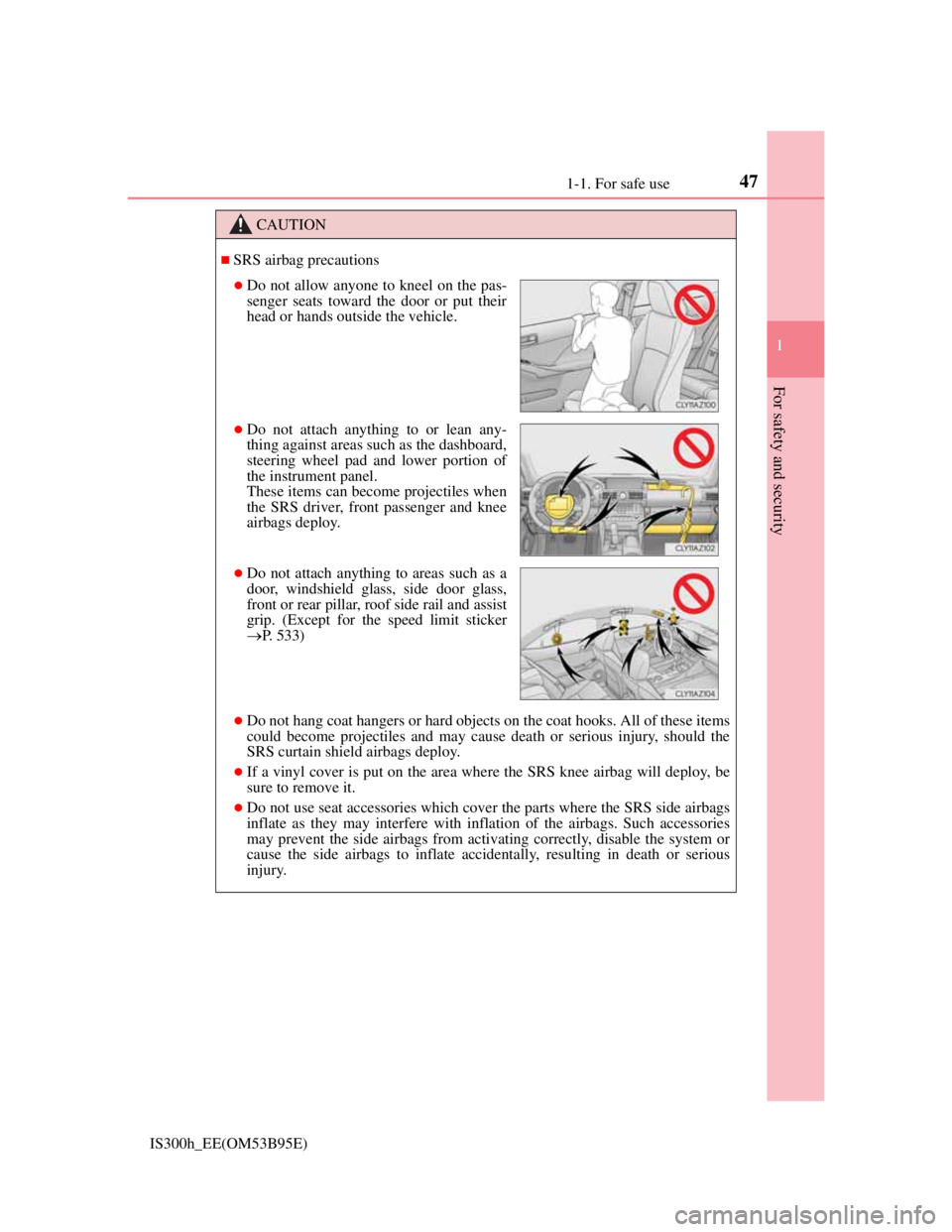
Do not allow anyone to kneel on the pas-
senger seats toward the door or put their
head or hands outside the vehicle.
Do not attach anything to or lean any-
thing against areas such as the dashboard,
steering wheel pad and lower portion of
the instrument panel.
These items can become projectiles when
the SRS driver, front passenger and knee
airbags deploy.
Do not attach anything to areas such as a
door, windshield glass, side door glass,
front or rear pillar, roof side rail and assist
grip. (Except for the speed limit sticker
P. 533)
Page 49 of 628
491-1. For safe use
1
For safety and security
IS300h_EE(OM53B95E)
If the SRS airbags deploy (inflate)
Bruising and slight abrasions may result from contact with a deploying (inflat-
ing) SRS airbag.
A loud noise and white powder will be emitted.
Parts of the airbag module (steering wheel hub, airbag cover and inflator) as
well as the front seats, parts of the front and rear pillars, and roof side rails, may
be hot for several minutes. The airbag itself may also be hot.
The windshield may crack.
SRS airbag deployment conditions (SRS front airbags)
The SRS front airbags will deploy in the event of an impact that exceeds the set
threshold level (the level of force corresponding to an approximately 20 - 30
km/h [12 - 18 mph] frontal collision with a fixed wall that does not move or
deform).
However, this threshold velocity will be considerably higher in the following
situations:
• If the vehicle strikes an object, such as a parked vehicle or sign pole, which
can move or deform on impact
• If the vehicle is involved in an underride collision, such as a collision in
which the front of the vehicle “underrides”, or goes under, the bed of a truck
Depending on the type of collision, it is possible that only the seat belt preten-
sioners will activate.
SRS airbag deployment conditions (SRS side and curtain shield airbags)
The SRS side and curtain shield airbags will deploy in the event of an impact
that exceeds the set threshold level (the level of force corresponding to the
impact force produced by an approximately 1500 kg [3300 lb.] vehicle collid-
ing with the vehicle cabin from a direction perpendicular to the vehicle orienta-
tion at an approximate speed of 20 - 30 km/h [12 - 18 mph]).
The SRS curtain shield airbags may also deploy in the event of a severe frontal
collision.
Page 50 of 628
501-1. For safe use
IS300h_EE(OM53B95E)
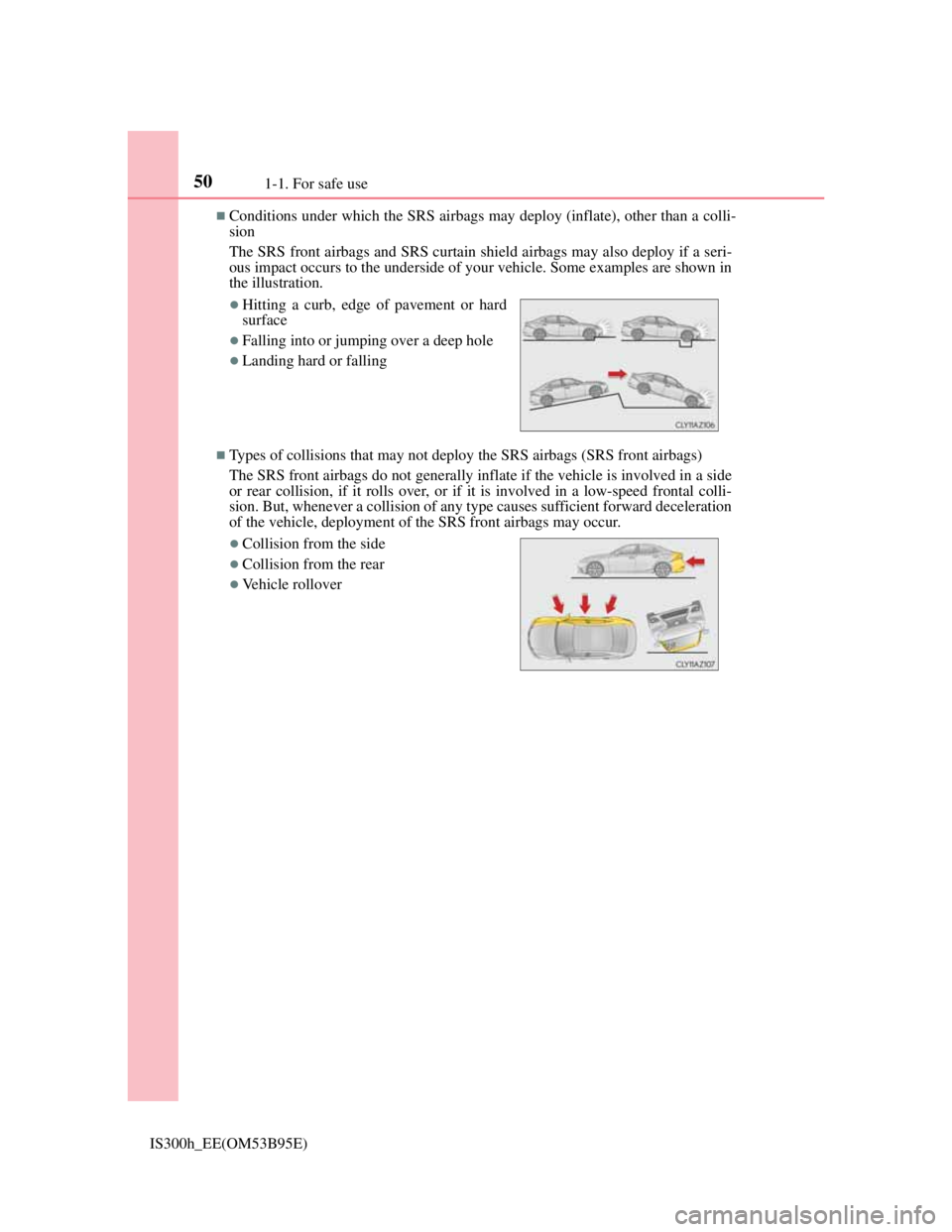
Conditions under which the SRS airbags may deploy (inflate), other than a colli-
sion
The SRS front airbags and SRS curtain shield airbags may also deploy if a seri-
ous impact occurs to the underside of your vehicle. Some examples are shown in
the illustration.
Types of collisions that may not deploy the SRS airbags (SRS front airbags)
The SRS front airbags do not generally inflate if the vehicle is involved in a side
or rear collision, if it rolls over, or if it is involved in a low-speed frontal colli-
sion. But, whenever a collision of any type causes sufficient forward deceleration
of the vehicle, deployment of the SRS front airbags may occur.
Hitting a curb, edge of pavement or hard
surface
Falling into or jumping over a deep hole
Landing hard or falling
Collision from the side
Collision from the rear
Vehicle rollover
Page 51 of 628
511-1. For safe use
1
For safety and security
IS300h_EE(OM53B95E)
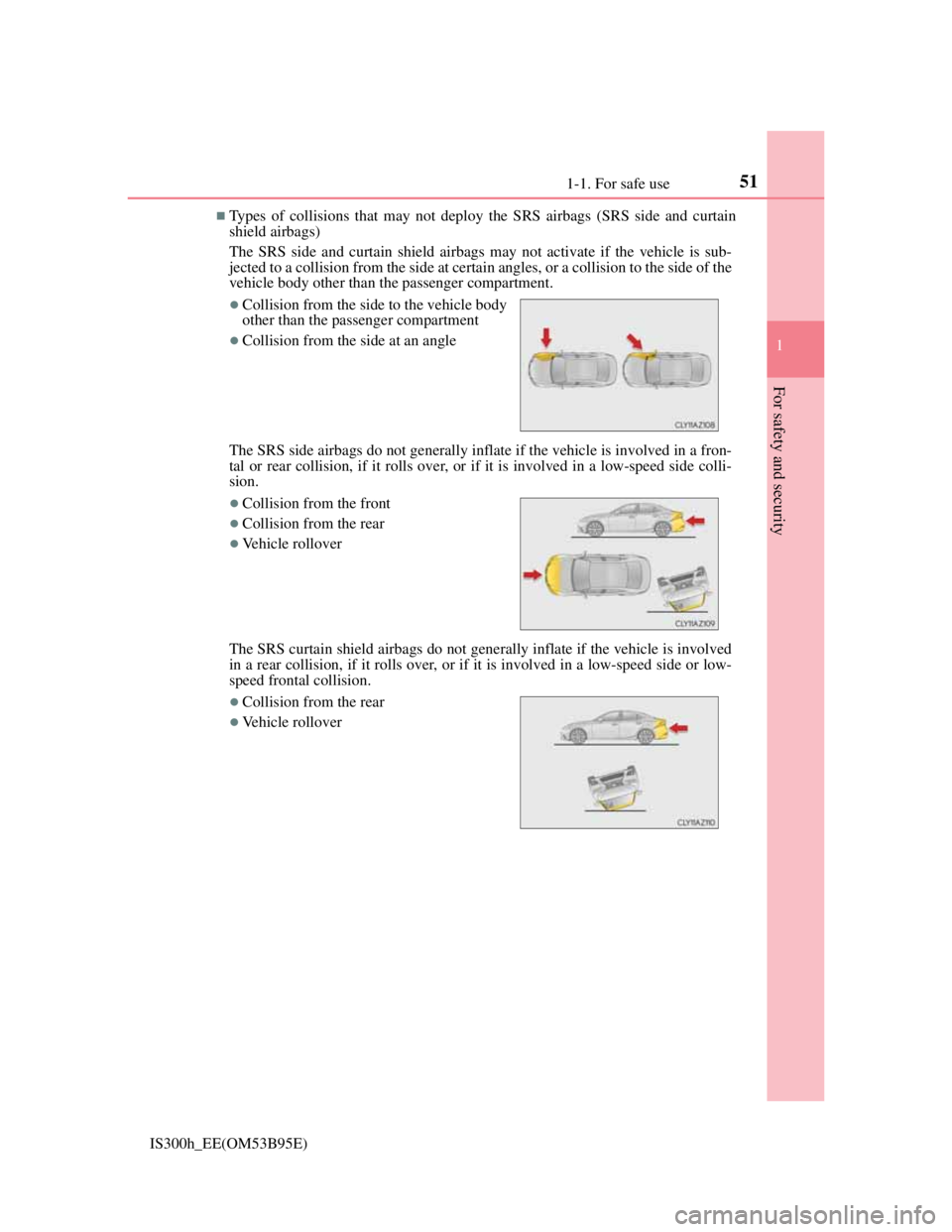
Types of collisions that may not deploy the SRS airbags (SRS side and curtain
shield airbags)
The SRS side and curtain shield airbags may not activate if the vehicle is sub-
jected to a collision from the side at certain angles, or a collision to the side of the
vehicle body other than the passenger compartment.
The SRS side airbags do not generally inflate if the vehicle is involved in a fron-
tal or rear collision, if it rolls over, or if it is involved in a low-speed side colli-
sion.
The SRS curtain shield airbags do not generally inflate if the vehicle is involved
in a rear collision, if it rolls over, or if it is involved in a low-speed side or low-
speed frontal collision.
Collision from the side to the vehicle body
other than the passenger compartment
Collision from the side at an angle
Collision from the front
Collision from the rear
Vehicle rollover
Collision from the rear
Vehicle rollover
Page 56 of 628
561-1. For safe use
IS300h_EE(OM53B95E)
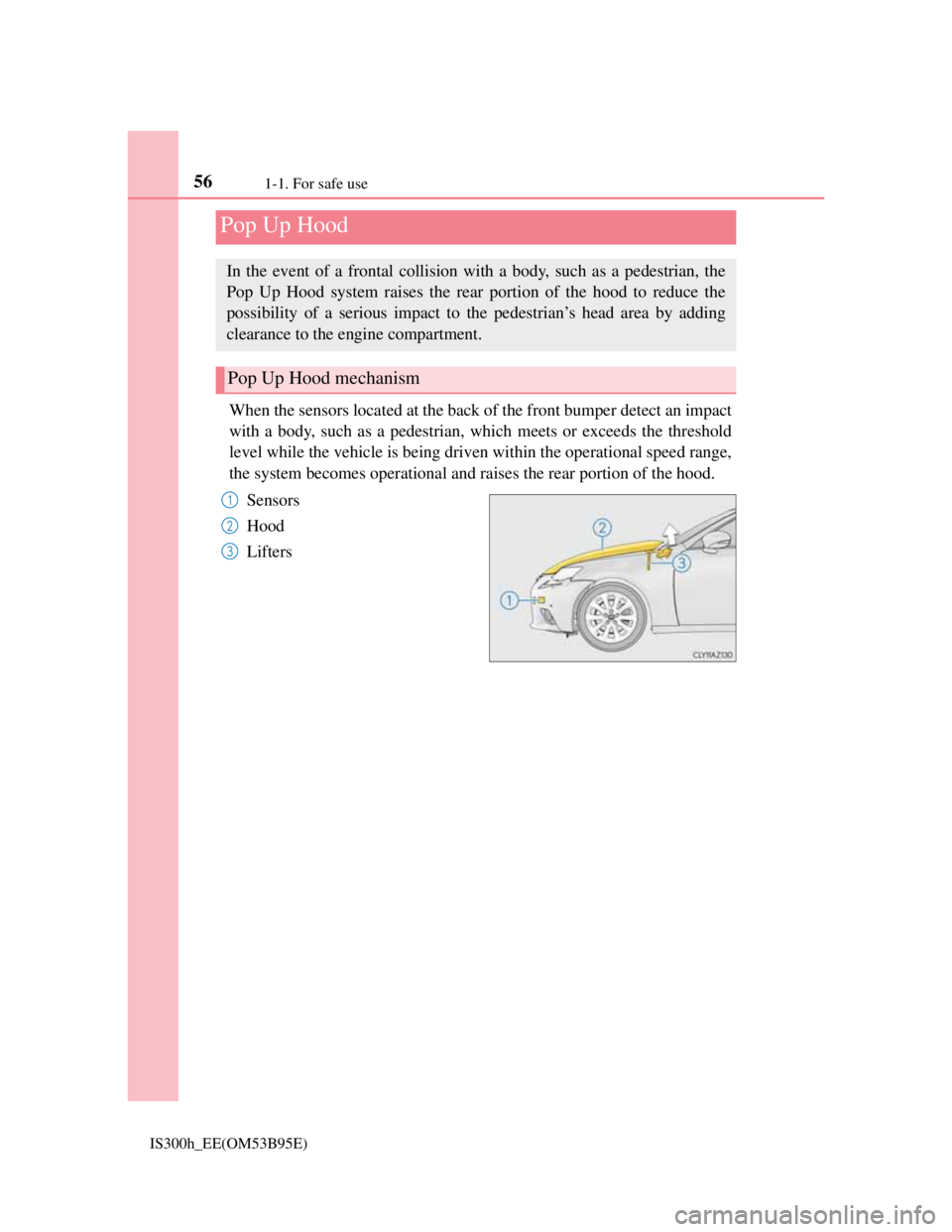
When the sensors located at the back of the front bumper detect an impact
with a body, such as a pedestrian, which meets or exceeds the threshold
level while the vehicle is being driven within the operational speed range,
the system becomes operational and raises the rear portion of the hood.
Sensors
Hood
Lifters
Pop Up Hood
In the event of a frontal collision with a body, such as a pedestrian, the
Pop Up Hood system raises the rear portion of the hood to reduce the
possibility of a serious impact to the pedestrian’s head area by adding
clearance to the engine compartment.
Pop Up Hood mechanism
1
2
3
Page 57 of 628
571-1. For safe use
1
For safety and security
IS300h_EE(OM53B95E)
The Pop Up Hood will operate when the vehicle detects an impact such as
the following:
The front bumper detects a frontal impact equivalent to or greater than
that of a pedestrian while the vehicle being driven within the opera-
tional speed range of approximately 25 to 55 km/h (16 to 34 mph).
(The system is operated by an impact of threshold level or greater, even
in the case of a minor collision that may not leave a trace on the front
bumper. Also, depending on the impact conditions or vehicle speed,
the system may be operated by a collision with a light or small object
or a small animal.)
In other situations the system may operate when an impact is applied to
the lower part of the vehicle or front bumper, such as the following:
• Colliding with a curb
• Falling into a deep hole
• Landing hard
• Hitting the slope of a parking lot, an undulating road, a protruding
object or falling object
Pop Up Hood operational conditions
CAUTION
When the Pop Up Hood is operated
Do not pull the hood lock release lever. Doing so after the Pop Up Hood has
operated will further raise the hood and may cause an injury.
Do not drive with the hood raised, as doing so may block the driver’s vision,
possibly causing an accident.
Do not forcibly push down the hood. As the popped up hood cannot be low-
ered by hand, doing so may deform the hood or cause an injury.
If the Pop Up Hood has operated, have the vehicle inspected by any autho-
rized Lexus dealer or repairer, or another duly qualified and equipped profes-
sional. If the Pop Up Hood has operated, stop the vehicle in a safe place and
contact any authorized Lexus dealer or repairer, or another duly qualified and
equipped professional.
Do not touch the lifters immediately after the Pop Up Hood has operated, as
the lifters may be hot and burn you.
Page 58 of 628
581-1. For safe use
IS300h_EE(OM53B95E)
Pop Up Hood precautions
Before scrapping your vehicle, make sure to contact any authorized Lexus
dealer or repairer, or another duly qualified and equipped professional.
The Pop Up Hood system cannot be reused once it has operated. Have it
replaced by any authorized Lexus dealer or repairer, or another duly qualified
and equipped professional.
Conditions under which the Pop Up Hood may not operate properly
The Pop Up Hood may not operate properly under the following conditions:
If a pedestrian collides with the right or left corner of the front bumper or the
side of the vehicle. As such impacts may be difficult to detect, the system may
not operate.
If the vehicle speed is not detected correctly, such as if the vehicle is sliding
sideways, the system may not operate properly.
Conditions under which the Pop Up Hood may not operate
The Pop Up Hood may not operate in the following situations:
Colliding with a lying pedestrian
A frontal impact applied to the front bumper while driving at speeds outside of
the operational speed range
A side impact or rear impact
A vehicle rollover (In some accident situations, the Pop Up Hood may operate.)
Page 68 of 628
681-1. For safe use
IS300h_EE(OM53B95E)
CAUTION
Child restraint precautions
For effective protection in automobile accidents and sudden stops, a child
must be properly restrained, using a seat belt or child restraint system depend-
ing on the age and size of the child. Holding a child in your arms is not a sub-
stitute for a child restraint system. In an accident, the child can be crushed
against the windshield, or between you and the vehicle’s interior. This may
cause death or serious injury to the child in the event of a sudden stop, sudden
swerve or accident.
Lexus strongly urges the use of a proper child restraint system that conforms
to the size of the child, installed on the rear seat. According to accident statis-
tics, the child is safer when properly restrained in the rear seat than in the
front seat.
Never use a rear-facing child restraint system on the front passenger seat
when the airbag manual on-off switch is on. (P. 5 4 )
In the event of an accident, the force of the rapid inflation of the front passen-
ger airbag can cause death or serious injury to the child.
A forward-facing child restraint system may be installed on the front passen-
ger seat only when it is unavoidable. A child restraint system that requires a
top tether strap should not be used in the front passenger seat since there is no
top tether strap anchor for the front passenger seat. Adjust the seatback as
upright as possible and always move the seat as far back as possible because
the front passenger airbag could inflate with considerable speed and force.
Otherwise, the child may be killed or seriously injured.
Do not allow the child to lean his/her head or any part of his/her body against
the door or the area of the seat, front, center and rear pillars or roof side rails
from which the SRS side airbags or SRS curtain shield airbags deploy even if
the child is seated in the child restraint system. It is dangerous if the SRS side
airbags and curtain shield airbags inflate, and the impact could cause death or
serious injury to the child.
Make sure you have complied with all installation instructions provided by
the child restraint manufacturer and that the system is properly secured. If it is
not secured properly, it may cause death or serious injury to the child in the
event of a sudden stop, sudden swerve or accident.
Page 81 of 628

801-2. Hybrid system
IS300h_EE(OM53B95E)
When stopped/during start off
The gasoline engine stops when the vehicle is stopped. During start off,
the electric motor (traction motor) drives the vehicle. At slow speeds or
when traveling down a gentle slope, the engine is stopped and the elec-
tric motor (traction motor) is used.
During normal driving
The gasoline engine is predominantly used. The electric motor (trac-
tion motor) charges the hybrid battery (traction battery) as necessary.
When accelerating sharply
When the accelerator pedal is depressed heavily, the power of the
hybrid battery (traction battery) is added to that of the gasoline engine
via the electric motor (traction motor).
When braking (regenerative braking)
The electric motor (traction motor) charges the hybrid battery (traction
battery).