speed Lexus IS300h 2013 Owner's Guide
[x] Cancel search | Manufacturer: LEXUS, Model Year: 2013, Model line: IS300h, Model: Lexus IS300h 2013Pages: 628, PDF Size: 20.23 MB
Page 197 of 628

1954-1. Before driving
4
Driving
IS300h_EE(OM53B95E)
CAUTION
Observe the following precautions.
Failure to do so may result in death or serious injury.
When starting the vehicle
Always keep your foot on the brake pedal while stopped with the hybrid system
operating. This prevents the vehicle from creeping.
When driving the vehicle
Do not drive if you are unfamiliar with the location of the brake and accelera-
tor pedals to avoid depressing the wrong pedal.
• Accidentally depressing the accelerator pedal instead of the brake pedal
will result in sudden acceleration that may lead to an accident.
• When backing up, you may twist your body around, leading to a difficulty
in operating the pedals. Make sure to operate the pedals properly.
• Make sure to keep a correct driving posture even when moving the vehicle
only slightly. This allows you to depress the brake and accelerator pedals
properly.
• Depress the brake pedal using your right foot. Depressing the brake pedal
using your left foot may delay response in an emergency, resulting in an
accident.
The driver should pay extra attention to pedestrians when the vehicle is pow-
ered only by the electric motor (traction motor). As there is no engine noise,
the pedestrians may misjudge the vehicle’s movement.
Do not drive the vehicle over or stop the vehicle near flammable materials.
The exhaust system and exhaust gases can be extremely hot. These hot parts
may cause a fire if there is any flammable material nearby.
During normal driving, do not turn off the hybrid system. Turning the hybrid
system off while driving will not cause loss of steering or braking control, but
the power assist to these systems will be lost. This will make it more difficult
to steer and brake, so you should pull over and stop the vehicle as soon as it is
safe to do so.
However, in the event of an emergency, such as if it becomes impossible to
stop the vehicle in the normal way: P. 499
Use engine braking (downshift) to maintain a safe speed when driving down a
steep hill.
Using the brakes continuously may cause the brakes to overheat and lose
effectiveness. (P. 216)
Do not adjust the positions of the steering wheel, the seat, or the inside or out-
side rear view mirrors while driving.
Doing so may result in a loss of vehicle control.
Always check that all passengers’ arms, heads or other parts of their body are
not outside the vehicle.
Page 198 of 628

1964-1. Before driving
IS300h_EE(OM53B95E)
CAUTION
Observe the following precautions.
Failure to do so may result in death or serious injury.
When driving on slippery road surfaces
Sudden braking, acceleration and steering may cause tire slippage and reduce
your ability to control the vehicle.
Sudden acceleration, engine braking due to shift changing, or changes in
engine speed could cause the vehicle to skid.
After driving through a puddle, depress the brake pedal to make sure that the
brakes are functioning properly. Wet brake pads may prevent the brakes from
functioning properly. If the brakes on only one side are wet and not function-
ing properly, steering control may be affected.
When shifting the shift lever
Do not let the vehicle roll backward while the shift lever is in D or S, or roll
forward while the shift lever is in R.
Doing so may result in an accident or damage to the vehicle.
Do not shift the shift lever to P while the vehicle is moving.
Doing so can damage the transmission and may result in a loss of vehicle con-
trol.
Do not shift the shift lever to R while the vehicle is moving forward.
Doing so can damage the transmission and may result in a loss of vehicle con-
trol.
Do not shift the shift lever to D while the vehicle is moving backward.
Doing so can damage the transmission and may result in a loss of vehicle con-
trol.
Shifting the shift lever to N while the vehicle is moving will disengage the
hybrid system. Engine braking is not available when N is selected.
Be careful not to shift the shift lever with the accelerator pedal depressed.
Shifting the shift lever to a gear other than P or N may lead to unexpected
rapid acceleration of the vehicle that may cause an accident and result in
death or serious injury.
If you hear a squealing or scraping noise (brake pad wear indicators)
Have the brake pads checked and replaced by any authorized Lexus dealer or
repairer, or another duly qualified and equipped professional as soon as possi-
ble.
Rotor damage may result if the pads are not replaced when needed.
Moderate levels of brake pad and disc wear allow enhanced braking power. As
a result, the discs may wear more quickly than conventional brake discs. There-
fore, when replacing the brake pads, Lexus recommends that you also have the
thickness of the discs measured.
It is dangerous to drive the vehicle when the wear limits of the brake pads and/
or those of the brake discs are exceeded.
Page 199 of 628

1974-1. Before driving
4
Driving
IS300h_EE(OM53B95E)
CAUTION
Observe the following precautions.
Failure to do so may result in death or serious injury.
When the vehicle is stopped
Do not depress the accelerator pedal unnecessarily.
If the shift lever is any position other than P or N, the vehicle may accelerate
suddenly and unexpectedly, causing an accident.
In order to prevent accidents due to the vehicle rolling away, always keep
depressing the brake pedal while stopped with the “READY” indicator on,
and apply the parking brake as necessary.
If the vehicle is stopped on an incline, in order to prevent accidents caused by
the vehicle rolling forward or backward, always depress the brake pedal and
securely apply the parking brake as needed.
Avoid revving or racing the engine.
Running the engine at high speed while the vehicle is stopped may cause the
exhaust system to overheat, which could result in a fire if combustible mate-
rial is nearby.
When the vehicle is parked
Do not leave glasses, cigarette lighters, spray cans, or soft drink cans in the
vehicle when it is in the sun.
Doing so may result in the following:
• Gas may leak from a cigarette lighter or spray can, and may lead to a fire.
• The temperature inside the vehicle may cause the plastic lenses and plastic
material of glasses to deform or crack.
• Soft drink cans may fracture, causing the contents to spray over the interior
of the vehicle, and may also cause a short circuit in the vehicle’s electrical
components.
Do not leave cigarette lighters in the vehicle. If a cigarette lighter is in a place
such as the glove box or on the floor, it may be lit accidentally when luggage
is loaded or the seat is adjusted, causing a fire.
Do not attach adhesive discs to the windshield or windows. Do not place con-
tainers such as air fresheners on the instrument panel or dashboard. Adhesive
discs or containers may act as lenses, causing a fire in the vehicle.
Do not leave a door or window open if the curved glass is coated with a met-
allized film such as a silver-colored one. Reflected sunlight may cause the
glass to act as a lens, causing a fire.
Always apply the parking brake, shift the shift lever to P, stop the hybrid sys-
tem and lock the vehicle.
Do not leave the vehicle unattended while the hybrid system is operating.
Do not touch the exhaust pipes while the hybrid system is operating or imme-
diately after turning the hybrid system off.
Doing so may cause burns.
Page 203 of 628
2014-1. Before driving
4
Driving
IS300h_EE(OM53B95E)
Weight limits
Check the allowable towing capacity, GVM (Gross Vehicle Mass),
MPAC (Maximum Permissible Axle Capacity), and permissible draw
bar load before towing. (P. 562)
Towing hitch/bracket
Lexus recommends the use of the Lexus hitch/bracket for your vehicle.
Other products of a suitable nature and comparable quality may also be
used.
To prevent an accident
The handling of the vehicle will feel different when towing a trailer.
Beware of the 3 most common causes of towing-related accidents:
driver error, excessive speed, and overloading.
Trailer towing (vehicles with a towing package)
The strain of towing a trailer will have a negative impact on the running
performance, handling, fuel consumption and endurance of your vehicle.
Use the vehicle features in the correct manner and operate the vehicle
with care for safer driving and optimal comfort. Damage and/or malfunc-
tions that occur as a result of towing performed for commercial purposes
are not covered by the Lexus warranty.
Ask your local authorized Lexus dealer or repairer, or another duly qual-
ified and equipped professional for further details before towing, as there
are additional legal requirements in some countries.
Page 205 of 628

2034-1. Before driving
4
Driving
IS300h_EE(OM53B95E)
CAUTION
When the gross vehicle mass limit or maximum permissible axle capacity is
exceeded
Do not exceed the established speed limit for towing a trailer in built-up areas
or 100 km/h (62 mph), whichever is the lower.
Page 208 of 628

2064-1. Before driving
IS300h_EE(OM53B95E)
Your vehicle will handle differently when towing a trailer. In order to
avoid accident, death or serious injury, keep the following in mind when
towing:
Checking connections between trailer and lights
Stop the vehicle and check the operation of the connection between the
trailer and lights after driving for a brief period as well as before start-
ing off.
Practicing driving with a coupled trailer
Get the feel for turning, stopping and reversing with the trailer cou-
pled by practicing in an area with no or light traffic.
When reversing with a coupled trailer, hold the section of the steer-
ing wheel nearest to you and rotate clockwise to turn the trailer left
or counterclockwise to turn it right. Always rotate a little at a time to
prevent steering error. Have someone guide you when reversing to
lessen the risk of an accident.
Increasing vehicle-to-vehicle distance
At a speed of 10 km/h (6 mph), the distance to the vehicle running
ahead of you should be equivalent to or greater than the combined
length of your vehicle and trailer. Avoid sudden braking that may cause
skidding. Otherwise, the vehicle may spin out of control. This is espe-
cially true when driving on wet or slippery road surfaces.
Sudden acceleration/steering input/cornering
Executing sharp turns when towing may result in the trailer colliding
with your vehicle. Decelerate well in advance when approaching turns
and take them slowly and carefully to avoid sudden braking.
Important points regarding turning
The wheels of the trailer will travel closer to the inside of the curve
than the wheels of the vehicle. To make allowance for this, take the
turns wider than you would normally do.
Guidance
Page 210 of 628

2084-1. Before driving
IS300h_EE(OM53B95E)
CAUTION
To avoid accident or injury
Do not tow a trailer when a tire installed is repaired with the emergency tire
puncture repair kit.
Vehicle speed in towing
Observe the legal maximum speeds for trailer towing.
Before descending hills or long declines
Reduce speed and downshift. However, never downshift suddenly while
descending steep or long downhill grades.
Operation of the brake pedal
Do not hold the brake pedal depressed often or for long periods of time.
Doing so may result in the brake overheating or reduce braking effects.
NOTICE
For vehicles with an emergency tire puncture repair kit (if equipped)
Do not tow anything if a tire that has been repaired using the emergency tire
puncture repair kit is installed. The load on the tire may cause unexpected dam-
age to the tire.
Page 216 of 628
2144-2. Driving procedures
IS300h_EE(OM53B95E)
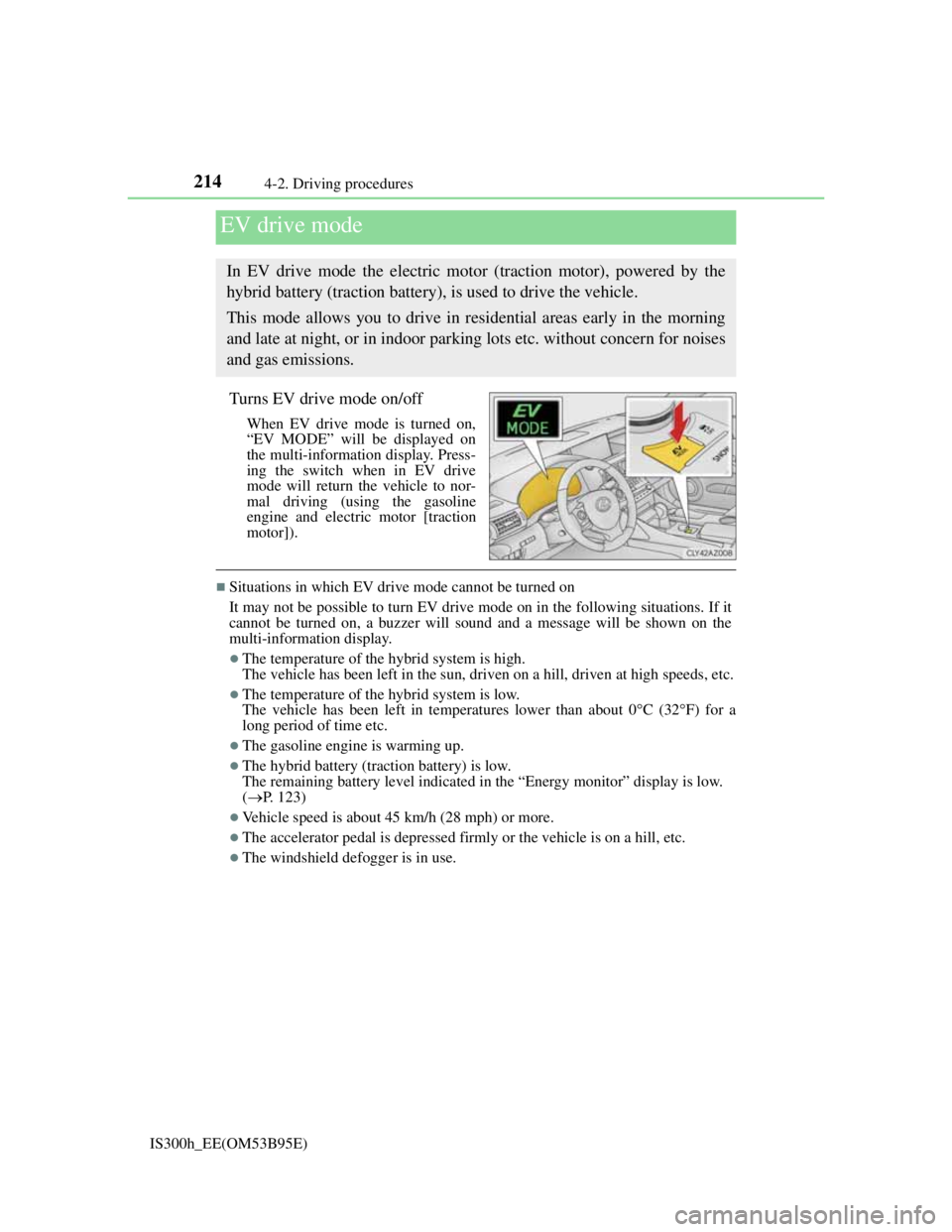
Turns EV drive mode on/off
When EV drive mode is turned on,
“EV MODE” will be displayed on
the multi-information display. Press-
ing the switch when in EV drive
mode will return the vehicle to nor-
mal driving (using the gasoline
engine and electric motor [traction
motor]).
Situations in which EV drive mode cannot be turned on
It may not be possible to turn EV drive mode on in the following situations. If it
cannot be turned on, a buzzer will sound and a message will be shown on the
multi-information display.
The temperature of the hybrid system is high.
The vehicle has been left in the sun, driven on a hill, driven at high speeds, etc.
The temperature of the hybrid system is low.
The vehicle has been left in temperatures lower than about 0C (32F) for a
long period of time etc.
The gasoline engine is warming up.
The hybrid battery (traction battery) is low.
The remaining battery level indicated in the “Energy monitor” display is low.
(P. 123)
Vehicle speed is about 45 km/h (28 mph) or more.
The accelerator pedal is depressed firmly or the vehicle is on a hill, etc.
The windshield defogger is in use.
EV drive mode
In EV drive mode the electric motor (traction motor), powered by the
hybrid battery (traction battery), is used to drive the vehicle.
This mode allows you to drive in residential areas early in the morning
and late at night, or in indoor parking lots etc. without concern for noises
and gas emissions.
Page 217 of 628

2154-2. Driving procedures
4
Driving
IS300h_EE(OM53B95E)
Switching to EV drive mode when the gasoline engine is cold
If the hybrid system is started while the gasoline engine is cold, the gasoline
engine will start automatically after a short period of time in order to warm up. In
this case, you will become unable to switch to EV drive mode.
After the hybrid system has started and the “READY” indicator has illuminated,
press the EV drive mode switch before the gasoline engine starts to switch to EV
drive mode.
Automatic cancelation of EV drive mode
When driving in EV drive mode, the gasoline engine may automatically restart in
the following situations. When EV drive mode is canceled, a buzzer will sound
and the EV drive mode indicator will flash and go off.
The hybrid battery (traction battery) becomes low.
The remaining battery level indicated in the “Energy monitor” display is low.
(P. 123)
Vehicle speed becomes more than about 45 km/h (28 mph).
The accelerator pedal is depressed firmly or the vehicle is on a hill, etc.
When it is possible to inform the driver of automatic cancelation in advance, a
prior notice screen will appear on the multi-information display.
Possible driving distance when driving in EV drive mode
EV drive mode’s possible driving distance ranges from a few hundred meters to
approximately 2 km (1.2 mile). Driving is possible at speeds of less than approx-
imately 45 km/h (28 mph). However, depending on vehicle conditions, there are
situations when EV drive mode cannot be used.
(The distance that is possible depends on the hybrid battery [traction battery]
level and driving conditions.)
Fuel economy
Your Lexus is designed to achieve the best possible fuel economy during normal
driving (using the gasoline engine and electric motor [traction motor]). Driving
in EV drive mode more than necessary may lower fuel economy.
CAUTION
Caution while driving
When driving in EV drive mode, pay special attention to the area around the
vehicle. Because there is no engine noise, pedestrians, people riding bicycles or
other people and vehicles in the area may not be aware of the vehicle starting
off or approaching them, so take extra care while driving.
Page 220 of 628
2184-2. Driving procedures
IS300h_EE(OM53B95E)
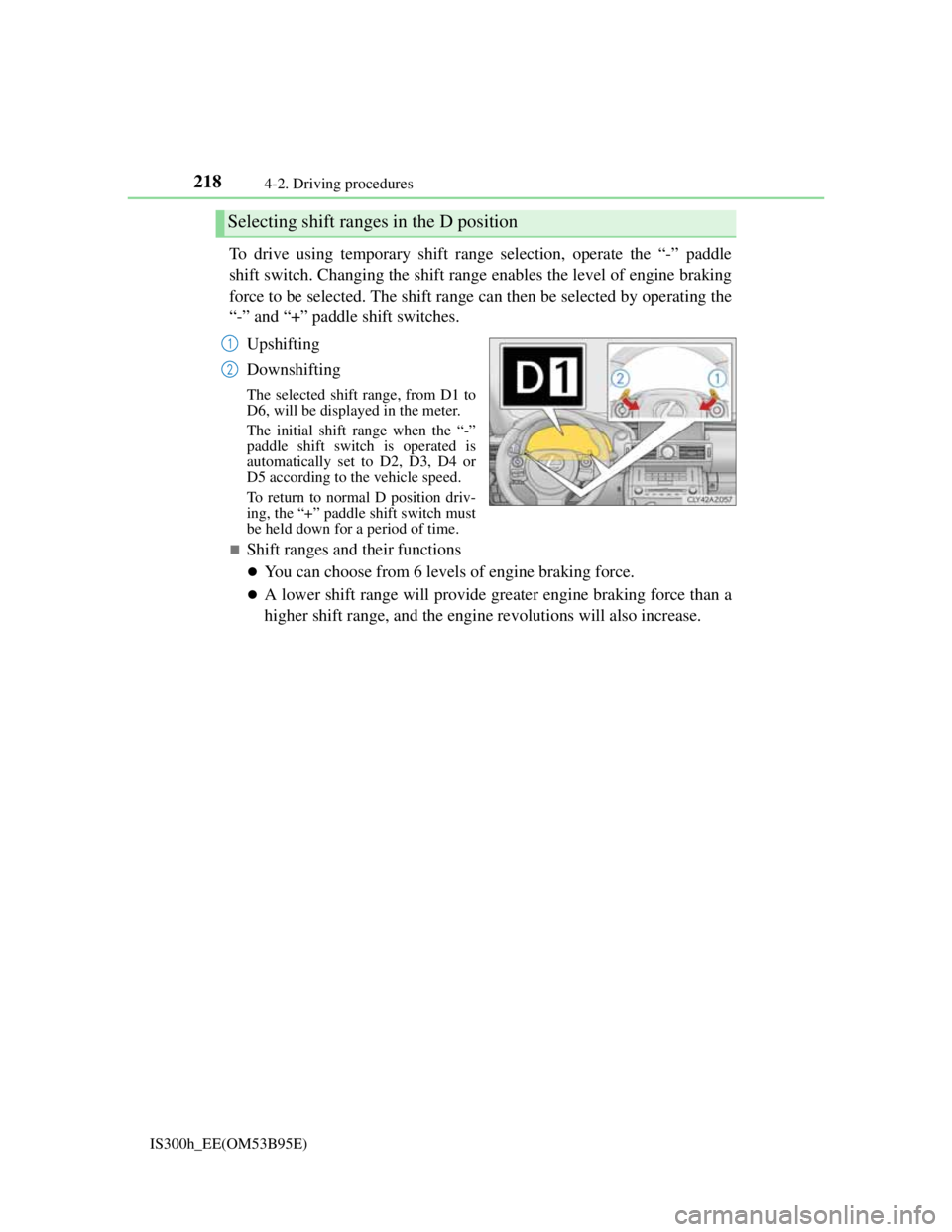
To drive using temporary shift range selection, operate the “-” paddle
shift switch. Changing the shift range enables the level of engine braking
force to be selected. The shift range can then be selected by operating the
“-” and “+” paddle shift switches.
Upshifting
Downshifting
The selected shift range, from D1 to
D6, will be displayed in the meter.
The initial shift range when the “-”
paddle shift switch is operated is
automatically set to D2, D3, D4 or
D5 according to the vehicle speed.
To return to normal D position driv-
ing, the “+” paddle shift switch must
be held down for a period of time.
Shift ranges and their functions
You can choose from 6 levels of engine braking force.
A lower shift range will provide greater engine braking force than a
higher shift range, and the engine revolutions will also increase.
Selecting shift ranges in the D position
1
2