wheel lexus LFA 2012 Technical Information / LEXUS 2012 LFA (OM77006U) Owner's Manual
[x] Cancel search | Manufacturer: LEXUS, Model Year: 2012, Model line: LFA, Model: Lexus LFA 2012Pages: 420, PDF Size: 5.02 MB
Page 70 of 420

68
1-7. Safety information
CAUTION
■SRS airbag precautions
Observe the following precautions regarding the airbags.
Failure to do so may cause death or serious injury.
●The driver and passenger in the vehicle must wear their seat belts properly.
The SRS airbags are supplemental devices to be used with the seat belts.
●The SRS driver airbag deploys with considerable force, and can cause death or
serious injury especially if the driver is very close to the airbag. The National
Highway Traffic Safety Administration (“NHTSA”) advises:
Since the risk zone for the driver airbag is the first 2 - 3 in. (50 - 75 mm) of infla-
tion, placing yourself 10 in. (250 mm) from your driver airbag provides you with a
clear margin of safety. This distance is measured from the center of the steering
wheel to your breastbone. If you sit less than 10 in. (250 mm) away now, you can
change your driving position in several ways:
• Move your seat to the rear as far as you can while still reaching the pedals
comfortably.
• Slightly recline the back of the seat. Although vehicle designs vary, many dr ivers can achieve the 10 in. (250 mm)
distance, even with the driver’s seat all the way forward, simply by reclining
the back of the seat somewhat. If reclining the back of your seat makes it hard
to see the road, raise yourself by using a firm, or raise the seat if your vehicle
has that feature.
• If your steering wheel is adjustable, ti lt it downward. This points the airbag
toward your chest instead of your head and neck.
The seat should be adjusted as recommended by NHTSA above, while still main-
taining control of the foot pedals, steering wheel, and your view of the instrument
panel controls.
Page 71 of 420
69
1-7. Safety information
1
Before driving
CAUTION
■SRS airbag precautions
●The SRS passenger airbag also deploys with considerable force, and can cause
death or serious injury especially if the passenger is very close to the airbag. The
passenger seat should be as far from the airbag as possible with the seatback
adjusted, so the passenger sits upright.
●Improperly seated and/or restrained infants and children can be killed or seri-
ously injured by a deploying airbag. An infant or child who is too small to use a
seat belt should be properly secured using a child restraint system. Lexus strongly
recommends that all infants and children be properly restrained. The rear seats
are the safest for infants and children. ( P. 76 )
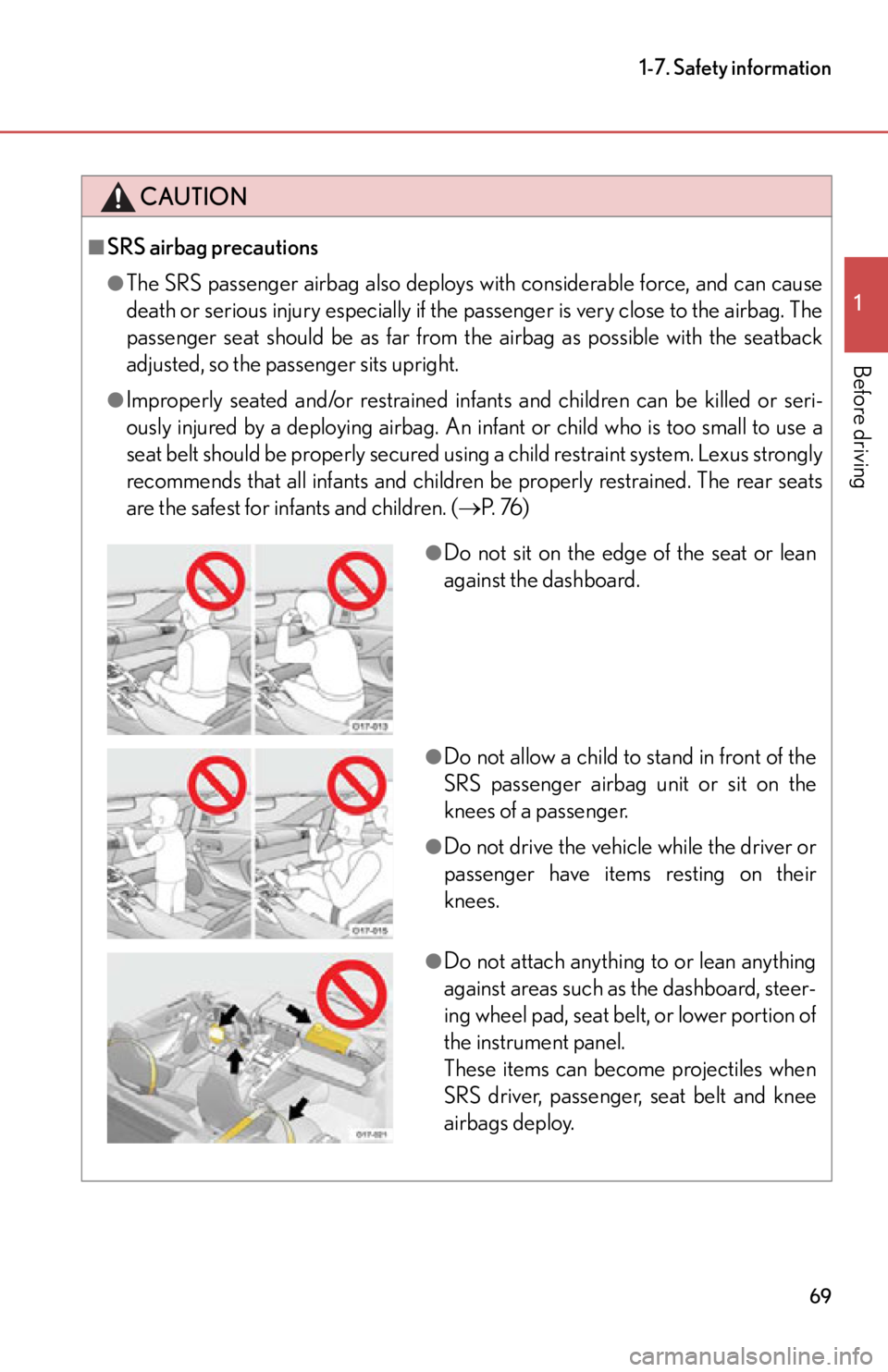
●Do not sit on the edge of the seat or lean
against the dashboard.
●Do not allow a child to stand in front of the
SRS passenger airbag unit or sit on the
knees of a passenger.
●Do not drive the vehicle while the driver or
passenger have items resting on their
knees.
●Do not attach anything to or lean anything
against areas such as the dashboard, steer-
ing wheel pad, seat belt, or lower portion of
the instrument panel.
These items can become projectiles when
SRS driver, passenger, seat belt and knee
airbags deploy.
Page 72 of 420

70
1-7. Safety information
CAUTION
■SRS airbag precautions
●Wear the seat belt correctly.
●If a vinyl cover is put on the area where the SRS knee airbag will deploy, be sure to
remove it.
●Do not wrap seat belt covers or other such items around the area where the SRS
seat belt air bag will inflate.
●Do not strike or apply significant levels of force to the area of the SRS airbag
components shown on P. 63.
Doing so can cause the SRS airbags to malfunction.
●Do not touch any of the component parts immediately after the SRS airbags have
deployed (inflated) as they may be hot.
●If breathing becomes difficult after the SRS airbag has deployed, open a door or
window to allow fresh air in, or leave the vehicle if it is safe to do so. Wash off any
residue as soon as possible to prevent skin irritation.
●If the areas where the SRS airbags are stored, such as the steering wheel pad
and/or seat belt, are damaged or cracked, have them replaced by your Lexus
dealer.
Page 73 of 420

71
1-7. Safety information
1
Before driving
CAUTION
■Modification and disposal of SRS airbag system components
Do not dispose of your vehicle or perform any of the following modifications with-
out consulting your Lexus dealer.
The SRS airbags may malfunction or deploy (inflate) accidentally, causing death or
serious injury.
●Installation, removal, disassembly and repair of the SRS airbags.
●Repairs, modifications, removal or replace ment of the steering wheel, instrument
panel, dashboard or seat belt.
●Repairs or modifications of the front fender or front bumper.
●Installation of snow plows, winches, etc. to the front grille (bull bars, kangaroo bar
etc.).
●Modifications to the vehi cle's suspension system.
●Installation of electronic devices such as mobile two-way radios or CD players.
●Modifications to your vehicle for a person with a physical disability.
Page 94 of 420

92
2-1. Driving procedures
CAUTION
●Do not adjust the positions of the steering wheel, the seat, or the inside or outside
rear view mirrors while driving.
Doing so may result in a loss of vehicle control that can cause accidents, resulting
in death or serious injury.
●Always check that all occupants’ arms, heads and other body parts are not out-
side the vehicle, as this may result in death or serious injury.
■When driving on slippery road surfaces
●Sudden braking, acceleration and steer ing may cause tire slippage and reduce
your ability to control the vehi cle, resulting in an accident.
●Sudden changes in engine speed, such as engine braking caused by up-shifting
and down-shifting, may cause the vehicle to skid, resulting in an accident.
●After driving through a pudd le, lightly depress the brake pedal to make sure that
the brakes are functioning properly. Wet brake pads may prevent the brakes from
functioning properly. If the brakes on on ly one side are wet and not functioning
properly, steering control may be af fected, resulting in an accident.
■When operating the paddle shift switches/reverse selector switch
Do not operate the paddle shift switches or reverse selector switch with the accel-
erator pedal depressed and Neutral selected.
Doing so may lead to unexpected rapid acceleration of the vehicle that may cause
an accident and result in death or serious injury.
■If a brake pad wear warning message is displayed
Have your Lexus dealer check and replac e the brake pads as soon as possible.
The disc damage can result if the pads are not replaced when needed.
Moderate levels of the brake pad and disc wear allow enhanced braking power. As
a result, the discs may wear more quickly than conventional brake discs. Therefore,
when replacing the brake pads, Lexus recommends that you also have the thick-
ness of the discs measured.
It is dangerous to drive the vehicle when the wear limits of the brake pads and/or
those of the brake discs are exceeded.
Page 98 of 420

96
2-1. Driving procedures
NOTICE
■When driving the vehicle
●Do not depress the accelerator and brake pedals at the same time during driving.
If the brake pedal is depressed whil e driving with the accelerator pedal
depressed, driving torque may be restrained.
●Do not use the accelerator pedal or depress the accelerator and brake pedals at
the same time to hold the vehicle on a hill. Doing so may damage the clutch.
■When parking the vehicle
●Parking with the rear of the vehicle close to a wall or similar structure may cause
the area around the exhaust pipes to over heat. As this may result in damage to
the rear bumper or other components, be sure to park the vehicle rear end as far
away as possible from walls and other such structures.
●When it rains, do not park on a slope with an angle of 15 degrees or more, as rain-
water may enter the vehicle. If parking at such an angle is unavoidable, use wheel
chocks and place a car cover over the vehicle.
■Avoiding damage to vehicle parts
●Do not turn the steering wheel fully in either direction and hold it there for an
extended period of time.
Doing so may damage the power steering motor.
●When driving over bumps in the road, be careful and drive as slowly as possible
to avoid damaging the wheels, tires, underside of the vehicle, etc.
■If you get a flat tire while driving
A flat or damaged tire may cause the following situations. Hold the steering wheel
firmly and gradually depress the brak e pedal to slow down the vehicle.
●It may be difficult to control your vehicle.
●The vehicle will make abnormal sounds or vibrations.
●The vehicle will lean.
Information on what to do in case of a flat tire ( P. 3 3 2 )
Page 100 of 420

98
2-1. Driving procedures
Ignition switch
■Starting the engine
Sit in the driver’s seat and firmly depress the brake pedal.
Turn the ignition switch to the
“ON” position.
The current gear will be displayed
on the meter as a blinking symbol.
Pull both paddle shift switches at
the same time.
“N” will be displayed in the gear
indicator.
The indicator light on the steering
wheel illuminates in red.
Press the “ENGINE START”
switch.
After one press, the engine will
crank until it starts or for up to 20
seconds, whichever is less.
Continue depressing the brake
pedal until the engine is completely
started.
STEP1
STEP2
STEP3
STEP4
Page 101 of 420
99
2-1. Driving procedures
2
When driving
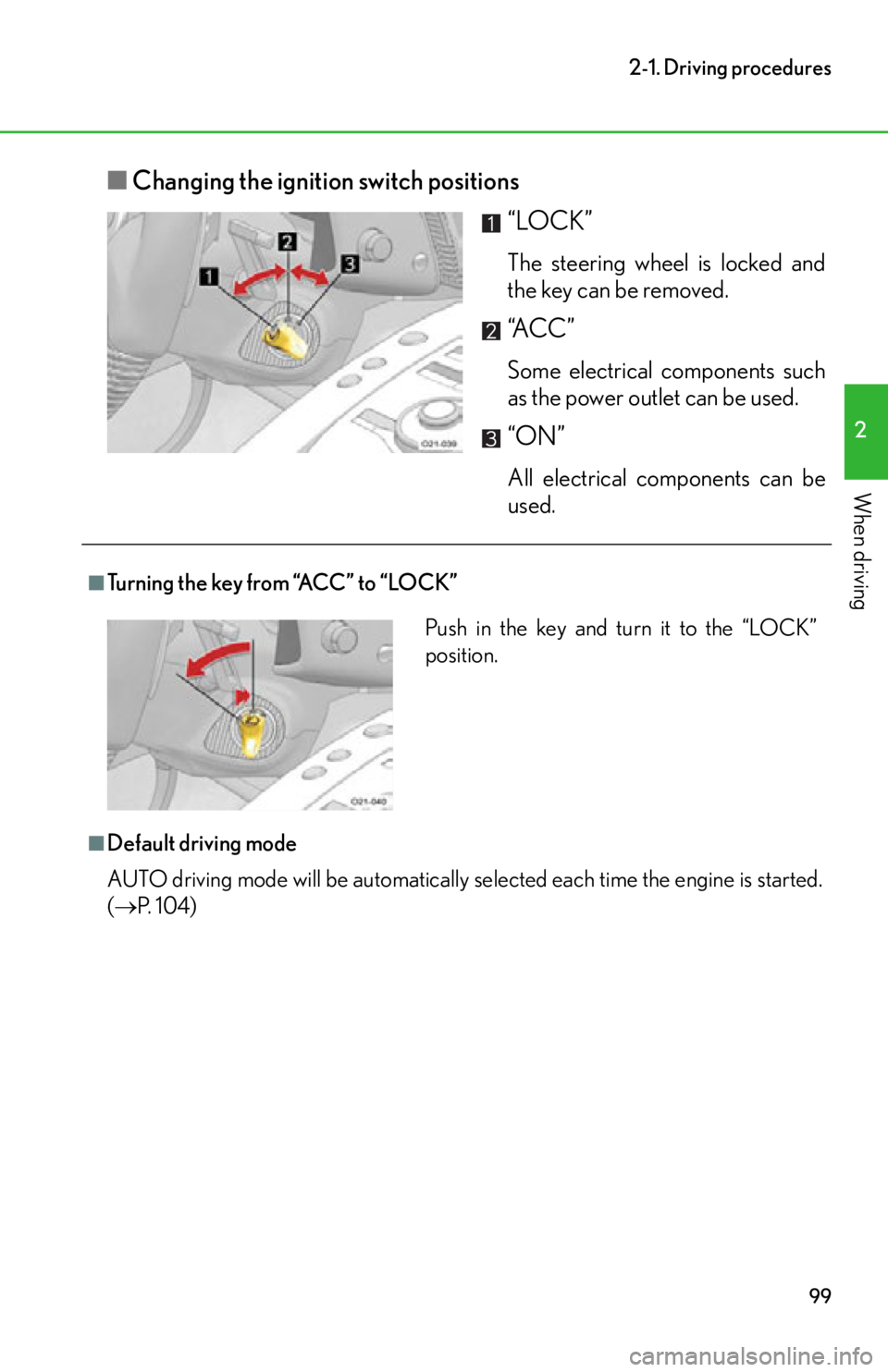
■Changing the ignition switch positions
“LOCK”
The steering wheel is locked and
the key can be removed.
“A C C ”
Some electrical components such
as the power outlet can be used.
“ON”
All electrical components can be
used.
■Turning the key from “ACC” to “LOCK”
■Default driving mode
AUTO driving mode will be automatically se lected each time the engine is started.
( P. 1 0 4 )
Push in the key and turn it to the “LOCK”
position.
Page 102 of 420
100
2-1. Driving procedures
■If the engine does not start
●Repeat the procedure again. If the engine does not start after a few tries, the
“ENGINE START” switch may be malfunctioning. Have the vehicle inspected
by your Lexus dealer.
●Check to make sure that the brake pedal is firmly depressed and that “N” is dis-
played in the gear indicator. (If the brake pedal is not depressed or “N” is not
displayed, the engine will not start.)
●The engine immobilizer system may not have been deactivated. ( P. 5 3 )
●In order to protect the engine, the engine may not start when the engine coolant
temperature or the engine oil temperature is below -13 F (-25C). In that case,
a buzzer will sound and “Temp low Engine cannot be started” will be shown on
the meter. ( P. 3 2 7 )
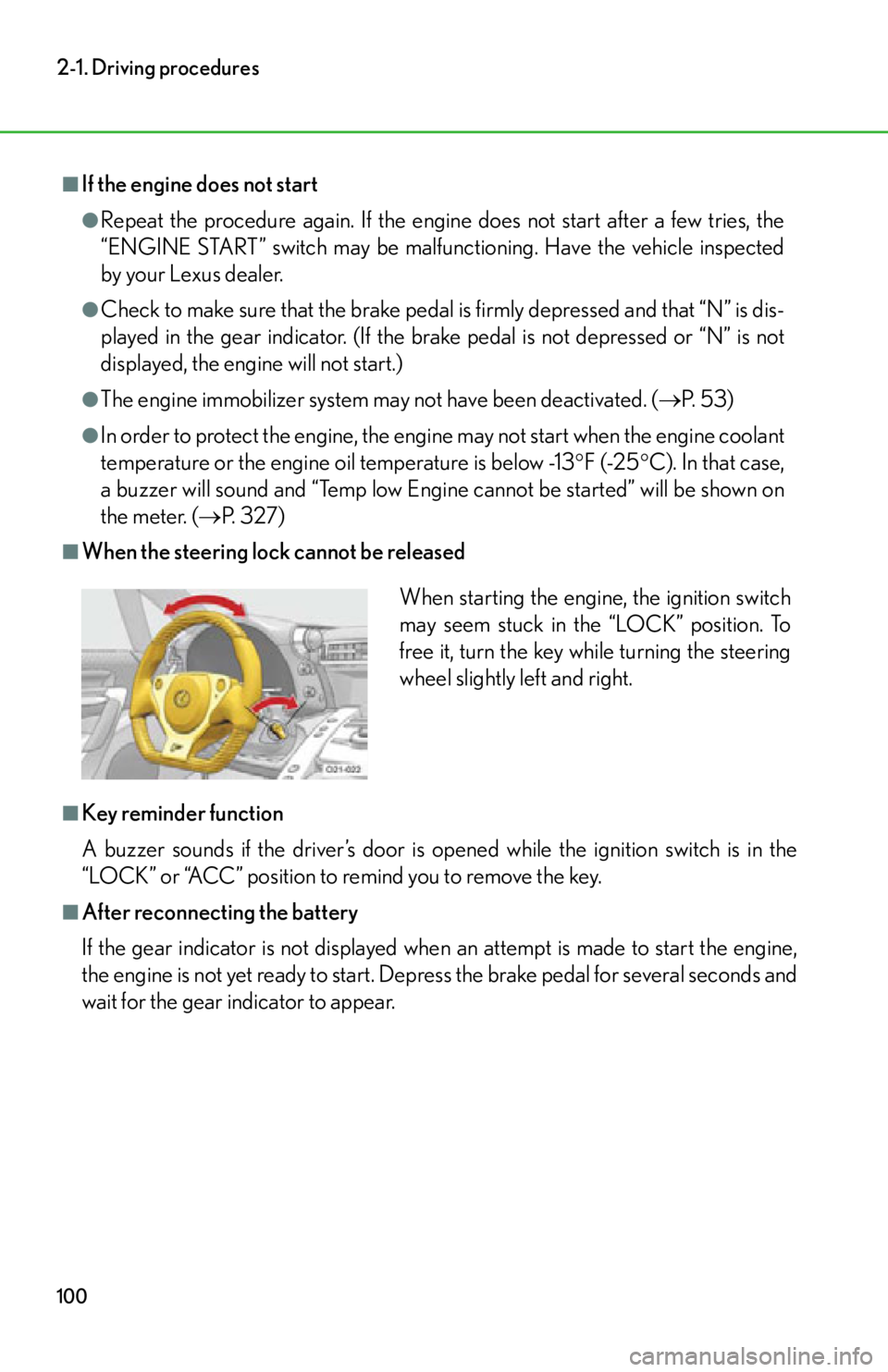
■When the steering lock cannot be released
■Key reminder function
A buzzer sounds if the driver’s door is opened while the ignition switch is in the
“LOCK” or “ACC” position to remind you to remove the key.
■After reconnecting the battery
If the gear indicator is not displayed when an attempt is made to start the engine,
the engine is not yet ready to start. Depr ess the brake pedal for several seconds and
wait for the gear indicator to appear.
When starting the engine, the ignition switch
may seem stuck in the “LOCK” position. To
free it, turn the key while turning the steering
wheel slightly left and right.
Page 117 of 420

115
2-1. Driving procedures
2
When driving
Horn
To sound the horn, press the pad in
the middle of the steering wheel.
■After adjusting the steering wheel
Make sure that the steering wheel is securely locked.
The horn may not sound if the steering wheel is not securely locked. (P. 4 1 )