wheel lexus LFA 2012 Technical Information / LEXUS 2012 LFA (OM77006U) Workshop Manual
[x] Cancel search | Manufacturer: LEXUS, Model Year: 2012, Model line: LFA, Model: Lexus LFA 2012Pages: 420, PDF Size: 5.02 MB
Page 282 of 420
280
4-3. Do-it-yourself maintenance
CAUTION
■Proper inflation is critical to save tire performance
Keep your tires properly inflated. Otherwise, the following conditions may occur
and result in an accident causing death or serious injury:
●Excessive wear
●Uneven wear
●Poor handling
●Possibility of blowouts resulting from overheated tires
●Poor sealing of the tire bead
●Wheel deformation and/or tire separation
●A greater possibility of tire damage from road hazards
NOTICE
■When inspecting and adjusting tire inflation pressure
Be sure to put the tire valve caps back on.
Without the valve caps, dirt or moisture could get into the valve and cause air leak-
age, which could result in an accident. If the caps are lost, replace them as soon as
possible.
Page 283 of 420
281
4-3. Do-it-yourself maintenance
4
Maintenance and care
Wheels
If a wheel is bent, cracked or heavily corroded, it should be replaced.
Otherwise, the tire may separate from the wheel or cause loss of handling
control.
The wheel bolts used are exclusive to the LFA. When replacing the wheels or
wheel bolts, consult your Lexus dealer.
■ Aluminum wheel precautions
●Use only Lexus wheel bolts design ed for use with your aluminum
wheels.
● When repairing or changing your tires, check that the wheel bolts
are still tight after driving 1000 miles (1600 km).
● Use only Lexus genuine balance we ights or equivalent when bal-
ancing your wheels.
■When replacing wheels
The wheels of your Lexus are equipped with tire pressure warning valves and trans-
mitters that allow the tire pressure warning system to provide advanced warning in
the event of a loss in tire inflation pres sure. Whenever wheels are replaced, the tire
pressure warning valves and tran smitters must be installed. (P. 2 7 1 )
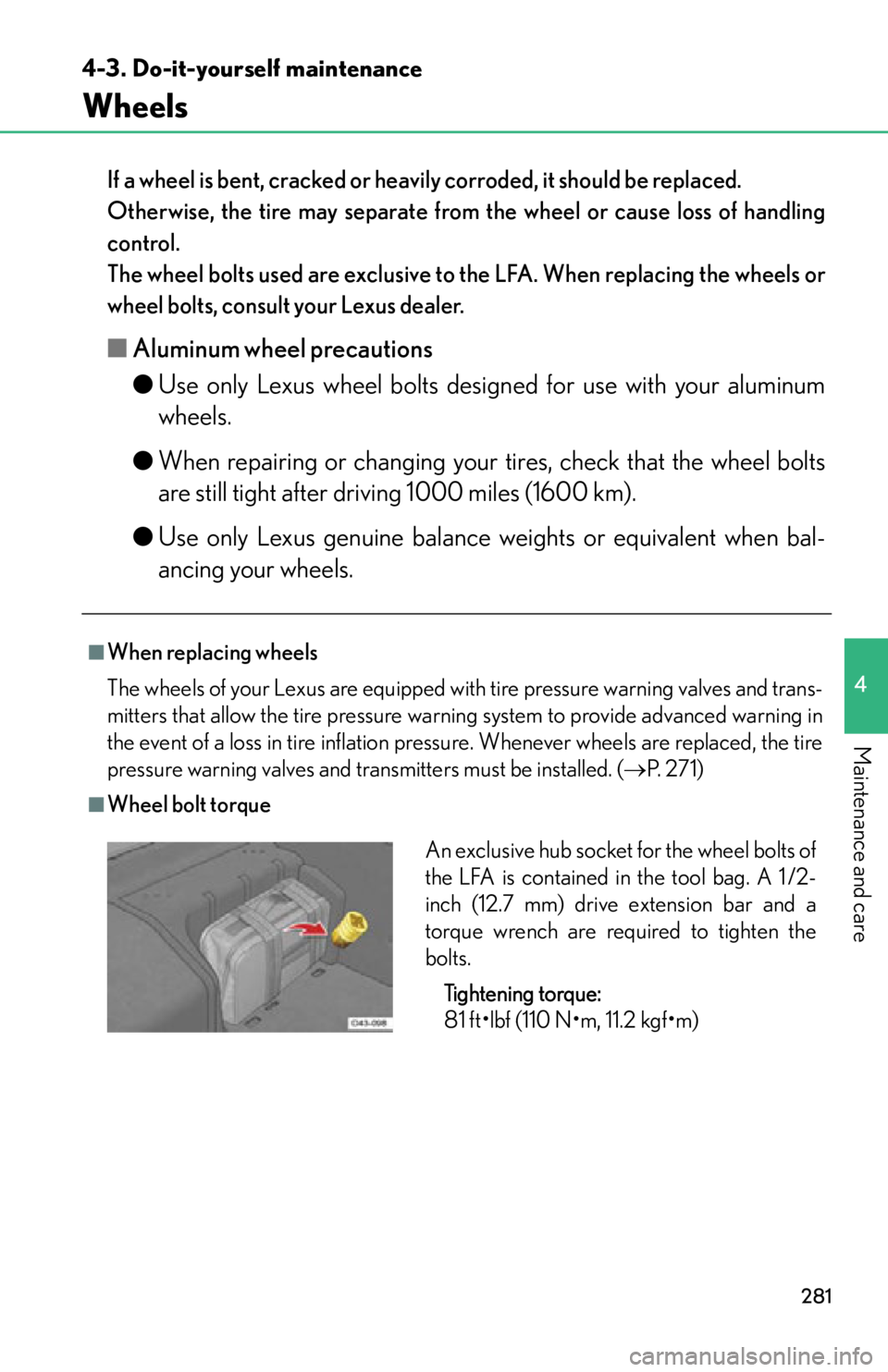
■Wheel bolt torque
An exclusive hub socket for the wheel bolts of
the LFA is contained in the tool bag. A 1 /2-
inch (12.7 mm) drive extension bar and a
torque wrench are required to tighten the
bolts.
Tightening torque:
81 ft
•lbf (110 N•m, 11.2 kgf•m)
Page 284 of 420

282
4-3. Do-it-yourself maintenance
CAUTION
■When replacing wheels
●Do not use wheels that are a different size from those recommended in the
Owner’s Manual, as this may result in loss of handling control.
●Never use an inner tube in a leaking wheel which is designed for a tubeless tire.
Doing so may result in an accident, causing death or serious injury.
■Wheel bolts
Observe the following precautions to reduce the risk of death or serious injury:
●Do not over tighten.
●Never use oil or grease on the wheel bolts.
Oil and grease may cause the wheel bolts to be excessively tightened, leading to
bolt or disc wheel damage. In addition, the oil or grease can cause the wheel bolts
to loosen and the wheel may fall off, causing a serious accident. Remove any oil or
grease from the wheel bolts.
●If there are any cracks or deformations in the wheel bolts, or if the surface treat-
ment becomes worn, have the wheel bolts replaced at your Lexus dealer.
Failure to follow these precautions could cause the wheel bolts to loosen and the
tire to fall off, resulting in death or serious injury.
●If the wheels are frequently removed and installed due to circuit driving etc.,
Lexus recommends periodic changing of the wheel bolts.
NOTICE
■Replacing tire pressure warning valves and transmitters
●Because tire repair or replacement may affect the tire pressure warning valves
and transmitters, make sure to have tires serviced by your Lexus dealer or other
qualified service shop. In addition, make sure to purchase your tire pressure
warning valves and transmitters at your Lexus dealer.
●Ensure that only genuine Lexus wheels are used on your vehicle.
Tire pressure warning valves and transmitters may not work properly with non-
genuine wheels.
Page 305 of 420
5
When trouble arises
303
5-1. Essential information
If your vehicle needs to be towed
If towing is necessary, we recommend having your vehicle towed and loaded/
unloaded by your Lexus dealer or a commercial towing service, using a flat-
bed truck.
Use a safety chain system for all towing, and abide by all state/provincial and
local laws.
Before towing
The following may indicate a problem with your transmission. Contact
your Lexus dealer before towing.
● The engine is running but the vehicle will not move.
● The vehicle makes an abnormal sound.
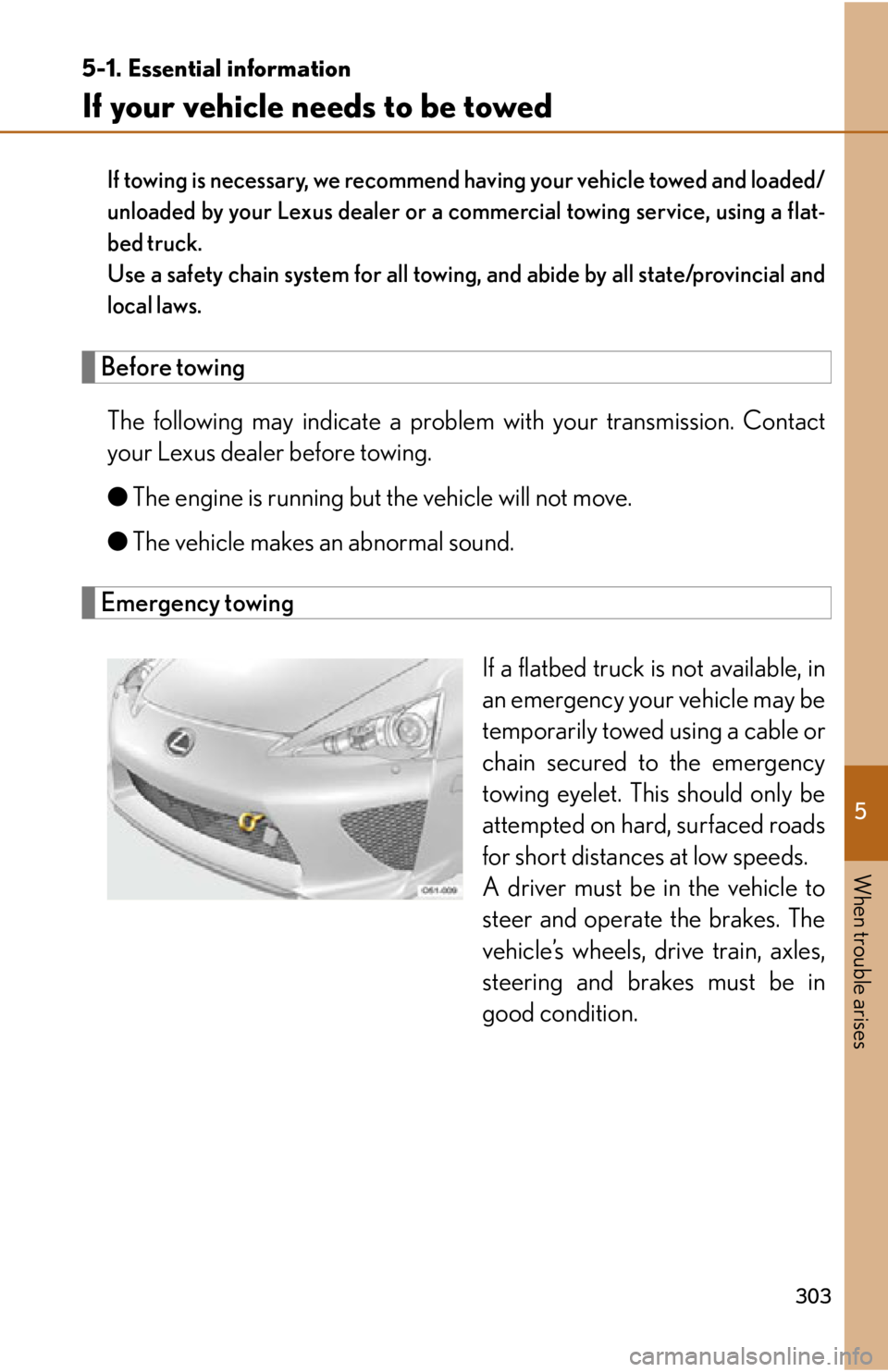
Emergency towing
If a flatbed truck is not available, in
an emergency your vehicle may be
temporarily towed using a cable or
chain secured to the emergency
towing eyelet. This should only be
attempted on hard, surfaced roads
for short distances at low speeds.
A driver must be in the vehicle to
steer and operate the brakes. The
vehicle’s wheels, drive train, axles,
steering and brakes must be in
good condition.
Page 308 of 420
306
5-1. Essential information
Using a flatbed truckUse a flatbed truck suitable for vehicles with low ground clearance. To
prevent body damage, do not tow with a wheel-lift or sling type truck. We
recommend having your Lexus dealer or a commercial towing service
load and unload the vehicle whenever possible.
■ Before loading the vehicle on a flatbed truck
Deactivate the tilt sensor. ( P. 56)
■ After the vehicle is loaded
Select Neutral, apply the parking brake and turn the ignition
switch to the “LOCK” position.
Use wheel chocks for all 4 wheels to prevent the vehicle from rolling.
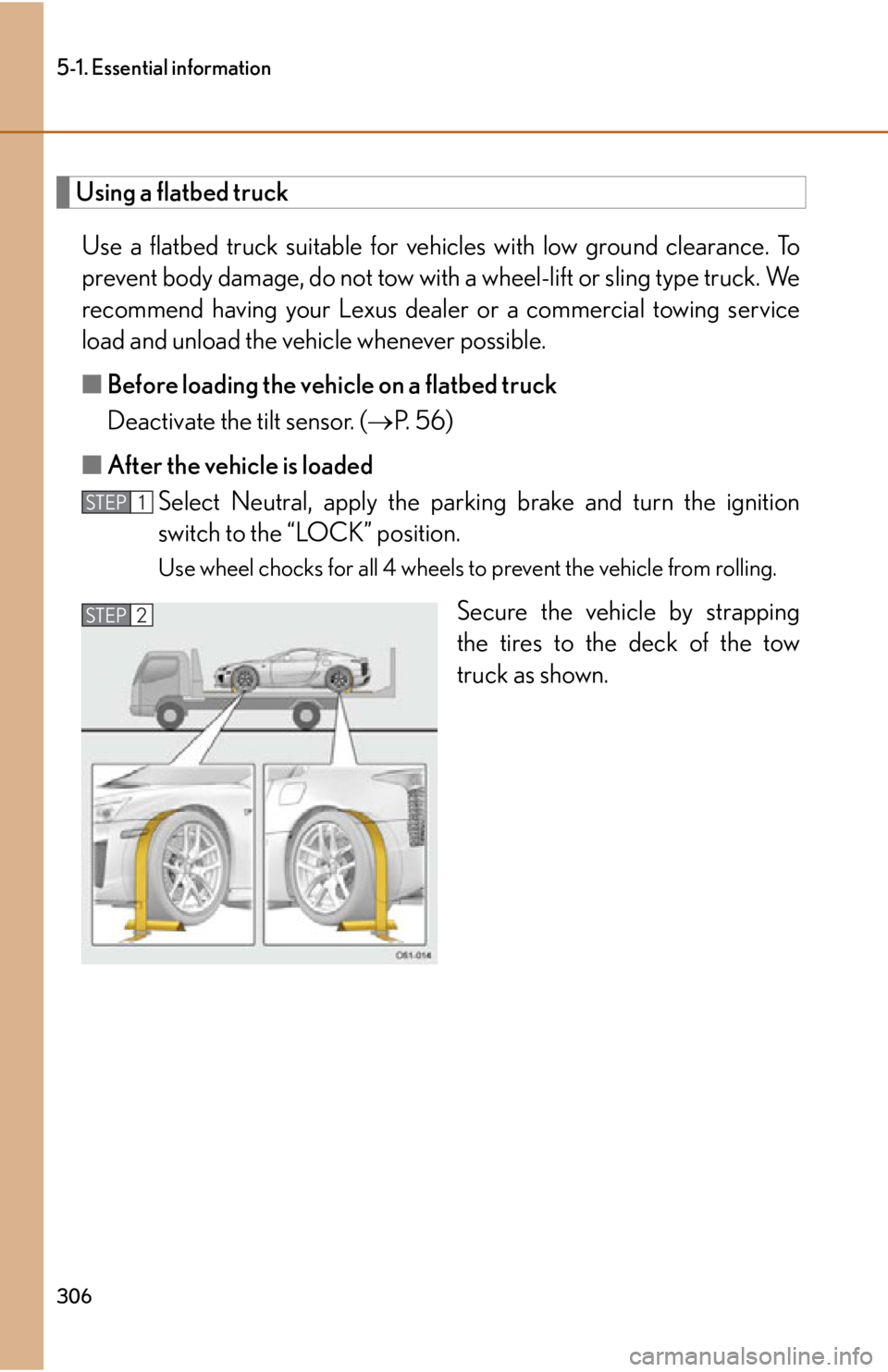
Secure the vehicle by strapping
the tires to the deck of the tow
truck as shown.
STEP1
STEP2
Page 309 of 420
5
When trouble arises
307
5-1. Essential information
■Emergency towing procedureStart the engine.
If the engine cannot be started, turn the ignition switch to the “ACC” or
“ON” position.
With Neutral selected, release the parking brake.
■When using the towing eyelet
Use the towing eyelet only when your vehicle is being towed.
Do not use the towing eyelet to tow another vehicle or to tie down your vehicle on a
flatbed truck.
CAUTION
■Caution while towing
●Use extreme caution when towing the vehicle.
Avoid sudden starts or erratic driving maneuvers which place excessive stress on
the emergency towing eyelet and the cable or chain. Always be cautious of the
surroundings and other vehicles while towing.
●If the engine is not running , the power assist for the brakes and steering may not
function, making steering and braking more difficult.
■Installing towing eyelet to the vehicle
Make sure that towing eyelet is installed securely.
If not securely installed, towing eyelet may come loose during towing. This may lead
to accidents that cause serious injury or even death.
NOTICE
■To prevent vehicle damage
Observe the following precautions when using a flatbed truck:
●Do not drive over wheel chocks, as doing so may damage the tires.
●Do not tie down the vehicle over any part s other than the tires (do not use parts
such as the suspension).
STEP1
STEP2
Page 320 of 420

318
5-2. Steps to take in an emergency
■If the tire pressure warning system is not functioning
The tire pressure warning system will be disabled in the following conditions:
(When the condition becomes normal, the system will work properly.)
●If tires not equipped with tire pressure warning valves and transmitters are used
●If the ID code on the tire pressure warning valves and transmitters is not regis-
tered in the tire pressure warning computer
●If the tire inflation pressure is 73 psi (500 kPa, 5.1 kgf/cm2 or bar) or higher
The tire pressure warning system may be disabled in the following conditions:
(When the condition becomes normal, the system will work properly.)
●If electronic devices or facilities using similar radio wave frequencies are nearby
●If a radio set at similar frequencies is in use in the vehicle
●If there is a lot of snow or ice on the vehicle, particularly around the wheels or
wheel housings
●If non-genuine Lexus wheels are used (Even if you use Lexus wheels, the tire
pressure warning system may not work properly with some types of tires.)
●If a tire is repaired with the emergency tire puncture repair kit
■If the tire pressure warning light comes on after flashing frequently for 1 minute
If the tire pressure warning light comes on after flashing frequently for 1 minute
when the ignition switch is turned to th e “ON” position, have it checked by your
Lexus dealer.
■Customization that can be configured at Lexus dealer
The vehicle speed linked seat belt reminder buzzer can be disabled.
(Customizable features P. 383)
Page 321 of 420

5
When trouble arises
319
5-2. Steps to take in an emergency
CAUTION
■When the electric power steering system warning light comes on
The steering wheel may become extremely heavy.
If the steering wheel becomes heavier than usual when operating, hold firmly and
operate using more force than usual.
■If the tire pressure warning light comes on
Be sure to observe the following precaution s. Failure to do so could cause a loss of
vehicle control and result in death or serious injury.
●Stop your vehicle in a safe place as soon as possible. Adjust the tire inflation pres-
sure immediately.
●If the tire pressure warning light comes on even after tire inflation pressure adjust-
ment, it is probable that you have a flat tire. Check the tires. If a tire is flat, tempo-
rarily repair the tire using the em ergency tire puncture repair kit ( P. 3 3 2 ) a n d
then have the tire repaired or replaced by the nearest Lexus dealer.
●Avoid abrupt maneuvering and braking. If the vehicle tires deteriorate, you could
lose control of the steering wheel or the brakes.
■If a blowout or sudden air leakage should occur
The tire pressure warning system may not activate immediately.
Page 322 of 420

320
5-2. Steps to take in an emergency
CAUTION
■Maintenance of the tires
Each tire, including the spare (if provided), should be checked monthly when cold
and inflated to the inflation pressure re commended by the vehicle manufacturer on
the vehicle placard or tire inflation pressu re label (tire and load information label).
(If your vehicle has tires of a different size than the size indicated on the vehicle
placard or tire inflation pressure label [tire and load information label], you should
determine the proper tire inflation pressure for those tires.)
As an added safety feature, your vehicl e has been equipped with a tire pressure
monitoring system (TPMS-tire pressure warning system) that illuminates a low tire
pressure telltale (tire pressure warning light) when one or more of your tires is sig-
nificantly under-inflated. Accordingly, when the low tire pressure telltale (tire pres-
sure warning light) illuminates, you should stop and check your tires as soon as
possible, and inflate them to the proper pressure. Driving on a significantly under-
inflated tire causes the tire to overheat and can lead to tire failure. Under-inflation
also reduces fuel efficiency and tire tread life, and may affect the vehicle's handling
and stopping ability.
Please note that the TPMS (tire pressure warning system) is not a substitute for
proper tire maintenance, and it is the driv er's responsibility to maintain correct tire
pressure, even if under-inflation has not reached the level to trigger illumination of
the TPMS low tire pressure telltale (tire pressure warning light).
Your vehicle has also been equipped with a TPMS (tire pressure warning system)
malfunction indicator to indicate when th e system is not operating properly. The
TPMS (tire pressure warning system) malfunction indicator is combined with the
low tire pressure telltale (tire pressure warning light). When the system detects a
malfunction, the telltale will flash for approximately one minute and then remain
continuously illuminated. This sequence will continue upon subsequent vehicle
start-ups as long as the malfunction exists . When the malfunction indicator is illumi-
nated, the system may not be able to detect or signal low tire pressure as intended.
TPMS (tire pressure warning system) malfunctions may occur for a variety of rea-
sons, including the installation of replacem ent or alternate tires or wheels on the
vehicle that prevent the TPMS (tire pres sure warning system) from functioning
properly. Always check the TPMS (tire pressure warning system) malfunction tell-
tale after replacing one or more tires or wheels on your vehicle to ensure that the
replacement or alternate tires and wheels allow the TPMS (tire pressure warning
system) to continue to function properly.
Page 336 of 420
334
5-2. Steps to take in an emergency
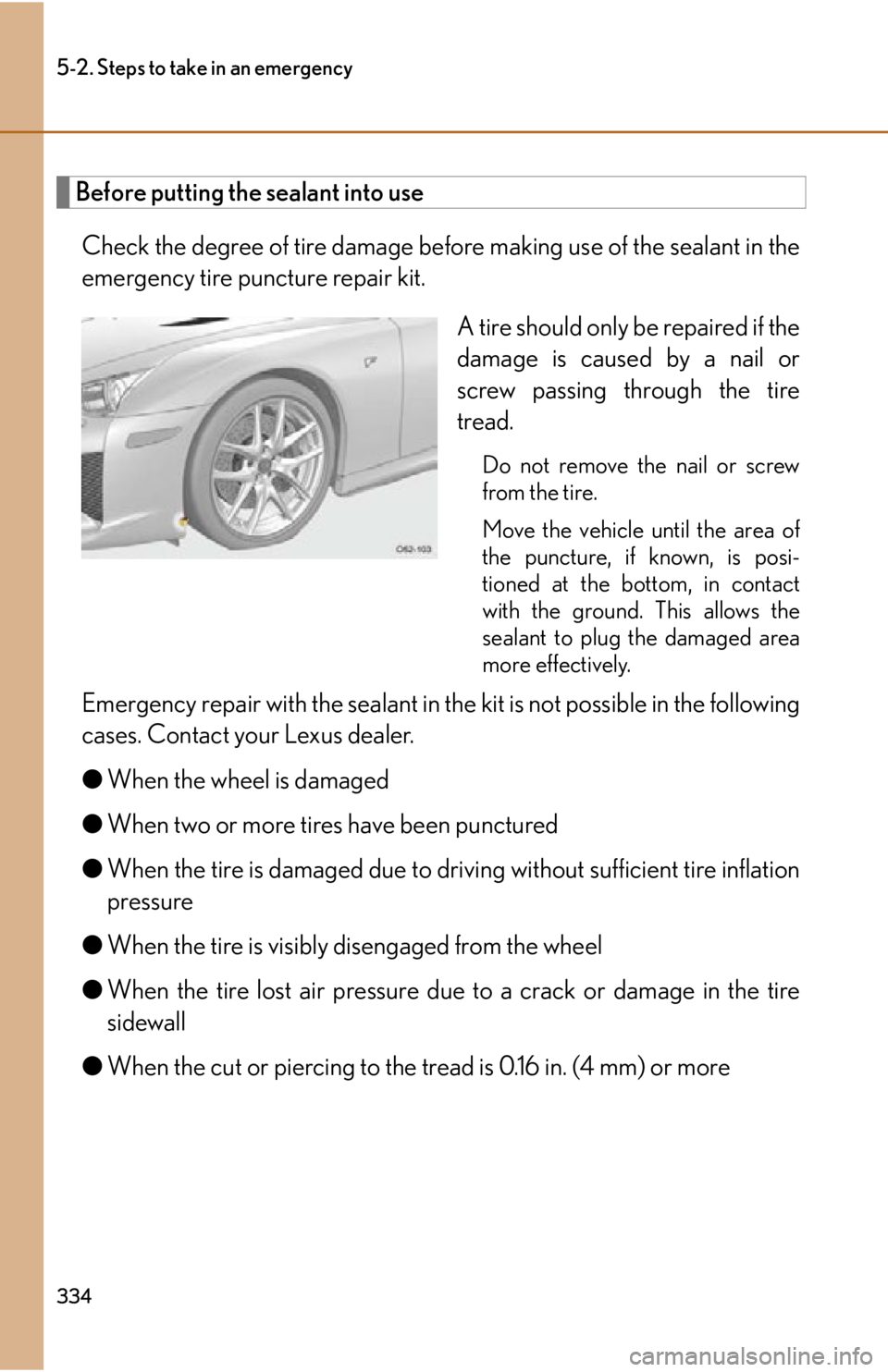
Before putting the sealant into useCheck the degree of tire damage befo re making use of the sealant in the
emergency tire puncture repair kit.
A tire should only be repaired if the
damage is caused by a nail or
screw passing through the tire
tread.
Do not remove the nail or screw
from the tire.
Move the vehicle until the area of
the puncture, if known, is posi-
tioned at the bottom, in contact
with the ground. This allows the
sealant to plug the damaged area
more effectively.
Emergency repair with the sealant in the kit is not possible in the following
cases. Contact your Lexus dealer.
● When the wheel is damaged
● When two or more tires have been punctured
● When the tire is damage d due to driving without sufficient tire inflation
pressure
● When the tire is visibly disengaged from the wheel
● When the tire lost air pressure due to a crack or damage in the tire
sidewall
● When the cut or piercing to the tread is 0.16 in. (4 mm) or more