wheel lexus LFA 2012 Technical Information / LEXUS 2012 LFA (OM77006U) Repair Manual
[x] Cancel search | Manufacturer: LEXUS, Model Year: 2012, Model line: LFA, Model: Lexus LFA 2012Pages: 420, PDF Size: 5.02 MB
Page 342 of 420

340
5-2. Steps to take in an emergency
■Sealant
●One tire can be repaired using the bottle of sealant stored in the emergency tire
puncture repair kit.
●The sealant can be used when the outside temperature is from -22°F (-30°C)
to 140°F (60°C).
●When the outside temperature is low, the viscosity of the sealant becomes high
and it will be more difficult to inject th e sealant. In this case, warm the sealant in
the vehicle before using it.
●The sealant has a limited lifespan. The expi ration date is marked on the bottle.
The sealant should be replaced before the expiration date. Contact your Lexus
dealer.
●If the sealant gets on your clothes, it may stain.
●After using the sealant, bring the empty bottle of sealant to your Lexus dealer
and purchase a new bottle. Keep the ne w bottle of sealant in your vehicle.
■Compressor
●The compressor is a pneumatic filling type for passenger vehicles.
●When the compressor is operating, a loud operating noise will be produced.
This does not indicate a malfunction.
■The wheel of a tire that has been repaired
If you remove the sealant adhering to the wheel with a rag, you can reuse the wheel.
■The valve of a tire that has been repaired
●After a tire is repaired with the emergency tire puncture repair kit, the tire pres-
sure warning valve and transm itter should be replaced.
●After a tire is repaired with the emergency tire puncture repair kit, even if the
tire inflation pressure is at the recommended level, the tire pressure warning
light may come on/flash.
Page 343 of 420

5
When trouble arises
341
5-2. Steps to take in an emergency
CAUTION
■Precaution for children
Keep the emergency tire puncture repair kit out of the reach of children and store it
properly.
■Sealant precautions
●The sealant in the emergency tire puncture repair kit is not for human consump-
tion.
If the sealant is consumed, drink a large quantity of water and get medical atten-
tion immediately.
●If sealant gets in your eyes or on your skin, thoroughly wash with a large quantity
of water. If necessary, get medical attention.
■When fixing the flat tire
●Stop your vehicle in a safe and flat area.
●If force is used to turn the valve core tool while air remains in the tire, special care
should be taken because the valve core could fly out.
●Be careful, as sealant may fly out if you shake the bottle with the hose installed.
●If the hose is not securely installed, sealant may leak out when filling.
●Connect the valve and hose securely with the tire installed on the vehicle.
●Be careful handling the compressor, as parts of the compressor get hot during
operation. Some parts of the compressor may remain hot after use.
●Do not attach the vehicle speed warning sticker to an area other than the one
indicated. If the sticker is attached to an area where an SRS airbag is located,
such as the pad of the steering wheel, it may prevent the SRS airbag from operat-
ing properly.
■Driving to spread the liquid sealant evenly
Drive cautiously at a moderate speed, avoi ding sudden starts, sudden braking, and
abrupt steering maneuvers.
Page 344 of 420

342
5-2. Steps to take in an emergency
NOTICE
■Vehicles with a flat tire
Do not continue driving with a flat tire.
Driving even a short distance with a flat tire can damage the tire and the wheel
beyond repair.
■When performing an emergency repair
Perform the emergency repair without removing the nail or screw that has punc-
tured the tread of the tire. If the object th at has punctured the tire is removed, the
repair using the sealant in the emergenc y tire puncture repair kit may fail.
■When fixing the flat tire
●Do not put the valve core on dirty ground or in the sand.
Store it in a clean place.
●Do not remove the inside cap of the sealant bottle.
●Turn the valve core tool with your hand when screwing it in. If you use another tool
in conjunction with the valve core tool, damage may occur.
●Do not operate the compressor continuously for more than 10 minutes. The
motor may overheat and be damaged. Le t the compressor cool before using it
again.
■Compressor precautions
●The compressor power source should be 12 V DC suitable for vehicle use.
Do not connect the compressor to 24 V DC or any other power source.
●The compressor is an oil-less type. Do not lubricate with oil.
●If the compressor does not operate properly or becomes hot, it may be over-
heated. Turn off the switch and leave the compressor to cool down for at least 30
minutes.
●The compressor is not waterproof. Make sure that the compressor is not exposed
to water, such as when it is being used in the rain.
●Do not put the compressor directly onto dusty ground such as sand at the side of
the road. If the compressor vacuums up dust etc., a malfunction may occur.
●Do not disassemble or modify the compre ssor. Do not subject parts such as the
air pressure indicator to impacts. This may cause a malfunction.
Page 356 of 420
354
5-2. Steps to take in an emergency
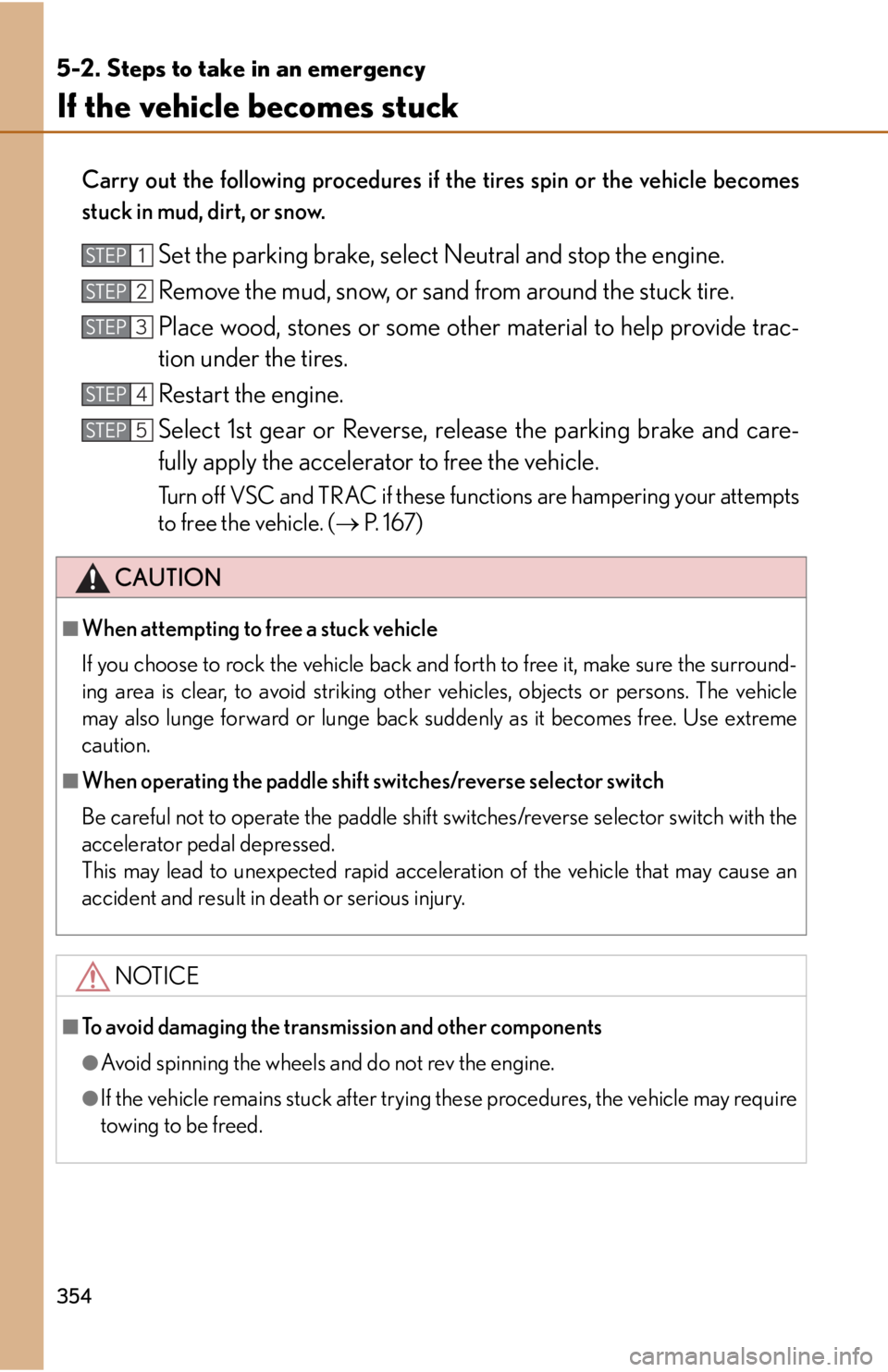
If the vehicle becomes stuck
Carry out the following procedures if the tires spin or the vehicle becomes
stuck in mud, dirt, or snow.
Set the parking brake, select Neutral and stop the engine.
Remove the mud, snow, or sand from around the stuck tire.
Place wood, stones or some other material to help provide trac-
tion under the tires.
Restart the engine.
Select 1st gear or Reverse, release the parking brake and care-
fully apply the accelerator to free the vehicle.
Turn off VSC and TRAC if these functions are hampering your attempts
to free the vehicle. ( P. 1 6 7 )
CAUTION
■When attempting to free a stuck vehicle
If you choose to rock the vehicle back and forth to free it, make sure the surround-
ing area is clear, to avoid striking other vehicles, objects or persons. The vehicle
may also lunge forward or lunge back suddenly as it becomes free. Use extreme
caution.
■When operating the paddle shift switches/reverse selector switch
Be careful not to operate the paddle shift switches/reverse selector switch with the
accelerator pedal depressed.
This may lead to unexpected rapid acceleration of the vehicle that may cause an
accident and result in death or serious injury.
NOTICE
■To avoid damaging the transm ission and other components
●Avoid spinning the wheels and do not rev the engine.
●If the vehicle remains stuck after trying these procedures, the vehicle may require
towing to be freed.
STEP1
STEP2
STEP3
STEP4
STEP5
Page 358 of 420

356
5-2. Steps to take in an emergency
CAUTION
■If the engine has to be turned off while driving
●If the engine is turned off, the power assist for the brakes and steering may not
function, making braking and steering more difficult. Decelerate as much as pos-
sible before turning off the engine.
●Never attempt to remove the key, as doing so will lock the steering wheel.
Page 367 of 420
365
6-1. Specifications
6
Vehicle specifications
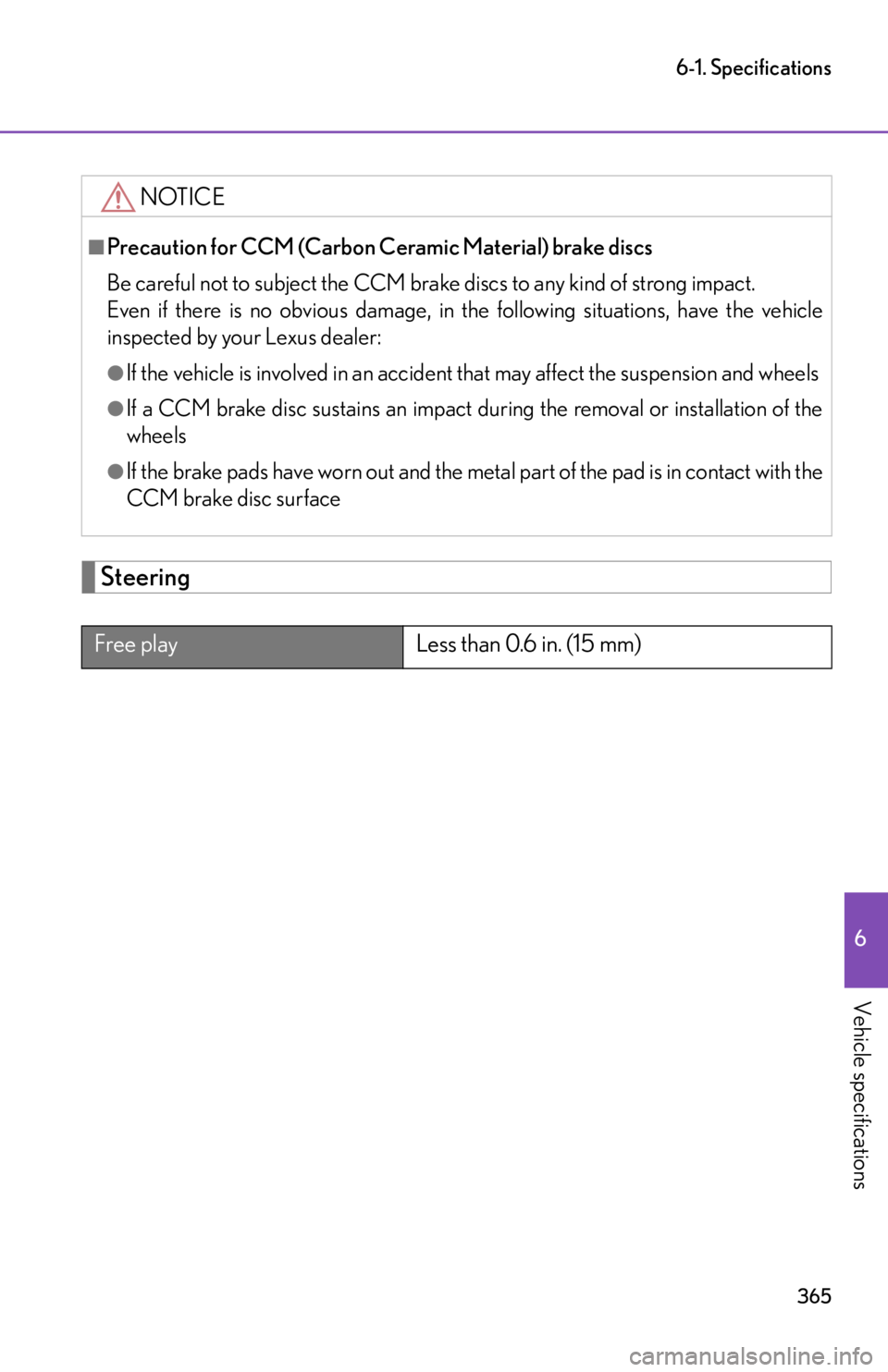
Steering
NOTICE
■Precaution for CCM (Carbon Ceramic Material) brake discs
Be careful not to subject the CCM brake discs to any kind of strong impact.
Even if there is no obvious damage, in the following situations, have the vehicle
inspected by your Lexus dealer:
●If the vehicle is involved in an accident that may affect the suspension and wheels
●If a CCM brake disc sustains an impact during the removal or installation of the
wheels
●If the brake pads have worn out and the metal part of the pad is in contact with the
CCM brake disc surface
Free playLess than 0.6 in. (15 mm)
Page 368 of 420
366
6-1. Specifications
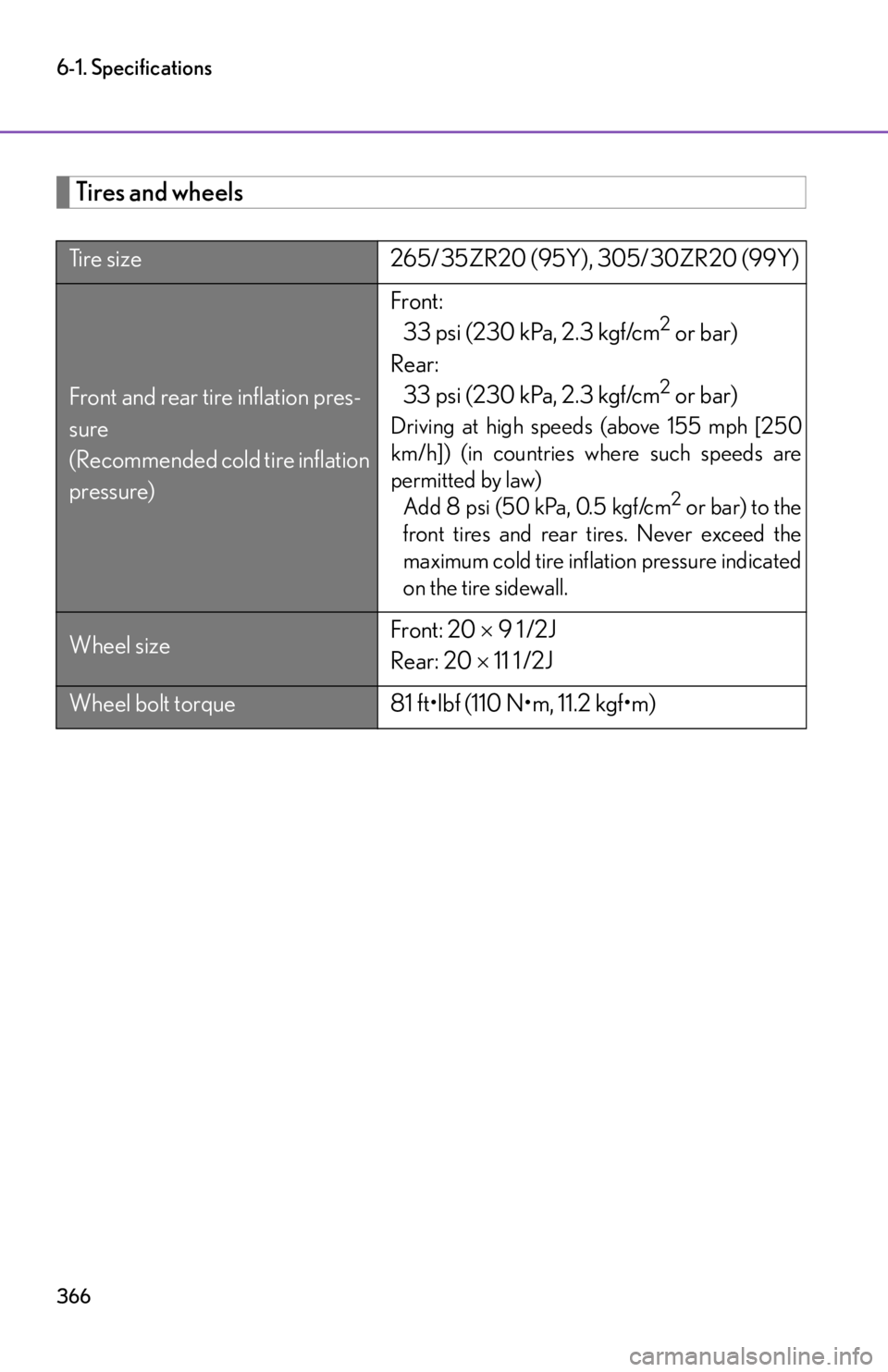
Tires and wheels
Ti r e s i z e265/35ZR20 (95Y), 305/30ZR20 (99Y)
Front and rear tire inflation pres-
sure
(Recommended cold tire inflation
pressure) Front:
33 psi (230 kPa, 2.3 kgf/cm
2 or bar)
Rear: 33 psi (230 kPa, 2.3 kgf/cm
2 or bar)
Driving at high speeds (above 155 mph [250
km/h]) (in countries where such speeds are
permitted by law) Add 8 psi (50 kPa, 0.5 kgf/cm
2 or bar) to the
front tires and rear tires. Never exceed the
maximum cold tire inflation pressure indicated
on the tire sidewall.
Wheel size Front: 20
9 1 /2J
Rear: 20 11 1 /2J
Wheel bolt torque 81 ft•lbf (110 N•m, 11.2 kgf•m)
Page 375 of 420
373
6-1. Specifications
6
Vehicle specifications
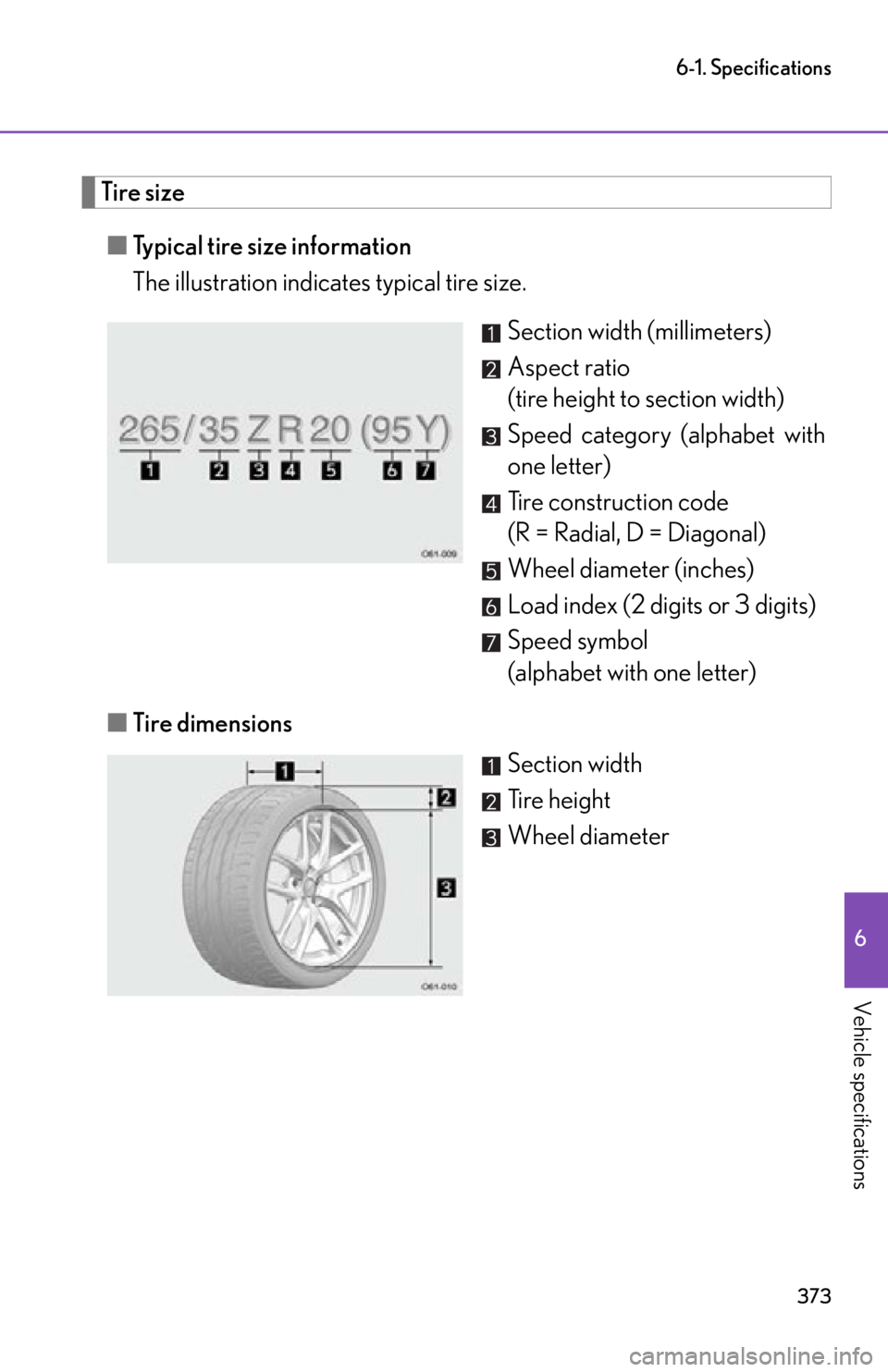
Tire size■ Typical tire size information
The illustration indicates typical tire size.
Section width (millimeters)
Aspect ratio
(tire height to section width)
Speed category (alphabet with
one letter)
Tire construction code
(R = Radial, D = Diagonal)
Wheel diameter (inches)
Load index (2 digits or 3 digits)
Speed symbol
(alphabet with one letter)
■ Tire dimensions
Section width
Ti r e h e i g h t
Wheel diameter
Page 378 of 420

376
6-1. Specifications
■Traction AA, A, B, C
The traction grades, from highest to lowest, are AA, A, B and C, and
they represent the tire's ability to stop on wet pavement as measured
under controlled condit ions on specified government test surfaces of
asphalt and concrete.
A tire marked C may have poor traction performance.
Warning: The traction grade assigned to this tire is based on braking
(straight ahead) traction tests and does not include cornering (turning) trac-
tion.
■ Temperature A, B, C
The temperature grades are A (the highest), B, and C, representing
the tire's resistance to the generation of heat and its ability to dissipate
heat when tested under controlled conditions on a specified indoor
laboratory test wheel.
Sustained high temperature can cause the material of the tire to degenerate
and reduce tire life, and excessive temperature can lead to sudden tire fail-
ure.
The grade C corresponds to a level of performance which all passenger car
tires must meet under the Federal Mo tor Vehicle Safety Standard No. 139.
Grades B and A represent higher levels of performance on the laboratory
test wheel than the minimum required by law.
Warning: The temperature grades for this tire are established for a tire that
is properly inflated and not overloaded.
Excessive speed, underinflation, or excess ive loading, either separately or in
combination, can cause heat buildup and possible tire failure.
Page 380 of 420

378
6-1. Specifications
Vehicle capacity weight
(Total load capacity)The rated cargo and luggage load plus 150 lb. (68
kg) times the vehicle's designated seating capacity
Occupant distribution Distribution of occupants in a vehicle as specified in
the third column of Table 1
* below
Recommended inflation
pressure Cold tire inflation pressure recommended by a man-
ufacturer.
Rim A metal support for a tire or a tire and tube assembly
upon which the tire beads are seated
Rim diameter
(Wheel diameter) Nominal diameter of the bead seat
Rim size designation Rim diameter and width
Rim type designation The industry manufacturer's designation for a rim by
style or code
Rim width Nominal distan ce between rim flanges
Vehicle maximum load on
the tire The load on an individual tire that is determined by
distributing to each axle its share of the maximum
loaded vehicle weight, and dividing by two
Vehicle normal load on
the tire The load on an individual tire that is determined by
distributing to each axle its share of curb weight,
accessory weight, and normal occupant weight (dis-
tributed in accordance with Table 1
* below), and
dividing by two
We a t h e r s i d e The surface area of the rim not covered by the
inflated tire
Bead The part of the tire that is made of steel wires,
wrapped or reinforced by ply cords and that is
shaped to fit the rim
Bead separation A breakdown of the bond between components in
the bead
Tire related termMeaning