light lexus LFA 2012 Technical Information / LEXUS 2012 LFA (OM77006U) Repair Manual
[x] Cancel search | Manufacturer: LEXUS, Model Year: 2012, Model line: LFA, Model: Lexus LFA 2012Pages: 420, PDF Size: 5.02 MB
Page 221 of 420
219
3-5. Other interior features
3
Interior features
Safety Connect
Safety Connect is a subscription-based telematics service that uses Global
Positioning System (GPS) data and embe dded cellular technology to provide
safety and security features to subscribers. Safety Connect is supported by
Lexus’ designated response center, which operates 24 hours per day, 7 days
per week.
Safety Connect service is available by subscription on select, telematics
hardware-equipped vehicles.
By using the Safety Connect service, you are agreeing to be bound by the
Telematics Subscription Service Agreement and its Terms and Conditions, as
in effect and amended from time to time, a current copy of which is available
at Lexus.com. All use of the Safety Co nnect service is subject to such then-
applicable Terms and Conditions.
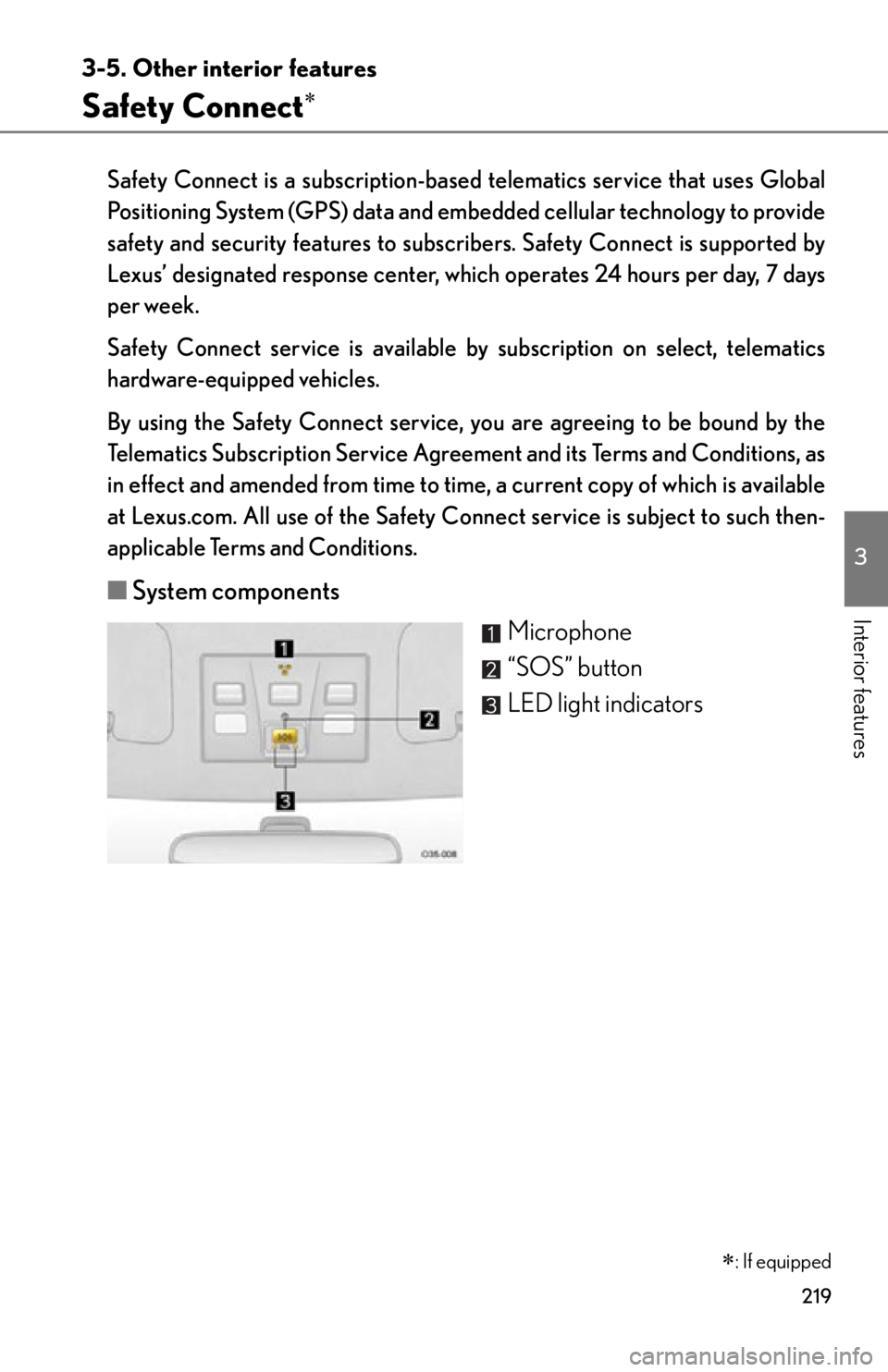
■ System components
Microphone
“SOS” button
LED light indicators
: If equipped
Page 224 of 420

222
3-5. Other interior features
Safety Connect LED light IndicatorsWhen the ignition switch is turned to the “ON” position, the red indicator
light comes on for 2 seconds then tu rns off. Afterward, the green indica-
tor light comes on, indicating that the service is active.
The following indicator light patterns indicate specific system usage con-
ditions:
● Green indicator light on = Active service
● Green indicator light flashing = Safety Connect call in process
● Red indicator light (except at vehicle start-up) = System malfunction
(contact your Lexus dealer)
● No indicator light (off) = Saf ety Connect service not active
Safety Connect services
■ Automatic Collision Notification
In case of either airbag deployment or severe rear-end collision, the
system is designed to automatically call the response center. The
responding agent receives the vehicl e’s location and attempts to speak
with the vehicle occupants to asse ss the level of emergency. If the
occupants are unable to communicate, the agent automatically treats
the call as an emergency, contacts the nearest emergency services
provider to describe the situation, and requests that assistance be sent
to the location.
Page 229 of 420

Maintenance and care4
227
4-1. Maintenance and careCleaning and protecting the vehicle exterior............ 228
Cleaning and protecting the vehicle interior .............. 235
4-2. Maintenance Maintenance requirements ........................ 240
General maintenance .......... 242
Emission inspection and maintenance (I/M)
programs................................ 246 4-3. Do-it-yourself
maintenance
Do-it-yourself service precautions ............................ 247
Hood .......................................... 250
Positioning a floor jack ......... 253
Engine compartment ........... 256
Adding washer fluid .............. 264
Battery ...................................... 265
Tires............................................ 270
Tire inflation pressure............ 277
Wheels ....................................... 281
Air conditioning filter ........... 283
Wireless remote control battery .................................... 285
Checking and replacing fuses ........................................ 287
Light bulbs ................................ 299
Page 231 of 420

229
4-1. Maintenance and care
4
Maintenance and care
■Automatic car washes
Do not use automatic car washes as they may scratch the vehicle body and damage
the paint.
■High pressure car washes
●Do not allow the nozzles of the car wash to come within close proximity of the
windows or rear hatch.
●Before car wash, check that the fuel filler door on your vehicle is closed prop-
erly.
■Aluminum wheels
●Remove any dirt immediately by using a neutral detergent. Do not use hard
brushes or abrasive cleaners. Do not use strong or harsh chemical cleaners.
Use the same mild detergent and wax as used on the paint.
●Do not use detergent on the wheels when they are hot, for example after driving
for long distance in the hot weather.
●Wash detergent from the wheels immediately after use.
■Cleaning the rear quarter glass
As the rear quarter glasses are made of polycarbonate, follow the procedure
below.
Remove dust and dirt on the surface with plenty of water.
Clean the surface using a mild soap or neutral detergent.
Rinse it with adequate water.
■Cleaner precaution
Do not use abrasive cleaners.
■Outside rear view mirror rain-clearing coating
Observe the following precautions in order to retain the rain-clearing properties of
the mirrors:
●Clean the mirrors using a car shampoo or glass cleaner that does not contain
silicone or an abrasive compound, and rinse thoroughly with water.
●Allow the mirrors to be exposed to direct sunlight for 1 to 2 days.
STEP1
STEP2
STEP3
Page 234 of 420
232
4-1. Maintenance and care
NOTICE
■When washing the vehicle
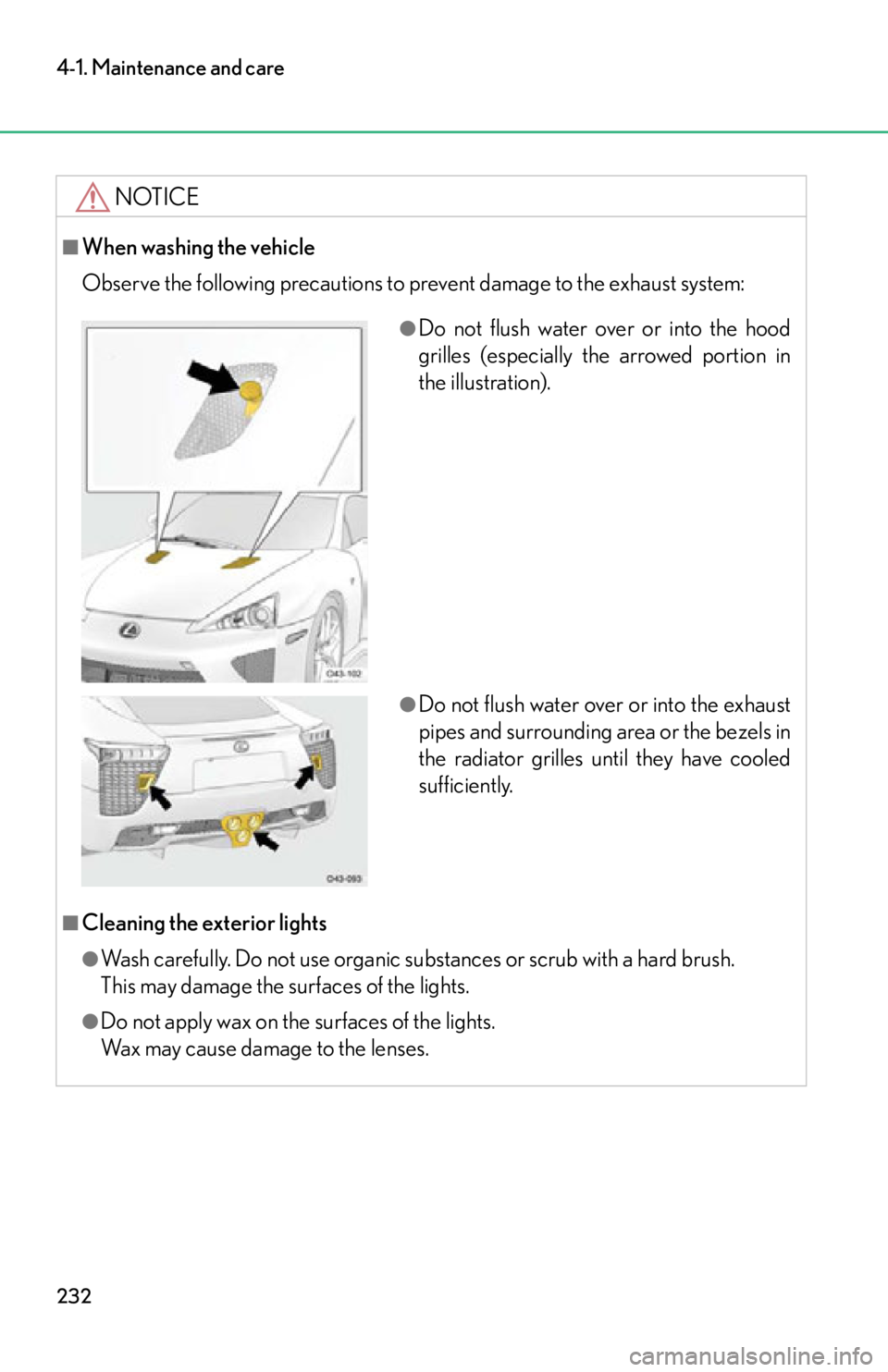
Observe the following precautions to prevent damage to the exhaust system:
■Cleaning the exterior lights
●Wash carefully. Do not use organic substances or scrub with a hard brush.
This may damage the surfaces of the lights.
●Do not apply wax on the surfaces of the lights.
Wax may cause damage to the lenses.
●Do not flush water over or into the hood
grilles (especially the arrowed portion in
the illustration).
●Do not flush water over or into the exhaust
pipes and surrounding area or the bezels in
the radiator grilles until they have cooled
sufficiently.
Page 240 of 420

238
4-1. Maintenance and care
NOTICE
■Cleaning detergents
●Do not use the following agents, as they may discolor the vehicle interior or cause
streaks or damage to painted surfaces:
• Organic solvents such as benzene, thinner, gasoline or alcohol
• Alkaline or acidic detergent, dye, or bleach
●Do not use polish wax or polish cleaner. The instrument panel's or other interior
part’s painted surface may be damaged.
■Preventing damage to leather surfaces
Observe the following precautions to avoid damage to and deterioration of leather
surfaces:
●Remove any dust or dirt from leather surfaces immediately.
●Do not expose the vehicle to direct sunlight for extended periods of time.
Park the vehicle in the shade, especially during summer.
●Do not place items made of vinyl, plastic, or containing wax on the upholstery, as
they may stick to the leather surface if the vehicle interior heats up significantly.
■Floor mats
Do not wash the mats with water as doing so may damage the leather.
■Water on the floor
Do not wash the vehicle floor with water.
Vehicle systems may be damaged if water comes into contact with electrical com-
ponents such as the audio system above or under the floor of the vehicle.
■Pa r t i t i o n g l a s s
As the partition glass is made of polyca rbonate and easily damaged, observe the
following precautions:
●When cleaning the partition glass:
• Do not use wax, window cl eaner or abrasive cleaner.
• Do not touch glass surface with anything hard or sharp.
●Do not attach stickers to the partition glass.
Contact with glue or other agents ma y cause the glass to become cloudy or
blemished.
Page 245 of 420

243
4-2. Maintenance
4
Maintenance and care
Vehicle interior
ItemsCheck points
Accelerator pedal • The accelerator pedal should move
smoothly (without uneven pedal
effort or catching).
Brake pedal • Does the brake pedal move
smoothly?
• Does the brake pedal have appro- priate clearance from the floor?
( P. 3 6 4 )
• Does the brake pedal have the cor- rect amount of free play?
( P. 3 6 4 )
Brakes • The vehicle should not pull to one
side when the brakes are applied.
• The brakes should work effectively.
• The brake pedal should not feel
spongy.
• The brake pedal should not get too close to the floor when the brakes
are applied.
Indicators/buzzers • Do the indicators and buzzers
function properly?
Lights • Do all the lights come on?
Pa r k i n g b r a ke • When parked on a slope and the
parking brake is on, is the vehicle
securely stopped?
Seat belts • Do the seat belts operate
smoothly?
• The seat belts should not be dam- aged.
Page 252 of 420
250
4-3. Do-it-yourself maintenance
Hood
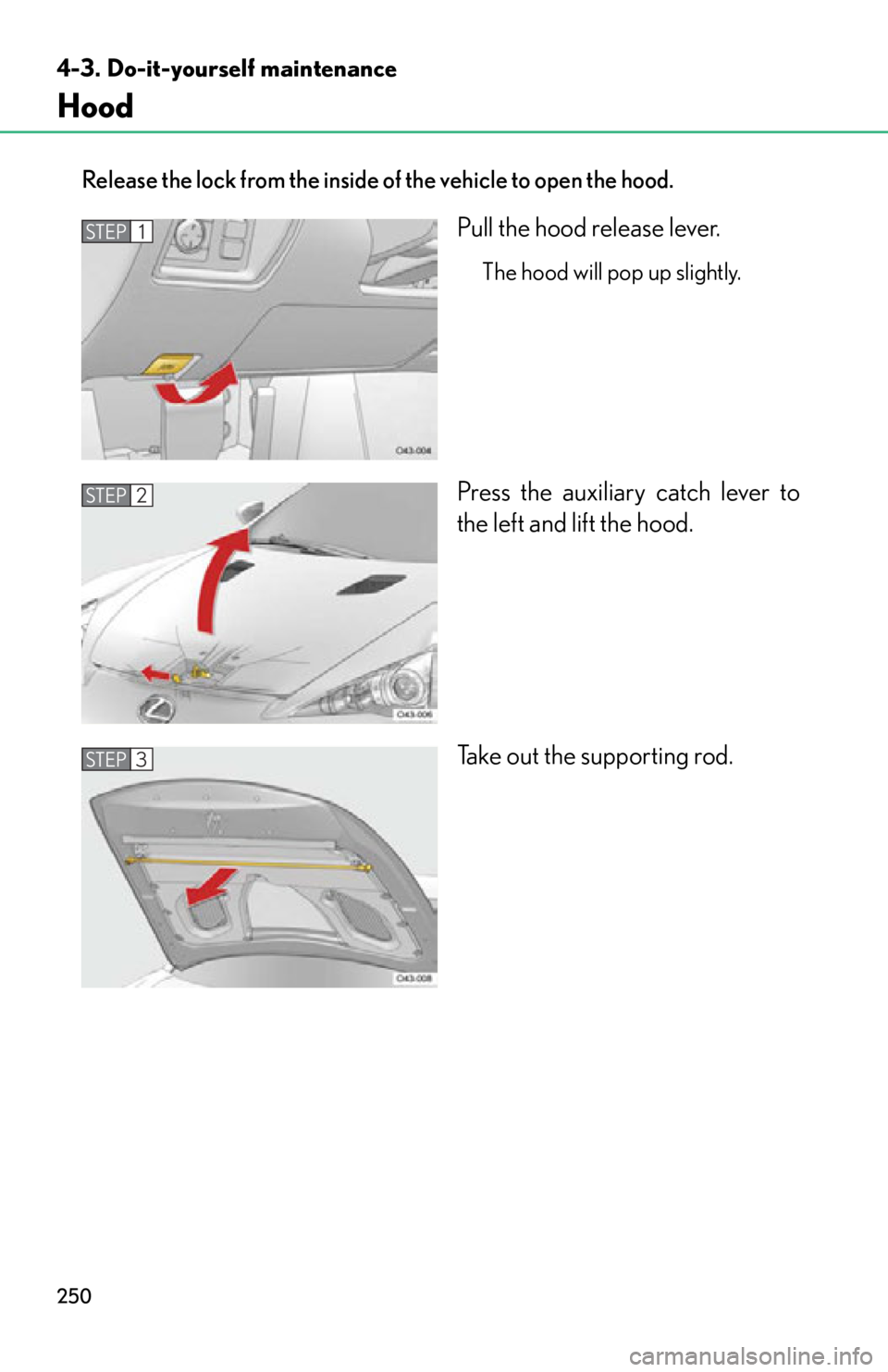
Release the lock from the inside of the vehicle to open the hood.
Pull the hood release lever.
The hood will pop up slightly.
Press the auxiliary catch lever to
the left and lift the hood.
Take out the supporting rod.
STEP1
STEP2
STEP3
Page 265 of 420

263
4-3. Do-it-yourself maintenance
4
Maintenance and care
NOTICE
■If the fluid level is low or high
It is normal for the brake fluid level to go down slightly as the brake pads wear out or
when the fluid level in the accumulator is high.
If the reservoir needs frequent refilling, there may be a serious problem.
Page 270 of 420
268
4-3. Do-it-yourself maintenance
CAUTION
■When connecting the battery terminal
Lower the lever into the locked position and ensure that the terminal is securely
fixed in place.
If the terminal is not securely fixed in place, it may come off while the vehicle is
being driven. This may cause the engine and electronic components to stop func-
tioning, resulting in an accident.
■Chemicals in the battery
A battery contains poisonous and corrosive sulfuric acid and may produce hydro-
gen gas which is flammable and explosive. To reduce the risk of death or serious
injury, take the following precautions while working on or near the battery:
●Do not cause sparks by touching the battery terminals with tools.
●Do not smoke or light a match near the battery.
●Avoid contact with eyes, skin and clothes.
●Never inhale or swallow electrolyte.
●Wear protective safety glasses when working near the battery.
●Keep children away from the battery.
■Where to safely charge the battery
Always charge the battery in an open area. Do not charge the battery in a garage or
closed room where there is insufficient ventilation.
■How to recharge the battery
Only perform a slow charge (5 A or less). The battery may explode if charged at a
quicker rate.